Seeing the Difference: A Project on Viewing Death and Dying in Interdisciplinary Perspective
A project of the Doreen B. Townsend Center for the Humanities UC Berkeley
From the introduction:
What is this project about?
Regina Barreca has given us a stark dichotomy. She gives us death as "separation," as "difference." But so too do we, in our various disciplines, view death "differently." Dying bridges a "no man's land" where the unfathomed and the unknowable confront the scientific and the humanistic imaginations. While death may be the vanishing point of medical knowledge and representation, it is also a point of mediation. Neither doctors nor humanists, nor artists or policy makers can provide all the answers where death is concerned; any inquiry into its cultural, scientific, and perhaps even spiritual contours must be a plural one.
"Seeing the Difference" brings together three angles of perception: those of clinicians, humanists, and artists. These conceptual frameworks offer in turn different ways of understanding the dying body: the medical view of the body as literal text for implementing physical and psychological change; the humanist's view of the body as the site of complex layers of meaning to be explored through a range of interpretive strategies; and the artist's creation of the body in terms of alternative explanatory systems that may mediate between the physical and the metaphysical, that may confront an "unknowable" or "inexplicable" and give it form.
"Seeing the Difference" explores the boundaries and the connections that pertain among these different sites of knowledge and interpretation. The project links artists, humanists, and medical practitioners in an effort to clarify our own understandings through exchange across disciplines, to work toward the conceptualization of new forms of empathy towards those who face imminent death, and to produce a guide, in both print and video formats, that can be used in other settings where practitioners are trained to work with the dying.
Our project is in one sense about what cannot be figured: it is about absence, "negative space," "silence," and the liminal. But it is also about "making meaning" of what seems a paradox. Its purpose is to take up the challenge offered by psychiatrist and anthropologist Arthur Kleinman when he emphasized--in a residency at Berkeley in 1997--that when we address severe illness and the processes of dying and death, meaning cannot be made in medical settings alone.
To the Visit the Conference Website (Includes video/conversations/exhibits/presentations)
Tuesday, August 22, 2006

Monday, August 21, 2006
Drinks With Tony
"Drinks with Tony is a radio show that includes an informal brain picking of writers and other artists. The interviews are conducted at a bar and edited to keep an informal feel, like you're sitting on the stool next to us. The rest of show includes current music."
Archived interviews available on this website:
Amy Sedaris
Amy started her career at Second City where she met Stephen Colbert and Paul Dinello. The three of them collaborated and experimented with the character of Jerry Blank, who became the star of the Comedy Central series Strangers with Candy. Yes, Amy is the sister of David Sedaris.
Larry Clark
Larry Clark talks about his latest film Wassup Rockers, a story of Latino punk rockers who live in South Central Los Angeles and don't buy into the gangs and styles of the ghetto. They stand out with their skateboards, long hair and play in punk rock bands. Wassup Rockers shows an optimistic Larry Clark that we haven't seen in his other films.
Daniel Clowes
The writer of Eightball, Ghost World and Art School Confidential talks about erection episodes with figure drawing models and collaborating with Terry Zwigoff.
Terry Zwigoff
The director of Art School Confidential, Bad Santa and Ghost World talks about his difficult transition from documentary to narrative filmmaking as well as his love of 78rpm records and Steve Buscemi.
Blag Dahlia (archive coming soon)
aka Blag Jesus, Blag the Ripper, Blag of the mother fucking Dwarves! He played an acoustic set on the show and answered some questions. Clips and transcripts will be up shortly.
Frank Portman
Frank Portman is the author of KING DORK which was released April 11, 2006. I interviewed him last year, but this time I actually read the book before we talked, so this interview is more focused on his novel and the characters.
Wim Wenders
The director of Don't Come Knocking discusses film, Wings of Desire, Nick Cave and the Bad Seeds, West Berlin in the 1980's, Writing with Sam Shepard and his spiritual beliefs.
James Duval
James discusses Gregg Araki, Mad Cowgirl, playing the Bunny in Donnie Darko, nudity in film, religion, penises and more.
Wesley Strick
Strick talks about his novel Out There in the Dark as well as screenwriting, working with Scorsese, the Juliette Lewis/Robert De Niro finger sucking scene in Cape Fear and being Jewish in Hollywood in the 1940's compared to now.
Edward Furlong
Furlong discusses penis shrinkage while shooting nude scenes in cold weather (and options for enlarging said penis), his films Animal Factory, Jimmy & Judy, American Heart and more.
Rachael Bella
Rachel talks about nudity in film, her acting career, working with Zach Galifinackas on Tru Calling and her latest film Jimmy & Judy
Philip Chidel
Philip discusses how he got his film, Subject Two, into Sundance and how his twisted psychological thriller started from a concept to a feature length film.
Kris Saknussemm
The author of Zanesville discusses his book, prescription drugs, depression, suicide and his process for creating the amazing quirky world of novel.
Walter Kirn
The author of Mission to America and Thumbsucker discusses his writing, masturbation, growing up as a Mormon and how he got into the publishing business.
Paul Feig
The creator of Freaks and Geeks talks about masturbation, religion, Christian guilt and his latest book, Superstud, or How I Became a 24 Year Old Virgin.
Chelsea Handler
The author of My Horizontal Life talks about her break into television, standup comedy and her sex life.
Marlon James
Author of John Crow's Devil talks about publishing, religion and slavery in Jamaica.
Lydia Millet
Lydia talks about her new book, Oh Pure and Radiant Heart and her experiences being published at big houses versus small presses.
Richard Hell
Hell talks about his music, writing and his new novel Godlike available from Akashic.
Todd Solondz
Solondz talks about his films, Palindromes, Happiness, Storytelling, Welcome to the Dollhouse and Fear, Loathing and Anxiety.
Hal Hartley
Indie filmmaker Hal Hartley talks about the sequel to Henry Fool, his latest film, The Girl From Monday, and his older films.
William T. Vollmann
The author of Europe Central, The Royal Family and Whores for Gloria talks about prostitutes, smoking crack, the ignorance of most Americans and gives advice for beginning writers.
Dr. Frank
Dr. Frank is the lead singer of Mr. T Experience. His debut novel, King Dork, comes out April 2006. He talks about how to get published, his writing process and about his band.
Miranda July
Miranda talks about her debut film, Me and You and Everyone We Know, and about her live performances, writing and Wayne Wang.
Seth Greenland
Seth Greenland, the author of The Bones, discusses what it takes to be a writer, how screenwriting affects his sphincter and his excitement over David Mamet directing the film version of The Bones.
Moritz Bleibtreu
Moritz Bleibtreu is most famous for playing the role of Manni in Run Lola Run. He discusses acting technique, German cinema and Das Experiment.
Mark Haskell Smith
Mark Haskell Smith, the author of Moist and many screenplays, discusses masturbation, Christopher Walken, agents, editors and his debut novel.
Chuck Palahniuk
Chuck Palahniuk, the author of Fight Club, Survivor, Choke and more, discusses drugs, writing and love.
Chuck Prophet
Chuck talks about songwriting, the West Memphis Three and the fun of touring.
Archived interviews available on this website:
Amy Sedaris
Amy started her career at Second City where she met Stephen Colbert and Paul Dinello. The three of them collaborated and experimented with the character of Jerry Blank, who became the star of the Comedy Central series Strangers with Candy. Yes, Amy is the sister of David Sedaris.
Larry Clark
Larry Clark talks about his latest film Wassup Rockers, a story of Latino punk rockers who live in South Central Los Angeles and don't buy into the gangs and styles of the ghetto. They stand out with their skateboards, long hair and play in punk rock bands. Wassup Rockers shows an optimistic Larry Clark that we haven't seen in his other films.
Daniel Clowes
The writer of Eightball, Ghost World and Art School Confidential talks about erection episodes with figure drawing models and collaborating with Terry Zwigoff.
Terry Zwigoff
The director of Art School Confidential, Bad Santa and Ghost World talks about his difficult transition from documentary to narrative filmmaking as well as his love of 78rpm records and Steve Buscemi.
Blag Dahlia (archive coming soon)
aka Blag Jesus, Blag the Ripper, Blag of the mother fucking Dwarves! He played an acoustic set on the show and answered some questions. Clips and transcripts will be up shortly.
Frank Portman
Frank Portman is the author of KING DORK which was released April 11, 2006. I interviewed him last year, but this time I actually read the book before we talked, so this interview is more focused on his novel and the characters.
Wim Wenders
The director of Don't Come Knocking discusses film, Wings of Desire, Nick Cave and the Bad Seeds, West Berlin in the 1980's, Writing with Sam Shepard and his spiritual beliefs.
James Duval
James discusses Gregg Araki, Mad Cowgirl, playing the Bunny in Donnie Darko, nudity in film, religion, penises and more.
Wesley Strick
Strick talks about his novel Out There in the Dark as well as screenwriting, working with Scorsese, the Juliette Lewis/Robert De Niro finger sucking scene in Cape Fear and being Jewish in Hollywood in the 1940's compared to now.
Edward Furlong
Furlong discusses penis shrinkage while shooting nude scenes in cold weather (and options for enlarging said penis), his films Animal Factory, Jimmy & Judy, American Heart and more.
Rachael Bella
Rachel talks about nudity in film, her acting career, working with Zach Galifinackas on Tru Calling and her latest film Jimmy & Judy
Philip Chidel
Philip discusses how he got his film, Subject Two, into Sundance and how his twisted psychological thriller started from a concept to a feature length film.
Kris Saknussemm
The author of Zanesville discusses his book, prescription drugs, depression, suicide and his process for creating the amazing quirky world of novel.
Walter Kirn
The author of Mission to America and Thumbsucker discusses his writing, masturbation, growing up as a Mormon and how he got into the publishing business.
Paul Feig
The creator of Freaks and Geeks talks about masturbation, religion, Christian guilt and his latest book, Superstud, or How I Became a 24 Year Old Virgin.
Chelsea Handler
The author of My Horizontal Life talks about her break into television, standup comedy and her sex life.
Marlon James
Author of John Crow's Devil talks about publishing, religion and slavery in Jamaica.
Lydia Millet
Lydia talks about her new book, Oh Pure and Radiant Heart and her experiences being published at big houses versus small presses.
Richard Hell
Hell talks about his music, writing and his new novel Godlike available from Akashic.
Todd Solondz
Solondz talks about his films, Palindromes, Happiness, Storytelling, Welcome to the Dollhouse and Fear, Loathing and Anxiety.
Hal Hartley
Indie filmmaker Hal Hartley talks about the sequel to Henry Fool, his latest film, The Girl From Monday, and his older films.
William T. Vollmann
The author of Europe Central, The Royal Family and Whores for Gloria talks about prostitutes, smoking crack, the ignorance of most Americans and gives advice for beginning writers.
Dr. Frank
Dr. Frank is the lead singer of Mr. T Experience. His debut novel, King Dork, comes out April 2006. He talks about how to get published, his writing process and about his band.
Miranda July
Miranda talks about her debut film, Me and You and Everyone We Know, and about her live performances, writing and Wayne Wang.
Seth Greenland
Seth Greenland, the author of The Bones, discusses what it takes to be a writer, how screenwriting affects his sphincter and his excitement over David Mamet directing the film version of The Bones.
Moritz Bleibtreu
Moritz Bleibtreu is most famous for playing the role of Manni in Run Lola Run. He discusses acting technique, German cinema and Das Experiment.
Mark Haskell Smith
Mark Haskell Smith, the author of Moist and many screenplays, discusses masturbation, Christopher Walken, agents, editors and his debut novel.
Chuck Palahniuk
Chuck Palahniuk, the author of Fight Club, Survivor, Choke and more, discusses drugs, writing and love.
Chuck Prophet
Chuck talks about songwriting, the West Memphis Three and the fun of touring.
Amy Goodman and Raed Jarrar: Iraqi Peace Activist Forced to Change T-Shirt Bearing Arabic Script Before Boarding Plane at JFK
Iraqi Peace Activist Forced to Change T-Shirt Bearing Arabic Script Before Boarding Plane at JFK
Amy Goodman and Raed Jarrar
Democracy Now
On a trip back from the Middle East, Iraqi blogger and activist Raed Jarrar was not allowed to board a flight at JFK airport because he was wearing a T-Shirt that said "We will not be silent" in English and Arabic. Representatives of Jet Blue Airways forced him to change his T-Shirt saying wearing it was like "going to a bank with a T-Shirt reading 'I am a robber.'"
To Reda/Listen/Watch
Amy Goodman and Raed Jarrar
Democracy Now
On a trip back from the Middle East, Iraqi blogger and activist Raed Jarrar was not allowed to board a flight at JFK airport because he was wearing a T-Shirt that said "We will not be silent" in English and Arabic. Representatives of Jet Blue Airways forced him to change his T-Shirt saying wearing it was like "going to a bank with a T-Shirt reading 'I am a robber.'"
To Reda/Listen/Watch
Sunday, August 20, 2006
Howard Zinn: The Problem of Civil Obedience
“Civil disobedience is not our problem. Our problem is civil obedience. Our problem is that people all over the world have obeyed the dictates of leaders…and millions have been killed because of this obedience…Our problem is that people are obedient all over the world in the face of poverty and starvation and stupidity, and war, and cruelty. Our problem is that people are obedient while the jails are full of petty thieves…(and) the grand thieves are running the country. That’s our problem.”
Howard Zinn quoted in Will we use the power we have on September 24?
Howard Zinn quoted in Will we use the power we have on September 24?
Friday, August 18, 2006
Maureen Freely: Writers On Trial in Turkey
Writers on Trial
By MAUREEN FREELY
The New York Times
Elif Shafak is a Turkish novelist who has spent much of her life in Europe and the United States. She fills her books with characters who defy all orthodoxy, and in her journalism she lives by the same code, mixing feminism and nuanced political analysis with a deep interest in Ottoman culture. She has been much criticized by literary purists for using words of Arabic and Persian origin that the reformers of the early republic worked so hard to expunge, and for drawing on Sufi traditions that continue to inform popular culture 80 years after those same reformers banned Turkey’s dervish sects. She has a particular genius for depicting backstreet Istanbul, where the myriad cultures of the Ottoman Empire are still in tangled evidence on every family tree.
In her sixth and most recent novel, “The Bastard of Istanbul,” which is already a best seller in Turkey and will be published in the United States by Viking next year, one character declares: “My father is Barsam Tchakhmakhchian, my great-uncle is Dikran Stamboulian, his father is Varvant Istanboluian, my name is Armanoush Tchakhmakhchian, all my family tree has been Something Somethingian, and I am the grandchild of genocide survivors who lost all their relatives in the hands of Turkish butchers in 1915, but I myself have been brainwashed to deny the genocide because I was raised by some Turk named Mustapha!” These are strong words in a country whose official historians maintain that the Armenian genocide at the hands of Turks is itself a fiction. In February 2005, when Orhan Pamuk, Turkey’s most famous novelist, said in passing to a Swiss journalist that “a million Armenians had been killed in these lands, and I am the only one who talks about it,” he was branded a traitor and prosecuted for “denigrating Turkishness.” Shafak must have known that she was risking the same, as she has frequently challenged Turkey’s treatment of its minorities. In September, she spoke at a conference at Bilgi University in Istanbul — the first Turkish conference ever to challenge the official line on the Ottoman Armenians — and though she went on to state her own position clearly and unequivocally in several newspapers, the censors left her alone. But early last month, Shafak learned that she was to be prosecuted for, among other things, allowing a character of partly Armenian heritage in “The Bastard of Istanbul” to utter the forbidden G-word. Her trial is scheduled for Sept. 21.
Since its inception in 1923, the Turkish Republic has policed its writers fiercely. Its penal code, taken from Mussolini’s Italy, puts serious curbs on freedom of expression, but Turkey’s leading writers have never toed the line. The great modernist poet Nazim Hikmet spent much of his adult life in prison and died in exile. The novelist Yashar Kemal, for many decades Turkey’s most famous writer, has been serially harassed and prosecuted. During the 70’s, 80’s and 90’s, so many writers, journalists and scholars were imprisoned for their views that a prosecution became a badge of honor: if you had not yet angered the state, then perhaps you hadn’t said anything of importance.
To Read the Rest of the Essay
By MAUREEN FREELY
The New York Times
Elif Shafak is a Turkish novelist who has spent much of her life in Europe and the United States. She fills her books with characters who defy all orthodoxy, and in her journalism she lives by the same code, mixing feminism and nuanced political analysis with a deep interest in Ottoman culture. She has been much criticized by literary purists for using words of Arabic and Persian origin that the reformers of the early republic worked so hard to expunge, and for drawing on Sufi traditions that continue to inform popular culture 80 years after those same reformers banned Turkey’s dervish sects. She has a particular genius for depicting backstreet Istanbul, where the myriad cultures of the Ottoman Empire are still in tangled evidence on every family tree.
In her sixth and most recent novel, “The Bastard of Istanbul,” which is already a best seller in Turkey and will be published in the United States by Viking next year, one character declares: “My father is Barsam Tchakhmakhchian, my great-uncle is Dikran Stamboulian, his father is Varvant Istanboluian, my name is Armanoush Tchakhmakhchian, all my family tree has been Something Somethingian, and I am the grandchild of genocide survivors who lost all their relatives in the hands of Turkish butchers in 1915, but I myself have been brainwashed to deny the genocide because I was raised by some Turk named Mustapha!” These are strong words in a country whose official historians maintain that the Armenian genocide at the hands of Turks is itself a fiction. In February 2005, when Orhan Pamuk, Turkey’s most famous novelist, said in passing to a Swiss journalist that “a million Armenians had been killed in these lands, and I am the only one who talks about it,” he was branded a traitor and prosecuted for “denigrating Turkishness.” Shafak must have known that she was risking the same, as she has frequently challenged Turkey’s treatment of its minorities. In September, she spoke at a conference at Bilgi University in Istanbul — the first Turkish conference ever to challenge the official line on the Ottoman Armenians — and though she went on to state her own position clearly and unequivocally in several newspapers, the censors left her alone. But early last month, Shafak learned that she was to be prosecuted for, among other things, allowing a character of partly Armenian heritage in “The Bastard of Istanbul” to utter the forbidden G-word. Her trial is scheduled for Sept. 21.
Since its inception in 1923, the Turkish Republic has policed its writers fiercely. Its penal code, taken from Mussolini’s Italy, puts serious curbs on freedom of expression, but Turkey’s leading writers have never toed the line. The great modernist poet Nazim Hikmet spent much of his adult life in prison and died in exile. The novelist Yashar Kemal, for many decades Turkey’s most famous writer, has been serially harassed and prosecuted. During the 70’s, 80’s and 90’s, so many writers, journalists and scholars were imprisoned for their views that a prosecution became a badge of honor: if you had not yet angered the state, then perhaps you hadn’t said anything of importance.
To Read the Rest of the Essay
Wednesday, August 16, 2006
Wendell Berry: A Citizen's Response to the National Security Strategy of the United States of America
A Citizen's Response to the National Security Strategy of the United States of America
by WENDELL BERRY
Orion Magazine (March/April 2003)
I.
THE NEW NATIONAL SECURITY STRATEGY published by the White House in September 2002, if carried out, would amount to a radical revision of the political character of our nation. Its central and most significant statement is this:
A democratic citizen must deal here first of all with the question, Who is this "we"? It is not the "we" of the Declaration of Independence, which referred to a small group of signatories bound by the conviction that "governments [derive] their just powers from the consent of the governed." And it is not the "we" of the Constitution, which refers to "the people [my emphasis] of the United States."
This "we" of the new strategy can refer only to the president. It is a royal "we". A head of state, preparing to act alone in starting a preemptive war, will need to justify his intention by secret information, and will need to plan in secret and execute his plan without forewarning. The idea of a government acting alone in preemptive war is inherently undemocratic, for it does not require or even permit the president to obtain the consent of the governed. As a policy, this new strategy depends on the acquiescence of a public kept fearful and ignorant, subject to manipulation by the executive power, and on the compliance of an intimidated and office dependent legislature. To the extent that a government is secret, it cannot be democratic or its people free. By this new doctrine, the president alone may start a war against any nation at any time, and with no more forewarning than preceded the Japanese attack on Pearl Harbor.
Would be participating citizens of a democratic nation, unwilling to have their consent coerced or taken for granted, therefore have no choice but to remove themselves from the illegitimate constraints of this "we" in as immediate and public a way as possible.
THE ALLEGED JUSTIFICATION for this new strategy is the recent emergence in the United States of international terrorism. But why the events of September 11, 2001, horrifying as they were, should have called for a radical new investiture of power in the executive branch is not clear.
The National Security Strategy defines terrorism as "premeditated, politically motivated violence perpetrated against innocents" (p. 5). This is truly a distinct kind of violence, but to imply by the word "terrorism" that this sort of terror is the work exclusively of "terrorists" is misleading. The "legitimate" warfare of technologically advanced nations likewise is premeditated, politically motivated violence perpetrated against innocents. The distinction between the intention to perpetrate violence against innocents, as in "terrorism," and the willingness to do so, as in "war," is not a source of comfort.
Supposedly, if a nation perpetrates violence officially -- whether to bomb an enemy airfield or a hospital it is not guilty of "terrorism." But there is no need to hesitate over the difference between "terrorism" and any violence or threat of violence that is terrifying. The National Security Strategy wishes to cause "terrorism" to be seen "in the same light as slavery, piracy, or genocide" (p. 6) but not in the same light as war. It accepts and affirms the legitimacy of war.
THE WAR AGAINST TERRORISM is not, strictly speaking, a war against nations, even though it has already involved international war in Afghanistan and presidential threats against other nations. This is a war against "the embittered few" "thousands of trained terrorists" -- who are "at large" (p. 5) among many millions of others who are, in the language of this document, "innocents," and thus are deserving of our protection.
Unless we are willing to kill innocents in order to kill the guilty, the need to be lethal will be impeded constantly by the need to be careful. Because we must suppose a new supply of villains to be always in the making, we can expect the war on terrorism to be more or less endless, endlessly costly and endlessly supportive of a thriving bureaucracy.
Unless, that is, we should become willing to ask why, and to do something about the causes. Why do people become terrorists? Such questions arise from the recognition that problems have causes. There is, however, no acknowledgement in The National Security Strategy that terrorism might have a cause that could possibly be discovered and possibly remedied. "The embittered few," it seems, are merely "evil."
To Read the Rest of the Essay
by WENDELL BERRY
Orion Magazine (March/April 2003)
America! America!
God mend thine every flaw,
Confirm thy soul in self control,
Thy liberty in law.
Katherine Lee Bates, "America the Beautiful"
I.
THE NEW NATIONAL SECURITY STRATEGY published by the White House in September 2002, if carried out, would amount to a radical revision of the political character of our nation. Its central and most significant statement is this:
While the United States will constantly strive to enlist the support of the international community, we will not hesitate to act alone, if necessary, to exercise our right of self defense by acting preemptively against such terrorists... (p. 6)
A democratic citizen must deal here first of all with the question, Who is this "we"? It is not the "we" of the Declaration of Independence, which referred to a small group of signatories bound by the conviction that "governments [derive] their just powers from the consent of the governed." And it is not the "we" of the Constitution, which refers to "the people [my emphasis] of the United States."
This "we" of the new strategy can refer only to the president. It is a royal "we". A head of state, preparing to act alone in starting a preemptive war, will need to justify his intention by secret information, and will need to plan in secret and execute his plan without forewarning. The idea of a government acting alone in preemptive war is inherently undemocratic, for it does not require or even permit the president to obtain the consent of the governed. As a policy, this new strategy depends on the acquiescence of a public kept fearful and ignorant, subject to manipulation by the executive power, and on the compliance of an intimidated and office dependent legislature. To the extent that a government is secret, it cannot be democratic or its people free. By this new doctrine, the president alone may start a war against any nation at any time, and with no more forewarning than preceded the Japanese attack on Pearl Harbor.
Would be participating citizens of a democratic nation, unwilling to have their consent coerced or taken for granted, therefore have no choice but to remove themselves from the illegitimate constraints of this "we" in as immediate and public a way as possible.
THE ALLEGED JUSTIFICATION for this new strategy is the recent emergence in the United States of international terrorism. But why the events of September 11, 2001, horrifying as they were, should have called for a radical new investiture of power in the executive branch is not clear.
The National Security Strategy defines terrorism as "premeditated, politically motivated violence perpetrated against innocents" (p. 5). This is truly a distinct kind of violence, but to imply by the word "terrorism" that this sort of terror is the work exclusively of "terrorists" is misleading. The "legitimate" warfare of technologically advanced nations likewise is premeditated, politically motivated violence perpetrated against innocents. The distinction between the intention to perpetrate violence against innocents, as in "terrorism," and the willingness to do so, as in "war," is not a source of comfort.
Supposedly, if a nation perpetrates violence officially -- whether to bomb an enemy airfield or a hospital it is not guilty of "terrorism." But there is no need to hesitate over the difference between "terrorism" and any violence or threat of violence that is terrifying. The National Security Strategy wishes to cause "terrorism" to be seen "in the same light as slavery, piracy, or genocide" (p. 6) but not in the same light as war. It accepts and affirms the legitimacy of war.
THE WAR AGAINST TERRORISM is not, strictly speaking, a war against nations, even though it has already involved international war in Afghanistan and presidential threats against other nations. This is a war against "the embittered few" "thousands of trained terrorists" -- who are "at large" (p. 5) among many millions of others who are, in the language of this document, "innocents," and thus are deserving of our protection.
Unless we are willing to kill innocents in order to kill the guilty, the need to be lethal will be impeded constantly by the need to be careful. Because we must suppose a new supply of villains to be always in the making, we can expect the war on terrorism to be more or less endless, endlessly costly and endlessly supportive of a thriving bureaucracy.
Unless, that is, we should become willing to ask why, and to do something about the causes. Why do people become terrorists? Such questions arise from the recognition that problems have causes. There is, however, no acknowledgement in The National Security Strategy that terrorism might have a cause that could possibly be discovered and possibly remedied. "The embittered few," it seems, are merely "evil."
To Read the Rest of the Essay
Charles Simic: Making It New
Making It New
By Charles Simic
The New York Review of Books
A Review of:
Dada: Zurich, Berlin, Hannover, Cologne, New York, Paris
Catalog of the exhibition by Leah Dickerman, with essays by Brigid Doherty, Dorothea Dietrich, Sabine T. Kriebel, Michael R. Taylor, Janine Mileaf, and Matthew S. Witkovsky
National Gallery of Art/DAP, 519 pp.
On February 5, 1916, Hugo Ball, a German avant-garde theater director, and Emmy Hennings, his mistress and a nightclub singer, opened for the first time the Cabaret Voltaire in Zurich where they presented exhibitions of contemporary art and performances of experimental music, poetry, and dance. The cabaret had a small stage, room for forty to fifty people in the audience, and was located in a seedy neighborhood of bars, variety shows, and cheap hotels in an otherwise respectable city in which many expatriate artists, writers, journalists, actors, intellectuals, and professional revolutionaries were then living, as well as international war profiteers and spies. Lenin rented rooms on the same narrow alley. Joyce worked on Ulysses in a neighborhood not very far away.
Dada did not yet exist as a movement, nor did it have a name. What started as a series of evenings where poems of modern German and French poets were recited, art songs performed, and compositions by Franz Liszt, Alexander Scriabin, and Claude Debussy played on the café's piano changed over the next few weeks into something quite different under the influence of new arrivals on the scene. They were the poet Richard Huelsenbeck, whom Ball had known in Berlin, the Alsatian-born artist Hans Arp, and the twenty-year-old Romanian poet Tristan Tzara and his not-much-older compatriot, the painter Marcel Janco. What brought them together was their hatred of the war and their belief that both art and politics needed a revolutionary change.
Already while living in Berlin in 1915, Ball and Hennings had organized a series of antiwar literary evenings with the intention, they said, to provoke, perturb, bewilder, tease, tickle to death, and confuse the audience. In Zurich, Janco made cardboard masks reminiscent of the ones used in African rituals and Japanese theater, but also strikingly original. As Ball wrote in his journal, "The masks simply demanded that their wearers start to move in a tragic-absurd dance."[1] Patrons of the cabaret who came expecting to hear selections from the works of Voltaire and Turgenev or another balalaika orchestra were subjected instead to skits enacted by masked figures dressed in colorful costumes made from cardboard and poster paint who accompanied themselves with drums, pot covers, and frying pans as they recited poems that sounded like this:
Gadji beri bimba
Glandridi lauli lonni cadori
Gadjama bim beri glassala
Glandridi glassala tuffm Izimbrabim
Blassa galassasa tuffm Izimbrabim.
The noise from the stage was deafening. There was bedlam in the audience too. The performers behaved like new recruits simulating mental illness before a medical commission. In less than a month the cabaret, which at first had welcomed all modern tendencies in the arts and hoped to entertain and educate the customer, had turned into a theater of the absurd. That was the intention. "What we are celebrating," Ball wrote in his diary, "is both buffoonery and a requiem mass." The scandal spread. Lenin, who played chess with Tzara, wanted to know what Dada was all about.
There has never been an easy answer. As late as 1920, Marcel Duchamp said he didn't know what Dada was. The accounts of the original participants in Zurich are conflicting; there is even uncertainty about where the name came from. The most plausible version is that Ball and Huelsenbeck found the French word for "hobbyhorse" accidentally in a French–German dictionary while looking for something else. Another possibility is that it came from the name of a popular hair-strengthening tonic. Whatever its origin, the word, which in several Slavic languages sounds like an emphatic declaration of agreement ("yes, yes"), quickly became as popular as a brand name: a one-word manifesto guaranteed either to amuse or to irritate. Hans Arp tells how he and his friends used to make rounds of the bars, opening the door of each and saying in a loud, clear voice: "Long live Dada!" The patrons would open their mouths in amazement, dropping their forks and their sausages.
The attitude toward the arts that the Zurich Dada brought to light long precedes the movement. "Without knowing one another we worked towards the same goal," Hans Arp later said. He found it sickening to feed art eternally with still lifes, landscapes, and nudes. All forms of imitation, the Italian Futurists had already announced, must be despised; all forms of originality glorified. The idea was to make something no one had ever seen or experienced before. The activities in Zurich gave a name to a loose confederation of artists and poets in New York, Berlin, Hannover, Cologne and Paris who exchanged letters and circulated little magazines and reproductions of their work without ever bothering to iron out their disagreements on aesthetic issues. They no longer believed in trying to understand things from a single point of view. Though they all pretty much did what they pleased, they shared an interest in abstraction, collage, photo- montage, and using chance as a tool. Even more important than any particular technique was their belief that the traditional division between art and non-art ought to be abolished. What they sought was the secret of making masterpieces while repudiating art.
The beginnings of Dada do not lie in art but in disgust, one of its leaders said. This was precisely the attitude of the Italian Futurists who just a few years earlier had demanded that we do away with museums, libraries, and other cultural landmarks for the sake of the Future. However, the war of 1914 divided the sympathies not only of intellectuals of various European countries, but of their avant-garde movements as well. "We will glorify war—the only true hygiene of the world—militarism, patriotism, the destructive gesture of anarchist, the beautiful Ideas which kill, and the scorn of woman," the Futurist Marinetti wrote. Quite the reverse, the poets and artists who were to call themselves Dadaists were pacifists and internationalists. Most of them were draft-dodgers on the run from military authorities in their respective countries. Their revulsion at the butchery of the Great War, in which about ten million men died, over twenty million were wounded, and several hundred thousand lost limbs and sight, had a lot to do with what Dada was to become.
To Read the Rest of the Review
By Charles Simic
The New York Review of Books
A Review of:
Dada: Zurich, Berlin, Hannover, Cologne, New York, Paris
Catalog of the exhibition by Leah Dickerman, with essays by Brigid Doherty, Dorothea Dietrich, Sabine T. Kriebel, Michael R. Taylor, Janine Mileaf, and Matthew S. Witkovsky
National Gallery of Art/DAP, 519 pp.
On February 5, 1916, Hugo Ball, a German avant-garde theater director, and Emmy Hennings, his mistress and a nightclub singer, opened for the first time the Cabaret Voltaire in Zurich where they presented exhibitions of contemporary art and performances of experimental music, poetry, and dance. The cabaret had a small stage, room for forty to fifty people in the audience, and was located in a seedy neighborhood of bars, variety shows, and cheap hotels in an otherwise respectable city in which many expatriate artists, writers, journalists, actors, intellectuals, and professional revolutionaries were then living, as well as international war profiteers and spies. Lenin rented rooms on the same narrow alley. Joyce worked on Ulysses in a neighborhood not very far away.
Dada did not yet exist as a movement, nor did it have a name. What started as a series of evenings where poems of modern German and French poets were recited, art songs performed, and compositions by Franz Liszt, Alexander Scriabin, and Claude Debussy played on the café's piano changed over the next few weeks into something quite different under the influence of new arrivals on the scene. They were the poet Richard Huelsenbeck, whom Ball had known in Berlin, the Alsatian-born artist Hans Arp, and the twenty-year-old Romanian poet Tristan Tzara and his not-much-older compatriot, the painter Marcel Janco. What brought them together was their hatred of the war and their belief that both art and politics needed a revolutionary change.
Already while living in Berlin in 1915, Ball and Hennings had organized a series of antiwar literary evenings with the intention, they said, to provoke, perturb, bewilder, tease, tickle to death, and confuse the audience. In Zurich, Janco made cardboard masks reminiscent of the ones used in African rituals and Japanese theater, but also strikingly original. As Ball wrote in his journal, "The masks simply demanded that their wearers start to move in a tragic-absurd dance."[1] Patrons of the cabaret who came expecting to hear selections from the works of Voltaire and Turgenev or another balalaika orchestra were subjected instead to skits enacted by masked figures dressed in colorful costumes made from cardboard and poster paint who accompanied themselves with drums, pot covers, and frying pans as they recited poems that sounded like this:
Gadji beri bimba
Glandridi lauli lonni cadori
Gadjama bim beri glassala
Glandridi glassala tuffm Izimbrabim
Blassa galassasa tuffm Izimbrabim.
The noise from the stage was deafening. There was bedlam in the audience too. The performers behaved like new recruits simulating mental illness before a medical commission. In less than a month the cabaret, which at first had welcomed all modern tendencies in the arts and hoped to entertain and educate the customer, had turned into a theater of the absurd. That was the intention. "What we are celebrating," Ball wrote in his diary, "is both buffoonery and a requiem mass." The scandal spread. Lenin, who played chess with Tzara, wanted to know what Dada was all about.
There has never been an easy answer. As late as 1920, Marcel Duchamp said he didn't know what Dada was. The accounts of the original participants in Zurich are conflicting; there is even uncertainty about where the name came from. The most plausible version is that Ball and Huelsenbeck found the French word for "hobbyhorse" accidentally in a French–German dictionary while looking for something else. Another possibility is that it came from the name of a popular hair-strengthening tonic. Whatever its origin, the word, which in several Slavic languages sounds like an emphatic declaration of agreement ("yes, yes"), quickly became as popular as a brand name: a one-word manifesto guaranteed either to amuse or to irritate. Hans Arp tells how he and his friends used to make rounds of the bars, opening the door of each and saying in a loud, clear voice: "Long live Dada!" The patrons would open their mouths in amazement, dropping their forks and their sausages.
The attitude toward the arts that the Zurich Dada brought to light long precedes the movement. "Without knowing one another we worked towards the same goal," Hans Arp later said. He found it sickening to feed art eternally with still lifes, landscapes, and nudes. All forms of imitation, the Italian Futurists had already announced, must be despised; all forms of originality glorified. The idea was to make something no one had ever seen or experienced before. The activities in Zurich gave a name to a loose confederation of artists and poets in New York, Berlin, Hannover, Cologne and Paris who exchanged letters and circulated little magazines and reproductions of their work without ever bothering to iron out their disagreements on aesthetic issues. They no longer believed in trying to understand things from a single point of view. Though they all pretty much did what they pleased, they shared an interest in abstraction, collage, photo- montage, and using chance as a tool. Even more important than any particular technique was their belief that the traditional division between art and non-art ought to be abolished. What they sought was the secret of making masterpieces while repudiating art.
The beginnings of Dada do not lie in art but in disgust, one of its leaders said. This was precisely the attitude of the Italian Futurists who just a few years earlier had demanded that we do away with museums, libraries, and other cultural landmarks for the sake of the Future. However, the war of 1914 divided the sympathies not only of intellectuals of various European countries, but of their avant-garde movements as well. "We will glorify war—the only true hygiene of the world—militarism, patriotism, the destructive gesture of anarchist, the beautiful Ideas which kill, and the scorn of woman," the Futurist Marinetti wrote. Quite the reverse, the poets and artists who were to call themselves Dadaists were pacifists and internationalists. Most of them were draft-dodgers on the run from military authorities in their respective countries. Their revulsion at the butchery of the Great War, in which about ten million men died, over twenty million were wounded, and several hundred thousand lost limbs and sight, had a lot to do with what Dada was to become.
To Read the Rest of the Review
Jeff Madrick: The US in Peril?
(Courtesy of Dale Fitzgibbons)
The US in Peril?
By Jeff Madrick
The New York Review of Books
A Review of:
American Theocracy: The Peril and Politics of Radical Religion, Oil, and Borrowed Money in the 21st Century
by Kevin Phillips
Viking, 462 pp.
1.
In the early 1970s, the United States imported approximately one third of the oil it consumed. Today, it imports almost 60 percent and by 2025, so the Energy Department forecasts, the US will probably have to import 65 percent of its oil. Meanwhile, worldwide demand for energy will rise rapidly, especially as China and India increase their consumption, keeping up the prices American consumers and businesses pay for gasoline, home heating oil, kerosene, and jet fuel, as well as other petroleum products crucial for industries like plastics and pharmaceuticals.
But until recently—when rising gasoline prices have forced Bush to talk of conservation—the Bush administration's domestic energy policy has emphasized a proposal that will hardly ameliorate the nation's energy dependency.[1] For five years, it has strenuously sought to open the Arctic National Wildlife Refuge in Alaska to private petroleum exploration. Even if successful, however, Alaskan drilling would reduce the nation's oil imports modestly at best from 65 percent of its needs in 2025 to 61 or 62 percent and, in doing so, damage a valuable natural environment.[2] So far, Congress has not granted the administration its wish.
In Kevin Phillips's view, the Bush energy policy is a prime example of America's failure to confront its most difficult challenges. Phillips, once a member of the Nixon administration, has written a timely book that argues that America is very different from the independent and omnipotent nation portrayed by President Bush and his administration. Dependency on oil is one of three major tendencies that will seriously undermine America's future, he writes, the other two being the influence of radical religion and the growing reliance on debt to support the economy. For Phillips, these constitute "the three major perils to the United States of the twenty-first century," and he offers little hope that the US will avoid the consequences. Since he wrote his widely read The Emerging Republican Majority in 1969, Phillips has published several books lamenting how poorly the Republicans have handled their responsibilities. American Theocracy is his most pessimistic work to date.
Phillips is concerned with problems that all nations have to contend with in one form or other as they grow older. The very sources of national success, whether in resources or industrial innovation, eventually reach their limits; what lasts is a structure of power and influence that inhibits reform. But by limiting the scope of his book to oil, religion, and debt—although they can be connected with practically every other issue—Phillips has only partially described what is wrong with the US. Moreover, in this new book clear analy-sis is too often displaced by sermonizing to the effect that America is in ineluctable decline.
Phillips's three major threats to the nation are well chosen, and he presents much information about them; but he could usefully have considered other perils to the US as well. The rising cost of health care, for example, is as grave a concern as the three issues on which he concentrates. Unless that system is radically reformed the US will face a future in which growing numbers of people will not receive adequate treatment. The cost of education is on a similar trajectory, as the chances of getting even a minimal education in the poorer neighborhoods become smaller. Similarly urgent are the failures of the economy. Despite rapid increases in productivity, which is historically the source of a rising standard of living, family incomes are not growing. In fact, after the five recent years of economic expansion, median family income is roughly what it was in 1999, even though wages at last rose early this year.
In foreign affairs, one could argue that oil dependency and born-again religion have much influence over this administration's unfortunate policies. But they cannot alone account for its advocacy of preemptive war and its concerted efforts to update, improve, and build new weapons, including nuclear weapons, for conventional warfare. Bush's assertion of presidential authority to ignore Congress and authorize wiretapping, torture, and illegal detentions threatens the principles on which America's republican democracy is based. Phillips does not give these threats the attention they deserve.
Still, the damage being done by the administration's irresponsible energy policies, more evident by the day, is an appropriate place to begin a book on American ills. Despite its having reduced the use of oil over the past thirty years as a percentage of the nation's income, America is still by far the world's largest user of oil, consuming 25 percent of the world's daily production. Most of this is for transportation. Of the 520 million cars in the world, 200 million are driven in America, while the US makes up only 5 percent of the world's population. It also has only 3 percent of the world's petroleum reserves, meaning growing imports are a certainty. Domestic production has been falling for decades.
Drawing on previous history, Phillips argues that the price of oil, now more than $70 a barrel, could go higher than $100 a barrel as worldwide reserves begin to decline. If his predictions come true, this could drive fuel and gasoline prices to levels that could seriously slow down the American economy. At more than $3.00 a gallon today, gasoline prices may soon start restraining economic growth. But long-term forecasting of oil prices has usually been unreliable and overly pessimistic. Of greater concern than dwindling reserves is the increasing demand for energy by newly expanding economies, notably China and India. Prices are now more than double what they were two years ago, and are likely to stay relatively high as long as the world economy grows. In addition, access to oil production is increasingly threatened by both political and natural events.
The biggest exporters of oil to the US are Canada and Mexico. But the fourth largest, Nigeria, may be on the brink of a civil war that could threaten production. Venezuela, another major oil exporter, is increasingly antagonistic to the US and American oil companies. Bolivia recently announced plans to nationalize foreign-owned natural gas companies. The US imports about 17 percent of its oil from the Middle East, a proportion that will rise. When Iran first threatened to cut off exports to the US during the currentdispute over its nuclear program, oil prices jumped and have only risen further as tensions increase. Russia, a major producer, has been using its oil and natural gas reserves as a political weapon, threatening to shut down flows of oil and natural gas to the rest of Europe if it doesn't get its way. Gasoline prices also rose to $3.00 a gallon, if only temporarily, after Hurricane Katrina devastated refining facilities in the Gulf last summer.
A serious energy policy providing for security, diversity of sources, and, most important, conservation is necessary. But as Phillips shows in detail, such a policy is stymied by a US administration that is highly sympathetic to the powerful oil companies that would rather promote further exploration than reduce oil use. It is also an administration that does not want to ask Americans to make sacrifices. This was a political lesson learned from the Reagan administration, which successfully portrayed President Carter as a weak and confused pessimist because he called attention to the limits of natural resources. "The glory of the twentieth century is now the burden," writes Phillips somewhat rhetorically.
Oil has soaked deeply—in all likelihood indelibly—into the politics and power structure of the United States, partly because over two bountiful centuries it has also seeped, spouted, and oozed up from so many sections of so many states. More than a fuel, oil became a heritage and also the basis of a lifestyle.
Oil was first produced in volume in Ohio, Pennsylvania, and West Virginia, and later Louisiana, Texas, Oklahoma, and California. Oil companies and auto companies were among America's largest throughout much of the twentieth century, and Rockefellers, Fords, and Dodges were among the nation's richest people. As late as 1982, as Phillips observes, the fortunes of half of the top thirty of those on the Forbesmagazine list of the 400 richest Americans originated in petroleum. It is also to be expected that a huge nation with tens of millions of drivers will demand low gas prices. As Phillips shows, the high excise taxes of the kind levied in Europe to conserve oil have always been resisted in America, particularly by the auto industry and its powerful allies.
To Read the Rest of the Review
The US in Peril?
By Jeff Madrick
The New York Review of Books
A Review of:
American Theocracy: The Peril and Politics of Radical Religion, Oil, and Borrowed Money in the 21st Century
by Kevin Phillips
Viking, 462 pp.
1.
In the early 1970s, the United States imported approximately one third of the oil it consumed. Today, it imports almost 60 percent and by 2025, so the Energy Department forecasts, the US will probably have to import 65 percent of its oil. Meanwhile, worldwide demand for energy will rise rapidly, especially as China and India increase their consumption, keeping up the prices American consumers and businesses pay for gasoline, home heating oil, kerosene, and jet fuel, as well as other petroleum products crucial for industries like plastics and pharmaceuticals.
But until recently—when rising gasoline prices have forced Bush to talk of conservation—the Bush administration's domestic energy policy has emphasized a proposal that will hardly ameliorate the nation's energy dependency.[1] For five years, it has strenuously sought to open the Arctic National Wildlife Refuge in Alaska to private petroleum exploration. Even if successful, however, Alaskan drilling would reduce the nation's oil imports modestly at best from 65 percent of its needs in 2025 to 61 or 62 percent and, in doing so, damage a valuable natural environment.[2] So far, Congress has not granted the administration its wish.
In Kevin Phillips's view, the Bush energy policy is a prime example of America's failure to confront its most difficult challenges. Phillips, once a member of the Nixon administration, has written a timely book that argues that America is very different from the independent and omnipotent nation portrayed by President Bush and his administration. Dependency on oil is one of three major tendencies that will seriously undermine America's future, he writes, the other two being the influence of radical religion and the growing reliance on debt to support the economy. For Phillips, these constitute "the three major perils to the United States of the twenty-first century," and he offers little hope that the US will avoid the consequences. Since he wrote his widely read The Emerging Republican Majority in 1969, Phillips has published several books lamenting how poorly the Republicans have handled their responsibilities. American Theocracy is his most pessimistic work to date.
Phillips is concerned with problems that all nations have to contend with in one form or other as they grow older. The very sources of national success, whether in resources or industrial innovation, eventually reach their limits; what lasts is a structure of power and influence that inhibits reform. But by limiting the scope of his book to oil, religion, and debt—although they can be connected with practically every other issue—Phillips has only partially described what is wrong with the US. Moreover, in this new book clear analy-sis is too often displaced by sermonizing to the effect that America is in ineluctable decline.
Phillips's three major threats to the nation are well chosen, and he presents much information about them; but he could usefully have considered other perils to the US as well. The rising cost of health care, for example, is as grave a concern as the three issues on which he concentrates. Unless that system is radically reformed the US will face a future in which growing numbers of people will not receive adequate treatment. The cost of education is on a similar trajectory, as the chances of getting even a minimal education in the poorer neighborhoods become smaller. Similarly urgent are the failures of the economy. Despite rapid increases in productivity, which is historically the source of a rising standard of living, family incomes are not growing. In fact, after the five recent years of economic expansion, median family income is roughly what it was in 1999, even though wages at last rose early this year.
In foreign affairs, one could argue that oil dependency and born-again religion have much influence over this administration's unfortunate policies. But they cannot alone account for its advocacy of preemptive war and its concerted efforts to update, improve, and build new weapons, including nuclear weapons, for conventional warfare. Bush's assertion of presidential authority to ignore Congress and authorize wiretapping, torture, and illegal detentions threatens the principles on which America's republican democracy is based. Phillips does not give these threats the attention they deserve.
Still, the damage being done by the administration's irresponsible energy policies, more evident by the day, is an appropriate place to begin a book on American ills. Despite its having reduced the use of oil over the past thirty years as a percentage of the nation's income, America is still by far the world's largest user of oil, consuming 25 percent of the world's daily production. Most of this is for transportation. Of the 520 million cars in the world, 200 million are driven in America, while the US makes up only 5 percent of the world's population. It also has only 3 percent of the world's petroleum reserves, meaning growing imports are a certainty. Domestic production has been falling for decades.
Drawing on previous history, Phillips argues that the price of oil, now more than $70 a barrel, could go higher than $100 a barrel as worldwide reserves begin to decline. If his predictions come true, this could drive fuel and gasoline prices to levels that could seriously slow down the American economy. At more than $3.00 a gallon today, gasoline prices may soon start restraining economic growth. But long-term forecasting of oil prices has usually been unreliable and overly pessimistic. Of greater concern than dwindling reserves is the increasing demand for energy by newly expanding economies, notably China and India. Prices are now more than double what they were two years ago, and are likely to stay relatively high as long as the world economy grows. In addition, access to oil production is increasingly threatened by both political and natural events.
The biggest exporters of oil to the US are Canada and Mexico. But the fourth largest, Nigeria, may be on the brink of a civil war that could threaten production. Venezuela, another major oil exporter, is increasingly antagonistic to the US and American oil companies. Bolivia recently announced plans to nationalize foreign-owned natural gas companies. The US imports about 17 percent of its oil from the Middle East, a proportion that will rise. When Iran first threatened to cut off exports to the US during the currentdispute over its nuclear program, oil prices jumped and have only risen further as tensions increase. Russia, a major producer, has been using its oil and natural gas reserves as a political weapon, threatening to shut down flows of oil and natural gas to the rest of Europe if it doesn't get its way. Gasoline prices also rose to $3.00 a gallon, if only temporarily, after Hurricane Katrina devastated refining facilities in the Gulf last summer.
A serious energy policy providing for security, diversity of sources, and, most important, conservation is necessary. But as Phillips shows in detail, such a policy is stymied by a US administration that is highly sympathetic to the powerful oil companies that would rather promote further exploration than reduce oil use. It is also an administration that does not want to ask Americans to make sacrifices. This was a political lesson learned from the Reagan administration, which successfully portrayed President Carter as a weak and confused pessimist because he called attention to the limits of natural resources. "The glory of the twentieth century is now the burden," writes Phillips somewhat rhetorically.
Oil has soaked deeply—in all likelihood indelibly—into the politics and power structure of the United States, partly because over two bountiful centuries it has also seeped, spouted, and oozed up from so many sections of so many states. More than a fuel, oil became a heritage and also the basis of a lifestyle.
Oil was first produced in volume in Ohio, Pennsylvania, and West Virginia, and later Louisiana, Texas, Oklahoma, and California. Oil companies and auto companies were among America's largest throughout much of the twentieth century, and Rockefellers, Fords, and Dodges were among the nation's richest people. As late as 1982, as Phillips observes, the fortunes of half of the top thirty of those on the Forbesmagazine list of the 400 richest Americans originated in petroleum. It is also to be expected that a huge nation with tens of millions of drivers will demand low gas prices. As Phillips shows, the high excise taxes of the kind levied in Europe to conserve oil have always been resisted in America, particularly by the auto industry and its powerful allies.
To Read the Rest of the Review
John Dickerson: Stranger and Stranger
(Courtesy of Nikki Tarrant-Hoskins)
Stranger and Stranger: Why is George Bush reading Camus?
By John Dickerson
Slate
On his summer vacation in Crawford, Texas, George Bush read Albert Camus' novel The Stranger. I'm not sure what to make of this. It's usually college freshmen who suddenly take up the French existentialist's slim volume, and then usually to impress some literature major with wavy hair. Perhaps it was an act of glasnost: Bush has spent much of his presidency dismissing the French, so now he reads one of the country's literary heroes and goes public about it. But in Crawford? The president and his aides have long characterized the town as the kind of sensible place where anyone caught reading heady foreign literature-philosophy would be driven to the county line. Maybe that's the ideachallenge the prevailing stereotype about the president's favorite place and his intellect?
Whatever the reasons, Camus' story line is ripe for geopolitical literary misinterpretation. The main character, Meursault, spends much of his life as the young George Bush did, engaging in escapades that demonstrate little drive or motivation. On a visit to the beach with friends, he gets into a fight with some Arabs. Later, he finds one of the Arabs and without much further provocation shoots him repeatedly. During the circus-trial that follows, and the long hours Meursault spends in jail, he is remorseless and unable to engage in contemplation. On the day of his execution, he has a flickering thought that he might have lived another life. But mostly he's excited about the day and hopes that everyone will cheer for his death.
Unhappy tales of East meets West are found in the papers every day, so presumably the president was looking for more, but his aides will not tell us what he made of the story of a remorseless killer of Arabs. White House spokesman Tony Snow said Bush "found it an interesting book and a quick read" and talked about it with aides. "I don't want to go too deep into it, but we discussed the origins of existentialism," said Snow.
Oh please, Tony, go into it. This is no time to be vague. The president uttered the word "crusade" a single time when talking about fighting terrorists and critics in Europe and the Middle East still use it as proof that his war aims are motivated by 11th-century wide-eyed religious zealotry. Surely someone is going to think that Bush read the book because he identifies with Meursault. There's got to be another explanation. Does his experience in Iraq push him to read works replete with themes of angst, anxiety, and dread? Was the president trying to gain insight into the thinking of Europeans who are skeptical of his plan for democracy in the Middle East, founded as it is on the idea of a universal rational essence that existentialists reject? Did he just want to read something short for his truncated vacation? This may be the first time that national security demands an official version of literary criticism. We want a book report!
John Dickerson is Slate's chief political correspondent and author of On Her Trail. He can be reached at slatepolitics@gmail.com .
Link to the Hyperlinked Article, Includes an Audio Version
Stranger and Stranger: Why is George Bush reading Camus?
By John Dickerson
Slate
On his summer vacation in Crawford, Texas, George Bush read Albert Camus' novel The Stranger. I'm not sure what to make of this. It's usually college freshmen who suddenly take up the French existentialist's slim volume, and then usually to impress some literature major with wavy hair. Perhaps it was an act of glasnost: Bush has spent much of his presidency dismissing the French, so now he reads one of the country's literary heroes and goes public about it. But in Crawford? The president and his aides have long characterized the town as the kind of sensible place where anyone caught reading heady foreign literature-philosophy would be driven to the county line. Maybe that's the ideachallenge the prevailing stereotype about the president's favorite place and his intellect?
Whatever the reasons, Camus' story line is ripe for geopolitical literary misinterpretation. The main character, Meursault, spends much of his life as the young George Bush did, engaging in escapades that demonstrate little drive or motivation. On a visit to the beach with friends, he gets into a fight with some Arabs. Later, he finds one of the Arabs and without much further provocation shoots him repeatedly. During the circus-trial that follows, and the long hours Meursault spends in jail, he is remorseless and unable to engage in contemplation. On the day of his execution, he has a flickering thought that he might have lived another life. But mostly he's excited about the day and hopes that everyone will cheer for his death.
Unhappy tales of East meets West are found in the papers every day, so presumably the president was looking for more, but his aides will not tell us what he made of the story of a remorseless killer of Arabs. White House spokesman Tony Snow said Bush "found it an interesting book and a quick read" and talked about it with aides. "I don't want to go too deep into it, but we discussed the origins of existentialism," said Snow.
Oh please, Tony, go into it. This is no time to be vague. The president uttered the word "crusade" a single time when talking about fighting terrorists and critics in Europe and the Middle East still use it as proof that his war aims are motivated by 11th-century wide-eyed religious zealotry. Surely someone is going to think that Bush read the book because he identifies with Meursault. There's got to be another explanation. Does his experience in Iraq push him to read works replete with themes of angst, anxiety, and dread? Was the president trying to gain insight into the thinking of Europeans who are skeptical of his plan for democracy in the Middle East, founded as it is on the idea of a universal rational essence that existentialists reject? Did he just want to read something short for his truncated vacation? This may be the first time that national security demands an official version of literary criticism. We want a book report!
John Dickerson is Slate's chief political correspondent and author of On Her Trail. He can be reached at slatepolitics@gmail.com .
Link to the Hyperlinked Article, Includes an Audio Version
Tuesday, August 15, 2006
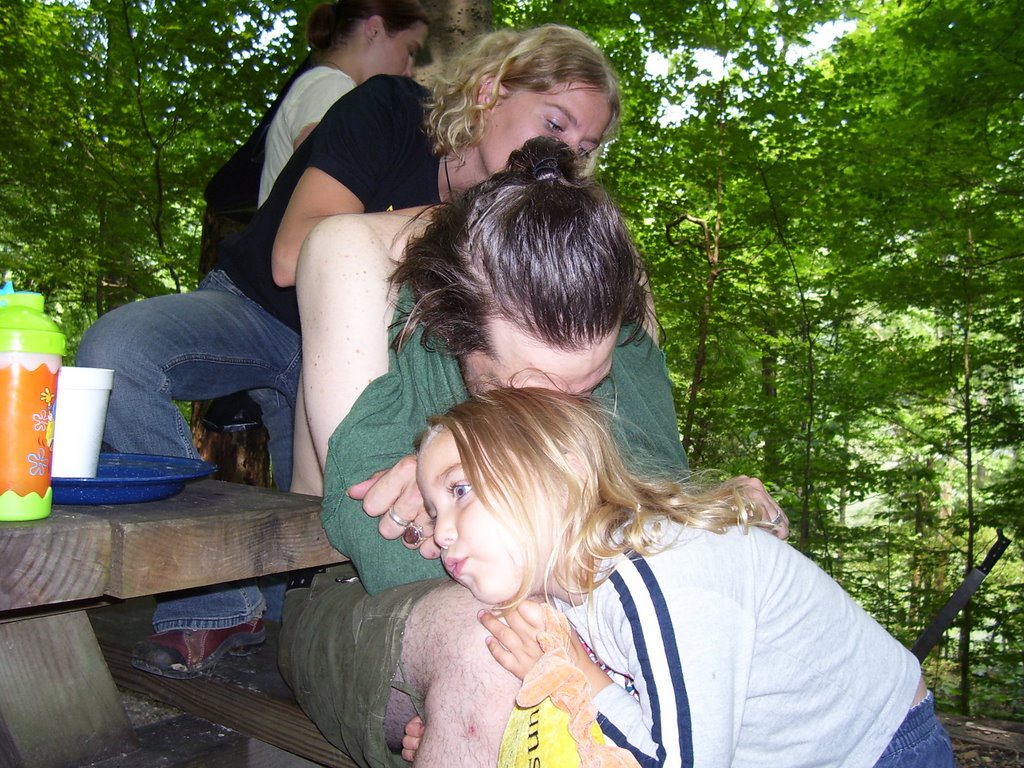
Sometimes You Catch People Unaware For a Perfect Shot
Camping with some friends in Kentucky I just happened to catch them as (unaware) they lined up for a great shot:

MLA PhD Student Travel Grant Awards for 2006 Conference in Philadelphia
The MLA has a new grant program that provides $200 travel grants toward the cost of attending the 2006 MLA Convention in Philadelphia for "qualified PhD candidates."
The deadline for applications is November 1. The MLA Web Site has the criteria and procedure. From the home page, click on "Professional Resources" and on the next page use the link to "MLA Prizes and Awards."
The deadline for applications is November 1. The MLA Web Site has the criteria and procedure. From the home page, click on "Professional Resources" and on the next page use the link to "MLA Prizes and Awards."
The Daily Show: Win, Lose, or Withdraw
(Courtesy of Alternet)
Another satirical look at the propaganda, newspeak, doublespeak, etc... of the Bush Administration in regards to the War in Iraq:
Daily Show skewers Rumsfeld, Gonzales, Rice
Another satirical look at the propaganda, newspeak, doublespeak, etc... of the Bush Administration in regards to the War in Iraq:
Daily Show skewers Rumsfeld, Gonzales, Rice
Annotated Bibliography on New Urbanism
(Courtesy of Charles Bohl)
A wide range of recommendations here, many of them very good, but in order to introduce New Urbanism you should start with the primary documents:
The Charter for the New Urbanism - the short manifesto downloadable from the cnu.org web site and/or the book of essays on the principles written by a few dozen people in Leccese, Michael and McCormick, Kathleen eds. _Charter of the New Urbanism_ (New York: McGraw-Hill, 2000).
Katz, Peter. ) _The New Urbanism: Toward an Architecture of Community_. (New York: McGraw-Hill Inc., 1994).
The short opening essays by Calthorpe and other CNU founders on the region, neighborhoods-districts-corridors, and block-street-building are still some of the best introductions, and the plans, illustrations and photos of projects (most of them unbuilt at the time) were the visual material that really ignited interest in New Urbanism.
Dutton, John A. _New American Urbanism : Re-forming the Suburban Metropolis_. (Milano : New York, NY: Skira; Distributed in North America and Latin America by Abbeville Pub. Group, 2000). This book is a good update to the Katz book, much more dense, but also filled with projects and graphic material.
Steuteville, Rob. _New Urbanism: Comprehensive Report and Best Practices Guide_. (Ithaca, NY: New Urban News, 2004) combines introductory material with well organized topical sections that are practitioner-oriented and cut across a wide range of fields.
Duany, Andres, Elizabeth Plater-Zyberk and Jeff Speck. _Suburban Nation: The Rise of Sprawl and the Decline of the American Dream_. (New York: North Point Press, a Division of Farrar, Straus and Giroux, 2000). A popular presentation of polemic and thought from leading new urbanist thinkers.
Kunstler, James Howard. _The Geography of Nowhere_. (New York: Simon & Schuster, 1993). No introduction to New Urbanism is complete without at least a generous excerpt from Kunstler's searing critique of the U.S. built environment - a student favorite.
Beyond introductory readings:
It would also be good to include an article on the rural-to-urban transect in the _Journal of the American Planning Association_ (JAPA) and the _Journal of Urban Design_ by Emily Talen, Andres Duany, and others or in a new theme issue of the journal _Places_ devoted to "Building Community Across the Transect" (Places 18:1 2006).
For a perspective on New Urbanism in its more urban context that you can download see: Bohl, Charles C. "New Urbanism in the City: Potential Applications and Implications for Distressed Inner-City Neighborhoods." _Housing Policy Debate_, 2000, 11(4), pp. 761-801 along with commentaries by Michael Pyatok, Shelley Poticha and the editors
From here you can choose from 57 varieties of commentaries and critique of New Urbanism, much of it of the armchair variety, but more recently getting into actual research on the plans, codes and built places produced by new urbanists.
For a firsthand perspective by an American Studies professor who lived in a New Urbanist town for a year, and who writes in an accessible, wide ranging and critical manner that students enjoy try: Ross, Andrew. _The Celebration Chronicles: Life, Liberty, and the Pursuit of Property Value in Disney’s New Town_. (New York, NY: Ballantine Books, 1999). Ross lived in Celebration at a time when there were about 1200 more articles written about the town than there were people living there, but by actually living there he provides a much more in-depth perspective.
Bibliographies of articles, theses and dissertations on or related to New Urbanism can be found here:
Congress for New Urbanism
A wide range of recommendations here, many of them very good, but in order to introduce New Urbanism you should start with the primary documents:
The Charter for the New Urbanism - the short manifesto downloadable from the cnu.org web site and/or the book of essays on the principles written by a few dozen people in Leccese, Michael and McCormick, Kathleen eds. _Charter of the New Urbanism_ (New York: McGraw-Hill, 2000).
Katz, Peter. ) _The New Urbanism: Toward an Architecture of Community_. (New York: McGraw-Hill Inc., 1994).
The short opening essays by Calthorpe and other CNU founders on the region, neighborhoods-districts-corridors, and block-street-building are still some of the best introductions, and the plans, illustrations and photos of projects (most of them unbuilt at the time) were the visual material that really ignited interest in New Urbanism.
Dutton, John A. _New American Urbanism : Re-forming the Suburban Metropolis_. (Milano : New York, NY: Skira; Distributed in North America and Latin America by Abbeville Pub. Group, 2000). This book is a good update to the Katz book, much more dense, but also filled with projects and graphic material.
Steuteville, Rob. _New Urbanism: Comprehensive Report and Best Practices Guide_. (Ithaca, NY: New Urban News, 2004) combines introductory material with well organized topical sections that are practitioner-oriented and cut across a wide range of fields.
Duany, Andres, Elizabeth Plater-Zyberk and Jeff Speck. _Suburban Nation: The Rise of Sprawl and the Decline of the American Dream_. (New York: North Point Press, a Division of Farrar, Straus and Giroux, 2000). A popular presentation of polemic and thought from leading new urbanist thinkers.
Kunstler, James Howard. _The Geography of Nowhere_. (New York: Simon & Schuster, 1993). No introduction to New Urbanism is complete without at least a generous excerpt from Kunstler's searing critique of the U.S. built environment - a student favorite.
Beyond introductory readings:
It would also be good to include an article on the rural-to-urban transect in the _Journal of the American Planning Association_ (JAPA) and the _Journal of Urban Design_ by Emily Talen, Andres Duany, and others or in a new theme issue of the journal _Places_ devoted to "Building Community Across the Transect" (Places 18:1 2006).
For a perspective on New Urbanism in its more urban context that you can download see: Bohl, Charles C. "New Urbanism in the City: Potential Applications and Implications for Distressed Inner-City Neighborhoods." _Housing Policy Debate_, 2000, 11(4), pp. 761-801 along with commentaries by Michael Pyatok, Shelley Poticha and the editors
From here you can choose from 57 varieties of commentaries and critique of New Urbanism, much of it of the armchair variety, but more recently getting into actual research on the plans, codes and built places produced by new urbanists.
For a firsthand perspective by an American Studies professor who lived in a New Urbanist town for a year, and who writes in an accessible, wide ranging and critical manner that students enjoy try: Ross, Andrew. _The Celebration Chronicles: Life, Liberty, and the Pursuit of Property Value in Disney’s New Town_. (New York, NY: Ballantine Books, 1999). Ross lived in Celebration at a time when there were about 1200 more articles written about the town than there were people living there, but by actually living there he provides a much more in-depth perspective.
Bibliographies of articles, theses and dissertations on or related to New Urbanism can be found here:
Congress for New Urbanism
The Litblog Co-Op
Uniting the leading literary weblogs for the purpose of drawing attention to the best of contemporary fiction, authors and presses that are struggling to be noticed in a flooded marketplace.
The Litblog Co-Op
The Litblog Co-Op
Monday, August 14, 2006
Aasif Mandvi: The Birth Pangs of a New Middle East
"You can't get hummus without mashing some chickpeas"
Courtesy of Women of Color Blog (recommended by Hysterical Blackness) the Daily Show's satirical look at the absurd, positive-spin, Bush-speak in regards to continuing conflicts in the Middle East:
To Watch the Clip
Courtesy of Women of Color Blog (recommended by Hysterical Blackness) the Daily Show's satirical look at the absurd, positive-spin, Bush-speak in regards to continuing conflicts in the Middle East:
To Watch the Clip
John Twelve Hawks: The Traveler

A recommended book. I picked this up at a local store as a summer read (not academically dense, something that could help me to relax while traveling/camping). Usually, these days, I have had bad luck finding fiction that is entertaining and complex and makes me think about contemporary issues. The Traveler does all three--1) it is at its heart a thriller designed to keep the pages turning; 2) having said that, it is not simple by any means, and it juggles multiple narratives and eras--bringing them together with the necessary rhyme and reason; 3) at the root of the novel is a concern about our surveillance society and loss of personal freedoms.
More about John Twelve Hawks and his first novel The Traveler:
John Twelve Hawks: Living Off the Grid
New York Times Review: It Takes a Superhuman Effort to Escape Human Control
Excerpt from The Traveler
John Twelve Hawks: How We Live Now


Guillermo Gómez-Peña: Notes on the death of the American artist
(The first article is courtesy of Jonathan Zachary Long, who discovered Guillermo Gomez-Pena with me at Bowling Green State University--here are two essays that describe the power of this performance and the radical changes it provoked in my pedagogy and thinking: Learning From El Extermnator and Cyber Vato: Social Anxiety as Performative Pedagogy and Ethnography for the 21st Century)
Disclaimer: Notes on the death of the American artist
By Guillermo Gómez-Peña
In These Times

People ask me all the time: Is La Pocha Nostra (my performance troupe) being censored in the USA? Tired of silence and diplomacy, with my heart aching and my political consciousness swelling, I now choose to speak.
As a child in Mexico, I heard adults whispering about blacklists and those who named names. My older brother, Carlos, was involved in the 1968 movimiento estudiantil, and several of his friends disappeared for good. During my formative years in Latin America, censorship was indistinguishable from political repression and often resulted in the imprisonment, displacement, exile or death of “dissident” intellectuals and artists.

In the ’70s, many Latin American artists ended up migrating to the United States and Europe, in search of the freedom we couldn’t find in our homelands. When I moved to California in 1978, I found a very different situation. Artists and intellectuals simply didn’t matter. The media treated our art as either an exotic new trend or a human-interest story, and the political class didn’t pay attention to us, which gave us the illusion of freedom. As artists, we rejoiced in our mythical condition of liberty, our celebrated “American freedom.”
I developed a reputation as an iconoclast by engaging in symbolic acts of transgression that explored and exposed sources of racism and nationalism. Coco Fusco and I exhibited ourselves inside a gilded cage, dressed as fictitious “Indians,” to protest the quincentennial celebrations of Columbus’ arrival in the Western hemisphere (Two Undiscovered Amerindians Visit …, 1992–93). Roberto Sifuentes and I crucified ourselves in full mariachi regalia to protest immigration policy (The Cruci-fiction Project, 1994). I became good at organizing ephemeral communities of like-minded rebel artists. I advised activists on how to use performance art strategies to enhance their political actions. I used the art world as a base of operations.

In 20 years of touring the United States as a “radical” performance artist, I have come across innumerable situations in which the content of my “politically direct,” “racially sensitive” and “sexually explicit” material had to be “adapted” and “translated” to the site. Because of this, according to a curator friend of mine, I am “no virgin in the house of censorship.”
Since 9/11, however, my collaborators and I are facing an entirely new dilemma: prohibition—both overtly imposed and internalized. My agent, Nola Mariano, recently told me in a letter:

The imposed culture of panic, prohibition and high security permeating every corner of society—including our arts organizations—has created an incendiary environment for the production of critical culture. We are being offered budgets that are half what we used to work with in the pre-Bush era. As a result, we can only present small-scale projects in the United States, and under technically primitive conditions. These new conditions are similar to those we face in Latin America, but without the community spirit and the humane environment we find there—without people’s willingness to be always present and donate their time and skills.
So far, what has saved La Pocha Nostra from closing our doors is international touring. Sixty percent of our budget now comes from other countries.

As if this weren’t enough, due to “security restrictions,” our props, costumes and art materials are carefully scrutinized at every airport we enter. Homeland Security officers are now even checking the titles of our books and opening our notebooks and phone agendas, both when we leave and when we return to the United States. Frequently our materials are confiscated. Once, our trunk of props was confiscated by security at Boston’s Logan Airport, held for two days, and then delivered to us a half-hour before opening night—with no explanation. Not surprisingly, all the “weird”-looking props were missing, courtesy of Homeland Security. Should we change the nature of our props and art materials, and the way we dress? My colleagues and I are already doing this. Isn’t this a form of censorship?
To Read the Rest of this Essay

More on this subject:
La Pocha Nostra: Performance Art for the New Millennium
The Virtual Barrio and Other Frontiers
-----------------------------------------------
Free Art Agreement
Guillermo Gómez-Peña, 'Free Art Agreement'
In: map. London: Institute of international Visual Arts, 1996, 1-25.
"El Tratado de Libre Cultura" by Guillermo Gómez-Peña,
from The Subversive Imagination
The job of the artist is to force open the matrix of reality to admit unsuspected possibilities. Artists and writers throughout the continent are currently involved in a project of redefinition of our continental topography. We image better maps. We imagine either a map of the Americas without borders, a map turned upside down, or one in which countries having different sizes and borders are organically drawn by geography and culture, not by the capricious fingers of economic domination. Congruent to this continental project, I try to imagine better maps.
I oppose the outdated fragmentation of the map of America with that of Arte-America, a continent made out of people, art and ideas, not countries: when I perform this map becomes my conceptual stage.
I oppose the sinister cartography of the New World Order with that of the New World Border, a great trans- and intercontinental border zone in which no centers remains. It's all margins, meaning there are no "Others" left. Or, better said, the only true "Others" are those resisting fusion, mestizaje, and ongoing dialogue. In this utopian cartography, hybridity becomes the dominant culture; spanglish is the lingua franca, and monoculture becomes a culture of resistance practiced by stubborn Caucasian minorities.
Guillermo Gomez-Pena. Free Art Agreement. 1996
-------------------------------------------------
Multiculturalism and Epistemic Rupture: The Vanishing Acts of Guillermo Gomez-Pena and Alfredo Vea Jr - Critical Essay
From the Tortilla Curtain to the Former East Berlin: The Performances of Guillermo Gomez-Pena and the City In-Between Identities and Times
Radical Changers
Culture-Trafficking for the 21st Century
The New World Border
Disclaimer: Notes on the death of the American artist
By Guillermo Gómez-Peña
In These Times
People ask me all the time: Is La Pocha Nostra (my performance troupe) being censored in the USA? Tired of silence and diplomacy, with my heart aching and my political consciousness swelling, I now choose to speak.
As a child in Mexico, I heard adults whispering about blacklists and those who named names. My older brother, Carlos, was involved in the 1968 movimiento estudiantil, and several of his friends disappeared for good. During my formative years in Latin America, censorship was indistinguishable from political repression and often resulted in the imprisonment, displacement, exile or death of “dissident” intellectuals and artists.
In the ’70s, many Latin American artists ended up migrating to the United States and Europe, in search of the freedom we couldn’t find in our homelands. When I moved to California in 1978, I found a very different situation. Artists and intellectuals simply didn’t matter. The media treated our art as either an exotic new trend or a human-interest story, and the political class didn’t pay attention to us, which gave us the illusion of freedom. As artists, we rejoiced in our mythical condition of liberty, our celebrated “American freedom.”
I developed a reputation as an iconoclast by engaging in symbolic acts of transgression that explored and exposed sources of racism and nationalism. Coco Fusco and I exhibited ourselves inside a gilded cage, dressed as fictitious “Indians,” to protest the quincentennial celebrations of Columbus’ arrival in the Western hemisphere (Two Undiscovered Amerindians Visit …, 1992–93). Roberto Sifuentes and I crucified ourselves in full mariachi regalia to protest immigration policy (The Cruci-fiction Project, 1994). I became good at organizing ephemeral communities of like-minded rebel artists. I advised activists on how to use performance art strategies to enhance their political actions. I used the art world as a base of operations.
In 20 years of touring the United States as a “radical” performance artist, I have come across innumerable situations in which the content of my “politically direct,” “racially sensitive” and “sexually explicit” material had to be “adapted” and “translated” to the site. Because of this, according to a curator friend of mine, I am “no virgin in the house of censorship.”
Since 9/11, however, my collaborators and I are facing an entirely new dilemma: prohibition—both overtly imposed and internalized. My agent, Nola Mariano, recently told me in a letter:
Besides the ideological censorship exercised by the Bush administration, I believe that we have entered a new era of psychological censorship, one that is sustainable as we, our collaborators, and allies find ourselves second-guessing our audience responses, fearing for our jobs, and unsure of our boards’ support. Unable to quickly identify the opposition, we find ourselves shadowboxing with our conscience and censoring ourselves. This is a victory for a repressive political administration. One not won but rather handed to them.
The imposed culture of panic, prohibition and high security permeating every corner of society—including our arts organizations—has created an incendiary environment for the production of critical culture. We are being offered budgets that are half what we used to work with in the pre-Bush era. As a result, we can only present small-scale projects in the United States, and under technically primitive conditions. These new conditions are similar to those we face in Latin America, but without the community spirit and the humane environment we find there—without people’s willingness to be always present and donate their time and skills.
So far, what has saved La Pocha Nostra from closing our doors is international touring. Sixty percent of our budget now comes from other countries.
As if this weren’t enough, due to “security restrictions,” our props, costumes and art materials are carefully scrutinized at every airport we enter. Homeland Security officers are now even checking the titles of our books and opening our notebooks and phone agendas, both when we leave and when we return to the United States. Frequently our materials are confiscated. Once, our trunk of props was confiscated by security at Boston’s Logan Airport, held for two days, and then delivered to us a half-hour before opening night—with no explanation. Not surprisingly, all the “weird”-looking props were missing, courtesy of Homeland Security. Should we change the nature of our props and art materials, and the way we dress? My colleagues and I are already doing this. Isn’t this a form of censorship?
To Read the Rest of this Essay
More on this subject:
La Pocha Nostra: Performance Art for the New Millennium
The Virtual Barrio and Other Frontiers
-----------------------------------------------
Free Art Agreement
Guillermo Gómez-Peña, 'Free Art Agreement'
In: map. London: Institute of international Visual Arts, 1996, 1-25.
"El Tratado de Libre Cultura" by Guillermo Gómez-Peña,
from The Subversive Imagination
The job of the artist is to force open the matrix of reality to admit unsuspected possibilities. Artists and writers throughout the continent are currently involved in a project of redefinition of our continental topography. We image better maps. We imagine either a map of the Americas without borders, a map turned upside down, or one in which countries having different sizes and borders are organically drawn by geography and culture, not by the capricious fingers of economic domination. Congruent to this continental project, I try to imagine better maps.
I oppose the outdated fragmentation of the map of America with that of Arte-America, a continent made out of people, art and ideas, not countries: when I perform this map becomes my conceptual stage.
I oppose the sinister cartography of the New World Order with that of the New World Border, a great trans- and intercontinental border zone in which no centers remains. It's all margins, meaning there are no "Others" left. Or, better said, the only true "Others" are those resisting fusion, mestizaje, and ongoing dialogue. In this utopian cartography, hybridity becomes the dominant culture; spanglish is the lingua franca, and monoculture becomes a culture of resistance practiced by stubborn Caucasian minorities.
Guillermo Gomez-Pena. Free Art Agreement. 1996
-------------------------------------------------
Multiculturalism and Epistemic Rupture: The Vanishing Acts of Guillermo Gomez-Pena and Alfredo Vea Jr - Critical Essay
From the Tortilla Curtain to the Former East Berlin: The Performances of Guillermo Gomez-Pena and the City In-Between Identities and Times
Radical Changers
Culture-Trafficking for the 21st Century
The New World Border
Sunday, August 13, 2006
Peter Friederici: Is the Big Cat Back?
Is the Big Cat Back?: Against long odds, jaguars are crossing from Mexico into the United States—and new conservation efforts aim to help these animals prosper on both sides of the border
By Peter Friederici
Defender's Magazine

It’s only 65 miles from the nearest small town to northern Mexico’s greatest jaguar stronghold. But even without the torrential spring rains, it still takes the better part of a day to navigate the rocky, four-wheel-drive-only road.
What you’ll reach, eventually, is Los Pavos, a 10,000-acre ranch where you can climb the arid ridges and see more than 15 other mountain ranges winding off blue in the distance. “You really feel like you’re out in the wild, says Juan Carlos Bravo, who manages the ranch for the Mexican conservation group Naturalia—and for the local jaguars. “That remoteness really gets into you."
It’s that same “remoteness” that has been the saving grace for jaguars in Sonora—and the United States. Here, in the rugged heart of the Sierra Madre Occidental mountain range, a small population of jaguars has withstood many decades of hunting and persecution by ranchers. The area has likely served as the source for a handful of the big cats that have, against long odds, shown up in Arizona over the last decade.
With new conservation initiatives now taking hold in Sonora, there’s hope that the continent’s largest wild cat will persist here and on the northern frontier of its range. But to be successful, the work undertaken in places like Los Pavos will have to be linked to progressive management strategies in the more heavily peopled areas to the north—and to the idea that the imaginary line between the two countries shouldn’t be a real boundary for wildlife.
Green with evergreen oaks and pinyon pines, the forested borderlands that stretch in all directions from the meeting points of Arizona, New Mexico and the Mexican states of Sonora and Chihuahua are home to many wildlife species—cougars, black bears, coatimundis and numerous bird species—precisely because they’re so rugged.
That point was underscored in 1996, when the hounds of cougar hunters cornered two jaguars in two southern Arizona mountain ranges more than 125 miles apart. Rugged and forested, the Peloncillos and the Baboquivaris both extend north from Sonora into Arizona like rocky spines, providing excellent wildlife corridors rich with water, cover and prey.
Breaking with long-standing tradition—such encounters in the American Southwest usually resulted in dead cats—both hunters shot their quarry with a camera instead of a gun. Prior to the 1960s, jaguars were periodically shot or trapped just north of the border, where a handful of jaguars roamed. Numbers thinned farther north, although some jaguars were found as far as the Grand Canyon.
Over the decades, hunters, trappers and predator-control agents did their job too well: When the Endangered Species Act was passed in 1973, the U.S. Fish and
Wildlife Service (FWS) listed jaguars as endangered only south of the border—assuming the big cats no longer roamed farther north.
The 1996 sightings proved that assumption false and presented state and federal agencies with a new dilemma: How do you manage a large, charismatic predator that everyone had assumed was long gone?
In an effort to avert endangered species listing in the United States, the state of Arizona, ranchers, hunters and conservation groups—including Defenders of Wildlife—joined together to address jaguar conservation issues. FWS, under pressure, still listed the species the following year. But the newly created Jaguar Conservation Team took on a life of its own and met with some positive results.
For example, to uncover the big cat’s current numbers on this side of the border, Jack Childs, the hunter who spotted the jaguar in the Baboquivari range and a member of the conservation team, helped found the Borderlands Jaguar Detection Project, which placed about 40 automatic cameras in the mountains. In the last four years, they have snapped photos of two and possibly three jaguars.
To Read the Rest of the Article
By Peter Friederici
Defender's Magazine
It’s only 65 miles from the nearest small town to northern Mexico’s greatest jaguar stronghold. But even without the torrential spring rains, it still takes the better part of a day to navigate the rocky, four-wheel-drive-only road.
What you’ll reach, eventually, is Los Pavos, a 10,000-acre ranch where you can climb the arid ridges and see more than 15 other mountain ranges winding off blue in the distance. “You really feel like you’re out in the wild, says Juan Carlos Bravo, who manages the ranch for the Mexican conservation group Naturalia—and for the local jaguars. “That remoteness really gets into you."
It’s that same “remoteness” that has been the saving grace for jaguars in Sonora—and the United States. Here, in the rugged heart of the Sierra Madre Occidental mountain range, a small population of jaguars has withstood many decades of hunting and persecution by ranchers. The area has likely served as the source for a handful of the big cats that have, against long odds, shown up in Arizona over the last decade.
With new conservation initiatives now taking hold in Sonora, there’s hope that the continent’s largest wild cat will persist here and on the northern frontier of its range. But to be successful, the work undertaken in places like Los Pavos will have to be linked to progressive management strategies in the more heavily peopled areas to the north—and to the idea that the imaginary line between the two countries shouldn’t be a real boundary for wildlife.
Green with evergreen oaks and pinyon pines, the forested borderlands that stretch in all directions from the meeting points of Arizona, New Mexico and the Mexican states of Sonora and Chihuahua are home to many wildlife species—cougars, black bears, coatimundis and numerous bird species—precisely because they’re so rugged.
That point was underscored in 1996, when the hounds of cougar hunters cornered two jaguars in two southern Arizona mountain ranges more than 125 miles apart. Rugged and forested, the Peloncillos and the Baboquivaris both extend north from Sonora into Arizona like rocky spines, providing excellent wildlife corridors rich with water, cover and prey.
Breaking with long-standing tradition—such encounters in the American Southwest usually resulted in dead cats—both hunters shot their quarry with a camera instead of a gun. Prior to the 1960s, jaguars were periodically shot or trapped just north of the border, where a handful of jaguars roamed. Numbers thinned farther north, although some jaguars were found as far as the Grand Canyon.
Over the decades, hunters, trappers and predator-control agents did their job too well: When the Endangered Species Act was passed in 1973, the U.S. Fish and
Wildlife Service (FWS) listed jaguars as endangered only south of the border—assuming the big cats no longer roamed farther north.
The 1996 sightings proved that assumption false and presented state and federal agencies with a new dilemma: How do you manage a large, charismatic predator that everyone had assumed was long gone?
In an effort to avert endangered species listing in the United States, the state of Arizona, ranchers, hunters and conservation groups—including Defenders of Wildlife—joined together to address jaguar conservation issues. FWS, under pressure, still listed the species the following year. But the newly created Jaguar Conservation Team took on a life of its own and met with some positive results.
For example, to uncover the big cat’s current numbers on this side of the border, Jack Childs, the hunter who spotted the jaguar in the Baboquivari range and a member of the conservation team, helped found the Borderlands Jaguar Detection Project, which placed about 40 automatic cameras in the mountains. In the last four years, they have snapped photos of two and possibly three jaguars.
To Read the Rest of the Article
Patrick Jonsson: North Carolina creates a new route to exoneration
North Carolina creates a new route to exoneration: An official innocence commission can revisit death penalty convictions.
By Patrik Jonsson
The Christian Science Monitor
RALEIGH, N.C. – Eighty-five percent of all executions in the US take place in the South.
For that reason alone, anti-death penalty activists claimed a major victory when North Carolina last week became the first state in the union to establish a government commission that will review evidence and, if warranted, send a recommendation of innocence to a three-judge panel.
The creation of the North Carolina Innocence Inquiry Commission fits in with a broader national inquiry into the moral responsibility of legal executions. In North Carolina, it was primarily those who work inside the justice system who helped bring about the commission.
It's an idea with appeal: Lawmakers in at least 12 other states - including Texas, where nearly half of all executions take place each year - are considering filing similar legislation next year, according to the National Coalition to Abolish the Death Penalty.
"North Carolina is now the center of gravity in the death penalty debate," says David Elliot of the coalition. "That's significant because the death penalty increasingly is a Southern phenomenon."
There are 188 convicts in North Carolina on death row. After the high-profile exonerations of death row inmate Alan Gell and "lifer" Darryl Hunt in the state, a judicial review committee found a proliferation of both large and small mistakes that cast a shadow on the state's justice system. For one: 80 percent of freed prisoners were exonerated because of faulty eyewitness accounts. That opened some eyes, including those of then-Supreme Court Chief Justice I. Beverly Lake.
"We realized we had a problem and that we needed to take a look at what was causing these wrongful convictions and how we might correct the mistakes that were being made," says Judge Lake, a conservative jurist and death penalty supporter who led the reform effort.
To Read the Rest of the Article
By Patrik Jonsson
The Christian Science Monitor
RALEIGH, N.C. – Eighty-five percent of all executions in the US take place in the South.
For that reason alone, anti-death penalty activists claimed a major victory when North Carolina last week became the first state in the union to establish a government commission that will review evidence and, if warranted, send a recommendation of innocence to a three-judge panel.
The creation of the North Carolina Innocence Inquiry Commission fits in with a broader national inquiry into the moral responsibility of legal executions. In North Carolina, it was primarily those who work inside the justice system who helped bring about the commission.
It's an idea with appeal: Lawmakers in at least 12 other states - including Texas, where nearly half of all executions take place each year - are considering filing similar legislation next year, according to the National Coalition to Abolish the Death Penalty.
"North Carolina is now the center of gravity in the death penalty debate," says David Elliot of the coalition. "That's significant because the death penalty increasingly is a Southern phenomenon."
There are 188 convicts in North Carolina on death row. After the high-profile exonerations of death row inmate Alan Gell and "lifer" Darryl Hunt in the state, a judicial review committee found a proliferation of both large and small mistakes that cast a shadow on the state's justice system. For one: 80 percent of freed prisoners were exonerated because of faulty eyewitness accounts. That opened some eyes, including those of then-Supreme Court Chief Justice I. Beverly Lake.
"We realized we had a problem and that we needed to take a look at what was causing these wrongful convictions and how we might correct the mistakes that were being made," says Judge Lake, a conservative jurist and death penalty supporter who led the reform effort.
To Read the Rest of the Article
Subscribe to:
Posts (Atom)