Tuesday, October 02, 2007

Kavita N. Ramdas: No Fair Trade for Trafficked Women

No Fair Trade for Trafficked Women
By Kavita N. Ramdas
AlterNet


The new film TRADE shows the dark world of human trafficking, a crime that exists in our own backyards.

This week marks the premiere of “TRADE” in local theaters, a powerful new film about the underworld of sex trafficking. (See trailer to the right.) The movie is inspired by a 2004 New York Times Magazine cover story by journalist Peter Landesman and shares with it the revelation that human trafficking exists right here in our own backyards. The release of the film also testifies to the success that the women’s movement has had in its sustained efforts over 10 years to bring an end to the traffic in human beings, partly by drawing much needed media attention to this hidden human rights violation.


In the film, a 13-year-old girl from Mexico City is kidnapped by sex traffickers, smuggled across the Rio Grande border and held prisoner in a “stash house” in New Jersey on a street that looks just like thousands of other streets in suburban USA. The girl represents one of an estimated 18,000 -- 20,000 people who are brought to the United States and used for forced labor or sex, according to State Department figures.

Many of them end up in my home state, California; in fact, San Francisco is one of the biggest receiving ports for human cargo shipped in from Asia. Earlier this month, six people were indicted for running a trafficking ring in Los Angeles that lured young women from Guatemala with the promise of good jobs. Once they crossed the border, the women were forced into prostitution to pay off smuggling debts.

Today, human trafficking is approximately a $31.6 billion global industry, making it the third most lucrative criminal activity in the world after illegal drugs and black-market guns. Worldwide, the United Nations estimates that one to four million people are trafficked each year, the majority from Thailand, Mexico and Russia.


Here in the U.S., 34 states have laws that specifically address human trafficking, which President Bush called “a special evil.” California led the way a few years ago by passing a comprehensive bill that makes human trafficking a felony and assists victims with social services to help rebuild their lives. Last May, New York State followed suit with similar legislation that cracks down on perpetrators.

Unfortunately, at the federal level, enforcement remains, at best, a work in progress. Federal laws aimed at prosecuting and punishing traffickers have few teeth because the Bush Administration has not committed the funds necessary to see them through. The number of trafficking investigations is also low: Between 2001 and 2006, the Department of Justice opened just 639 cases, resulting in 238 convictions. The resources allocated to address the crisis are simply not keeping pace with the rhetoric of the administration.

More importantly, as women’s rights groups know from experience, a purely punitive approach to human trafficking is unlikely to achieve long-term results. The growth of the industry in recent times is closely linked to the economic inequalities caused by globalization. The extreme poverty that persists in developing countries often forces families and young women themselves to sell their bodies to survive. War and the presence of armed militias can exacerbate the problem as women’s groups have documented in both Iraq and Afghanistan. In Africa where HIV/AIDS has orphaned thousands, it is not uncommon for girls to be sold by relatives in order to pay for the care of their siblings.

To Read the Rest of the Article and to Watch the Trailer

More on this:

The online feminist journal Agenda has a special issue on Sex/Human Trafficking (#70)

Ms. Magazine also has a special report: The Invisible Ones

Jennifer Cognard-Black: Has Artificial Beauty Become the New Feminism?

Has Artificial Beauty Become the New Feminism?
By Jennifer Cognard-Black, Ms. Magazine and AlterNet

How the pitch for cosmetic surgery co-opts feminism.

This spring, Sideways star Virginia Madsen became a spokesperson for Allergan Inc., the maker of Botox." Quoted in People magazine, Madsen asserts that she's made "a lot of choices" to keep herself "youthful and strong": "I work out. I eat good foods. And I also get injectables."

In celebrity promos such as Madsen's, the current pop-cultural acceptance of cosmetic medicine is clear -- and is borne out by the rising numbers of customers. Since 2000, the American Society of Plastic Surgeons (ASPS) reports a 48 percent increase in all cosmetic (elective) procedures, both surgical, such as breast augmentations, and minimally invasive, such as the injectable wrinkle-filler Botox.

Once considered clandestine and risky, cosmetic procedures are currently treated across a variety of media as if they were as benign and mundane as whitening your teeth. Advertisers, TV producers, publishers, PR personnel and even physicians themselves are touting it as an effortless, egalitarian way for women of all backgrounds to "enhance" their looks and "stay young."

Not only have cosmetic procedures become more acceptable, but they're being promoted in less sensationalized ways to whole new markets. Increasingly, reality TV's Cinderella tale of surgical transformation is being replaced with a smart woman's narrative of enlightened self-maintenance. While Extreme Makeover and its imitators shame and blame ugly-duck patients in order for prince-surgeons to rescue them and magically unlock their inner swans through "drastic plastic" (multiple surgeries), other media sources now compliment potential customers as mature women who are "smart," "talented" and "wise." Such women are supposedly savvy enough to appreciate their own wisdom -- but, then again, they should want to soften the telltale marks of how many years it took them to acquire it. "I am not using these injectables to look 25," Madsen insists. "I don't want to be 25. I just want to look like me."

Alex Kuczynski, a New York Times reporter and author of Beauty Junkies (Doubleday, 2006) calls these latest appeals "the new feminism, an activism of aesthetics." That ignores the work of feminists from Susan Faludi to Susan Bordo, who have argued for years against the global beauty industry and its misogynistic practices. Yet the cosmetic-surgery industry is doing exactly what the beauty industry has done for years: It's co-opting, repackaging and reselling the feminist call to empower women into what may be dubbed "consumer feminism." Under the dual slogans of possibility and choice, producers, promoters and providers are selling elective surgery as self-determination.

Moreover, much of the media covering cosmetic surgery centers on the idea of choice. Parallel to Madsen's insistence that using Botox is just another lifestyle choice with little difference from working out and eating well, Cosmetic Surgery for Dummies (For Dummies, 2005) promises that the reader will discover how to "decide whether surgery is right for you," "find a qualified surgeon," "set realistic expectations," "evaluate the cons," "make the surgical environment safe" and ultimately "make an informed choice." The word "choice" obviously plays on reproductive-rights connotations, so that consumers will trust that they are maintaining autonomy over their bodies. Yet one choice goes completely unmentioned: The choice not to consider cosmetic surgery at all.

To Read the Rest of the Article

Saturday, September 29, 2007

You Know Who You Are...

(We here at Dialogic feel sorry for disturbed people... but draw the line when they start stalking our friends--as one disturbed person from the online world is currently doing to one of our comrades. We hope that person finds the help and peace that is needed to regain a sense of perspective. May we suggest unplugging for awhile and breathing some fresh air... good luck with your struggles... elsewhere.)

Friday, September 28, 2007

The Repression of Democratic Protests in Burma

Paul Schmelzer over at Eyeteeth has a good series of posts on current events in Burma, including the murder of Japanese photojournalist Kenji Nagai by Burmese Police (captured on video). Make sure to scan down the site for more reports and photographs of the protests.

Tuesday, September 25, 2007

Michael Haneke: On the Divergent Routes Taken by Hollywood and European Cinema

Rob Sica points out this important quote from the Austrian director Michael Haneke (from the earlier post Minister of Fear ):

Haneke has his own theory for the divergent routes taken by Hollywood and Europe, one in which, perhaps not surprisingly, the darker side of German and Austrian history plays a central role. "At the beginning of the 20th century," he told me, "when film began in Europe, storytelling of the kind still popular in Hollywood was every bit as popular here. Then the Nazis came, and the intellectuals — a great number of whom were Jewish — were either murdered or managed to escape to America and elsewhere. There were no intellectuals anymore — most of them were dead. Those who escaped to America were able to continue the storytelling approach to film — really a 19th-century tradition — with a clear conscience, since it hadn't been tainted by fascism. But in the German-speaking world, and in most of the rest of Europe, that type of straightforward storytelling, which the Nazis had made such good use of, came to be viewed with distrust. The danger hidden in storytelling became clear — how easy it was to manipulate the crowd. As a result, film, and especially literature, began to examine itself. Storytelling, with all the tricks and ruses it requires, became gradually suspect. This was not the case in Hollywood." At this point, Haneke asked politely whether I was following him, and I told him that I was. "I'm glad," he said, apparently with genuine relief. "For Americans, this can sometimes be hard to accept."

Friday, September 21, 2007

International Day of Peace (September 21)

If only the world could have a day set aside where everyone would stop, listen, reflect and share peacefully...


International Day of Peace

Imagine by John Lennon

"You may say I'm a dreamer but I'm not the only one."


"What's So Funny Bout Peace, Love and Understanding" by Elvis Costello


"Understanding" by Last Town Chorus


Hi, good to meet you, my personal perspective is a solipsistic distillation resulting from my promentalshitbackwashpsychosis, but what the hell I'll give it a shot and funk them if they can't take a joke.

I've been searching for rare insights that circulate amongst a chosen few. Good news though, I'm using my time wisely here in Lexington, KY searching amongst the Moonshine Clans of the Alphane Mountains for the secret recipe that will allow me to unlock the paradox of a program centered around the mythical "critical theory." So far only manic giggling whenever I mention my desire for answers ... the whispering behind my back almost broke my determination but I hung in there until an elder Magi of the Clans began to take pity on this Lost Boy from the Western Lands. She claimed to have originally come from the City of the Red Night where they teach their young that one cannnot seek "the" answer, instead they must explore the "multiplicity" of questions, for it is in the masking of "possible" questions that power rests upon and the prying free of these nuggets from the earth's moist grasp is the quest of the Moonshine Clans of the Alphane Mountains.

The ancient Moonshine Magi cackled, swigged from her jug, and said "this is where the neophytes can get in trouble." In the act of chasing these shy questions the hunter notices that the landscape often shifts and reshapes each time a question is revealed. It seems that the Clans learned long ago that when one unearths a question revealing its essence the disturbance of the surrounding landscape generally causes an accompanying reveiling of surrounding questions. In fact, she warned that often eager groups of diggers, banded together for strength and safety, often bury smaller groups/individuals digging nearby. This is why a true Digger of the Clans of the Alphane Mountain always stops and retraces their steps reflecting on the pathway they are traveling and seeking to understand what disturbances their digging causes. The Magi seemed to derive much amusement from my comment that the Bushes that cover the Western Lands have long forbidden self-reflective contemplation in order to freeze traditional concepts and to fuel the travel back to the future-past.

I asked the Magi how do the Diggers of the Clan of the Alphane Moon retain their reflective ability while eagerly unearthing large concepts and revealing troublesome questions. "How do they dream the impossible and imagine the unaskable?" The Magi leaned back and swigged from her jug and chuckled at my Western ignorance. She stared at me like an adder stares down a mouse and dared me to think upon it.

After a long uncomfortable two days I unkinked my frozen limbs. The emptying of my mind allowed me to recognize that the best way to build a hearty, enrichening intellectual-spiritual bouillabaise, is to blend it with (an)other body(ies) of knowledge. The clans, following the wisdom of the Dispossessed, require all learners to travel to other realms (physical, spiritual, and mental) in order to experience different realities and to act as multi-conduit translators (within and without their clan)

Its obvious that the Magi is still toying with me. Perhaps I still must quest for these answers on my own, perhaps I still must travel, perhaps I should look into the interstices of our collective understanding for missing clues?

I screamed, "Please help me! What is a traveler to do when there is no map to guide me" ... the Magi just cackles!!! "Foolish Lost Boy of the Western Lands, when will you learn that the quest is the journey and that as soon as you pin down an answer, it only means that you have reveiled other healthy questions--questions that must then be once again revealed."

Shaking and confused, I picked up a large jug of Alphane moonshine and stumbled into the forest to look for questions.........


  • The most beautiful people we have known are those who have known defeat, known suffering, known loss, and have found their way out of the depths.
    These persons have an appreciation, a sensitivity, and an understanding of life that fills them with compassion, gentleness, and a deep, loving concern.
    Beautiful people do not just happen.
    -Elizabeth Kubler-Ross


  • My heroes are those that defend the weak, that challenge the abusive, and seek to deepen our understanding of life upon this world.

    (I'm thinking about my own personal philosophy these days and these are just some thoughts...)

    On Existentialism--what I like about the body of thought ...

    1) As humans we all exist, but it is our essence that makes us unique. What you are (essence) is the result of your choices (your existence) rather than the reverse. Essence is not destiny. You are what you make yourself to be. Our lives are not given to us, but must be developed consciously with care and consideration.

    2) Living in the moment is essential, but we also interact and adapt based on pur past experiences and future expectations. Yes, we are fundamentally time-bound beings, but we are also, much, much more than that. Unlike measurable (quantative), "clock" time, "lived" time is qualitative: the "not yet," the "already," and the "present" differ among themselves in meaning and value. We need to be aware of all of these. The impetus of living in the "moment" is that we should not let the past hang on us like a weight causing us to drown, or allow the possibility of an uncertain future intimidate us to the point of inaction. Remember the lessons of the past, recognize the possibilities of the future, in order to fully live in the present.

    3) Radical Humanism. Existentialism is a person-centered philosophy. It's focus is on the human individual's pursuit of identity and meaning amidst the social and economic pressures of mass society for superficiality and conformism. It is our responsibility, as free and conscious beings, to create meaning out of life and to develop an authentic essense. It is also, in my opinion, in this regard, our duty to help others develop their response-ability to do the same (for me as a teacher this is the core of an existentialist pedagogy). In this we are cultivating free, ethical and responsible individuals who care about their community. My radical humanism does not discount other beings in this world... it is holistic, in the sense of recognizing that humans are just one set of beings that live and share in the development and continuation of the broader ecosphere.

    4) Freedom = Responsibility. Existentialism is a philosophy of freedom. It requires that we step back and reflect/reassess on what we have been doing and what effect our thoughts/actions have on the world. In this sense we are more than just individuals, we are members of larger collectives and our personal ethics always extends beyond ourselves (existentialism is not vulgar egotism). In this we can only be as "responsible" as we are "free." Response-ability, the ability for people to respond to the problems of their society and the impetus for them to care beyond themselves, is only realized by free, authentic and ethical beings. Where there is mindless conformism, shallow consumerism, or brutal oppression, you will see a breakdown in the development of response-ability (both in the ruled and rulers... or, manipulated and manipulators).

    5) Ethical considerations are the primary questions. We all understand ethics and freedom differently, this is a given, and we must bring each of our understandings into play and sharpen our ideas through open/free public discourse. In this we, as individuals, as a community, as a society, and as a global ecosystem, should consider ethical questions. Each individual is responsible to develop and consider the authenticity of their own personal lives and their society.

    Existentialism is a philosophy of living authentically in the world, but in the realization of our authentic self we also have an ethical responsibility to ensure that others have that same opportunity. My authenticism should not be at the expense of your opportunity to realize yourself (for example, we are not bloated ticks that feed off the misery of others in order to realize some twisted sense of self).

    Tuesday, September 18, 2007

    Maya Khankhoje: Review of David Tracey's Guerrilla Gardening: A Manualfesto

    (Courtesy of Danny Mayer)

    Sowing content: Digging deep to find your radical planter within. Be prepared to get your hands dirty
    by Maya Khankhoje
    Rabble

    Guerrilla Gardening: A Manualfesto, by David Tracey (New Society Publishers, 2007; $23.95)


    THE CONVENTIONAL army loses if it does not win. The guerrilla wins if he does not lose.
    —Henry Kissinger


    Guerrilla gardening can be summarily defined as gardening in public urban spaces with or without permission. Gardening by the citizens, that is, by urban guerrillas intent, not on destroying the status quo as such but on restoring the web of life that the status quo has been destroying so wantonly. Why do these citizens feel such a sense of urgency? Consider the following:

    The earth is cultivated more than ever before…swamps are drying up and cities are springing up at an unprecedented scale. We have become a burden to our planet. Resources are becoming scarce and soon nature will no longer be able to satisfy our needs.

    This pressing concern was voiced by Quintus Septimus Tertullian more than 2,200 years ago. This is the very same concern that has spurred urban guerrillas of a gentler, albeit no less radical bend of mind than armed guerrillas, to engage in urban gardening tactics, risking fines and imprisonment. These include fly-by-night plantings in urban wastelands, lobbing “seed grenades” into fenced-off empty lots, planting trees in the middle of nowhere, covering traffic circles with native ground cover, sowing edible plants in school-yards, draping lamp posts with decorative creepers, developing community gardens and empowering disaffected youth by reintroducing them to the joys of dirtying one’s hands in the soil. The list is as boundless as any warrior’s imagination.

    The police, supermarkets, developers and constipated city councillors are often not amused. Some, however, are ultimately inducted into the process.

    What is the city but the people?—Shakespeare in “Coriolanus”


    David Tracey, a journalist and environmental designer based in Vancouver, speaks from hands-on experience as executive director of Tree City, an engaged ecology group helping citizens plant and care for the urban forest. In his excellent manualfesto – both political and practical as the name implies — he traces the history of this movement and offers practical guidelines on how to join it, even as a lone planter of the Johnny Appleseed ilk. He does, however, caution readers that loners might get a task done very efficiently but seldom generate greater group participation. This is why he advocates organized group action.

    To Read the Rest of the Review

    Want to do your own Guerrilla Gardening--check out these tips from GuerrillaGardening.org

    There but for the grace of (insert diety of choice) go I....

    (Just like this song and wanted to hear more... even though I have them at home...)

    "Rise Up with Fists" by Jenny Lewis and the Watson Twins


    (I highly recommend Jenny's new release "Under the Blacklight" as the lead singer of Rilo Kiley)

    "The Moneymaker" by Rilo Kiley


    "You Are What You Love" by Jenny Lewis and the Watson Twins


    "Its a Hit" by Rilo Kiley

    Mike Davis: Home Front Ecology

    (Courtesy of Danny Mayer)

    Home-Front Ecology: What our grandparents can teach us about saving the world
    By Mike Davis
    Sierra Magazine


    DOES THIS GENERATION OF AMERICANS have the "right stuff" to meet the epic challenges of sustaining life on a rapidly warming planet? Sure, the mainstream media are full of talk about carbon credits, hybrid cars, and smart urbanism--but even so, our environmental footprints are actually growing larger, not smaller.

    The typical new U.S. home, for instance, is 40 percent larger than that of 25 years ago, even though the average household has fewer people. In that same period, dinosaur-like SUVs (now 50 percent of all private vehicles) have taken over the freeways, while the amount of retail space per capita (an indirect but reliable measure of consumption) has quadrupled.

    Too many of us, in other words, talk green but lead supersized lifestyles--giving fodder to the conservative cynics who write columns about Al Gore's electricity bills. Our culture appears hopelessly addicted to fossil fuels, shopping sprees, suburban sprawl, and beef-centered diets. Would Americans ever voluntarily give up their SUVs, McMansions, McDonald's, and lawns?

    The surprisingly hopeful answer lies in living memory. In the 1940s, Americans simultaneously battled fascism overseas and waste at home. My parents, their neighbors, and millions of others left cars at home to ride bikes to work, tore up their front yards to plant cabbage, recycled toothpaste tubes and cooking grease, volunteered at daycare centers and USOs, shared their houses and dinners with strangers, and conscientiously attempted to reduce unnecessary consumption and waste. The World War II home front was the most important and broadly participatory green experiment in U.S. history. Lessing Rosenwald, the chief of the Bureau of Industrial Conservation, called on Americans "to change from an economy of waste--and this country has been notorious for waste--to an economy of conservation." A majority of civilians, some reluctantly but many others enthusiastically, answered the call.

    The most famous symbol of this wartime conservation ethos was the victory garden. Originally promoted by the Wilson administration to combat the food shortages of World War I, household and communal kitchen gardens had been revived by the early New Deal as a subsistence strategy for the unemployed. After Pearl Harbor, a groundswell of popular enthusiasm swept aside the skepticism of some Department of Agriculture officials and made the victory garden the centerpiece of the national "Food Fights for Freedom" campaign.

    By 1943, beans and carrots were growing on the former White House lawn, and First Lady Eleanor Roosevelt and nearly 20 million other victory gardeners were producing 30 to 40 percent of the nation's vegetables--freeing the nation's farmers, in turn, to help feed Britain and Russia. In The Garden Is Political, a 1942 volume of popular verse, poet John Malcolm Brinnin acclaimed these "acres of internationalism" taking root in U.S. cities. Although suburban and rural gardens were larger and usually more productive, some of the most dedicated gardeners were inner-city children. With the participation of the Boy Scouts, trade unions, and settlement houses, thousands of ugly, trash-strewn vacant lots in major industrial cities were turned into neighborhood gardens that gave tenement kids the pride of being self-sufficient urban farmers. In Chicago, 400,000 schoolchildren enlisted in the "Clean Up for Victory" campaign, which salvaged scrap for industry and cleared lots for gardens.

    To Read the Rest of the Essay

    Student Tasered for Asking Questions at a John Kerry Event at U of Florida

    (Courtesy of Brian)

    Monday, September 17, 2007

    Alfonso Cuarón and Naomi Klein: The CIA's Love Affair With Shock Therapy

    The CIA's Love Affair With Shock Therapy
    Posted by Cliff Schecter
    AlterNet

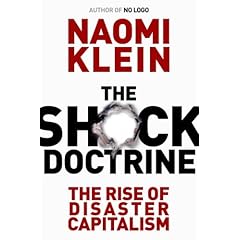
    Alfonso Cuarón, director of "Children of Men", and Naomi Klein present a short film from Klein's book "The Shock Doctrine: The Rise of Disaster Capitalism."


    This film and book discuss the CIA's experimentation with using electric shock to break people down. Yet, the more important point of these works is that a broader "shock" to the systems of a people as a whole, like say 9/11, can have the kind of impact the CIA was searching for in their tests, one that breaks down a whole society and makes them so fearful they are open to nefarious suggestions.

    I am sure none of this sound familiar, does it? This is very powerful stuff that can explain how a traumatized society may act, and may just explain to you why a certain former Mayor of New York mentions 9/11 4.75 times per sentence.

    In any case here is a description in Naomi Klein's words--Watch the video!:

    "My publisher came up with the idea of a "web trailer" but we ended up with a powerful piece of cinema instead. I never saw the film as a promotional tool for the book, or even an adaptation of it. I always saw it as a companion piece to the book, as a way to enter the same subject matter -- shock therapy, disorientation, torture -- on a different, much more emotional level. The central idea of the book is about the use of shocks to exploit people, whether an individual in a torture cell or an entire society. That is such a visual, physical idea that I felt limited by what I could do with mere words on a page -- I could argue and document but I knew that a true artist could find ways to take that argument and reach people on a deeper level. That's what Alfonso did.

    When I finished the book, I sent it to Alfonso because I adore his films and felt that the future he created for Children of Men was very close to the present I was seeing in disaster zones. I was hoping he would send me a quote for the book jacket and instead he pulled together this amazing team of artists -- including Jonás Cuarón who directed and edited -- to make The Shock Doctrine short film. It was one of those blessed projects where everything felt fated."


    To Watch the Video

    A version is also on YouTube:

    Lexington’s 3rd annual multi-faith Walk for World Peace and Solidarity

    (Courtesy of Rebecca Glasscock)

    Lexington’s 3rd annual multi-faith
    Walk for World Peace and Solidarity
    *slow-walking a way of prayer

    Sunday, October 14, 2007
    3:00-5:00 pm, Downtown, Lexington KY

    2:45 p.m.—GATHER at High Street parking lot
    above Lexington Transit Center
    3:00 p.m.—WALK in and around downtown parks
    5:00 p.m.—END with a simple meal shared with
    our friends in the city

    SAVE THE DATE and JOIN US FOR …

    PRAYER—reflections along the way on Murray Bodo’s poem “slow-walking a
    way of prayer”

    SERVICE—hear about volunteer opportunities from service organizations—volunteer pledge cards available

    BLESSINGS—from various faith traditions

    Please, this walk is an expression of our unity and solidarity as peoples of the Earth and not a protest of any particular political or governmental fraction. Let us walk with the desire for peace.


    Franciscan Peace Center, Inc.
    freeing the fire of compassion

    859.230.1986, FranciscanVision@aol.com

    Friday, September 14, 2007

    Wendell Berry: Open Letter on the Proposed Plan to Clear-Cut 800 Acres of Robinson Forest

    (Courtesy of Rebecca Glasscock. Wendell Berry has long been one of the most important writers/voices of Kentucky, again he demonstrates the power of his vision/words in his support of young activists fighting to protect Robinson Forest.)


    Wendell Berry
    Lanes Landing Farm
    Box 1
    Port Royal, KY 40058


    September 4, 2007


    Dr. Scott Smith, Dean
    College of Agriculture
    Room S 123
    Agricultural Science Bldg. N
    University of Kentucky
    Lexington, KY 40506

    Dear Scott:

    I am grateful to you and your forestry colleagues for your willingness to meet, on August 21st, with me and other questioners of your plan for logging research in Robinson Forest. It was for several reasons regrettable that you had to leave before the meeting ended, but you were there long enough, I am sure, to discover that the questioners were serious and that they were asking substantive questions in good faith. And I don’t doubt that, as a teacher, you were as proud as I was of the excellent young people who are leading the questioners, and who are taking up the burden of patriotism and civic responsibility, exactly as their best teachers have bidden them to do.

    I must also give you my personal thanks for the meeting. Your willingness to talk across differences with critics has endeared you to me. As a result, I have always tried to speak with you openly, as a friend, and I will continue to do so.

    My purpose in writing this letter is to set forth my understanding of the issues, for whatever good there may be in doing so, and it seems right to begin with the issue that is most obscure to me: namely, the suggestion that we can choose only between your proposed experiment, which involves clear-cutting 800 acres of the forest now, and strip-mining the whole forest perhaps in three years. These stark alternatives first came to my attention in an email from John Cox to Garrett Graddy, and then you set them forth with heavy and solemn emphasis in your “last words” to our meeting on the 21st.

    The possibility that the forest will be strip-mined has been plainly in sight for several years, but it is hard to know what to make of it in its new manifestation as an either-or tradeoff. This seems to be a threat, but it is an obscure threat. Does it originate with you, or from somewhere higher in the University administration, or from somewhere in state government?

    In your remarks to us, you spoke of the financial needs of the Robinson Scholars Fund, which has been imprudently depleted, but then you said that the proposed 800-acre clear-cut was driven by research, not the need for income. There can be no such confusion about strip-mining the forest; the only possible motive for that would be financial.

    Strip-mining the forest would be confusing only in light of the University’s strong public commitment to research. How could it earn or maintain respect for itself as a research institution if it destroys, for a financial return, one of its most valuable resources for study and experimentation? If Robinson Forest is strip-mined, one would have to conclude that the University’s business interest (its need for money) had come disastrously into conflict with its research commitment.

    Whatever substance there may be to this threat, the would-be protectors of the forest are obliged to take it seriously. Taking it seriously requires us to suppose that the forest may be both clear-cut and strip-mined. (I asked your people at our meeting if they could confidently doubt that the forest will eventually be strip-mined, and they answered no.) It seems, then, that my side is rightly opposed to any destructive practice in the forest. We must assume that the proposed clear-cut is not an alternative to strip-mining, but instead is the first step in a business plan that will culminate in strip-mining.

    To answer for myself the question I asked earlier, I don’t believe that the threat to Robinson Forest originates with you. And so this letter is addressed to you only as the host of our meeting on the 21st. I am not thinking of our determination to protect the forest as your problem, nor am I thinking of you as our problem. I feel sure, and for good reason, that the pressure on the forest is not scientific but financial, and that it is coming from somewhere outside the College of Agriculture. Because of my uncertainty of the point of origin, I am making this a public letter, hoping that it will reach the persons or powers who will in fact decide the fate of the forest, and wishing to bring into the conversation all who are concerned.

    The questioners’ opposition to the planned experiment may be summed up as their inability to accept, or believe, the proposition that the only way to preserve the forest is to clear-cut it – and this in eastern Kentucky, the scene already of total industrial war against the land, the forest, and the people. This is a paradox that our civilization involves us in from time to time, and your questioners are justly dismayed and frightened by it. You, like some of us, are old enough to remember the village in Vietnam that had to be destroyed in order to save it.

    I of course am older than you. At my age it is hardly conceivable that I
    would be questioning your proposed experiment in my own behalf. I was there necessarily in behalf of younger people. I came partly to see how our University would respond to the good young citizens who had come rightfully and appropriately with their questions, and whose motive is only to preserve what they can of a natural birthright by now greatly diminished.

    Your need to leave the meeting is perfectly understandable to me, and yet I am sorry, not least because the meeting got better and more cordial the longer it went on. Your people responded to the questioners with increasing, and finally with great, generosity. The questioners, for the most part, diverted any hard feelings to their own ulcers and returned kindness for kindness.

    My sense of the meeting (and I don’t think I am speaking only for myself or my side) is that it produced finally a real conversation, which not only did no damage but was good for us all. All the participants agreed that the conversation ought to continue, and that it would do so in another meeting. Your people agreed to have their plan reviewed by a panel of scientists selected by the questioners – as was only appropriate, if we want to be objective in every way.

    Finally, and I’m speaking now just for myself, I began to see our conversation of that day as the sad result of our immensely expensive failure here in Kentucky to hold, ever in the 232 years of European “settlement,” a public deliberation on our relation to our land. That such a discussion might be sponsored or led by state government, even so late, defies hope. But the University of Kentucky could do it. And who might more appropriately begin it than you? Such a discussion would make our University extraordinary, and probably unique.

    As I understand it, the experiment involving the 800-acre clear-cut is to be performed in order to establish a basis of knowledge for sustainable forestry. You would not expect me to quarrel with that motive, and I won’t. But from your own point of view, the most serious weakness of your planned experiment is that it is redundant. Though you have published “Sustainable Management Guidelines” for Robinson Forest, you and your colleagues apparently are assuming that sustainable forestry actually does not yet exist, and that it can begin only with such a drastic experiment as you propose.

    On the contrary, sustainable forestry already exists, and its existence can be verified by records, proofs, and observation; to a significant extent, it is in commercial practice. Apparently it was practiced in Europe at least as early as 1605. Aldo Leopold mentions this date in his reference to the Spessart forest in the Alps, which at the time of his writing had been in continuous production of “the finest cabinet oak in the world” for 337 years. And Leopold goes on to say, much to the point of our discussion: “While the northern hardwood forest, like the Spessart, is injured by violence, it is known to stand up under gentle intelligent use to an extraordinary degree. You can cut a third of the volume of a 200-year-old stand and come back every 20 years and take as much again. . . . This . . . is called selective logging. Its technology has been fully explored by the research branch of the Forest Service.” (“The Last Stand,” The River of the Mother of God, 292-293.)

    Nearer home, the Menominee Reservation in Wisconsin consists almost entirely of forest, amounting to 220,000 acres. This forest has been sustainably logged for a century and a half. It is said to have more standing timber in it now than it had in 1854 when logging began.

    The Pioneer Forest in the Missouri Ozarks consists of 150,000 acres which have been sustainably logged since the 1950s. It likewise has increased in quantity and quality of standing timber. Pioneer’s eleventh forest inventory in 2002 showed that “Standing volume had nearly tripled in the half century . . . while species composition had remained stable except for an increase in the more valuable white oak and pine. . . . In the last six years . . . income has been exceeding expenses by more than 50 percent.” (Susan Flader, “Missouri’s Pioneer in Sustainable Forestry,” Forestry History Today, Spring/Fall 2004, 14.)

    Troy Firth, a forest owner and manager in Pennsylvania, was the subject of an article in Forbes magazine because producing forests managed by him increased so remarkably in value.

    Charlie Fisher, who was a logger in Ohio, and Jason Rutledge, who is still logging and teaching loggers in Virginia, have followed the same principles. I have visited logging operations of both men and found them conforming closely to the Menominee pattern.

    All of these American examples are businesses, constantly answerable to the economic pressures of “the real world.” All of them – with the possible exception (so I hear) of the Menominee forest – would welcome observation and testing of their work and results by academic foresters. They have received almost none.

    Mr. John A. Karel, President of the L – A – D Foundation which administers the Pioneer Forest, told me that they had finally secured the interest of two faculty members of the University of Missouri School of Forestry, and that there is some talk about internships. Also they were visited once by scientists from the Yale School of Forestry, who said, “We don’t understand what you’re doing, but it seems to work.”

    I asked, “Did they ever come back to try to understand what you are doing?”

    Mr. Karel said, “No.”

    I do not mean to imply that sustainable forestry anywhere is beyond question. Human use of the land will never be beyond question, and I think that part of the responsibility of scientists is to question it ceaselessly. The practices will remain questionable, and the standards of practice will probably remain to some degree suppositional. This seems to me to call, not for eventual solution, but for an unrelenting intellectual engagement and dialogue, which will remain an essential part of the work of any responsible university.

    My point is that if the University of Kentucky would send its forest scientists to places where sustainable forestry is being practiced in order to study what is being done, to subject it to rigorous testing and observation, and then to use that knowledge to establish similar but locally adapted practices in Robinson Forest and throughout Kentucky, then our University would not be “top twenty” in forestry research; it would be number one.

    Yours cordially and sincerely,


    Wendell Berry

    Copies to:
    Dr. Lee T. Todd, Jr.
    Dr. Steven Bullard
    Dr. Ernest J. Yanarella
    Dr. Julian Campbell
    Mr. Hank Graddy
    Ms. Tina Marie Johnson
    Mr. Doug Doerrfeld
    Ms. Garrett Graddy
    Mr. Paul Lovelace
    Any others who may be concerned

    dpc


    President Lee T. Todd, Jr.
    Office of the President
    101 Main Building
    University of Kentucky
    Lexington, KY 40506-0032

    Dr. Steven Bullard, Chair
    214 Thomas Poe Copper Building
    Office 106
    University of Kentucky
    Lexington, KY 40506-0073

    Dr. Ernest J. Yanarella
    Department of Political Science
    1659 Patterson Office Tower
    University of Kentucky
    Lexington, KY 40506

    Dr. Julian Campbell
    3525 Willowood Road
    Lexington, KY 40517

    Mr. Hank Graddy
    PO Box 4307
    Midway, KY 40347

    Ms. Tina Marie Johnson
    140 East Haiti Road
    Berea, KY 40403

    Mr. Doug Doerrfeld
    PO Box 177
    Elliottville, KY 40317

    Ms. Garrett Graddy
    Mr. Paul Lovelace
    PO Box 158
    Wellington, KY 40387

    Keith Olbermann: Bush Is Just Trying to Play Us With 'Troop Withdrawal' in Iraq

    Bush Is Just Trying to Play Us With 'Troop Withdrawal' in Iraq
    By Keith Olbermann
    MSNBC and AlterNet

    The following is MSNBC Countdown host Keith Olbermann's special comment addressed to President Bush.

    And so he is back from his annual surprise gratuitous photo-op in Iraq, and what a sorry spectacle it was. But it was nothing compared to the spectacle of one unfiltered, unguarded, horrifying quotation in the new biography to which Mr. Bush has consented.

    As he deceived the troops at Al-Asad Air Base yesterday with the tantalizing prospect that some of them might not have to risk being killed and might get to go home, Mr. Bush probably did not know that, with his own words, he had already proved that he had been lying, is lying and will be lying about Iraq.

    He presumably did not know that there had already appeared those damning excerpts from Robert Draper's book Dead Certain.

    "I'm playing for October-November," Mr. Bush said to Draper. That, evidently, is the time during which, he thinks he can sell us the real plan, which is "to get us in a position where the presidential candidates will be comfortable about sustaining a presence."

    Comfortable, that is, with saying about Iraq, again quoting the President, "stay ... longer."

    And there it is. We've caught you. Your goal is not to bring some troops home, maybe, if we let you have your way now. Your goal is not to set the stage for eventual withdrawal. You are, to use your own disrespectful, tone-deaf word, playing at getting the next Republican nominee to agree to jump into this bottomless pit with you, and take us with him, as we stay in Iraq for another year, and another, and another, and anon.

    To Read/Watch the Rest of this Commentary

    Stanford Prison Experiment

    In case there are some people who are not aware of this important (failed--the reasons why it failed though contribute to our understanding of human nature) experiment:

    Stanford Prison Experiment

    Wednesday, September 12, 2007

    Noam Chomsky and Edward S. Herman: The Role of the Mass Media

    The mass media serve as a system for communicating messages and symbols to the general populace. It is their function to amuse, entertain, and inform, and to inculcate individuals with the values, beliefs, and codes of behavior that will integrate them into the institutional structures of the larger society. In a world of concentrated wealth and major conflicts of class interest, to fulfill this role requires systematic propaganda.

    Noam Chomsky and Edwards S. Herman
    Manufacturing Consent (1988)

    Sunday, September 09, 2007

    George Carlin: "It's Called the American Dream Because You Have To Be Asleep to Believe It"

    (Courtesy of Rebecca Glasscock.)

    Carlin, "There's a reason education sucks and it'll never get any better, because the owners of this country don't want it better."

    [This video] clip ... is tough, gruff George Carlin routine from his stand up special, "This Life is Worth Losing." He starts out slamming America's education system and moves on to how the corporations and business interests have Americans "by the balls." Carlin says the people that run this country want nothing more than "obedient workers" and now they want our social security money and retirement. "It's a big club and you and I aren't in it," says Carlin. Check out the video to your right for more harsh but funny truths.

    Watch the Video Clip

    One At a Time

    (Source Chicken Soup for the Soul--passed on by Rebecca Glasscock and BCTC Peace & Justice Coalition)

    One at a Time

    "A friend of ours was walking down a deserted Mexican beach at sunset. As he walked along, he began to see another man in the distance. As he grew nearer, he noticed that the local native kept leaning down, picking something up and throwing it out into the water. Time and again, he kept hurling things out into the ocean. As our friend approached even closer, he noticed that the man was picking up starfish that had been washed up on the beach and, one at a time, he was throwing them back into the water. Our friend was puzzled. He approached the man and said "Good evening, friend. I was wondering what you are doing."

    "I'm throwing these starfish back into the ocean. You see, it's low tide right now and all of these starfish have been washed up onto the shore. If I don't throw them back into the sea, they'll die up here from lack of oxygen."

    "I understand," my friend replied, "but there must be thousands of starfish on this beach. You can't possibly get to all of them. There are simply too many. And don't you realize this is probably happening on hundreds of beaches all up and down this coast ? Can't you see that you can't possibly make a difference?"

    The local native smiled, bent down and pick up yet another starfish, and as he threw it back into the sea, he replied, "Made a difference to that one!"

    Saturday, September 08, 2007

    Mitch McConnell Votes Against Making College More Affordable For Kentucky Families

    (As reported by Media Czech at Bluegrass Roots--original link to his post at the bottom of the page)

    McConnell Votes Against Making College More Affordable For Kentucky Families
    Matthew Miller, DSCC

    Kentucky Senator Mitch McConnell today voted against the bi-partisan College Cost Reduction Act of 2007, a bill which will benefit tens of thousands of Kentucky students and families and make the single largest investment in student aid since the GI Bill.

    "As the cost of college continues to rise and more and more Kentuckians feel the pinch, Mitch McConnell has turned a deaf ear to the need to make college more affordable," DSCC spokesman Matthew Miller said. "Kentuckians want a leader who will work for their children's education, not one who stands in the way of it."

    The bi-partisan legislation passed 79-12.

    Today, McConnell Rejected Largest Single Student Aid Investment Since GI Bill. The bill McConnell voted against this morning - which passed 79-12 with overwhelmingly bipartisan support - will cut roughly $20 billion from lender subsidies and use the funds to beef up aid to college students and cut interest rates on subsidized loans in half. It also includes a $1,090 increase in the maximum Pell Grant award and debt forgiveness after ten years for certain public-sector employees. "This bill will do more to help students and families in this country pay for college than any effort since the GI Bill," said House Education and Labor Committee Chairman George Miller. [Vote 326, 9/7/07; CQ Today, 9/6/07; Wall Street Journal, 9/6/07; HELP Press Release, 9/5/07]

    New Student Aid Bill Will Benefit Tens of Thousands of Kentucky Students and Families. In the 2005-06 school year, nearly 80,000 Kentucky students received federal Pell grants. Still, though, more than half of Kentucky's college seniors graduate with debt. [HELP Committee, September 2007; US Department of Education, 2005-2006 Federal Pell Grant Program End-of-Year Report]

    Debt Forgiveness Program Will Be a Huge Benefit for KY Nurses, Teachers and Law Enforcement Officials. Under the bill McConnell opposed today, a starting teacher in Kentucky earning $30,619 with the state average loan debt of $15,861 could have loan payments capped at 15% - reducing his or her monthly payments by 29%. After 10 years of teaching, all remaining debt would be forgiven - in this case, a benefit worth $9,049. [HELP Committee, September 2007]

    THIS ISN'T THE FIRST TIME MCCONNELL HAS VOTED AGAINST MAKING COLLEGE AFFORDABLE...
    McConnell Cast Critical Vote for Largest Student Loan Cuts in History. McConnell voted for the final version of the 2005 budget reconciliation bill, which cut $12.7 million from college loans, the largest cuts to the student loan program in its history. The measure was approved 50-50 with the Vice President voting to break the tie. [Vote 363, 12/21/05; AP, 12/19/05; Washington Post, 12/19/05]

    This Is McConnell's Fifth Vote Against Raising Pell Grants In Just Four Years. From 2004 through 2006, McConnell voted at least four times against raising maximum Pell grant awards. [Vote 39, 3/14/06; Vote 268, 10/25/05; Vote 68, 3/17/05; Vote 51, 3/11/04]

    For the Full Hyperlinked Report