Showing posts with label Sheldon Wolin. Show all posts

Monday, January 31, 2011

Paul le Blanc: What Do Socialists Say About Democracy?

What Do Socialists Say About Democracy?
by Paul le Blanc
International Socialist Review

...

There are additional realities that flow from this, and you don’t have to be a genius like Albert Einstein to figure out what they are. The fact remains, however, that Einstein did discuss the question in 1949 and expressed himself rather well, so let’s see what he had to say:

Private capital tends to become concentrated in few hands, partly because of competition among the capitalists, and partly because technological development and the increasing division of labor encourage the formation of larger units of production at the expense of smaller ones. The result of these developments is an oligarchy of private capital the enormous power of which cannot be effectively checked even by a democratically organized political society. This is true since the members of legislative bodies are selected by political parties, largely financed or otherwise influenced by private capitalists who, for all practical purposes, separate the electorate from the legislature. The consequence is that the representatives of the people do not in fact sufficiently protect the interests of the underprivileged sections of the population. Moreover, under existing conditions, private capitalists inevitably control, directly or indirectly, the main sources of information (press, radio, education). It is thus extremely difficult, and indeed in most cases quite impossible, for the individual citizen to come to objective conclusions and to make intelligent use of his political rights.16


More recently, Sheldon Wolin, Professor Emeritus of Political Theory at Princeton University, updated some of Einstein’s points. To understand what he says, you need to understand Greek—so I will now give you a Greek language lesson. We got the word “democracy” from the ancient Greeks—demokratia, derived from demos (the people) and kratia (rule). Sheldon Wolin says: “It is obvious that today—in the age of communication conglomerates, media pundits, television, public opinion surveys, and political consultants—the exercise of popular will, the expression of its voice, and the framing of its needs have been emptied of all promise of autonomy.” No kidding! Noting that “American politicians and publicists claim that theirs is the world’s greatest democracy,” Wolin tells us, instead (and remember, “demos” means “the people”): “The reality is a democracy without the demos as actor. The voice is that of a ventriloquist democracy.”17 That is, “we the people” seem to be expressing ourselves politically, but really what is being expressed comes from the wealthy elites and their minions who control the economy, the larger culture, the sources of information, the shaping of opinion, and the political process as a whole.

Many anarchists, quite understandably, denounce the very concept of democracy as a swindle that should be rejected by all honest revolutionaries. Marxists argue, however, that the swindle must be rejected—but democracy should be fought for. It does seem, however, that given the many ways in which the electoral process in the United States is stacked in favor of capitalism and capitalists, a case can be made, at least in the present time, for our efforts to be concentrated outside the electoral arena. Just as politics involves much, much more than elections and electoral parties, so the struggle for democracy—as the comments of Howard Zinn suggest—can often be pursued far more effectively in workplaces, in communities, in schools, in the streets, in the larger culture through non-electoral struggles, and creative work of various kinds. The key for us is to draw more and more people into pathways of thinking and pathways of action that go in the direction of questioning established authority and giving people a meaningful say about the realities and decisions affecting their lives. That is the opposite of how so-called democracy—focused on elections—actually works in our country. This comes through brilliantly in the description of the wonderful anarchist educator Paul Goodman regarding the U.S. political system in the early 1960s:

Concretely, our system of government at present comprises the military-industrial complex, the secret paramilitary agencies, the scientific war corporations, the blimps, the horses’ asses, the police, the administrative bureaucracy, the career diplomats, the lobbies, the corporations that contribute Party funds, the underwriters and real-estate promoters that batten on urban renewal, the official press and the official opposition press, the sounding-off and jockeying for the next election, the National Unity, etc., etc. All this machine is grinding along by the momentum of the power and profit motives and style long since built into it; it cannot make decisions of a kind radically different than it does. Even if an excellent man happens to be elected to office, he will find that it is no longer a possible instrument for social change on any major issues of war and peace and the way of life of the Americans.18


Elections can sometimes be used effectively by revolutionaries to reach out to masses of people with ideas, information, analyses, and proposals that challenge the established order. If elected, they may also find that—aside from proposing and voting for positive, if relatively modest, social reforms—they will also be able to use elected office to help inform, mobilize, and support their constituents in non-electoral mass struggles. But the insertion of revolutionaries into the existing capitalist state will not be sufficient to bring about the “true democracy” that Marx spoke of, because they would find themselves within political structures designed to maintain the existing power relations. They would not have the power to end capitalist oppression or to transform the capitalist state into a structure permitting actual “rule by the people.” Marx and Engels themselves came to the conclusion that it would not be possible for the working class simply to use the existing state—designed by our exploiters and oppressors—to create a new society. The workers would need to smash the oppressive apparatus in order to allow for a genuinely democratic rule, through their own movements and organizations, and through new and more democratic governmental structures.

It is possible that some revolutionaries might be elected before such revolutionary change restructures the state. But they can be effective in what they actually want to do only by working in tandem with broader social movements and with non-electoral struggles. These movements and struggles must be working to empower masses of people in our economy and society, and to put increasing pressure on all politicians and government figures, and also on capitalist owners and managers, to respond to the needs and the will of the workers, of the oppressed, and of the majority of the people. Remember C. L. R. James’s comment: “To the degree that the [working class] mobilizes itself and the great masses of the people, the socialist revolution is advanced. The [working class] mobilizes itself as a self-acting force through its own committees, unions, parties, and other organizations.” These are, potentially, the seeds of the workers’ democracy—germinating in the present—that will take root and grow, challenging and displacing the undemocratic and corrupted structures associated with the so-called bourgeois democracies.

Democracy and “communism”

Before we conclude, we need to look more closely, even if briefly, at a contradiction that seems to have arisen between the notion of democracy and the realities of what came to be known as Communism. Within the tradition of twentieth-century Communism, many (in sharp contrast to Marx) came to counterpose revolution and communism to democracy as such. This can’t be justified, but it needs to be explained. Lenin, Trotsky, and the Bolsheviks led a super-democratic upsurge of the laboring masses, resulting in the initial triumph of the Russian Revolution of 1917. Immediately afterward, Russia was overwhelmed by foreign military invasions, economic blockades, and a very bloody civil war nurtured by hostile foreign capitalist powers. In that horrific situation, a brutal one-party dictatorship was established to hold things together. The Bolsheviks (even comrades Lenin and Trotsky) came up with highly dubious theoretical justifications for the dictatorship, which caused Rosa Luxemburg—correctly—to sharply criticize them, even as she supported the Russian Revolution. The justifications they put forward were soon used as an ideological cover for the crystallization of a vicious bureaucratic tyranny propagated, in the name of “Communism,” by Joseph Stalin and others, ultimately miseducating millions of people throughout the world.19

Both Lenin and Trotsky, and also many others who were true to the revolutionary-democratic essence of the Bolshevik tradition, sought to push back this horrendous corruption of the Communist cause. But it was too late, and after the late 1920s such words as Communism, Marxism, and socialism became wrongly identified throughout the world with that horrendous, totalitarian, murderous corruption represented by the Stalin regime. The ideology and practices of Stalinism are close to being the opposite of classical Marxism.

To Read the Entire Essay

Saturday, January 23, 2010

Chalmers Johnson: Review of Sheldon Wolin's Democracy Incorporated

(Sheldon Wolin's Politics and Vision, 2nd ed., is one of the best political science/theory books I have read. I plan on reading it again and I am going to get his new book described below... which seems essential for understanding the corporate dominance of our political process.)

Inverted Totalitarianism: A New Way of Understanding How the U.S. Is Controlled
By Chalmers Johnson
Truthdig


We now have a new, comprehensive diagnosis of our failings as a democratic polity by one of our most seasoned and respected political philosophers. For well over two generations, Sheldon Wolin taught the history of political philosophy from Plato to the present to Berkeley and Princeton graduate students (including me; I took his seminars at Berkeley in the late 1950s, thus influencing my approach to political science ever since). He is the author of the prize-winning classic Politics and Vision (1960; expanded edition, 2006) and Tocqueville Between Two Worlds (2001), among many other works.

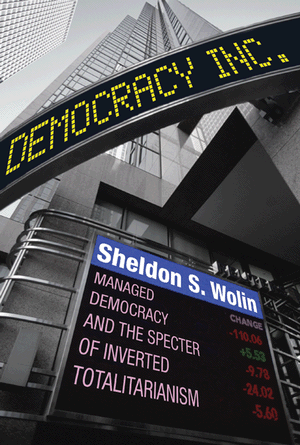
His new book, Democracy Incorporated: Managed Democracy and the Specter of Inverted Totalitarianism, is a devastating critique of the contemporary government of the United States -- including what has happened to it in recent years and what must be done if it is not to disappear into history along with its classic totalitarian predecessors: Fascist Italy, Nazi Germany and Bolshevik Russia. The hour is very late and the possibility that the American people might pay attention to what is wrong and take the difficult steps to avoid a national Gtterdmmerung are remote, but Wolin's is the best analysis of why the presidential election of 2008 probably will not do anything to mitigate our fate. This book demonstrates why political science, properly practiced, is the master social science.

Wolin's work is fully accessible. Understanding his argument does not depend on possessing any specialized knowledge, but it would still be wise to read him in short bursts and think about what he is saying before moving on. His analysis of the contemporary American crisis relies on a historical perspective going back to the original constitutional agreement of 1789 and includes particular attention to the advanced levels of social democracy attained during the New Deal and the contemporary mythology that the U.S., beginning during World War II, wields unprecedented world power.

Given this historical backdrop, Wolin introduces three new concepts to help analyze what we have lost as a nation. His master idea is "inverted totalitarianism," which is reinforced by two subordinate notions that accompany and promote it -- "managed democracy" and "Superpower," the latter always capitalized and used without a direct article. Until the reader gets used to this particular literary tic, the term Superpower can be confusing. The author uses it as if it were an independent agent, comparable to Superman or Spiderman, and one that is inherently incompatible with constitutional government and democracy.

Wolin writes, "Our thesis is this: it is possible for a form of totalitarianism, different from the classical one, to evolve from a putatively 'strong democracy' instead of a 'failed' one." His understanding of democracy is classical but also populist, anti-elitist and only slightly represented in the Constitution of the United States. "Democracy," he writes, "is about the conditions that make it possible for ordinary people to better their lives by becoming political beings and by making power responsive to their hopes and needs." It depends on the existence of a demos -- "a politically engaged and empowered citizenry, one that voted, deliberated, and occupied all branches of public office." Wolin argues that to the extent the United States on occasion came close to genuine democracy, it was because its citizens struggled against and momentarily defeated the elitism that was written into the Constitution.

"No working man or ordinary farmer or shopkeeper," Wolin points out, "helped to write the Constitution." He argues, "The American political system was not born a democracy, but born with a bias against democracy. It was constructed by those who were either skeptical about democracy or hostile to it. Democratic advance proved to be slow, uphill, forever incomplete. The republic existed for three-quarters of a century before formal slavery was ended; another hundred years before black Americans were assured of their voting rights. Only in the twentieth century were women guaranteed the vote and trade unions the right to bargain collectively. In none of these instances has victory been complete: women still lack full equality, racism persists, and the destruction of the remnants of trade unions remains a goal of corporate strategies. Far from being innate, democracy in America has gone against the grain, against the very forms by which the political and economic power of the country has been and continues to be ordered." Wolin can easily control his enthusiasm for James Madison, the primary author of the Constitution, and he sees the New Deal as perhaps the only period of American history in which rule by a true demos prevailed.

To reduce a complex argument to its bare bones, since the Depression, the twin forces of managed democracy and Superpower have opened the way for something new under the sun: "inverted totalitarianism," a form every bit as totalistic as the classical version but one based on internalized co-optation, the appearance of freedom, political disengagement rather than mass mobilization, and relying more on "private media" than on public agencies to disseminate propaganda that reinforces the official version of events. It is inverted because it does not require the use of coercion, police power and a messianic ideology as in the Nazi, Fascist and Stalinist versions (although note that the United States has the highest percentage of its citizens in prison -- 751 per 100,000 people -- of any nation on Earth). According to Wolin, inverted totalitarianism has "emerged imperceptibly, unpremeditatedly, and in seeming unbroken continuity with the nation's political traditions."

The genius of our inverted totalitarian system "lies in wielding total power without appearing to, without establishing concentration camps, or enforcing ideological uniformity, or forcibly suppressing dissident elements so long as they remain ineffectual. A demotion in the status and stature of the 'sovereign people' to patient subjects is symptomatic of systemic change, from democracy as a method of 'popularizing' power to democracy as a brand name for a product marketable at home and marketable abroad. The new system, inverted totalitarianism, is one that professes the opposite of what, in fact, it is. The United States has become the showcase of how democracy can be managed without appearing to be suppressed."

Among the factors that have promoted inverted totalitarianism are the practice and psychology of advertising and the rule of "market forces" in many other contexts than markets, continuous technological advances that encourage elaborate fantasies (computer games, virtual avatars, space travel), the penetration of mass media communication and propaganda into every household in the country, and the total co-optation of the universities. Among the commonplace fables of our society are hero worship and tales of individual prowess, eternal youthfulness, beauty through surgery, action measured in nanoseconds, and a dream-laden culture of ever-expanding control and possibility, whose adepts are prone to fantasies because the vast majority have imagination but little scientific knowledge. Masters of this world are masters of images and their manipulation. Wolin reminds us that the image of Adolf Hitler flying to Nuremberg in 1934 that opens Leni Riefenstahl's classic film "Triumph of the Will" was repeated on May 1, 2003, with President George Bush's apparent landing of a Navy warplane on the flight deck of the USS Abraham Lincoln to proclaim "Mission Accomplished" in Iraq.

On inverted totalitarianism's "self-pacifying" university campuses compared with the usual intellectual turmoil surrounding independent centers of learning, Wolin writes, "Through a combination of governmental contracts, corporate and foundation funds, joint projects involving university and corporate researchers, and wealthy individual donors, universities (especially so-called research universities), intellectuals, scholars, and researchers have been seamlessly integrated into the system. No books burned, no refugee Einsteins. For the first time in the history of American higher education top professors are made wealthy by the system, commanding salaries and perks that a budding CEO might envy."

The main social sectors promoting and reinforcing this modern Shangri-La are corporate power, which is in charge of managed democracy, and the military-industrial complex, which is in charge of Superpower. The main objectives of managed democracy are to increase the profits of large corporations, dismantle the institutions of social democracy (Social Security, unions, welfare, public health services, public housing and so forth), and roll back the social and political ideals of the New Deal. Its primary tool is privatization. Managed democracy aims at the "selective abdication of governmental responsibility for the well-being of the citizenry" under cover of improving "efficiency" and cost-cutting.

Managed democracy is a powerful solvent for any vestiges of democracy left in the American political system, but its powers are weak in comparison with those of Superpower. Superpower is the sponsor, defender and manager of American imperialism and militarism, aspects of American government that have always been dominated by elites, enveloped in executive-branch secrecy, and allegedly beyond the ken of ordinary citizens to understand or oversee. Superpower is preoccupied with weapons of mass destruction, clandestine manipulation of foreign policy (sometimes domestic policy, too), military operations, and the fantastic sums of money demanded from the public by the military-industrial complex. (The U.S. military spends more than all other militaries on Earth combined. The official U.S. defense budget for fiscal year 2008 is $623 billion; the next closest national military budget is China's at $65 billion, according to the Central Intelligence Agency.)

Foreign military operations literally force democracy to change its nature: "In order to cope with the imperial contingencies of foreign war and occupation," according to Wolin, "democracy will alter its character, not only by assuming new behaviors abroad (e.g., ruthlessness, indifference to suffering, disregard of local norms, the inequalities in ruling a subject population) but also by operating on revised, power-expansive assumptions at home. It will, more often than not, try to manipulate the public rather than engage its members in deliberation. It will demand greater powers and broader discretion in their use ('state secrets'), a tighter control over society's resources, more summary methods of justice, and less patience for legalities, opposition, and clamor for socioeconomic reforms."

Imperialism and democracy are, in Wolin's terms, literally incompatible, and the ever greater resources devoted to imperialism mean that democracy will inevitably wither and die. He writes, "Imperial politics represents the conquest of domestic politics and the latter's conversion into a crucial element of inverted totalitarianism. It makes no sense to ask how the democratic citizen could 'participate' substantively in imperial politics; hence it is not surprising that the subject of empire is taboo in electoral debates. No major politician or party has so much as publicly remarked on the existence of an American empire."

To Read the Entire Review

More:

To Read the First Chapter of Democracy Incorporated

To Read the First Chapter of Politics and Vision