Thursday, July 13, 2006

Waiting (im)Patiently For the Release of the Film A Scanner Darkly


I cannot believe it! Someone (actually Steven Soderbergh/George Clooney, et al are producing and Richard Linklater is directing) has finally decided to go through with adapting Philip K. Dick's novel A Scanner Darkly...


I don't know though, I'm not a big fan of this "live action photograph overlay" technique that Linklater favors (see "Waking Life"), but I'm willing to "hope" that it will be a good attempt and recognize that this is probably a more appropriate style to realize Dick's vision:

Trailers


A report from the Philip K. Dick trust:

A Scanner Darkly: Film Adaptation


Can anyone though truly bring to life the true subtext of this powerful pulp novel. Philip K. Dick's exploration of the incestous, symbiotic relationship of chaos/order, law/crime, yin/yang, and so on and the reproduction of this destructive/creative duality within us all... even more disturbing for some may be the conclusion that we all have that dark side and feed it one way or another. Mind your addictions folks...

-----------------------------------------------------------------
The links in the text below were added by me--it just seemed appropriate. This can give the uninitiated insight to why Philip K. Dick, a true pulp writer, has developed such a following... remember this speech was in 1978!!!
-------------------------------------------------------------------
(Courtesy of The Deoxyribonucleic Hyperdimension)

How to Build a Universe That Doesn't Fall Apart Two Days Later
by Philip K. Dick, 1978

Well, I will tell you what interests me, what I consider important. I can't claim to be an authority on anything, but I can honestly say that certain matters absolutely fascinate me, and that I write about them all the time. The two basic topics which fascinate me are "What is reality?" and "What constitutes the authentic human being?" Over the twenty-seven years in which I have published novels and stories I have investigated these two interrelated topics over and over again. I consider them important topics. What are we? What is it which surrounds us, that we call the not-me, or the empirical or phenomenal world?

...

In 1951, when I sold my first story, I had no idea that such fundamental issues could be pursued in the science fiction field. I began to pursue them unconsciously. My first story had to do with a dog who imagined that the garbagemen who came every Friday morning were stealing valuable food which the family had carefully stored away in a safe metal container. Every day, members of the family carried out paper sacks of nice ripe food, stuffed them into the metal container, shut the lid tightly—and when the container was full, these dreadful-looking creatures came and stole everything but the can.

Finally, in the story, the dog begins to imagine that someday the garbagemen will eat the people in the house, as well as stealing their food. Of course, the dog is wrong about this. We all know that garbagemen do not eat people. But the dog's extrapolation was in a sense logical—given the facts at his disposal. The story was about a real dog, and I used to watch him and try to get inside his head and imagine how he saw the world. Certainly, I decided, that dog sees the world quite differently than I do, or any humans do. And then I began to think, Maybe each human being lives in a unique world, a private world, a world different from those inhabited and experienced by all other humans. And that led me wonder, If reality differs from person to person, can we speak of reality singular, or shouldn't we really be talking about plural realities? And if there are plural realities, are some more true (more real) than others? What about the world of a schizophrenic? Maybe, it's as real as our world. Maybe we cannot say that we are in touch with reality and he is not, but should instead say, His reality is so different from ours that he can't explain his to us, and we can't explain ours to him. The problem, then, is that if subjective worlds are experienced too diffrently, there occurs a breakdown of communication... and there is the real illness.

...

It was always my hope, in writing novels and stories which asked the question "What is reality?", to someday get an answer. This was the hope of most of my readers, too. Years passed. I wrote over thirty novels and over a hundred stories, and still I could not figure out what was real. One day a girl college student in Canada asked me to define reality for her, for a paper she was writing for her philosophy class. She wanted a one-sentence answer. I thought about it and finally said, "Reality is that which, when you stop believing in it, doesn't go away." That's all I could come up with. That was back in 1972. Since then I haven't been able to define reality any more lucidly.

But the problem is a real one, not a mere intellectual game. Because today we live in a society in which spurious realities are manufactured by the media, by governments, by big corporations, by religious groups, political groups—and the electronic hardware exists by which to deliver these pseudo-worlds right into the heads of the reader, the viewer, the listener. Sometimes when I watch my eleven-year-old daughter watch TV, I wonder what she is being taught. The problem of miscuing; consider that. A TV program produced for adults is viewed by a small child. Half of what is said and done in the TV drama is probably misunderstood by the child. Maybe it's all misunderstood. And the thing is, Just how authentic is the information anyhow, even if the child correctly understood it? What is the relationship between the average TV situation comedy to reality? What about the cop shows? Cars are continually swerving out of control, crashing, and catching fire. The police are always good and they always win. Do not ignore that point: The police always win. What a lesson that is. You should not fight authority, and even if you do, you will lose. The message here is, Be passive. And—cooperate. If Officer Baretta asks you for information, give it to him, because Officer Beratta is a good man and to be trusted. He loves you, and you should love him.

So I ask, in my writing, What is real? Because unceasingly we are bombarded with pseudo-realities manufactured by very sophisticated people using very sophisticated electronic mechanisms. I do not distrust their motives; I distrust their power. They have a lot of it. And it is an astonishing power: that of creating whole universes, universes of the mind. I ought to know. I do the same thing. It is my job to create universes, as the basis of one novel after another. And I have to build them in such a way that they do not fall apart two days later. Or at least that is what my editors hope. However, I will reveal a secret to you: I like to build universes which do fall apart. I like to see them come unglued, and I like to see how the characters in the novels cope with this problem. I have a secret love of chaos. There should be more of it. Do not believe—and I am dead serious when I say this—do not assume that order and stability are always good, in a society or in a universe. The old, the ossified, must always give way to new life and the birth of new things. Before the new things can be born the old must perish. This is a dangerous realization, because it tells us that we must eventually part with much of what is familiar to us. And that hurts. But that is part of the script of life. Unless we can psychologically accommodate change, we ourselves begin to die, inwardly. What I am saying is that objects, customs, habits, and ways of life must perish so that the authentic human being can live. And it is the authentic human being who matters most, the viable, elastic organism which can bounce back, absorb, and deal with the new.

...

The basic tool for the manipulation of reality is the manipulation of words. If you can control the meaning of words, you can control the people who must use the words. George Orwell made this clear in his novel 1984. But another way to control the minds of people is to control their perceptions. If you can get them to see the world as you do, they will think as you do. Comprehension follows perception. How do you get them to see the reality you see? After all, it is only one reality out of many. Images are a basic constituent: pictures. This is why the power of TV to influence young minds is so staggeringly vast. Words and pictures are synchronized. The possibility of total control of the viewer exists, especially the young viewer. TV viewing is a kind of sleep-learning. An EEG of a person watching TV shows that after about half an hour the brain decides that nothing is happening, and it goes into a hypnoidal twilight state, emitting alpha waves. This is because there is such little eye motion. In addition, much of the information is graphic and therefore passes into the right hemisphere of the brain, rather than being processed by the left, where the conscious personality is located. Recent experiments indicate that much of what we see on the TV screen is received on a subliminal basis. We only imagine that we consciously see what is there. The bulk of the messages elude our attention; literally, after a few hours of TV watching, we do not know what we have seen. Our memories are spurious, like our memories of dreams; the blank are filled in retrospectively. And falsified. We have participated unknowingly in the creation of a spurious reality, and then we have obligingly fed it to ourselves. We have colluded in our own doom.

And—and I say this as a professional fiction writer—the producers, scriptwriters, and directors who create these video/audio worlds do not know how much of their content is true. In other words, they are victims of their own product, along with us. Speaking for myself, I do not know how much of my writing is true, or which parts (if any) are true. This is a potentially lethal situation. We have fiction mimicking truth, and truth mimicking fiction. We have a dangerous overlap, a dangerous blur. And in all probability it is not deliberate. In fact, that is part of the problem. You cannot legislate an author into correctly labelling his product, like a can of pudding whose ingredients are listed on the label... you cannot compel him to declare what part is true and what isn't if he himself does not know.

...

If any of you have read my novel Ubik, you know that the mysterious entity or mind or force called Ubik starts out as a series of cheap and vulgar commercials and winds up saying:

I am Ubik. Before the universe was I am. I made the suns. I made the worlds. I created the lives and the places they inhabit; I move them here, I put them there. They go as I say, they do as I tell them. I am the word and my name is never spoken, the name which no one knows. I am called Ubik but that is not my name. I am. I shall always be.


It is obvious from this who and what Ubik is; it specifically says that it is the word, which is to say, the Logos. In the German translation, there is one of the most wonderful lapses of correct understanding that I have ever come across; God help us if the man who translated my novel Ubik into German were to do a translation from the koine Greek into German of the New Testament. He did all right until he got to the sentence "I am the word." That puzzled him. What can the author mean by that? he must have asked himself, obviously never having come across the Logos doctrine. So he did as good a job of translation as possible. In the German edition, the Absolute Entity which made the suns, made the worlds, created the lives and the places they inhabit, says of itself:

I am the brand name.


Had he translated the Gospel according to Saint John, I suppose it would have come out as:

When all things began, the brand name already was. The brand name dwelt with God, and what God was, the brand name was.


...

Such is the fate of an author who hoped to include theological themes in his writing. "The brand name, then, was with God at the beginning, and through him all things came to be; no single thing was created without him." So it goes with noble ambitions. Let's hope God has a sense of humor.

Or should I say, Let's hope the brand name has a sense of humor.

Link to Read the Entire Speech

also:

In the comment section of an earlier post of this speech, many of us listed our favorite PKD novels (for those that would like to read some of his work). Please feel free to suggest more in these comments.

Elizabeth Weil: Breeder Reaction

Breeder Reaction: Does everybody have the right to have a baby? And who should pay when nature alone doesn’t work?
by Elizabeth Weil
Mother Jones

Guadalupe Benitez and her partner, Joanne Clark, had been buying frozen sperm at a bank in Los Angeles and trying to get pregnant at home for two years when Benitez finally sought out the services of a fertility specialist. Not at all uncommon—infertility affects more than 6 million Americans, and about 20 percent of them seek help through assisted reproductive technology, or ART. At that point, 1999, Benitez was 27 years old, Clark was 40 years old, and the couple had been together for eight years, since Benitez emigrated from Culiacán, Mexico. Benitez, a medical assistant, had some infertility benefits at a nearby OB/GYN clinic, the North Coast Women’s Care Medical Group. There, Dr. Christine Brody put Benitez on a hormonal drug called Clomid, to treat her polycystic ovarian syndrome, and also told her that she was willing to oversee her treatment but not to perform inseminations because, as a Christian, she disapproved of lesbians having children.

“When she said that,” Benitez told me, “I was so upset, but she made it better by saying the other doctors would do it for us.” Benitez and Clark tried home inseminations for a few more months, and Brody even did some exploratory surgery. But when the time came to schedule a more effective in utero insemination—a procedure that involves injecting sperm directly into the uterus—an assistant from North Coast Women’s Care called to inform Benitez that no one in the practice would do the procedure, nor would they refill her prescriptions. Benitez demanded to speak with the head of the clinic, who responded by telling her that he, too, objected to helping lesbians have children and would not further her care. “They had just lied and lied to me, trying to brush me aside to do inseminations at home as some form of excuse. But once they found themselves against the wall, they had no choice but to tell me they flat-out wouldn’t do it.” So Benitez sued.

Benitez’s is far from the only case brought by a woman turned down for fertility services. Kijuana Chambers, a single blind woman living in Denver, Colorado, was eventually turned away from her fertility clinic. Among the reasons cited at trial by one of the clinic’s doctors: She was prone to emotional outbursts; she had dirty underwear. Chambers lost her trial in the U.S. District Court in Denver in November 2003. Last summer, the 10th Circuit Court of Appeals declined to rehear her case.

Screening at fertility clinics is not just a concern for gays, lesbians, and the disabled. Women over 39 and women with severely compromised fertility are commonly turned down for services or told they won’t be treated unless they agree to use donor eggs. This is largely a matter of economics. Assisted reproduction is a $4 billion-a-year business. The average cost of a single cycle of in vitro fertilization, including medications, egg retrieval, sperm washing, fertilization, incubation, and embryo transfer, is $12,400. Given all the failures and repeat attempts, the average amount spent per baby born through IVF in the United States is much higher: $100,000. Few insurance companies pick up the tab, so patients themselves decide where to spend their considerable money, and they do this largely based on a clinic’s success rate. As a result, many doctors try to game the system, producing high “live birth” success rates by cherry-picking patients. Before being accepted by a clinic, a woman must submit to a battery of tests to determine things like the level of follicle-stimulating hormone on day three of her menstrual cycle. Get a number over 12, and she’s out of luck.

According to Dr. Geoffrey Sher, founder and medical director of the Sher Institute of Reproductive Medicine, the largest chain of privately owned fertility clinics in the world, almost any clinic that can afford to turn down patients does. “I’d like to think most doctors try to be honest. The problem is, you’re confronted with the reality that if you don’t get high success rates, patients don’t come to you.”

To Read the Rest of the Article

Wednesday, July 12, 2006

Bohemian Grove Protest: July 22--Monte Rio, CA

BOHEMIAN GROVE PROTEST

JULY 22 1:00 PM MONTE RIO, CA

NO: IRAQ WAR/OCCUPATION!
NO: US MILITARY GLOBAL DOMINATION!
YES: IMMIGRANT RIGHTS!
YES: IMPEACHMENT!

It is time for social justice/progressive people to stand up to the global domination group celebrating themselves in Sonoma County. War contractors, torture advocates, election thieves, spy masters, immigrant bashers, will all be at the Bohemian Grove this summer. You can speak truth to the powerful on Saturday, July 22, 2006 beginning at 1PM in the main Monte Rio Parking lot in western Sonoma County, California.

Invited speakers include Cora Lee Simmons of Round Valley Indians for Justice, Casimiro Alvarez, regional director of the United Farm Workers and Calvin Gibson and Gloria LaRiva of the ANSWER coalition. M.C.'s will be Kris Welch and Miguel Molina of KPFA Free Speech Radio. Native Resistance Drum Group will create the opening ceremony. At 2PM there will be a march to the gates of Bohemian Grove.

At 4 PM there will be a gathering in the Monte Rio amphitheater on the south side of the Russian River. Music and food will be available as well as networking possibilities for activists from the many issues.

Global Dominance Group Bohemians from major defense contractors, DOD, CIA and neo-conservative policy councils include: James Baker III, Riley Bechtel, Steve Bechtel, George H. W. Bush, Lewis Coleman, Alan Dachs, Christopher DeMuth, Kenneth Derr, Edwin Feulner, Bobby Ray Inman, Charles Larson, Ed Meese, William Owens, Colin Powell, Joseph Ralston, Donald Rumsfeld, James Woolsey and many more undisclosed guests

For individual information on each of the people above see:
Global Dominance Group

Bohemian Grove is a 2000 acre ancient redwood grove in Monte Rio California owned by the San Francisco Bohemian Club. For over 130 years the power elite of the corporate, banking, military and political circles have gathered for two weeks in July to play in the woods and celebrate themselves by watching elaborate plays, drinking, feasting, story telling, and listening to "lakeside chats" from their peers.


Since 1980 a growing coalition of peace and social justice groups have worked to expose these powerful Bohemians and their global connections. This year's protest sponsors include: A.N.S.W.E.R. Coalition, S.F. Bohemian Action Network, Green Party of California, International Indian Treaty Council, Peace and Justice Center of Sonoma County, Project Censored and United Farm Workers

For more information contact:
Mary Moore, 707-874-2248, Bohemian Grove Action Network
Bill Hackwell, 415-269-7917 or 821 6545, ANSWER Coalition
Peter Phillips, 707-664-2588 (research & background) Project Censored

For More Information on The Bohemian Club see:
Here
or
Here

Tuesday, July 11, 2006

Consumption, Markets & Culture

Full PDF Texts available of the first 5 volumes of this journal:

Consumption, Markets & Culture

Karen W. Arenson: Panel Explores Standard Tests for Colleges

(One of the members of the commission is Jonathan Grayer, chief executive of the test-coaching company Kaplan Inc.--conflict of interest? Wonder why the Bush Administration is so eager to put higher education on a leash?)

Panel Explores Standard Tests for Colleges
by Karen W. Arenson
New York Times (February)

... university officials are wary of the notion that testing regimes should be used to measure all the different institutions that make up American higher education — small liberal arts colleges, large public universities, proprietary schools and religious academies — particularly if there is government involvement.

David L. Warren, president of the National Association of Independent Colleges and Universities, a group representing private, nonprofit colleges and universities, said: "What we oppose is a single, national, high-stakes, one-size-fits-all, uber-outcome exam. The notion of a single exam implies there are national standards, and that implies a national curriculum. Then we are on the way to a centralized Prussian education system."

When Ms. Spellings, the education secretary, named the commission, she said that choosing a college was one of the most important and expensive decisions families make and that they were entitled to more information.

There is no unanimity on the commission, but some members also expressed interest in measuring student learning.

Kati Haycock, a commissioner who is director of the Education Trust in Washington, which has supported standardized testing, said in an e-mail message: "Any honest look at the new adult literacy level data for recent college grads leaves you very queasy. And the racial gaps are unconscionable. So doing something on the assessment side is probably important. The question is what and when."

Jonathan Grayer, another commissioner, who is chief executive of the test-coaching company Kaplan Inc., said that with so many students in college and so many tax dollars being spent, "it is important for us to seek some type of knowledge about how much learning is going on."

To Read the Entire Article

Also:

NPR Reports

Thursday, July 06, 2006

Rolling Thunder: An Anarchist Journal of Dangerous Living

(From the cover of the first issue)

A fault line runs through every society
through every community, through every human heart.
On one side is obedience; on the other freedom.
On one side is cowardice; on the other, compassion.
On one side is despair; on the other, action.
Sometimes the boundaries shift as gains are made or lost--
but however things appear, that fault line is always there.

Most everything you can read nowadays is published from one side of this divide.
This magazine hails from the other.

Rolling Thunder

Distinguished Women of the Past and Present

(In a 2002 report it was found that Kentucky’s women rank--in order of states--49th in the percentage of women with Bachelor’s degrees, 48th in political participation, and 50th in health and well-being. Keeping that in mind I was wondering what is the problem and what models there are for the young women I teach in Kentucky.)

Subject Guide

Main Site

Sunday, July 02, 2006

Immanuel Wallerstein: The Worries of the U.S. Ambassador to Iraq

Commentary No. 188, July 1, 2006

"The Worries of the U.S. Ambassador to Iraq"

The U.S. government tries to keep a brave face about Iraq. It regularly claims it is making progress in its objectives. The recent publication in the press of a June 6 memo that U.S. Ambassador Zalmay Khalilzad sent to the Secretary of State shows internal discussion that is much more pessimistic. It relates the multiple and growing problems of the Iraqi staff who work for the U.S. government in the ultra-protected Green Zone. It is not a happy story. The Iraqi staff is complaining, says Khalilzad, that "Islamist and/or militia groups have been negatively affecting their daily routine."

Female employees are under great pressure to wear so-called modest dress, sometimes more extreme than that required in Iran. One of them reports that the taxi driver who brings her to work daily has informed her that "he cannot let her ride unless she wears a headcover." In addition to the multiple pressures concerning dresswear (for men as well - no shorts), the employees complain of daily lack of power in their apartments and of having to spend 12 hours on a Saturday on lines for gas.

The situation has become so risky for the employees that they are hiding their employment from everyone, including their own families. They do not use cellphones outside the Green Zone, or even carry them, because this is a dangerous giveaway, especially for females. They reply only in Arabic if called by the Embassy at home. The Embassy has, as a result, ceased calling them at all because they've decided it blows their "cover." Nor can the Iraqi employees be used to translate if press cameras are there.

To enter the Green Zone, the employees must pass checkpoints. Since April the Iraqi guards at these checkpoints have been more "militia-like" and "taunting." One employee asked the Embassy to give her press credentials rather than an employee pass, so that these guards cannot hold up her pass publicly, loudly proclaiming her status to bystanders. "Such information is a death sentence if heard by the wrong people."

Nor are these problems only true of those living in poorer districts. It has affected the so-called "upscale" districts in Baghdad as well, the nearest of which has become an "unrecognizable ghost town" because of fear of being on the streets and growing emigration of the Iraqi middle class. Employees report that their safety depends on their relations with what are in effect neighborhood governments, in which "even local mukhtars have been displaced or coopted by militias." One result is that "people no longer trust most neighbors."

In turn the U.S. Embassy is no longer sure it trusts its very apprehensive Iraqi employees. "We fear they may exaggerate developments or steer us towards news that comports with their own worldview." It makes for a dysfunctional workplace. The Ambassador feels it necessary to report the view of an Arab newspaper editor that "ethnic cleansing...is taking place in almost every Iraqi province."

But the most extraordinary segment of the cable needs to be reproduced in full: "More recently, we have begun shredding documents printed out that show local staff surnames. In March, a few staff members approached us to ask what provisions would we make for them if we evacuate."

Shredding documents? If the United States evacuates? Obviously, the Iraqi employees are remembering Saigon in 1975 as Vietnamese employees of the U.S. embassy and armed forces struggled to get on departing helicopters. Are we already coming to that point? It seems some of the Iraqi employees of the U.S. embassy in Baghdad think so, and the U.S. ambassador is so informing Washington.

by Immanuel Wallerstein

[Copyright by Immanuel Wallerstein, distributed by Agence Global. For rights and permissions, including translations and posting to non-commercial sites, and contact: rights@agenceglobal.com, 1.336.686.9002 or 1.336.286.6606. Permission is granted to download, forward electronically, or e-mail to others, provided the essay remains intact and the copyright note is displayed. To contact author, write: immanuel.wallerstein@yale.edu.

These commentaries, published twice monthly, are intended to be reflections on the contemporary world scene, as seen from the perspective not of the immediate headlines but of the long term.]

Thursday, June 29, 2006

Kentucky Fairness Alliance July 4th Events: Volunteers Needed

Kentucky Fairness Alliance Bluegrass Chapter is seeking volunteers for these upcoming events:

SATURDAY JULY 1: LEXINGTON DIVERSITY FESTIVAL
A full day of ethnic food and music at the Robert F. Stephens Courthouse Plaza (North Limestone and Main).

Volunteer to staff a 2-hour shift at our informational table, between 1:00 and 11:00 p.m. Sign up Here

TUESDAY JULY 4: LEXINGTON FOURTH OF JULY FESTIVAL
Bluegrass chapter will also have an informational table at the street fair on the Fourth.

Sign up to staff a 2-hour shift between 10:00 a.m. and 6:00 p.m.
To Sign Up

TUESDAY JULY 4: LEXINGTON FOURTH OF JULY PARADE
Celebrate the Fourth with Fairness in Lexington's annual parade! Stop by the booth on Midland Ave., right in front of the Herald Leader building, to find our spot in line. The parade starts and ends on Midland, and proceeds down Main and back up Vine.

Sign up to march in the parade!

Want to lend your creativity to building our float? Contact Jennifer: jennifer@qx.net

Please contact Cindy Downey, Bluegrass Chapter co-chair, for more information:
seecdsign@yahoo.com. We look forward to seeing you!

Christopher Kelly: Fear Factors


Fear factors: Don't expect to escape nightmares with a smile on you face
by Christopher Kelly
The Star-Telegram


The most gruesomely vivid, elegantly made horror movie in recent memory opened with little fanfare on Dec. 25, 2005 in approximately 1,500 theaters nationwide. Titled Wolf Creek, it's a low-budget shocker from The Texas Chain Saw Massacre old school, about three carefree twentysomethings whose hiking trip goes terribly awry after they are kidnapped by a maniacal serial killer in the Aussie outback. As is often the case with horror pictures, it was greeted by many critics like a Christmas present wrapped in soiled tissue paper. (Sample review, from Roger Ebert: "There is a role for violence in film, but what the hell is the purpose of this sadistic celebration of pain and cruelty?") The fact that the movie announced the arrival of an immensely gifted new director named Greg McLean -- whose patience, control and ability to play the audience like a very cheap fiddle would have done Alfred Hitchcock proud -- seemed lost on most adult moviegoers.

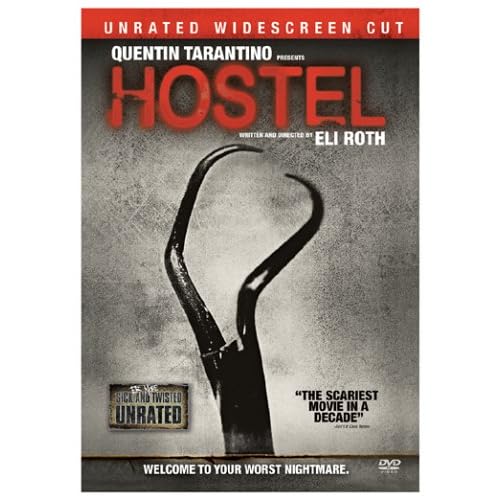
An isolated case of a terrific B movie falling under the radar? Not exactly. Because the very same thing happened a few weeks later with Eli Roth's Hostel -- a viciously entertaining exploitation thriller, about American college students who find themselves trapped in an Eastern European slaughterhouse where rich businessmen pay to torture hapless victims. The movie creepily captured the experience of being a clueless American in a foreign country that pays you very little heed. (It also showed us what it might look like to have your eyeball slowly pulled out of its socket with pliers.) Once again, the reviewers turned up their noses. ("[Hostel] willfully takes us someplace cruel -- and deeply unfunny," wrote The Denver Post.)

And again and again . . . with Final Destination 3, the technically dazzling third installment in the teenagers-who-can't-outrun-Death franchise, and with Alexandre Aja's The Hills Have Eyes, the unrelentingly menacing and bloody remake of the Wes Craven cult classic. Needless to say, neither of these films (both of which are currently still in theaters) will be in the running for next year's Best Picture Oscar.

Except there's another story here: namely, that these movies aren't slipping under the radar and disappearing straight to video. Instead, the largely teenage and college-age audiences who flood the multiplexes on Friday nights have turned them all into modest hits. In the case of Hostel, which opened to $19.6 million and went on to gross $47.3 million, it might just end up being the most profitable movie of 2006. (That film arrives on DVD April 18, a week after Wolf Creek.)

"In the box-office slump of the last year, these movies are the only movies that audiences are responding to," says Hostel director Roth. "Both Saw II and Hostel were made for $4 million, and they're beating movies that cost $200 million dollars."

Are the critics simply out of touch? Well, yes. Because if you can't recognize the often-astonishing level of craft on display in these films, then you're watching them with your eyes closed.

But the teenagers are getting it -- and embracing perhaps the only movies around that dare to speak to larger social concerns and anxieties, especially about the often-faceless, unfathomably evil villains we must contend with in the aftermath of Sept. 11. Hostel, Final Destination 3, Wolf Creek and The Hills Have Eyes are hardly uplifting, redemptive horror stories, where the hero wages battle with a bad guy and emerges a better, stronger man. Nor do these movies offer any of the self-reflexive irony-soaked fun of films like Scream from the 1990s or the spook-house pleasures of the Asian-influenced horror movies like The Ring from earlier in this decade.

What has emerged, instead, is a modern strain of horror that takes us straight back to the politically conscious, deeply despairing 1970s classics like The Last House on the Left, The Texas Chain Saw Massacre, and the original Hills Have Eyes. The often hopeless message of these movies is, "Your life may seem perfect right now, but the other shoe is about to drop, at which point there will be no one around to save you." And it's a message that seems scarily appropriate for a generation of teens and twentysomethings who were mostly raised in privilege but whose lives have had a pall cast over them -- first by the omnipresent threat of terrorist attacks and now by an ongoing war in Iraq.

To Read the Entire Essay


Also check out the debate, at The House Next Door, on this essay:

Blood and guts: Christopher Kelly sees art in mainstream splatter

An Inconvenient Truth

Is in town at the Kentucky Theatre:


To Watch the Preview

Wednesday, June 28, 2006

The Struggle to Care

OK, I said I would write (publicly) on a regular basis, but I'm finding it difficult to care these days...


(a nod to Wood's Lot for introducing to this artist)

United Nations: 2006 List of 10 Stories the World Should Hear More About

(Courtesy of Spontaneous Arising)

2006 LIST OF '10 STORIES THE WORLD SHOULD HEAR MORE ABOUT'
United Nations

Concerned that some issues continue not to receive sustained media attention or slip off the radar screen, the United Nations Department of Public Information (DPI) has unveiled a new list of "Ten Stories the World Should Hear More About."

"The media and the UN share an interest in getting information about what is happening in our world to the public," says Shashi Tharoor, Under-Secretary-General for Communications and Public Information. "But journalists are often inundated with stories, all competing for their -- and the public's -- attention. Our aim is to make it easier for them to see that important issues do not fade from the headlines."

The initiative, first launched in 2004, is not meant to be representative of the Organization's agenda. As in previous years, the 2006 list covers a spectrum of issues and geographical regions, some of which draw on troubling humanitarian emergencies and conflict situations (such as the Democratic Republic of Congo and Nepal) while others focus on such vital areas as human rights (asylum law and child prisoners) and development (Liberia and water as a shared resource).

While the stories are enumerated from one to ten, their ranking is not a reflection of their relative significance. In this year's list, some stories focus on conflicts that may have been in the media spotlight - but highlight a perspective that does not usually get much play. Although DPI takes responsibility for the final list, it was arrived at following extensive consultation with UN departments, field offices and programmes.

To Read the Stories

Environmental Ethics

Environmental Ethics, is "human responsibility to nature and the remote future." The key concept in this definition is responsibility, which entails: (a) knowledge of the consequences of an act or policy, (b) capacity to carry out that act or policy, (c) freedom to do otherwise, and (d) a value significance of those consequences -- as these consequences affect the welfare or worth of morally significant beings (persons, animals, natural objects, etc.). Environmental ethics is a new field of moral philosophy, primarily because of the recent emergence of knowledge (in science) and capacity (in technology) regarding humanity's impacts upon nature and the future.

• To become acquainted with concepts and methods of philosophical ethics that apply to issues regarding mankind's dealings with the natural world.
• To critically assess alternative approaches to, and defenses of, a code of responsibility to nature (i.e., an "environmental ethic").
• To gain a clear understanding of the obstacles in moral philosophy, public policy-making and public attitudes to a coherent and sound system of environmental ethics.
• To offer the student a repertory of resources and skills with which to formulate his/her own environmental ethic and to articulate and defend these ideas with clarity, consistency and coherence.

Laura Sullivan: Al-Qaida's Playbook

For those with a strong interest and lots of time, a 268 page translation of the The Management of Savagery which critiques the West and discusses goals/tactics of Al Qaida.

Claudio Sanchez: States Inflate School Graduation Rates

(Approximately 30% of students fail to get a high school diploma--states now are finding ways to hide this failure through imaginative data keeping. I would also add that many of the graduating seniors are poorly prepared to enter/succeed in college and life.)

States Inflate School Graduation Rates, Report Says
by Claudio Sanchez
NPR

There are serious gaps between the high school graduation rates that states report and the actual number of students who receive a diploma, according to a new report.

The study, from the journal Education Week, estimates that in the school year that just ended, 1.2 million students failed to graduate.

The report explains that states have a variety of methods for calculating graduation rates, which can cause them to overestimate graduation rates.

To Listen to the Report

Also:

Diplomas Count: An Essential to Graduation Policy and Rates

What is Your Local Water Quality?

Of course to me this seems flawed in that Kentucky American Water is doing the report and their parent company, RWE AG of Essen, Germany, has a long record of abuses along these lines... so is there still something to worry about, are we getting all of the information?

2005 Central Kentucky Report

To find information about the quality and owners of your local water system:

EPA: Local Drinking Water Quality Reports

EPA: Public Drinking Water Systems Programs

EPA: Drinking Water and Health

Also read an introductory essay on the problems associated with growing bottled water consumption:

Jay Weinstein: Water Crisis Ships In

Tuesday, June 27, 2006

Jeremy Brecher and Brendan Smith: Lieutenant Watada's War Against the War

Lieutenant Watada's War Against the War
Jeremy Brecher & Brendan Smith
The Nation

In a remarkable protest from inside the ranks of the military, First Lieut. Ehren Watada has become the Army's first commissioned officer to publicly refuse orders to fight in Iraq on grounds that the war is illegal. The 28-year-old announced his decision not to obey orders to deploy to Iraq in a video press conference June 7, saying, "My participation would make me party to war crimes."

An artillery officer stationed at Fort Lewis, Washington, Watada wore a business suit rather than his military uniform when making his statement. "It is my conclusion as an officer of the armed forces that the war in Iraq is not only morally wrong but a horrible breach of American law," he said. "Although I have tried to resign out of protest, I am forced to participate in a war that is manifestly illegal. As the order to take part in an illegal act is ultimately unlawful as well, I must as an officer of honor and integrity refuse that order."

A native of Hawaii who enlisted in the Army after graduating from college in 2003, Watada differs from other military personnel who have sought conscientious-objector status to avoid deployment to Iraq.

Watada told Truthout's Sarah Olson that at first he gave the Bush Administration the benefit of the doubt as it built the case for war. But when he discovered he was being sent to Iraq, he began reading everything he could, such as James Bamford's Pretext for War. He concluded that the war was based on false pretenses, ranging from the nonexistent weapons of mass destruction to the claim that Saddam had ties to Al Qaeda and 9/11 to the idea that the United States is in Iraq to promote democracy.

His investigation led him to question the very legality of the war. In an interview with Democracy Now!, he explained that as he read articles by experts on international and constitutional law, reports from governmental and nongovernmental agencies, revelations from independent journalists, writings by the Iraqi people and the words of soldiers coming home, "I came to the conclusion that the war and what we're doing over there is illegal."

First, he concluded that the war violates the Constitution and War Powers Act, which, he said, "limits the President in his role as commander in chief from using the armed forces in any way he sees fit." Watada also concluded that "my moral and legal obligation is to the Constitution and not to those who would issue unlawful orders."

Second, he claims the war is illegal under international law. He discovered that "the UN Charter, the Geneva Convention and the Nuremberg principles all bar wars of aggression." The Constitution makes such treaties part of American law as well.

These are not wild legal claims. Watada's conclusions are supported by mountains of evidence and experts, including the judgment of UN Secretary General Kofi Annan, who in 2004 declared that the US invasion was "not in conformity with the UN Charter, and from our point of view...was illegal."

Watada said he came to recognize that the military conduct of the occupation is also illegal: "If you look at the Army Field Manual, 27-10, which governs the laws of land warfare, it states certain responsibilities for the occupying power. As the occupying power, we have failed to follow a lot of those regulations." He told ABC News that the "wholesale slaughter and mistreatment of the Iraqi people" is "a contradiction to the Army's own law of land warfare."

To Read the entire hyperlinked report and watch the video

Monday, June 26, 2006

T.C. Boyle's Drop City; Mindset; Raven Run; Johannes Fabian's Time and the Other; George Marcus' "Modernist Sensibility"

(1000 words a day--Day II. In reading notes I am generally addressing myself--so when I exhort, condemn, or chide, it is not directed toward anyone who may be reading it, but at myself.)

I recently finished another book by T.C. Boyle. The novel is called Drop City and it is a continuation of some of the same themes (community, nature, relationships, violence, freedom, survival, activism) from an earlier novel, A Friend of the Earth. While A Friend of the Earth is set mostly in the future to examine the direction we may be moving toward as a society, Drop City takes place in 1970 and looks at the turmoil and optimism of two different communities—the polyamorous, communal lifestyle of a back-to-the-earth group of dropouts and the hardened lifestyles of solitary, traditional people who survive in the Alaskan frontier by carving out their own space—as a method of understanding the legacy of 60s rebellion and the continuing problems of today. While both groups have widely differing politics/perspectives, they both share a disdain for the consumer society of mainstream America and they both have a vision of an unmediated life lived directly off the land. For me, this book, like Ruth Ozeki’s All Over Creation, is a powerful exploration of two different groups seeking authentic meaning in their lives. Of course, both the hedonistic and traditional groups include members who take the ideas to the extreme and while friendships are formed and enemies are made, I found myself pondering my own thoughts on community, authenticity, and relationships. I highly recommend this book—Boyle is one of my favorite contemporary novelists.

So my second summer session just ended and I’m looking forward to the six weeks I will have off before fall semester to heal my body. I have another nagging pain, a much more longstanding affliction, this is a dis-ease I have long felt. I’ve been discontented for awhile and I finally have decided that it must be addressed head on. My mental/spiritual state has been in turmoil and I have mapped out some behavioral patterns that I must work on if I am to find some peace. So, since I have health insurance for the first time since I was a teen, I have signed up for counseling—conveniently located down the street from my new place. I don’t know if it will be effective, but I’m willing to give it a try…

I went hiking at Raven Run Sanctuary yesterday with a friend. We are both dealing with a lot these days and the 4 ½ mile hike along the cliffs of the Kentucky River was very therapeutic. It was a great day, the temperature was mild, there was not many people visiting, and the animals were active. We observed a beautiful snake, probably about 4-5 feet long making its way along a branch. A turkey trotted up the hill and we laughed watching his bobbing head as he skirted away from us in a new direction. We also came upon a doe and her two fawns—very small and curious—as they picked their way amongst the berries of the hillside. We crept along following them for about 20 minutes, trying our best to signal that we meant no harm. The natural fauna of the sanctuary is amazing and I took some pictures that, as soon as I get my hook-up for my digital camera unpacked, I will put up online. Also, there is this amazing viewpoint called The Overlook and this alone is worth the trip. Raven Run is only about 25 minutes from my house, so I am going to start regularly visiting as a sanctuary from the hustle and bustle of my small urban area.

Thoughts on Johannes Fabian’s Time and the Other and George E. Marcus’ “The Modernist Sensibility in Recent Ethnographic Writing and the Cinematic Metaphor of Montage.” :

Is Ernst Bloch correct when he states “At any rate, the primacy of space over time is an infallible sign of reactionary language” (38).

Fabian uses Gellner as an example of how “The denial of coevalness becomes intensified as time-distancing turns from an explicit concern into an implicit theoretical assumption” (39). It is quite clear that even though Gellner claims that anthropology is “timeless” that he still views “’primitive’ tribes” as throwbacks to another time. How is this still carried out today? In academia? In advertisement? In popular culture? In politics? Through NGOs? Through racist rhetoric (think of media depictions of inner-urban or Appalachian mountain cultures)?

Fabian makes a critical distinction between the supposedly progressive move towards treating other societies “in their own terms” instead of “on their own terms” (39). Is he nitpicking, or, based upon this simple distinction, can we begin to understand the invisible power of defining sociocultural orders or systems, especially when one groups has the power to define another’s “own terms” (40).

Fabian explains how Talcott Parson’s in “The Social System” comes to the conclusion that “time” is an essential condition for “goal attainment” and, thus, those that waste or misuse time are deviant. Ideally, then, “Time is a means to keep out conflict and interference” in a “complex industrial society” (40). Parson’s views societies that are not centered around management of time as primitive. For a minute, slip on your Marxist lenses (or any other critical theory) and critique Parson’s position—a hint, how does his position on time support capitalist management/control of time? If you’re feeling really energetic perhaps you could show how this would relate to Foucault’s, in Discipline and Punish (1977), critique of a “carceral” system that requires “docile bodies”. Could you provide an alternative vision of contemporary society that is not centered around “management of time”? Here are some counter-arguments from Karl Marx’s son-in-law Paul Lafargue's The Right To Be Lazy (1912), Situationists, such as, Raol Vaneigem's The Revolution of Everyday Life (1972), or neo-anarchists, such as, Bob Black (“The Abolition of Work”—1985) or Hakim Bey or CrimethInc: The Ex-Workers Collective.

Fabian mentions “Victor Turner’s analyses of ritual process” in works, such as, Forest of Symbols (1967), if you have read Turner, think about his concept of the “liminal” state in rituals. Is this work participating in the “denial of coevalness”?

Maurice Bloch provides us with a critique of Structuralist-Functionalist arguments for “temporal relativity”, on the top of page 43, Bloch’s argument would also deny Althusserian Marxist belief in an all-encompassing societal system that structures our awareness from birth.

Ernst Bloch writes that “historical relativism” creates cultural monads “without windows, with no link among each other, yet full of mirrors facing inside” (44-45). Fabian continues the metaphor by musing on whether “such mirrors, if placed at propitious angles, also have the miraculous power to make real objects disappear” (45). Are anthropologists (or anyone who theorizes/observes/relates cultural practices/myths) cultural magicians who through ‘smoke and mirrors’ create their own ethnographic stories?

Fabian discusses how the American anthropologists were heavily influenced by WWII and Cold War debates over “national character” and “values” (46). He then goes on to say that these concerns usually take at least a generation to “percolate to the level of popular consciousness.” For those who have managed to stay involved in the recent, acrimonious political campaigns, on the national, regional and local levels—can you explain any current manifestations of “wartime cultural relativism”?

Fabian discusses (47) the “alliance between theoretical relativism and [the] fight for a cause perceived as just and necessary” and how this leads to our perception of the cultural “Other” as “fenced off … [in] culture gardens.” Since the fall of the USSR whom have Americans viewed as “fenced off … culture gardens” that are the antagonistic, alien Other who threatens the American ‘way of life’?

George Marcus provides a brief schematic for laying “out a set of requirements for shifting the space-time framework of ethnography” that would entail “both changing certain parameters in the way that ethnographic subjects are analytically constructed as subjects as well as altering the nature of the theoretical intervention of the ethnographer in the text that he or she creates” (43).

Marcus states that one of the problems is anthropology’s borrowing of techniques from realist fiction to construct its ethnographic narratives (the false “realism” of realistic narratives for instance). Marcus believes that anthropology should learn, from experimental modernist literature and film, the technique of “montage”.

Here is a mapping of possibilities exposed from the “experimentation with creating the effect of real time or simultaneity through montage, cross-cutting, and the like” (50):

1. Let us begin with the proposition that in the late twentieth century world, cultural events/processes anywhere cannot be comprehended as primarily localized phenomena, or are only superficially so. In the full mapping of a cultural identity, its production and variant representations, one must come to terms with multiple agencies in varying locales the connections among which are sometimes apparent, sometimes not, and a matter for ethnographic discovery and argument. In short, culture is increasingly deterritorialized, and is the product of parallel diverse and simultaneous worlds operating consciously and blindly with regard to each other. What “relationship” is in this configuration becomes a matter of focal interest for ethnography, which presents itself initially as a problem of form, or representation. [uses example from David Lodge’s “Small World”] ...

A life goes on in place A and place B, for example. In the more difficult case, there is very little contact between the two in everyday life, yet they are intimately or powerfully related to one another in that they have mutual unintended consequences for each other. How does one explore this kind of complex relationship without dramatic resolutions, how to give a cultural account of this structure, how to represent it ethnographically?

2. The ethnographic grasp of many cultural phenomena and processes can no longer be contained by the conventions that fix place as the most distinctive dimension of culture. Merely historicizing local culture—connecting the village community to a particular historical narration—or describing the depth and richness of tradition fails to capture the side of culture that travels, its production in multiple, parallel, and simultaneous worlds of variant connection.

3. This problem of description and theoretical construction is nothing new in anthropology. In the 1960s anthropologists came to terms with the forms of social/cultural organization of modernity (so called nongroups) through formalist techniques of modeling and the imagery of network and systems analysis from cybernetics. Models of course had their advantages, in dealing abstractly and linearly with relationships, but for the kinds of contemporary questions being asked about distinctly cultural processes within social organizations or as social organizations, they are descriptively impoverished. Models of networks, for example, are linear spatially and temporally: A moves to B, A causes B. There is no sense of the simultaneity of process and action which provides a profoundly different and more ambiguous sort of analytic experience of organization that allows one to understand content as well as form or rather from as content and vice versa.

I see the attempt to achieve the effect of simultaneity as a revision of the spatial-temporal plane on which ethnography has worked. Experiments with it posit three kinds of organizational situations:

a. Simultaneous operations, spatially dispersed within a conventional single institutional frame as a representation of process within it ... .

b. The operation of institutionally diverse agencies to constitute an entity and organization which they all fragmentally share ... .

c. Independent worlds, operating blindly in relationships of unintended consequences in terms of one another. These are most exciting, in terms of the discovery of non-obvious relationships, and controversial objects for this kind of experiment in anthropology. The kind of relationships posited in the 1960s project of cultural ecology in anthropology would offer examples. So would the ethnographic study of markets, especially highly speculative commodity markets (see, for example, Stephen Fay’s account, 1981, of the attempt of the Hunt brothers to corner the world silver market in Beyond Greed).

The capacity, indeed the necessity, to deal ethnographically with the operation of complex systems in a world where cultural process is deterritorialized requires a replacement of the old social structural imageries, through models of network and system, with something equivalent to modernist literary techniques for the representation of simultaneity in social process and action.

4. In my own research projects, I have time and again come upon the multilocale determination of the identity of subjects upon whom I at first focussed as occupying a situated place. This necessitated for me a reconceptualization toward, in each case, a broader and more complex understanding of what the dimensions of the phenomena were that I was addressing. Often this shift has occurred in the middle or at the end of the work that had operated through the conventional ways of representing my subjects whose lives seemed to be encompassed in knowable communities (to use Raymond Williams’ term for the space-time framework of the pre-industrial revolution English novel). My realization of the partiality of this kind of knowledge stimulated me to look for an ethnography of different horizons.

My original work in the Polynesian Kingdom of Tonga during the 1970s was located in a number of different Tongan villages. This was a time of massive migration internally and overseas. Virtually nothing that happened in a village from kava ceremonies to church collections could be understood only in the terms of the life of the village. What was happening in the village was always being experienced vicariously elsewhere—for example, in San Francisco, Sydney, Auckland, Honolulu—and vice versa. I tried to follow and map migration networks as an understanding of this internationalized dimension of Tongan culture, in which the home islands were becoming just one site, among others, in which contemporary Tongan identity was being constructed. From a cultural perspective, network/systems modeling takes one only so far; rather, one needs a sense of parallel existences through juxtapositions of everyday life in different locales. Models, perhaps too literally and linearly, imaging the connecting lines between such locales without fully describing life in the latter. Cultural description demands an account of ongoing, simultaneous activity in locales for which connections are posited (that is, the linkages are secondary to a description of life in the locales linked). This line of thinking in my Tongan work stopped here in the early 1980s without a clear sense at the time that the problem was one of technique of representation rather than being purely theoretical and methodological (now I understand problems of representation as the distinctive medium of theoretical and methodological discourse in contemporary anthropology) (50-52)


There is more but I am getting very tired—Marcus points out Michael Taussig’s “Colonialism, Shamanism, and the Wild Man” (1978) as an early example of anthropology’s usage of the modernistic “montage” technique. I, myself, would recommend most of Taussig’s work as superb reading and research—the later works also border on the transgressive, in a disciplinary, genre, and thematic sense.

Lastly, Marcus insists that when engaging in critical (my term) ethnography that we must remember that when constructing subject/cultural identity we must engage in “problematizing the construction of the spatial, of the temporal, and of perspective of voice in realist ethnography.” Furthermore, “three requirements” also “concern” the “analytic presence of the ethnographer in his or her text: the dialogic appropriation of analytic concepts, bifocality, and the critical juxtaposition of possibilities” (43).

Marcus, George E. “The Modernist Sensibility in Recent Ethnographic Writing and the Cinematic Metaphor of Montage.” Visualizing Theory. ed. Lucien Taylor. NY: Routledge, 1994: 37-53.

Sunday, June 25, 2006

CFP: "Threatening Bodies: Nationalism, Sexuality, and Race" (August 1, 2006)

Call for Papers: Special theme issue of 'Reconstruction: Studies in Contemporary Culture'

'Reconstruction: Studies in Contemporary Culture' is an open access, electronic,
peer-reviewed journal devoted to publishing cultural studies work from emerging and established scholars worldwide.

We now invite submissions for our special-theme issue tentatively titled, "Threatening Bodies: Nationalism, Sexuality, and Race"

Different types of bodies threaten the status quo, through their physical forms, bodily practices, or embodied identities. Such bodies, when read as text, are seen as dangerous to the institution of heterosexuality, gender stability, racialized identities, the nation, and the reproduction of future citizenry.

Often, for safety purposes, these bodies must move through spaces undetected. This collection seeks to examine how various bodies both threaten the nation and are simultaneously threatened by the nation. We invite papers that theorize the body through varied frameworks: as readable texts, as lived bodies, as systems, as cultural constructions, etc. Ultimately, we want to investigate how bodies threaten, trespass, spy, pass, "terrorize" and/or subvert the nation and dominant ideas of citizenship.

Possible topics may include:

transsexed and transgendered bodies

passing while pregnant bodies

sex working bodies

bodies that have aborted fetuses

racialized bodies

closeted bodies

spy/stealth operative bodies

mental health survivors' bodies

imperceptibly physically impaired bodies

self-cutting bodies

undocumented and illegal bodies

modified and manipulated bodies

**We are also accepting book reviews and review essays on fiction and
non-fiction texts that suit the theme of the special issue.**

Completed papers must be submitted by August 1, 2006 to threateningbodies@yahoo.com. Inquiries can be made to the same address.

Final journal to go online in January 2007.

Submission guidelines can bb found here

Co-editors:
Jennifer Musial and Emily van der Meulen
School of Women's Studies, York University
4700 Keele St, Toronto ON, Canada, M3J 1P3

A 1000 Words a Day

(I feel some trepidation about doing this--anyone else game?)

So if one had to write one thousand words a day for a period of time what kinds of thoughts would be released? Writing—free thought—no revision (ok, maybe later if someone should read what you have said you might revise in the sense of responding to the comments and revisiting your position—of course we are always revising and rewriting—it is the nature of thought and writing?)

Would the petty annoyances of daily life dominate the exercise? Would the subconscious, or that deep down funky, stinky shit, in the basementt of one’s soul come to the top—like a seven year sea change—when the whole water bound area turns upside down and the muck comes to the top?

Pain… that is all I have been thinking about lately. My body has hurt. A rib broken has a way of signifying so much more though… physicality is one thing… but the body will heal. What will happen once that is done—will I recover? Will I remember being helpless?

Fuck… what I’m trying to say is that this is a pain that I can deal with… the others that plague me:

Wanting to know the meaning of my pitiful life—but never finding much of use.

Seeking deep, meaningful, connections with other people—but finding so few that I can do this with in a way that seems fulfilling (and seeming like a misanthropic because so may others don’t have this problem, or perhaps my standards are to high, or perhaps I am just an asshole)

Being scared about the direction my country is going—knowing full well the history of empires and their eventual destination—feeling anguish about who we hurt in the process of domination.

Domination—can we live without it? Can we “be”… can we “become”… without control and domination. I like to think so, but so may people view me a being naïve because of this perspective.

Being—can I just “be”? The life of a being is a process of “becoming”—I can never be happy just being, I must think about what I am becoming (no matter where I am what I am)… a continual process—when it stops I am dead.

How do I understand others? Really—how do I understand others!?

Asking questions—the important part of understanding and then, even more importantly, listening… that’s right… clearing a spot and allowing what you are trying to understand to speak to you.

Does this just involve humans—NO! Problem, disregard for non-human consciousness—the world constantly speaks to us in many ways—we need to listen instead of always trying to dominate and control our environment.

Can I love someone and be happy when they choose someone else. I say yes, the person I love thinks I am delusional and masochistic. Perhaps we are both correct—but I still wish her the best and hope she finds what she is looking for…

How come sometimes I lay in bed thinking about the mistakes of my youth? Are these not the steps that led to where I am now? What would I have been if I had made different choices (of course the question then lays with the decision of whether I approve of the person I am now?)

A 1000 words is a lot…

I am often a lot more friendly with animals than I am with humans—why is that?

My ceiling fan makes a very soothing sound and can often lull me into a very sound sleep.

Dadadadaddadadadadadadadadadadadadadadadadadad

Walking downstairs—will be right back. A cigarette and a Heineken—lets see if that helps? (hey my word checker capitalizes Heineken—lets me know where the programmers minds were at.)

OK, academic mindset…

I've been designing courses centered around identity/place/community, etymology/keywords, global/local/interrelatedness and community service/activism/learning. The Greek idea of Oikos (eco), along with inquiry and orientation are key grounding concepts... also recognition of student experience and reconnection to place through an awareness of interrelatedness on multiple levels (including research into origins of words/beliefs/places/objects/etc...)

I’m teaching writing-courses centered around the concepts of Place, Identity, and Community. I hope that through discussion and writing about our sense of self, place, and community, we can develop a new awareness of the possibilities of writing/thinking as a form of civic engagement and hopefully, in the process, provide a helping hand to at-risk students.

This is doubly distressing for me because, at the same time, I am developing a coursesw designed to facilitate student engagement with the larger social issues. How can I expect my students to make meaning out of the swirl of data when I am devoting large parts of my life to informing myself about current events without clear results? I lack certainty! I am often confused! I know my reflective doubt is supposed to be a good sign in that I am avoiding the dogmatic certainty that often leads to abuses, but can radical doubt be the foundation for critical engagement?

Perhaps in this time of secrecy and lies it is time to think about a reconstructive ethics?

Still stumped, I have to return to the basics. What is it I see as a problem in our society? What plagues my own thoughts? What would I like my students to learn? What ideas can frame the beginning questions that might allow the imagining of new possibilities? This nausea that pervades my being initiates a radical need to return to the etymological roots (rad-) of the words that might jumpstart my stalled intellect.

A framing concern for me — personally and professionally — is ecology as the study of the interconnectedness of beings in environmental systems of all types. The root “eco-” originates from the Greek word oikos, which referred to an understanding of home, household, or more fully, our habitus. Ecology, then, is the study or understanding (take that apart — the foundations of the ground below us that support our current position) of the world which we inhabit and the attempt to derive new meanings from the interconnectedness and interrelationships of life. The need for ecological awareness seem obvious to me, but the word has unfortunately been paired in an oppositional relationship to another dominating term — “economics.” While ecology derives its conjunctive meaning from logos (knowledge), economics draws its conjunctive power from nomos (law). We have then in contemporary society a dualistic division of the concerns of these two important and powerful words. The study, knowledge, and understanding of our environments vs. the control, regulation, and management of those environments.

Might a reconstructive ethics start here in a rapprochement of these two essential concepts for understanding the increasingly interrelated and interconnected global system? Would the breaking down of these artificial barriers between these two major concerns of life allow for a fuller understanding of how we might restore a sense of justice, rights, and responsibilites? No longer would it simply be an issue of ecology against economics, or the market before our environment, or a separation of the human from nature.

Why can I ramble on about these kind of things in such a logical order, yet when it comes to emotions and feelings I am often stumped?

A 1000 words a day--DAY 1

Friday, June 23, 2006

Quotes Concerning Democracy

(Some of my favorites from a large collection of quotes in the beginning of Lummis' book)

C. Douglas Lummis. Radical Democracy. Ithaca, NY: Cornell University Press, 1996.

The devil was the first democrat. –Lord Byron (Quoted, 2)

There is one safeguard known generally to the wise, which is an advantage and security to all, but especially to democracies as against despots. What is it? Distrust. –Demosthenes (Quoted, 2)

It cannot be reconciled with any philosophy of democracy that 50,000,000 white folk of the British Empire should be able to make the destiny of 450,000,000 yellow, brown, and black people a matter of solely their own internal decision. –W.E.B. Du Bois (quoted, 2)

Democracy has failed because so many fear it. They believe that wealth and happiness are so limited that a world full of intelligent, healthy and free people is impossible, if not undesirable. So, the world stews in blood, hunger, and shame. The fear is false, yet naught can face it but Faith. –W.E.B. Dubois (quoted, 2)

Democracy is based upon the conviction that there are extraordinary possibilities in ordinary people. –Harry Emerson Fosdick (quoted, 3)

Democracy is like love in this: it cannot be brought to life by others in command. –Sidney Hook (quoted, 3)

As I would not be a slave, so I would not be a master. This expresses my idea of democracy. Whatever differs from this, to the extent of the difference, is no democracy.—Abraham Lincoln (quoted, 4)

Go thou, and first establish democracy in thy household.—Lycurgus (quoted, 4)

Man’s capacity for justice makes democracy possible, but man’s inclination to injustice makes democracy necessary—Reinhold Niebuhr (quoted, 4)

A democratic orientation does not grow from and cannot exist within the present bureaucratic and “meritorian” ethic. It is an alternative to the present ethic, not an expansion or outgrowth of it—John Schaar (quoted 7)

Democracy is based in the existence of a strong hierarchy. The oligarchy of gross success seekers must have an eager troop of underlings who never cease to work in the interest of the leaders and who derive little material profit from their activity. It is necessary to keep this type of petty nobility in a state of excitement by lavishing them with tokens of friendship and by arousing them with feelings of honor while speaking to them in idealistic phrases. National glory, the domination of natural forces by science, the march of humanity toward enlightenment—this is the nonsense which is heard in the speeches of democratic orators.—Georges Sorel (quoted 7-8)

People who want to understand democracy should spend less time in the library with Aristotle and more time on the buses and subway.—Simeon Strunsky (quoted 8)

It would sometimes be easier to believe in democracy, or to stand for it, if the [19th-cemtury] change had not happened and it were still an unfavorable or factional term—Raymond Williams (quoted 8)

Michael Bakunin: On Patriotism

Found at Recollection Used Books

"The very existence of the State demands that there be some privileged class vitally
interested in maintaining that existence. & it is precisely the group interests
of that class that are called patriotism."

— Michael Bakunin, Letters on Patriotism, 1869.

Toggle Switch: Markers

(A powerful testament to the significance of the AIDs quilt upon the 25th anniversary of the naming of AIDs as a disease.)


Markers
Toggle Switch

It took more than $3 million, but in October 1996, the whole quilt — then totaling 40,000 panels — was laid over the National Mall in Washington. More than a million people showed up. There were 20,000 boxes of tissues on hand. Afterwards, the money flowed.

I read two newspapers regularly: The Wall Street Journal and the Sunday Los Angeles Times. Last Sunday, the Times cover story was this: AIDS at 25 – The Quilt Fades to Obscurity.

I felt as if I had seen the name of a long lost friend when I saw this article. I think I even uttered an, “Ooh.” If I didn’t out load, I did in my mind.

Seeing the NAMES Quilt at 25 says to me I’ve been an out-lesbian for a very long time, more than half of my life! Not that that has any significance, other than to mark time for myself and make me reflect on my participation in activism that was driven by a deadly disease.

I was a 21 year-old woman who came out when young men were dying for no apparent reason, before the virus and disease that was killing them had names and acronyms.

My coming out was joyously spent in gay bars on Sunday nights at the edge of the ocean, where the party seemed to tumble toward infinity carried on a disco beat that boomed louder than the breaking waves. The heady smell of dance floor sweat, amyl nitrate and Polo cologne created an aural memory for me that I will never forget.

When I wasn’t partying with the gay boys, I was dropping dollar bills into Melissa Etheridge’s tip cup over at the Que Sera. She drove a yellow AMC Pacer then and had some groupie chick unload her acoustic guitar and amplifier into the legendary lesbian bar on Cherry and Seventh Street in Long Beach, California. She perfected “Meet Me In the Back” and “Bring Me Some Water” in front of the Norm-like dykes on their bar stools and baby dykes like me perched within feet of the woman who exuded passion for the songs she sang. Ah, good times, good times.
I first saw the NAMES quilt displayed at the Queen Mary in Long Beach. (Yes, what an apt venue for such a display!) I don’t remember the year now, it may have been 1990. The air was thick in the Queen’s Salon with grief and mourning. I added my own after seeing the partner of one of the shop owners in town there, completely ravaged with AIDS. I remember he gave me a friendly smile and we chatted a bit before I moved on along the panels and sobbed into my hands.

Before AIDS drug cocktails, there was activism. I walked in many AIDS-walk fundraisers. I raised money for the NAMES Quilt because it was such a tangible and personal way for people who had lost a loved-one to mourn. My NAMES T-shirt with the purple letters faded from the wear.

The AIDS hysteria that reached a shrieking pitch during the late eighties spawned a political movement has not been matched since. It is because of AIDS and the SILENCE=DEATH urgency that so many people came out of the closet at work, to their families, to themselves. Why not? They had nothing to lose except their lives.

To Read the Rest of the Post

Daniel Schulman: Mind Games; Sam Gardiner: Truth From These Podia

(Courtesy of Thoughts on the Eve of the Apocalypse)

Mind Games
By Daniel Schulman
Columbia Journalism Review

When the United States launched Operation Iraqi Freedom in March 2003, Sam Gardiner, a sixty-four-year-old retired Air Force colonel, was a regular on The NewsHour with Jim Lehrer on PBS, where it was his job to place the day’s events in context. As the campaign wore on, and he monitored the press coverage and parsed the public statements of military and administration officials, he at first became uneasy, then deeply concerned.

A longtime Defense Department consultant who has taught strategy at three of the military’s top war colleges, Gardiner had participated throughout the 1990s in a series of war games that simulated attacks on Iraq. He was familiar with Iraq’s military and was therefore surprised to hear officials, such as the Army Brigadier General Vincent Brooks, the deputy director of operations of Central Command’s headquarters in Qatar, tell the press of ongoing operations to eliminate “terrorist death squads.” The allegation struck Gardiner as odd. Matter-of-fact and precise in their speech, military officers would not typically refer to irregulars as “death squads.” More important, as far as Gardiner knew, in 2003, when the invasion began, Iraq had no “terrorist death squads.”

Gardiner believes that this formulation, which first entered the official vernacular a week after the invasion began, was a skillful execution of a classic propaganda technique known as the “excluded middle.” The excluded middle is premised on the idea that people, provided with incomplete but suggestive information, will draw false assumptions — in this case that Saddam Hussein had ties to terrorism and therefore to Al Qaeda (a connection that administration officials actively pushed during the run-up to the war).

As Gardiner further analyzed the coverage in the early days of the invasion, he saw what he believed was a pattern of misinformation being fed to the press. There was the report, carried by The Associated Press, CNN, and The New York Times, among many other news outlets, that Iraq was seeking uniforms worn by U.S. and British troops (“identical down to the last detail”) so that atrocities carried out on Iraqis by Saddam’s Fedayeen could be blamed on the coalition. There was the claim that prisoners of war had been executed by their Iraqi captors, and there was the announced surrender of Iraq’s entire Fifty-first Division. Government officials eventually eased off the POW assertion, and the story of the uniforms was never corroborated and soon disappeared. As for the Fifty-first Division, on March 21 a cascade of news stories, citing anonymous British and American military officials, reported its mass surrender. “Hordes of Iraqi soldiers, underfed and overwhelmed, surrendered Friday in the face of a state-of-the-art allied assault,” the AP reported. “An entire division gave itself up to the advancing allied forces, U.S. military officials said.” Unnamed “officials in Washington” told The Washington Post that the division had been taken “out of the fight for Basra.” Days later, however, coalition troops were still clashing with units of the Fifty-first there. And two days after it was reported that General Khaled Saleh al-Hashimi and the 8,000 men under his command had surrendered, the general was interviewed in Basra by Al Jazeera. “I am with my men . . . . We continue to defend the people and riches” of this city, he told the network. Was this the fog of war or was something else at play?

Gardiner believes that the story of the Fifty-first’s mass capitulation may have been part of a psychological operation, its goal to “broadcast to the other units in Iraq that troops were giving up en masse and very quickly, so there was no reason to resist,” he said. “That’s a valid psychological operation. But it was directly entered into a press briefing.” Gardiner eventually concluded that the flow of misinformation to the press was no accident. It was a well-coordinated campaign, intended not only to confound Iraqi combatants but to shape perceptions of the war back home.

Throughout the summer of 2003, Gardiner documented incidents that he saw as information-warfare campaigns directed both at targeted foreign populations and the American public. By the fall, he had collected his analysis into a lengthy treatise, called “Truth from These Podia,” which concluded that “the war was handled like a political campaign,” in which the emphasis was not on the truth but on the message.

As his paper circulated among government and military officials that fall, Gardiner says he received a call at home one night from a spokesman for the chairman of the Joint Chiefs of Staff. He told Gardiner that his conclusions were on target. “But I want you to know,” the spokesman added, “that it was civilians who did this.”

The weaponization of information is not original to the war in Iraq, nor is it unique to any military engagement during what has come to be known as the information age. Journalists have always encountered wartime spin, they have been the targets of propaganda and selective leaks, and, on occasion, have been used for purposes of deception (which has resulted, in certain cases, in saving the lives of American soldiers). In The Art of War, which remains an influential text among military strategists though it was written during the sixth century B.C., the Chinese general Sun Tzu writes: “All warfare is based on deception. Hence, when able to attack, we must seem unable; when using our forces, we must seem inactive; when we are near, we must make the enemy believe that we are far away; when far away, we must make him believe we are near.”

In Iraq then, and indeed in the broader war on terror, it is not the use of information as a weapon that is new, but rather the scale of the strategy and the nature of the targets. Increasingly, the information environment has become the battlefield in a war that knows no boundaries, its offensives directed not just at the insurgents in Iraq and the Taliban in Afghanistan, or at regimes that take an adversarial posture to U.S. policy, but at the world at large. Technological advances, meanwhile, have made access to information instantaneous and ubiquitous, erasing longstanding barriers, legal and otherwise, that in the past have protected the American public and press from collateral damage in propaganda campaigns.

To Read the Rest of the Article


Truth from These Podia: Summary of a Study of Strategic Influence, Perception Management, Strategic Information Warfare and Strategic Psychological Operations in Gulf II
By Sam Gardiner, Colonel, USAF (Retired)
Information Clearing House

Preface
My intent was not to do this myself. The work had to be a combination of the kind of research I was doing and investigative journalism. I could do the outside part. Someone had to talk to those inside. After my return from an information warfare conference in London in July, I began looking for interest in one of the major newspapers. I found that interest in Mark Fineman at the LA Times.

Mark had covered the war and previously had been bureau chief for the paper in Philippines, India, Cyprus and Mexico City. Although he had covered some of the stories I examined in my research, he saw very early the point I was making about the implication of their being seen as a whole, the strategic picture. We continued to exchange e-mails, talk by phone and met four times after our initial session. He shared information he was uncovering. I shared my developing research.

Mark Fineman died of an apparent heart attack while on assignment in Baghdad on September 23, 2003.

It was not bad intelligence.

It was much more. It was an orchestrated effort. It began before the war, was a major effort during the war and continues as post-conflict distortions.

The title of this study was difficult for me. When I began I thought it was going to be an analysis of Pentagon spin. I was going to call it, “Truth from this Podium.” That was to be a play on promises we were given before the war. The more I did, the more it became clear that it was not just the Pentagon. It was the White House, and it was Number 10 Downing Street. It was more than spin.

I though about calling it “Apparatus of Lies,” connecting to a title the White House gave a paper on Iraq’s decade of fabrication, mostly about weapons of destruction. Although lies were part of the effort, that title would have been off the mark because the story is more about aversion to truth rather than the open lie.

I also missed on the subject. I thought it was going to be about spinning the stories of the conflict. I was wrong. The real essence of what I found was a much broader problem. It is a problem about the future as much as the past. This problem became the story of the study.

This is one way of summarizing the study:

The United States (and UK) conducted a strategic influence campaign that:

…distorted perceptions of the situation both before and during the conflict.

…caused misdirection of portions of the military operation.

…was irresponsible in parts.

…might have been illegal in some ways.

…cost big bucks.

…will be even more serious in the future.

I know what I am suggesting is serious. I did not come to these conclusions lightly. Because my plea is for truth in war, I have tried to be very careful not to fall into a trap of describing exaggerations with exaggeration. I hope I’ve done that. I expect some will believe I have been guilty of the same sins. As long as we can have some discussion about truth in war, I accept the criticism.

You will see in my analysis and comments that I do not accept the notion that the first casualty of war is truth. I think we have to have a higher standard.

In the most basic sense, Washington and London did not trust the peoples of their democracies to come to right decisions. Truth became a casualty. When truth is a casualty, democracy receives collateral damage.

My plea is for truth. I believe we have to find ways to restore truth as currency of government in matters as serious as war. My story would be important if it were the last chapter of the book. It’s not. There is more to come. As the United States struggles with a post-conflict Iraq, distortions continue. Probably of more concern, major players in the game are working on ways to do it “better” in future conflicts.

In other words, it appears as if the issues of this war will become even more important for future wars. We have reason to be concerned.

To Read the Rest of the Report

Nicola Baird: On Street Safari

(Walking is the best way to learn places, to understand one's environment, and to see the world anew. Whenever possible abandon your gas-guzzler and directly experience/engage your environment.)

On street safari
by Nicola Baird
Open Democracy (2001)


A mother who takes her small children around their north London streets to walk, shop, play, smell, imagine and interact describes their endlessly various explorations. In an environment dominated by cars and speed, does this represent a different way not just of moving, but of being?

...

I walk the streets because walking guarantees surprising pleasures. For me this may be the bloom of the first rose of summer – or indeed the last – and for my eldest daughter it will be an array of urban treasures from bottle tops to heart-shaped leaves. Meanwhile the baby looks on, eyes wide open, riding her chariot into the wind. How different her world views would be if she was marooned in a baby car seat, a metre or two’s mirror vision from her mum.

Link to the Entire Essay

Lori Aratani: Film Restrictions in Montgomery Schools Earn Poor Reviews

Film Restrictions in Montgomery Schools Earn Poor Reviews
By Lori Aratani
Washington Post

Last fall, educators in Montgomery County announced a new regulation that effectively bans high school teachers from showing R-rated movies such as "One Flew Over the Cuckoo's Nest," "Saving Private Ryan" and "Schindler's List" in classes. In middle schools, teachers no longer can show movies rated PG-13 to help illustrate pieces of literature or historical events.

But after complaints from teachers, students and parents, Maryland's largest school system formed a 33-member working group in January to revisit the decision to use Motion Picture Association of America (MPAA) ratings as a guide for what is appropriate to show students.

Betsy Brown, director of the department of curriculum and instruction, said the group is examining ways the policy might be altered to address some of the concerns raised. Among the ideas being discussed: allowing teachers to show the movies as long as parents have signed consent forms, or allowing clips of R-rated movies to be shown -- similar to a policy in Fairfax County public schools. An R rating by MPAA requires those younger than 17 to have a parent or guardian accompany them to the movie.

Some might question why teenagers should be able to see films in school that they wouldn't be able to see on their own in a theater, but educators say such movies -- viewed in a classroom with proper supervision -- can be important teaching tools.

For example, at Quince Orchard High School, teachers might use films to complement certain novels, such as "Lord of the Flies," said Barbara Blum, head of the school's English Department.

"Sometimes it's just interesting for students to see the different interpretations," she said, adding that clips of films can spark discussions about less concrete concepts such as tone and character in novels.

Hilary Gates, an English teacher at Walter Johnson High School, added that students "will come in and say, 'I can't tell you how much more vivid this book is to me. It comes to life so much more when I read it having seen the film.'

"We understand people are concerned and that there are teachers who might be showing inappropriate material," she said, "but our professional judgment is being overruled by the county."

The National Council of Teachers of English, which endorses the use of film in English classrooms, said individual movies should be evaluated on their educational value.

"MPAA ratings are not ratings of education value," said Millie Davis, spokeswoman for the council, which tracks the issue. "They don't claim they are, and so for a school district to use them as if they are, is using them in a way that they're not intended to be used."

The ban took many teachers by surprise. It was approved by senior staff members at the school system's central office in the fall, but because the change was a regulation and not a policy, it did not require action by the Board of Education.

Brown said the change was not prompted by any parent complaints. Rather, officials were looking to offer teachers more uniform guidelines for how they use movies in the classroom.

To Read the Entire Article

Kentucky Governor Ernie Fletcher Orders Blocks of Critical Blogs on all State Computers

(Courtesy of Abby Normal)

Visit Bluegrass Report for the lowdown on our indicted republican Governor's latest act of political censorship.

Thursday, June 22, 2006

Noam Chomsky: Language, Politics and Composition

(Courtesy of Comp Mafia ... although I disagree with the simplification that all academics have arrived by toeing the line... I was a high school drop out, criminal, convict and later went to college and argued/fought with those I felt were full of shit/dangerous to others... of course I'm not an administrator, but I am a professor... but there is also so much truth in Chomsky's words, especially in the disdain I have felt from elitist professors who disrespect the knowledge/experiences of working class people... and it is not just Chomsky's rather awkward justification of his working class background as intellectual because they read/listened to high culture classics, but what about the knowledge of someone who is a skilled worker, people who have participated in the life of their community and people who have raised families. I'm the first academic in my working class family--no one said to me, you will go to college... it was you should learn a skill)

Language, Politics, and Composition
Noam Chomsky interviewed by Gary A. Olson and Lester Faigley
Journal of Advanced Composition, Vol. 11, No. 1

Q. You have suggested that 'intellectuals are the most indoctrinated part of the population ... the ones most susceptible to propaganda.' You have explained that the educated classes are “ideological managers,” complicit in 'controlling all the organized flow of information.' How and why is this so? What can be done to change this situation?

A. Well, there’s something almost tautological about that; that is, the people we call intellectuals are those who have passed through various gates and filters and have made it into positions in which they can serve as cultural managers. There are plenty of other people just as smart, smarter, more independent, more thoughtful, who didn’t pass through those gates and we just don’t call them intellectuals. In fact, this is a process that starts in elementary school. Let’s be concrete about it. You and I went to good graduate schools and teach in fancy universities, and the reason we did this is because we’re obedient. That is, you and I, and typically people like us, got to the positions we’re in because from childhood we were willing to follow orders. If the teacher in third grade told us to do some stupid thing, we didn’t say, “Look, that’s ridiculous. I’m not going to do it.” We did it because we wanted to get on to fourth grade. We came from the kind of background where we’d say, “Look, do it, forget about it, so the teacher’s a fool, do it, you’ll get ahead, don’t worry about it.” That goes on all through school, and it goes on through your professional career. You’re told in graduate school, “Look, don’t work on that; it’s a wrong idea. Why not work on this? You’ll get ahead.” However it’s put, and there are subtle ways of putting it, you allow yourself to be shaped by the system of authority that exists out there and is trying to shape you. Well, some people do this. They’re submissive and obedient, and they accept it and make it through; they end up being people in the high places—economic managers, cultural managers, political managers. There are other people who were in your class and in my class who didn’t do it. When the teacher told them in the third grade to do x, they said, “That’s stupid, and I’m not going to do it.” Those are people who are more independent minded, for example, and there’s a name for them: they’re called “behavior problems.” You’ve got to deal with them somehow, so you send them to a shrink, or you put them in a special program, or maybe you just kick them out and they end up selling drugs or something. In fact, the whole educational system involves a good deal of filtering of this sort, and it’s a kind of filtering towards submissiveness and obedience.

This goes on through professional careers, as well. You’re a journalist, let’s say, and you want to write a story that’s going to expose people in high places, and somebody else is going to write a story that serves the needs of people in high places; you know which one is going to end up being the bureau chief. That’s the way it works. So in a way there’s something almost tautological about your question. Sure, the people who make it into positions in which they’re respected and recognized as intellectuals are the people who are not subversive of structures of power. They’re the people who in one way or another serve those structures, or at least are neutral with respect to them. The ones who would be more subversive aren’t called intellectuals; they’re called wackos, or crazies, or “wild men in the wings,” as McGeorge Bundy put it when he said, “There arc people who understand that we have to be in Indochina and just differ on the tactics, and then there are the wild men in the wings who think there’s something wrong with carrying out aggression against another country.” (He said that in Foreign Affairs—a mainstream journal.) But that’s the idea. There are wild men in the wings who don’t accept authority, and they remain wild men in the wings and not intellectuals, not respected intellectuals. Of course, this isn’t one-hundred percent. These are tendencies, actually very strong tendencies, and they’re reinforced by other strong tendencies.

Another strong tendency has to do with the role of intellectuals. Why are you and I called intellectuals but some guy working in an automobile plant isn’t an intellectual? I don’t think it’s necessarily because we read more or go to better concerts or anything like that. Maybe he does; in fact, I’ve known such cases. I grew up in such an environment. I grew up in an environment where my aunts and uncles were New York Jewish working class, and this was still the 1930s when there was a rich working-class culture. Lots of them had barely gone to school. I had one uncle who never got past fourth grade and an aunt who never graduated from school. But that was the richest intellectual environment I’ve ever seen. And I mean high culture, not comic book culture: Freud, Steckel, the Budapest String Quartet, and debates about anything you can imagine. But those people were never called intellectuals. They were called “unemployed workers” or something like that. Now why are they not intellectuals whereas a lot of people in the universities who are basically doing clerical work (from an intellectual point of view, a lot of scholarship is just very low-level clerical work) are respected intellectuals? First of all, it’s a matter of subordination and power, and secondly it’s a matter of which role you choose for yourself. The ones we call intellectuals, especially the public intellectuals—you know, the ones who make a splash or who are called upon to be the experts—are people who have chosen for themselves the role of manager. In earlier societies they would have been priests; in our societies they form a kind of secular priesthood.

To Read the Entire Interview

Chris Floyd: The Alchemists

(Courtesy of loveecstasycrime)

The Alchemists: Turning Blood Into Gold
Written by Chris Floyd (and reposted on his website)
Shorter, originally version was published in The Moscow Times

This week an interesting story appeared in the Washington Post – buried on page 16, of course, lest anyone think it was of the slightest importance. It revealed that documentary proof has now emerged confirming the fact that in the spring of 2003, the Bush Regime – flush with its illusory "victory" in Iraq – spurned a wide-ranging peace feeler from Iran which offered "full cooperation" on every issue that the Bushists claim to be concerned about in regard to Tehran: "nuclear programs, acceptance of Israel and the termination of Iranian support for Palestinian militant groups."

The offer was made through the Swiss Embassy, which has served as the conduit for communication between Washington and Tehran since America's Peacock patsy, the Shah of Iran, was overthrown in 1979. The 2003 proposal included "full cooperation on nuclear safeguards, 'decisive action,' against terrorists, coordination in Iraq, ending 'material support' for Palestinian militias and accepting the Saudi initiative for a two-state solution in the Israeli-Palestinian conflict [which called for all Muslim states to recognize Israel]," the Post reports. The unprecedented initiative was approved by Iran's supreme leader, Ayatollah Ali Khamenei and then-President Mohammad Khatami – the moderate whose attempts at dialogue were mocked and undercut at every turn by the Bush Regime, helping to discredit the entire reformist movement in Iran and leading to Khatami's replacement by the militant hardliner Mahmoud Ahmadinejad.

In other words, everything that George W. Bush says he wants from the Iranians now, he could have had for the asking – three years ago. What then can we conclude from the rejection of this extraordinary initiative? The answer is obvious: that the Bush Faction is not really interested in curbing nuclear proliferation or defusing the powder keg of the Palestinian-Israeli conflict, and the regional and global terror that it spawns.

What are they interested in? This answer too is obvious, to anyone who's been paying the slightest attention to the Faction's words and actions over the years: they are interested in loot and dominion. What they want from Iran is nothing less than its return to quasi-colonial control by the crony conquistadors of the West. And they're willing to play a (reasonably) long game to get it.

To Read the Entire Hyperlinked Article