Racial Tinge Stains World Cup Exit in France
By STEVEN ERLANGER
The New York Times
After France was booted from this year’s World Cup on Tuesday without winning a match — amid scenes of selfishness, indifference and indiscipline — the French news media piled on about the humiliation to the country and the misbehavior of its players. There were calls for a complete restructuring of the French team: its management, its method for choosing players, its training.
But there is a more troubling aspect to the reaction to the defeat, which has focused on lack of patriotism, shared values and national honor on a team with many members who are black or brown and descended from immigrants.
The philosopher Alain Finkielkraut, who has often criticized the failures of French assimilation, compared the players to youths rioting in the banlieues, France’s suburban ghettos. “We now have proof that the French team is not a team at all, but a gang of hooligans that knows only the morals of the mafia,” he said in a radio interview.
While most politicians have talked carefully of values and patriotism, rather than immigration and race, some legislators blasted the players as “scum,” “little troublemakers” and “guys with chickpeas in their heads instead of a brain,” according to news reports.
Fadela Amara, the junior minister for the racially charged suburbs who was born to Algerian parents, warned on Tuesday that the reaction to the team’s loss had become racially charged.
“There is a tendency to ethnicize what has happened,” she told a gathering of President Nicolas Sarkozy’s governing party, according to news reports. “Everyone condemns the lower-class neighborhoods. People doubt that those of immigrant backgrounds are capable of respecting the nation.”
She criticized Mr. Sarkozy’s handling of a debate on “national identity,” warning that “all democrats and all republicans will be lost” in this ethnically tinged criticism about Les Bleus, the French team. “We’re building a highway for the National Front,” she said, in a reference to the far-right, anti-immigrant, anti-Muslim party founded by Jean-Marie Le Pen.
To Read the Rest of the Article
Showing posts with label Sports. Show all posts
Showing posts with label Sports. Show all posts
Friday, June 25, 2010

Thursday, June 17, 2010
Radio Open Source: Vishwas Satgar -- The Political Economy of FIFA
Vishwas Satgar: the Political Economy of FIFA
Radio Open Source with Christopher Lydon
Vishwas Satgar has a half-time message from South Africa for World Cup watchers. It’s a quick introduction to “the political economy of soccer” that won’t dent any grown-up’s pleasure in the athletic or human spectacle — no more than, say, the endless buzzing of those vuvuzelas. Short form: most of the money that comes with the games will leave with the games. South Africa will be stuck with four new white-elephant stadia and public deficits and debts much worse than California’s. The engine of Africa’s development will still be a site of rising unemployment, falling life expectancy (at just under 50 years, below Sudan and Ethiopia), and a health-care system in shambles. There’s money in those Budweiser and VISA ads around the World Cup matches that might have been invested in universities, not in FIFA, the football federation.
Vishwas Satgar is a labor lawyer and leftwing activist, an insurgent ex-Secretary of the South African Communist Party who’s way out of alliance with the ANC on the uplift politics of the World Cup. Satgar’s message resonates with the remarkably fair-and-balanced film Fahrenheit 2010 by South Africa-born Craig Tanner. Archbishop Desmond Tutu feels “a world of good — well worth the price” in a South Africa’s month in the sun; “if we’re going to have white elephants,” he says in the film, “so be it.” But the argument that lingers is that “public funds have been looted for a moment in our history. People are still going to be living in shacks.”
Like the Beijing Olympics in Summer ‘08, this World Cup is a coming-out party, and a historic marker for Africa at the center of the maximum stage… without anything like the long-term strategic planning China put into its primetime debut, Satgar argues:
Vishwas Satgar in conversation with Chris Lydon at Brown University, June 15, 2010.
To Listen to the Interview
Radio Open Source with Christopher Lydon
Vishwas Satgar has a half-time message from South Africa for World Cup watchers. It’s a quick introduction to “the political economy of soccer” that won’t dent any grown-up’s pleasure in the athletic or human spectacle — no more than, say, the endless buzzing of those vuvuzelas. Short form: most of the money that comes with the games will leave with the games. South Africa will be stuck with four new white-elephant stadia and public deficits and debts much worse than California’s. The engine of Africa’s development will still be a site of rising unemployment, falling life expectancy (at just under 50 years, below Sudan and Ethiopia), and a health-care system in shambles. There’s money in those Budweiser and VISA ads around the World Cup matches that might have been invested in universities, not in FIFA, the football federation.
Vishwas Satgar is a labor lawyer and leftwing activist, an insurgent ex-Secretary of the South African Communist Party who’s way out of alliance with the ANC on the uplift politics of the World Cup. Satgar’s message resonates with the remarkably fair-and-balanced film Fahrenheit 2010 by South Africa-born Craig Tanner. Archbishop Desmond Tutu feels “a world of good — well worth the price” in a South Africa’s month in the sun; “if we’re going to have white elephants,” he says in the film, “so be it.” But the argument that lingers is that “public funds have been looted for a moment in our history. People are still going to be living in shacks.”
Like the Beijing Olympics in Summer ‘08, this World Cup is a coming-out party, and a historic marker for Africa at the center of the maximum stage… without anything like the long-term strategic planning China put into its primetime debut, Satgar argues:
This World Cup has been done, technically and in terms of construction, in sort of record time. There was a grand display of engineering capability and technology and so on. And people in South Africa’s squatter settlements, and in what we could call our slums, I am sure are wondering, ‘If they could do all this grandiose stuff, why haven’t they built us houses over fifteen, sixteen years of democracy?’ So I think these contradictions are going to come back to haunt the political forces that have stood by this.
Vishwas Satgar in conversation with Chris Lydon at Brown University, June 15, 2010.
To Listen to the Interview
Thursday, May 06, 2010
Will Bunch: The Taserification of America
The Taserification of America
by Will Bunch
Common Dreams
Unless you've been living in a Waziristan cave for the last 24 years, you've heard about the unfortunate misdemeanor-breaking dude who got Tasered at a Phillies game at Citizens Bank Park last night. My computer screen here in Center City went all a-Twitter about it even before all the electrons had even stopped flowing through 17-year-old suburban high school senior Steve Consalvi.
My gut instinct when I first learned of it was the same as I feel about it a day later: That while it wasn't exactly a Rodney King affair, clearly the officer had used excessive force. I've been watching baseball games for more than 40 years, and the drills is always the same. The fan isn't trying to do harm, just get attention; it used to be that the TV cameras never even showed a field-jumper for exactly that reason, back before ESPN needed an endless stream of fodder for its "Top 10 Plays."
People forget that the whole justification for police to get Tasers in the first place was to subdue potentially violent suspects in cases in the past in which they might have been tempted to use lethal force. But the notion that the cops would have pulled a gun and shot 17-year-old field jumper Steve Consalvi is absurd, which means the rationale for tasing him is...what? There's something oddly funny about zapping a fellow human for some reason, but Tasers are no joke to the loved ones of the estimated 50 people who died because of their use.
Consalvi didn't have the risk factors of most of those killed or injured -- he is young, health, and wasn't drunk or on drugs. But he still -- while committing a misdemeanor, let's remember -- was subjected to the brief, intense pain of 50,000 volts of electricty. There was a simpler, quainter time when causing pain to another person was called...violence.
I guess that quaint time was America before 9/11 -- after which for some reason we lost all sense of proportionality on how to respond to various levels of wrongdoing.
To Read the Rest of the Essay and Access Hyperlinks
by Will Bunch
Common Dreams
Unless you've been living in a Waziristan cave for the last 24 years, you've heard about the unfortunate misdemeanor-breaking dude who got Tasered at a Phillies game at Citizens Bank Park last night. My computer screen here in Center City went all a-Twitter about it even before all the electrons had even stopped flowing through 17-year-old suburban high school senior Steve Consalvi.
My gut instinct when I first learned of it was the same as I feel about it a day later: That while it wasn't exactly a Rodney King affair, clearly the officer had used excessive force. I've been watching baseball games for more than 40 years, and the drills is always the same. The fan isn't trying to do harm, just get attention; it used to be that the TV cameras never even showed a field-jumper for exactly that reason, back before ESPN needed an endless stream of fodder for its "Top 10 Plays."
People forget that the whole justification for police to get Tasers in the first place was to subdue potentially violent suspects in cases in the past in which they might have been tempted to use lethal force. But the notion that the cops would have pulled a gun and shot 17-year-old field jumper Steve Consalvi is absurd, which means the rationale for tasing him is...what? There's something oddly funny about zapping a fellow human for some reason, but Tasers are no joke to the loved ones of the estimated 50 people who died because of their use.
Consalvi didn't have the risk factors of most of those killed or injured -- he is young, health, and wasn't drunk or on drugs. But he still -- while committing a misdemeanor, let's remember -- was subjected to the brief, intense pain of 50,000 volts of electricty. There was a simpler, quainter time when causing pain to another person was called...violence.
I guess that quaint time was America before 9/11 -- after which for some reason we lost all sense of proportionality on how to respond to various levels of wrongdoing.
To Read the Rest of the Essay and Access Hyperlinks
Thursday, February 11, 2010
Worldview: "Soccernomics” and a World Cup Preview
"Soccernomics” and a World Cup Preview
Worldview (WBEZ: Chicago)
The biggest sporting event on the planet is coming up in June. The 2010 World Cup is in South Africa this time around. Worldview will again offer insightful commentary about the World Cup largely I hope from the band of contributors we had last time around.
We’ll have a World Cup blog and probably have an event or two in a soccer related bar before one of the contests. Before the 2006 World Cup, we had a writing contest and the three winners became our main analysts. One of them was Euan Hague. When he’s not watching soccer, Euan is Chair of the Geography Department at DePaul.
Euan sat down recently with Simon Kuper, a sports writer for the Financial Times. Kuper co-authored a new book "Soccernomics: Why England Loses, Why Germany and Brazil Win, and Why the U.S., Japan, Australia, Turkey--and Even Iraq--Are Destined to Become the Kings of the World's Most Popular Sport."
To Listen to the Episode
Worldview (WBEZ: Chicago)
The biggest sporting event on the planet is coming up in June. The 2010 World Cup is in South Africa this time around. Worldview will again offer insightful commentary about the World Cup largely I hope from the band of contributors we had last time around.
We’ll have a World Cup blog and probably have an event or two in a soccer related bar before one of the contests. Before the 2006 World Cup, we had a writing contest and the three winners became our main analysts. One of them was Euan Hague. When he’s not watching soccer, Euan is Chair of the Geography Department at DePaul.
Euan sat down recently with Simon Kuper, a sports writer for the Financial Times. Kuper co-authored a new book "Soccernomics: Why England Loses, Why Germany and Brazil Win, and Why the U.S., Japan, Australia, Turkey--and Even Iraq--Are Destined to Become the Kings of the World's Most Popular Sport."
To Listen to the Episode
Monday, January 04, 2010
Diana Nyad, Jennifer Ring and Donna Lopiano: Stolen Bases -- Why American Girls Don't Play Baseball
Stolen Bases: Why American Girls Don't Play Baseball
Host: Diana Nyad
Politics of Culture (KCRW: Los Angeles)
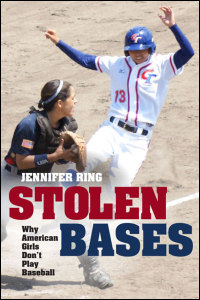
Hall of fame swimmer and KCRW commentator Diana Nyad speaks to author Jennifer Ring about her new book, Stolen Bases: Why American Girls Don't Play Baseball, along with former softball pitcher and longtime Women's Sports Foundation chief executive Donna Lopiano. They discuss the hidden history of women in baseball, and the upcoming push to get women's baseball into the Olympics.
* Jennifer Ring: author, 'Stolen Bases: Why American Girls Don't Play Baseball'
* Donna Lopiano: former CEO, Women's Sports Foundation
To Listen to the Conversation
Host: Diana Nyad
Politics of Culture (KCRW: Los Angeles)
Hall of fame swimmer and KCRW commentator Diana Nyad speaks to author Jennifer Ring about her new book, Stolen Bases: Why American Girls Don't Play Baseball, along with former softball pitcher and longtime Women's Sports Foundation chief executive Donna Lopiano. They discuss the hidden history of women in baseball, and the upcoming push to get women's baseball into the Olympics.
* Jennifer Ring: author, 'Stolen Bases: Why American Girls Don't Play Baseball'
* Donna Lopiano: former CEO, Women's Sports Foundation
To Listen to the Conversation
Wednesday, December 09, 2009

Wednesday, November 04, 2009
Rollergirls of Central Kentucky (ROCK)
Forget the coal corporation UK Wilcats :P I'm a fan of ROCK! Buy independent, eat local, DIY, support independent/amateur sports! Most importantly become/make/distribute your own culture!
KY Kernel: Can’t keep them down: Lexington women find release in rough and tumble sport
KY Kernel: Can’t keep them down: Lexington women find release in rough and tumble sport
Subscribe to:
Posts (Atom)