[Dialogic is saddened to hear of the passing of Chalmers Johnson. He was a leading critic of American empire and militaristic expansion. He was also a fearless intellectual who stood up to abusive power in his own institutions. We will let those that knew him better explain below, but we must state how much Johnson contributed to our understanding of the world and for that we celebrate his life and accomplishments.]
Chalmers Johnson, author of Blowback; The Sorrows of Empire, Dead at 79: The Impact Today and Tomorrow of Chalmers Johnson
by Steve Clemons
Common Dreams
...
Johnson's ability to launch an instant, debilitating broadside against the intellectual vacuousness of friends or foes made him controversial. He chafed under the UC Berkeley Asia Program leadership of Robert Scalapino whom Johnson viewed as one of the primary dynastic chiefs of what became known as the "Chrysanthemum Club", those whose Japan-hugging meant overlooking and/or ignoring the characteristics of Japan's state-led form of capitalism. Johnson was provocatively challenged graduate students in the field to choose sides -- to work either on the side where they acquiesced to a corrupt culture of US-Japan apologists who wanted the quaint big brother-little brother frame for the relationship to remain the dominant portal through which Japan was viewed or alternatively on the side of those who saw Japan and America's forfeiture of its own economic interests as empirical facts.
When Robert Scalapino refused to budge despite Johnson's agitation, Johnson who then headed UC Berkeley's important China Studies program abandoned the university and became the star intellectual of UC San Diego's School of International Relations and Pacific Studies. There is no doubt that Johnson but UCSD's IRPS on the map and gave it an instant, global boost.
But as usual, Johnson -- incorruptible and passionate about policy, theory, and their practice -- eventually went to war with the bureaucrats running that institution. Those who had come in to head it were devotees of "rational choice theory" -- which was spreading through the fields of political science and other social sciences as the so-called softer sciences were trying to absorb and apply the harder-edged econometrics-driven models of behavior that the neoliberal trends in economics were using.
Johnson and one of his proteges, E.B. "Barry" Keehn, wrote a powerful indictment of rational choice theory that helped trigger a long-running and still important intellectual divide that showed that rational choice theory was one of the great ideological delusions of the era. I too joined this battle and wrote extensively about the limits of rational choice theory which I myself saw dislodging university language programs, cultural studies, and more importantly -- the institutional/structural approaches to understanding other political systems.
Johnson once told me when I was visiting him and his long-term, constant intellectual partner and wife, Sheila Johnson, that the UCSD School of International Relations and Pacific Studies no longer either really taught international relations or pacific studies -- and that a student's entire first year was focused on acultural skill set development in economics and statistics. To Johnson, this tendency to elevate econometric formulas over the actual study of a nation's language, history, culture and political system was part of America's growing cultural imperialism. Studying "them" is really about "us" -- as "they" will converge to be like "us" or will fall to the way side and be insignificant.
It was that night that Chalmers Johnson, Sheila Johnson and I agreed to form an idea on had been developing called the Japan Policy Research Institute. Chalmers became President and I the Director. We maintained this working relationship at the helm of JPRI together for more than 12 years and spoke nearly every week if not every other day as we tried to acquire and publish the leading thinking on Japan, US-Japan relations and Asia more broadly. We became conveners, published works on Asia that the official journals of record of US-Asia policy viewed as too risky, and emerged as key players in the media on all matters of America's economic, political, and military engagement in the Pacific. Today, JPRI is headed by Chiho Sawada and is based at the University of San Francisco.
However, this base of JPRI gave Chalmers Johnson the launch pad that led to the largest contribution of his career to America's national discourse. From his granular understanding of political economy of competing nations, his understanding of the national security infrastructure of both sides of the Cold War, he saw better than most that the US had organized its global assets -- particularly its vassals Japan and Germany -- in a manner similar to the Soviet Union. Both sides looked like the other. Both were empires. The Soviets collapsed, Chalmers told me and wrote. The U.S. did not -- yet.
To Read the Entire Essay
Chalmers Johnson, 1931-2010, on the Last Days of the American Republic
Democracy Now
The distinguished scholar and best-selling author Chalmers Johnson has died. He passed away in California on Saturday afternoon at the age of 79. During the Cold War, he served as a consultant to the Central Intelligence Agency and was a supporter of the Vietnam War, however, later became a leading critic of U.S. militarism and imperialism. He wrote the book, Blowback: The Costs and Consequences of American Empire in 2000, which became a bestseller after the 9/11 attacks. He went on to complete what would become a trilogy about American empire. Today we re-air part of our last interview with Chalmers Johnson from 2007.
To Watch/Listen/Read
More:
Dialogic Archive: Chalmers Johnson
Showing posts with label Asia. Show all posts
Showing posts with label Asia. Show all posts
Monday, November 22, 2010

Thursday, November 13, 2008
Chi-Yun Shin: Art of branding--Tartan "Asia Extreme" films
Art of branding: Tartan "Asia Extreme" films
by Chi-Yun Shin
Jump Cut #50


"Asia Extreme" is the first distribution label created to specifically deal with East Asian film titles by Tartan Films, which operated as Metro-Tartan Distribution between 1992 and 2003, before reverting back to the name Tartan Films.[1][open endnotes in new window] Launched in 2001 as the first of its kind, Tartan Asia Extreme has successfully released a number of titles which, to name just a few, include
Japanese films such as Ring/Ringu (1998), Audition (1999), and Battle Royale (2000);
South Korean films – The Isle (2000), Old Boy (2003) and A Tale of Two Sisters (2003);
Hong Kong films from Hard-Boiled (1992) to the Infernal Affairs series (2002-4)
as well as the films from Thailand – Bangkok Dangerous (1999), The Eye (2002).
Now with an extensive and ever growing DVD catalogue, which includes the pan-Asian horror omnibus films, Three … Extremes (2004) and Three Extremes 2, Tartan Asia Extreme has emerged as the most high-profile label amongst the East Asian film providers, playing an instrumental role in promoting and disseminating East Asian films in the West in recent years. It has also launched an U.S. distribution of many of the same titles, although a significant number of the best-known titles are distributed by other firms in North America.
Hamish McAlpine, who is the founder and owner of Tartan Films, is in fact responsible for the creation of the Asia Extreme label. The story goes that one weekend at the end of 1999, McAlpine watched two Japanese films on video, and he was “totally blown away by them.” The two films he watched back to back that weekend were Hideo Nakata’s Ringu and Takashi Miike’s Audition. Soon after, he came across Thai and South Korean titles – Bangkok Dangerous and Nowhere to Hide (Lee Myung-Se, 1999), which were also “outrageously shocking” to him. In an interview, McAlpine emphasised the fact that the films came first:
And, that’s how the label was born. Since then, as the Tartan Asia Extreme website boasts,
It is important to note here that region-free or multi-region DVD players and the proliferation of international mail-order websites (Internet DVD shops) since the end of the 1990s had enabled Asian film fans to purchase titles from abroad.[4] What the Tartan Asia Extreme has achieved, however, is successfully infiltrating into the minds of mainstream audience and shelves of high street shops (such as HMV in Britain) as well as Internet shopping sites such as Amazon and Play.com.
Starting off as a cult phenomenon, targeting the cult "fan-boys" but soon incorporating the art-house audiences (or world cinema patrons) to its niche, the Tartan Asia Extreme label has established itself as an immediately recognisable brand.[5] Subsequently, as McAlpine himself described, with the Asia Extreme label, Tartan
Recent high profile Hollywood remakes of such East Asian titles as Ringu, Ju-on: The Grudge (Takashi Shimuzu, 2002), Dark Water (Hideo Nakata, 2002) and Infernal Affairs (the remake of which was directed by Martin Scorsese and re-titled as Departed, the film winning the best film award at the 2007 Oscar), as well as Quentin Tarantino’s reported support and endorsement of OldBoy at the 2004 Cannes Film festival (where the film won the second prize, Grand Prix du Jury), only raised the interest in, and the profile of, East Asian cinema and the size of "the pot of gold" McAlpine had discovered.
Indeed, it is commendable that Tartan Asia Extreme has carved a viable East Asian film niche, at the same time establishing its name in the industry where distribution labels do not normally make much impact in the market place. Questions, however, are raised as to the reductive nature of Tartan’s marketing practices, which repackages the films “as exotic and dangerous cinematic thrills.”[7] In addition, the output of the label, and indeed the name of the label itself, invoke and in part rely on the western audiences’ perception of the East as weird and wonderful, sublime and grotesque. At the same time, the ways in which Tartan registers and navigates the vagaries of distinct national cultures and different genres gathered under the Asia Extreme banner provide a fascinating site to explore how the West consumes East Asian cinema.
In order to illustrate how the so-called Asia Extreme films are presented, this article will examine Tartan’s marketing strategies for the Asia Extreme brand, especially its horror titles, not only because they have become the most prominent and leading examples of the label, but also because the rise of Asia Extreme coincided with the phenomenal success of "Asian horror" with branches such as "J-Horror" and "K-Horror," which have been celebrated as the most original and innovative horror movies of the last decade. (The notion of horror or what constitutes horror, however, is not the main concern here, but horror films here broadly refer to films that evoke fright, terror and abjection from viewers.) Needless to say, different audiences understand films in different ways, but as Mark Jancovich pointed out,
The article will also engage with the critical reception of the most "notorious" Asia Extreme titles – Audition, The Isle and Oldboy — in the U.K. and the U.S. so as to understand the different discourses through which the Asia Extreme films are evaluated and mediated.
To Read the Rest of the Essay

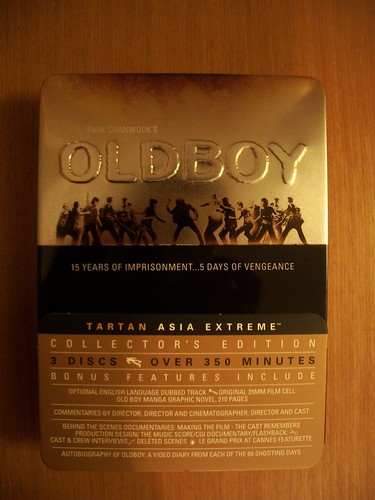

by Chi-Yun Shin
Jump Cut #50
"Asia Extreme" is the first distribution label created to specifically deal with East Asian film titles by Tartan Films, which operated as Metro-Tartan Distribution between 1992 and 2003, before reverting back to the name Tartan Films.[1][open endnotes in new window] Launched in 2001 as the first of its kind, Tartan Asia Extreme has successfully released a number of titles which, to name just a few, include
Japanese films such as Ring/Ringu (1998), Audition (1999), and Battle Royale (2000);
South Korean films – The Isle (2000), Old Boy (2003) and A Tale of Two Sisters (2003);
Hong Kong films from Hard-Boiled (1992) to the Infernal Affairs series (2002-4)
as well as the films from Thailand – Bangkok Dangerous (1999), The Eye (2002).
Now with an extensive and ever growing DVD catalogue, which includes the pan-Asian horror omnibus films, Three … Extremes (2004) and Three Extremes 2, Tartan Asia Extreme has emerged as the most high-profile label amongst the East Asian film providers, playing an instrumental role in promoting and disseminating East Asian films in the West in recent years. It has also launched an U.S. distribution of many of the same titles, although a significant number of the best-known titles are distributed by other firms in North America.
Hamish McAlpine, who is the founder and owner of Tartan Films, is in fact responsible for the creation of the Asia Extreme label. The story goes that one weekend at the end of 1999, McAlpine watched two Japanese films on video, and he was “totally blown away by them.” The two films he watched back to back that weekend were Hideo Nakata’s Ringu and Takashi Miike’s Audition. Soon after, he came across Thai and South Korean titles – Bangkok Dangerous and Nowhere to Hide (Lee Myung-Se, 1999), which were also “outrageously shocking” to him. In an interview, McAlpine emphasised the fact that the films came first:
“When I realised that these films were not one-offs and there was a constant flow of brilliant films coming out of Asia, I decided to brand it and make Asia Extreme.”[2]
And, that’s how the label was born. Since then, as the Tartan Asia Extreme website boasts,
“Asia Extreme has been single-handedly responsible for the groundswell of interest in Asian cinema and the widespread attention that its roster of World class directors, such as Hideo Nakata, Miike Takashi, Kim Ki-duk and Park Chan-wook, have enjoyed.”[3]
It is important to note here that region-free or multi-region DVD players and the proliferation of international mail-order websites (Internet DVD shops) since the end of the 1990s had enabled Asian film fans to purchase titles from abroad.[4] What the Tartan Asia Extreme has achieved, however, is successfully infiltrating into the minds of mainstream audience and shelves of high street shops (such as HMV in Britain) as well as Internet shopping sites such as Amazon and Play.com.
Starting off as a cult phenomenon, targeting the cult "fan-boys" but soon incorporating the art-house audiences (or world cinema patrons) to its niche, the Tartan Asia Extreme label has established itself as an immediately recognisable brand.[5] Subsequently, as McAlpine himself described, with the Asia Extreme label, Tartan
“found the pot of gold at the end of the rainbow [by identifying] ‘the next big thing’ ahead of your competitors and becoming the early dominant provider.”[6]
Recent high profile Hollywood remakes of such East Asian titles as Ringu, Ju-on: The Grudge (Takashi Shimuzu, 2002), Dark Water (Hideo Nakata, 2002) and Infernal Affairs (the remake of which was directed by Martin Scorsese and re-titled as Departed, the film winning the best film award at the 2007 Oscar), as well as Quentin Tarantino’s reported support and endorsement of OldBoy at the 2004 Cannes Film festival (where the film won the second prize, Grand Prix du Jury), only raised the interest in, and the profile of, East Asian cinema and the size of "the pot of gold" McAlpine had discovered.
Indeed, it is commendable that Tartan Asia Extreme has carved a viable East Asian film niche, at the same time establishing its name in the industry where distribution labels do not normally make much impact in the market place. Questions, however, are raised as to the reductive nature of Tartan’s marketing practices, which repackages the films “as exotic and dangerous cinematic thrills.”[7] In addition, the output of the label, and indeed the name of the label itself, invoke and in part rely on the western audiences’ perception of the East as weird and wonderful, sublime and grotesque. At the same time, the ways in which Tartan registers and navigates the vagaries of distinct national cultures and different genres gathered under the Asia Extreme banner provide a fascinating site to explore how the West consumes East Asian cinema.
In order to illustrate how the so-called Asia Extreme films are presented, this article will examine Tartan’s marketing strategies for the Asia Extreme brand, especially its horror titles, not only because they have become the most prominent and leading examples of the label, but also because the rise of Asia Extreme coincided with the phenomenal success of "Asian horror" with branches such as "J-Horror" and "K-Horror," which have been celebrated as the most original and innovative horror movies of the last decade. (The notion of horror or what constitutes horror, however, is not the main concern here, but horror films here broadly refer to films that evoke fright, terror and abjection from viewers.) Needless to say, different audiences understand films in different ways, but as Mark Jancovich pointed out,
“Advertising campaigns were designed in part to present a range of possible ways of reading films.”[8]
The article will also engage with the critical reception of the most "notorious" Asia Extreme titles – Audition, The Isle and Oldboy — in the U.K. and the U.S. so as to understand the different discourses through which the Asia Extreme films are evaluated and mediated.
To Read the Rest of the Essay
Subscribe to:
Posts (Atom)