Fragile victory in Egypt: Will U.S. foreign aid impede the will of the Egyptian people?
By Michael Dean Benton
North of Center
As I write this (Sunday February 13), the Egyptian dictator Hosni Mubarak has been forced by the Egyptian people to step down as president after thirty years of ruling the country with an iron fist. The Armed Forces Supreme Council has temporarily taken control of the nation while the Egyptian people are still occupying Tahrir Square and are publicly demonstrating for more democratic openness in the decision making on the future direction of their country.
As we congratulate the Egyptian people on this partial revolutionary victory it is time for Americans to reflect on their own involvement with and support of the 30 year reign of Mubarak.
Mubarak and the U.S.: true valentines
We have long been a major problem in the world. We provide back-door support of any brutal regime that privileges American corporate interests over the interests of their own people. We actively destabilize, if not outright attack, any social-justice-minded leader that privileges their own people over the profiteering American/Western way of privatizing natural resources or public services.
Our involvement with Mubarak’s dictatorship has been that of a close friendship, with many American presidents citing his support of Israeli and American ambitions in the region as a necessary evil. A series of American presidents have also claimed access to the Suez Canal for American military ships as a geopolitical necessity.
Our involvement takes on an even more sinister tone, though, as we recognize that as far back as 1995 during the Clinton presidency, through a process known as extraordinary rendition, the C.I.A. has been transporting prisoners to Egypt for interrogations and torture. These have been administered in Egypt by the 18 year former-head of the feared Egyptian National Intelligence Agency Omar Suleiman.
To Read the Rest of the Essay
Showing posts with label Military Industrial Complex. Show all posts
Showing posts with label Military Industrial Complex. Show all posts
Saturday, March 05, 2011

Monday, February 21, 2011
Friday, February 18, 2011
Empire: Hollywood and the War Machine
Hollywood and the war machine: Empire examines the symbiotic relationship between the movie industry and the military-industrial complex.
Empire (Al Jazeera)
War is hell, but for Hollywood it has been a Godsend, providing the perfect dramatic setting against which courageous heroes win the hearts and minds of the movie going public.
The Pentagon recognises the power of these celluloid dreams and encourages Hollywood to create heroic myths; to rewrite history to suit its own strategy and as a recruiting tool to provide a steady flow of willing young patriots for its wars.
What does Hollywood get out of this 'deal with the devil'? Access to billions of dollars worth of military kit, from helicopters to aircraft carriers, enabling filmmakers to make bigger and more spectacular battle scenes, which in turn generate more box office revenue. Providing they accept the Pentagon's advice, even toe the party line and show the US military in a positive light.
So is it a case of art imitating life, or a sinister force using art to influence life and death - and the public perception of both?
Empire will examine Hollywood, the Pentagon, and war.
Joining us as guests: Oliver Stone, the eight times Academy Award-winning filmmaker; Michael Moore, the Academy Award-winning filmmaker; and Christopher Hedges, an author and the former Middle East bureau chief of the New York Times.
Our interviewees this week are: Phil Strub, US Department of Defense Film Liaison Unit; Julian Barnes, Pentagon correspondent, LA Times; David Robb, the author of Operation Hollywood; Prof Klaus Dodds, the author of Screening Terror; Matthew Alford, the author of Reel Power; Prof Melani McAlister, the author of Culture, Media, and US Interests in the Middle East.
To Watch the Documentary
Empire (Al Jazeera)
War is hell, but for Hollywood it has been a Godsend, providing the perfect dramatic setting against which courageous heroes win the hearts and minds of the movie going public.
The Pentagon recognises the power of these celluloid dreams and encourages Hollywood to create heroic myths; to rewrite history to suit its own strategy and as a recruiting tool to provide a steady flow of willing young patriots for its wars.
What does Hollywood get out of this 'deal with the devil'? Access to billions of dollars worth of military kit, from helicopters to aircraft carriers, enabling filmmakers to make bigger and more spectacular battle scenes, which in turn generate more box office revenue. Providing they accept the Pentagon's advice, even toe the party line and show the US military in a positive light.
So is it a case of art imitating life, or a sinister force using art to influence life and death - and the public perception of both?
Empire will examine Hollywood, the Pentagon, and war.
Joining us as guests: Oliver Stone, the eight times Academy Award-winning filmmaker; Michael Moore, the Academy Award-winning filmmaker; and Christopher Hedges, an author and the former Middle East bureau chief of the New York Times.
Our interviewees this week are: Phil Strub, US Department of Defense Film Liaison Unit; Julian Barnes, Pentagon correspondent, LA Times; David Robb, the author of Operation Hollywood; Prof Klaus Dodds, the author of Screening Terror; Matthew Alford, the author of Reel Power; Prof Melani McAlister, the author of Culture, Media, and US Interests in the Middle East.
To Watch the Documentary
Thursday, February 10, 2011
Facing South: U.S. defense contractors with the most at stake in Egypt
(via Sue Sturgis and Herb Reid)
U.S. defense contractors with the most at stake in Egypt
Facing South (Institute for Southern Studies)
Facing South reviewed the Department of Defense contract database over the past two years to see what deals are already in place, and discovered many contracts with connections to the South. The following are the 10 biggest contracts involving aid to Egypt in that period.
1. Lockheed Martin -- Fort Worth, Texas and Orlando, Fla. Last March, the aerospace giant won a $213 million Air Force contract to provide Egypt with 20 F-16 fighter jets. The following month, its Lockheed Martin Missiles subsidiary in Orlando, Fla. got a $46 million Army contract to provide night vision sensor systems for Apache helicopters.
2. DRS C3 and Aviation -- Horsham, Pa. In December 2010, this subsidiary of the Italian company Finmeccanica received a $46.1 million Army contract to provide vehicles, hardware and services for Egypt's border surveillance program. That same month DRS landed another $19.6 million Army contract to provide surveillance hardware and services for the Egyptian government.
3. L-3 Communication Ocean Systems -- Sylmar, Calif. and Garland, Texas. The company's Sylmar operations completed a $24.7 million deal with the Navy last August to provide a sonar system for the Egyptian Navy. And in April 2009, L-3's EOS Division in Garland, Texas got a $6.6 million Army contract to provide Egypt with military imaging equipment.
4. Deloitte Consulting -- Arlington, Va. The professional services firm won a $28.1 million Navy contract in December 2009 to provide planning and other support for Egyptian aircraft programs.
5. Boeing -- Mesa, Ariz. and St. Louis. Last May, the aerospace firm landed a $22.5 million Army contract to provide Egypt with 10 Apache helicopters. The month before that, the company's St. Louis operations won a $5.8 million Navy contract to provide logistics support for other governments, with $262,530 of that designated for assistance to Egypt.
6. Raytheon -- Tucson, Ariz. and Andover, Mass. The weapons and electronics firm received a $26 million Navy contract in June 2009 to provide 178 Stinger missiles to both Egypt and Turkey. This past December, it finalized a $5.6 million Army contract to provide Hawk missile system technical assistance to the Egyptian government.
7. AgustaWestland -- Reston, Va. In November 2009, the Navy made definite a previously awarded $17.3 million contract for the company -- a subsidiary of Italy's Finmeccanica -- to provide helicopter maintenance for the Egyptian government.
8. US Motor Works -- Cerritos, Calif. and Grand Prairie, Texas. The company got a $14.5 million Army contract in June 2009 to provide engines, components and spare parts for vehicles acquired for the Egyptian Armament Authority, with most of that work to be done in Texas.
9. Goodrich Corp. --- Chelmsford, Mass. In October 2010, Goodrich landed a $10.8 million Air Force deal to procure and deploy reconnaissance systems for use on the F-16 fighter jets purchased by the Egyptian Air Force.
10. Columbia Group -- Washington, D.C. In June 2009, the defense contractor completed a $10.6 million contract with the Navy to provide remotely operated vehicle systems as well as technical support and training to the Egyptian Navy, with most of the work to be performed out of the company's Panama City, Fla. operations.
Many other companies with recent deals related to Egypt have operations in the South as well. They include Michelin Aircraft Tire of Greenville, S.C.; Wyle Laboratories, Camber Corp. and Summa Technology, all of Huntsville, Ala.; WRSystems Ltd. of Fairfax, Va.; TASC of Chantilly, Va.; and Clayton International of Peachtree City, Ga.
To Read the Rest of the Report and Access Hyperlinked Resources
U.S. defense contractors with the most at stake in Egypt
Facing South (Institute for Southern Studies)
Facing South reviewed the Department of Defense contract database over the past two years to see what deals are already in place, and discovered many contracts with connections to the South. The following are the 10 biggest contracts involving aid to Egypt in that period.
1. Lockheed Martin -- Fort Worth, Texas and Orlando, Fla. Last March, the aerospace giant won a $213 million Air Force contract to provide Egypt with 20 F-16 fighter jets. The following month, its Lockheed Martin Missiles subsidiary in Orlando, Fla. got a $46 million Army contract to provide night vision sensor systems for Apache helicopters.
2. DRS C3 and Aviation -- Horsham, Pa. In December 2010, this subsidiary of the Italian company Finmeccanica received a $46.1 million Army contract to provide vehicles, hardware and services for Egypt's border surveillance program. That same month DRS landed another $19.6 million Army contract to provide surveillance hardware and services for the Egyptian government.
3. L-3 Communication Ocean Systems -- Sylmar, Calif. and Garland, Texas. The company's Sylmar operations completed a $24.7 million deal with the Navy last August to provide a sonar system for the Egyptian Navy. And in April 2009, L-3's EOS Division in Garland, Texas got a $6.6 million Army contract to provide Egypt with military imaging equipment.
4. Deloitte Consulting -- Arlington, Va. The professional services firm won a $28.1 million Navy contract in December 2009 to provide planning and other support for Egyptian aircraft programs.
5. Boeing -- Mesa, Ariz. and St. Louis. Last May, the aerospace firm landed a $22.5 million Army contract to provide Egypt with 10 Apache helicopters. The month before that, the company's St. Louis operations won a $5.8 million Navy contract to provide logistics support for other governments, with $262,530 of that designated for assistance to Egypt.
6. Raytheon -- Tucson, Ariz. and Andover, Mass. The weapons and electronics firm received a $26 million Navy contract in June 2009 to provide 178 Stinger missiles to both Egypt and Turkey. This past December, it finalized a $5.6 million Army contract to provide Hawk missile system technical assistance to the Egyptian government.
7. AgustaWestland -- Reston, Va. In November 2009, the Navy made definite a previously awarded $17.3 million contract for the company -- a subsidiary of Italy's Finmeccanica -- to provide helicopter maintenance for the Egyptian government.
8. US Motor Works -- Cerritos, Calif. and Grand Prairie, Texas. The company got a $14.5 million Army contract in June 2009 to provide engines, components and spare parts for vehicles acquired for the Egyptian Armament Authority, with most of that work to be done in Texas.
9. Goodrich Corp. --- Chelmsford, Mass. In October 2010, Goodrich landed a $10.8 million Air Force deal to procure and deploy reconnaissance systems for use on the F-16 fighter jets purchased by the Egyptian Air Force.
10. Columbia Group -- Washington, D.C. In June 2009, the defense contractor completed a $10.6 million contract with the Navy to provide remotely operated vehicle systems as well as technical support and training to the Egyptian Navy, with most of the work to be performed out of the company's Panama City, Fla. operations.
Many other companies with recent deals related to Egypt have operations in the South as well. They include Michelin Aircraft Tire of Greenville, S.C.; Wyle Laboratories, Camber Corp. and Summa Technology, all of Huntsville, Ala.; WRSystems Ltd. of Fairfax, Va.; TASC of Chantilly, Va.; and Clayton International of Peachtree City, Ga.
To Read the Rest of the Report and Access Hyperlinked Resources
Saturday, November 27, 2010
Cultures of Resistance: A Look at Global Militarization
Cultures of Resistance: A Look at Global Militarization
We Are Many
In this short film the activist network known as Cultures of Resistance takes a brief look at the current state of what President Eisenhower famously called the “military industrial complex.” With the U.S. waging two wars overseas at the same time that millions of people are out of work at home, those pushing to reel in government spending and balance the budget would be wise to look carefully at bloated and unchecked military spending.
We Are Many
In this short film the activist network known as Cultures of Resistance takes a brief look at the current state of what President Eisenhower famously called the “military industrial complex.” With the U.S. waging two wars overseas at the same time that millions of people are out of work at home, those pushing to reel in government spending and balance the budget would be wise to look carefully at bloated and unchecked military spending.
Cultures of Resistance: A Look at Global Militarization from Cultures of Resistance on Vimeo.
Monday, November 22, 2010
Chalmers Johnson (1931-2010)
[Dialogic is saddened to hear of the passing of Chalmers Johnson. He was a leading critic of American empire and militaristic expansion. He was also a fearless intellectual who stood up to abusive power in his own institutions. We will let those that knew him better explain below, but we must state how much Johnson contributed to our understanding of the world and for that we celebrate his life and accomplishments.]
Chalmers Johnson, author of Blowback; The Sorrows of Empire, Dead at 79: The Impact Today and Tomorrow of Chalmers Johnson
by Steve Clemons
Common Dreams
...
Johnson's ability to launch an instant, debilitating broadside against the intellectual vacuousness of friends or foes made him controversial. He chafed under the UC Berkeley Asia Program leadership of Robert Scalapino whom Johnson viewed as one of the primary dynastic chiefs of what became known as the "Chrysanthemum Club", those whose Japan-hugging meant overlooking and/or ignoring the characteristics of Japan's state-led form of capitalism. Johnson was provocatively challenged graduate students in the field to choose sides -- to work either on the side where they acquiesced to a corrupt culture of US-Japan apologists who wanted the quaint big brother-little brother frame for the relationship to remain the dominant portal through which Japan was viewed or alternatively on the side of those who saw Japan and America's forfeiture of its own economic interests as empirical facts.
When Robert Scalapino refused to budge despite Johnson's agitation, Johnson who then headed UC Berkeley's important China Studies program abandoned the university and became the star intellectual of UC San Diego's School of International Relations and Pacific Studies. There is no doubt that Johnson but UCSD's IRPS on the map and gave it an instant, global boost.
But as usual, Johnson -- incorruptible and passionate about policy, theory, and their practice -- eventually went to war with the bureaucrats running that institution. Those who had come in to head it were devotees of "rational choice theory" -- which was spreading through the fields of political science and other social sciences as the so-called softer sciences were trying to absorb and apply the harder-edged econometrics-driven models of behavior that the neoliberal trends in economics were using.
Johnson and one of his proteges, E.B. "Barry" Keehn, wrote a powerful indictment of rational choice theory that helped trigger a long-running and still important intellectual divide that showed that rational choice theory was one of the great ideological delusions of the era. I too joined this battle and wrote extensively about the limits of rational choice theory which I myself saw dislodging university language programs, cultural studies, and more importantly -- the institutional/structural approaches to understanding other political systems.
Johnson once told me when I was visiting him and his long-term, constant intellectual partner and wife, Sheila Johnson, that the UCSD School of International Relations and Pacific Studies no longer either really taught international relations or pacific studies -- and that a student's entire first year was focused on acultural skill set development in economics and statistics. To Johnson, this tendency to elevate econometric formulas over the actual study of a nation's language, history, culture and political system was part of America's growing cultural imperialism. Studying "them" is really about "us" -- as "they" will converge to be like "us" or will fall to the way side and be insignificant.
It was that night that Chalmers Johnson, Sheila Johnson and I agreed to form an idea on had been developing called the Japan Policy Research Institute. Chalmers became President and I the Director. We maintained this working relationship at the helm of JPRI together for more than 12 years and spoke nearly every week if not every other day as we tried to acquire and publish the leading thinking on Japan, US-Japan relations and Asia more broadly. We became conveners, published works on Asia that the official journals of record of US-Asia policy viewed as too risky, and emerged as key players in the media on all matters of America's economic, political, and military engagement in the Pacific. Today, JPRI is headed by Chiho Sawada and is based at the University of San Francisco.
However, this base of JPRI gave Chalmers Johnson the launch pad that led to the largest contribution of his career to America's national discourse. From his granular understanding of political economy of competing nations, his understanding of the national security infrastructure of both sides of the Cold War, he saw better than most that the US had organized its global assets -- particularly its vassals Japan and Germany -- in a manner similar to the Soviet Union. Both sides looked like the other. Both were empires. The Soviets collapsed, Chalmers told me and wrote. The U.S. did not -- yet.
To Read the Entire Essay
Chalmers Johnson, 1931-2010, on the Last Days of the American Republic
Democracy Now
The distinguished scholar and best-selling author Chalmers Johnson has died. He passed away in California on Saturday afternoon at the age of 79. During the Cold War, he served as a consultant to the Central Intelligence Agency and was a supporter of the Vietnam War, however, later became a leading critic of U.S. militarism and imperialism. He wrote the book, Blowback: The Costs and Consequences of American Empire in 2000, which became a bestseller after the 9/11 attacks. He went on to complete what would become a trilogy about American empire. Today we re-air part of our last interview with Chalmers Johnson from 2007.
To Watch/Listen/Read
More:
Dialogic Archive: Chalmers Johnson
Chalmers Johnson, author of Blowback; The Sorrows of Empire, Dead at 79: The Impact Today and Tomorrow of Chalmers Johnson
by Steve Clemons
Common Dreams
...
Johnson's ability to launch an instant, debilitating broadside against the intellectual vacuousness of friends or foes made him controversial. He chafed under the UC Berkeley Asia Program leadership of Robert Scalapino whom Johnson viewed as one of the primary dynastic chiefs of what became known as the "Chrysanthemum Club", those whose Japan-hugging meant overlooking and/or ignoring the characteristics of Japan's state-led form of capitalism. Johnson was provocatively challenged graduate students in the field to choose sides -- to work either on the side where they acquiesced to a corrupt culture of US-Japan apologists who wanted the quaint big brother-little brother frame for the relationship to remain the dominant portal through which Japan was viewed or alternatively on the side of those who saw Japan and America's forfeiture of its own economic interests as empirical facts.
When Robert Scalapino refused to budge despite Johnson's agitation, Johnson who then headed UC Berkeley's important China Studies program abandoned the university and became the star intellectual of UC San Diego's School of International Relations and Pacific Studies. There is no doubt that Johnson but UCSD's IRPS on the map and gave it an instant, global boost.
But as usual, Johnson -- incorruptible and passionate about policy, theory, and their practice -- eventually went to war with the bureaucrats running that institution. Those who had come in to head it were devotees of "rational choice theory" -- which was spreading through the fields of political science and other social sciences as the so-called softer sciences were trying to absorb and apply the harder-edged econometrics-driven models of behavior that the neoliberal trends in economics were using.
Johnson and one of his proteges, E.B. "Barry" Keehn, wrote a powerful indictment of rational choice theory that helped trigger a long-running and still important intellectual divide that showed that rational choice theory was one of the great ideological delusions of the era. I too joined this battle and wrote extensively about the limits of rational choice theory which I myself saw dislodging university language programs, cultural studies, and more importantly -- the institutional/structural approaches to understanding other political systems.
Johnson once told me when I was visiting him and his long-term, constant intellectual partner and wife, Sheila Johnson, that the UCSD School of International Relations and Pacific Studies no longer either really taught international relations or pacific studies -- and that a student's entire first year was focused on acultural skill set development in economics and statistics. To Johnson, this tendency to elevate econometric formulas over the actual study of a nation's language, history, culture and political system was part of America's growing cultural imperialism. Studying "them" is really about "us" -- as "they" will converge to be like "us" or will fall to the way side and be insignificant.
It was that night that Chalmers Johnson, Sheila Johnson and I agreed to form an idea on had been developing called the Japan Policy Research Institute. Chalmers became President and I the Director. We maintained this working relationship at the helm of JPRI together for more than 12 years and spoke nearly every week if not every other day as we tried to acquire and publish the leading thinking on Japan, US-Japan relations and Asia more broadly. We became conveners, published works on Asia that the official journals of record of US-Asia policy viewed as too risky, and emerged as key players in the media on all matters of America's economic, political, and military engagement in the Pacific. Today, JPRI is headed by Chiho Sawada and is based at the University of San Francisco.
However, this base of JPRI gave Chalmers Johnson the launch pad that led to the largest contribution of his career to America's national discourse. From his granular understanding of political economy of competing nations, his understanding of the national security infrastructure of both sides of the Cold War, he saw better than most that the US had organized its global assets -- particularly its vassals Japan and Germany -- in a manner similar to the Soviet Union. Both sides looked like the other. Both were empires. The Soviets collapsed, Chalmers told me and wrote. The U.S. did not -- yet.
To Read the Entire Essay
Chalmers Johnson, 1931-2010, on the Last Days of the American Republic
Democracy Now
The distinguished scholar and best-selling author Chalmers Johnson has died. He passed away in California on Saturday afternoon at the age of 79. During the Cold War, he served as a consultant to the Central Intelligence Agency and was a supporter of the Vietnam War, however, later became a leading critic of U.S. militarism and imperialism. He wrote the book, Blowback: The Costs and Consequences of American Empire in 2000, which became a bestseller after the 9/11 attacks. He went on to complete what would become a trilogy about American empire. Today we re-air part of our last interview with Chalmers Johnson from 2007.
To Watch/Listen/Read
More:
Dialogic Archive: Chalmers Johnson
Sunday, October 17, 2010
Chalmers Johnson: An Empire of Bases
An Empire of Bases
TomDispatch
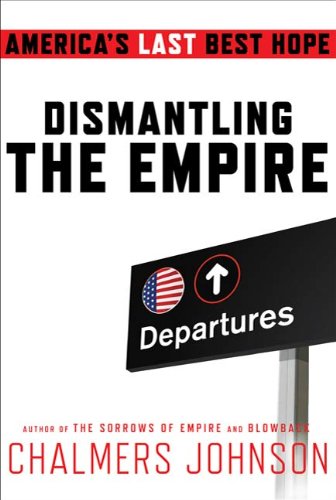
Chalmers Johnson discusses how the US became an unprecedented empire of bases, as well as the topic of his new book "Dismantling the Empire."
To Listen to the Interview
TomDispatch
Chalmers Johnson discusses how the US became an unprecedented empire of bases, as well as the topic of his new book "Dismantling the Empire."
To Listen to the Interview
Monday, March 15, 2010
Democracy Now: David Price -- “The CIA Is Welcoming Itself Back onto American University Campuses”
David Price: “The CIA Is Welcoming Itself Back onto American University Campuses”
Democracy Now
In the latest edition of CounterPunch magazine, the anthropologist David Price reveals the US intelligence community has established academic outposts at twenty-two US universities over the past four years. Government agencies, including the CIA, FBI, National Security Agency, Defense Intelligence Agency, and Homeland Security, have helped found “Intelligence Community Centers for Academic Excellence,” or ICCAEs—pronounced “Icky.” The ICCAEs aim to create a “systematic long-term program at universities and colleges to recruit and hire eligible talent for [intelligence community] agencies and components” and “increase the [intelligence recruiting] pipeline of students.”
Guest:
David Price, founding member of the Network of Concerned Anthropologists, which just published The Counter-Counterinsurgency Manual: Or Notes on Demilitarizing American Society. He is also an associate professor of anthropology at St. Martin’s University in Lacey, Washington, and the author of Anthropological Intelligence: The Deployment and Neglect of American Anthropology in the Second World War and Threatening Anthropology: McCarthyism and the FBI’s Surveillance of Activist Anthropologists.
To Watch/Listen/Read
Democracy Now
In the latest edition of CounterPunch magazine, the anthropologist David Price reveals the US intelligence community has established academic outposts at twenty-two US universities over the past four years. Government agencies, including the CIA, FBI, National Security Agency, Defense Intelligence Agency, and Homeland Security, have helped found “Intelligence Community Centers for Academic Excellence,” or ICCAEs—pronounced “Icky.” The ICCAEs aim to create a “systematic long-term program at universities and colleges to recruit and hire eligible talent for [intelligence community] agencies and components” and “increase the [intelligence recruiting] pipeline of students.”
Guest:
David Price, founding member of the Network of Concerned Anthropologists, which just published The Counter-Counterinsurgency Manual: Or Notes on Demilitarizing American Society. He is also an associate professor of anthropology at St. Martin’s University in Lacey, Washington, and the author of Anthropological Intelligence: The Deployment and Neglect of American Anthropology in the Second World War and Threatening Anthropology: McCarthyism and the FBI’s Surveillance of Activist Anthropologists.
To Watch/Listen/Read
Saturday, March 13, 2010
Robert Becker: Best Picture No Shill for War Hubris, Invasion or Empire - Robert Scheer Better at Politics than Film Criticism
(Courtesy of Danny Mayer)
Best Picture No Shill for War Hubris, Invasion or Empire - Robert Scheer Better at Politics than Film Criticism
by Robert Becker
The Smirking Chimp

...
What's brilliant about "Hurt Locker" is not just its compelling take on damaged soldiers but the enticing ambiguities, making it a telling Rorschach test. The director endorses bravery but not the mission, thus deflecting nonsense she's just a white-flag-waving traitor. U.S. Army advisers withdrew because Bigelow didn't appear pro-war enough. The director knew better, that audiences would be less engaged in experiencing the front lines when political lines in the sand are drawn (either gung ho or Scheer's).
Notably, on screen, this disposal team saves no lives or assures no American safety. Sustained, high tension makes the opposite point: no one here is safe, victory is an illusion, and justification for the occupation, AWOL. Sometimes what's not said or dramatized matters more than what so immediate, however well crafted.
My personal take: the movie presents menacing patterns of randomized violence. Dramatizing the life-long trauma of soldiers we fund, without redemptive trade-offs, questions militarized violence as solution. War here is mania, whether personal and/or political addiction, and that makes the movie qualify as both anti-war and anti-Iraq. Its opening moment quotes strident anti-war critic, Chris Hedges, on war as addiction (vs. honor), and the movie follows through with this dark view.
First hand, we experience unspeakable pain endured by sympathetic characters with little to show for it. The protagonist is brave but also an obsessed daredevil, dangerous to himself and his crew - no hero for our children or his, no exemplar for the glory of Yankee war-making. The one visible Army officer conspicuously rags on James' recklessness - without narrative offset. While Bigelow doesn't flesh in background Iraqis, nor does she detail Americans, except our team and one psychologist, foolishly getting himself blown up. Another non-hero. Yes, the movie presents Iraq as American-instigated dogfight, but neither side is honored, neither murderous insurgents, nor the more powerful, hubristic, occupying Americans.
Any Hollywood war movie not glorifying noble Americans in justified armed combat against a dastardly enemy is exceptional. If "Hurt Locker" was intended to promote positives about Iraq, count it an utter failure, from first to last scene. The movie's finale provides the simplest "statement" -- reinforcing Iraq as an endless, addictive drug for a crisis junkie doomed to tempt death, incapable of living with his own family in his home country. Imperial triumph, indeed.
To Read the Entire Essay
Best Picture No Shill for War Hubris, Invasion or Empire - Robert Scheer Better at Politics than Film Criticism
by Robert Becker
The Smirking Chimp
...
What's brilliant about "Hurt Locker" is not just its compelling take on damaged soldiers but the enticing ambiguities, making it a telling Rorschach test. The director endorses bravery but not the mission, thus deflecting nonsense she's just a white-flag-waving traitor. U.S. Army advisers withdrew because Bigelow didn't appear pro-war enough. The director knew better, that audiences would be less engaged in experiencing the front lines when political lines in the sand are drawn (either gung ho or Scheer's).
Notably, on screen, this disposal team saves no lives or assures no American safety. Sustained, high tension makes the opposite point: no one here is safe, victory is an illusion, and justification for the occupation, AWOL. Sometimes what's not said or dramatized matters more than what so immediate, however well crafted.
My personal take: the movie presents menacing patterns of randomized violence. Dramatizing the life-long trauma of soldiers we fund, without redemptive trade-offs, questions militarized violence as solution. War here is mania, whether personal and/or political addiction, and that makes the movie qualify as both anti-war and anti-Iraq. Its opening moment quotes strident anti-war critic, Chris Hedges, on war as addiction (vs. honor), and the movie follows through with this dark view.
First hand, we experience unspeakable pain endured by sympathetic characters with little to show for it. The protagonist is brave but also an obsessed daredevil, dangerous to himself and his crew - no hero for our children or his, no exemplar for the glory of Yankee war-making. The one visible Army officer conspicuously rags on James' recklessness - without narrative offset. While Bigelow doesn't flesh in background Iraqis, nor does she detail Americans, except our team and one psychologist, foolishly getting himself blown up. Another non-hero. Yes, the movie presents Iraq as American-instigated dogfight, but neither side is honored, neither murderous insurgents, nor the more powerful, hubristic, occupying Americans.
Any Hollywood war movie not glorifying noble Americans in justified armed combat against a dastardly enemy is exceptional. If "Hurt Locker" was intended to promote positives about Iraq, count it an utter failure, from first to last scene. The movie's finale provides the simplest "statement" -- reinforcing Iraq as an endless, addictive drug for a crisis junkie doomed to tempt death, incapable of living with his own family in his home country. Imperial triumph, indeed.
To Read the Entire Essay
Friday, March 12, 2010
Democracy Now: “Blackwatergate” –- Private Military Firm in Firestorm of Controversy over Involvements in Iraq, Afghanistan and Germany
“Blackwatergate”–Private Military Firm in Firestorm of Controversy over Involvements in Iraq, Afghanistan and Germany
Democracy Now
Blackwater is all over the news. In the last seventy-two hours, a series of breaking developments involving the notorious private military firm have come to light, ranging from their involvement in Afghanistan and Iraq, and even Germany, as well as legal cases here at home. We speak with investigative journalist and Democracy Now! correspondent Jeremy Scahill and Rep. Jan Schakowsky (D-IL), a leading member of the House Permanent Select Committee on Intelligence and the chair of the Subcommittee on Oversight and Investigations, who is launching an investigation into why two Blackwater contractors were among the dead in the December 30 suicide bombing at the CIA station at Forward Operating Base Chapman in Khost, Afghanistan.
To Read/Listen/Watch
Democracy Now
Blackwater is all over the news. In the last seventy-two hours, a series of breaking developments involving the notorious private military firm have come to light, ranging from their involvement in Afghanistan and Iraq, and even Germany, as well as legal cases here at home. We speak with investigative journalist and Democracy Now! correspondent Jeremy Scahill and Rep. Jan Schakowsky (D-IL), a leading member of the House Permanent Select Committee on Intelligence and the chair of the Subcommittee on Oversight and Investigations, who is launching an investigation into why two Blackwater contractors were among the dead in the December 30 suicide bombing at the CIA station at Forward Operating Base Chapman in Khost, Afghanistan.
To Read/Listen/Watch
Monday, March 01, 2010
Sebastian Jones: The Media-Lobbying Complex
The Media-Lobbying Complex
By Sebastian Jones
The Nation
President Obama spent most of December 4 touring Allentown, Pennsylvania, meeting with local workers and discussing the economic crisis. A few hours later, the state's former governor, Tom Ridge, was on MSNBC's Hardball With Chris Matthews, offering up his own recovery plan. There were "modest things" the White House might try, like cutting taxes or opening up credit for small businesses, but the real answer was for the president to "take his green agenda and blow it out of the box." The first step, Ridge explained, was to "create nuclear power plants." Combined with some waste coal and natural gas extraction, you would have an "innovation setter" that would "create jobs, create exports."
As Ridge counseled the administration to "put that package together," he sure seemed like an objective commentator. But what viewers weren't told was that since 2005, Ridge has pocketed $530,659 in executive compensation for serving on the board of Exelon, the nation's largest nuclear power company. As of March 2009, he also held an estimated $248,299 in Exelon stock, according to SEC filings.
Moments earlier, retired general and "NBC Military Analyst" Barry McCaffrey told viewers that the war in Afghanistan would require an additional "three- to ten-year effort" and "a lot of money." Unmentioned was the fact that DynCorp paid McCaffrey $182,309 in 2009 alone. The government had just granted DynCorp a five-year deal worth an estimated $5.9 billion to aid American forces in Afghanistan. The first year is locked in at $644 million, but the additional four options are subject to renewal, contingent on military needs and political realities.
In a single hour, two men with blatant, undisclosed conflicts of interest had appeared on MSNBC. The question is, was this an isolated oversight or business as usual? Evidence points to the latter. In 2003 The Nation exposed McCaffrey's financial ties to military contractors he had promoted on-air on several cable networks; in 2008 David Barstow wrote a Pulitzer Prize-winning series for the New York Times about the Pentagon's use of former military officers--many lobbying or consulting for military contractors--to get their talking points on television in exchange for access to decision-makers; and in 2009 bloggers uncovered how ex-Newsweek writer Richard Wolffe had guest-hosted Countdown With Keith Olbermann while working at a large PR firm specializing in "strategies for managing corporate reputation."
These incidents represent only a fraction of the covert corporate influence peddling on cable news, a four-month investigation by The Nation has found. Since 2007 at least seventy-five registered lobbyists, public relations representatives and corporate officials--people paid by companies and trade groups to manage their public image and promote their financial and political interests--have appeared on MSNBC, Fox News, CNN, CNBC and Fox Business Network with no disclosure of the corporate interests that had paid them. Many have been regulars on more than one of the cable networks, turning in dozens--and in some cases hundreds--of appearances.
For lobbyists, PR firms and corporate officials, going on cable television is a chance to promote clients and their interests on the most widely cited source of news in the United States. These appearances also generate good will and access to major players inside the Democratic and Republican parties. For their part, the cable networks, eager to fill time and afraid of upsetting the political elite, have often looked the other way. At times, the networks have even disregarded their own written ethics guidelines. Just about everyone involved is heavily invested in maintaining the current system, with the exception of the viewer.
To Read the Rest of the Article
More:
Democracy Now: “The Media-Lobbying Complex”: Investigation Exposes Undisclosed Corporate Ties of Network Political Pundits
By Sebastian Jones
The Nation
President Obama spent most of December 4 touring Allentown, Pennsylvania, meeting with local workers and discussing the economic crisis. A few hours later, the state's former governor, Tom Ridge, was on MSNBC's Hardball With Chris Matthews, offering up his own recovery plan. There were "modest things" the White House might try, like cutting taxes or opening up credit for small businesses, but the real answer was for the president to "take his green agenda and blow it out of the box." The first step, Ridge explained, was to "create nuclear power plants." Combined with some waste coal and natural gas extraction, you would have an "innovation setter" that would "create jobs, create exports."
As Ridge counseled the administration to "put that package together," he sure seemed like an objective commentator. But what viewers weren't told was that since 2005, Ridge has pocketed $530,659 in executive compensation for serving on the board of Exelon, the nation's largest nuclear power company. As of March 2009, he also held an estimated $248,299 in Exelon stock, according to SEC filings.
Moments earlier, retired general and "NBC Military Analyst" Barry McCaffrey told viewers that the war in Afghanistan would require an additional "three- to ten-year effort" and "a lot of money." Unmentioned was the fact that DynCorp paid McCaffrey $182,309 in 2009 alone. The government had just granted DynCorp a five-year deal worth an estimated $5.9 billion to aid American forces in Afghanistan. The first year is locked in at $644 million, but the additional four options are subject to renewal, contingent on military needs and political realities.
In a single hour, two men with blatant, undisclosed conflicts of interest had appeared on MSNBC. The question is, was this an isolated oversight or business as usual? Evidence points to the latter. In 2003 The Nation exposed McCaffrey's financial ties to military contractors he had promoted on-air on several cable networks; in 2008 David Barstow wrote a Pulitzer Prize-winning series for the New York Times about the Pentagon's use of former military officers--many lobbying or consulting for military contractors--to get their talking points on television in exchange for access to decision-makers; and in 2009 bloggers uncovered how ex-Newsweek writer Richard Wolffe had guest-hosted Countdown With Keith Olbermann while working at a large PR firm specializing in "strategies for managing corporate reputation."
These incidents represent only a fraction of the covert corporate influence peddling on cable news, a four-month investigation by The Nation has found. Since 2007 at least seventy-five registered lobbyists, public relations representatives and corporate officials--people paid by companies and trade groups to manage their public image and promote their financial and political interests--have appeared on MSNBC, Fox News, CNN, CNBC and Fox Business Network with no disclosure of the corporate interests that had paid them. Many have been regulars on more than one of the cable networks, turning in dozens--and in some cases hundreds--of appearances.
For lobbyists, PR firms and corporate officials, going on cable television is a chance to promote clients and their interests on the most widely cited source of news in the United States. These appearances also generate good will and access to major players inside the Democratic and Republican parties. For their part, the cable networks, eager to fill time and afraid of upsetting the political elite, have often looked the other way. At times, the networks have even disregarded their own written ethics guidelines. Just about everyone involved is heavily invested in maintaining the current system, with the exception of the viewer.
To Read the Rest of the Article
More:
Democracy Now: “The Media-Lobbying Complex”: Investigation Exposes Undisclosed Corporate Ties of Network Political Pundits
Sunday, February 21, 2010
Revolution By the Book: Academic Repression -- Reflections from the Academic Industrial Complex
Academic Repression: Reflections from the Academic Industrial Complex
Peter McLaren (Editor), Steven Best (Editor), and Anthony J. Nocella, II (Editors)
Revolution By the Book

...
Neoliberalism and Academia
It was not paranoia that led John Dewey in the 1940s to warn that a corporatization process had begun whereby universities learned to shape and pattern themselves on a business model driven by the need to compete and turn education into a profit-making enterprise. Nor was it delusional when, in 1961, President Eisenhower warned that the “military industrial complex” posed a threat to the balance of powers and to civil liberties. The fusion of warfare, capitalism, science, and technology cannot take place without knowledge, advanced technologies, and a low-cost labor base, such as one finds ready-made in universities and their graduate student labor pools. Where science, engineering, and technology are crucial to capitalist militarism and militarist capitalism, universities form the third leg in a triadic system of postmodern power. It is a telling fact that the US spends more in the military sector than the rest of the world combined.
Consequently, deconstructing fictitious humanist ideals, describing the real goals and imperatives of “higher learning,” and delegitimizing the power systems that actually run universities, many theorists during the last two decades understood that the boundary lines between universities, corporations, and military/warfare/social policing systems were dissolving. They no longer saw three separate, unrelated entities, but rather one gigantic industrial complex. The term “academic-military-industrial complex” is shorthand for the intersection, overlapping, and implosion of universities, the corporate private sector, the Department of Defense and various armed forces services, and the security and regulatory apparatuses of the State—all knotted together in a vast, predatory bureaucratic system developed for social and geopolitical domination.1/2 By the 1990s, certainly, the questioning of scientific epistemology took on a far broader and more consequential term with critical scrutiny of the university institution itself, by charting the transformations of the mission and function of universities in the post-war era. Building on attacks on the politics of knowledge driving university research, a number of radical theorists, such as Stanley Aronowitz, Henry Giroux, Peter McLaren, Sandra Harding, and numerous contributors to this book analyzed how the nobler purposes and missions of universities and institutions of “higher learning” became corrupted and degraded. Hence, a spate of important new critical works emerged deconstructing the mythology of higher education and the academy as an institution.
As capitalism changes, so must education, and the rise of science and technology to dominant “productive forces” in the postindustrial phase of capital transforms education increasingly from a focus on humanities to narrow functional knowledge. The noble functions of higher education such as inculcating critical thinking skills, identities as citizens and members of interdependent communities, and the ability to meaningfully participate in and shape a democratic form of government gave way to reconfiguring the university as a corporation, ideological state apparatus, and technical school for training laborers.
Universities had become part of the “one dimensional society” (Marcuse), they had the potential to devastatingly criticize and overturn in favor of richly educated, highly cultured, autonomous citizens. Increasingly, the humanities and liberal arts were eclipsed by science, chemistry, mathematics, agriculture, geology, engineering, marketing, business, accounting, advertising, and other fields including sports. The economic rationale to increase university profits and functional purpose of producing individuals trained for science, technology, and business had the ideological bonus of homogenizing thought and stifling critical thinking. And under conditions of economic recession such as began to devastate global markets in 2008, universities have to tighten budgets and reduce or eliminate “superfluous” knowledges. Simultaneously, students increasingly turn toward practical realities of careers and economic survival and forego the “luxury” of studying literature, philosophy, or art, fields that regardless are grossly underfunded as they occupy the bottom rung of budgetary priorities. As the 2008–2009 crisis worsened, plunging much of the globe into recession and depression, worried students fall in line with corporate academic policies that reduce or eliminate “superfluous” humanities requirements in order to peddle degrees in marketable careers.
Partly due to economic constraints and partly because of the growing hegemony of technoscience, it is hard to miss the implosion between universities and vocational schools that eliminate liberal arts requirements and do little more than job training and indoctrinating students with capitalist values of competition, individualism, materialism, greed, and so on. Vocational schools such as Phoenix University are themselves corporate behemoths with branches spread throughout the US like fast-food chains. Indeed, on the neoliberal-consumerist model of education, knowledge is nothing but information to be consumed as quickly as possible, a sugary pabulum as injurious to the health of the mind as Whoppers and Big Macs are to the life of the body. In a society organized around work, productivity, and maximal exploitation of labor, no one has time for a satisfying meal let alone a genuine education, and the “slow food” movement ought to be linked to a drive toward a “slow education” that allows students the time and leisure to think and mature as human beings in pursuit of autonomy rather than in the service of capital.
As corporations, universities were interested in buying materials, investing in research and projects, inventing and patenting new technologies or advances in science and medicine, and competing on the marketplace. In fact, by the 1980s and 1990s, universities and society as a whole were becoming increasingly corporatized, marketized, and globalized. Acting like capitalists committed to the tyranny of the bottom line, universities began the cut-and-slash tactics that Reagan took to social programs in the 1980s, for a profitable enterprise cannot have excess costs, and labor expenses must be minimized. The dynamic that led to the restructuring of universities along corporate lines stemmed from aggressive neoliberal policies. The laissez-faire spirit of early capitalism was revived as neoliberalism, in order to dismantle welfare states, trade barriers, environmental regulations, and anything that stood in the way of trade. Universities moved in consort with the social, political, economic, and military systems that were changing the nature of the world through an aggressive neo-imperialism policy that was part and parcel of neoliberal attempts to subjugate the entire world to corporate power and market logic, while hopefully reviving a moribund American Empire.
Following the dominant corporate model, universities initiated a “de-skilling” of labor, and replaced the skilled labor of faculty with technology.3 Compliant with the needs of businesses and an overworked labor force, and updating higher learning for the age of the Internet, universities began to offer “long-distance learning” such that students could earn a degree at home through correspondence, with “teachers” reduced to functionaries who grade quantitative exams, raising the specter of a future university system that dispenses with teachers altogether in favor of computerized grading machines.4 “Increasingly,” Ollman writes, “university life has been organized on the basis of a complex system of tests, grades, and degrees, so that people know exactly where they fit, what they deserve, what has to be done to rise another notch on the scale, and so on. Discounting—as most educators do—their negative effects on scholarship, critical thinking, and collegiality, these practices have succeeded in instilling a new discipline and respect for hierarchy.”5
To Read the Rest of Excerpts
Peter McLaren (Editor), Steven Best (Editor), and Anthony J. Nocella, II (Editors)
Revolution By the Book
...
Neoliberalism and Academia
It was not paranoia that led John Dewey in the 1940s to warn that a corporatization process had begun whereby universities learned to shape and pattern themselves on a business model driven by the need to compete and turn education into a profit-making enterprise. Nor was it delusional when, in 1961, President Eisenhower warned that the “military industrial complex” posed a threat to the balance of powers and to civil liberties. The fusion of warfare, capitalism, science, and technology cannot take place without knowledge, advanced technologies, and a low-cost labor base, such as one finds ready-made in universities and their graduate student labor pools. Where science, engineering, and technology are crucial to capitalist militarism and militarist capitalism, universities form the third leg in a triadic system of postmodern power. It is a telling fact that the US spends more in the military sector than the rest of the world combined.
Consequently, deconstructing fictitious humanist ideals, describing the real goals and imperatives of “higher learning,” and delegitimizing the power systems that actually run universities, many theorists during the last two decades understood that the boundary lines between universities, corporations, and military/warfare/social policing systems were dissolving. They no longer saw three separate, unrelated entities, but rather one gigantic industrial complex. The term “academic-military-industrial complex” is shorthand for the intersection, overlapping, and implosion of universities, the corporate private sector, the Department of Defense and various armed forces services, and the security and regulatory apparatuses of the State—all knotted together in a vast, predatory bureaucratic system developed for social and geopolitical domination.1/2 By the 1990s, certainly, the questioning of scientific epistemology took on a far broader and more consequential term with critical scrutiny of the university institution itself, by charting the transformations of the mission and function of universities in the post-war era. Building on attacks on the politics of knowledge driving university research, a number of radical theorists, such as Stanley Aronowitz, Henry Giroux, Peter McLaren, Sandra Harding, and numerous contributors to this book analyzed how the nobler purposes and missions of universities and institutions of “higher learning” became corrupted and degraded. Hence, a spate of important new critical works emerged deconstructing the mythology of higher education and the academy as an institution.
As capitalism changes, so must education, and the rise of science and technology to dominant “productive forces” in the postindustrial phase of capital transforms education increasingly from a focus on humanities to narrow functional knowledge. The noble functions of higher education such as inculcating critical thinking skills, identities as citizens and members of interdependent communities, and the ability to meaningfully participate in and shape a democratic form of government gave way to reconfiguring the university as a corporation, ideological state apparatus, and technical school for training laborers.
Universities had become part of the “one dimensional society” (Marcuse), they had the potential to devastatingly criticize and overturn in favor of richly educated, highly cultured, autonomous citizens. Increasingly, the humanities and liberal arts were eclipsed by science, chemistry, mathematics, agriculture, geology, engineering, marketing, business, accounting, advertising, and other fields including sports. The economic rationale to increase university profits and functional purpose of producing individuals trained for science, technology, and business had the ideological bonus of homogenizing thought and stifling critical thinking. And under conditions of economic recession such as began to devastate global markets in 2008, universities have to tighten budgets and reduce or eliminate “superfluous” knowledges. Simultaneously, students increasingly turn toward practical realities of careers and economic survival and forego the “luxury” of studying literature, philosophy, or art, fields that regardless are grossly underfunded as they occupy the bottom rung of budgetary priorities. As the 2008–2009 crisis worsened, plunging much of the globe into recession and depression, worried students fall in line with corporate academic policies that reduce or eliminate “superfluous” humanities requirements in order to peddle degrees in marketable careers.
Partly due to economic constraints and partly because of the growing hegemony of technoscience, it is hard to miss the implosion between universities and vocational schools that eliminate liberal arts requirements and do little more than job training and indoctrinating students with capitalist values of competition, individualism, materialism, greed, and so on. Vocational schools such as Phoenix University are themselves corporate behemoths with branches spread throughout the US like fast-food chains. Indeed, on the neoliberal-consumerist model of education, knowledge is nothing but information to be consumed as quickly as possible, a sugary pabulum as injurious to the health of the mind as Whoppers and Big Macs are to the life of the body. In a society organized around work, productivity, and maximal exploitation of labor, no one has time for a satisfying meal let alone a genuine education, and the “slow food” movement ought to be linked to a drive toward a “slow education” that allows students the time and leisure to think and mature as human beings in pursuit of autonomy rather than in the service of capital.
As corporations, universities were interested in buying materials, investing in research and projects, inventing and patenting new technologies or advances in science and medicine, and competing on the marketplace. In fact, by the 1980s and 1990s, universities and society as a whole were becoming increasingly corporatized, marketized, and globalized. Acting like capitalists committed to the tyranny of the bottom line, universities began the cut-and-slash tactics that Reagan took to social programs in the 1980s, for a profitable enterprise cannot have excess costs, and labor expenses must be minimized. The dynamic that led to the restructuring of universities along corporate lines stemmed from aggressive neoliberal policies. The laissez-faire spirit of early capitalism was revived as neoliberalism, in order to dismantle welfare states, trade barriers, environmental regulations, and anything that stood in the way of trade. Universities moved in consort with the social, political, economic, and military systems that were changing the nature of the world through an aggressive neo-imperialism policy that was part and parcel of neoliberal attempts to subjugate the entire world to corporate power and market logic, while hopefully reviving a moribund American Empire.
Following the dominant corporate model, universities initiated a “de-skilling” of labor, and replaced the skilled labor of faculty with technology.3 Compliant with the needs of businesses and an overworked labor force, and updating higher learning for the age of the Internet, universities began to offer “long-distance learning” such that students could earn a degree at home through correspondence, with “teachers” reduced to functionaries who grade quantitative exams, raising the specter of a future university system that dispenses with teachers altogether in favor of computerized grading machines.4 “Increasingly,” Ollman writes, “university life has been organized on the basis of a complex system of tests, grades, and degrees, so that people know exactly where they fit, what they deserve, what has to be done to rise another notch on the scale, and so on. Discounting—as most educators do—their negative effects on scholarship, critical thinking, and collegiality, these practices have succeeded in instilling a new discipline and respect for hierarchy.”5
To Read the Rest of Excerpts
Subscribe to:
Posts (Atom)