Showing posts with label Film. Show all posts

Wednesday, March 23, 2011

To the Best of Our Knowledge: Arts Education

Arts Education
To the Best of Our Knowledge (Wisconsin Public Radio)

SEGMENT 1:


Eric Booth is one of America's leading teaching artists and trainer of teaching artists. He's also the author of "The Music Teaching Artist's Bible: Becoming a Virtuoso Educator." He talks to Steve Paulson about the current state of arts education in American schools and shares his thoughts on how to engage children through arts education.

SEGMENT 2:


Michael Doucet is the founder of the pioneering, Grammy Award-winning Cajun band, BeauSoleil. The band recently released its 29th album, "Alligator Purse." Doucet also has an extensive background in arts education. He talks to Steve Paulson about educating people about Cajun culture through Cajun music. We also hear some music from BeauSoleil's "Alligator Purse" album.

Katie Salen is a game designer, interactive designer, animator and design educator. She's also the editor of "The Ecology of Games: Connecting Youth, Games, and Learning." Salen talks to Anne Strainchamps about what children can learn from designing and playing games.

SEGMENT 3:


David Gilmour is a Canadian film critic and novelist. He's also the author of a memoir called "The Film Club." In the book, Gilmour writes about his decision to let his son, Jesse, drop out of school, provided that he agrees to watch three movies a week with his father. Gilmour talks to Jim Fleming about the experience. We also hear clips from a few of the films that Gilmour watched with his son

To Listen to the Episode

Sunday, March 20, 2011

Harry M. Benshoff: Brokering Brokeback Mountain -- A Local Reception Study

Brokering Brokeback Mountain — a local reception study
by Harry M. Benshoff
Jump Cut


By almost anyone’s calculations, Brokeback Mountain was the movie event of 2005/2006. Based on a story by Annie Proulx, this “gay cowboy movie” (a misnomer, as I shall argue below) generated considerable box office revenue, multiple interpretations, and a fair amount of controversy, as pundits of every ideological stripe weighed in on its cultural significance. As one of the few popular movies dealing with issues surrounding male homosexual desire and identity, the reception of Brokeback Mountain makes for an interesting case study. Not only does its reception support various concepts of contemporary cultural theory (such as the necessarily negotiated decoding of polysemous, heteroglossic media texts), it also underscores the many interpretive meanings of (male) homosexuality that exist within contemporary culture-at-large. As will be shown, by challenging the ideological foundations of heteronormative patriarchy, Brokeback Mountain generated a large amount of fear, anger, delight, disappointment, and/or moral outrage among diverse groups of filmgoers.

The following analysis also draws upon queer theory, an array of ideas about human sexuality that critiques “normalising ways of knowing and of being.”[2] Queer theory is informed by many of the same poststructuralist and postmodern ideas that shape third wave feminism, postcolonial theory, and other contemporary ways of thinking about the politics, practice, and production of social identities. Like much of that thinking, queer theory postulates that human sexuality is not an essentialized or biological given, but is rather a fluid construct that is shaped by the various discourses within which it is spoken. In its broadest terms, queer theory insists that there is a general overlap between all forms of human sexuality — that there are multifarious human sexualities situated between the essentialist poles of homosexuality and heterosexuality. As such, one of queer theory’s central goals is to deconstruct and complicate Western culture’s illusory straight-gay binary. Other aspects of queer theory investigate the multiple meanings of male homosocial desire and explore its relationship to masculinity, (homo)sexuality, patriarchy, and the so-called “closet” within which homosexual desire has been said to hide.

To Read the Rest of the Essay

Tuesday, March 08, 2011

Robin Wood: Only (Dis)Connect; and Never Relaxez-Vous; or, I Can’t Sleep

Only (Dis)Connect; and Never Relaxez-Vous; or, ‘I Can’t Sleep’
by Robin Wood
Film International


...

Confessions of an Incompetent Film Critic

For people of my generation, who grew up in the 1940s/50s on an exclusive diet of classical Hollywood cinema (with the occasional British movie), the European ‘arthouse’ cinema always presented problems which linger on even today, a simple basic one being that of following the plot. This is not because the plot is necessarily complex or obscure, but, frequently, because of the way in which the characters are introduced and the action presented. When I grew up there was remarkably little serious criticism available (not much beyond the weekly reviews), and film studies courses in schools or universities were not even thought of. I was seventeen when I saw my first foreign language film (Torment/Frenzy [Hets, 1944], by Alf Sjöberg, from an early but already characteristic screenplay by Ingmar Bergman). I knew from the reviews that it would carry me far beyond anything I had seen previously, both in style and subject-matter, and my hand was trembling when I bought my ticket. I believe I had great difficulty following it (my first subtitles, not to mention extreme psychological disturbance). Fifty-five years later I still have the same problem when confronted with the films of Claire Denis (or Michael Haneke, or Hou Hsiao-Hsien…). The habits acquired during one’s formative years are never quite cast off; when I showed I Can’t Sleep to a graduate film group last year, my students corrected me over a number of details and pointed out many things I hadn’t noticed, although this was their first viewing of the film and I had already watched it three times. A classical Hollywood film – however intelligent and complex – is dependent on its surface level upon ‘popular’ appeal and its action must be fully comprehensible to a general audience at one viewing, covering all levels of educatedness from the illiterate to the university professor. (The same was of course true of the Elizabethan theatre – see, for example, the conventions of the soliloquy and the aside, wherein a character explains his/her motivation, reactions or thoughts to the audience). One of the cardinal rules was that every plot point must be doubly articulated, in both the action and the dialogue; another was the use of the cut to close-up that tells us ‘This character is important’; yet another, the presence of instantly recognizable stars or character actors. All of these Denis systematically denies us. It is a part of her great distinction that her films (and especially I Can’t Sleep, arguably her masterpiece to date) demand intense and continuous mental activity from the spectator: we are not to miss a single detail or to pass over a gesture or facial expression, even if it is shown in long shot within an ensemble, with no ‘helpful’ underlining and no ‘spelling out’ in dialogue.

It is the particular distinction of Denis’ cinema that sets it apart from – almost, indeed, in opposition to – the work of many of our most celebrated ‘arthouse’ directors: Bergman, for example, or Fellini or Antonioni. Their films are rooted in autobiography – not necessarily in any literal sense, but in terms of personal introspection – whereas Denis left autobiography behind with Chocolat, and even that film is notable for its poise and critical distance, its objectivity. Where Bergman or Fellini seems to be saying to us ‘Come with me and I’ll tell you my secrets, share my experiences – how I feel about things, my thoughts about existence’, Denis issues a very different invitation to the spectator: ‘Come with me and we’ll play a game, albeit a serious one. Let’s see how much you can notice in what I decide to show you, how you interpret what you see and hear, what connections you can make, how much can be explained and how much remains mysterious and uncertain, as so much in our lives remains unclear. I’ll allow you a certain leeway of interpretation, because I don’t always understand everything myself, not even my own creations, though I’ll be as precise as possible…’ A few examples from the film’s first ten minutes will illustrate various aspects of this.

To Read the Rest of the Essay

Sunday, March 06, 2011

Zadie Smith: Generation Why?

Generation Why?
by Zadie Smith
The New York Review of Books


How long is a generation these days? I must be in Mark Zuckerberg’s generation—there are only nine years between us—but somehow it doesn’t feel that way. This despite the fact that I can say (like everyone else on Harvard’s campus in the fall of 2003) that “I was there” at Facebook’s inception, and remember Facemash and the fuss it caused; also that tiny, exquisite movie star trailed by fan-boys through the snow wherever she went, and the awful snow itself, turning your toes gray, destroying your spirit, bringing a bloodless end to a squirrel on my block: frozen, inanimate, perfect—like the Blaschka glass flowers. Doubtless years from now I will misremember my closeness to Zuckerberg, in the same spirit that everyone in ’60s Liverpool met John Lennon.

At the time, though, I felt distant from Zuckerberg and all the kids at Harvard. I still feel distant from them now, ever more so, as I increasingly opt out (by choice, by default) of the things they have embraced. We have different ideas about things. Specifically we have different ideas about what a person is, or should be. I often worry that my idea of personhood is nostalgic, irrational, inaccurate. Perhaps Generation Facebook have built their virtual mansions in good faith, in order to house the People 2.0 they genuinely are, and if I feel uncomfortable within them it is because I am stuck at Person 1.0. Then again, the more time I spend with the tail end of Generation Facebook (in the shape of my students) the more convinced I become that some of the software currently shaping their generation is unworthy of them. They are more interesting than it is. They deserve better.

In The Social Network Generation Facebook gets a movie almost worthy of them, and this fact, being so unexpected, makes the film feel more delightful than it probably, objectively, is. From the opening scene it’s clear that this is a movie about 2.0 people made by 1.0 people (Aaron Sorkin and David Fincher, forty-nine and forty-eight respectively). It’s a talkie, for goodness’ sake, with as many words per minute as His Girl Friday. A boy, Mark, and his girl, Erica, sit at a little table in a Harvard bar, zinging each other, in that relentless Sorkin style made famous by The West Wing (though at no point does either party say “Walk with me”—for this we should be grateful).

But something is not right with this young man: his eye contact is patchy; he doesn’t seem to understand common turns of phrase or ambiguities of language; he is literal to the point of offense, pedantic to the point of aggression. (“Final clubs,” says Mark, correcting Erica, as they discuss those exclusive Harvard entities, “Not Finals clubs.”) He doesn’t understand what’s happening as she tries to break up with him. (“Wait, wait, this is real?”) Nor does he understand why. He doesn’t get that what he may consider a statement of fact might yet have, for this other person, some personal, painful import:

ERICA: I have to go study.

MARK: You don’t have to study.

ERICA: How do you know I don’t have to study?!

MARK: Because you go to B.U.!

Simply put, he is a computer nerd, a social “autistic”: a type as recognizable to Fincher’s audience as the cynical newshound was to Howard Hawks’s. To create this Zuckerberg, Sorkin barely need brush his pen against the page. We came to the cinema expecting to meet this guy and it’s a pleasure to watch Sorkin color in what we had already confidently sketched in our minds. For sometimes the culture surmises an individual personality, collectively. Or thinks it does. Don’t we all know why nerds do what they do? To get money, which leads to popularity, which leads to girls. Sorkin, confident of his foundation myth, spins an exhilarating tale of double rejection—spurned by Erica and the Porcellian, the Finaliest of the Final Clubs, Zuckerberg begins his spite-fueled rise to the top. Cue a lot of betrayal. A lot of scenes of lawyers’ offices and miserable, character-damning depositions. (“Your best friend is suing you!”) Sorkin has swapped the military types of A Few Good Men for a different kind of all-male community in a different uniform: GAP hoodies, North Face sweats.

To Read the Rest of the Essay

Monday, February 21, 2011

Orwell Rolls in His Grave (USA: Robert Kane Pappas, 2003: 84 mins)


Director Robert Kane Pappas’ ORWELL ROLLS IN HIS GRAVE is the consummate critical examination of the Fourth Estate, once the bastion of American democracy. Asking whether America has entered an Orwellian world of doublespeak where outright lies can pass for the truth, Pappas explores what the media doesn’t like to talk about: itself. Meticulously tracing the process by which media has distorted and often dismissed actual news events, Pappas presents a riveting and eloquent mix of media professionals and leading intellectual voices on the media. Among the cast of characters in ORWELL ROLLS IN HIS GRAVE are Charles Lewis, director of the Center for Public Integrity, Vincent Bugliosi, former L.A. prosecutor and legal scholar, film director and author Michael Moore, Rep. Bernie Sanders, Danny Schecter, author and former producer for ABC and CNN, and Tony Benn, former member of the British Parliament. ORWELL ROLLS IN HIS GRAVE provides a vital forum for ideas that will never be heard in mainstream media. From Globalvision’s Danny Schecter: “We falsely think of our country as a democracy when it has evolved into a mediacracy – where a media that is supposed to check political abuse is part of the political abuse.” New York University media professor Mark Crispin Miller says, “These commercial entities now vie with the government for control over our lives. They are not a healthy counterweight to government. Goebbels said that what you want in a media system – he meant the Nazi media system - is to present the ostensible diversity that conceals an actual uniformity.” From the very size of the media monopolies and how they got that way to who decides what gets on the air and what doesn’t, ORWELL ROLLS IN HIS GRAVE moves through a troubling list of questions and news stories that go unanswered and unreported in the mainstream media. Are Americans being given the information a democracy needs to survive or have they been electronically lobotomized? Has the frenzy for media consolidation led to a dangerous irony where in an era of more news sources the majority of the population has actually become less informed? ORWELL ROLLS IN HIS GRAVE reminds us that 1984 is no longer a date in the future.

Friday, February 18, 2011

Empire: Hollywood and the War Machine

Hollywood and the war machine: Empire examines the symbiotic relationship between the movie industry and the military-industrial complex.
Empire (Al Jazeera)

War is hell, but for Hollywood it has been a Godsend, providing the perfect dramatic setting against which courageous heroes win the hearts and minds of the movie going public.

The Pentagon recognises the power of these celluloid dreams and encourages Hollywood to create heroic myths; to rewrite history to suit its own strategy and as a recruiting tool to provide a steady flow of willing young patriots for its wars.

What does Hollywood get out of this 'deal with the devil'? Access to billions of dollars worth of military kit, from helicopters to aircraft carriers, enabling filmmakers to make bigger and more spectacular battle scenes, which in turn generate more box office revenue. Providing they accept the Pentagon's advice, even toe the party line and show the US military in a positive light.

So is it a case of art imitating life, or a sinister force using art to influence life and death - and the public perception of both?

Empire will examine Hollywood, the Pentagon, and war.

Joining us as guests: Oliver Stone, the eight times Academy Award-winning filmmaker; Michael Moore, the Academy Award-winning filmmaker; and Christopher Hedges, an author and the former Middle East bureau chief of the New York Times.

Our interviewees this week are: Phil Strub, US Department of Defense Film Liaison Unit; Julian Barnes, Pentagon correspondent, LA Times; David Robb, the author of Operation Hollywood; Prof Klaus Dodds, the author of Screening Terror; Matthew Alford, the author of Reel Power; Prof Melani McAlister, the author of Culture, Media, and US Interests in the Middle East.

To Watch the Documentary

Wednesday, February 09, 2011

Me Facing Life: Cyntoia's Story

(Extra credit opportunity for my students -- go watch it and write a two page, typed, response)

Join KET for monthly screenings of Independent Lens films in Lexington as part of the Independent Television Service's (ITVS) nationwide Community Cinema program. All Screenings are FREE and open to the public!

February's film is Me Facing Life: Cyntoia's Story. In 2004, sixteen year old Cyntoia Brown was arrested for murder. There was no question that a 43-year-old man is dead and that she killed him. What mystified filmmaker Daniel Birman was just how common violence among youth is, and just how rarely we stop to question our assumptions about it. He wondered in this case what led a girl—who grew-up in a reasonable home environment—to this tragic end?

February 17, 2010
6:00 PM
Lexington Public Library, Central Branch
140 East Main Street
Lexington, KY 40507

Sunday, February 06, 2011

Monday, January 24, 2011

Democracy Now: "The Black Power Mixtape"–Danny Glover Discusses New Doc -- Rare Archival Footage of Angela Davis/Huey P. Newton/Stokely Carmichael

"The Black Power Mixtape"–Danny Glover Discusses New Doc Featuring Rare Archival Footage of Angela Davis, Huey P. Newton, Stokely Carmichael
Democracy Now

We broadcast from Park City, Utah, home of the Sundance Film Festival, the nation’s largest festival for independent cinema. One of this year’s selections that is creating a lot of buzz is a documentary called The Black Power Mixtape. The film features rare archival footage shot between 1967 and 1975 by two Swedish journalists and was discovered in the basement of Swedish public television 30 years later. We speak with renowned actor and activist Danny Glover, who co-produced The Black Power Mixtape.

To Watch/Listen/Read

Sunday, January 23, 2011

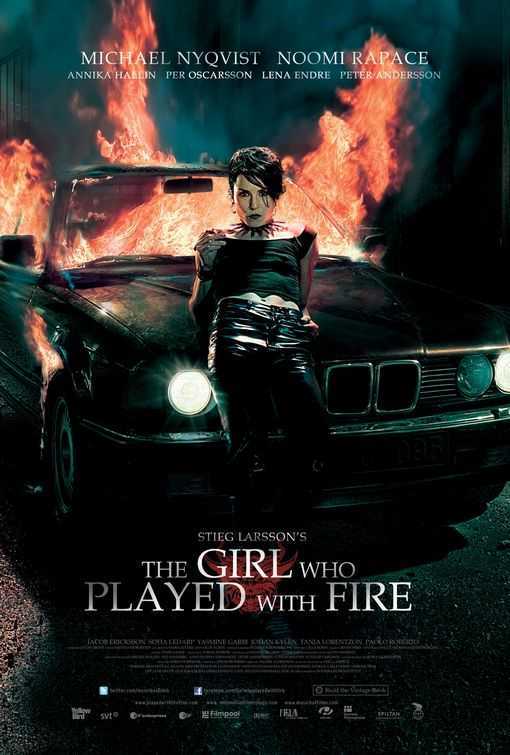
Skepchick: Girls, Violence and Dragon Tattoos

Girls, Violence and Dragon Tattoos
by Jen
Skepchick


Like many another crime fiction junkie, I’m mildly obsessed with Steig Larsson’s Millennium trilogy. I pounced on the first book, The Girl with the Dragon Tattoo, when it first appeared in the States, and was rather thrilled to discover a good crime story with a startling unique and complex female character at its heart – an unfortunately rare occurrence. All too often, especially historically, women only occupy the backdrops of noir genre tales.

But beyond the story itself, the (anti-)heroine Lisbeth Salander has also seemed to find herself in the middle of a popular criticism debate about women, violence and the representation of both in art. The graphic depiction of both the violence – extremely sexual in nature – she is subject to and the violence she delivers in return has been the justification for critics to discuss whether or not her story deserves to be taken seriously or if it’s nothing but salacious drama only befitting the pulp from which tradition it springs.

Let’s say this immediately and clearly – misogynist imagery does not equal a misogynist work of art. That’s a lazy correlation too many readers, watchers and reviewers currently make about books, films and the like, and it’s simplistic and shallow. Rape scenes do not automatically mean sexual content is being using gratuitously. Descriptions of women being victimized do not immediately point to exploitation.

The impulse to label it as such is of course well-intended, and sometimes well-suited. It’s a sign of progress and, in general, a step in the right direction. But it’s not truly progress if it’s only an impulsive leap to the opposite end of the spectrum instead of a carefully considered conclusion about a terribly complicated and nuanced topic.

Let’s also be clear about this – it’s entirely possible for a book to be feminist without featuring a single feminist in it. Lisbeth Salander, for example, is not a feminist. She’s an extremely emotionally damaged individual focused on survival, although she seems to be at least on the path to improvement by the close of the trilogy. She’s a victim of systematic abuse and torture, and she’s committed to self-preservation and revenge by any means possible. She’s not a necessarily noble figure. She doesn’t have to be to prove Larsson’s point. The fact that she isn’t proves it even more successfully.

To Read the Rest of the Essays

Saturday, January 22, 2011

Cathering Grant: Establishing Split in Darren Aronofsky's Requiem for a Dream

Establishing Split from Catherine Grant on Vimeo.

Seung-hoon Jeong: Gaze, Suture, Interface: The Suicide Scene in Michael Haneke’s Caché

(If you have not seen this excellent film, wait to read this until after watching it because it will ruin the film for you. ENG 282 students, we will be watching this in class.)

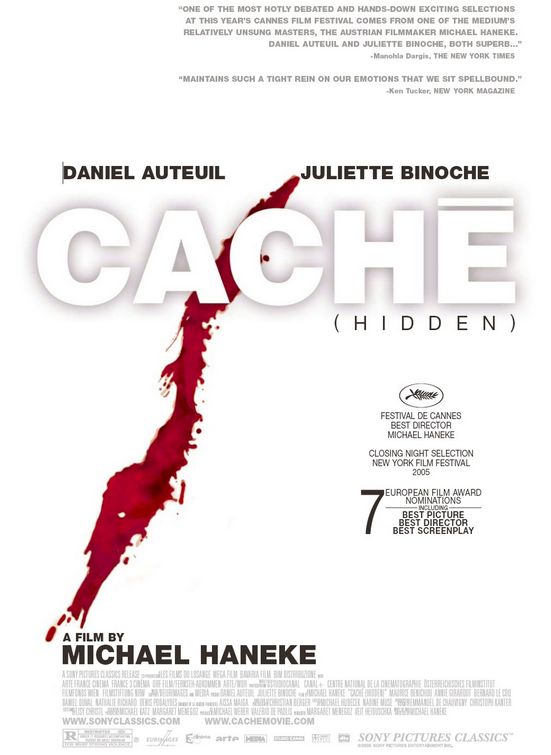
Gaze, Suture, Interface: The Suicide Scene in Michael Haneke’s Caché
Seung-hoon Jeong
Cinephile (The University of British Columbia)


Georges (Daniel Auteuil), a host of a high-brow talk show, receives suspicious videotapes that display the peaceful façade of his upper middle class house. Nothing is clear in this CCTV footage in which there is ostensibly ‘nothing happening’: who has been watching his family, and why? Subsequent clips lead him to his childhood home and to an unknown apartment, which turns out to be the dingy place of his adopted, then abandoned, Algerian brother Majid (Maurice Bénichou). This forgotten ‘other’ confronts Georges with an uncomfortable truth from the past: young Georges’s jealousy forced Majid to be sent off to an orphanage, whereafter Majid had to survive without the educational and social benefits given to Georges. The nature of the video thus changes from provocation to evocation, from surveillance to reminiscence. Michael Haneke’s Caché [Hidden] (2005) uncannily uncovers this hidden trauma that resurfaces in the present. But my primary question is simple: why video?

Let me call this video an ‘interface’. Technically meaning the contact surface between image and spectator, the notion can be applied to the camera, the filmstrip, and the screen. That such a cinematic interface appears onscreen might not merit discussion in many cases, but it can play a central role in the narrative, whose unity is often thwarted and destabilized by the interface image. The subjectivity of characters or spectators can also be shaped or shaken through their encounters with the interface-within-the-film. A diegetic interface may then affect the ‘perception’ and ‘memory’ chain along which ‘image’ and ‘subjectivity’ are interconnected. Caché seems ideal for a case study in this regard, not only because of its video insertions, but because of the consequent revelation of perceptual and mnemonic mechanisms. What follows begins with a close analysis of a scene that exposes these mechanisms and thereby inspires us to explore, even expand the theoretical implications of the interface.

Among many significant scenes, I take Georges’s second visit to Majid’s flat as a kernel of the film’s structure. Its impressiveness, of course, bursts out of Majid’s sudden suicide; Majid lets Georges in, talks for a second, takes out a knife as Georges slightly falters, and slits his own throat, leaving no room for anticipation. The abruptness of this action marks the abruption of Majid’s emotion: a remarkable calmness and gentleness, not usually found in revenge suspects. It is rather Georges, the white Parisian intellectual, who has always lost his temper in front of his lower class, dark-skinned brother (and later, in front of Majid’s son, too); this Algerian outcast has reversed the standard image of the brutal invader of the bourgeois family like the De Niro figure in Cape Fear (Martin Scorsese, 1991). By killing himself, Majid releases something repressed beneath his tranquil face and fractures the peace of both his banlieue home and Georges’s bourgeois life. The flash of his blood sprayed onto the wall visualizes this fracture like an unstitched slash; the blood slowly exuding from his head onto the floor insinuates that this trauma will only grow like a nightmare in Georges’s memory.

In view of other scenes, Majid’s bloodstain on the wall triggers a déjà-vu that allows us to retroactively recognize the drawings sent to Georges (of a child vomiting blood) as forewarnings of this suicide. And through the same logic of ‘deferred action’ (Freudian Nachträglichkeit), this bloody event serves to repeat the film’s first instant flashback, prompted by a reverse-action tape, of young Majid coughing tubercular blood by a window, and the childhood trauma staged in Georges’s nightmare: Majid kills a cockerel, which also leaves a sharp blood mark, and he approaches Georges with the bloody hatchet. This killing was in fact orchestrated by Georges, but he told his parents that Majid had wanted to scare him, a joking lie that, along with Majid’s tuberculosis, ultimately resulted in Majid’s expulsion. However, only through recurrent visual traces after the fact does that original scene manifest its latent meaning as Georges’s original sin. The question would be how guilty and responsible the child and/or adult Georges is for that tiny ‘twisted joke’ that had lifelong repercussions/consequences for Majid. One may conclude: “Georges’s refusal as an adult to acknowledge the effects of his earlier actions suggests a parallel with the postcolonial metropolitan who is neither wholly responsible for, nor wholly untainted by, past events from which he or she has benefited” (Ezra and Sillars 219).1 Or, Majid’s suicide might bring a deep, if guilty, pleasure to a deeply ‘twisted’ xenophobe European: “the comforting idea that the colonial native can be made to disappear in an instant through the auto-combustive agency of their own violence” (Gilroy 234).

To See the Video of the Scene and Read the Rest of the Analysis

Sunday, January 16, 2011

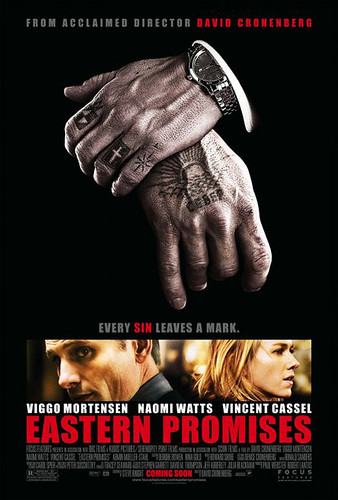
Jessica Hughes: In the Bathhouse: -- Collective Violence and Eastern Promises

(Warning: plot spoilers throughout this essay)

In the Bathhouse: Collective Violence and Eastern Promises
by Jessica Hughes
Cinephile


In Eastern Promises, Nikolai (Viggo Mortensen) is similarly caught between the ‘I’ and the ‘we’ in his relationship with both Scotland Yard and the Russian mafia. Both groups offer a sense of belonging that is Nikolai’s reality, making him unable to exist as an individual without also being part of the group. But, the maintenance of the ‘I’ within the inseparable ‘we’ calls attention to Badiou’s representation of the collective as a contradictory relationship between the group and the individual: “The demand of the ‘we’ [...] appears as a demand for inseparateness.” Rather than insisting on a complete transformation of the ‘I’ into the ‘we’, Badiou suggests it is more important for “the ‘I’ to abide within the ‘we’ in an inseparate form” so as to highlight the individual’s existence within the group (122). In accordance with this, rather than wholly submitting himself to either group, Nikolai maintains his sense of ‘I’ as a part of the ‘we’ in order to reinforce his role as a supporter of the greater Idea. Just as the relationship between the young Comrade and the Communist Party suggests in The Decision, the obligation for a permanent bond between members of the vory v zakone in Eastern Promises is so strong that if one were to expose himself as an outsider, it would be necessary to eliminate that person altogether. With this in mind, Nikolai takes advantage of the conformity expected from members of the mob and works his way to the top by means of forged loyalty.

The film opens with a murder arranged by Kirill (Vincent Cassel), the son of a Russian mafia leader in London, Semyon (Armin Mueller-Stahl). To dispose of the bloody corpse, Kirill calls in Nikolai, whom we learn is both Kirill’s driver and ‘undertaker’. Later in the film, however, when Nikolai is shown relaying his life story to the senior members of the vory v zakone (literally, “thieves by the code”), it becomes clear that he is a greater asset to Semyon’s family. His interview with the head members of the gang is followed by the tattooing of three stars on his body: two on either side of his heart and one on his knee. These stars signify his acceptance into the family, a decision based on his perceived devotion to the group as well as his criminal past-as illustrated by the array of Siberian prison tattoos already adorning his body. After he passes this physical examination, Nikolai is elevated to the same status as Kirill within the hierarchy of the mob family. However, this promotion turns out to be a ploy arranged by Semyon to save his son’s reputation. Two scenes later, Nikolai meets Azim (Mina E. Mina), a member from a rival faction, at the local bathhouse, for a meeting arranged by both the family that has taken him in and the rival Chechen family, who believe he is Kirill. Leaving Nikolai in the bathhouse, Azim tells two other men that ‘Kirill’ is waiting for them and they will recognize him by his vory v zakone tattoos. The two men enter the steam room and brutally attack Nikolai, who, naked and unarmed, appears completely vulnerable, though his self-defense skills quickly counter this impression.

The details of this scene draw attention to the way Eastern Promises portrays the relationship between appearance, truth, and the figure of the Real. The preceding scenes suggest Nikolai is accepted into the family because they value his dedication, but the bathhouse scene proves otherwise. The reliance on group membership is emphasized here by the fact that, in a group with distinctive traits, such as the tattoos of the Russian mafia, members are distinguishable by their ranking, rather than as individuals. Thus, Nikolai can easily be mistaken for Kirill because they have the same markings on their bodies, which declare not only their membership and position in the group but also their absolute loyalty. Semyon exploits this loyalty to the collective in order to maintain control-without the cooperation of the members, he would be unable to uphold his rule.

Although having the appropriate tattoos confirms Nikolai’s acceptance within the vory v zakone, it is also what betrays him to the attackers. The Real is presented here as the result of preconceived expectations of defining characteristics associated with groups rather than individuals. Nikolai’s connection to Kirill as a friend, brother, and guardian is enough to make him pass as the real Kirill, regardless of any other facts that might suggest otherwise. The film offers very little confirmed background information about Nikolai prior to the knife fight, so having the tattoos, and the consequential cuts on his body, confirm his association with Kirill and Semyon. Paradoxically, the ensuing gashes and bruises inflicted on Nikolai’s body satisfy a Badiouian passion for the Real, which convinces all parties, and the audience as well, of a loyalty paid for in blood. It is significant that the revelation that Nikolai is working for Scotland Yard succeeds the bathhouse scene, emphasizing how he has consciously risked his safety as an individual for the benefit of the group. In this sense, the damage done to the body is ultimately the cost of belonging to a collective and Nikolai is presented as the heroic figure. The passion for the Real is here expressed by the graphic violence of the bathhouse scene. Simultaneously, the scene forces the viewers to consider the implications of Nikolai’s naked and tattooed body-which at once marks him as part of a group, while, at the same time, renders him vulnerable and exposed, an individual struggling for his own survival.

While the power of the collective is emphasized here, on a deeper level it also reveals how being a member of a group can be used to advance one’s position as an individual. Rather than devoting himself entirely to one group, Nikolai pledges his allegiance to both the vory v zakone and Scotland Yard by offering portions of his individuality to each. In the process, however, he is forced to come to terms with the cruelty he has become tied to by association. In his study of how violent acts are influenced by other people and events, historian and philosopher Rene Girard observes: “[m]en cannot confront the naked truth of their own violence without the risk of abandoning themselves to it entirely” (87). Rather than openly accepting our roles as individuals, Girard suggests that it is easier to attribute our violent tendencies to some kind of collective bond by joining forces with other individuals who are likely to issue the same kind of reactions. This allows us to incorporate cruelty into our lives without accepting personal responsibility for it. The violence Nikolai partakes in is similarly justified by his ties to a greater cause-Scotland Yard’s effort to reduce crime by bringing down the Russian mob.

To Read the Rest of the Essay

Saturday, January 15, 2011

Brian Fauteux: Television, Live Transmission -- Control and the Televised Performance Scene

Television, Live Transmission: Control and the Televised Performance Scene
by Brian Fauteux
Cinephile


A performance scene is a critical component of the music biopic, establishing links between the past and present, and between viewers and their memories of a particular band or (more often than not deceased) artist. Performances-whether revered or criticized-highlight memorable moments of a musical career and can motivate and structure the narrative of a music biopic. Gary R. Edgerton cites television as an especially influential medium for delivering music performances to viewers, arguing that it has “transformed the way tens of millions of viewers think about historical figures and events” through numerous nonfictional and fictional portrayals (1). This essay considers the televised performance of “Transmission” by Joy Division in Anton Corbijn’s Control (2007) to highlight the ways in which the performance scene, as a signature event in the band’s popular memory, bridges the past and present by integrating aspects of the original televised performances into contemporary popular culture. Moreover, the performance of “Transmission” marks a critical point in Joy Division’s career. The band generates attention and popularity through the exposure granted by the power of television-an increasingly prominent medium in the promotion of popular music at the time of the original performances. Corbijn’s representation of the “Transmission” performance advances both the represented and popular historic narrative of the band, illustrating the significant contribution of both television and film to the collective and popular history and memory of Joy Division.

Control recalls the life of the late Ian Curtis (Sam Riley), from his time as a young David Bowie fan and student in Macclesfield, England, to his years as the lead singer of Joy Division. The film ends with Curtis’s suicide on May 18, 1980, succeeding emotional hardships stemming from his difficulties in balancing his marriage to Deborah Woodruff (Samantha Morton), and time spent on the road with his band and girlfriend, Annik Honoré (Alexandra Maria Lara). Control is Corbijn’s first feature film, following a directorial career that includes many music videos, such as Nirvana’s “Heart-Shaped Box” (1993), multiple videos for Depeche Mode (e.g. “Personal Jesus” in 1989 and “In Your Room” in 1994), and the video for Joy Division’s “Atmosphere” (1988 reissue). Corbijn’s relationship to Joy Division precedes his direction of “Atmosphere,” as he photographed the band in the late 1970s. As Corbijn notes in a recent interview, “I had moved to England to be close to that music at the time, and I was very into Joy Division. I worked with them, took pictures of them that became synonymous with their music, and I was forever linked” (Tewksbury). The framing, composition and aesthetics of the places and spaces seen and heard in Control are often reflective of Corbijn’s iconic black-and-white images from that time.

Corbijn’s transition from photographing Joy Division to directing a feature film about the band is important to consider within the context of the music biopic. Certainly, Corbijn’s extensive role as a shaper of Joy Division’s mediated image factors into the way in which Control’s aesthetics and narrative are represented. The high-contrast black and white scenes in Control recall this relationship between Corbijn and Joy Division-that of the mediator and the mediated-emphasizing the camera’s place in representing, re-imagining, and transmitting music history. It seems fitting then, that Corbijn should choose to amalgamate two memorable live televised performances into his “Transmission” scene: the September 1978 performance of “Shadowplay” on Tony Wilson’s Granada Reports, and the September 1979 performance of “Transmission,” Unknown Pleasure’s non-album single, on BBC2’s Something Else. “Transmission” is the only full-length, complete performance in the film, recorded and played in actuality by Riley and the other actors who play the band.

Control’s “Transmission” performance begins in similar fashion to the 1978 performance of “Shadowplay” (with some slight differences in Wilson’s introduction of the band). Riley, like Curtis, stands to the left of Craig Parkinson (playing Wilson), with his head bowed as the band is introduced: “Seeing as how this is the first television program which brought you the first appearances from everyone from The Beatles to The Buzzcocks, we like to think we bring you the most new and interesting sounds in the Northwest. They’re called Joy Division…” The band of actors is positioned on individual cylindrical podiums (aside from the drummer, Harry Treadaway, playing Stephen Morris), just as Joy Division is on the original Granada Reports performance of “Shadowplay.” After this introduction, the scene cuts to a shot of the performance framed by a television set in the Curtis family homes (that of Ian’s parents’ and of Ian and Deborah’s), followed then by the performance of “Transmission,” which, for the most part, mirrors the 1979 BBC2 performance. The iconic shots of Peter Hook with his Rickenbacker bass are recreated with actor Joe Anderson in Hook’s place, and the low-angle shots from the original broadcast looking up at Bernard Sumner (James Anthony Pearson), who glares downward at his guitar neck while playing the song’s riff, also make their way into Corbijn’s representation of “Transmission.” The performance effectively joins the most compelling parts from the original two broadcasts: that of Wilson’s introduction of “Shadowplay,” and the more proficient performance of “Transmission” that takes place later in the band’s career. The result is a new performance scene that draws upon memorable moments from Joy Division’s popular history.

To Read the Rest of the Essay and View the Clip of the Scene

Thursday, January 13, 2011

ENG 282: International Film Studies -- Spring 2011

IMDB

Y Tu Mamá También (Mexico: Alfonso Cuarón, 2001: 106 mins)

City of God (Brazil: Fernando Meirelles and Kátia Lund, 2002: 130 mins)

Oldboy (South Korea: Chan-wook Park, 2003: 120 mins)

I Heart Huckabees (USA/Germany: David O'Russell, 2004: 107 mins)

Moolaadé (Burkina Faso/Senegal: Ousmane Sembene, 2004: 124 mins)

Cache (France/Austria: Michael Haneke, 2005: 117 mins)

Pan's Labyrinth (Spain/USA/Mexico: Guillermo del Toro, 2006: 119 mins)

Shortbus (USA: John Cameron Mitchell, 2006: 101 mins)

Still Life (China/Hong Kong: Jia Zhangke, 2006: 111 mins)

Syndromes and a Century (Thailand: Apichatpong Weerasethakul, 2006: 105 mins)

4 Months, 3 Weeks, and 2 Days (Romania: Cristian Mungiu, 2007: 113 mins)

Gomorrah (Italy: Matteo Garrone, 2008: 137 mins)

Hunger (Ireland/UK: Steve McQueen, 2008: 96 mins)

Waltz with Bashir (Israel: Ari Folman, 2008: 90 mins)