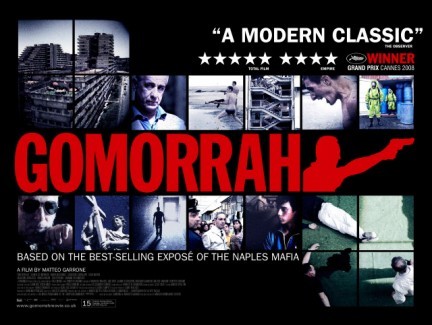
(I recently read Gomorrah while traveling. It is a gripping expose of the Italian Camorra and resonates for anyone exploring the tangled web of the global economy--highly recommended!!!)
NEW ITALIAN EPIC: WE'RE GOING TO HAVE TO BE THE PARENTS
by Wu Ming
Opening talk @ the conference "The Italian Perspective on Metahistorical Fiction: The New Italian Epic", Institute of Germanic and Romance Studies, University of London, UK, October
2, 2008.
Wu Ming Founbdation
...
This is what I call the New Italian Epic. Its main characteristics are:
1. Ethical commitment to writing and storytelling, which means: a deep trust in the healing power of language and stories.
2. A sense of political necessity -- and you can choose between the broader and the stricter sense of the adjective "political".
3. The choice of stories that have a complex allegorical value. The initial choice may not even be intentional: the author may feel compelled to tell the story and later on understand what he was trying to say.
4. An explicit preoccupation for the loss of the future, with a propensity to use alternative history and alternative realities to force our gaze into imagining the future.
5. A subtle subversion of registers and language. "Subtle" because what's important is not language experimentation in and of itself; what's important is telling your story in what you feel is the best possible way.
6. A way of blending fiction and non-fiction that's different from the ones we've gotten used to (e.g. Hunter S. Thompson's "gonzo journalism"), a manner that I dare describe as "distinctly Italian", which produces "unidentified narrative objects".
7. Last but certainly not least, a "communitarian" use of the Internet to - as Genna himself put it - "share a hug with the reader".
Several books published in Italy in the past few years share all or many of these features. Each one is peculiar, and sometimes, if we judge by immediate appearances, a novel doesn't resemble the next in the slightest: different styles, different plots, different historical backdrops, seemingly different genres. And yet, if we go down deep enough, we'll see that all these books are in resonance with each other.
The most famous and successful of these works is of course Roberto Saviano's Gomorrah, which sold about a million and a half copies and triumphantly entered Italian popular culture. In Gomorrah the synthesis of non-fiction and auto-fiction is so subtle that it reaches uncanny heights. It looks like a powerful report on Naples' organized crime and the way it operates in the globalized economy, and certainly the state of things it describes is painfully real, but this is no ordinary piece of journalism. There are also autobiographical, introspective chapters. In many passages the prose is rather visionary. The "narrating I" frequently hallucinates and "hijacks" the points of view of other people, intentionally playing on the confusion between the author, the narrator and a "narrating I" that doesn't belong to any of them. Alessandro Vicenzi summarized this matter in the most simple and effective way:
Saviano indifferently uses police reports, judicial documents and personal experience, and describes the camorra adopting a first-person narrative, but the "I" of the novel isn't always the real Roberto Saviano. The book oscillates between objective accounts and literary renditions of facts. [...] If Saviano uses the first person to describe things he didn't actually witness it's because that is the most effective way of telling them, the most communicative one, the most absorbing one. [...] Saviano doesn't only jump over the barriers between fiction and non-fiction: he utterly ignores them. I don't know on what shelves bookshop clerks are putting Gomorrah now. I suspect that the success of the book allows them to overcome embarrassment and put the book in those displays of best-sellers at the entrance, where there are no particular genre distinctions.
As I said a few minutes ago, these works are different from the"non-fiction novels" and hyper-subjective news stories in the tradition of so-called "New Journalism" or "gonzo journalism". That kind of writing is now quite familiar, while these works are more disquieting. I believe that the most appropriate adjective is "uncanny". When the book was published in the English-speaking countries (unfortunately in a poor translation), reviewers got puzzled about it. Here's a passage from Rachel Donadio's review in The New York Times:
Far more problematic is the difficulty in pinning this book down. In Italy, Gomorrah was described as a "docufiction," suggesting that Saviano took liberties with his first-person accounts. [The American publisher] calls it a work of "investigative writing," a phrase that suggests careful lawyering. Some anecdotes are suspiciously perfect — the tailor who quits his job after seeing Angelina Jolie on television at the Oscars wearing a white suit he made in a Camorra sweatshop; the man who loves his AK-47 so much he makes a pilgrimage to Russia to visit its creator, Mikhail Kalashnikov. Did the author change any names? If so, readers aren’t informed. These are ot small matters, and should have been disclosed. But the emotional truth of Saviano’s account is unassailable. I could not get this brave book out of my head.
I guess Donadio never had such perplexities in reading a book by Hunter S. Thompson. Nobody ever cared about what was true and what was fictional in Thompson's writing. What's the difference here?
The difference is that Gomorrah is far from being an ironic piece of work. Gomorrah is d-e-a-d-l-y serious.
As you all probably know, "uncanny" is the way we translate into English a word Sigmund Freud used: "Unheimliche". Unheimliche is used for things that look repulsively strange and attractively familiar at the same time.
As happens in Genna's Medium, in Gomorrah too a troublesome relationship between the narrator and his father becomes strongly symbolic of something bigger. It casts light on the ambiguous "double-consciousness" several Southern Italians are painfully aware of. The narrator is the child of a culture that he cannot really renounce, and although he deeply despises the mafia and fights against it, he knows that the mafia is part of that culture, that it is consistent with that culture. In fact the nàrrator shares some deep conceptual frames with the people he denounces, and he admits it by sharing with us memories from his childhood, conversations with his father. To the narrator's eyes, the camorra is uncanny, it's repulsively strange and attractively familiar at the same time. Gomorrah is an unidentified narrative object about an unidentified feeling. The readers read their way through an "uncanny valley", and Saviano walks through another "uncanny valley": a larger one, a social one, an anthropological one.
"Uncanny valley" is a phrase coined by Japanese engineer Mori Masahiro in 1970. Mori's hypothesis is that when a robot looks and acts almost like a human being, this will cause a response of horror and rejection among humans. According to Mori, it's a case of the night being darker just before dawn, because as soon as the robot will look and act exactly like a human being, reactions among humans will be positive. He calls this period of revulsion "the uncanny valley", because it's a dip in a graph.
Now, forget about robots. I think this is a useful metaphor to describe the way an unidentified narrative object is perceived by attentive readers. There's a phase in which you start asking yourself: how is it possible that Saviano witnessed a scene like this? Mobsters using heroin addicts as guinea pigs to test newly arrived stuff, junkies collapsing after they shot up, people left to die? Where the hell was Saviano to see anything like this? Who's the narrating I? If this is undercover journalism, what is Saviano's cover? Where is he hidden? Is the narrator Saviano? Am I reading a piece of journalism or am I reading a novel disguised as a piece of journalism? You just entered the "uncanny valley" of the unidentified narrative object. Less attentive readers may never experience this, because they take everything for granted.
Anyway, it's just a dip in the graph, because you go on reading the book and gradually understand what Saviano is trying to do, and you not only accept it: you're moved by it, because this thing does the job very well, and doubts and revulsion are replaced by admiration.
My hypothesis is that many of those who criticized Gomorrah for its "ambiguity" and accused Saviano of "having confused things", never got over the dip, they stopped reading right in the middle of the "uncanny valley", and never got out of it.
Every "unidentified narrative object" has its "uncanny valley". In Medium, for example, it is located at the beginning of the second chapter, right after the funeral.
One of the most impressive things in Gomorrah is the scope, the scale of the book: the journey begins at the docks of Naples and in the destitute outskirts of that city, but then Saviano takes us to Russia, Bélarùs, Scotland, the United States, Spain, the Middle East, Hollywood, Colombia... Saviano's gaze makes incursions all over the world, because Italian organized crime makes business all over the world.
Nothing to be patriotic about.
To Read the Entire Essay