Showing posts with label Organized Crime. Show all posts

Sunday, January 16, 2011

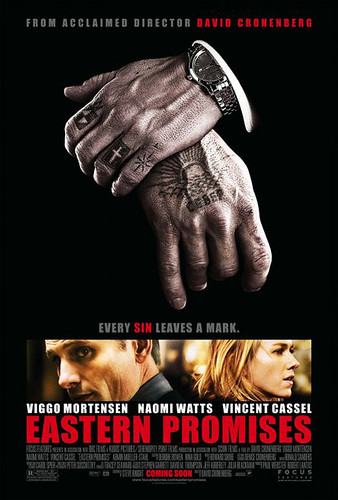
Jessica Hughes: In the Bathhouse: -- Collective Violence and Eastern Promises

(Warning: plot spoilers throughout this essay)

In the Bathhouse: Collective Violence and Eastern Promises
by Jessica Hughes
Cinephile


In Eastern Promises, Nikolai (Viggo Mortensen) is similarly caught between the ‘I’ and the ‘we’ in his relationship with both Scotland Yard and the Russian mafia. Both groups offer a sense of belonging that is Nikolai’s reality, making him unable to exist as an individual without also being part of the group. But, the maintenance of the ‘I’ within the inseparable ‘we’ calls attention to Badiou’s representation of the collective as a contradictory relationship between the group and the individual: “The demand of the ‘we’ [...] appears as a demand for inseparateness.” Rather than insisting on a complete transformation of the ‘I’ into the ‘we’, Badiou suggests it is more important for “the ‘I’ to abide within the ‘we’ in an inseparate form” so as to highlight the individual’s existence within the group (122). In accordance with this, rather than wholly submitting himself to either group, Nikolai maintains his sense of ‘I’ as a part of the ‘we’ in order to reinforce his role as a supporter of the greater Idea. Just as the relationship between the young Comrade and the Communist Party suggests in The Decision, the obligation for a permanent bond between members of the vory v zakone in Eastern Promises is so strong that if one were to expose himself as an outsider, it would be necessary to eliminate that person altogether. With this in mind, Nikolai takes advantage of the conformity expected from members of the mob and works his way to the top by means of forged loyalty.

The film opens with a murder arranged by Kirill (Vincent Cassel), the son of a Russian mafia leader in London, Semyon (Armin Mueller-Stahl). To dispose of the bloody corpse, Kirill calls in Nikolai, whom we learn is both Kirill’s driver and ‘undertaker’. Later in the film, however, when Nikolai is shown relaying his life story to the senior members of the vory v zakone (literally, “thieves by the code”), it becomes clear that he is a greater asset to Semyon’s family. His interview with the head members of the gang is followed by the tattooing of three stars on his body: two on either side of his heart and one on his knee. These stars signify his acceptance into the family, a decision based on his perceived devotion to the group as well as his criminal past-as illustrated by the array of Siberian prison tattoos already adorning his body. After he passes this physical examination, Nikolai is elevated to the same status as Kirill within the hierarchy of the mob family. However, this promotion turns out to be a ploy arranged by Semyon to save his son’s reputation. Two scenes later, Nikolai meets Azim (Mina E. Mina), a member from a rival faction, at the local bathhouse, for a meeting arranged by both the family that has taken him in and the rival Chechen family, who believe he is Kirill. Leaving Nikolai in the bathhouse, Azim tells two other men that ‘Kirill’ is waiting for them and they will recognize him by his vory v zakone tattoos. The two men enter the steam room and brutally attack Nikolai, who, naked and unarmed, appears completely vulnerable, though his self-defense skills quickly counter this impression.

The details of this scene draw attention to the way Eastern Promises portrays the relationship between appearance, truth, and the figure of the Real. The preceding scenes suggest Nikolai is accepted into the family because they value his dedication, but the bathhouse scene proves otherwise. The reliance on group membership is emphasized here by the fact that, in a group with distinctive traits, such as the tattoos of the Russian mafia, members are distinguishable by their ranking, rather than as individuals. Thus, Nikolai can easily be mistaken for Kirill because they have the same markings on their bodies, which declare not only their membership and position in the group but also their absolute loyalty. Semyon exploits this loyalty to the collective in order to maintain control-without the cooperation of the members, he would be unable to uphold his rule.

Although having the appropriate tattoos confirms Nikolai’s acceptance within the vory v zakone, it is also what betrays him to the attackers. The Real is presented here as the result of preconceived expectations of defining characteristics associated with groups rather than individuals. Nikolai’s connection to Kirill as a friend, brother, and guardian is enough to make him pass as the real Kirill, regardless of any other facts that might suggest otherwise. The film offers very little confirmed background information about Nikolai prior to the knife fight, so having the tattoos, and the consequential cuts on his body, confirm his association with Kirill and Semyon. Paradoxically, the ensuing gashes and bruises inflicted on Nikolai’s body satisfy a Badiouian passion for the Real, which convinces all parties, and the audience as well, of a loyalty paid for in blood. It is significant that the revelation that Nikolai is working for Scotland Yard succeeds the bathhouse scene, emphasizing how he has consciously risked his safety as an individual for the benefit of the group. In this sense, the damage done to the body is ultimately the cost of belonging to a collective and Nikolai is presented as the heroic figure. The passion for the Real is here expressed by the graphic violence of the bathhouse scene. Simultaneously, the scene forces the viewers to consider the implications of Nikolai’s naked and tattooed body-which at once marks him as part of a group, while, at the same time, renders him vulnerable and exposed, an individual struggling for his own survival.

While the power of the collective is emphasized here, on a deeper level it also reveals how being a member of a group can be used to advance one’s position as an individual. Rather than devoting himself entirely to one group, Nikolai pledges his allegiance to both the vory v zakone and Scotland Yard by offering portions of his individuality to each. In the process, however, he is forced to come to terms with the cruelty he has become tied to by association. In his study of how violent acts are influenced by other people and events, historian and philosopher Rene Girard observes: “[m]en cannot confront the naked truth of their own violence without the risk of abandoning themselves to it entirely” (87). Rather than openly accepting our roles as individuals, Girard suggests that it is easier to attribute our violent tendencies to some kind of collective bond by joining forces with other individuals who are likely to issue the same kind of reactions. This allows us to incorporate cruelty into our lives without accepting personal responsibility for it. The violence Nikolai partakes in is similarly justified by his ties to a greater cause-Scotland Yard’s effort to reduce crime by bringing down the Russian mob.

To Read the Rest of the Essay

Saturday, September 18, 2010

Media Matters: Alex Gibney -- Casino Jack and the United States of Money

Alex Gibney - Filmmaker talks with Bob about "Casino Jack"
Media Matters with Bob McChesney (WILL: Illinois)


Alex Gibney is the founder of Jigsaw Productions. An Oscar, Emmy and Grammy award-winning producer, he is well known for producing one of the top grossing documentaries of all time, “Enron: The Smartest Guys in the Room.” In addition, Gibney is sought after for his experience in mounting large international productions, particularly multi-part series, such as Martin Scorsese’s Emmy and Grammy award-winning “The Blues” and David Halberstam’s “The Fifties.”

An accomplished writer and director in his own right, Gibney is the leading creative force behind many of Jigsaw’s productions and is well known for crafting stories that take an unflinching look at the political landscape of America. His work as a writer/director includes: the 2008 Oscar-winning film "Taxi to the Dark Side," the 2006 Oscar-nominated film “Enron: The Smartest Guys in the Room,” and the current Magnolia Pictures release, “Gonzo: The Life and Work of Dr. Hunter S. Thompson,” featuring Johnny Depp.

To Listen to the Episode

Tuesday, July 27, 2010

Democracy Now: Jury Convicts Chicago Police Commander Jon Burge of Lying About Torture

Jury Convicts Chicago Police Commander Jon Burge of Lying About Torture
Democracy Now

Decades after torture allegations were first leveled against former Chicago police commander Jon Burge, a federal jury has found him guilty of lying about torturing prisoners into making confessions. Burge has long been accused of overseeing the systematic torture of more than 100 African American men. Two years ago federal prosecutors finally brought charges against Burge—not for torture, but for lying about it. On Monday afternoon, after a five-week trial, Jon Burge was found guilty on all counts of perjury and obstruction of justice for lying about the abuse. He could face up to forty-five years in prison.

To Watch/Listen/Read

Tuesday, July 20, 2010

Roderick Heath on Election (Johnnie To, 2005)

Election (Hak se wui, 2005) Director: Johnnie To
by Roderick Heath
Ferdy on Films


...

To’s quick eye takes in a raft of small details that fill out the universe of the triad bosses with alternatively disarming and dismaying effect. Most of these gangsters aren’t actually very tough or especially good at their jobs—they’re mostly middle-age men whose days of roughneck street warfare and standover work are behind them. Amongst the younger ones, who include young punks with something to prove, and genuinely fierce warriors in need of a watchful eye, the slickest is the preternaturally cool Jimmy Lee (Louis Koo), who distributes bribes and collects debts whilst also attending seminars in finance. Small and large rituals—Teng Wai making tea for the uncles to seal their election decision; a later, full-on, religious-flavoured, blood-brother ceremony—define and seal their society. The power of ritual and tradition is simultaneously endangered, illusory, and still binding in subtle and supple ways. The governorship of the triad is established by totems and oaths, and but these are only emblems of real things, and the competition to command the emblems will finally express the reality of those symbols. As the film plays out, the meanings of those symbols become thoroughly apparent.

Election also hints at broader meanings through its title: the election, the illusion of democracy, is a sanctified ritual in the triad. But it’s only possible because of the mutual consent of powerful men, and To encompasses the history of Hong Kong and the relationship of Chinese society to centuries of hegemonic rulers both foreign and domestic. Simultaneously, what adherence to a creed means is taken seriously all the way through, even though the drama is driven by upstart Big D’s refusal to accept the rules, a breach of the creed. He threatens that if he doesn’t get his way, he will break away and form his own triad, a potent threat indeed as no one wants a war. The police know they can’t stamp out the triads, and are happy to act as something like referees in this game to reduce collateral damage; their attempts to corral the uncles before the situation combusts prove partly successful. In a moment that’s both ribald and telling, Long Gun, whilst berating Sam and Big D for failing to give a big enough bribe, orders a nubile young prostitute to jump up and down for him: those old farts are happy as long as their pockets are stuffed, their dicks are wet, and the world’s jumping to their regulated beat.

To Read the Rest of the Essay

Wednesday, July 14, 2010

Democracy Now: Rolling Stone’s Tim Dickinson on the Inside Story of How Obama Let the World’s Most Dangerous Oil Company Get Away with Murder

Rolling Stone’s Tim Dickinson on the Inside Story of How Obama Let the World’s Most Dangerous Oil Company Get Away with Murder
Democracy Now

An extensive new investigation into the Obama administration’s handling of the BP oil spill disaster reveals that it was government mismanagement, delays and absence of oversight that allowed the crisis to spiral out of control. In the article "The Spill, the Scandal, and the President," Rolling Stone’s Tim Dickinson writes, "Though George W. Bush paved the way for the catastrophe, it was Obama who gave BP the green light to drill." Dickinson explores how Interior Secretary Ken Salazar kept in place the oil industry-friendly environmental guidelines that Bush had implemented and ultimately let BP, an oil company with the worst safety record, to get away with murder.

To Watch/Listen/Read and Access More Resources

Sunday, May 23, 2010

Bill Moyers Journal: Capitol Crimes

Capitol Crimes
Bill Moyers Journal


With disgraced lobbyist Jack Abramoff back in the news and on the big screen in Alex Gibney's new film, CASINO JACK AND THE UNITED STATES OF MONEY, we re-present Bill Moyers 2006 exploration of Abramoff and his Washington world. CAPITOL CRIMES delved deep into the dark side of American politics — bringing to light a web of relationships, secret deals and political manipulation. The DALLAS MORNING NEWS said: "If anyone can untangle a complicated new story and make it understandable, it's Bill Moyers. So if you're trying to figure out the Jack Abramoff lobbying scandal, he explains it all in CAPITOL CRIMES."


To Watch the Episode

Saturday, April 24, 2010

Nils Gilman: The Global Illicit Economy


A new class of global actors is playing an increasingly important role in globalization: smugglers, warlords, guerrillas, terrorists, gangs, and bandits of all stripes. Since the end of the Cold War, the global illicit economy has consistently grown at twice the rate of the licit global economy. Increasingly, illicit actors will represent not just an economic but a political force. As globalization hollows out traditional nation-states, what will fill the power vacuum in slums and hinterlands will be informal non-state governance structures. These zones will be globally connected, effectively run by local gangs, religious leaders, or quasi-tribal organizations – organizations that will govern without aspiring to statehood.

Friday, April 23, 2010

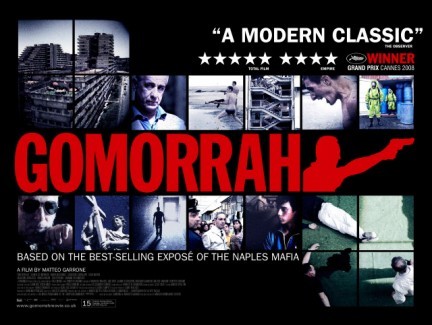
Wu Ming: New Italian Epic; Roberto Saviano: Gomorrah

(I recently read Gomorrah while traveling. It is a gripping expose of the Italian Camorra and resonates for anyone exploring the tangled web of the global economy--highly recommended!!!)

NEW ITALIAN EPIC: WE'RE GOING TO HAVE TO BE THE PARENTS
by Wu Ming
Opening talk @ the conference "The Italian Perspective on Metahistorical Fiction: The New Italian Epic", Institute of Germanic and Romance Studies, University of London, UK, October
2, 2008.
Wu Ming Founbdation


...

This is what I call the New Italian Epic. Its main characteristics are:

1. Ethical commitment to writing and storytelling, which means: a deep trust in the healing power of language and stories.

2. A sense of political necessity -- and you can choose between the broader and the stricter sense of the adjective "political".

3. The choice of stories that have a complex allegorical value. The initial choice may not even be intentional: the author may feel compelled to tell the story and later on understand what he was trying to say.

4. An explicit preoccupation for the loss of the future, with a propensity to use alternative history and alternative realities to force our gaze into imagining the future.

5. A subtle subversion of registers and language. "Subtle" because what's important is not language experimentation in and of itself; what's important is telling your story in what you feel is the best possible way.

6. A way of blending fiction and non-fiction that's different from the ones we've gotten used to (e.g. Hunter S. Thompson's "gonzo journalism"), a manner that I dare describe as "distinctly Italian", which produces "unidentified narrative objects".

7. Last but certainly not least, a "communitarian" use of the Internet to - as Genna himself put it - "share a hug with the reader".

Several books published in Italy in the past few years share all or many of these features. Each one is peculiar, and sometimes, if we judge by immediate appearances, a novel doesn't resemble the next in the slightest: different styles, different plots, different historical backdrops, seemingly different genres. And yet, if we go down deep enough, we'll see that all these books are in resonance with each other.

The most famous and successful of these works is of course Roberto Saviano's Gomorrah, which sold about a million and a half copies and triumphantly entered Italian popular culture. In Gomorrah the synthesis of non-fiction and auto-fiction is so subtle that it reaches uncanny heights. It looks like a powerful report on Naples' organized crime and the way it operates in the globalized economy, and certainly the state of things it describes is painfully real, but this is no ordinary piece of journalism. There are also autobiographical, introspective chapters. In many passages the prose is rather visionary. The "narrating I" frequently hallucinates and "hijacks" the points of view of other people, intentionally playing on the confusion between the author, the narrator and a "narrating I" that doesn't belong to any of them. Alessandro Vicenzi summarized this matter in the most simple and effective way:

Saviano indifferently uses police reports, judicial documents and personal experience, and describes the camorra adopting a first-person narrative, but the "I" of the novel isn't always the real Roberto Saviano. The book oscillates between objective accounts and literary renditions of facts. [...] If Saviano uses the first person to describe things he didn't actually witness it's because that is the most effective way of telling them, the most communicative one, the most absorbing one. [...] Saviano doesn't only jump over the barriers between fiction and non-fiction: he utterly ignores them. I don't know on what shelves bookshop clerks are putting Gomorrah now. I suspect that the success of the book allows them to overcome embarrassment and put the book in those displays of best-sellers at the entrance, where there are no particular genre distinctions.


As I said a few minutes ago, these works are different from the"non-fiction novels" and hyper-subjective news stories in the tradition of so-called "New Journalism" or "gonzo journalism". That kind of writing is now quite familiar, while these works are more disquieting. I believe that the most appropriate adjective is "uncanny". When the book was published in the English-speaking countries (unfortunately in a poor translation), reviewers got puzzled about it. Here's a passage from Rachel Donadio's review in The New York Times:

Far more problematic is the difficulty in pinning this book down. In Italy, Gomorrah was described as a "docufiction," suggesting that Saviano took liberties with his first-person accounts. [The American publisher] calls it a work of "investigative writing," a phrase that suggests careful lawyering. Some anecdotes are suspiciously perfect — the tailor who quits his job after seeing Angelina Jolie on television at the Oscars wearing a white suit he made in a Camorra sweatshop; the man who loves his AK-47 so much he makes a pilgrimage to Russia to visit its creator, Mikhail Kalashnikov. Did the author change any names? If so, readers aren’t informed. These are ot small matters, and should have been disclosed. But the emotional truth of Saviano’s account is unassailable. I could not get this brave book out of my head.


I guess Donadio never had such perplexities in reading a book by Hunter S. Thompson. Nobody ever cared about what was true and what was fictional in Thompson's writing. What's the difference here?

The difference is that Gomorrah is far from being an ironic piece of work. Gomorrah is d-e-a-d-l-y serious.

As you all probably know, "uncanny" is the way we translate into English a word Sigmund Freud used: "Unheimliche". Unheimliche is used for things that look repulsively strange and attractively familiar at the same time.

As happens in Genna's Medium, in Gomorrah too a troublesome relationship between the narrator and his father becomes strongly symbolic of something bigger. It casts light on the ambiguous "double-consciousness" several Southern Italians are painfully aware of. The narrator is the child of a culture that he cannot really renounce, and although he deeply despises the mafia and fights against it, he knows that the mafia is part of that culture, that it is consistent with that culture. In fact the nàrrator shares some deep conceptual frames with the people he denounces, and he admits it by sharing with us memories from his childhood, conversations with his father. To the narrator's eyes, the camorra is uncanny, it's repulsively strange and attractively familiar at the same time. Gomorrah is an unidentified narrative object about an unidentified feeling. The readers read their way through an "uncanny valley", and Saviano walks through another "uncanny valley": a larger one, a social one, an anthropological one.

"Uncanny valley" is a phrase coined by Japanese engineer Mori Masahiro in 1970. Mori's hypothesis is that when a robot looks and acts almost like a human being, this will cause a response of horror and rejection among humans. According to Mori, it's a case of the night being darker just before dawn, because as soon as the robot will look and act exactly like a human being, reactions among humans will be positive. He calls this period of revulsion "the uncanny valley", because it's a dip in a graph.

Now, forget about robots. I think this is a useful metaphor to describe the way an unidentified narrative object is perceived by attentive readers. There's a phase in which you start asking yourself: how is it possible that Saviano witnessed a scene like this? Mobsters using heroin addicts as guinea pigs to test newly arrived stuff, junkies collapsing after they shot up, people left to die? Where the hell was Saviano to see anything like this? Who's the narrating I? If this is undercover journalism, what is Saviano's cover? Where is he hidden? Is the narrator Saviano? Am I reading a piece of journalism or am I reading a novel disguised as a piece of journalism? You just entered the "uncanny valley" of the unidentified narrative object. Less attentive readers may never experience this, because they take everything for granted.

Anyway, it's just a dip in the graph, because you go on reading the book and gradually understand what Saviano is trying to do, and you not only accept it: you're moved by it, because this thing does the job very well, and doubts and revulsion are replaced by admiration.

My hypothesis is that many of those who criticized Gomorrah for its "ambiguity" and accused Saviano of "having confused things", never got over the dip, they stopped reading right in the middle of the "uncanny valley", and never got out of it.

Every "unidentified narrative object" has its "uncanny valley". In Medium, for example, it is located at the beginning of the second chapter, right after the funeral.

One of the most impressive things in Gomorrah is the scope, the scale of the book: the journey begins at the docks of Naples and in the destitute outskirts of that city, but then Saviano takes us to Russia, Bélarùs, Scotland, the United States, Spain, the Middle East, Hollywood, Colombia... Saviano's gaze makes incursions all over the world, because Italian organized crime makes business all over the world.

Nothing to be patriotic about.

To Read the Entire Essay