Establishing Split from Catherine Grant on Vimeo.
Showing posts with label Scene Analysis. Show all posts
Showing posts with label Scene Analysis. Show all posts
Saturday, January 22, 2011

Seung-hoon Jeong: Gaze, Suture, Interface: The Suicide Scene in Michael Haneke’s Caché
(If you have not seen this excellent film, wait to read this until after watching it because it will ruin the film for you. ENG 282 students, we will be watching this in class.)
Gaze, Suture, Interface: The Suicide Scene in Michael Haneke’s Caché
Seung-hoon Jeong
Cinephile (The University of British Columbia)
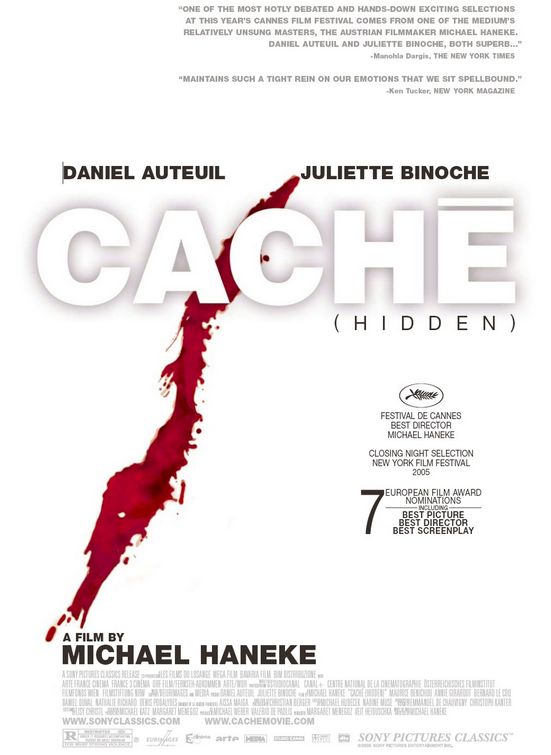
Georges (Daniel Auteuil), a host of a high-brow talk show, receives suspicious videotapes that display the peaceful façade of his upper middle class house. Nothing is clear in this CCTV footage in which there is ostensibly ‘nothing happening’: who has been watching his family, and why? Subsequent clips lead him to his childhood home and to an unknown apartment, which turns out to be the dingy place of his adopted, then abandoned, Algerian brother Majid (Maurice Bénichou). This forgotten ‘other’ confronts Georges with an uncomfortable truth from the past: young Georges’s jealousy forced Majid to be sent off to an orphanage, whereafter Majid had to survive without the educational and social benefits given to Georges. The nature of the video thus changes from provocation to evocation, from surveillance to reminiscence. Michael Haneke’s Caché [Hidden] (2005) uncannily uncovers this hidden trauma that resurfaces in the present. But my primary question is simple: why video?
Let me call this video an ‘interface’. Technically meaning the contact surface between image and spectator, the notion can be applied to the camera, the filmstrip, and the screen. That such a cinematic interface appears onscreen might not merit discussion in many cases, but it can play a central role in the narrative, whose unity is often thwarted and destabilized by the interface image. The subjectivity of characters or spectators can also be shaped or shaken through their encounters with the interface-within-the-film. A diegetic interface may then affect the ‘perception’ and ‘memory’ chain along which ‘image’ and ‘subjectivity’ are interconnected. Caché seems ideal for a case study in this regard, not only because of its video insertions, but because of the consequent revelation of perceptual and mnemonic mechanisms. What follows begins with a close analysis of a scene that exposes these mechanisms and thereby inspires us to explore, even expand the theoretical implications of the interface.
Among many significant scenes, I take Georges’s second visit to Majid’s flat as a kernel of the film’s structure. Its impressiveness, of course, bursts out of Majid’s sudden suicide; Majid lets Georges in, talks for a second, takes out a knife as Georges slightly falters, and slits his own throat, leaving no room for anticipation. The abruptness of this action marks the abruption of Majid’s emotion: a remarkable calmness and gentleness, not usually found in revenge suspects. It is rather Georges, the white Parisian intellectual, who has always lost his temper in front of his lower class, dark-skinned brother (and later, in front of Majid’s son, too); this Algerian outcast has reversed the standard image of the brutal invader of the bourgeois family like the De Niro figure in Cape Fear (Martin Scorsese, 1991). By killing himself, Majid releases something repressed beneath his tranquil face and fractures the peace of both his banlieue home and Georges’s bourgeois life. The flash of his blood sprayed onto the wall visualizes this fracture like an unstitched slash; the blood slowly exuding from his head onto the floor insinuates that this trauma will only grow like a nightmare in Georges’s memory.
In view of other scenes, Majid’s bloodstain on the wall triggers a déjà-vu that allows us to retroactively recognize the drawings sent to Georges (of a child vomiting blood) as forewarnings of this suicide. And through the same logic of ‘deferred action’ (Freudian Nachträglichkeit), this bloody event serves to repeat the film’s first instant flashback, prompted by a reverse-action tape, of young Majid coughing tubercular blood by a window, and the childhood trauma staged in Georges’s nightmare: Majid kills a cockerel, which also leaves a sharp blood mark, and he approaches Georges with the bloody hatchet. This killing was in fact orchestrated by Georges, but he told his parents that Majid had wanted to scare him, a joking lie that, along with Majid’s tuberculosis, ultimately resulted in Majid’s expulsion. However, only through recurrent visual traces after the fact does that original scene manifest its latent meaning as Georges’s original sin. The question would be how guilty and responsible the child and/or adult Georges is for that tiny ‘twisted joke’ that had lifelong repercussions/consequences for Majid. One may conclude: “Georges’s refusal as an adult to acknowledge the effects of his earlier actions suggests a parallel with the postcolonial metropolitan who is neither wholly responsible for, nor wholly untainted by, past events from which he or she has benefited” (Ezra and Sillars 219).1 Or, Majid’s suicide might bring a deep, if guilty, pleasure to a deeply ‘twisted’ xenophobe European: “the comforting idea that the colonial native can be made to disappear in an instant through the auto-combustive agency of their own violence” (Gilroy 234).
To See the Video of the Scene and Read the Rest of the Analysis
Gaze, Suture, Interface: The Suicide Scene in Michael Haneke’s Caché
Seung-hoon Jeong
Cinephile (The University of British Columbia)
Georges (Daniel Auteuil), a host of a high-brow talk show, receives suspicious videotapes that display the peaceful façade of his upper middle class house. Nothing is clear in this CCTV footage in which there is ostensibly ‘nothing happening’: who has been watching his family, and why? Subsequent clips lead him to his childhood home and to an unknown apartment, which turns out to be the dingy place of his adopted, then abandoned, Algerian brother Majid (Maurice Bénichou). This forgotten ‘other’ confronts Georges with an uncomfortable truth from the past: young Georges’s jealousy forced Majid to be sent off to an orphanage, whereafter Majid had to survive without the educational and social benefits given to Georges. The nature of the video thus changes from provocation to evocation, from surveillance to reminiscence. Michael Haneke’s Caché [Hidden] (2005) uncannily uncovers this hidden trauma that resurfaces in the present. But my primary question is simple: why video?
Let me call this video an ‘interface’. Technically meaning the contact surface between image and spectator, the notion can be applied to the camera, the filmstrip, and the screen. That such a cinematic interface appears onscreen might not merit discussion in many cases, but it can play a central role in the narrative, whose unity is often thwarted and destabilized by the interface image. The subjectivity of characters or spectators can also be shaped or shaken through their encounters with the interface-within-the-film. A diegetic interface may then affect the ‘perception’ and ‘memory’ chain along which ‘image’ and ‘subjectivity’ are interconnected. Caché seems ideal for a case study in this regard, not only because of its video insertions, but because of the consequent revelation of perceptual and mnemonic mechanisms. What follows begins with a close analysis of a scene that exposes these mechanisms and thereby inspires us to explore, even expand the theoretical implications of the interface.
Among many significant scenes, I take Georges’s second visit to Majid’s flat as a kernel of the film’s structure. Its impressiveness, of course, bursts out of Majid’s sudden suicide; Majid lets Georges in, talks for a second, takes out a knife as Georges slightly falters, and slits his own throat, leaving no room for anticipation. The abruptness of this action marks the abruption of Majid’s emotion: a remarkable calmness and gentleness, not usually found in revenge suspects. It is rather Georges, the white Parisian intellectual, who has always lost his temper in front of his lower class, dark-skinned brother (and later, in front of Majid’s son, too); this Algerian outcast has reversed the standard image of the brutal invader of the bourgeois family like the De Niro figure in Cape Fear (Martin Scorsese, 1991). By killing himself, Majid releases something repressed beneath his tranquil face and fractures the peace of both his banlieue home and Georges’s bourgeois life. The flash of his blood sprayed onto the wall visualizes this fracture like an unstitched slash; the blood slowly exuding from his head onto the floor insinuates that this trauma will only grow like a nightmare in Georges’s memory.
In view of other scenes, Majid’s bloodstain on the wall triggers a déjà-vu that allows us to retroactively recognize the drawings sent to Georges (of a child vomiting blood) as forewarnings of this suicide. And through the same logic of ‘deferred action’ (Freudian Nachträglichkeit), this bloody event serves to repeat the film’s first instant flashback, prompted by a reverse-action tape, of young Majid coughing tubercular blood by a window, and the childhood trauma staged in Georges’s nightmare: Majid kills a cockerel, which also leaves a sharp blood mark, and he approaches Georges with the bloody hatchet. This killing was in fact orchestrated by Georges, but he told his parents that Majid had wanted to scare him, a joking lie that, along with Majid’s tuberculosis, ultimately resulted in Majid’s expulsion. However, only through recurrent visual traces after the fact does that original scene manifest its latent meaning as Georges’s original sin. The question would be how guilty and responsible the child and/or adult Georges is for that tiny ‘twisted joke’ that had lifelong repercussions/consequences for Majid. One may conclude: “Georges’s refusal as an adult to acknowledge the effects of his earlier actions suggests a parallel with the postcolonial metropolitan who is neither wholly responsible for, nor wholly untainted by, past events from which he or she has benefited” (Ezra and Sillars 219).1 Or, Majid’s suicide might bring a deep, if guilty, pleasure to a deeply ‘twisted’ xenophobe European: “the comforting idea that the colonial native can be made to disappear in an instant through the auto-combustive agency of their own violence” (Gilroy 234).
To See the Video of the Scene and Read the Rest of the Analysis
Sunday, January 16, 2011
Jessica Hughes: In the Bathhouse: -- Collective Violence and Eastern Promises
(Warning: plot spoilers throughout this essay)
In the Bathhouse: Collective Violence and Eastern Promises
by Jessica Hughes
Cinephile

In Eastern Promises, Nikolai (Viggo Mortensen) is similarly caught between the ‘I’ and the ‘we’ in his relationship with both Scotland Yard and the Russian mafia. Both groups offer a sense of belonging that is Nikolai’s reality, making him unable to exist as an individual without also being part of the group. But, the maintenance of the ‘I’ within the inseparable ‘we’ calls attention to Badiou’s representation of the collective as a contradictory relationship between the group and the individual: “The demand of the ‘we’ [...] appears as a demand for inseparateness.” Rather than insisting on a complete transformation of the ‘I’ into the ‘we’, Badiou suggests it is more important for “the ‘I’ to abide within the ‘we’ in an inseparate form” so as to highlight the individual’s existence within the group (122). In accordance with this, rather than wholly submitting himself to either group, Nikolai maintains his sense of ‘I’ as a part of the ‘we’ in order to reinforce his role as a supporter of the greater Idea. Just as the relationship between the young Comrade and the Communist Party suggests in The Decision, the obligation for a permanent bond between members of the vory v zakone in Eastern Promises is so strong that if one were to expose himself as an outsider, it would be necessary to eliminate that person altogether. With this in mind, Nikolai takes advantage of the conformity expected from members of the mob and works his way to the top by means of forged loyalty.
The film opens with a murder arranged by Kirill (Vincent Cassel), the son of a Russian mafia leader in London, Semyon (Armin Mueller-Stahl). To dispose of the bloody corpse, Kirill calls in Nikolai, whom we learn is both Kirill’s driver and ‘undertaker’. Later in the film, however, when Nikolai is shown relaying his life story to the senior members of the vory v zakone (literally, “thieves by the code”), it becomes clear that he is a greater asset to Semyon’s family. His interview with the head members of the gang is followed by the tattooing of three stars on his body: two on either side of his heart and one on his knee. These stars signify his acceptance into the family, a decision based on his perceived devotion to the group as well as his criminal past-as illustrated by the array of Siberian prison tattoos already adorning his body. After he passes this physical examination, Nikolai is elevated to the same status as Kirill within the hierarchy of the mob family. However, this promotion turns out to be a ploy arranged by Semyon to save his son’s reputation. Two scenes later, Nikolai meets Azim (Mina E. Mina), a member from a rival faction, at the local bathhouse, for a meeting arranged by both the family that has taken him in and the rival Chechen family, who believe he is Kirill. Leaving Nikolai in the bathhouse, Azim tells two other men that ‘Kirill’ is waiting for them and they will recognize him by his vory v zakone tattoos. The two men enter the steam room and brutally attack Nikolai, who, naked and unarmed, appears completely vulnerable, though his self-defense skills quickly counter this impression.
The details of this scene draw attention to the way Eastern Promises portrays the relationship between appearance, truth, and the figure of the Real. The preceding scenes suggest Nikolai is accepted into the family because they value his dedication, but the bathhouse scene proves otherwise. The reliance on group membership is emphasized here by the fact that, in a group with distinctive traits, such as the tattoos of the Russian mafia, members are distinguishable by their ranking, rather than as individuals. Thus, Nikolai can easily be mistaken for Kirill because they have the same markings on their bodies, which declare not only their membership and position in the group but also their absolute loyalty. Semyon exploits this loyalty to the collective in order to maintain control-without the cooperation of the members, he would be unable to uphold his rule.
Although having the appropriate tattoos confirms Nikolai’s acceptance within the vory v zakone, it is also what betrays him to the attackers. The Real is presented here as the result of preconceived expectations of defining characteristics associated with groups rather than individuals. Nikolai’s connection to Kirill as a friend, brother, and guardian is enough to make him pass as the real Kirill, regardless of any other facts that might suggest otherwise. The film offers very little confirmed background information about Nikolai prior to the knife fight, so having the tattoos, and the consequential cuts on his body, confirm his association with Kirill and Semyon. Paradoxically, the ensuing gashes and bruises inflicted on Nikolai’s body satisfy a Badiouian passion for the Real, which convinces all parties, and the audience as well, of a loyalty paid for in blood. It is significant that the revelation that Nikolai is working for Scotland Yard succeeds the bathhouse scene, emphasizing how he has consciously risked his safety as an individual for the benefit of the group. In this sense, the damage done to the body is ultimately the cost of belonging to a collective and Nikolai is presented as the heroic figure. The passion for the Real is here expressed by the graphic violence of the bathhouse scene. Simultaneously, the scene forces the viewers to consider the implications of Nikolai’s naked and tattooed body-which at once marks him as part of a group, while, at the same time, renders him vulnerable and exposed, an individual struggling for his own survival.
While the power of the collective is emphasized here, on a deeper level it also reveals how being a member of a group can be used to advance one’s position as an individual. Rather than devoting himself entirely to one group, Nikolai pledges his allegiance to both the vory v zakone and Scotland Yard by offering portions of his individuality to each. In the process, however, he is forced to come to terms with the cruelty he has become tied to by association. In his study of how violent acts are influenced by other people and events, historian and philosopher Rene Girard observes: “[m]en cannot confront the naked truth of their own violence without the risk of abandoning themselves to it entirely” (87). Rather than openly accepting our roles as individuals, Girard suggests that it is easier to attribute our violent tendencies to some kind of collective bond by joining forces with other individuals who are likely to issue the same kind of reactions. This allows us to incorporate cruelty into our lives without accepting personal responsibility for it. The violence Nikolai partakes in is similarly justified by his ties to a greater cause-Scotland Yard’s effort to reduce crime by bringing down the Russian mob.
To Read the Rest of the Essay
In the Bathhouse: Collective Violence and Eastern Promises
by Jessica Hughes
Cinephile
In Eastern Promises, Nikolai (Viggo Mortensen) is similarly caught between the ‘I’ and the ‘we’ in his relationship with both Scotland Yard and the Russian mafia. Both groups offer a sense of belonging that is Nikolai’s reality, making him unable to exist as an individual without also being part of the group. But, the maintenance of the ‘I’ within the inseparable ‘we’ calls attention to Badiou’s representation of the collective as a contradictory relationship between the group and the individual: “The demand of the ‘we’ [...] appears as a demand for inseparateness.” Rather than insisting on a complete transformation of the ‘I’ into the ‘we’, Badiou suggests it is more important for “the ‘I’ to abide within the ‘we’ in an inseparate form” so as to highlight the individual’s existence within the group (122). In accordance with this, rather than wholly submitting himself to either group, Nikolai maintains his sense of ‘I’ as a part of the ‘we’ in order to reinforce his role as a supporter of the greater Idea. Just as the relationship between the young Comrade and the Communist Party suggests in The Decision, the obligation for a permanent bond between members of the vory v zakone in Eastern Promises is so strong that if one were to expose himself as an outsider, it would be necessary to eliminate that person altogether. With this in mind, Nikolai takes advantage of the conformity expected from members of the mob and works his way to the top by means of forged loyalty.
The film opens with a murder arranged by Kirill (Vincent Cassel), the son of a Russian mafia leader in London, Semyon (Armin Mueller-Stahl). To dispose of the bloody corpse, Kirill calls in Nikolai, whom we learn is both Kirill’s driver and ‘undertaker’. Later in the film, however, when Nikolai is shown relaying his life story to the senior members of the vory v zakone (literally, “thieves by the code”), it becomes clear that he is a greater asset to Semyon’s family. His interview with the head members of the gang is followed by the tattooing of three stars on his body: two on either side of his heart and one on his knee. These stars signify his acceptance into the family, a decision based on his perceived devotion to the group as well as his criminal past-as illustrated by the array of Siberian prison tattoos already adorning his body. After he passes this physical examination, Nikolai is elevated to the same status as Kirill within the hierarchy of the mob family. However, this promotion turns out to be a ploy arranged by Semyon to save his son’s reputation. Two scenes later, Nikolai meets Azim (Mina E. Mina), a member from a rival faction, at the local bathhouse, for a meeting arranged by both the family that has taken him in and the rival Chechen family, who believe he is Kirill. Leaving Nikolai in the bathhouse, Azim tells two other men that ‘Kirill’ is waiting for them and they will recognize him by his vory v zakone tattoos. The two men enter the steam room and brutally attack Nikolai, who, naked and unarmed, appears completely vulnerable, though his self-defense skills quickly counter this impression.
The details of this scene draw attention to the way Eastern Promises portrays the relationship between appearance, truth, and the figure of the Real. The preceding scenes suggest Nikolai is accepted into the family because they value his dedication, but the bathhouse scene proves otherwise. The reliance on group membership is emphasized here by the fact that, in a group with distinctive traits, such as the tattoos of the Russian mafia, members are distinguishable by their ranking, rather than as individuals. Thus, Nikolai can easily be mistaken for Kirill because they have the same markings on their bodies, which declare not only their membership and position in the group but also their absolute loyalty. Semyon exploits this loyalty to the collective in order to maintain control-without the cooperation of the members, he would be unable to uphold his rule.
Although having the appropriate tattoos confirms Nikolai’s acceptance within the vory v zakone, it is also what betrays him to the attackers. The Real is presented here as the result of preconceived expectations of defining characteristics associated with groups rather than individuals. Nikolai’s connection to Kirill as a friend, brother, and guardian is enough to make him pass as the real Kirill, regardless of any other facts that might suggest otherwise. The film offers very little confirmed background information about Nikolai prior to the knife fight, so having the tattoos, and the consequential cuts on his body, confirm his association with Kirill and Semyon. Paradoxically, the ensuing gashes and bruises inflicted on Nikolai’s body satisfy a Badiouian passion for the Real, which convinces all parties, and the audience as well, of a loyalty paid for in blood. It is significant that the revelation that Nikolai is working for Scotland Yard succeeds the bathhouse scene, emphasizing how he has consciously risked his safety as an individual for the benefit of the group. In this sense, the damage done to the body is ultimately the cost of belonging to a collective and Nikolai is presented as the heroic figure. The passion for the Real is here expressed by the graphic violence of the bathhouse scene. Simultaneously, the scene forces the viewers to consider the implications of Nikolai’s naked and tattooed body-which at once marks him as part of a group, while, at the same time, renders him vulnerable and exposed, an individual struggling for his own survival.
While the power of the collective is emphasized here, on a deeper level it also reveals how being a member of a group can be used to advance one’s position as an individual. Rather than devoting himself entirely to one group, Nikolai pledges his allegiance to both the vory v zakone and Scotland Yard by offering portions of his individuality to each. In the process, however, he is forced to come to terms with the cruelty he has become tied to by association. In his study of how violent acts are influenced by other people and events, historian and philosopher Rene Girard observes: “[m]en cannot confront the naked truth of their own violence without the risk of abandoning themselves to it entirely” (87). Rather than openly accepting our roles as individuals, Girard suggests that it is easier to attribute our violent tendencies to some kind of collective bond by joining forces with other individuals who are likely to issue the same kind of reactions. This allows us to incorporate cruelty into our lives without accepting personal responsibility for it. The violence Nikolai partakes in is similarly justified by his ties to a greater cause-Scotland Yard’s effort to reduce crime by bringing down the Russian mob.
To Read the Rest of the Essay
Saturday, January 15, 2011
Brian Fauteux: Television, Live Transmission -- Control and the Televised Performance Scene
Television, Live Transmission: Control and the Televised Performance Scene
by Brian Fauteux
Cinephile

A performance scene is a critical component of the music biopic, establishing links between the past and present, and between viewers and their memories of a particular band or (more often than not deceased) artist. Performances-whether revered or criticized-highlight memorable moments of a musical career and can motivate and structure the narrative of a music biopic. Gary R. Edgerton cites television as an especially influential medium for delivering music performances to viewers, arguing that it has “transformed the way tens of millions of viewers think about historical figures and events” through numerous nonfictional and fictional portrayals (1). This essay considers the televised performance of “Transmission” by Joy Division in Anton Corbijn’s Control (2007) to highlight the ways in which the performance scene, as a signature event in the band’s popular memory, bridges the past and present by integrating aspects of the original televised performances into contemporary popular culture. Moreover, the performance of “Transmission” marks a critical point in Joy Division’s career. The band generates attention and popularity through the exposure granted by the power of television-an increasingly prominent medium in the promotion of popular music at the time of the original performances. Corbijn’s representation of the “Transmission” performance advances both the represented and popular historic narrative of the band, illustrating the significant contribution of both television and film to the collective and popular history and memory of Joy Division.
Control recalls the life of the late Ian Curtis (Sam Riley), from his time as a young David Bowie fan and student in Macclesfield, England, to his years as the lead singer of Joy Division. The film ends with Curtis’s suicide on May 18, 1980, succeeding emotional hardships stemming from his difficulties in balancing his marriage to Deborah Woodruff (Samantha Morton), and time spent on the road with his band and girlfriend, Annik Honoré (Alexandra Maria Lara). Control is Corbijn’s first feature film, following a directorial career that includes many music videos, such as Nirvana’s “Heart-Shaped Box” (1993), multiple videos for Depeche Mode (e.g. “Personal Jesus” in 1989 and “In Your Room” in 1994), and the video for Joy Division’s “Atmosphere” (1988 reissue). Corbijn’s relationship to Joy Division precedes his direction of “Atmosphere,” as he photographed the band in the late 1970s. As Corbijn notes in a recent interview, “I had moved to England to be close to that music at the time, and I was very into Joy Division. I worked with them, took pictures of them that became synonymous with their music, and I was forever linked” (Tewksbury). The framing, composition and aesthetics of the places and spaces seen and heard in Control are often reflective of Corbijn’s iconic black-and-white images from that time.
Corbijn’s transition from photographing Joy Division to directing a feature film about the band is important to consider within the context of the music biopic. Certainly, Corbijn’s extensive role as a shaper of Joy Division’s mediated image factors into the way in which Control’s aesthetics and narrative are represented. The high-contrast black and white scenes in Control recall this relationship between Corbijn and Joy Division-that of the mediator and the mediated-emphasizing the camera’s place in representing, re-imagining, and transmitting music history. It seems fitting then, that Corbijn should choose to amalgamate two memorable live televised performances into his “Transmission” scene: the September 1978 performance of “Shadowplay” on Tony Wilson’s Granada Reports, and the September 1979 performance of “Transmission,” Unknown Pleasure’s non-album single, on BBC2’s Something Else. “Transmission” is the only full-length, complete performance in the film, recorded and played in actuality by Riley and the other actors who play the band.
Control’s “Transmission” performance begins in similar fashion to the 1978 performance of “Shadowplay” (with some slight differences in Wilson’s introduction of the band). Riley, like Curtis, stands to the left of Craig Parkinson (playing Wilson), with his head bowed as the band is introduced: “Seeing as how this is the first television program which brought you the first appearances from everyone from The Beatles to The Buzzcocks, we like to think we bring you the most new and interesting sounds in the Northwest. They’re called Joy Division…” The band of actors is positioned on individual cylindrical podiums (aside from the drummer, Harry Treadaway, playing Stephen Morris), just as Joy Division is on the original Granada Reports performance of “Shadowplay.” After this introduction, the scene cuts to a shot of the performance framed by a television set in the Curtis family homes (that of Ian’s parents’ and of Ian and Deborah’s), followed then by the performance of “Transmission,” which, for the most part, mirrors the 1979 BBC2 performance. The iconic shots of Peter Hook with his Rickenbacker bass are recreated with actor Joe Anderson in Hook’s place, and the low-angle shots from the original broadcast looking up at Bernard Sumner (James Anthony Pearson), who glares downward at his guitar neck while playing the song’s riff, also make their way into Corbijn’s representation of “Transmission.” The performance effectively joins the most compelling parts from the original two broadcasts: that of Wilson’s introduction of “Shadowplay,” and the more proficient performance of “Transmission” that takes place later in the band’s career. The result is a new performance scene that draws upon memorable moments from Joy Division’s popular history.
To Read the Rest of the Essay and View the Clip of the Scene
by Brian Fauteux
Cinephile
A performance scene is a critical component of the music biopic, establishing links between the past and present, and between viewers and their memories of a particular band or (more often than not deceased) artist. Performances-whether revered or criticized-highlight memorable moments of a musical career and can motivate and structure the narrative of a music biopic. Gary R. Edgerton cites television as an especially influential medium for delivering music performances to viewers, arguing that it has “transformed the way tens of millions of viewers think about historical figures and events” through numerous nonfictional and fictional portrayals (1). This essay considers the televised performance of “Transmission” by Joy Division in Anton Corbijn’s Control (2007) to highlight the ways in which the performance scene, as a signature event in the band’s popular memory, bridges the past and present by integrating aspects of the original televised performances into contemporary popular culture. Moreover, the performance of “Transmission” marks a critical point in Joy Division’s career. The band generates attention and popularity through the exposure granted by the power of television-an increasingly prominent medium in the promotion of popular music at the time of the original performances. Corbijn’s representation of the “Transmission” performance advances both the represented and popular historic narrative of the band, illustrating the significant contribution of both television and film to the collective and popular history and memory of Joy Division.
Control recalls the life of the late Ian Curtis (Sam Riley), from his time as a young David Bowie fan and student in Macclesfield, England, to his years as the lead singer of Joy Division. The film ends with Curtis’s suicide on May 18, 1980, succeeding emotional hardships stemming from his difficulties in balancing his marriage to Deborah Woodruff (Samantha Morton), and time spent on the road with his band and girlfriend, Annik Honoré (Alexandra Maria Lara). Control is Corbijn’s first feature film, following a directorial career that includes many music videos, such as Nirvana’s “Heart-Shaped Box” (1993), multiple videos for Depeche Mode (e.g. “Personal Jesus” in 1989 and “In Your Room” in 1994), and the video for Joy Division’s “Atmosphere” (1988 reissue). Corbijn’s relationship to Joy Division precedes his direction of “Atmosphere,” as he photographed the band in the late 1970s. As Corbijn notes in a recent interview, “I had moved to England to be close to that music at the time, and I was very into Joy Division. I worked with them, took pictures of them that became synonymous with their music, and I was forever linked” (Tewksbury). The framing, composition and aesthetics of the places and spaces seen and heard in Control are often reflective of Corbijn’s iconic black-and-white images from that time.
Corbijn’s transition from photographing Joy Division to directing a feature film about the band is important to consider within the context of the music biopic. Certainly, Corbijn’s extensive role as a shaper of Joy Division’s mediated image factors into the way in which Control’s aesthetics and narrative are represented. The high-contrast black and white scenes in Control recall this relationship between Corbijn and Joy Division-that of the mediator and the mediated-emphasizing the camera’s place in representing, re-imagining, and transmitting music history. It seems fitting then, that Corbijn should choose to amalgamate two memorable live televised performances into his “Transmission” scene: the September 1978 performance of “Shadowplay” on Tony Wilson’s Granada Reports, and the September 1979 performance of “Transmission,” Unknown Pleasure’s non-album single, on BBC2’s Something Else. “Transmission” is the only full-length, complete performance in the film, recorded and played in actuality by Riley and the other actors who play the band.
Control’s “Transmission” performance begins in similar fashion to the 1978 performance of “Shadowplay” (with some slight differences in Wilson’s introduction of the band). Riley, like Curtis, stands to the left of Craig Parkinson (playing Wilson), with his head bowed as the band is introduced: “Seeing as how this is the first television program which brought you the first appearances from everyone from The Beatles to The Buzzcocks, we like to think we bring you the most new and interesting sounds in the Northwest. They’re called Joy Division…” The band of actors is positioned on individual cylindrical podiums (aside from the drummer, Harry Treadaway, playing Stephen Morris), just as Joy Division is on the original Granada Reports performance of “Shadowplay.” After this introduction, the scene cuts to a shot of the performance framed by a television set in the Curtis family homes (that of Ian’s parents’ and of Ian and Deborah’s), followed then by the performance of “Transmission,” which, for the most part, mirrors the 1979 BBC2 performance. The iconic shots of Peter Hook with his Rickenbacker bass are recreated with actor Joe Anderson in Hook’s place, and the low-angle shots from the original broadcast looking up at Bernard Sumner (James Anthony Pearson), who glares downward at his guitar neck while playing the song’s riff, also make their way into Corbijn’s representation of “Transmission.” The performance effectively joins the most compelling parts from the original two broadcasts: that of Wilson’s introduction of “Shadowplay,” and the more proficient performance of “Transmission” that takes place later in the band’s career. The result is a new performance scene that draws upon memorable moments from Joy Division’s popular history.
To Read the Rest of the Essay and View the Clip of the Scene
Subscribe to:
Posts (Atom)