Anti-terrorism and uprisings: North African leaders have worked with the West against Islamists and migrants - becoming more repressive as a result.
by Yasmine Ryan
Al Jazeera
The string of uprisings in North Africa have laid bare Western governments' relationships with regimes in the region, which pro-democracy activists argue have long been fixated on anti-terrorism, immigration and oil.
Muammar Gaddafi, the Libyan leader, appears to be on the brink of joining Tunisia's Zine El Abidine Ben Ali and Egypt's Hosni Mubarak - both ousted by their own people. In Algeria, meanwhile, Abdelaziz Bouteflika's government is holding firm, clamping down on protests and carrying out limited reforms in a bid to lull anti-regime rage.
The four men have co-operated to varying degrees with the West in the post 9/11 era, offering their services against the perceived twin menaces of political Islam and migration from the African continent to Europe.
Salima Ghezali, a well-known Algerian journalist and rights activist, says that politicians have used these supposed threats to justify state violence. Elites in the West, she argues, have attempted to distract voters by playing up threats to security, whilst sidestepping debate on their economies. Their counterparts in the developing world have used the same arguments to draw attention away from "institutional chaos".
"It is this chaos which is provoking and fuelling the anger of the people," she says.
By focusing on security, leaders have found a means to legitimise state violence, withhold rights and freedoms and neglect political and social management, Ghezali says. "Violence has even become a means of social and political advancement. Murderers have become heroes and hold power in public institutions."
Jeremy Keenan, a professorial research associate at the School of Oriental and African Studies in London, agrees that the uprisings are, in some way, related to the prevalence of anti-terrorist policy.
"I think that whole 'war on terror' syndrome has had a potentially significant role in what we're seeing today," Keenan says. "These states have become more repressive in the knowledge that they have the backing of the West."
Demographic disconnect
Many youthful protesters are no longer willing to swallow their leaders’ use of anti-colonialist ideology to justify their political power.
Far from fighting imperialism, these leaders, their opponents say, have been complicit with the West: Acting as its torturers, buying its arms and patrolling the Mediterranean Sea to stem the tides of young people desperate to flee their homelands. All were partners in the CIA's controversial 'extraordinary rendition programme' and Libya has been a pro-active partner in a secretive Rome-Tripoli deal, signed in 2009, to intercept boats carrying migrants. In return for the sea patrols, Italy pledged to pay Libya $7bn over 20 years.
"The young generation of Algerians, and the not-so-young, don’t have any illusions about the convictions of their leaders," Ghezali explains.
Despite being sceptical of their leaders' ideological leanings, Ghezali says the youth do still respect authentic symbols of the Algerian War of Independence. Anti-government protesters in Libya have taken to waving the pre-Gaddafi, post-independence flag - a reference to the country's struggle against colonial rule.
With the exception of Ben Ali, all of these leaders have been in government since before most of their people were born. Bouteflika, for example, first became a minister in 1962, yet rules over a country where the average age is 27, according to the CIA World Factbook. Gaddafi took power in 1969, while the average Libyan is just 24.
Playing the 'Islamist card'
The region's leaders have repeatedly tried to portray the current wave of uprisings as somehow terrorist-related.
In a recently released report, Martin Scheinin, the UN special rapporteur on the protection of human rights while countering terrorism, details how Tunisia's counterterrorism laws and policies played a central part in the former government's crushing of political opposition.
And, as Scheinin notes in an interview with Al Jazeera, this was the very language Ben Ali turned to when he responded to the Tunisian uprising.
"I think it is important that when the people started to revolt in Tunisia, the initial reaction by the president and by the government was to say this is terrorists," the UN Rapporteur says.
Ben Ali accused demonstrators in the centre of the country of "unpardonable terrorist acts" on January 10, two days after Tunisian security forces had begun deliberately killing protesters in the centre of the country. The Libyan leader's son, Saadi Gaddafi, told the Financial Times on Wednesday that bombing in the east of Libya was necessary because "thousands" of al-Qaeda fighters were taking control of the region. His father elaborated on these allegations in a speech on Thursday night, accusing Osama bin Laden of brainwashing, and even drugging, the country's youth.
Ghezali points to Gaddafi's most recent threats to end his co-operation on immigration, as well as his attempts to blame protests on al-Qaeda, as a particularly "ludicrous" example of what has become a standard form of blackmail.
Tunisian activists interviewed by Al Jazeera cited ending corruption and tyranny and the right to employment, democracy and freedom of expression as the motivations that drove their uprising, while Libyans likewise dismissed Gaddafi's assertion that Osama bin Laden was working to incite dissent against his rule.
Keenan says that the absence of Islamist ideology in the protest movements has underlined the extent to which the "Islamist card" has been overplayed by politicians and the media. "These revolts have nothing much to do with Islamism, they are to do with young people fighting for their rights.
"All of these countries, to varying degrees, have exaggerated the menace of terrorism," says the author of The Dark Sahara: America's War on Terror in Africa.
To Read the Rest of the Article
Showing posts with label Algeria. Show all posts
Showing posts with label Algeria. Show all posts
Friday, February 25, 2011

Saturday, January 22, 2011
Seung-hoon Jeong: Gaze, Suture, Interface: The Suicide Scene in Michael Haneke’s Caché
(If you have not seen this excellent film, wait to read this until after watching it because it will ruin the film for you. ENG 282 students, we will be watching this in class.)
Gaze, Suture, Interface: The Suicide Scene in Michael Haneke’s Caché
Seung-hoon Jeong
Cinephile (The University of British Columbia)
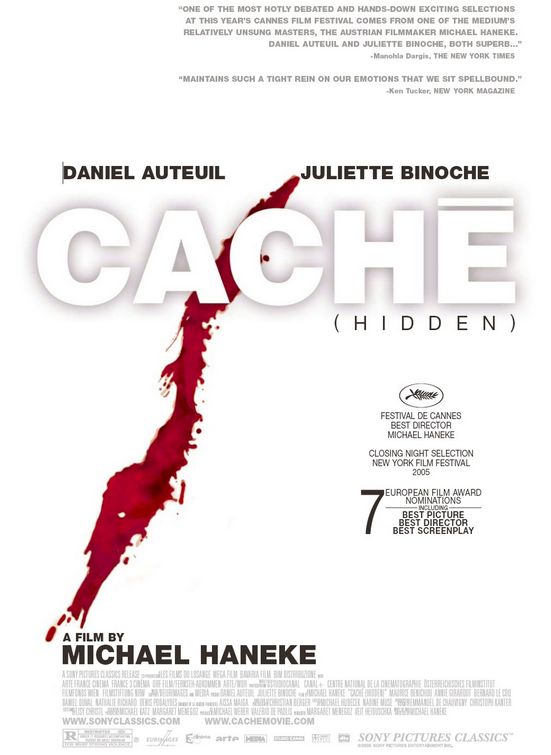
Georges (Daniel Auteuil), a host of a high-brow talk show, receives suspicious videotapes that display the peaceful façade of his upper middle class house. Nothing is clear in this CCTV footage in which there is ostensibly ‘nothing happening’: who has been watching his family, and why? Subsequent clips lead him to his childhood home and to an unknown apartment, which turns out to be the dingy place of his adopted, then abandoned, Algerian brother Majid (Maurice Bénichou). This forgotten ‘other’ confronts Georges with an uncomfortable truth from the past: young Georges’s jealousy forced Majid to be sent off to an orphanage, whereafter Majid had to survive without the educational and social benefits given to Georges. The nature of the video thus changes from provocation to evocation, from surveillance to reminiscence. Michael Haneke’s Caché [Hidden] (2005) uncannily uncovers this hidden trauma that resurfaces in the present. But my primary question is simple: why video?
Let me call this video an ‘interface’. Technically meaning the contact surface between image and spectator, the notion can be applied to the camera, the filmstrip, and the screen. That such a cinematic interface appears onscreen might not merit discussion in many cases, but it can play a central role in the narrative, whose unity is often thwarted and destabilized by the interface image. The subjectivity of characters or spectators can also be shaped or shaken through their encounters with the interface-within-the-film. A diegetic interface may then affect the ‘perception’ and ‘memory’ chain along which ‘image’ and ‘subjectivity’ are interconnected. Caché seems ideal for a case study in this regard, not only because of its video insertions, but because of the consequent revelation of perceptual and mnemonic mechanisms. What follows begins with a close analysis of a scene that exposes these mechanisms and thereby inspires us to explore, even expand the theoretical implications of the interface.
Among many significant scenes, I take Georges’s second visit to Majid’s flat as a kernel of the film’s structure. Its impressiveness, of course, bursts out of Majid’s sudden suicide; Majid lets Georges in, talks for a second, takes out a knife as Georges slightly falters, and slits his own throat, leaving no room for anticipation. The abruptness of this action marks the abruption of Majid’s emotion: a remarkable calmness and gentleness, not usually found in revenge suspects. It is rather Georges, the white Parisian intellectual, who has always lost his temper in front of his lower class, dark-skinned brother (and later, in front of Majid’s son, too); this Algerian outcast has reversed the standard image of the brutal invader of the bourgeois family like the De Niro figure in Cape Fear (Martin Scorsese, 1991). By killing himself, Majid releases something repressed beneath his tranquil face and fractures the peace of both his banlieue home and Georges’s bourgeois life. The flash of his blood sprayed onto the wall visualizes this fracture like an unstitched slash; the blood slowly exuding from his head onto the floor insinuates that this trauma will only grow like a nightmare in Georges’s memory.
In view of other scenes, Majid’s bloodstain on the wall triggers a déjà-vu that allows us to retroactively recognize the drawings sent to Georges (of a child vomiting blood) as forewarnings of this suicide. And through the same logic of ‘deferred action’ (Freudian Nachträglichkeit), this bloody event serves to repeat the film’s first instant flashback, prompted by a reverse-action tape, of young Majid coughing tubercular blood by a window, and the childhood trauma staged in Georges’s nightmare: Majid kills a cockerel, which also leaves a sharp blood mark, and he approaches Georges with the bloody hatchet. This killing was in fact orchestrated by Georges, but he told his parents that Majid had wanted to scare him, a joking lie that, along with Majid’s tuberculosis, ultimately resulted in Majid’s expulsion. However, only through recurrent visual traces after the fact does that original scene manifest its latent meaning as Georges’s original sin. The question would be how guilty and responsible the child and/or adult Georges is for that tiny ‘twisted joke’ that had lifelong repercussions/consequences for Majid. One may conclude: “Georges’s refusal as an adult to acknowledge the effects of his earlier actions suggests a parallel with the postcolonial metropolitan who is neither wholly responsible for, nor wholly untainted by, past events from which he or she has benefited” (Ezra and Sillars 219).1 Or, Majid’s suicide might bring a deep, if guilty, pleasure to a deeply ‘twisted’ xenophobe European: “the comforting idea that the colonial native can be made to disappear in an instant through the auto-combustive agency of their own violence” (Gilroy 234).
To See the Video of the Scene and Read the Rest of the Analysis
Gaze, Suture, Interface: The Suicide Scene in Michael Haneke’s Caché
Seung-hoon Jeong
Cinephile (The University of British Columbia)
Georges (Daniel Auteuil), a host of a high-brow talk show, receives suspicious videotapes that display the peaceful façade of his upper middle class house. Nothing is clear in this CCTV footage in which there is ostensibly ‘nothing happening’: who has been watching his family, and why? Subsequent clips lead him to his childhood home and to an unknown apartment, which turns out to be the dingy place of his adopted, then abandoned, Algerian brother Majid (Maurice Bénichou). This forgotten ‘other’ confronts Georges with an uncomfortable truth from the past: young Georges’s jealousy forced Majid to be sent off to an orphanage, whereafter Majid had to survive without the educational and social benefits given to Georges. The nature of the video thus changes from provocation to evocation, from surveillance to reminiscence. Michael Haneke’s Caché [Hidden] (2005) uncannily uncovers this hidden trauma that resurfaces in the present. But my primary question is simple: why video?
Let me call this video an ‘interface’. Technically meaning the contact surface between image and spectator, the notion can be applied to the camera, the filmstrip, and the screen. That such a cinematic interface appears onscreen might not merit discussion in many cases, but it can play a central role in the narrative, whose unity is often thwarted and destabilized by the interface image. The subjectivity of characters or spectators can also be shaped or shaken through their encounters with the interface-within-the-film. A diegetic interface may then affect the ‘perception’ and ‘memory’ chain along which ‘image’ and ‘subjectivity’ are interconnected. Caché seems ideal for a case study in this regard, not only because of its video insertions, but because of the consequent revelation of perceptual and mnemonic mechanisms. What follows begins with a close analysis of a scene that exposes these mechanisms and thereby inspires us to explore, even expand the theoretical implications of the interface.
Among many significant scenes, I take Georges’s second visit to Majid’s flat as a kernel of the film’s structure. Its impressiveness, of course, bursts out of Majid’s sudden suicide; Majid lets Georges in, talks for a second, takes out a knife as Georges slightly falters, and slits his own throat, leaving no room for anticipation. The abruptness of this action marks the abruption of Majid’s emotion: a remarkable calmness and gentleness, not usually found in revenge suspects. It is rather Georges, the white Parisian intellectual, who has always lost his temper in front of his lower class, dark-skinned brother (and later, in front of Majid’s son, too); this Algerian outcast has reversed the standard image of the brutal invader of the bourgeois family like the De Niro figure in Cape Fear (Martin Scorsese, 1991). By killing himself, Majid releases something repressed beneath his tranquil face and fractures the peace of both his banlieue home and Georges’s bourgeois life. The flash of his blood sprayed onto the wall visualizes this fracture like an unstitched slash; the blood slowly exuding from his head onto the floor insinuates that this trauma will only grow like a nightmare in Georges’s memory.
In view of other scenes, Majid’s bloodstain on the wall triggers a déjà-vu that allows us to retroactively recognize the drawings sent to Georges (of a child vomiting blood) as forewarnings of this suicide. And through the same logic of ‘deferred action’ (Freudian Nachträglichkeit), this bloody event serves to repeat the film’s first instant flashback, prompted by a reverse-action tape, of young Majid coughing tubercular blood by a window, and the childhood trauma staged in Georges’s nightmare: Majid kills a cockerel, which also leaves a sharp blood mark, and he approaches Georges with the bloody hatchet. This killing was in fact orchestrated by Georges, but he told his parents that Majid had wanted to scare him, a joking lie that, along with Majid’s tuberculosis, ultimately resulted in Majid’s expulsion. However, only through recurrent visual traces after the fact does that original scene manifest its latent meaning as Georges’s original sin. The question would be how guilty and responsible the child and/or adult Georges is for that tiny ‘twisted joke’ that had lifelong repercussions/consequences for Majid. One may conclude: “Georges’s refusal as an adult to acknowledge the effects of his earlier actions suggests a parallel with the postcolonial metropolitan who is neither wholly responsible for, nor wholly untainted by, past events from which he or she has benefited” (Ezra and Sillars 219).1 Or, Majid’s suicide might bring a deep, if guilty, pleasure to a deeply ‘twisted’ xenophobe European: “the comforting idea that the colonial native can be made to disappear in an instant through the auto-combustive agency of their own violence” (Gilroy 234).
To See the Video of the Scene and Read the Rest of the Analysis
Wednesday, December 01, 2010
Michael Azar: The stranger, the mother and the Algerian revolution -- A postcolonial reading of Albert Camus
The stranger, the mother and the Algerian revolution: A postcolonial reading of Albert Camus
by Michael Azar
Eurozine
The purely existential themes of The Stranger hide Camus' critique of the discriminatory nature of French rule in Algeria. Yet Camus never entirely renounced the civilizing premise of colonialism. The reason lies in his relation to his mother, writes Michael Azar on the fiftieth anniversary of Camus' death.

In The Myth of Sisyphus Albert Camus seeks his own answer to the question that Kierkegaard, Dostoevsky and Nietzsche have bequeathed to us: is it possible to live without God, without any hope of salvation as death looms? At first sight the outlook is bleak: we are, says Camus, thrust into existence as into an exile with no return. From the viewpoint of eternity, we are passions that can never be satisfied, cries that go unheard. Human beings and the world do not mix. He sums up man's tragic existence in one word: the absurd. It emerges from the fracture between the soul's desperate desire for clarity and the incomprehensibility of reality, the gap between our craving for meaning and the cold grave that awaits us. Camus understood early on that reason – the traditional weapon of philosophy – would always be powerless to address the futile, ill-fated game of existence.
Even so, the work essentially represents a manifesto for revolt and the ecstasy of life. It is a passionate revolt that answers the question of the meaning of life: if there is any raison d'être worthy of the name, it is born of a piece of trembling flesh. Desire, affection and generosity: these are the bread and wine of the mortal human being. Anyone who does not live to serve an immortal Creator must become a creator himself. The absurd man, as Camus calls his hero, transforms his days into a work of art, a defiant celebration of the battle which, as he knows from the outset, must eventually end in his death. Camus quotes Nietzsche: "It is not a question of eternal life but of being eternally alive."[1] It is the destiny of the absurd man to try to make something out of the nothingness, to grasp his life from death itself. Sisyphus shows us the way: happiness is the leap we make both with and in spite of our burden.
To Read the Rest of the Essay

by Michael Azar
Eurozine
The purely existential themes of The Stranger hide Camus' critique of the discriminatory nature of French rule in Algeria. Yet Camus never entirely renounced the civilizing premise of colonialism. The reason lies in his relation to his mother, writes Michael Azar on the fiftieth anniversary of Camus' death.
In The Myth of Sisyphus Albert Camus seeks his own answer to the question that Kierkegaard, Dostoevsky and Nietzsche have bequeathed to us: is it possible to live without God, without any hope of salvation as death looms? At first sight the outlook is bleak: we are, says Camus, thrust into existence as into an exile with no return. From the viewpoint of eternity, we are passions that can never be satisfied, cries that go unheard. Human beings and the world do not mix. He sums up man's tragic existence in one word: the absurd. It emerges from the fracture between the soul's desperate desire for clarity and the incomprehensibility of reality, the gap between our craving for meaning and the cold grave that awaits us. Camus understood early on that reason – the traditional weapon of philosophy – would always be powerless to address the futile, ill-fated game of existence.
Even so, the work essentially represents a manifesto for revolt and the ecstasy of life. It is a passionate revolt that answers the question of the meaning of life: if there is any raison d'être worthy of the name, it is born of a piece of trembling flesh. Desire, affection and generosity: these are the bread and wine of the mortal human being. Anyone who does not live to serve an immortal Creator must become a creator himself. The absurd man, as Camus calls his hero, transforms his days into a work of art, a defiant celebration of the battle which, as he knows from the outset, must eventually end in his death. Camus quotes Nietzsche: "It is not a question of eternal life but of being eternally alive."[1] It is the destiny of the absurd man to try to make something out of the nothingness, to grasp his life from death itself. Sisyphus shows us the way: happiness is the leap we make both with and in spite of our burden.
To Read the Rest of the Essay
Saturday, November 27, 2010
British Anthropologist Jeremy Keenan on "The Dark Sahara: America’s War on Terror in Africa"
British Anthropologist Jeremy Keenan on "The Dark Sahara: America’s War on Terror in Africa"
Democracy Now

... we hear from British anthropologist Jeremy Keenan. He traces AFRICOM, the US military command in Africa, to a 2003 kidnapping of European tourists. The hostage taking was widely blamed on Islamic militants thought to be affiliated with al-Qaeda, but Keenan argues that the Bush administration and the Algerian government were the ones responsible.
To Watch/Listen/Read
Democracy Now
... we hear from British anthropologist Jeremy Keenan. He traces AFRICOM, the US military command in Africa, to a 2003 kidnapping of European tourists. The hostage taking was widely blamed on Islamic militants thought to be affiliated with al-Qaeda, but Keenan argues that the Bush administration and the Algerian government were the ones responsible.
To Watch/Listen/Read
Tuesday, August 10, 2010
Nicholas Sammond: "Hidden," or Fear of a Black Planet
(Comparative analysis of Haneke's Cache; the French banlieues riots, Jeremiah Wright's sermons, Gate's arrest in his home, Obama's speeches, and the rise of militias in the US)
"Hidden," or fear of a black planet
by Nicholas Sammond
Jump Cut

On July 23, 2009, Harvard professor Henry Louis Gates, who is African American, was arrested on the front porch of his home in Cambridge Massachusetts, on charges of disorderly conduct. The professor had yelled at the white police officer who was responding to a neighbor’s call about a suspicious looking man (Gates himself) trying to break into Gates’ home. The charges were soon dropped. Several days later, when asked about the arrest, President Barack Obama suggested that the Cambridge Police Department had acted “stupidly,” setting off a storm of media criticism. Regretting his words, President Obama invited Gates and the arresting officer to join him for a beer and a private conversation about the incident. The President and his aides described the event as a “teachable moment” about race, without specifying exactly who was teaching whom or what might actually be learned.
This empty moment of racial panic and its containment recalls the day in Barack Obama’s 2008 presidential campaign when he had to repudiate the words of his onetime mentor, the Reverend Jeremiah Wright, after it came out that Wright had earlier delivered sermons critical of the United States. While the speech that Obama gave was moving and beautifully crafted, it reduced Wright’s complex commentaries on the history of racial oppression and its current expressions to a “teachable moment” about those who cling to outmoded ideas of race and those who do not. Wright’s sermons had been much more than that. They had explored the relationship between racism and colonialism, and between U.S. foreign and domestic policies, in interesting and troubling ways. Given that Barack Obama then reduced them to caricature in order to call for a postracial capitalist United States, “teachable moment” would seem to mean “forgetting.” This brief essay explores three distinct but related moments of race and its erasure, one of which is the Jeremiah Wright incident, with an eye to reclaiming teachable moments from the dustbin of history.
Caché: beheading the chicken
Michael Haneke’s Caché ("Hidden," France 2005) is a story about urban bourgeois anxiety. Georges and Anne Laurent (Daniel Auteuil and Juliette Binoche) are a successful couple with a handsome teenage son, living in a stylish townhouse in Paris. Georges hosts a television talk show; Anne is a player in the Parisian literary scene. Their life is elegant, graceful, and good. Then, someone begins to videotape their home and to leave the tapes—sometimes accompanied by bloody, childish, violent drawings—on their doorstep. The mystery of who is behind this is never fully resolved, but it reveals discord in the marriage and the family. This seeming invasion of the Laurents’ privacy also spurs Georges to relive a childhood trauma surrounding the betrayal of his boyhood playmate and foster brother, Majid (Maurice Bénichou), an orphan of the brutal 1961 massacre of peaceful Algerian protesters by the French police.
Though we will not learn much of this till later in the film, from its very beginning Caché imposes on us a question that makes this information seem like a series of clues that will help us solve the mystery. The film’s first establishing shot shows a building seen from street level. By convention, we are to understand that both the scene and our relationship to it as neutral observers has been established. But then the shot goes on, and on, and on. We are presented with a decision. Is this an establishing shot or a point of view shot? If a POV, then whose? In an intervening shot from a different angle a man comes out of the same building and looks up the street. Then we are back in the first shot…which then shudders, and the bars of a tape rewinding appear on the screen. We discover we are watching a videotape of the Laurent home…playing on the television in the living room of that home.
This is the question we are offered: “Who’s watching?” It’s the one the film asks us to address. It’s also the wrong question. Although it persists throughout the film and is never fully answered, it obscures the very real relationship between the Laurents’ comfort and security and the eventual immiseration of Majid and his son (Walid Afkir).
A series of scenes describes the problem in miniature. After the film has been going on for a while, we have learned some things. We know that someone is watching the Laurent family. We know that the observation throws the family into crisis and that Anne may be romantically involved with a close friend. We come to know that Georges suspects his boyhood playmate, Majid—whom he coldly betrayed to secure his mother’s love all for himself—of being the voyeur. The scene is set.
To Read the Rest of the Essay

"Hidden," or fear of a black planet
by Nicholas Sammond
Jump Cut
On July 23, 2009, Harvard professor Henry Louis Gates, who is African American, was arrested on the front porch of his home in Cambridge Massachusetts, on charges of disorderly conduct. The professor had yelled at the white police officer who was responding to a neighbor’s call about a suspicious looking man (Gates himself) trying to break into Gates’ home. The charges were soon dropped. Several days later, when asked about the arrest, President Barack Obama suggested that the Cambridge Police Department had acted “stupidly,” setting off a storm of media criticism. Regretting his words, President Obama invited Gates and the arresting officer to join him for a beer and a private conversation about the incident. The President and his aides described the event as a “teachable moment” about race, without specifying exactly who was teaching whom or what might actually be learned.
This empty moment of racial panic and its containment recalls the day in Barack Obama’s 2008 presidential campaign when he had to repudiate the words of his onetime mentor, the Reverend Jeremiah Wright, after it came out that Wright had earlier delivered sermons critical of the United States. While the speech that Obama gave was moving and beautifully crafted, it reduced Wright’s complex commentaries on the history of racial oppression and its current expressions to a “teachable moment” about those who cling to outmoded ideas of race and those who do not. Wright’s sermons had been much more than that. They had explored the relationship between racism and colonialism, and between U.S. foreign and domestic policies, in interesting and troubling ways. Given that Barack Obama then reduced them to caricature in order to call for a postracial capitalist United States, “teachable moment” would seem to mean “forgetting.” This brief essay explores three distinct but related moments of race and its erasure, one of which is the Jeremiah Wright incident, with an eye to reclaiming teachable moments from the dustbin of history.
Caché: beheading the chicken
Michael Haneke’s Caché ("Hidden," France 2005) is a story about urban bourgeois anxiety. Georges and Anne Laurent (Daniel Auteuil and Juliette Binoche) are a successful couple with a handsome teenage son, living in a stylish townhouse in Paris. Georges hosts a television talk show; Anne is a player in the Parisian literary scene. Their life is elegant, graceful, and good. Then, someone begins to videotape their home and to leave the tapes—sometimes accompanied by bloody, childish, violent drawings—on their doorstep. The mystery of who is behind this is never fully resolved, but it reveals discord in the marriage and the family. This seeming invasion of the Laurents’ privacy also spurs Georges to relive a childhood trauma surrounding the betrayal of his boyhood playmate and foster brother, Majid (Maurice Bénichou), an orphan of the brutal 1961 massacre of peaceful Algerian protesters by the French police.
Though we will not learn much of this till later in the film, from its very beginning Caché imposes on us a question that makes this information seem like a series of clues that will help us solve the mystery. The film’s first establishing shot shows a building seen from street level. By convention, we are to understand that both the scene and our relationship to it as neutral observers has been established. But then the shot goes on, and on, and on. We are presented with a decision. Is this an establishing shot or a point of view shot? If a POV, then whose? In an intervening shot from a different angle a man comes out of the same building and looks up the street. Then we are back in the first shot…which then shudders, and the bars of a tape rewinding appear on the screen. We discover we are watching a videotape of the Laurent home…playing on the television in the living room of that home.
This is the question we are offered: “Who’s watching?” It’s the one the film asks us to address. It’s also the wrong question. Although it persists throughout the film and is never fully answered, it obscures the very real relationship between the Laurents’ comfort and security and the eventual immiseration of Majid and his son (Walid Afkir).
A series of scenes describes the problem in miniature. After the film has been going on for a while, we have learned some things. We know that someone is watching the Laurent family. We know that the observation throws the family into crisis and that Anne may be romantically involved with a close friend. We come to know that Georges suspects his boyhood playmate, Majid—whom he coldly betrayed to secure his mother’s love all for himself—of being the voyeur. The scene is set.
To Read the Rest of the Essay
Tuesday, February 16, 2010
Africa Today: Piero Gleijeses author of Conflicting Missions: Havana, Washington and Africa 1959-1976

Africa Today (KPFA: Berkeley)
Piero Gleijeses author of "Conflicting Missions: Havana, Washington and Africa 1959-1976" is interviewed on Cuba's policies with the African continent.
To Listen to the Episode
Subscribe to:
Posts (Atom)