Showing posts with label Existentialism. Show all posts

Wednesday, December 01, 2010

Michael Azar: The stranger, the mother and the Algerian revolution -- A postcolonial reading of Albert Camus

The stranger, the mother and the Algerian revolution: A postcolonial reading of Albert Camus
by Michael Azar
Eurozine

The purely existential themes of The Stranger hide Camus' critique of the discriminatory nature of French rule in Algeria. Yet Camus never entirely renounced the civilizing premise of colonialism. The reason lies in his relation to his mother, writes Michael Azar on the fiftieth anniversary of Camus' death.


In The Myth of Sisyphus Albert Camus seeks his own answer to the question that Kierkegaard, Dostoevsky and Nietzsche have bequeathed to us: is it possible to live without God, without any hope of salvation as death looms? At first sight the outlook is bleak: we are, says Camus, thrust into existence as into an exile with no return. From the viewpoint of eternity, we are passions that can never be satisfied, cries that go unheard. Human beings and the world do not mix. He sums up man's tragic existence in one word: the absurd. It emerges from the fracture between the soul's desperate desire for clarity and the incomprehensibility of reality, the gap between our craving for meaning and the cold grave that awaits us. Camus understood early on that reason – the traditional weapon of philosophy – would always be powerless to address the futile, ill-fated game of existence.

Even so, the work essentially represents a manifesto for revolt and the ecstasy of life. It is a passionate revolt that answers the question of the meaning of life: if there is any raison d'être worthy of the name, it is born of a piece of trembling flesh. Desire, affection and generosity: these are the bread and wine of the mortal human being. Anyone who does not live to serve an immortal Creator must become a creator himself. The absurd man, as Camus calls his hero, transforms his days into a work of art, a defiant celebration of the battle which, as he knows from the outset, must eventually end in his death. Camus quotes Nietzsche: "It is not a question of eternal life but of being eternally alive."[1] It is the destiny of the absurd man to try to make something out of the nothingness, to grasp his life from death itself. Sisyphus shows us the way: happiness is the leap we make both with and in spite of our burden.

To Read the Rest of the Essay

Wednesday, November 24, 2010

Scott Tobias: The New Cult Canon -- Donnie Darko (2001)

Donnie Darko
by Scott Tobias
The New Cult Canon (The A.V. Club)


In embarking on the mammoth, open-ended project that is The New Cult Canon, I face the scary and exhilarating prospect of a journey with no set course and no planned destination, but there was never a question that I'd be leaving port with Richard Kelly's Donnie Darko. To my mind, Donnie Darko is the quintessential cult movie of the last 20 years: Here was a much-hyped washout at Sundance that fell to a second-tier distributor (Newmarket), which released the film to middling reviews and feeble arthouse box-office (barely half a million when all was said and done). The film was left for dead until, miraculously, word of mouth started to swell and an audience steadily grew and rallied around it. The Pioneer Theater in New York ran it as a midnight movie for two years—this at a time when the midnight movie itself had long been left for dead. And DVD sales were so robust that Newmarket attempted to re-release the "Director's Cut" theatrically. (It tanked a second time, too.) The movie has inspired a level of obsession that separates cult phenomena from the everyday hits that wither past opening weekend.

I saw Donnie Darko three times in the theater: Once at the press screening, where I was apoplectic to find many of my fellow critics shrugging their shoulders; a second time during its two-week run here in Chicago, where I saw it with maybe five or six other people in the theater; and a third time at the Gene Siskel Film Center, where it kept coming back month after month to packed houses, including the near-soldout showing I attended. (And on a weeknight, no less!)

Why did I and so many others keep shuffling, zombie-like, to see this movie again and again in the theater? It certainly isn't perfect—films this crazily ambitious, from a first-time director no less, are rarely flawless—but Donnie Darko accomplishes perhaps the one thing I value most in cinema: It creates a world to get lost in, so particular and full of life that other concerns (in this case, an overstuffed mind-bender of a plot that has never quite cohered for me) fall by the wayside. And though I'll probably be defining cult movies a million different ways in this column, that's likely the common denominator, because once you have the ins and outs of the story figured out, what's the point of seeing a movie a second or third or hundredth time? The world of the film is paramount.

To Read the Rest of the Essay

Thursday, June 10, 2010

Michael Benton: On Anarchism

1) As humans we all exist, but it is our essence that makes us unique. What you are (essence) is the result of your choices (your existence) rather than the reverse. Essence is not destiny. You are what you make yourself to be. Our lives are not given to us, but must be developed consciously with care/consideration.

2) Living in the moment is essential, but we also interact and adapt based on our past experiences and future expectations. Yes, we are fundamentally time-bound beings, but we are also, much, much more than that. Unlike measurable (quantative), "clock" time, "lived" time is qualitative: the "not yet," the "already," and the "present" differ among themselves in meaning/value. We need to be aware of all of these. The impetus of living in the "moment" is that we should not let the past hang on us like a weight causing us to drown, or allow the possibility of an uncertain future to intimidate us to the point of inaction. Remember the lessons of the past, recognize the possibilities of the future, in order to fully live in the present.

3) Anarchism is a person-centered philosophy. Its focus is on autonomy amidst the social and economic pressures of mass society for superficiality and conformism. It is our responsibility, as free and conscious beings, to create meaning out of life and to develop an authentic existence. It is also, in my opinion, in this regard, our duty to help others develop their response-ability to do the same (for me as a teacher this is the core of an anarchist pedagogy). In this anarchism is radically collective in orientation. We are cultivating autonomous, ethical and responsible individuals who care about their community. Anarchism does not discount other beings in this world... it is holistic, in the sense of recognizing that humans are just one set of beings that live and share in the development and continuation of the broader ecosphere.

4) Freedom = Responsibility. Anarchism is a philosophy of freedom. It requires that we step back and reflect/reassess on what we have been doing and what effect our thoughts/actions have on the world. In this sense we are more than just individuals, we are members of larger collectives and our personal ethics always extend beyond ourselves (anarchism is not vulgar egotism). In this we can only be as "responsible" as we are "free." Response-ability, the ability for people to respond to the problems of their society and the impetus for them to care beyond themselves, is only realized by free, authentic and ethical beings. Where there is mindless conformism, shallow consumerism, or brutal oppression, you will see a breakdown in the development of response-ability (both in the ruled/rulers... or, manipulated/manipulators).

5) Ethical considerations are the primary questions. We all understand ethics and freedom differently, this is a given, and thus we must bring each of our understandings into play and sharpen our ideas through open/free public discourse. In this we, as individuals, as a community, as a society, and as a global ecosystem, should consider ethical questions as primary steps to building a better world. An autonomous individual is responsible to develop and consider the authenticity of their own personal lives in relation to their society. My authenticity should not be at the expense of your opportunity to realize yourself (for example, we are not bloated ticks that feed off the misery of others in order to realize some twisted sense of self).

Monday, March 08, 2010

Chris Hedges: Calling All Rebels

Calling All Rebels
by Chris Hedges
Common Dreams

How do we resist? How, if this descent is inevitable, as I believe it is, do we fight back? Why should we resist at all? Why not give in to cynicism and despair? Why not carve out as comfortable a niche as possible within the embrace of the corporate state and spend our lives attempting to satiate our private needs? The power elite, including most of those who graduate from our top universities and our liberal and intellectual classes, have sold out for personal comfort. Why not us?

The French moral philosopher Albert Camus argued that we are separated from each other. Our lives are meaningless. We cannot influence fate. We will all die and our individual being will be obliterated. And yet Camus wrote that "one of the only coherent philosophical positions is revolt. It is a constant confrontation between man and his obscurity. It is not aspiration, for it is devoid of hope. That revolt is the certainty of a crushing fate, without the resignation that ought to accompany it."

"A living man can be enslaved and reduced to the historic condition of an object," Camus warned. "But if he dies in refusing to be enslaved, he reaffirms the existence of another kind of human nature which refuses to be classified as an object."

The rebel, for Camus, stands with the oppressed-the unemployed workers being thrust into impoverishment and misery by the corporate state, the Palestinians in Gaza, the civilians in Iraq and Afghanistan, the disappeared who are held in our global black sites, the poor in our inner cities and depressed rural communities, immigrants and those locked away in our prison system. And to stand with them does not mean to collaborate with parties, such as the Democrats, who can mouth the words of justice while carrying out acts of oppression. It means open and direct defiance.

The power structure and its liberal apologists dismiss the rebel as impractical and see the rebel's outsider stance as counterproductive. They condemn the rebel for expressing anger at injustice. The elites and their apologists call for calm and patience. They use the hypocritical language of spirituality, compromise, generosity and compassion to argue that the only alternative is to accept and work with the systems of power. The rebel, however, is beholden to a moral commitment that makes it impossible to stand with the power elite. The rebel refuses to be bought off with foundation grants, invitations to the White House, television appearances, book contracts, academic appointments or empty rhetoric. The rebel is not concerned with self-promotion or public opinion. The rebel knows that, as Augustine wrote, hope has two beautiful daughters, anger and courage-anger at the way things are and the courage to see that they do not remain the way they are. The rebel is aware that virtue is not rewarded. The act of rebellion defines itself.

"You do not become a ‘dissident' just because you decide one day to take up this most unusual career," Vaclav Havel said when he battled the communist regime in Czechoslovakia. "You are thrown into it by your personal sense of responsibility, combined with a complex set of external circumstances. You are cast out of the existing structures and placed in a position of conflict with them. It begins as an attempt to do your work well, and ends with being branded an enemy of society. ... The dissident does not operate in the realm of genuine power at all. He is not seeking power. He has no desire for office and does not gather votes. He does not attempt to charm the public. He offers nothing and promises nothing. He can offer, if anything, only his own skin-and he offers it solely because he has no other way of affirming the truth he stands for. His actions simply articulate his dignity as a citizen, regardless of the cost."

Those in power have disarmed the liberal class. They do not argue that the current system is just or good, because they cannot, but they have convinced liberals that there is no alternative. But we are not slaves. We have a choice. We can refuse to be either a victim or an executioner. We have the moral capacity to say no, to refuse to cooperate. Any boycott or demonstration, any occupation or sit-in, any strike, any act of obstruction or sabotage, any refusal to pay taxes, any fast, any popular movement and any act of civil disobedience ignites the soul of the rebel and exposes the dead hand of authority. "There is beauty and there are the humiliated," Camus wrote. "Whatever difficulties the enterprise may present, I should like never to be unfaithful either to the second or the first."

"There is a time when the operation of the machine becomes so odious, makes you so sick at heart, that you can't take part; you can't even passively take part, and you've got to put your bodies upon the gears and upon the wheels, upon the levers, upon all the apparatus, and you've got to make it stop," Mario Savio said in 1964. "And you've got to indicate to the people who run it, to the people who own it, that unless you're free, the machine will be prevented from working at all."

The capacity to exercise moral autonomy, the capacity to refuse to cooperate, offers us the only route left to personal freedom and a life with meaning. Rebellion is its own justification. Those of us who come out of the religious left have no quarrel with Camus. Camus is right about the absurdity of existence, right about finding worth in the act of rebellion rather than some bizarre dream of an afterlife or Sunday School fantasy that God rewards the just and the good. "Oh my soul," the ancient Greek poet Pindar wrote, "do not aspire to immortal life, but exhaust the limits of the possible." We differ with Camus only in that we have faith that rebellion is not ultimately meaningless. Rebellion allows us to be free and independent human beings, but rebellion also chips away, however imperceptibly, at the edifice of the oppressor and sustains the dim flames of hope and love. And in moments of profound human despair these flames are never insignificant. They keep alive the capacity to be human. We must become, as Camus said, so absolutely free that "existence is an act of rebellion." Those who do not rebel in our age of totalitarian capitalism and who convince themselves that there is no alternative to collaboration are complicit in their own enslavement. They commit spiritual and moral suicide.

To Read the Entire Essay

Monday, February 22, 2010

Michael Dean Benton: On Existentialism -- Five Propositions

(I'm thinking about my own personal philosophy these days and these are just some thoughts... responses appreciated!)

On Existentialism
by Michael Dean Benton

1) As humans we all exist, but it is our essence that makes us unique. What you are (essence) is the result of your choices (your existence) rather than the reverse. Essence is not destiny. You are what you make yourself to be. Our lives are not given to us, but must be developed consciously with care and consideration.

2) Living in the moment is essential, but we also interact and adapt based on our past experiences and future expectations. Yes, we are fundamentally time-bound beings, but we are also, much, much more than that. Unlike measurable (quantative), "clock" time, "lived" time is qualitative: the "not yet," the "already," and the "present" differ among themselves in meaning and value. We need to be aware of all of these. The impetus of living in the "moment" is that we should not let the past hang on us like a weight causing us to drown, or allow the possibility of an uncertain future to intimidate us to the point of inaction. Remember the lessons of the past, recognize the possibilities of the future, in order to fully live in the present.

3) Radical Humanism. Existentialism is a person-centered philosophy. It's focus is on the human individual's pursuit of identity and meaning amidst the social and economic pressures of mass society for superficiality and conformism. It is our responsibility, as free and conscious beings, to create meaning out of life and to develop an authentic essense. It is also, in my opinion, in this regard, our duty to help others develop their response-ability to do the same (for me as a teacher this is the core of an existentialist pedagogy). In this we are cultivating free, ethical and responsible individuals who care about their community. My radical humanism does not discount other beings in this world... it is holistic, in the sense of recognizing that humans are just one set of beings that live and share in the development and continuation of the broader ecosphere.

4) Freedom = Responsibility. Existentialism is a philosophy of freedom. It requires that we step back and reflect/reassess on what we have been doing and what effect our thoughts/actions have on the world. In this sense we are more than just individuals, we are members of larger collectives and our personal ethics always extend beyond ourselves (existentialism is not vulgar egotism). In this we can only be as "responsible" as we are "free." Response-ability, the ability for people to respond to the problems of their society and the impetus for them to care beyond themselves, is only realized by free, authentic and ethical beings. Where there is mindless conformism, shallow consumerism, or brutal oppression, you will see a breakdown in the development of response-ability (both in the ruled and rulers... or, manipulated and manipulators).

5) Ethical considerations are the primary questions. We all understand ethics and freedom differently, this is a given, and we must bring each of our understandings into play and sharpen our ideas through open/free public discourse. In this we, as individuals, as a community, as a society, and as a global ecosystem, should consider ethical questions. Each individual is responsible to develop and consider the authenticity of their own personal lives and their society.

Existentialism is a philosophy of living authentically in the world, but in the realization of our authentic self we also have an ethical responsibility to ensure that others have that same opportunity. My authenticity should not be at the expense of your opportunity to realize yourself (for example, we are not bloated ticks that feed off the misery of others in order to realize some twisted sense of self).

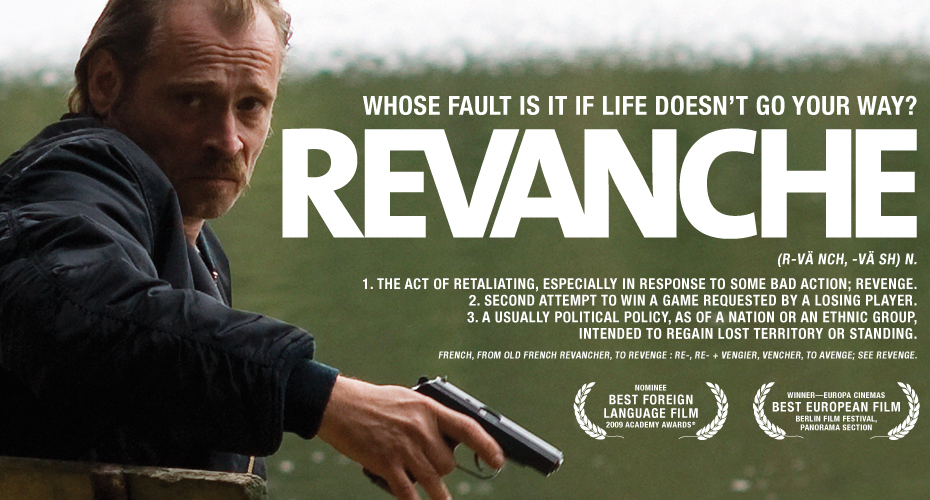
Green Cine Daily: DVD OF THE WEEK & PODCAST: Revanche (Gotz Spielmann)

DVD OF THE WEEK & PODCAST: Revanche (Gotz Spielmann)
Green Cine Daily


A gripping thriller and a tragic drama of nearly Greek proportions, Revanche is the stunning, Oscar-nominated international breakthrough of Austrian filmmaker Götz Spielmann. In a ragged section of Vienna, hardened ex-con Alex (the mesmerizing Johannes Krisch) works in a brothel, where he falls for Ukrainian hooker Tamara. Their desperate plans for escape unexpectedly intersect with the lives of a rural cop and his seemingly content wife. With meticulous, elegant direction, Spielmann creates a tense, existential, and surprising portrait of vengeance and redemption, and a journey into the darkest forest of human nature, in which violence and beauty exist side by side.

To Listen to the Podcast