Showing posts with label Science Fiction. Show all posts

Wednesday, November 24, 2010

Scott Tobias: The New Cult Canon -- Donnie Darko (2001)

Donnie Darko
by Scott Tobias
The New Cult Canon (The A.V. Club)


In embarking on the mammoth, open-ended project that is The New Cult Canon, I face the scary and exhilarating prospect of a journey with no set course and no planned destination, but there was never a question that I'd be leaving port with Richard Kelly's Donnie Darko. To my mind, Donnie Darko is the quintessential cult movie of the last 20 years: Here was a much-hyped washout at Sundance that fell to a second-tier distributor (Newmarket), which released the film to middling reviews and feeble arthouse box-office (barely half a million when all was said and done). The film was left for dead until, miraculously, word of mouth started to swell and an audience steadily grew and rallied around it. The Pioneer Theater in New York ran it as a midnight movie for two years—this at a time when the midnight movie itself had long been left for dead. And DVD sales were so robust that Newmarket attempted to re-release the "Director's Cut" theatrically. (It tanked a second time, too.) The movie has inspired a level of obsession that separates cult phenomena from the everyday hits that wither past opening weekend.

I saw Donnie Darko three times in the theater: Once at the press screening, where I was apoplectic to find many of my fellow critics shrugging their shoulders; a second time during its two-week run here in Chicago, where I saw it with maybe five or six other people in the theater; and a third time at the Gene Siskel Film Center, where it kept coming back month after month to packed houses, including the near-soldout showing I attended. (And on a weeknight, no less!)

Why did I and so many others keep shuffling, zombie-like, to see this movie again and again in the theater? It certainly isn't perfect—films this crazily ambitious, from a first-time director no less, are rarely flawless—but Donnie Darko accomplishes perhaps the one thing I value most in cinema: It creates a world to get lost in, so particular and full of life that other concerns (in this case, an overstuffed mind-bender of a plot that has never quite cohered for me) fall by the wayside. And though I'll probably be defining cult movies a million different ways in this column, that's likely the common denominator, because once you have the ins and outs of the story figured out, what's the point of seeing a movie a second or third or hundredth time? The world of the film is paramount.

To Read the Rest of the Essay

Monday, August 09, 2010

Gary K. Wolfe and Amelia Beamer: 21st Century Stories

21st Century Stories
by Gary K. Wolfe and Amelia Beamer
Foundation: The International Review of Science Fiction #103


...

Suffice to say that a bewildering array of terms has been suggested to describe recent fiction outside the traditional categories of the fantastic, and that some of these terms are being promoted and treated as actual literary movements. We’ve come a long way since Michael Swanwick, writing in Asimov’s in 1986, could note, “The generation I want to talk about hasn’t been named yet” (Swanwick 314). By now it’s been named with a vengeance. Let’s take slipstream as an example, since many of the stories that we’re discussing in this essay have been called slipstream. The original term, meaning a region of low pressure and forward suction in the wake of a fast-moving vehicle, provides an obvious source for the “piggybacking” that Clute referred to back in 1993. Jeff Prucher, in his Brave New Words: The Oxford Dictionary of Science Fiction, traces the first use of “slipstream” as a back-formation to a Bruce Sterling piece in SF Eye in 1989, where he proposes as shorthand for what he describes as “novels of Postmodern sensibility” (Prucher 189). But the word is also a parody of “mainstream”, according to Bruce Sterling in that same essay (in a column called Catscan). It’s difficult to trace when “mainstream” became a kind of derogatory code term among genre writers, but its first use in critical discourse about science fiction is likely an essay by Rosalie Moore, “Science Fiction and the Main Stream,” which appeared in Reginald Bretnor’s early critical anthology Modern Science Fiction: Its Meaning and Its Future, in 1953. To everyone else, it’s just general fiction—anything shelved in the Fiction & Literature section at your local chain bookstore.

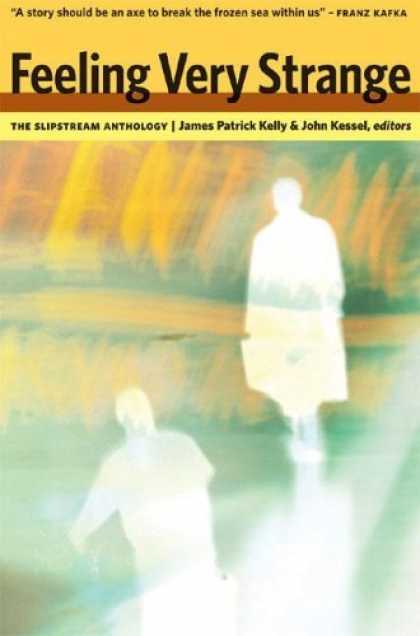
By 2003, in a column in Asimov’s, James Patrick Kelly could describe slipstream as “a type of writing that crosses genre boundaries in and out of science fiction” (Kelly 343), suggesting that it’s a conscious strategy on the part of a number of authors and identifying three in particular—Kelly Link, Karen Joy Fowler, and Carol Emshwiller—as the “muses” of the movement (351). And by 2006, it had all coalesced to the point where Kelly, with his collaborator John Kessel, could edit a slipstream anthology, Feeling Very Strange, only now they defined it as an effect rather than a genre, characterized by a violation of the tenets of realism, an abjuration of specific genre identity, “playful postmodernism,” and above all the quality of (another term from Sterling) “feeling very strange” (Kelly and Kessel, xii-xiii). In Kelly’s terms, slipstream is

a literary effect—in the same way that horror or comedy are literary effects achieved by many different kinds of dissimilar stories. What is that effect? We borrowed the term cognitive dissonance from the psychologists. When we are presented with two contradictory cognitions—impressions, feelings, beliefs—we experience cognitive dissonance, a kind of psychic discomfort that we normally try to ease by discounting one of the cognitions as false or illusory and promoting the other to reality… We think that what slipstream stories do is to embrace cognitive dissonance (Adams interview).


Kessel added, “Many people feel that the world doesn’t make sense according to the structures that held during the 20th century.” By way of example, he described a story by Mary Rickert, “You Have Never Been Here,” as follows: “It is both clearly written and profoundly disorienting. It does not resolve itself easily into any simple category. At times it seems like a dream. At times it seems like a dystopian fantasy. At times it seems to be a rational story told from the point of view of a madman. Just when you think you’ve got it figured out, it takes a left turn. Yet it does not feel arbitrary. This story makes me feel very strange” (Adams interview). Kelly and Kessel’s much-discussed anthology included not only the slipstream “muses” Link, Emshwiller, and Fowler, but also newer writers like Rickert and Benjamin Rosenbaum, writers with “mainstream” credentials like Michael Chabon and Jonathan Lethem, and comparative old-timers like Sterling and Howard Waldrop (not to mention Emshwiller herself, who had been doing something like this since the 1950s). Specific reference to any privileged association with science fiction in particular was omitted from this new definition. Slipstream was no longer viewed as an offshoot of genre SF, but as a mode of writing that might freely allude to all the genres of the fantastic, sometimes even within the same story.

To Read the Rest of the Essay

Thursday, July 15, 2010

Pinocchio Theory: Gamer

Gamer
by Steven Shaviro
Pinocchio Theory


Gamer is science fiction. This means, not just that the movie is set in the near future, in a world whose technology is extrapolated from our own, but also that it explores the futurity that is very much a part of our actual present — the potential for change that is inherent within our presentness. Literally speaking, the movie takes place “some years from this exact moment” (as an opening title tells us). The world of the film is one in which the media — and especially the computer gaming environment — that we know today are taken to the next level. In the movie’s near-future extrapolation, spectacle, virtualization, and “entertainment” in general have been pushed to their logical extremes. Everyone in the world, it seems, is addicted to MMORPGs (massively multi-player online role-playing games). But these games are themselves viscerally “real,” in a way that is not yet the case today. The basic science-fictional ploy of the movie is to envision a form of gaming in which gamers control the actions, not of virtual avatars on a screen, but of real, physical, flesh-and-blood bodies: human “actors.” In this way, Gamer combines, and updates, the two most prominent popular entertainment forms of the current decade: massively multiplayer online gaming, and reality television. Conceptually, Gamer explores these forms of entertainment in order to think about freedom and enslavement in what Deleuze called the control society, or in a world that — as McKenzie Wark describes it — has become indistinguishable from gamespace.

There are two games that dominate the world of Gamer: Society and Slayer. In both of these games, the human actors who actually perform the physical actions of the game have no free will. Thanks to nano-implants, they no longer control their own bodies and motor actions. Rather, they are forced to take orders from the gamers “playing” them. Artificial nanocells are introduced into their brains; these cells reproduce, replacing the original, organic nerve cells with synthetic ones. Once you have undergone this procedure, you have an IP address in your head, and your body obeys whatever commands are transmitted to that address by the player who controls you. You say what they say, and move the way that they want you to move. Of course, this only works one way: actors can’t see or hear their controllers, but the controllers are able to live vicariously through them.


Society is a hilariously sleazy live version of Second Life or The Sims, with gamers guiding their actors through scenarios of drug consumption, partying and clubbing, and (most of all) down ‘n’ dirty sex. Actors rollerskate through crowded plazas, crashing into one another; or they grope one another in crowded dance clubs; or they accost one another with corny pickup lines in bars. The gamespace of Society is visually garish, with hypersaturated colors, and with raunchy costumes and lurid, tacky interior decorations that egregiously shriek out their own “bad taste.” Our first view of Society’s gamespace is hilariously set to the satirical song “The Bad Touch” by Bloodhound Gang (“You and me baby ain’t nothin’ but mammals/ So let’s do it like they do on the Discovery Channel”). Gamer illustrates the relation between player and actor directly, by cutting back and forth between the “actor” Angie (Amber Valletta) and her controller (Ramsey Moore). Angie is ridiculously dressed in a white fur wrap, blue hot pants, pink platform boots, and an orange wig; she is reduced, basically, to being a sexbot in the world of Society. Her controller is a morbidly obese, wheelchair-bound man; we usually see him in extreme facial closeup, sweating profusely, consuming munchies, and licking his slobbering lips as he moves her into one degrading situation after another.


Society is all about sex as spectacle; but in reality, sex is subordinated to economics. The financial structure of Society is simple, and brilliantly capitalist: you can either be a consumer by paying to play, or be a worker by being paid to be played. As Vishnevetsky observes, Gamer is “the sort of movie that imagines what the working class would have to do in its fantasy scenario” — something that is left out of most transhumanist and “exodus-to-the-virtual-world” visions. On the one hand, consumers get a pornographic experience that is still vicarious (and therefore safe) for them, but more “real” than any mere simulation could be. On the other hand, the “actors” receive wages for what is the ne plus ultra of affective labor: the production, not of physical objects, but directly of moods, feelings, and experiences. The sim-actor is not just selling the use of his or her “labor-power” for a certain number of hours (as is the case in classical capitalism as described by Marx); more than this, he or she is actually selling his or her “life” itself as a commodity. Of course, such a “biopolitical” mode of exploitation (which would seem to combine the worst aspects of slavery and of wage labor) is increasingly the norm — as Hardt and Negri argue — in our contemporary world of post-Fordism, “real subsumption,” and immaterial or affective production. Today, profits are extracted from the whole texture of our lives, not just from the labor we perform during specific hours in a factory or an office. Behind both the consumer/player and the actor/slave, there is the billionaire software genius who created, and who owns, Society (more about him below). He not only makes immense profits from user fees, but also acquires massive amounts of economically-valuable data through the technology’s surveillance of everything that streams over the network, or that happens in the minds of the nano-implanted actors.

To Read the Rest of the Essay

Saturday, July 03, 2010

Kiji Johnson: 26 Monkeys, Also the Abyss; Spar

I just read Kiji Johnson's excellent 2009 World Fantasy Award winning short story in World Literature Today:

26 Monkeys, Also the Abyss

You can also listen to a reading of it:

audio version

and, if you like it as much as I do, you might want to read Juliette Wade's ridiculously close reading of the story

then, if you are feeling very adventurous, check out her 2010 Nebula Award Winning short story "Spar"

Wednesday, June 23, 2010

Keith Gessen: Dystopia

Dystopia: Is it time for dystopian novelists to end the reign of the free-market idealists?
by Keith Gessen
BookForum


About halfway through the Putin presidency, a funny thing started happening to Russian novelists: They all started writing dystopias. In 2006, Vladimir Sorokin, the legendary deconstructionist novelist, published a traditional dystopian satire about the secret services, A Day in the Life of an Oprichnik; that same year, the literary novelist Olga Slavnikova won the Russian Booker with 2017, and the prodigiously prolific and overweight man of letters Dmitry Bykov published ZhD, set in a future where Russia is at war with a Western force called the ZhDs, who are winning because of their discovery of "phlogiston," a remarkable substance that has replaced oil as the West's fuel of choice and rendered Russia nearly obsolete.

This strange literary outburst was related, I think, to the political stagnation of the Putin years. That he was bringing back authoritarianism in some form no one doubted; but in just what form, and how brutally, how totally, it was hard to tell. The present seemed to make no impression. A novelist who described this present would at some level simply be wrong. As far as the eye could see, nothing was happening. In order to create a meaning, in order to make sense of this present, you had to project current tendencies some years into the future.

Looking at American fiction of the same time, you see something like the exact opposite phenomenon. Instead of books looking to the future to understand the present, there were big counterhistorical novels: Michael Chabon on Jews exiled to Alaska, Philip Roth on the election of the anti-Semite Charles Lindbergh to the presidency. Nathan Englander, who grew up on Long Island, published a novel about Jews under Argentinean fascism, and Junot Díaz, who grew up in New Jersey, published one about the Dominican Republic. This, too, in its own way, was strange. If the efflorescence of historical-trauma novels in the mid- to late 1990s in the United States could be dismissed simply as the guilt-ridden scribblings of a prosperous, self-satisfied nation that didn't think it had anything else to trouble itself over, these new-millennium histories and counterhistories were something different.

American society, like Russian society, may have been stagnant, but it was no longer smug or self-satisfied. Indeed, it was stunned. No one was prepared for the terrorist attacks of September 11, but even less were American liberals prepared for the speed and agility with which the neocons turned the attacks to the service of their old agenda. The counterfactual histories were an escape from this, or a form of fantasy, or an attempt to determine just what had gone wrong.

To Read the Rest of the Essay

Wednesday, June 02, 2010

Left Field Cinema: Misunderstood Modern Cinema -- Alien 3

Misunderstood Modern Cinema: Alien 3
Left Field Cinema


Underdogs of cinema. Belittled on release, marginalised through their re-releases, they have been unfairly dismissed, by critics and audiences. Most major franchises of film have an entry which does not necessarily live up to the expectations created by their predecessors; these entries however may still be superior films in their own right. The Alien series is no exception. Alien 3 is a pleasure to watch, either a crusty VHS pan scan 1993 edition on a dusty CRT television, or crisp 2003 special extended wide screen DVD on a HiDef LCD - the essentials are still present and correct. The extended version is a superior cut of the film, the extra/alternative sequences rid the audience of some prior confusion as to which character is which, and create a much richer atmosphere. The new opening scene features a wider establishing shot of the penal colony and creates a sense of location which was previously lacking in the ’93 theatrical release. However the ’93 release still stands on its own merits.

The production was troubled, the film however was not. Wide spread condemnation of the film had began long before its release, different scripts were in production and different directors were attached before finally settling on first timer David Fincher. Dismissing the superficial attacks made on the film prior to its release, Alien 3 was still savagely attacked by critics upon release. The numerous negative reviews emerged as a result of one of five major factors. One, most of the major characters from Aliens are brutally killed within the opening credits. Two, they downsized the action budget from Aliens. Three, the film is not scary. Four, that the characters appear too similar. Five that it’s too depressing.

To counter: firstly, there were no survivors from Alien to Aliens other than Ellen Ripley and a cat and no-one complained, the series had never been about its supporting characters it was always the tale of Ellen Ripley, her journey is at the centre of the first three films. Although James Cameron would have probably preferred to continue the Ripley/Hicks/Bishop/Newt dynamic the producers and Fincher felt differently and the logic is sound. Not just move away from Cameron’s second instalment but completely destroy whatever hope had been built up, otherwise Alien 3 would quite possibly become a direct extension of Aliens.

To Read the Essay

To Listen to it

Thursday, March 04, 2010

Michael Dean Benton: Transperspective Waiting

(Part of a longer essay titled "Monsters, Spectres, and Differences: A Transperspective Waiting." In my mind, friendship is a radical engagement... )

I suffer from a Deleuzian stutter, or a Derrida-da-da, in which my language is stifled by my own personal ghosts. “We have lost the friend . . . the friend of the perhaps . . . of respectfully experiencing that friendship." So many dead, some institutionalized, and some just disappeared back into the void. “I will continue to begin again … and I’ll have to wander all alone in this long conversation that we were supposed to have together.”

These spectral visitors stay my hand reminding me that the only answers are in questions that produce more questions: “I know why you hardly sleep. Why you live alone and why night after night you sit at your computer. … I know because I was once looking for the same thing. … It’s the question that drives us."

They point out those that have escaped into the amnesia of recycled consumer pleasures, who can blame them for choosing the steak over the gruel? “Your soul is like an appendix! I don’t even use it!”

Still I am listening for the emergence of a being, another who escapes my comprehension, this listening requires a transition to a new dimension of understanding. I am listening to you: although I do not understand what you are saying, I am attentive to your silence amongst history’s mentions, I am attempting to understand and hear your intention. Which does not mean: I comprehend you, or that I know you … No, I am listening to you as someone that I do not truly know … with you but not as you … I reside in a realm of absolute silence in order to hear what you have to say or what is left unsaid or what reverberates from the unknown. I quest for new words, for new meanings, for new modes of understandings that will bridge this river of silence … for an alliance of possibilities that will not reduce the Other to an item of property or a subject to be mastered. This unspeakable silence is a rift that shatters the boundaries of my life in order to produce a conflagration of nothingness that sears the forest of my consciousness clearing the way for new growths. Perhaps, as the borders of my psyche that restrain my various selves breaks-up there will be the productive explosion of new life spreading across my interior landscape. Chaos enters my realm and produces … impossibilities. “Perhaps the impossible is the only chance of something new, of some new philosophy of the new … Perhaps friendship, if there is such a thing, must honor [faire droit] what appears impossible here." Where are the friends that ask questions of the dominant and seek the impossible?

Sources:

Jacques Derrida’s eulogy for Gilles Deleuze: “I’ll Have to Wander Alone.”
The character Trinity speaking to Neo in the movie The Matrix
Michael Kelso on That 70s Show
Jacques Derrida's Politics of Friendship

Sprinkled throughout:

Personal Pain Suffered By Thivai at Various Times

Additional inspiration:

Rebecca Saunders course "Mourning of Modernity"

Creative Screenwriting: Discussing District 9 with Writer-Director Neil Blomkamp, Actor Sharlto Copley, and Producer Peter Jackson

Peter Jackson - District 9 Comic-Con Q&A
Creative Screenwriting


The District 9 panel at 2009's Comic-Con featuring; producer Peter Jackson, writer-director Neil Blomkamp and star Sharlto Copley

To Listen to the Interviews

Thursday, February 25, 2010

Henriette Gunkel and Christiane König: ‘You are not welcome here’ -- post-apartheid negrophobia and real aliens in Blomkamp’s District 9

‘You are not welcome here’: post-apartheid negrophobia and real aliens in Blomkamp’s District 9
by Henriette Gunkel and Christiane König
DarkMatter

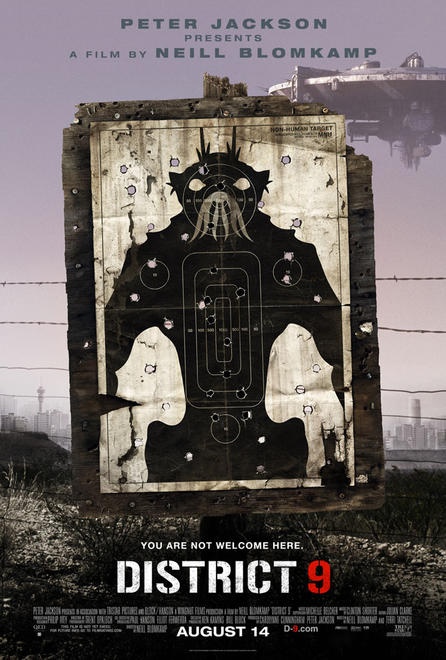
When District 9 (D9) was released in August 2009, the film was an immediate box office hit in several countries. This was much to the surprise of critics, reviewers and bloggers, who seemed astonished by the fact that a science fiction film with this impact could originate from South Africa. Internet forum discussions and an E-Symposium emerged as a response to the film, which continues to be the subject of controversial discussion.[1] While many celebrate the film in relation to the ‘generic’ genre of Science Fiction as a promising representative of a thriving African Cinema, others reject the film on the basis of its socio-political message, as yet another racist movie about Africa – with reference to the depiction of both ‘the Nigerians’ and the aliens.[2] In this article, we would like to move beyond a crudely metaphorical reading of representation (‘the aliens stand for X in reality’), and explore the degree to which the film foregrounds its own mediality. This focus moves us beyond a polarizing position that immediately rejects the film as racist, and allows us to engage with a complex and original text unlike so many other films that take ‘Africa’ as their subject.

From its first image, D9 is hyper-reflective on its own status as a medium. As viewers, we are confronted with a flamboyant play of remediation, as sketched out by Jay David Bolter and Richard Grusin.[3] There, the two strategies of immediacy (a medium makes itself transparent on the referent: ‘looking through’) and hypermediacy (a medium reflects on itself by differentiating itself from another: ‘looking at’) struggle in manifold ways to constitute a complexity not only of the narrative and its semiotic significance but also the overall status of the depicted. In D9, documentaries from the 1980s are used to depict the arrival of the aliens in South Africa. TV-reports are added, which not only show the (militant) conflicts between the local population and the aliens but also the struggles of the aliens with the local police over the following years. In interwoven faux documentaries ‘experts’ express their opinion concerning all social and political issues that the film raises within its course, culminating in a fictitious TV-report with a well-known news anchor man from the SABC network. Visual and aesthetic strategies from Hollywood movies, surveillance cameras and computer games complement and complicate this overloaded genre play.

This form of hypermediacy not only references surveillance societies and 24-hours news cycles but characterizes the film from its beginning as hybrid. As a hybrid the film systematically denies the viewer easy access to the authenticity of what is portrayed. By doing so the film unsettles dichotomies such as ‘us’ and ‘them’ as well as understandings of difference and identity. This needs to be understood as a strategy of subversion but more importantly as the productivity of the film itself. The reality that the film pretends to represent is in fact only produced through the film. In this way it becomes clear that the authenticity or putative origin of any identity (and therefore of any social reality depicted in the film) did not exist beforehand but is rather the effect of its positioning through media. Accordingly, it is important to look closely at the media strategies that are initiated through the film at particular moments and examine their purpose to either authenticate referents or to display their constructedness. We will return to these strategies throughout this article.

To Read the Rest of the Essay

Saturday, January 16, 2010

Nick Bostrom: Why Make a Matrix? And Why You Might Be in One

Why Make a Matrix? And Why You Might Be in One
Popular Culture and Philosophy (Open Court Books)


Are you a flesh-and-blood person, or an electrical impulse on a circuit board somewhere? According to ... philosopher Nick Bostrom, there's a high probability that you and everyone you know are living in a matrix. Think it's farfetched? Listen as Bostrom's ... arguments paint a picture of a computer-simulated reality with citizens just like you.

To Listen to the Reading (MP3)

Tuesday, January 05, 2010

Film School: Duncan Jones -- Moon

Duncan Jones -- Moon
Film School (KUCI)


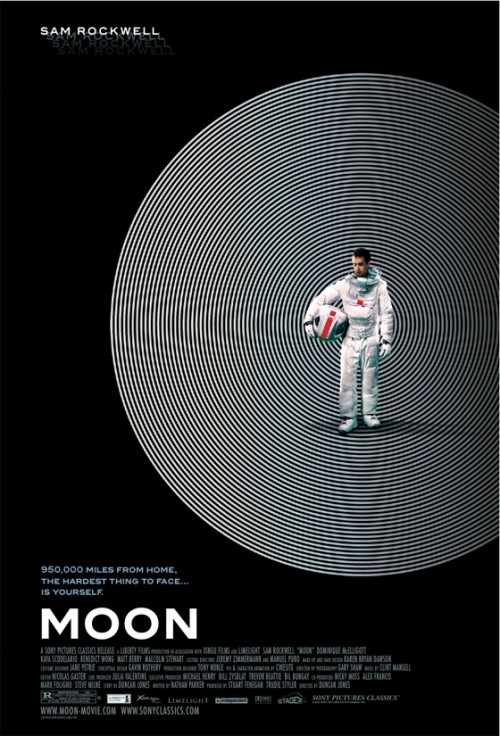
An interview with DUNCAN JONES the director of MOON — a science fiction thriller about a solitary lunar employee who finds that he may not be able to go home to Earth so easily. The film is the feature film debut of commercial director Duncan Jones. Sam Rockwell stars as the lunar employee. Kevin Spacey voices his robot companion. The film premiered at the 2009 Sundance Film Festival in January 2009. Bell is an employee contracted by the company Lunar to mine on the Moon the natural gas Helium 3, which could reverse Earth's energy crisis. Sam is stationed at the lunar base Sarang with only a robot named Gerty, but two weeks before completing his three-year assignment, he begins feeling out of place. An extraction goes wrong, and Sam suspects Lunar of trying to replace him as he realizes someone else is on the Moon. Jones co-wrote the script with Nathan Parker. The film was specifically written as a vehicle for actor Sam Rockwell and pays homage to the films of Jones' youth, such as Silent Running (1972), Alien (1979) and Outland (1981). Duncan Jones is also known as Zowie Bowie, the son of David Bowie and his ex-wife Angela Bowie.

To Listen to the Interview (MP3)

Friday, December 11, 2009

Joan Slonczewski: A Door Into Ocean

I literally devoured this book ... a beautiful realization of a pacifist, anti-authoritarian, all-female (but not necessarily anti-male) ocean world resisting a 100 world-spanning militaristic empire's attempt to place them under control/domination. All the way to the end I wasn't sure how it would turn out... Joan Slonczewski is a biologist and she spent eight years creating this book. It is evident in the careful construction of the novel, the characters are brilliantly realized and the strange world makes sense (at least to me).


A Library Journal reviewer stated "Slonczewski creates an all-female nonviolent culture that reaches beyond feminism to a new definition of human nature" (Library Journal Vol. 110 (Issue 20): p129) ... I can understand the reviewer's exuberance, but the definition of human nature is not new. It can be seen in anarchist collectives, Quaker gatherings, Unitarian spirituality and the tradition of non-violent resistance. The Shora gatherings for collective decision-making and their lack of official leaders/permanent hierarchy prove to be particularly frustrating for the empire trying to dominate them through the domestication of elite native puppet leaders.

A Door Into Ocean Study Guide

Wednesday, November 11, 2009

Kirk Boyle: Children of Men and I Am Legend: the disaster-capitalism complex hits Hollywood

Children of Men and I Am Legend: the disaster-capitalism complex hits Hollywood
by Kirk Boyle
Jump Cut


...

In addition to indulging the fantasies of late capitalist consumers, Legend targets its audience with “anamorphic advertising.” Lawrence replaces Cuarón’s background commentary on forced migrations and terrorism — newspaper clips that read, “Refugees Blamed for Increase in Terror Attacks” and “Immigrants Protest Against Government New Racist Policies” — with identifiable storefronts, billboards, and products. The “hyper-commercialization” of Hollywood is not a new phenomenon. Product placements, tie-ins, merchandising, and cross-promotions have proliferated in the age of media conglomeration to the point where younger generations no longer experience them as baleful, let alone disruptive. That the Shelby Mustang is clearly the choice of the post-apocalyptic sportsman — along with the Ford Explorer and Escape Hybrid — will come as no surprise to anyone familiar with this latest version of the culture industry.

Nonetheless, Children makes Legend’s participation in these dubious marketing trends look egregious. Brandchannel.com lists thirty-two corporate brands that appear in Legend (on average, a new one every three minutes) while Children features “almost zero brands” (Sauer 2007: unpaginated).[17] Beyond the quantity of ads lies an issue of quality. Where Children harnesses the political potentials of anamorphosis — especially in scenes where anamorphic advertisements of invented products ironize the consumerism of late capitalism — Legend exploits the same artful techniques to peddle products and promote corporate brand recognition.[18] Most disturbing of all, Lawrence uses anamorphosis to naturalize the corporate structure of neoliberal capitalism. Signs of multinational corporations litter the backgrounds of Legend. A mega-disaster has destroyed the signs’ referents within the film's diegesis, but their spectral presence sends the subliminal message to an early twenty-first century audience that corporate capitalism is all but indestructible. The first few minutes of Legend where Neville’s Shelby zips past strategically placed advertisements for XM Satellite Radio, Staples, and Hyatt, assure us that the world is more likely to end before capitalism does.

One final indication that Legend cuts ties with reality in order to enact a consumerist fantasy stems from what Popular Mechanics calls the “junk science” of the film. Popular Mechanics’ assistant editor Erin McCarthy consulted

“experts in the fields of structural engineering, virology, and wildlife to determine what could happen — and what certainly won’t happen” regarding Legend’s portrait of the future (McCarthy 2007: 1).


Pointing out the scientific inconsistencies of a film does not meet the criteria most moviegoers take to the theater, nor will it prove to be an ideological indicator in many cases. But as with Legend’s prevalent product placements, its “junk science” is symptomatic of a larger ideological problem. New York City would be in worse condition due to water and fire damage, and Neville would run into problems with powering his home that the film glosses over. Disbelief could be suspended if these vital infrastructural issues had not been ignored precisely because Neville exists in the fantasy space of a consumer and not a producer. In one representative scene, he harvests ears of corn in Central Park. That the corn is ripe is no accident. Legend cannot represent how the things Neville consumes were produced because labor does not exist in the consumerist fantasyland of the Last Men. Everything Neville needs or wants is simply there for the picking.

Legend creates a capitalist utopia by immersing its protagonist in a world that defies the laws of physics, a playground of consumer goods that hides the labor power of its construction and sustenance (and the problems that would inevitably plague its sole survivor). The film’s “anamorphic advertising” weaves its consuming public into this fantasy world to naturalize neoliberalism as if to say, “the world as we know it will never end, and we will always feel fine.”

Where Legend celebrates the Last Men and their late capitalist utopia, Children critiques their narcissism, cynicism, and classism (as soon will become apparent), by depicting their world — our world — as dystopian. With the dreamworld of wealth comes the catastrophe of crimes against humanity in the guise of free markets, illegal immigration, homeland security, and the War on Terror — all of the specious policies which Cuarón catalogues in his backdrops, the very same policies that Naomi Klein argues bankroll the well-orchestrated “disaster-capitalism complex.”

I Am Conservative-Corporatist

In The Shock Doctrine, Klein claims that the neoliberal era ushered in a “capitalist Reformation” that doubled as a counterrevolution to Keynesianism and Third World developmentalism (Klein 2007b: 53). Like Harvey, she views neoliberalism as a theory of political economic practices that seek to restore class power through deregulation, privatization, and cuts to social spending, a free-market trinity bent on redistributing wealth as much as generating it. Put into practice, neoliberalization morphs into corporatism, a vast collusion between Big Government and Big Business to transfer public wealth to private hands while an ever-widening chasm opens up between “the dazzling rich and the disposable poor” (Klein 2007b: 15). The recent $700 billion financial bailout of banks by the U.S. government provides a clear example of this collusion.

Klein charts how the rise of corporatism spawned a disaster-capitalism complex that at once extends and supersedes the military-industrial (and congressional) complex President Eisenhower diagnosed in his 1961 farewell address. With the emergence of the disaster-capitalism complex, the latent “creative destruction” that fueled the engines of capital since its inception surges to the surface to become the recognized modus operandi of the economy. Today, crisis opportunism entwines superprofits with megadisasters to the point where

“all conflict- and disaster-related functions (waging war, securing borders, spying on citizens, rebuilding cities, treating traumatized soldiers) can be performed by corporations at a profit” (Klein 2007c: 50).


Although “disaster capitalism” has been part of neoliberal policy for over three decades, it did not develop into a full-scale complex until after 9/11 with the War on Terror. As Klein writes,

“Although the state goal was fighting terrorism, the effect was the creation of the disaster capitalism complex — a full-fledged new economy in homeland security, privatized war and disaster reconstruction tasked with nothing less than building and running a privatized security state, both at home and abroad” (Klein 2007b: 299).


Under the auspice of fighting terrorism, the disaster-capitalism complex insidiously developed into a fully articulated state-within-a-state, a corporate shadow-state, that carries out the normal functions of a nation-state but at a heftier price.

To Read the Entire Essay


Naomi Klein: Shock Doctrine (Videos on YouTube)

Tuesday, November 10, 2009

Mythmakers and Lawbreakers (AK Press: ed. Margaret Killjoy, 2009)

Received this in my AK Press friend subscription this month and immediately devoured it. It is a collection of interviews and an annotated bibliography of anarchist fiction writers. A valuable resource that will help me extend my imaginative derives and has even inspired me to start writing fiction again.


Mythmakers and Lawbreakers (AK Press)

Monday, November 09, 2009

The Bat Segundo Show #298: China Mieville -- The City and the City

#298: China Mieville
The Bat Segundo Show


Subjects Discussed: When The City & The City was written, speculating on the novel’s setting, ratty technology and shambolic modern cities, passenger policy, comparisons between The City & The City and “Reports of Certain Events in London,” subconscious intent and conceptual framework, police procedural dialogue vs. melodramatic dialogue, whether an author’s voice is “reigned in” because of genre, the myths of genre constraints, steps taken in advance to alter voice, the dangers of reading while writing, maintaining two sets of momentum while writing two different books, the enabling qualities of thematics, multiculturalism in Canada, satire and political engagement within fiction, resisting critical labels within a cultural framework, Jacques Lacan, metaphors in fiction, Mieville’s frustrations with perceived author endorsements, readers who cling to rigid interpretation, disappointing mystery novels, designing endings as moral dilemmas, circumstances in which you can exonerate the author, Mary Doria Russell’s The Sparrow, uneasy books, the dangers of unease as an abstract concept, not distinguishing between aesthetic and emotive qualities within text, resisting post-structuralism, seeing text as part of social totality, and keeping people turning pages.

To Watch/Listen/Read

Thursday, October 29, 2009

Mary Doria Russell: The Novelist as God

(The Sparrow is one of my favorite SF books)

The Novelist as God
Speaking of Faith with Krista Tippett


Mary Doria Russell has grappled with large moral and religious questions on and off the page. We discover what she discerned — in the act of creating a new universe — about God and about dilemmas of evil, doubt, and free will. The ultimate moral of any life and any event, she believes, only shows itself across generations. And so the novelist, like God, she says, paints with the brush of time.

To Listen to the Episode and Access More Resources