“My Fear is that Climate Change is the Biggest Crisis of All”: Naomi Klein Warns Global Warming Could Be Exploited by Capitalism and Militarism
Democracy Now
Award-winning journalist Naomi Klein has been reporting on global warming and the climate justice movement for years. “My fear is that climate change is the biggest crisis of all,” Klein says. “If we don’t come up with a positive vision of how climate change can make our economies and our world more just, more livable, cleaner, fairer, then this crisis will be exploited to militarize our economies, to create fortress continents. And we’re really facing a choice. What we really need now is for the people fighting for economic justice and environmental justice to come together.”
To Watch/Listen/Read
Showing posts with label Naomi Klein. Show all posts
Showing posts with label Naomi Klein. Show all posts
Wednesday, March 09, 2011

Naomi Klein on Anti-Union Bills and Shock Doctrine American-Style: "This is a Frontal Assault on Democracy, It’s a Kind of a Corporate Coup D’Etat"
Naomi Klein on Anti-Union Bills and Shock Doctrine American-Style: "This is a Frontal Assault on Democracy, It’s a Kind of a Corporate Coup D’Etat"
Democracy Now
As a wave of anti-union bills are introduced across the country following the wake of Wall Street financial crisis, many analysts are picking up on the theory that award-winning journalist and author Naomi Klein first argued in her 2007 bestselling book, The Shock Doctrine: The Rise of Disaster Capitalism. In the book, she reveals how those in power use times of crisis to push through undemocratic and extreme free market economic policies. “The Wisconsin protests are an incredible example of how to resist the shock doctrine,” Klein says.
To Watch/Listen/Read
Democracy Now
As a wave of anti-union bills are introduced across the country following the wake of Wall Street financial crisis, many analysts are picking up on the theory that award-winning journalist and author Naomi Klein first argued in her 2007 bestselling book, The Shock Doctrine: The Rise of Disaster Capitalism. In the book, she reveals how those in power use times of crisis to push through undemocratic and extreme free market economic policies. “The Wisconsin protests are an incredible example of how to resist the shock doctrine,” Klein says.
To Watch/Listen/Read
Sunday, February 27, 2011
Abu Atris: A Revolution Against Neoliberalism?
[Thivai: Excellent short essay -- discusses neoliberalism here and abroad, through the lenses of David Harvey, Timothy Mitchell and Naomi Klein. Would be a great intro for people that are not familiar with neoliberalism or political economy or broader global interconnections or problems with free market/privatization in a real world setting.]
A revolution against neoliberalism? If rebellion results in a retrenchment of neoliberalism, millions will feel cheated.
by Abu Atris
Al Jazeera
...
Rhetoric vs. reality
Two observations about Egypt’s history as a neoliberal state are in order. First, Mubarak’s Egypt was considered to be at the forefront of instituting neoliberal policies in the Middle East (not un-coincidentally, so was Ben Ali’s Tunisia). Secondly, the reality of Egypt’s political economy during the Mubarak era was very different than the rhetoric, as was the case in every other neoliberal state from Chile to Indonesia. Political scientist Timothy Mitchell published a revealing essay about Egypt’s brand of neoliberalism in his book Rule of Experts (the chapter titled "Dreamland" — named after a housing development built by Ahmad Bahgat, one of the Mubarak cronies now discredited by the fall of the regime). The gist of Mitchell’s portrait of Egyptian neoliberalism was that while Egypt was lauded by institutions such as the International Monetary Fund as a beacon of free-market success, the standard tools for measuring economies gave a grossly inadequate picture of the Egyptian economy. In reality the unfettering of markets and agenda of privatization were applied unevenly at best.
The only people for whom Egyptian neoliberalism worked "by the book" were the most vulnerable members of society, and their experience with neoliberalism was not a pretty picture. Organised labor was fiercely suppressed. The public education and the health care systems were gutted by a combination of neglect and privatization. Much of the population suffered stagnant or falling wages relative to inflation. Official unemployment was estimated at approximately 9.4% last year (and much higher for the youth who spearheaded the January 25th Revolution), and about 20% of the population is said to live below a poverty line defined as $2 per day per person.
For the wealthy, the rules were very different. Egypt did not so much shrink its public sector, as neoliberal doctrine would have it, as it reallocated public resources for the benefit of a small and already affluent elite. Privatization provided windfalls for politically well-connected individuals who could purchase state-owned assets for much less than their market value, or monopolise rents from such diverse sources as tourism and foreign aid. Huge proportions of the profits made by companies that supplied basic construction materials like steel and cement came from government contracts, a proportion of which in turn were related to aid from foreign governments.
Most importantly, the very limited function for the state recommended by neoliberal doctrine in the abstract was turned on its head in reality. In Mubarak’s Egypt business and government were so tightly intertwined that it was often difficult for an outside observer to tease them apart. Since political connections were the surest route to astronomical profits, businessmen had powerful incentives to buy political office in the phony elections run by the ruling National Democratic Party. Whatever competition there was for seats in the Peoples’ Assembly and Consultative Council took place mainly within the NDP. Non-NDP representation in parliament by opposition parties was strictly a matter of the political calculations made for a given elections: let in a few independent candidates known to be affiliated with the Muslim Brotherhood in 2005 (and set off tremors of fear in Washington); dictate total NDP domination in 2010 (and clear the path for an expected new round of distributing public assets to "private" investors).
Parallels with America
The political economy of the Mubarak regime was shaped by many currents in Egypt’s own history, but its broad outlines were by no means unique. Similar stories can be told throughout the rest of the Middle East, Latin America, Asia, Europe and Africa. Everywhere neoliberalism has been tried, the results are similar: living up to the utopian ideal is impossible; formal measures of economic activity mask huge disparities in the fortunes of the rich and poor; elites become "masters of the universe," using force to defend their prerogatives, and manipulating the economy to their advantage, but never living in anything resembling the heavily marketised worlds that are imposed on the poor.
Unemployment was a major grievance for millions of Egyptian protesters [EPA]
The story should sound familiar to Americans as well. For example, the vast fortunes of Bush era cabinet members Donald Rumsfeld and Dick Cheney, through their involvement with companies like Halliburton and Gilead Sciences, are the product of a political system that allows them — more or less legally — to have one foot planted in "business" and another in "government" to the point that the distinction between them becomes blurred. Politicians move from the office to the boardroom to the lobbying organization and back again.
As neoliberal dogma disallows any legitimate role for government other than guarding the sanctity of free markets, recent American history has been marked by the steady privatization of services and resources formerly supplied or controlled by the government. But it is inevitably those with closest access to the government who are best positioned to profit from government campaigns to sell off the functions it formerly performed. It is not just Republicans who are implicated in this systemic corruption. Clinton-era Secretary of Treasury Robert Rubin’s involvement with Citigroup does not bear close scrutiny. Lawrence Summers gave crucial support for the deregulation of financial derivatives contracts while Secretary of Treasury under Clinton, and profited handsomely from companies involved in the same practices while working for Obama (and of course deregulated derivatives were a key element in the financial crisis that led to a massive Federal bailout of the entire banking industry).
So in Egyptian terms, when General Secretary of the NDP Ahmad Ezz cornered the market on steel and was given contracts to build public-private construction projects, or when former Minister of Parliament Talaat Mustafa purchased vast tracts of land for the upscale Madinaty housing development without having to engage in a competitive bidding process (but with the benefit of state-provided road and utility infrastructure), they may have been practicing corruption logically and morally. But what they were doing was also as American as apple pie, at least within the scope of the past two decades.
However, in the current climate the most important thing is not the depredations of deposed Mubarak regime cronies. It is rather the role of the military in the political system. It is the army that now rules the country, albeit as a transitional power, or so most Egyptians hope. No representatives of the upper echelons of the Egyptian military appear on the various lists of old-regime allies who need to be called to account. For example, the headline of the February 17th edition of Ahrar, the press organ of the Liberal party, was emblazoned with the headline "Financial Reserves of the Corrupt Total 700 Billion Pounds [about $118 billion] in 18 Countries."
A vast economic powerhouse
But the article did not say a single word about the place of the military in this epic theft. The military were nonetheless part of the crony capitalism of the Mubarak era. After relatively short careers in the military high-ranking officers are rewarded with such perks as highly remunerative positions on the management boards of housing projects and shopping malls. Some of these are essentially public-sector companies transferred to the military sector when IMF-mandated structural adjustment programs required reductions in the civilian public sector.
To Read the Rest of the Essay
A revolution against neoliberalism? If rebellion results in a retrenchment of neoliberalism, millions will feel cheated.
by Abu Atris
Al Jazeera
...
Rhetoric vs. reality
Two observations about Egypt’s history as a neoliberal state are in order. First, Mubarak’s Egypt was considered to be at the forefront of instituting neoliberal policies in the Middle East (not un-coincidentally, so was Ben Ali’s Tunisia). Secondly, the reality of Egypt’s political economy during the Mubarak era was very different than the rhetoric, as was the case in every other neoliberal state from Chile to Indonesia. Political scientist Timothy Mitchell published a revealing essay about Egypt’s brand of neoliberalism in his book Rule of Experts (the chapter titled "Dreamland" — named after a housing development built by Ahmad Bahgat, one of the Mubarak cronies now discredited by the fall of the regime). The gist of Mitchell’s portrait of Egyptian neoliberalism was that while Egypt was lauded by institutions such as the International Monetary Fund as a beacon of free-market success, the standard tools for measuring economies gave a grossly inadequate picture of the Egyptian economy. In reality the unfettering of markets and agenda of privatization were applied unevenly at best.
The only people for whom Egyptian neoliberalism worked "by the book" were the most vulnerable members of society, and their experience with neoliberalism was not a pretty picture. Organised labor was fiercely suppressed. The public education and the health care systems were gutted by a combination of neglect and privatization. Much of the population suffered stagnant or falling wages relative to inflation. Official unemployment was estimated at approximately 9.4% last year (and much higher for the youth who spearheaded the January 25th Revolution), and about 20% of the population is said to live below a poverty line defined as $2 per day per person.
For the wealthy, the rules were very different. Egypt did not so much shrink its public sector, as neoliberal doctrine would have it, as it reallocated public resources for the benefit of a small and already affluent elite. Privatization provided windfalls for politically well-connected individuals who could purchase state-owned assets for much less than their market value, or monopolise rents from such diverse sources as tourism and foreign aid. Huge proportions of the profits made by companies that supplied basic construction materials like steel and cement came from government contracts, a proportion of which in turn were related to aid from foreign governments.
Most importantly, the very limited function for the state recommended by neoliberal doctrine in the abstract was turned on its head in reality. In Mubarak’s Egypt business and government were so tightly intertwined that it was often difficult for an outside observer to tease them apart. Since political connections were the surest route to astronomical profits, businessmen had powerful incentives to buy political office in the phony elections run by the ruling National Democratic Party. Whatever competition there was for seats in the Peoples’ Assembly and Consultative Council took place mainly within the NDP. Non-NDP representation in parliament by opposition parties was strictly a matter of the political calculations made for a given elections: let in a few independent candidates known to be affiliated with the Muslim Brotherhood in 2005 (and set off tremors of fear in Washington); dictate total NDP domination in 2010 (and clear the path for an expected new round of distributing public assets to "private" investors).
Parallels with America
The political economy of the Mubarak regime was shaped by many currents in Egypt’s own history, but its broad outlines were by no means unique. Similar stories can be told throughout the rest of the Middle East, Latin America, Asia, Europe and Africa. Everywhere neoliberalism has been tried, the results are similar: living up to the utopian ideal is impossible; formal measures of economic activity mask huge disparities in the fortunes of the rich and poor; elites become "masters of the universe," using force to defend their prerogatives, and manipulating the economy to their advantage, but never living in anything resembling the heavily marketised worlds that are imposed on the poor.
Unemployment was a major grievance for millions of Egyptian protesters [EPA]
The story should sound familiar to Americans as well. For example, the vast fortunes of Bush era cabinet members Donald Rumsfeld and Dick Cheney, through their involvement with companies like Halliburton and Gilead Sciences, are the product of a political system that allows them — more or less legally — to have one foot planted in "business" and another in "government" to the point that the distinction between them becomes blurred. Politicians move from the office to the boardroom to the lobbying organization and back again.
As neoliberal dogma disallows any legitimate role for government other than guarding the sanctity of free markets, recent American history has been marked by the steady privatization of services and resources formerly supplied or controlled by the government. But it is inevitably those with closest access to the government who are best positioned to profit from government campaigns to sell off the functions it formerly performed. It is not just Republicans who are implicated in this systemic corruption. Clinton-era Secretary of Treasury Robert Rubin’s involvement with Citigroup does not bear close scrutiny. Lawrence Summers gave crucial support for the deregulation of financial derivatives contracts while Secretary of Treasury under Clinton, and profited handsomely from companies involved in the same practices while working for Obama (and of course deregulated derivatives were a key element in the financial crisis that led to a massive Federal bailout of the entire banking industry).
So in Egyptian terms, when General Secretary of the NDP Ahmad Ezz cornered the market on steel and was given contracts to build public-private construction projects, or when former Minister of Parliament Talaat Mustafa purchased vast tracts of land for the upscale Madinaty housing development without having to engage in a competitive bidding process (but with the benefit of state-provided road and utility infrastructure), they may have been practicing corruption logically and morally. But what they were doing was also as American as apple pie, at least within the scope of the past two decades.
However, in the current climate the most important thing is not the depredations of deposed Mubarak regime cronies. It is rather the role of the military in the political system. It is the army that now rules the country, albeit as a transitional power, or so most Egyptians hope. No representatives of the upper echelons of the Egyptian military appear on the various lists of old-regime allies who need to be called to account. For example, the headline of the February 17th edition of Ahrar, the press organ of the Liberal party, was emblazoned with the headline "Financial Reserves of the Corrupt Total 700 Billion Pounds [about $118 billion] in 18 Countries."
A vast economic powerhouse
But the article did not say a single word about the place of the military in this epic theft. The military were nonetheless part of the crony capitalism of the Mubarak era. After relatively short careers in the military high-ranking officers are rewarded with such perks as highly remunerative positions on the management boards of housing projects and shopping malls. Some of these are essentially public-sector companies transferred to the military sector when IMF-mandated structural adjustment programs required reductions in the civilian public sector.
To Read the Rest of the Essay
Monday, February 21, 2011
Naomi Klein: Goldstone's Legacy for Israel
Goldstone's Legacy for Israel
by Naomi Klein
The Nation
This essay is adapted from the introduction to The Goldstone Report: The Legacy of the Landmark Investigation of the Gaza Conflict (Nation Books).
A sprawling crime scene. That is what Gaza felt like when I visited in the summer of 2009, six months after the Israeli attack. Evidence of criminality was everywhere—the homes and schools that lay in rubble, the walls burned pitch black by white phosphorus, the children’s bodies still unhealed for lack of medical care. But where were the police? Who was documenting these crimes, interviewing the witnesses, protecting the evidence from tampering?
For months it seemed that there would be no investigation. Many Gazans I met on that trip appeared as traumatized by the absence of an international investigation as by the attacks. They explained that even in the darkest days of the Israeli onslaught, they had comforted themselves with the belief that, this time, Israel had gone too far. Mona al-Shawa, head of the Women’s Unit at the Palestinian Centre for Human Rights, told me that Gazans took great solace from news of pro-Palestinian protesters filling the streets of London and Toronto. “People called it war crimes,” she recalled. “We felt we were not alone in the world.” It seemed to follow from these expressions of outrage that there would be serious consequences for the attacks—criminal trials for the perpetrators, sentences. And under the glare of international investigation, Israel would surely have to lift the brutal embargo that had kept Gaza sealed off from the world since Hamas came to power. Those who really dared to dream convinced themselves that, out of the lawlessness and carnage, a just peace would emerge at last.
But six months later, an almost unbearable realization had set in: the cavalry wasn’t coming. Despite all the righteous indignation, Israel had not been forced to change its behavior in any way. Gaza’s borders were still sealed, only now the blockade was keeping out desperately needed rebuilding supplies in addition to many necessities of life. (It would take Israel’s lethal attack last year on a humanitarian aid flotilla for a debate about the siege to begin in earnest.) Even worse, the people I met were acutely aware that they could find themselves trapped under Israeli air bombardment again tomorrow, for any arbitrary excuse of Israel’s choosing. The message sent by the paralysis of the international legal system was terrifying: Israel enjoyed complete impunity. There was no recourse.
Then, out of nowhere, a representative of the law showed up. His name was Justice Richard Goldstone, and he was leading a fact-finding mission for the United Nations. His mandate was to assess whether war crimes had been committed in the context of the attack. I happened to be in Gaza City when Justice Goldstone was wrapping up his public hearings and met several people who had testified before him, as well as others who had opened their homes to the mission, showing the scars left by Israeli weapons and sharing photographs of family members killed in the attacks. Finally some light seemed to be shining on this rubble-choked strip of land. But it was faint, and many Gazans remained skeptical that justice would follow. If the attacks had failed to provoke action, they reasoned, what hope was there that words in a report would awaken the world? This caution, it turns out, was a wise form of self-preservation.
The attempts to block, then sabotage, then bury the Goldstone Report began before a single word had been written. The Israeli government rejected the original decision by the UN Human Rights Council to investigate allegations of war crimes during the Gaza attack. The council was hopelessly biased, Israel claimed, and the January 12, 2009, resolution creating the fact-finding mission was, according to Israel’s ministry of foreign affairs, “one-sided and irrelevant.” It is true that the original mandate of the mission called only for an investigation of violations committed “by the occupying Power, Israel, against the Palestinian people.” But when Justice Goldstone took the top job and announced that the mandate had been expanded to include possible crimes committed by Palestinians “whether before, during or after” the attacks, Israel flatly refused to acknowledge this new reality. “There is no formal expansion of the mandate,” foreign ministry spokesman Yossi Levy insisted, against abundant evidence to the contrary. He added, “We will not cooperate with the mission, because its duty is not to find the truth but to find semi-judicial ways to attack Israel.”
When it became clear that the mission would proceed despite this obstructionism, the Israeli government switched to a new strategy: doing almost everything in its considerable power to sabotage Goldstone’s work. To this end, the Israeli government refused to allow the UN team to travel inside Israel. That meant that to get into Gaza, members had to go through Egypt. It also meant that Goldstone’s investigators could not travel to Sderot and Ashkelon to hear from Israeli victims of Qassam rocket attacks—critical testimony if the mission was to fulfill its mandate to investigate crimes on all sides. Israel’s strategy was transparent enough: it would force Goldstone to produce a one-sided report, which it would then enthusiastically dismiss for being one-sided.
It didn’t work. To get around the government roadblocks, Goldstone flew Israelis to Geneva so he could hear their testimony in person. When the report came out, it reflected the scale of the crimes committed by each side, concentrating mostly on Israel’s actions, including attacks on houses, hospitals and mosques that together killed scores of people, as well as attacks on civilian infrastructure such as water installations, agricultural facilities and factories. But the report did not give Hamas a pass. Goldstone concluded that the launching of rockets and mortars into populated areas “where there is no intended military target”—a practice used by Hamas’s military wing as well as by other armed Palestinian groups—“indicates the commission of an indiscriminate attack on the civilian population of southern Israel, a war crime, and may amount to crimes against humanity.” He also accused Hamas of “extrajudicial executions” in the Gaza Strip and the Palestinian Authority of repression and possibly torture in the West Bank.
The Goldstone Report is a serious, fair-minded and extremely disturbing document—which is precisely why the Israeli strategy since its publication has been to talk about pretty much everything except the substance of the report. Distractions have ranged from further posturing about the UN’s bias, to smear campaigns about Justice Goldstone’s personal history, to claims that the report is an integral part of a grand conspiracy to deny Israel’s right to exist. Dore Gold, a former Israeli ambassador and top political adviser, said the report was “the most serious and vicious indictment of the State of Israel bearing the seal of the United Nations” since the UN equated Zionism with racism in 1975 and “an assault on Israeli society as a whole,” while Prime Minister Benjamin Netanyahu explained that “there are three primary threats facing us today: the nuclear threat, the missile threat and what I call the Goldstone threat.” The phrase “blood libel” was thrown around with great promiscuity, disgracefully equating the Goldstone Report with the anti-Semitic trials of the Middle Ages in which Jews were accused of drinking the blood of Christian children. (For some reason this seems to be a problem only when Sarah Palin abuses the term.)
Given this kind of incitement from the top, it’s little wonder that the 72-year-old judge was very nearly prevented from attending his grandson’s bar mitzvah in a Johannesburg suburb, with the synagogue worried about violence breaking out. “I could not believe that political anger against him—which people had every right to express—had evolved into an uncontrolled and unconscionable rage that sought to violate the spirit of one of the most sacred aspects of formal Jewish tradition,” observed noted South African judge Albie Sachs.
Israel has no shortage of critics, many of them Jewish. So what was it about Goldstone that ignited this conflagration? The likeliest answer lies in the particular rhetorical techniques Israel’s leaders reliably employ to defend their actions. For decades, Israeli officials have deflected any and all human rights criticisms by claiming that Israel was being unfairly “singled out” by those who claim to care about international law but who look the other way when equally serious crimes are committed by other states. The problem posed by Goldstone was that his record as a judge on the world stage made it impossible for Israel to make this claim with any credibility.
Goldstone began his judicial career as one of a handful of liberal judges serving on the South African bench during the apartheid era. Though required to enforce the country’s brutal discriminatory laws, these judges were also able to chip away at the system from within, helping to loosen the grip of apartheid in its final years. A 1982 ruling by Goldstone, for instance, blocked judges from evicting blacks and “coloreds” from their homes to make way for whites-only neighborhoods without considering whether suitable alternative accommodations could be found, a requirement that made it virtually impossible to enforce the much-hated Group Areas Act. As apartheid weakened, Goldstone began playing a more activist role, exposing a system of extrajudicial death squads within South Africa’s police and military—crimes that eventually came before the country’s Truth and Reconciliation Commission.
To Read the Rest of the Essay
by Naomi Klein
The Nation
This essay is adapted from the introduction to The Goldstone Report: The Legacy of the Landmark Investigation of the Gaza Conflict (Nation Books).
A sprawling crime scene. That is what Gaza felt like when I visited in the summer of 2009, six months after the Israeli attack. Evidence of criminality was everywhere—the homes and schools that lay in rubble, the walls burned pitch black by white phosphorus, the children’s bodies still unhealed for lack of medical care. But where were the police? Who was documenting these crimes, interviewing the witnesses, protecting the evidence from tampering?
For months it seemed that there would be no investigation. Many Gazans I met on that trip appeared as traumatized by the absence of an international investigation as by the attacks. They explained that even in the darkest days of the Israeli onslaught, they had comforted themselves with the belief that, this time, Israel had gone too far. Mona al-Shawa, head of the Women’s Unit at the Palestinian Centre for Human Rights, told me that Gazans took great solace from news of pro-Palestinian protesters filling the streets of London and Toronto. “People called it war crimes,” she recalled. “We felt we were not alone in the world.” It seemed to follow from these expressions of outrage that there would be serious consequences for the attacks—criminal trials for the perpetrators, sentences. And under the glare of international investigation, Israel would surely have to lift the brutal embargo that had kept Gaza sealed off from the world since Hamas came to power. Those who really dared to dream convinced themselves that, out of the lawlessness and carnage, a just peace would emerge at last.
But six months later, an almost unbearable realization had set in: the cavalry wasn’t coming. Despite all the righteous indignation, Israel had not been forced to change its behavior in any way. Gaza’s borders were still sealed, only now the blockade was keeping out desperately needed rebuilding supplies in addition to many necessities of life. (It would take Israel’s lethal attack last year on a humanitarian aid flotilla for a debate about the siege to begin in earnest.) Even worse, the people I met were acutely aware that they could find themselves trapped under Israeli air bombardment again tomorrow, for any arbitrary excuse of Israel’s choosing. The message sent by the paralysis of the international legal system was terrifying: Israel enjoyed complete impunity. There was no recourse.
Then, out of nowhere, a representative of the law showed up. His name was Justice Richard Goldstone, and he was leading a fact-finding mission for the United Nations. His mandate was to assess whether war crimes had been committed in the context of the attack. I happened to be in Gaza City when Justice Goldstone was wrapping up his public hearings and met several people who had testified before him, as well as others who had opened their homes to the mission, showing the scars left by Israeli weapons and sharing photographs of family members killed in the attacks. Finally some light seemed to be shining on this rubble-choked strip of land. But it was faint, and many Gazans remained skeptical that justice would follow. If the attacks had failed to provoke action, they reasoned, what hope was there that words in a report would awaken the world? This caution, it turns out, was a wise form of self-preservation.
The attempts to block, then sabotage, then bury the Goldstone Report began before a single word had been written. The Israeli government rejected the original decision by the UN Human Rights Council to investigate allegations of war crimes during the Gaza attack. The council was hopelessly biased, Israel claimed, and the January 12, 2009, resolution creating the fact-finding mission was, according to Israel’s ministry of foreign affairs, “one-sided and irrelevant.” It is true that the original mandate of the mission called only for an investigation of violations committed “by the occupying Power, Israel, against the Palestinian people.” But when Justice Goldstone took the top job and announced that the mandate had been expanded to include possible crimes committed by Palestinians “whether before, during or after” the attacks, Israel flatly refused to acknowledge this new reality. “There is no formal expansion of the mandate,” foreign ministry spokesman Yossi Levy insisted, against abundant evidence to the contrary. He added, “We will not cooperate with the mission, because its duty is not to find the truth but to find semi-judicial ways to attack Israel.”
When it became clear that the mission would proceed despite this obstructionism, the Israeli government switched to a new strategy: doing almost everything in its considerable power to sabotage Goldstone’s work. To this end, the Israeli government refused to allow the UN team to travel inside Israel. That meant that to get into Gaza, members had to go through Egypt. It also meant that Goldstone’s investigators could not travel to Sderot and Ashkelon to hear from Israeli victims of Qassam rocket attacks—critical testimony if the mission was to fulfill its mandate to investigate crimes on all sides. Israel’s strategy was transparent enough: it would force Goldstone to produce a one-sided report, which it would then enthusiastically dismiss for being one-sided.
It didn’t work. To get around the government roadblocks, Goldstone flew Israelis to Geneva so he could hear their testimony in person. When the report came out, it reflected the scale of the crimes committed by each side, concentrating mostly on Israel’s actions, including attacks on houses, hospitals and mosques that together killed scores of people, as well as attacks on civilian infrastructure such as water installations, agricultural facilities and factories. But the report did not give Hamas a pass. Goldstone concluded that the launching of rockets and mortars into populated areas “where there is no intended military target”—a practice used by Hamas’s military wing as well as by other armed Palestinian groups—“indicates the commission of an indiscriminate attack on the civilian population of southern Israel, a war crime, and may amount to crimes against humanity.” He also accused Hamas of “extrajudicial executions” in the Gaza Strip and the Palestinian Authority of repression and possibly torture in the West Bank.
The Goldstone Report is a serious, fair-minded and extremely disturbing document—which is precisely why the Israeli strategy since its publication has been to talk about pretty much everything except the substance of the report. Distractions have ranged from further posturing about the UN’s bias, to smear campaigns about Justice Goldstone’s personal history, to claims that the report is an integral part of a grand conspiracy to deny Israel’s right to exist. Dore Gold, a former Israeli ambassador and top political adviser, said the report was “the most serious and vicious indictment of the State of Israel bearing the seal of the United Nations” since the UN equated Zionism with racism in 1975 and “an assault on Israeli society as a whole,” while Prime Minister Benjamin Netanyahu explained that “there are three primary threats facing us today: the nuclear threat, the missile threat and what I call the Goldstone threat.” The phrase “blood libel” was thrown around with great promiscuity, disgracefully equating the Goldstone Report with the anti-Semitic trials of the Middle Ages in which Jews were accused of drinking the blood of Christian children. (For some reason this seems to be a problem only when Sarah Palin abuses the term.)
Given this kind of incitement from the top, it’s little wonder that the 72-year-old judge was very nearly prevented from attending his grandson’s bar mitzvah in a Johannesburg suburb, with the synagogue worried about violence breaking out. “I could not believe that political anger against him—which people had every right to express—had evolved into an uncontrolled and unconscionable rage that sought to violate the spirit of one of the most sacred aspects of formal Jewish tradition,” observed noted South African judge Albie Sachs.
Israel has no shortage of critics, many of them Jewish. So what was it about Goldstone that ignited this conflagration? The likeliest answer lies in the particular rhetorical techniques Israel’s leaders reliably employ to defend their actions. For decades, Israeli officials have deflected any and all human rights criticisms by claiming that Israel was being unfairly “singled out” by those who claim to care about international law but who look the other way when equally serious crimes are committed by other states. The problem posed by Goldstone was that his record as a judge on the world stage made it impossible for Israel to make this claim with any credibility.
Goldstone began his judicial career as one of a handful of liberal judges serving on the South African bench during the apartheid era. Though required to enforce the country’s brutal discriminatory laws, these judges were also able to chip away at the system from within, helping to loosen the grip of apartheid in its final years. A 1982 ruling by Goldstone, for instance, blocked judges from evicting blacks and “coloreds” from their homes to make way for whites-only neighborhoods without considering whether suitable alternative accommodations could be found, a requirement that made it virtually impossible to enforce the much-hated Group Areas Act. As apartheid weakened, Goldstone began playing a more activist role, exposing a system of extrajudicial death squads within South Africa’s police and military—crimes that eventually came before the country’s Truth and Reconciliation Commission.
To Read the Rest of the Essay
Monday, July 26, 2010
Toronto Police Arrest Over 600 in Crackdown Outside G20 Summit; Naomi Klein - The Real Crime Scene Was Inside the G20 Summit
(Reports on the June G20 Summit in Toronto, The Protests, and the Police Violence)
Democracy Now
Toronto Police Arrest Over 600 in Crackdown Outside G20 Summit
Canadian police have arrested over 600 people in Toronto in a police crackdown on protests at the G20 summit. Riot police used batons, plastic bullets and tear gas for the first time in the city’s history. More than 19,000 security personnel were deployed in Toronto, and a nearly four-mile-long security wall was erected around the G20 summit site at the Toronto Convention Center. The security price tag for the summit is estimated at around $1 billion. Franklin Lopez of the Vancouver Media Co-op filed this report from the streets of Toronto.
Naomi Klein: The Real Crime Scene Was Inside the G20 Summit
As thousands protested in the streets of Toronto, inside the G20 summit world leaders agreed to a controversial goal of cutting government deficits in half by 2013. We speak with journalist Naomi Klein. "What actually happened at the summit is that the global elites just stuck the bill for their drunken binge with the world’s poor, with the people that are most vulnerable," Klein says.
Journalist Describes Being Beaten, Arrested by Canadian Police While Covering G20 Protest
Among the hundreds of people arrested at the G20 protests in Toronto were a number of journalists. Jesse Rosenfeld is a freelance reporter who was on assignment for The Guardian newspaper of London. He is also a journalist with the Alternative Media Center. He was arrested and detained by Canadian police on Saturday evening covering a protest in front of the Novotel Hotel.
Democracy Now
Toronto Police Arrest Over 600 in Crackdown Outside G20 Summit
Canadian police have arrested over 600 people in Toronto in a police crackdown on protests at the G20 summit. Riot police used batons, plastic bullets and tear gas for the first time in the city’s history. More than 19,000 security personnel were deployed in Toronto, and a nearly four-mile-long security wall was erected around the G20 summit site at the Toronto Convention Center. The security price tag for the summit is estimated at around $1 billion. Franklin Lopez of the Vancouver Media Co-op filed this report from the streets of Toronto.
Naomi Klein: The Real Crime Scene Was Inside the G20 Summit
As thousands protested in the streets of Toronto, inside the G20 summit world leaders agreed to a controversial goal of cutting government deficits in half by 2013. We speak with journalist Naomi Klein. "What actually happened at the summit is that the global elites just stuck the bill for their drunken binge with the world’s poor, with the people that are most vulnerable," Klein says.
Journalist Describes Being Beaten, Arrested by Canadian Police While Covering G20 Protest
Among the hundreds of people arrested at the G20 protests in Toronto were a number of journalists. Jesse Rosenfeld is a freelance reporter who was on assignment for The Guardian newspaper of London. He is also a journalist with the Alternative Media Center. He was arrested and detained by Canadian police on Saturday evening covering a protest in front of the Novotel Hotel.
Saturday, July 03, 2010
Revolution By the Book: Jeff Conant -- A Poetics of Resistance: The Revolutionary Public Relations of the Zapatista Insurgency
A Poetics of Resistance: The Revolutionary Public Relations of the Zapatista Insurgency — Book Excerpt
By charles
Revolution By the Book (AK Press)

...
Branding Popular Resistance
“No space has been left unbranded.”
—Naomi Klein
Digging into the poetics of Zapatismo, analyzing the communiqués for their symbolic and literary content, seems a valid and valuable exercise, but it begs a question: if a story is told in the jungle and no one is there to hear it, is it still a story?
Introducing Gloria Muñoz Ramirez’s book The Fire and the Word: A History of the Zapatista Movement, Subcomandante Marcos has written the story of the Zapatistas’ early days: “According to our calendar, the history of the EZLN prior to the beginning of the war had seven stages.”21 Marcos goes on to tell of the events in the jungle during the early years, 1983 to 1993, from the first camp established in the Lacandon to the night of the uprising. The telling serves to build the myth of Zapatismo—but who has the ears to hear it? That is to say, while the Zapatista communiqués have been widely published in many languages, perhaps rivaling in our time the viral spread of older insurgent literature like The Communist Manifesto and The Declaration of the Rights of Man, and have been serialized in major Mexican periodicals, the numbers of actual readers, one can guess, is minimal. It would be disingenuous to suggest that the relatos of Old Antonio or of Don Durito serve to bring new sympathizers to the Zapatista cause, or to win them territory, either physical or psychological: by the time a reader has approached these stories, has taken the time to read and digest them, most likely she is already sympathetic to the cause. Still, the narrative itself has a certain intention and a certain promise. So how does the poetics of resistance, then, have its effect?
Aside from countless converging historical factors, what has drawn people in such numbers to a movement beginning in the most obscure corner of Mexico has been a web of stories and grand historical gestures: a ski-masked face and a rebel cry; a man on horseback, serenely smoking a pipe, with bullet belts marking a wide X across his chest; crowds of miniscule women in flower-embroidered dresses shoving and screaming at a ragged platoon of worried soldiers. Beginning in the mid-1990s, these images, seen worldwide, have evoked a global uprising against state and corporate capitalism, corrupt bureaucracy, and power wielded by the few against the interests of the many. Zapatismo, aside from creating a new kind of social movement that seeks to build local alternatives to power rather than to take the power of the state, has created an image and a mythic space that is unique among liberation movements, and that has allowed it to survive in the popular imagination, and therefore on the ground, for a decade and a half now.
By taking early and strategic advantage of the Internet and the news media, the Zapatistas have kept their story in the headlines, at least in their own country, and sometimes elsewhere. By using folktales, myths, jokes, and other ways of engaging an audience, they have filled what might be described as a psycho-emotional need for stories of resistance in the international left, and among those with a leftward tendency. By framing themselves as sympathetic characters—Subcomandante Marcos the charismatic and self-effacing wit, Comandanta Ramona the diminutive but persistent female presence who overcame illiteracy to speak before millions, and the rest of the Zapatistas, the unbending will of popular resistance—they have created a living history that wins them press, solidarity, and the attention of international human rights organizations, and that, generally, prevents the Mexican government from attacking them outright.
Dubious as it may at first appear, I’d suggest that the web of propaganda of which the communiqués are one piece—and perhaps the principal piece, the Rosetta Stone that allows us to decipher the meanings of the masks, the dolls, the encuentros, the public spectacles—goes beyond the means of literature, and certainly beyond the traditional limits of political pamphleteering, to function as branding.
To refer to the Zapatistas’ representation of a deeply marginalized multitude as branding might appear cynical or ill-considered, but it is fair to say that just as the Nike swoosh calls to mind not only athletic equipment but also athletics itself (and, for many, a supreme dog-eat-dog competitiveness, the fundamental ideology of predatory capitalism), and just as Starbucks represents not only gourmet coffee but yuppie comfort and conformity, the ski mask and other symbols of Zapatismo serve to deliver a dense package of information wrapped in a single visual icon—and to create name recognition for it. It is precisely this careful image management, along with a clear and consistent message, that prevented the Zapatistas from suffering the same fate as the multitudes slaughtered in neighboring Guatemala in the 1980s, and that has led them, instead, to inspire and represent global popular resistance.
As branding serves to expand the market of a product and broaden its market share by targeting a particular consumer profile, and as a national mythology serves to project qualities of authority, rightness and permanence—using such familiar advertising slogans as “The sun never sets on the British Empire,” “Como Mexico No Hay Dos,” “America the Beautiful,” “Land of the Free and Home of the Brave,” etcetera—the poetics of Zapatismo act as a portal to understanding the projected values, ideals, ideologies, and goals of the Zapatista movement.
Naomi Klein, in her era-defining opus No Logo, discusses the power of branded images, pointing out that “logos, by the force of ubiquity, have become the closest thing we have to an international language, recognized and understood in more places than English,” and describes them as a kind of magical shibboleth within “this global web of logos and products … couched in the euphoric marketing rhetoric of the global village, an incredible place where tribespeople in remotest rain forests tap away on laptop computers.”22
Indeed, just as Nike’s swoosh acts as a psychic trigger, urging the mind to recreate a set of relationships, feelings, urges, desires, there is a “magical” element to the way the ski-mask affects one’s perception of an indigenous woman, her face covered in order to be seen. The “magic” lies, in part, in what the mask implies through the Zapatistas’ manipulation of historical symbols, names, dates, and images. Just as “successful corporations must primarily produce brands, as opposed to products,”23 successful movements must engage in name recognition, guerilla marketing, and product placement, constantly opening “fresh new spaces to disseminate the brand’s idea of itself.”24 This is the cynic’s view, indeed, but it is fair to say that, just as the folk art of José Guadalupe Posada (you know the images even if you don’t recognize the artist’s name) in some sense brands a Mexican popular mythology at the turn of the last century—insurgent, satirical, redolent of class antagonism and the reclamation of native cultural symbols—the ski-masked face and the comical image of Don Durito de la Lacandona have branded Mexico’s grassroots rebellion at the vertiginous turn of our own century.
In the world of business, the objective of branding is, of course, to increase sales, or, put another way, to draw increased capital exchange. Since the Zapatistas are not a profit-seeking venture, the objective of their brand is not to increase revenue, but rather to encourage other forms of exchange: solidarity, reciprocity, material aid, human rights accompaniment, and so on. That is to say, the Zapatista brand attracts social and political capital. How else is it possible to explain that while impoverished people, rebel people, people demanding a voice exist everywhere, Zapatista rebel territory has attracted aid and accompaniment from so many since 1994? Human Rights Watch and the Red Cross, congressional delegations, cultural celebrities from Danielle Mitterrand and Oliver Stone to Rage Against the Machine, Manu Chao and the Indigo Girls, celebrated intellectuals, documentary film makers, boatloads of journalists and social scientists, educators, health workers, medical professionals, agronomists, organic farmers, collectivists, fair trade entrepreneurs, poets, community organizers, religious delegations, video artists, and scores of so-called “revolutionary tourists,” not to mention the steady stream of political visionaries, anarchists, and seekers and adventurers of all description. Where else on the planet do the likes of John Berger, Jose Saramago, and Susan Sontag chat with Catalan solidarity activists and peasant farmers in thatch-roofed huts?
To Read the Entire Excerpt and Access More Info About the Book
By charles
Revolution By the Book (AK Press)
...
Branding Popular Resistance
“No space has been left unbranded.”
—Naomi Klein
Digging into the poetics of Zapatismo, analyzing the communiqués for their symbolic and literary content, seems a valid and valuable exercise, but it begs a question: if a story is told in the jungle and no one is there to hear it, is it still a story?
Introducing Gloria Muñoz Ramirez’s book The Fire and the Word: A History of the Zapatista Movement, Subcomandante Marcos has written the story of the Zapatistas’ early days: “According to our calendar, the history of the EZLN prior to the beginning of the war had seven stages.”21 Marcos goes on to tell of the events in the jungle during the early years, 1983 to 1993, from the first camp established in the Lacandon to the night of the uprising. The telling serves to build the myth of Zapatismo—but who has the ears to hear it? That is to say, while the Zapatista communiqués have been widely published in many languages, perhaps rivaling in our time the viral spread of older insurgent literature like The Communist Manifesto and The Declaration of the Rights of Man, and have been serialized in major Mexican periodicals, the numbers of actual readers, one can guess, is minimal. It would be disingenuous to suggest that the relatos of Old Antonio or of Don Durito serve to bring new sympathizers to the Zapatista cause, or to win them territory, either physical or psychological: by the time a reader has approached these stories, has taken the time to read and digest them, most likely she is already sympathetic to the cause. Still, the narrative itself has a certain intention and a certain promise. So how does the poetics of resistance, then, have its effect?
Aside from countless converging historical factors, what has drawn people in such numbers to a movement beginning in the most obscure corner of Mexico has been a web of stories and grand historical gestures: a ski-masked face and a rebel cry; a man on horseback, serenely smoking a pipe, with bullet belts marking a wide X across his chest; crowds of miniscule women in flower-embroidered dresses shoving and screaming at a ragged platoon of worried soldiers. Beginning in the mid-1990s, these images, seen worldwide, have evoked a global uprising against state and corporate capitalism, corrupt bureaucracy, and power wielded by the few against the interests of the many. Zapatismo, aside from creating a new kind of social movement that seeks to build local alternatives to power rather than to take the power of the state, has created an image and a mythic space that is unique among liberation movements, and that has allowed it to survive in the popular imagination, and therefore on the ground, for a decade and a half now.
By taking early and strategic advantage of the Internet and the news media, the Zapatistas have kept their story in the headlines, at least in their own country, and sometimes elsewhere. By using folktales, myths, jokes, and other ways of engaging an audience, they have filled what might be described as a psycho-emotional need for stories of resistance in the international left, and among those with a leftward tendency. By framing themselves as sympathetic characters—Subcomandante Marcos the charismatic and self-effacing wit, Comandanta Ramona the diminutive but persistent female presence who overcame illiteracy to speak before millions, and the rest of the Zapatistas, the unbending will of popular resistance—they have created a living history that wins them press, solidarity, and the attention of international human rights organizations, and that, generally, prevents the Mexican government from attacking them outright.
Dubious as it may at first appear, I’d suggest that the web of propaganda of which the communiqués are one piece—and perhaps the principal piece, the Rosetta Stone that allows us to decipher the meanings of the masks, the dolls, the encuentros, the public spectacles—goes beyond the means of literature, and certainly beyond the traditional limits of political pamphleteering, to function as branding.
To refer to the Zapatistas’ representation of a deeply marginalized multitude as branding might appear cynical or ill-considered, but it is fair to say that just as the Nike swoosh calls to mind not only athletic equipment but also athletics itself (and, for many, a supreme dog-eat-dog competitiveness, the fundamental ideology of predatory capitalism), and just as Starbucks represents not only gourmet coffee but yuppie comfort and conformity, the ski mask and other symbols of Zapatismo serve to deliver a dense package of information wrapped in a single visual icon—and to create name recognition for it. It is precisely this careful image management, along with a clear and consistent message, that prevented the Zapatistas from suffering the same fate as the multitudes slaughtered in neighboring Guatemala in the 1980s, and that has led them, instead, to inspire and represent global popular resistance.
As branding serves to expand the market of a product and broaden its market share by targeting a particular consumer profile, and as a national mythology serves to project qualities of authority, rightness and permanence—using such familiar advertising slogans as “The sun never sets on the British Empire,” “Como Mexico No Hay Dos,” “America the Beautiful,” “Land of the Free and Home of the Brave,” etcetera—the poetics of Zapatismo act as a portal to understanding the projected values, ideals, ideologies, and goals of the Zapatista movement.
Naomi Klein, in her era-defining opus No Logo, discusses the power of branded images, pointing out that “logos, by the force of ubiquity, have become the closest thing we have to an international language, recognized and understood in more places than English,” and describes them as a kind of magical shibboleth within “this global web of logos and products … couched in the euphoric marketing rhetoric of the global village, an incredible place where tribespeople in remotest rain forests tap away on laptop computers.”22
Indeed, just as Nike’s swoosh acts as a psychic trigger, urging the mind to recreate a set of relationships, feelings, urges, desires, there is a “magical” element to the way the ski-mask affects one’s perception of an indigenous woman, her face covered in order to be seen. The “magic” lies, in part, in what the mask implies through the Zapatistas’ manipulation of historical symbols, names, dates, and images. Just as “successful corporations must primarily produce brands, as opposed to products,”23 successful movements must engage in name recognition, guerilla marketing, and product placement, constantly opening “fresh new spaces to disseminate the brand’s idea of itself.”24 This is the cynic’s view, indeed, but it is fair to say that, just as the folk art of José Guadalupe Posada (you know the images even if you don’t recognize the artist’s name) in some sense brands a Mexican popular mythology at the turn of the last century—insurgent, satirical, redolent of class antagonism and the reclamation of native cultural symbols—the ski-masked face and the comical image of Don Durito de la Lacandona have branded Mexico’s grassroots rebellion at the vertiginous turn of our own century.
In the world of business, the objective of branding is, of course, to increase sales, or, put another way, to draw increased capital exchange. Since the Zapatistas are not a profit-seeking venture, the objective of their brand is not to increase revenue, but rather to encourage other forms of exchange: solidarity, reciprocity, material aid, human rights accompaniment, and so on. That is to say, the Zapatista brand attracts social and political capital. How else is it possible to explain that while impoverished people, rebel people, people demanding a voice exist everywhere, Zapatista rebel territory has attracted aid and accompaniment from so many since 1994? Human Rights Watch and the Red Cross, congressional delegations, cultural celebrities from Danielle Mitterrand and Oliver Stone to Rage Against the Machine, Manu Chao and the Indigo Girls, celebrated intellectuals, documentary film makers, boatloads of journalists and social scientists, educators, health workers, medical professionals, agronomists, organic farmers, collectivists, fair trade entrepreneurs, poets, community organizers, religious delegations, video artists, and scores of so-called “revolutionary tourists,” not to mention the steady stream of political visionaries, anarchists, and seekers and adventurers of all description. Where else on the planet do the likes of John Berger, Jose Saramago, and Susan Sontag chat with Catalan solidarity activists and peasant farmers in thatch-roofed huts?
To Read the Entire Excerpt and Access More Info About the Book
Sunday, March 28, 2010
Saturday, March 06, 2010
Creative Screenwriting Magazine: Live From Sundance - The Shock Doctrine Q&A with Robert Redford, Naomi Klein, Michael Winterbottom & Mat Whitecross
Live From Sundance - The Shock Doctrine Q&A
Creative Screenwriting Magazine
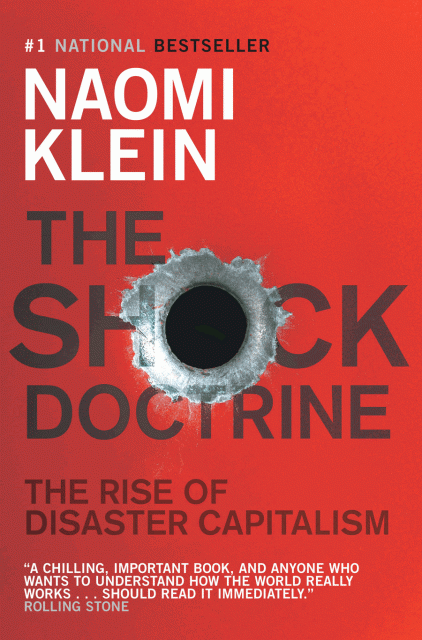
Senior Editor Jeff Goldsmith posts a Q&A live from the 2010 Sundance Film Festival featuring festival founder Robert Redford, author Naomi Klein and co-directors Michael Winterbottom & Mat Whitecross as they discuss The Shock Doctrine
To Listen to the Panel
Creative Screenwriting Magazine
Senior Editor Jeff Goldsmith posts a Q&A live from the 2010 Sundance Film Festival featuring festival founder Robert Redford, author Naomi Klein and co-directors Michael Winterbottom & Mat Whitecross as they discuss The Shock Doctrine
To Listen to the Panel
Tuesday, January 05, 2010
Media Matters: Naomi Klein
Naomi Klein, author of The Shock Doctrine: The Rise of Disaster Capitalism
Media Matters with Bob McChesney

To Listen to the Conversation
Media Matters with Bob McChesney
To Listen to the Conversation
Wednesday, November 11, 2009
Kirk Boyle: Children of Men and I Am Legend: the disaster-capitalism complex hits Hollywood
Children of Men and I Am Legend: the disaster-capitalism complex hits Hollywood
by Kirk Boyle
Jump Cut


...
In addition to indulging the fantasies of late capitalist consumers, Legend targets its audience with “anamorphic advertising.” Lawrence replaces Cuarón’s background commentary on forced migrations and terrorism — newspaper clips that read, “Refugees Blamed for Increase in Terror Attacks” and “Immigrants Protest Against Government New Racist Policies” — with identifiable storefronts, billboards, and products. The “hyper-commercialization” of Hollywood is not a new phenomenon. Product placements, tie-ins, merchandising, and cross-promotions have proliferated in the age of media conglomeration to the point where younger generations no longer experience them as baleful, let alone disruptive. That the Shelby Mustang is clearly the choice of the post-apocalyptic sportsman — along with the Ford Explorer and Escape Hybrid — will come as no surprise to anyone familiar with this latest version of the culture industry.
Nonetheless, Children makes Legend’s participation in these dubious marketing trends look egregious. Brandchannel.com lists thirty-two corporate brands that appear in Legend (on average, a new one every three minutes) while Children features “almost zero brands” (Sauer 2007: unpaginated).[17] Beyond the quantity of ads lies an issue of quality. Where Children harnesses the political potentials of anamorphosis — especially in scenes where anamorphic advertisements of invented products ironize the consumerism of late capitalism — Legend exploits the same artful techniques to peddle products and promote corporate brand recognition.[18] Most disturbing of all, Lawrence uses anamorphosis to naturalize the corporate structure of neoliberal capitalism. Signs of multinational corporations litter the backgrounds of Legend. A mega-disaster has destroyed the signs’ referents within the film's diegesis, but their spectral presence sends the subliminal message to an early twenty-first century audience that corporate capitalism is all but indestructible. The first few minutes of Legend where Neville’s Shelby zips past strategically placed advertisements for XM Satellite Radio, Staples, and Hyatt, assure us that the world is more likely to end before capitalism does.
One final indication that Legend cuts ties with reality in order to enact a consumerist fantasy stems from what Popular Mechanics calls the “junk science” of the film. Popular Mechanics’ assistant editor Erin McCarthy consulted
Pointing out the scientific inconsistencies of a film does not meet the criteria most moviegoers take to the theater, nor will it prove to be an ideological indicator in many cases. But as with Legend’s prevalent product placements, its “junk science” is symptomatic of a larger ideological problem. New York City would be in worse condition due to water and fire damage, and Neville would run into problems with powering his home that the film glosses over. Disbelief could be suspended if these vital infrastructural issues had not been ignored precisely because Neville exists in the fantasy space of a consumer and not a producer. In one representative scene, he harvests ears of corn in Central Park. That the corn is ripe is no accident. Legend cannot represent how the things Neville consumes were produced because labor does not exist in the consumerist fantasyland of the Last Men. Everything Neville needs or wants is simply there for the picking.
Legend creates a capitalist utopia by immersing its protagonist in a world that defies the laws of physics, a playground of consumer goods that hides the labor power of its construction and sustenance (and the problems that would inevitably plague its sole survivor). The film’s “anamorphic advertising” weaves its consuming public into this fantasy world to naturalize neoliberalism as if to say, “the world as we know it will never end, and we will always feel fine.”
Where Legend celebrates the Last Men and their late capitalist utopia, Children critiques their narcissism, cynicism, and classism (as soon will become apparent), by depicting their world — our world — as dystopian. With the dreamworld of wealth comes the catastrophe of crimes against humanity in the guise of free markets, illegal immigration, homeland security, and the War on Terror — all of the specious policies which Cuarón catalogues in his backdrops, the very same policies that Naomi Klein argues bankroll the well-orchestrated “disaster-capitalism complex.”
I Am Conservative-Corporatist
In The Shock Doctrine, Klein claims that the neoliberal era ushered in a “capitalist Reformation” that doubled as a counterrevolution to Keynesianism and Third World developmentalism (Klein 2007b: 53). Like Harvey, she views neoliberalism as a theory of political economic practices that seek to restore class power through deregulation, privatization, and cuts to social spending, a free-market trinity bent on redistributing wealth as much as generating it. Put into practice, neoliberalization morphs into corporatism, a vast collusion between Big Government and Big Business to transfer public wealth to private hands while an ever-widening chasm opens up between “the dazzling rich and the disposable poor” (Klein 2007b: 15). The recent $700 billion financial bailout of banks by the U.S. government provides a clear example of this collusion.
Klein charts how the rise of corporatism spawned a disaster-capitalism complex that at once extends and supersedes the military-industrial (and congressional) complex President Eisenhower diagnosed in his 1961 farewell address. With the emergence of the disaster-capitalism complex, the latent “creative destruction” that fueled the engines of capital since its inception surges to the surface to become the recognized modus operandi of the economy. Today, crisis opportunism entwines superprofits with megadisasters to the point where
Although “disaster capitalism” has been part of neoliberal policy for over three decades, it did not develop into a full-scale complex until after 9/11 with the War on Terror. As Klein writes,
Under the auspice of fighting terrorism, the disaster-capitalism complex insidiously developed into a fully articulated state-within-a-state, a corporate shadow-state, that carries out the normal functions of a nation-state but at a heftier price.
To Read the Entire Essay

Naomi Klein: Shock Doctrine (Videos on YouTube)
by Kirk Boyle
Jump Cut
...
In addition to indulging the fantasies of late capitalist consumers, Legend targets its audience with “anamorphic advertising.” Lawrence replaces Cuarón’s background commentary on forced migrations and terrorism — newspaper clips that read, “Refugees Blamed for Increase in Terror Attacks” and “Immigrants Protest Against Government New Racist Policies” — with identifiable storefronts, billboards, and products. The “hyper-commercialization” of Hollywood is not a new phenomenon. Product placements, tie-ins, merchandising, and cross-promotions have proliferated in the age of media conglomeration to the point where younger generations no longer experience them as baleful, let alone disruptive. That the Shelby Mustang is clearly the choice of the post-apocalyptic sportsman — along with the Ford Explorer and Escape Hybrid — will come as no surprise to anyone familiar with this latest version of the culture industry.
Nonetheless, Children makes Legend’s participation in these dubious marketing trends look egregious. Brandchannel.com lists thirty-two corporate brands that appear in Legend (on average, a new one every three minutes) while Children features “almost zero brands” (Sauer 2007: unpaginated).[17] Beyond the quantity of ads lies an issue of quality. Where Children harnesses the political potentials of anamorphosis — especially in scenes where anamorphic advertisements of invented products ironize the consumerism of late capitalism — Legend exploits the same artful techniques to peddle products and promote corporate brand recognition.[18] Most disturbing of all, Lawrence uses anamorphosis to naturalize the corporate structure of neoliberal capitalism. Signs of multinational corporations litter the backgrounds of Legend. A mega-disaster has destroyed the signs’ referents within the film's diegesis, but their spectral presence sends the subliminal message to an early twenty-first century audience that corporate capitalism is all but indestructible. The first few minutes of Legend where Neville’s Shelby zips past strategically placed advertisements for XM Satellite Radio, Staples, and Hyatt, assure us that the world is more likely to end before capitalism does.
One final indication that Legend cuts ties with reality in order to enact a consumerist fantasy stems from what Popular Mechanics calls the “junk science” of the film. Popular Mechanics’ assistant editor Erin McCarthy consulted
“experts in the fields of structural engineering, virology, and wildlife to determine what could happen — and what certainly won’t happen” regarding Legend’s portrait of the future (McCarthy 2007: 1).
Pointing out the scientific inconsistencies of a film does not meet the criteria most moviegoers take to the theater, nor will it prove to be an ideological indicator in many cases. But as with Legend’s prevalent product placements, its “junk science” is symptomatic of a larger ideological problem. New York City would be in worse condition due to water and fire damage, and Neville would run into problems with powering his home that the film glosses over. Disbelief could be suspended if these vital infrastructural issues had not been ignored precisely because Neville exists in the fantasy space of a consumer and not a producer. In one representative scene, he harvests ears of corn in Central Park. That the corn is ripe is no accident. Legend cannot represent how the things Neville consumes were produced because labor does not exist in the consumerist fantasyland of the Last Men. Everything Neville needs or wants is simply there for the picking.
Legend creates a capitalist utopia by immersing its protagonist in a world that defies the laws of physics, a playground of consumer goods that hides the labor power of its construction and sustenance (and the problems that would inevitably plague its sole survivor). The film’s “anamorphic advertising” weaves its consuming public into this fantasy world to naturalize neoliberalism as if to say, “the world as we know it will never end, and we will always feel fine.”
Where Legend celebrates the Last Men and their late capitalist utopia, Children critiques their narcissism, cynicism, and classism (as soon will become apparent), by depicting their world — our world — as dystopian. With the dreamworld of wealth comes the catastrophe of crimes against humanity in the guise of free markets, illegal immigration, homeland security, and the War on Terror — all of the specious policies which Cuarón catalogues in his backdrops, the very same policies that Naomi Klein argues bankroll the well-orchestrated “disaster-capitalism complex.”
I Am Conservative-Corporatist
In The Shock Doctrine, Klein claims that the neoliberal era ushered in a “capitalist Reformation” that doubled as a counterrevolution to Keynesianism and Third World developmentalism (Klein 2007b: 53). Like Harvey, she views neoliberalism as a theory of political economic practices that seek to restore class power through deregulation, privatization, and cuts to social spending, a free-market trinity bent on redistributing wealth as much as generating it. Put into practice, neoliberalization morphs into corporatism, a vast collusion between Big Government and Big Business to transfer public wealth to private hands while an ever-widening chasm opens up between “the dazzling rich and the disposable poor” (Klein 2007b: 15). The recent $700 billion financial bailout of banks by the U.S. government provides a clear example of this collusion.
Klein charts how the rise of corporatism spawned a disaster-capitalism complex that at once extends and supersedes the military-industrial (and congressional) complex President Eisenhower diagnosed in his 1961 farewell address. With the emergence of the disaster-capitalism complex, the latent “creative destruction” that fueled the engines of capital since its inception surges to the surface to become the recognized modus operandi of the economy. Today, crisis opportunism entwines superprofits with megadisasters to the point where
“all conflict- and disaster-related functions (waging war, securing borders, spying on citizens, rebuilding cities, treating traumatized soldiers) can be performed by corporations at a profit” (Klein 2007c: 50).
Although “disaster capitalism” has been part of neoliberal policy for over three decades, it did not develop into a full-scale complex until after 9/11 with the War on Terror. As Klein writes,
“Although the state goal was fighting terrorism, the effect was the creation of the disaster capitalism complex — a full-fledged new economy in homeland security, privatized war and disaster reconstruction tasked with nothing less than building and running a privatized security state, both at home and abroad” (Klein 2007b: 299).
Under the auspice of fighting terrorism, the disaster-capitalism complex insidiously developed into a fully articulated state-within-a-state, a corporate shadow-state, that carries out the normal functions of a nation-state but at a heftier price.
To Read the Entire Essay
Naomi Klein: Shock Doctrine (Videos on YouTube)
Subscribe to:
Posts (Atom)