Wisconsin Death Trip
By MICHAEL HUDSON and JEFFREY SOMMERS
Counterpunch
...
Economics textbooks, along with Fox News and shout radio commentators, spread the myth that fortunes are gained productively by investing in capital equipment and employing labor to produce goods and services that people want to buy. This may be how economies prosper, but it is not how fortunes are most easily made. One need only to turn to the 19th-century novelists such as Balzac to be reminded that behind every family fortune lies a great theft, often long-forgotten or even undiscovered.
But who is one to steal from? Most wealth in history has been acquired either by armed conquest of the land, or by political insider dealing, such as the great US railroad land giveaways of the mid 19th century. The great American fortunes have been founded by prying land, public enterprises and monopoly rights from the public domain, because that's where the assets are to take.
Throughout history the world's most successful economies have been those that have kept this kind of primitive accumulation in check. The US economy today is faltering largely because its past barriers against rent-seeking are being breached.
Nowhere is this more disturbingly on display than in Wisconsin. Today, Milwaukee – Wisconsin's largest city, and once the richest in America – is ranked among the four poorest large cities in the United States. Wisconsin is just the most recent case in this great heist. The US government itself and its regulatory agencies effectively are being privatized as the "final stage" of neoliberal economic doctrine.
A peek into Governor Walker's so-called "budget repair bill" reveals a shop of horrors that is just the opposite of actually repairing the budget. Among the items listed in the bill until Wednesday night were selloffs of state power generation facilities – in no-bid contracts notoriously prone to insider dealing.
The 37 facilities he wants to sell off that produce heating and cooling at low cost to the state's universities and prisons. Walker's budget repair bill would have unloaded them at a low price, presumably to campaign contributors such as Koch Industries – and then stick the bill for producing this power at higher rates to Wisconsin taxpayers in perpetuity. (And this is all being sold as a "taxpayer relief" plan!) Invariably, this will make its way into new legislation once attention is diverted from the current controversy.
The budget bill also plans to tear down the Wisconsin Retirement System (WRS). This is not New Jersey, where a succession of corrupt governments have underfunded (read: stolen) the state pension system in order to shift resources to pay for budget shortfalls in general revenues caused by tax breaks for the rich. The WRS is one of the nation's most stable, well-funded and best-managed pension systems. Although Wisconsin is not a big state, the WRS has amassed $75bn in reserves, and pays out handsome pensions to its public retirees, without needing new public subsidy. The Walker bill has language providing for tearing down this system, raiding its assets to pay for further tax cuts for the rich (especially property owners), and then throwing Wall Street a meaty bone as public employees would be shifted to 401k plans handled by money managers on commission.
In a separate proposal, Governor Walker would start privatizing the University of Wisconsin's two flagship doctorate-granting campuses. Ironically, the land grant universities – of which Wisconsin has long been among the best – were created by protectionist 19th-century Republicans as an alternative approach to British free-market doctrine, which dominated the prestigious and largely anglophile Ivy League universities. These universities, like their German counterparts, taught a new economic policy of state management and public enterprise that formed the basis for subsequent US and German development.
Walker would kill off this tradition, and return intellectual production to the highest bidder.
Other proposals suggest selling off Wisconsin's public northwoods lands with their cornucopia of mineral and timber wealth. And much more is said to be in the works.
So Walker's war is not only against the Democrats and labour, it is against Wisconsin's Progressive Era institutions. His policy threatens to pauperize the state and deal a coup de grace to Progressive Era institutions and impoverish the state's middle class. Contra John Maynard Keynes's gentle suggestion of "euthanasia of the rentier", it is the middle class that is being euthanized – throughout North America and Europe.
To Read the Entire Essay
Showing posts with label Privatization. Show all posts
Showing posts with label Privatization. Show all posts
Friday, March 11, 2011

Monday, February 28, 2011
Government Report: U.S. Has Wasted Tens Of Billions Of Dollars On Contractors In Iraq And Afghanistan
Report: U.S. Has Wasted Tens Of Billions Of Dollars On Contractors In Iraq And Afghanistan
by Susan Crabtree
Talking Points Memo
A new report from a bipartisan commission set up to scrutinize the unprecedented use of contractors in Iraq and Afghanistan concludes that the United States has wasted tens of billions of the nearly $177 billion that has been spent on those contracts and grants since 2002.
The report, titled "At What Risk? Correcting Over-reliance on Contractors in Contingency Operations," said its estimate may even understate the problem because it may not take into full account ill-conceived projects, poor planning and oversight by the U.S. government, as well as criminal behavior and blatant corruption by both government and contractor employees.
"For many years," the report says, "the government has abdicated its contracting responsibilities - too often using contractors as the default mechanism ... without consideration for the resources needed to manage them."
The commission, chaired by Michael Thibault, former deputy director of the Defense Contract Audit Agency, and former Rep. Chris Shays (R-CT) holds a hearing Monday to review the new report's findings.
About 200,000 contractor employees are working in Iraq and Afghanistan -- a number roughly equal to the American military forces deployed there, according to the report. Their work includes guarding bases, building facilities, providing food and laundry services, escorting supply and personnel movements, and translating local languages.
To Read the Rest of the Essay
by Susan Crabtree
Talking Points Memo
A new report from a bipartisan commission set up to scrutinize the unprecedented use of contractors in Iraq and Afghanistan concludes that the United States has wasted tens of billions of the nearly $177 billion that has been spent on those contracts and grants since 2002.
The report, titled "At What Risk? Correcting Over-reliance on Contractors in Contingency Operations," said its estimate may even understate the problem because it may not take into full account ill-conceived projects, poor planning and oversight by the U.S. government, as well as criminal behavior and blatant corruption by both government and contractor employees.
"For many years," the report says, "the government has abdicated its contracting responsibilities - too often using contractors as the default mechanism ... without consideration for the resources needed to manage them."
The commission, chaired by Michael Thibault, former deputy director of the Defense Contract Audit Agency, and former Rep. Chris Shays (R-CT) holds a hearing Monday to review the new report's findings.
About 200,000 contractor employees are working in Iraq and Afghanistan -- a number roughly equal to the American military forces deployed there, according to the report. Their work includes guarding bases, building facilities, providing food and laundry services, escorting supply and personnel movements, and translating local languages.
To Read the Rest of the Essay
Sunday, February 27, 2011
Abu Atris: A Revolution Against Neoliberalism?
[Thivai: Excellent short essay -- discusses neoliberalism here and abroad, through the lenses of David Harvey, Timothy Mitchell and Naomi Klein. Would be a great intro for people that are not familiar with neoliberalism or political economy or broader global interconnections or problems with free market/privatization in a real world setting.]
A revolution against neoliberalism? If rebellion results in a retrenchment of neoliberalism, millions will feel cheated.
by Abu Atris
Al Jazeera
...
Rhetoric vs. reality
Two observations about Egypt’s history as a neoliberal state are in order. First, Mubarak’s Egypt was considered to be at the forefront of instituting neoliberal policies in the Middle East (not un-coincidentally, so was Ben Ali’s Tunisia). Secondly, the reality of Egypt’s political economy during the Mubarak era was very different than the rhetoric, as was the case in every other neoliberal state from Chile to Indonesia. Political scientist Timothy Mitchell published a revealing essay about Egypt’s brand of neoliberalism in his book Rule of Experts (the chapter titled "Dreamland" — named after a housing development built by Ahmad Bahgat, one of the Mubarak cronies now discredited by the fall of the regime). The gist of Mitchell’s portrait of Egyptian neoliberalism was that while Egypt was lauded by institutions such as the International Monetary Fund as a beacon of free-market success, the standard tools for measuring economies gave a grossly inadequate picture of the Egyptian economy. In reality the unfettering of markets and agenda of privatization were applied unevenly at best.
The only people for whom Egyptian neoliberalism worked "by the book" were the most vulnerable members of society, and their experience with neoliberalism was not a pretty picture. Organised labor was fiercely suppressed. The public education and the health care systems were gutted by a combination of neglect and privatization. Much of the population suffered stagnant or falling wages relative to inflation. Official unemployment was estimated at approximately 9.4% last year (and much higher for the youth who spearheaded the January 25th Revolution), and about 20% of the population is said to live below a poverty line defined as $2 per day per person.
For the wealthy, the rules were very different. Egypt did not so much shrink its public sector, as neoliberal doctrine would have it, as it reallocated public resources for the benefit of a small and already affluent elite. Privatization provided windfalls for politically well-connected individuals who could purchase state-owned assets for much less than their market value, or monopolise rents from such diverse sources as tourism and foreign aid. Huge proportions of the profits made by companies that supplied basic construction materials like steel and cement came from government contracts, a proportion of which in turn were related to aid from foreign governments.
Most importantly, the very limited function for the state recommended by neoliberal doctrine in the abstract was turned on its head in reality. In Mubarak’s Egypt business and government were so tightly intertwined that it was often difficult for an outside observer to tease them apart. Since political connections were the surest route to astronomical profits, businessmen had powerful incentives to buy political office in the phony elections run by the ruling National Democratic Party. Whatever competition there was for seats in the Peoples’ Assembly and Consultative Council took place mainly within the NDP. Non-NDP representation in parliament by opposition parties was strictly a matter of the political calculations made for a given elections: let in a few independent candidates known to be affiliated with the Muslim Brotherhood in 2005 (and set off tremors of fear in Washington); dictate total NDP domination in 2010 (and clear the path for an expected new round of distributing public assets to "private" investors).
Parallels with America
The political economy of the Mubarak regime was shaped by many currents in Egypt’s own history, but its broad outlines were by no means unique. Similar stories can be told throughout the rest of the Middle East, Latin America, Asia, Europe and Africa. Everywhere neoliberalism has been tried, the results are similar: living up to the utopian ideal is impossible; formal measures of economic activity mask huge disparities in the fortunes of the rich and poor; elites become "masters of the universe," using force to defend their prerogatives, and manipulating the economy to their advantage, but never living in anything resembling the heavily marketised worlds that are imposed on the poor.
Unemployment was a major grievance for millions of Egyptian protesters [EPA]
The story should sound familiar to Americans as well. For example, the vast fortunes of Bush era cabinet members Donald Rumsfeld and Dick Cheney, through their involvement with companies like Halliburton and Gilead Sciences, are the product of a political system that allows them — more or less legally — to have one foot planted in "business" and another in "government" to the point that the distinction between them becomes blurred. Politicians move from the office to the boardroom to the lobbying organization and back again.
As neoliberal dogma disallows any legitimate role for government other than guarding the sanctity of free markets, recent American history has been marked by the steady privatization of services and resources formerly supplied or controlled by the government. But it is inevitably those with closest access to the government who are best positioned to profit from government campaigns to sell off the functions it formerly performed. It is not just Republicans who are implicated in this systemic corruption. Clinton-era Secretary of Treasury Robert Rubin’s involvement with Citigroup does not bear close scrutiny. Lawrence Summers gave crucial support for the deregulation of financial derivatives contracts while Secretary of Treasury under Clinton, and profited handsomely from companies involved in the same practices while working for Obama (and of course deregulated derivatives were a key element in the financial crisis that led to a massive Federal bailout of the entire banking industry).
So in Egyptian terms, when General Secretary of the NDP Ahmad Ezz cornered the market on steel and was given contracts to build public-private construction projects, or when former Minister of Parliament Talaat Mustafa purchased vast tracts of land for the upscale Madinaty housing development without having to engage in a competitive bidding process (but with the benefit of state-provided road and utility infrastructure), they may have been practicing corruption logically and morally. But what they were doing was also as American as apple pie, at least within the scope of the past two decades.
However, in the current climate the most important thing is not the depredations of deposed Mubarak regime cronies. It is rather the role of the military in the political system. It is the army that now rules the country, albeit as a transitional power, or so most Egyptians hope. No representatives of the upper echelons of the Egyptian military appear on the various lists of old-regime allies who need to be called to account. For example, the headline of the February 17th edition of Ahrar, the press organ of the Liberal party, was emblazoned with the headline "Financial Reserves of the Corrupt Total 700 Billion Pounds [about $118 billion] in 18 Countries."
A vast economic powerhouse
But the article did not say a single word about the place of the military in this epic theft. The military were nonetheless part of the crony capitalism of the Mubarak era. After relatively short careers in the military high-ranking officers are rewarded with such perks as highly remunerative positions on the management boards of housing projects and shopping malls. Some of these are essentially public-sector companies transferred to the military sector when IMF-mandated structural adjustment programs required reductions in the civilian public sector.
To Read the Rest of the Essay
A revolution against neoliberalism? If rebellion results in a retrenchment of neoliberalism, millions will feel cheated.
by Abu Atris
Al Jazeera
...
Rhetoric vs. reality
Two observations about Egypt’s history as a neoliberal state are in order. First, Mubarak’s Egypt was considered to be at the forefront of instituting neoliberal policies in the Middle East (not un-coincidentally, so was Ben Ali’s Tunisia). Secondly, the reality of Egypt’s political economy during the Mubarak era was very different than the rhetoric, as was the case in every other neoliberal state from Chile to Indonesia. Political scientist Timothy Mitchell published a revealing essay about Egypt’s brand of neoliberalism in his book Rule of Experts (the chapter titled "Dreamland" — named after a housing development built by Ahmad Bahgat, one of the Mubarak cronies now discredited by the fall of the regime). The gist of Mitchell’s portrait of Egyptian neoliberalism was that while Egypt was lauded by institutions such as the International Monetary Fund as a beacon of free-market success, the standard tools for measuring economies gave a grossly inadequate picture of the Egyptian economy. In reality the unfettering of markets and agenda of privatization were applied unevenly at best.
The only people for whom Egyptian neoliberalism worked "by the book" were the most vulnerable members of society, and their experience with neoliberalism was not a pretty picture. Organised labor was fiercely suppressed. The public education and the health care systems were gutted by a combination of neglect and privatization. Much of the population suffered stagnant or falling wages relative to inflation. Official unemployment was estimated at approximately 9.4% last year (and much higher for the youth who spearheaded the January 25th Revolution), and about 20% of the population is said to live below a poverty line defined as $2 per day per person.
For the wealthy, the rules were very different. Egypt did not so much shrink its public sector, as neoliberal doctrine would have it, as it reallocated public resources for the benefit of a small and already affluent elite. Privatization provided windfalls for politically well-connected individuals who could purchase state-owned assets for much less than their market value, or monopolise rents from such diverse sources as tourism and foreign aid. Huge proportions of the profits made by companies that supplied basic construction materials like steel and cement came from government contracts, a proportion of which in turn were related to aid from foreign governments.
Most importantly, the very limited function for the state recommended by neoliberal doctrine in the abstract was turned on its head in reality. In Mubarak’s Egypt business and government were so tightly intertwined that it was often difficult for an outside observer to tease them apart. Since political connections were the surest route to astronomical profits, businessmen had powerful incentives to buy political office in the phony elections run by the ruling National Democratic Party. Whatever competition there was for seats in the Peoples’ Assembly and Consultative Council took place mainly within the NDP. Non-NDP representation in parliament by opposition parties was strictly a matter of the political calculations made for a given elections: let in a few independent candidates known to be affiliated with the Muslim Brotherhood in 2005 (and set off tremors of fear in Washington); dictate total NDP domination in 2010 (and clear the path for an expected new round of distributing public assets to "private" investors).
Parallels with America
The political economy of the Mubarak regime was shaped by many currents in Egypt’s own history, but its broad outlines were by no means unique. Similar stories can be told throughout the rest of the Middle East, Latin America, Asia, Europe and Africa. Everywhere neoliberalism has been tried, the results are similar: living up to the utopian ideal is impossible; formal measures of economic activity mask huge disparities in the fortunes of the rich and poor; elites become "masters of the universe," using force to defend their prerogatives, and manipulating the economy to their advantage, but never living in anything resembling the heavily marketised worlds that are imposed on the poor.
Unemployment was a major grievance for millions of Egyptian protesters [EPA]
The story should sound familiar to Americans as well. For example, the vast fortunes of Bush era cabinet members Donald Rumsfeld and Dick Cheney, through their involvement with companies like Halliburton and Gilead Sciences, are the product of a political system that allows them — more or less legally — to have one foot planted in "business" and another in "government" to the point that the distinction between them becomes blurred. Politicians move from the office to the boardroom to the lobbying organization and back again.
As neoliberal dogma disallows any legitimate role for government other than guarding the sanctity of free markets, recent American history has been marked by the steady privatization of services and resources formerly supplied or controlled by the government. But it is inevitably those with closest access to the government who are best positioned to profit from government campaigns to sell off the functions it formerly performed. It is not just Republicans who are implicated in this systemic corruption. Clinton-era Secretary of Treasury Robert Rubin’s involvement with Citigroup does not bear close scrutiny. Lawrence Summers gave crucial support for the deregulation of financial derivatives contracts while Secretary of Treasury under Clinton, and profited handsomely from companies involved in the same practices while working for Obama (and of course deregulated derivatives were a key element in the financial crisis that led to a massive Federal bailout of the entire banking industry).
So in Egyptian terms, when General Secretary of the NDP Ahmad Ezz cornered the market on steel and was given contracts to build public-private construction projects, or when former Minister of Parliament Talaat Mustafa purchased vast tracts of land for the upscale Madinaty housing development without having to engage in a competitive bidding process (but with the benefit of state-provided road and utility infrastructure), they may have been practicing corruption logically and morally. But what they were doing was also as American as apple pie, at least within the scope of the past two decades.
However, in the current climate the most important thing is not the depredations of deposed Mubarak regime cronies. It is rather the role of the military in the political system. It is the army that now rules the country, albeit as a transitional power, or so most Egyptians hope. No representatives of the upper echelons of the Egyptian military appear on the various lists of old-regime allies who need to be called to account. For example, the headline of the February 17th edition of Ahrar, the press organ of the Liberal party, was emblazoned with the headline "Financial Reserves of the Corrupt Total 700 Billion Pounds [about $118 billion] in 18 Countries."
A vast economic powerhouse
But the article did not say a single word about the place of the military in this epic theft. The military were nonetheless part of the crony capitalism of the Mubarak era. After relatively short careers in the military high-ranking officers are rewarded with such perks as highly remunerative positions on the management boards of housing projects and shopping malls. Some of these are essentially public-sector companies transferred to the military sector when IMF-mandated structural adjustment programs required reductions in the civilian public sector.
To Read the Rest of the Essay
Thursday, February 24, 2011
Friday, January 21, 2011
Uprising Radio: Hedges, Shiva, and Scheer on Liberalism, Economy, and Corporate Domination
Hedges, Shiva, and Scheer on Liberalism, Economy, and Corporate Domination
Uprising Radio (Los Angeles: KPFK/Pacifica Radio)
Veteran journalist and author Chris Hedges says in his latest book, The Death of the Liberal Class, that American liberalism is dying. Surveying the current political state of affairs, Hedges makes the case that progressive institutions that have largely represented the interests of the poor, the working class, and the middle class— such as universities, the press, trade unions and the liberal Church—are being dismantled. Hedges makes the analogy with Tsarist Russia, Germany and Yugoslavia as he points out the enormous consequences that the fall of the middle class could have on the rest of American society. Chris Hedges spoke just 6 days ago about his new book at the Sanctuary for Independent Media in New York.
Chris Hedges is a columnist for Truthdig.com, and spent nearly two decades as a foreign correspondent in Central America, the Middle East, Africa and the Balkans. He has reported from more than 50 countries and has worked for The Christian Science Monitor, National Public Radio, The Dallas Morning News and The New York Times, for which he was a foreign correspondent for 15 years. Hedges is a senior fellow at The Nation Institute in New York City and has taught at Columbia University, New York University and Princeton University. He currently teaches inmates at a correctional facility in New Jersey. He has written nine books, including “Empire of Illusion: The End of Literacy and the Triumph of Spectacle” (2009), “I Don’t Believe in Atheists” (2008) and the best-selling “American Fascists: The Christian Right and the War on America” (2008). His book “War Is a Force That Gives Us Meaning” (2003) was a finalist for the National Book Critics Circle Award for Nonfiction.
* * *
Vandana Shiva, environmental activist, physicist, author, and founder of Navdanya. Her books include Water Wars; Privatization, Pollution, and Profit, Earth Democracy; Justice, Sustainability, and Peace, and her latest, Soil Not Oil. A winner of the Right Livlihood Award, known as the alternative Nobel Prize, Vandana Shiva is one of the most well known international advocate for the protection of our commons. She spoke recently at a fundraiser for Navdanya here in Los Angeles.
Shiva participated in the nonviolent Chipko movement during the 1970s. The movement, some of whose main participants were women, adopted the approach of forming human circles around trees to prevent their felling. She is one of the leaders of the International Forum on Globalization. She is featured in the documentaries, The Corporation, Dirt! The Movie, and FLOW: For the Love of Water.
* * *
In his new book, The Great American Stickup, author, journalist, and political watchdog Robert Scheer untangles the history of political maneuvering and financial deregulation that led to the financial crash. Scheer does not spare Former President Bill Clinton, President Barack Obama, or the media from blame. The book is an entertaining history and astute analysis of the free-market frenzy and lazy regulatory response that resulted in what Scheer calls “The Great American Stickup.”
Robert Scheer is founder and editor-in-chief of the progressive online news site Truthdig.com. His column is nationally syndicated in publications such as the San Francisco Chronicle and The Nation. He is a professor of communications at the University of Southern California. His earlier books include Playing President: My Close Encounters with Nixon, Carter, Bush I, Reagan and Clinton – and How They Did Not Prepare Me for George W. Bush, and The Pornography of Power: How Defense Hawks Hijacked 9/11 and Weakened America. Scheer’s latest book, The Great American Stickup: How Reagan Republicans and Clinton Democrats Enriched Wall Street While Mugging Main Street was published on September 7 of this year. Robert Scheer worked for the LA Times for 17 years, but was let go by the paper in 2005 and replaced with rightwing journalists, Joel Stein and Jonah Goldberg.
To Listen to the Episode
Uprising Radio (Los Angeles: KPFK/Pacifica Radio)
Veteran journalist and author Chris Hedges says in his latest book, The Death of the Liberal Class, that American liberalism is dying. Surveying the current political state of affairs, Hedges makes the case that progressive institutions that have largely represented the interests of the poor, the working class, and the middle class— such as universities, the press, trade unions and the liberal Church—are being dismantled. Hedges makes the analogy with Tsarist Russia, Germany and Yugoslavia as he points out the enormous consequences that the fall of the middle class could have on the rest of American society. Chris Hedges spoke just 6 days ago about his new book at the Sanctuary for Independent Media in New York.
Chris Hedges is a columnist for Truthdig.com, and spent nearly two decades as a foreign correspondent in Central America, the Middle East, Africa and the Balkans. He has reported from more than 50 countries and has worked for The Christian Science Monitor, National Public Radio, The Dallas Morning News and The New York Times, for which he was a foreign correspondent for 15 years. Hedges is a senior fellow at The Nation Institute in New York City and has taught at Columbia University, New York University and Princeton University. He currently teaches inmates at a correctional facility in New Jersey. He has written nine books, including “Empire of Illusion: The End of Literacy and the Triumph of Spectacle” (2009), “I Don’t Believe in Atheists” (2008) and the best-selling “American Fascists: The Christian Right and the War on America” (2008). His book “War Is a Force That Gives Us Meaning” (2003) was a finalist for the National Book Critics Circle Award for Nonfiction.
* * *
Vandana Shiva, environmental activist, physicist, author, and founder of Navdanya. Her books include Water Wars; Privatization, Pollution, and Profit, Earth Democracy; Justice, Sustainability, and Peace, and her latest, Soil Not Oil. A winner of the Right Livlihood Award, known as the alternative Nobel Prize, Vandana Shiva is one of the most well known international advocate for the protection of our commons. She spoke recently at a fundraiser for Navdanya here in Los Angeles.
Shiva participated in the nonviolent Chipko movement during the 1970s. The movement, some of whose main participants were women, adopted the approach of forming human circles around trees to prevent their felling. She is one of the leaders of the International Forum on Globalization. She is featured in the documentaries, The Corporation, Dirt! The Movie, and FLOW: For the Love of Water.
* * *
In his new book, The Great American Stickup, author, journalist, and political watchdog Robert Scheer untangles the history of political maneuvering and financial deregulation that led to the financial crash. Scheer does not spare Former President Bill Clinton, President Barack Obama, or the media from blame. The book is an entertaining history and astute analysis of the free-market frenzy and lazy regulatory response that resulted in what Scheer calls “The Great American Stickup.”
Robert Scheer is founder and editor-in-chief of the progressive online news site Truthdig.com. His column is nationally syndicated in publications such as the San Francisco Chronicle and The Nation. He is a professor of communications at the University of Southern California. His earlier books include Playing President: My Close Encounters with Nixon, Carter, Bush I, Reagan and Clinton – and How They Did Not Prepare Me for George W. Bush, and The Pornography of Power: How Defense Hawks Hijacked 9/11 and Weakened America. Scheer’s latest book, The Great American Stickup: How Reagan Republicans and Clinton Democrats Enriched Wall Street While Mugging Main Street was published on September 7 of this year. Robert Scheer worked for the LA Times for 17 years, but was let go by the paper in 2005 and replaced with rightwing journalists, Joel Stein and Jonah Goldberg.
To Listen to the Episode
Monday, July 19, 2010
Democracy Now: "Top Secret America" Washington Post Investigation Reveals Massive, Unmanageable, Outsourced US Intelligence System
"Top Secret America" Washington Post Investigation Reveals Massive, Unmanageable, Outsourced US Intelligence System
Democracy Now
An explosive investigative series published in the Washington Post today begins, "The top-secret world the government created in response to the terrorist attacks of Sept. 11, 2001, has become so large, so unwieldy and so secretive that no one knows how much money it costs, how many people it employs, how many programs exist within it or exactly how many agencies do the same work." Among the findings: An estimated 854,000 people hold top-secret security clearances. More than 1,200 government organizations and nearly 2,000 private companies work on programs related to counterterrorism, homeland security and intelligence in 10,000 locations. We speak with one of the co-authors of the series, Bill Arkin.
To Watch/Listen/Read
Tim Shorrock Asks Why It Took the Washington Post So Long to Investigate the US Intelligence System
Democracy Now
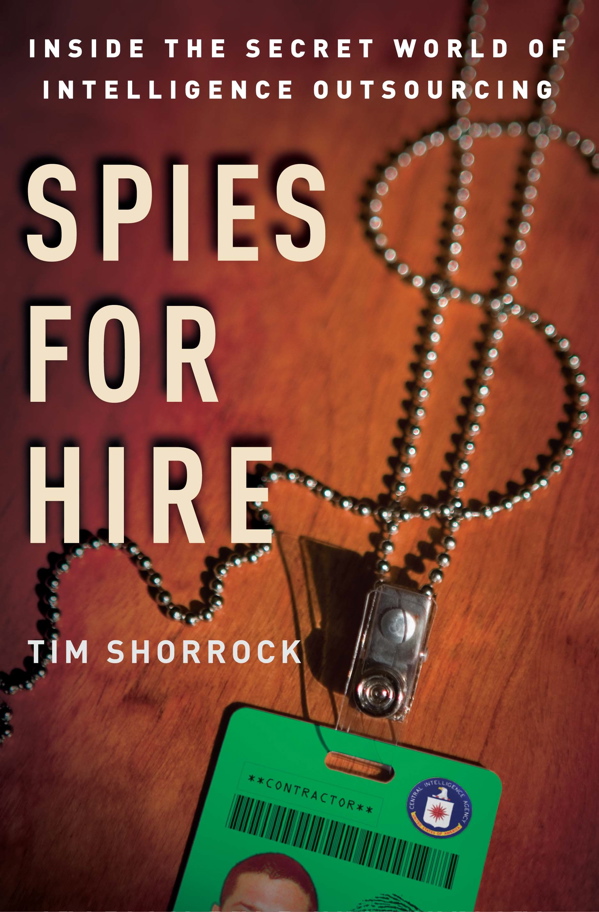
"With all due respect to the Washington Post, Dana Priest and Bill Arkin are very good reporters, we have to ask, why did it take them seven years to do this story?" says Tim Shorrock, an investigative journalist and author of Spies for Hire: The Secret World of Intelligence Outsourcing. "Anyone who’s been covering intelligence or national security in Washington knows that intelligence has been privatized to an incredible extent."
To Watch/Listen/Read
Democracy Now
An explosive investigative series published in the Washington Post today begins, "The top-secret world the government created in response to the terrorist attacks of Sept. 11, 2001, has become so large, so unwieldy and so secretive that no one knows how much money it costs, how many people it employs, how many programs exist within it or exactly how many agencies do the same work." Among the findings: An estimated 854,000 people hold top-secret security clearances. More than 1,200 government organizations and nearly 2,000 private companies work on programs related to counterterrorism, homeland security and intelligence in 10,000 locations. We speak with one of the co-authors of the series, Bill Arkin.
To Watch/Listen/Read
Tim Shorrock Asks Why It Took the Washington Post So Long to Investigate the US Intelligence System
Democracy Now
"With all due respect to the Washington Post, Dana Priest and Bill Arkin are very good reporters, we have to ask, why did it take them seven years to do this story?" says Tim Shorrock, an investigative journalist and author of Spies for Hire: The Secret World of Intelligence Outsourcing. "Anyone who’s been covering intelligence or national security in Washington knows that intelligence has been privatized to an incredible extent."
To Watch/Listen/Read
Tuesday, May 25, 2010
George Lakoff: HUD Is Trying to Privatize and Mortgage Off All of America's Public Housing
Below the Radar: HUD Is Trying to Privatize and Mortgage Off All of America's Public Housing
by George Lakoff
TruthOut
The Obama administration's move to the right is about to give conservatives a victory they could not have anticipated, even under Bush. HUD, under Obama, submitted legislation, called PETRA, to Congress that would result in the privatization of all public housing in America.
The new owners would charge ten percent above market rates to impoverished tenants, money that would be mostly paid by the US government (you and me, the taxpayers). To maintain the property, the new owners would take out a mortgage for building repair and maintenance (like a home equity loan), with no cap on interest rates.
With rents set above market rates, the mortgage risk would be attractive to banks. Either they make a huge profit on the mortgages paid for by the government, or, if the government lowers what it will pay for rents, the property goes into foreclosure. The banks get it and can sell it off to developers.
Sooner or later, the housing budget will be cut back and such foreclosures will happen. The structure of the proposal and the realities of Washington make it a virtual certainty.
The banks and developers make a fortune, with the taxpayers paying for it. The public loses its public housing property. The impoverished tenants lose their apartments, or have their rents go way up if they are forced into the private market. Homelessness increases; government gets smaller. The banks and developers win. It is a Bank Bonanza! The poor and the public lose.
And a precedent is set. The government can - privatize any public property: Schools, libraries, national parks, federal buildings - just as has begun to happen in California, where the right-wing governor has started to auction off state property and has even suggested selling off the Supreme Court building.
To Read the Rest of the Editorial
by George Lakoff
TruthOut
The Obama administration's move to the right is about to give conservatives a victory they could not have anticipated, even under Bush. HUD, under Obama, submitted legislation, called PETRA, to Congress that would result in the privatization of all public housing in America.
The new owners would charge ten percent above market rates to impoverished tenants, money that would be mostly paid by the US government (you and me, the taxpayers). To maintain the property, the new owners would take out a mortgage for building repair and maintenance (like a home equity loan), with no cap on interest rates.
With rents set above market rates, the mortgage risk would be attractive to banks. Either they make a huge profit on the mortgages paid for by the government, or, if the government lowers what it will pay for rents, the property goes into foreclosure. The banks get it and can sell it off to developers.
Sooner or later, the housing budget will be cut back and such foreclosures will happen. The structure of the proposal and the realities of Washington make it a virtual certainty.
The banks and developers make a fortune, with the taxpayers paying for it. The public loses its public housing property. The impoverished tenants lose their apartments, or have their rents go way up if they are forced into the private market. Homelessness increases; government gets smaller. The banks and developers win. It is a Bank Bonanza! The poor and the public lose.
And a precedent is set. The government can - privatize any public property: Schools, libraries, national parks, federal buildings - just as has begun to happen in California, where the right-wing governor has started to auction off state property and has even suggested selling off the Supreme Court building.
To Read the Rest of the Editorial
Tuesday, November 24, 2009
Blackwater’s Secret War in Pakistan: Jeremy Scahill Reveals Private Military Firm Operating in Pakistan Under Covert Assassination and Kidnapping
Blackwater’s Secret War in Pakistan: Jeremy Scahill Reveals Private Military Firm Operating in Pakistan Under Covert Assassination and Kidnapping Program
Democracy Now
In an explosive new article in The Nation magazine, investigative journalist and Democracy Now! correspondent Jeremy Scahill reveals the private military firm Blackwater is part of a covert program in Pakistan that includes planning the assassination and kidnapping of Taliban and Al-Qaeda suspects. Blackwater is also said to be involved in a previously undisclosed U.S. military drone campaign that has killed scores of people inside Pakistan. The article says the program has become so secretive that top Obama administration and military officials have likely been unaware of its existence.
...
Writing in the the Nation magazine, independent journalist Jeremy Scahill has revealed Blackwater is secretly operating in Pakistan under a covert program that includes planning the assassination and kidnapping of Taliban and Al-Qaeda suspects. Blackwater is also said to be involved in a previously undisclosed U.S. military drone campaign that has killed scores of people inside Pakistan.
Blackwater operatives have been working under a covert program run by the Joint Special Operations Command—the military’s top covert operations force. The previously undisclosed JSOC operations would mark the first known confirmation of U.S. military activity inside Pakistan. A military intelligence source said Blackwater operatives are effectively running the drone bombings for both JSOC and the CIA. The CIA drone program is already public knowledge. But the military source says some of the deadliest drone attacks attributed to the CIA were actually carried out by JSOC.
The article also reveals Blackwater operatives have taken part in ground operations with Pakistani forces under a subcontract with a local security firm. The operations have included house raids and border interdictions in northwest Pakistan and other areas. Blackwater has also been given responsibility for planning JSOC operations in Uzbekistan.
The Nation reports the program has become so secretive that top Obama administration and military officials have likely been unaware of its existence.
To Read/Listen/Watch
Democracy Now
In an explosive new article in The Nation magazine, investigative journalist and Democracy Now! correspondent Jeremy Scahill reveals the private military firm Blackwater is part of a covert program in Pakistan that includes planning the assassination and kidnapping of Taliban and Al-Qaeda suspects. Blackwater is also said to be involved in a previously undisclosed U.S. military drone campaign that has killed scores of people inside Pakistan. The article says the program has become so secretive that top Obama administration and military officials have likely been unaware of its existence.
...
Writing in the the Nation magazine, independent journalist Jeremy Scahill has revealed Blackwater is secretly operating in Pakistan under a covert program that includes planning the assassination and kidnapping of Taliban and Al-Qaeda suspects. Blackwater is also said to be involved in a previously undisclosed U.S. military drone campaign that has killed scores of people inside Pakistan.
Blackwater operatives have been working under a covert program run by the Joint Special Operations Command—the military’s top covert operations force. The previously undisclosed JSOC operations would mark the first known confirmation of U.S. military activity inside Pakistan. A military intelligence source said Blackwater operatives are effectively running the drone bombings for both JSOC and the CIA. The CIA drone program is already public knowledge. But the military source says some of the deadliest drone attacks attributed to the CIA were actually carried out by JSOC.
The article also reveals Blackwater operatives have taken part in ground operations with Pakistani forces under a subcontract with a local security firm. The operations have included house raids and border interdictions in northwest Pakistan and other areas. Blackwater has also been given responsibility for planning JSOC operations in Uzbekistan.
The Nation reports the program has become so secretive that top Obama administration and military officials have likely been unaware of its existence.
To Read/Listen/Watch
Subscribe to:
Posts (Atom)