25. Prisoners Still Brutalized at Gitmo
by Scott Macky and Peter Phillips
Project Censored
In Guantánamo, the notorious but seldom-discussed thug squad, officially known as the Immediate Reaction Force (IRF), deployed by the US military remains very much active. Inside the walls of Guantánamo, the prisoners know the squad as the Extreme Repression Force.
In reality, IRF is an extrajudicial terror squad, the existence of which has been documented since the early days of Guantánamo. IRF has rarely been mentioned in the United States media or in congressional inquiries into torture. On paper, IRF teams are made up of five military police officers who are on constant standby to respond to emergencies. “The IRF team is intended to be used primarily as a forced-extraction team, specializing in the extraction of a detainee who is combative, resistive, or if [there is] the possibility of a weapon . . . in the cell at the time of the extraction,” according to a declassified copy of the Standard Operating Procedures (SOP) for Camp Delta at Guantánamo. The document was signed on March 27, 2003, by Major General Geoffrey Miller, the man credited with eventually “Gitmoizing” Abu Ghraib and other US-run prisons.
When an IRF team is called in, its members are dressed in full riot gear, which some prisoners and their attorneys have compared to “Darth Vader” suits. Each officer is assigned a body part of the prisoner to restrain: head, right arm, left arm, left leg, right leg. According to the SOP document, the teams are to give verbal warnings to prisoners before storming the cell: “Prior to the use of the IRF team, an interpreter will be used to tell the detainee of the discipline measures to be taken against him and ask whether he intends to resist. Regardless of his answer, his recent behavior and demeanor should be taken into account in determining the validity of his answer.” The IRF team is authorized to spray the detainee in the face with mace twice before entering the cell.
To Read the Rest ofthe Report
Showing posts with label Terror. Show all posts
Showing posts with label Terror. Show all posts
Sunday, March 13, 2011

Friday, March 11, 2011
James Zogby: Islamophobia and Radicalization
Islamophobia and Radicalization: How Bigotry Creates Radicals
By JAMES ZOGBY
Counterpunch
Let me state quite directly: Islamophobia and those who promote it are a greater threat to the United States than Anwar Al-Awlaqi and his rag-tag team of terrorists.
On one level, Al-Awlaqi, from his cave hide out in Yemen, can only prey off alienation where it exists. Adopting the persona of a latter-day Malcolm X (though he seems not to have read the last chapters of the "Autobiography" or learned the lessons of Malcolm's ultimate conversion), he appears street-smart, brash, self- assured and assertive -- all of the assets needed to attract lost or wounded souls looking for certainty and an outlet for their rage. Like some parasites, Al-Awlaqi cannot create his own prey. He must wait for others to create his opportunities, which until now have been isolated and limited: a disturbed young man here, an increasingly deranged soldier there.
Islamophobia, on the other hand, if left unchecked, may serve to erect barriers to Muslim inclusion in America, increasing alienation, especially among young Muslims. Not only would such a situation do grave damage to one of the fundamental cornerstones of America's unique democracy, it would simultaneously and rapidly expand the pool of recruits for future radicalisation.
I have often remarked that America is different, in concept and reality, from our European allies. Third generation Kurds in Germany, Pakistanis in the UK, or Algerians in France, for example, may succeed and obtain citizenship, but they do not become German, British or French. Last year, I debated a German government official on this issue. She kept referring to "migrants" -- a term she used to describe all those of Turkish descent living in her country -- regardless of the number of generations they had been there. Similarly, following their last election, a leading British newspaper commented on the "number of immigrants" who won seats, without noting that many of those "immigrants" were third generation citizens.
America has prided itself on being different. Being "American" is not the possession of a single ethnic group, nor does any group define "America". Not only do new immigrants become citizens, they also secure a new identity. More than that, as new groups become American and are transformed, the idea of "America" itself has also changed to embrace these new cultures.
Within a generation, diverse ethnic and religious groups from every corner or the globe have become Americans, dramatically changing America in the process. Problems remain and intolerant bigots, in every age, have reared up against new groups, but history demonstrates that, in the end, the newcomers have been accepted, incorporated and absorbed into the American mainstream.
This defines not only our national experience, but our defining narrative as well. When immigrant school children in Europe learn French, German or British history, they are learning their host's history. In the US, from the outset, we are taught that this is "our new story" -- that it includes all of us, and has included us all, from the beginning.
It is because new immigrants and diverse ethnic and religious communities have found their place and acceptance in the American mainstream that the country, during the last century, survived and prospered despite being sorely tested with world wars, economic upheaval and bouts with internal strife. During this time we had to contend with anti-black, anti-Asian, anti-Catholic, anti-Jewish, anti-immigrant, and anti-Japanese movements. In the end, after creating their moment of pain, these efforts have always lost.
They lose, but they don't always go away. The Islamophobia we are witnessing today is the latest campaign by bigots to tear apart the very fabric of America. We know the groups promoting it. First, there is the well-funded "cottage industry", on the right, of groups and individuals with a long history of anti-Arab or anti-Muslim activity. Some of the individuals associated with these efforts have been given legitimacy as commentators on "terrorism", "radicalisation" or "national security concerns", despite their obvious bias and even obsession with all things Arab or Muslim (in this, they remind me of good old-fashioned anti-Semites who never tired of warning of Jewish threats or conspiracies or who while always claiming to like individual Jews rallied against any and all Jewish organisations).
If these "professional bigots" have provided the grist, the mill itself was run by the vast network of right-wing talk radio and TV shows and websites, and prominent preachers who have combined to amplify the anti-Muslim message nationwide. Their efforts have done real damage. They have tormented decent public servants, created protests that have shuttered legitimate institutions, fomented hate crimes, and produced fear in the Muslim community.
To Read the Rest of the Essay
By JAMES ZOGBY
Counterpunch
Let me state quite directly: Islamophobia and those who promote it are a greater threat to the United States than Anwar Al-Awlaqi and his rag-tag team of terrorists.
On one level, Al-Awlaqi, from his cave hide out in Yemen, can only prey off alienation where it exists. Adopting the persona of a latter-day Malcolm X (though he seems not to have read the last chapters of the "Autobiography" or learned the lessons of Malcolm's ultimate conversion), he appears street-smart, brash, self- assured and assertive -- all of the assets needed to attract lost or wounded souls looking for certainty and an outlet for their rage. Like some parasites, Al-Awlaqi cannot create his own prey. He must wait for others to create his opportunities, which until now have been isolated and limited: a disturbed young man here, an increasingly deranged soldier there.
Islamophobia, on the other hand, if left unchecked, may serve to erect barriers to Muslim inclusion in America, increasing alienation, especially among young Muslims. Not only would such a situation do grave damage to one of the fundamental cornerstones of America's unique democracy, it would simultaneously and rapidly expand the pool of recruits for future radicalisation.
I have often remarked that America is different, in concept and reality, from our European allies. Third generation Kurds in Germany, Pakistanis in the UK, or Algerians in France, for example, may succeed and obtain citizenship, but they do not become German, British or French. Last year, I debated a German government official on this issue. She kept referring to "migrants" -- a term she used to describe all those of Turkish descent living in her country -- regardless of the number of generations they had been there. Similarly, following their last election, a leading British newspaper commented on the "number of immigrants" who won seats, without noting that many of those "immigrants" were third generation citizens.
America has prided itself on being different. Being "American" is not the possession of a single ethnic group, nor does any group define "America". Not only do new immigrants become citizens, they also secure a new identity. More than that, as new groups become American and are transformed, the idea of "America" itself has also changed to embrace these new cultures.
Within a generation, diverse ethnic and religious groups from every corner or the globe have become Americans, dramatically changing America in the process. Problems remain and intolerant bigots, in every age, have reared up against new groups, but history demonstrates that, in the end, the newcomers have been accepted, incorporated and absorbed into the American mainstream.
This defines not only our national experience, but our defining narrative as well. When immigrant school children in Europe learn French, German or British history, they are learning their host's history. In the US, from the outset, we are taught that this is "our new story" -- that it includes all of us, and has included us all, from the beginning.
It is because new immigrants and diverse ethnic and religious communities have found their place and acceptance in the American mainstream that the country, during the last century, survived and prospered despite being sorely tested with world wars, economic upheaval and bouts with internal strife. During this time we had to contend with anti-black, anti-Asian, anti-Catholic, anti-Jewish, anti-immigrant, and anti-Japanese movements. In the end, after creating their moment of pain, these efforts have always lost.
They lose, but they don't always go away. The Islamophobia we are witnessing today is the latest campaign by bigots to tear apart the very fabric of America. We know the groups promoting it. First, there is the well-funded "cottage industry", on the right, of groups and individuals with a long history of anti-Arab or anti-Muslim activity. Some of the individuals associated with these efforts have been given legitimacy as commentators on "terrorism", "radicalisation" or "national security concerns", despite their obvious bias and even obsession with all things Arab or Muslim (in this, they remind me of good old-fashioned anti-Semites who never tired of warning of Jewish threats or conspiracies or who while always claiming to like individual Jews rallied against any and all Jewish organisations).
If these "professional bigots" have provided the grist, the mill itself was run by the vast network of right-wing talk radio and TV shows and websites, and prominent preachers who have combined to amplify the anti-Muslim message nationwide. Their efforts have done real damage. They have tormented decent public servants, created protests that have shuttered legitimate institutions, fomented hate crimes, and produced fear in the Muslim community.
To Read the Rest of the Essay
Monday, February 28, 2011
Chris Hedges: No Other Way Out
No Other Way Out
by Chris Hedges
TruthDig
I have watched mothers and fathers keening in grief over the frail corpses of their children in hospitals in Gaza and rural villages in El Salvador, Bosnia and Kosovo. The faces of these dead children, their bodies ripped apart by iron fragments or bullets tumbling end over end through their small, delicate frames, appear to me almost daily like faint and sadly familiar ghosts. The frailty and innocence of my own children make these images difficult to bear.
A child a day dies in war-related violence in Afghanistan. Children die in roadside explosions. They die in airstrikes. They die after militants lure them to carry suicide bombs, usually without their knowledge. They die in firefights. They are executed by the Taliban after being accused, sometimes correctly, of spying for the Afghan National Army. They are tiny pawns in a futile and endless war. They are robbed of their childhood. They live in fear and surrounded by the terror of indiscriminate violence. The United Nations, whose most recent report on children in Afghanistan covered a two-year period from Sept. 1, 2008, to Aug. 30, 2010, estimates that in the first half of last year at least 176 children were killed and 389 more wounded. But the real number is probably much, much higher. There are big parts of the country where research can no longer be carried out.
We will not stop the war in Afghanistan and Iraq, we will not end this slaughter of innocents, unless we are willing to rise up as have state workers in Wisconsin and citizens on the streets of Arab capitals. Repeated and sustained acts of civil disobedience are the only weapons that remain to us. Our political system is as broken and dysfunctional as that once presided over in Egypt by Hosni Mubarak. We must be willing to accept personal discomfort, to put our bodies in the way of the machine, if we hope to expose the lies of war and blunt the abuse by corporate profiteers. To do nothing, to refuse to act, to be passive, is to be an agent of injustice and to be complicit in murder. The U.N. report estimates that during the two-year period it studied almost 1,800 children were killed or injured in conflict-related violence, but numbers can never transmit the reality of such suffering.
On March 19, the eighth anniversary of the invasion of Iraq, I will join a coalition of U.S. military veterans from Iraq Veterans Against the War, March Forward!, Vietnam Veterans Against the War and Veterans for Peace who will gather in Lafayette Park across from the White House. The veteran-led action will result in numerous arrests, as did a Dec. 16 protest organized by Veterans for Peace. It will seek, because it is all we have left, to use our bodies to challenge the crimes of the state.
It does not matter if this protest or any other does not work. It does not matter if we are 500, as we were in December, or 50. It does not matter if the event is covered in the press or ignored. It matters only that those of us who believe in the rule of law, who find the organized sadism of war and militarism repugnant and who seek to protect the sanctity of life rise up. If we do not defend these virtues they will be extinguished. No one in power will defend them for us. Protests are rending the fabric of the U.S.-backed dictatorships in Tunisia, Yemen, Jordan, Egypt and Libya. They are flickering to life in the U.S. in states like Wisconsin. And they are beginning to convulse Iraq. Iraqis, for whom eight years of war and occupation have brought nothing but misery and death, are surrounding government buildings to denounce their puppet government. They are rising up to demand jobs, basic services including electricity, a reining in of our mercenary killers, some of whom have been used to quell restless crowds, and a right to determine their own future. These protesters are our true allies, not the hired thugs we pay to repress them.
We are wasting $700 million a day to pay for the wars in Iraq and Afghanistan, while our teachers, firefighters and police lose their jobs, while we slash basic assistance programs for the poor, children and the elderly, while we turn our backs on the some 3 million people being pushed from their homes by foreclosures and bank repossessions and while we do nothing to help the one in six American workers who cannot find work. These wars have taken hundreds of thousands of lives. They have pushed millions into refugee or displacement camps. They have left young men and women severely crippled and maimed. They have turned our nation into an isolated pariah, fueling the very terrorism we seek to defeat. And they cannot be won. The sooner we leave Iraq and Afghanistan the sooner we will save others and finally save ourselves.
To Read the Rest of the Commentary
by Chris Hedges
TruthDig
I have watched mothers and fathers keening in grief over the frail corpses of their children in hospitals in Gaza and rural villages in El Salvador, Bosnia and Kosovo. The faces of these dead children, their bodies ripped apart by iron fragments or bullets tumbling end over end through their small, delicate frames, appear to me almost daily like faint and sadly familiar ghosts. The frailty and innocence of my own children make these images difficult to bear.
A child a day dies in war-related violence in Afghanistan. Children die in roadside explosions. They die in airstrikes. They die after militants lure them to carry suicide bombs, usually without their knowledge. They die in firefights. They are executed by the Taliban after being accused, sometimes correctly, of spying for the Afghan National Army. They are tiny pawns in a futile and endless war. They are robbed of their childhood. They live in fear and surrounded by the terror of indiscriminate violence. The United Nations, whose most recent report on children in Afghanistan covered a two-year period from Sept. 1, 2008, to Aug. 30, 2010, estimates that in the first half of last year at least 176 children were killed and 389 more wounded. But the real number is probably much, much higher. There are big parts of the country where research can no longer be carried out.
We will not stop the war in Afghanistan and Iraq, we will not end this slaughter of innocents, unless we are willing to rise up as have state workers in Wisconsin and citizens on the streets of Arab capitals. Repeated and sustained acts of civil disobedience are the only weapons that remain to us. Our political system is as broken and dysfunctional as that once presided over in Egypt by Hosni Mubarak. We must be willing to accept personal discomfort, to put our bodies in the way of the machine, if we hope to expose the lies of war and blunt the abuse by corporate profiteers. To do nothing, to refuse to act, to be passive, is to be an agent of injustice and to be complicit in murder. The U.N. report estimates that during the two-year period it studied almost 1,800 children were killed or injured in conflict-related violence, but numbers can never transmit the reality of such suffering.
On March 19, the eighth anniversary of the invasion of Iraq, I will join a coalition of U.S. military veterans from Iraq Veterans Against the War, March Forward!, Vietnam Veterans Against the War and Veterans for Peace who will gather in Lafayette Park across from the White House. The veteran-led action will result in numerous arrests, as did a Dec. 16 protest organized by Veterans for Peace. It will seek, because it is all we have left, to use our bodies to challenge the crimes of the state.
It does not matter if this protest or any other does not work. It does not matter if we are 500, as we were in December, or 50. It does not matter if the event is covered in the press or ignored. It matters only that those of us who believe in the rule of law, who find the organized sadism of war and militarism repugnant and who seek to protect the sanctity of life rise up. If we do not defend these virtues they will be extinguished. No one in power will defend them for us. Protests are rending the fabric of the U.S.-backed dictatorships in Tunisia, Yemen, Jordan, Egypt and Libya. They are flickering to life in the U.S. in states like Wisconsin. And they are beginning to convulse Iraq. Iraqis, for whom eight years of war and occupation have brought nothing but misery and death, are surrounding government buildings to denounce their puppet government. They are rising up to demand jobs, basic services including electricity, a reining in of our mercenary killers, some of whom have been used to quell restless crowds, and a right to determine their own future. These protesters are our true allies, not the hired thugs we pay to repress them.
We are wasting $700 million a day to pay for the wars in Iraq and Afghanistan, while our teachers, firefighters and police lose their jobs, while we slash basic assistance programs for the poor, children and the elderly, while we turn our backs on the some 3 million people being pushed from their homes by foreclosures and bank repossessions and while we do nothing to help the one in six American workers who cannot find work. These wars have taken hundreds of thousands of lives. They have pushed millions into refugee or displacement camps. They have left young men and women severely crippled and maimed. They have turned our nation into an isolated pariah, fueling the very terrorism we seek to defeat. And they cannot be won. The sooner we leave Iraq and Afghanistan the sooner we will save others and finally save ourselves.
To Read the Rest of the Commentary
Friday, February 25, 2011
Anti-terrorism and uprisings: North African leaders have worked with the West against Islamists and migrants - becoming more repressive as a result.
Anti-terrorism and uprisings: North African leaders have worked with the West against Islamists and migrants - becoming more repressive as a result.
by Yasmine Ryan
Al Jazeera
The string of uprisings in North Africa have laid bare Western governments' relationships with regimes in the region, which pro-democracy activists argue have long been fixated on anti-terrorism, immigration and oil.
Muammar Gaddafi, the Libyan leader, appears to be on the brink of joining Tunisia's Zine El Abidine Ben Ali and Egypt's Hosni Mubarak - both ousted by their own people. In Algeria, meanwhile, Abdelaziz Bouteflika's government is holding firm, clamping down on protests and carrying out limited reforms in a bid to lull anti-regime rage.
The four men have co-operated to varying degrees with the West in the post 9/11 era, offering their services against the perceived twin menaces of political Islam and migration from the African continent to Europe.
Salima Ghezali, a well-known Algerian journalist and rights activist, says that politicians have used these supposed threats to justify state violence. Elites in the West, she argues, have attempted to distract voters by playing up threats to security, whilst sidestepping debate on their economies. Their counterparts in the developing world have used the same arguments to draw attention away from "institutional chaos".
"It is this chaos which is provoking and fuelling the anger of the people," she says.
By focusing on security, leaders have found a means to legitimise state violence, withhold rights and freedoms and neglect political and social management, Ghezali says. "Violence has even become a means of social and political advancement. Murderers have become heroes and hold power in public institutions."
Jeremy Keenan, a professorial research associate at the School of Oriental and African Studies in London, agrees that the uprisings are, in some way, related to the prevalence of anti-terrorist policy.
"I think that whole 'war on terror' syndrome has had a potentially significant role in what we're seeing today," Keenan says. "These states have become more repressive in the knowledge that they have the backing of the West."
Demographic disconnect
Many youthful protesters are no longer willing to swallow their leaders’ use of anti-colonialist ideology to justify their political power.
Far from fighting imperialism, these leaders, their opponents say, have been complicit with the West: Acting as its torturers, buying its arms and patrolling the Mediterranean Sea to stem the tides of young people desperate to flee their homelands. All were partners in the CIA's controversial 'extraordinary rendition programme' and Libya has been a pro-active partner in a secretive Rome-Tripoli deal, signed in 2009, to intercept boats carrying migrants. In return for the sea patrols, Italy pledged to pay Libya $7bn over 20 years.
"The young generation of Algerians, and the not-so-young, don’t have any illusions about the convictions of their leaders," Ghezali explains.
Despite being sceptical of their leaders' ideological leanings, Ghezali says the youth do still respect authentic symbols of the Algerian War of Independence. Anti-government protesters in Libya have taken to waving the pre-Gaddafi, post-independence flag - a reference to the country's struggle against colonial rule.
With the exception of Ben Ali, all of these leaders have been in government since before most of their people were born. Bouteflika, for example, first became a minister in 1962, yet rules over a country where the average age is 27, according to the CIA World Factbook. Gaddafi took power in 1969, while the average Libyan is just 24.
Playing the 'Islamist card'
The region's leaders have repeatedly tried to portray the current wave of uprisings as somehow terrorist-related.
In a recently released report, Martin Scheinin, the UN special rapporteur on the protection of human rights while countering terrorism, details how Tunisia's counterterrorism laws and policies played a central part in the former government's crushing of political opposition.
And, as Scheinin notes in an interview with Al Jazeera, this was the very language Ben Ali turned to when he responded to the Tunisian uprising.
"I think it is important that when the people started to revolt in Tunisia, the initial reaction by the president and by the government was to say this is terrorists," the UN Rapporteur says.
Ben Ali accused demonstrators in the centre of the country of "unpardonable terrorist acts" on January 10, two days after Tunisian security forces had begun deliberately killing protesters in the centre of the country. The Libyan leader's son, Saadi Gaddafi, told the Financial Times on Wednesday that bombing in the east of Libya was necessary because "thousands" of al-Qaeda fighters were taking control of the region. His father elaborated on these allegations in a speech on Thursday night, accusing Osama bin Laden of brainwashing, and even drugging, the country's youth.
Ghezali points to Gaddafi's most recent threats to end his co-operation on immigration, as well as his attempts to blame protests on al-Qaeda, as a particularly "ludicrous" example of what has become a standard form of blackmail.
Tunisian activists interviewed by Al Jazeera cited ending corruption and tyranny and the right to employment, democracy and freedom of expression as the motivations that drove their uprising, while Libyans likewise dismissed Gaddafi's assertion that Osama bin Laden was working to incite dissent against his rule.
Keenan says that the absence of Islamist ideology in the protest movements has underlined the extent to which the "Islamist card" has been overplayed by politicians and the media. "These revolts have nothing much to do with Islamism, they are to do with young people fighting for their rights.
"All of these countries, to varying degrees, have exaggerated the menace of terrorism," says the author of The Dark Sahara: America's War on Terror in Africa.
To Read the Rest of the Article
by Yasmine Ryan
Al Jazeera
The string of uprisings in North Africa have laid bare Western governments' relationships with regimes in the region, which pro-democracy activists argue have long been fixated on anti-terrorism, immigration and oil.
Muammar Gaddafi, the Libyan leader, appears to be on the brink of joining Tunisia's Zine El Abidine Ben Ali and Egypt's Hosni Mubarak - both ousted by their own people. In Algeria, meanwhile, Abdelaziz Bouteflika's government is holding firm, clamping down on protests and carrying out limited reforms in a bid to lull anti-regime rage.
The four men have co-operated to varying degrees with the West in the post 9/11 era, offering their services against the perceived twin menaces of political Islam and migration from the African continent to Europe.
Salima Ghezali, a well-known Algerian journalist and rights activist, says that politicians have used these supposed threats to justify state violence. Elites in the West, she argues, have attempted to distract voters by playing up threats to security, whilst sidestepping debate on their economies. Their counterparts in the developing world have used the same arguments to draw attention away from "institutional chaos".
"It is this chaos which is provoking and fuelling the anger of the people," she says.
By focusing on security, leaders have found a means to legitimise state violence, withhold rights and freedoms and neglect political and social management, Ghezali says. "Violence has even become a means of social and political advancement. Murderers have become heroes and hold power in public institutions."
Jeremy Keenan, a professorial research associate at the School of Oriental and African Studies in London, agrees that the uprisings are, in some way, related to the prevalence of anti-terrorist policy.
"I think that whole 'war on terror' syndrome has had a potentially significant role in what we're seeing today," Keenan says. "These states have become more repressive in the knowledge that they have the backing of the West."
Demographic disconnect
Many youthful protesters are no longer willing to swallow their leaders’ use of anti-colonialist ideology to justify their political power.
Far from fighting imperialism, these leaders, their opponents say, have been complicit with the West: Acting as its torturers, buying its arms and patrolling the Mediterranean Sea to stem the tides of young people desperate to flee their homelands. All were partners in the CIA's controversial 'extraordinary rendition programme' and Libya has been a pro-active partner in a secretive Rome-Tripoli deal, signed in 2009, to intercept boats carrying migrants. In return for the sea patrols, Italy pledged to pay Libya $7bn over 20 years.
"The young generation of Algerians, and the not-so-young, don’t have any illusions about the convictions of their leaders," Ghezali explains.
Despite being sceptical of their leaders' ideological leanings, Ghezali says the youth do still respect authentic symbols of the Algerian War of Independence. Anti-government protesters in Libya have taken to waving the pre-Gaddafi, post-independence flag - a reference to the country's struggle against colonial rule.
With the exception of Ben Ali, all of these leaders have been in government since before most of their people were born. Bouteflika, for example, first became a minister in 1962, yet rules over a country where the average age is 27, according to the CIA World Factbook. Gaddafi took power in 1969, while the average Libyan is just 24.
Playing the 'Islamist card'
The region's leaders have repeatedly tried to portray the current wave of uprisings as somehow terrorist-related.
In a recently released report, Martin Scheinin, the UN special rapporteur on the protection of human rights while countering terrorism, details how Tunisia's counterterrorism laws and policies played a central part in the former government's crushing of political opposition.
And, as Scheinin notes in an interview with Al Jazeera, this was the very language Ben Ali turned to when he responded to the Tunisian uprising.
"I think it is important that when the people started to revolt in Tunisia, the initial reaction by the president and by the government was to say this is terrorists," the UN Rapporteur says.
Ben Ali accused demonstrators in the centre of the country of "unpardonable terrorist acts" on January 10, two days after Tunisian security forces had begun deliberately killing protesters in the centre of the country. The Libyan leader's son, Saadi Gaddafi, told the Financial Times on Wednesday that bombing in the east of Libya was necessary because "thousands" of al-Qaeda fighters were taking control of the region. His father elaborated on these allegations in a speech on Thursday night, accusing Osama bin Laden of brainwashing, and even drugging, the country's youth.
Ghezali points to Gaddafi's most recent threats to end his co-operation on immigration, as well as his attempts to blame protests on al-Qaeda, as a particularly "ludicrous" example of what has become a standard form of blackmail.
Tunisian activists interviewed by Al Jazeera cited ending corruption and tyranny and the right to employment, democracy and freedom of expression as the motivations that drove their uprising, while Libyans likewise dismissed Gaddafi's assertion that Osama bin Laden was working to incite dissent against his rule.
Keenan says that the absence of Islamist ideology in the protest movements has underlined the extent to which the "Islamist card" has been overplayed by politicians and the media. "These revolts have nothing much to do with Islamism, they are to do with young people fighting for their rights.
"All of these countries, to varying degrees, have exaggerated the menace of terrorism," says the author of The Dark Sahara: America's War on Terror in Africa.
To Read the Rest of the Article
History for the Future: Wendy Goldman on the Purges in the USSR
Wendy Goldman on the Purges in the USSR
History for the Future
On this brand new episode of HFTF, Wendy Z. Goldman, professor of history at Carnegie Mellon University, discusses the dynamics of the Purges that gripped the Soviet Union during the 1930s. In doing so she gives HFTF a sneak peak at her latest work on the early history of the Soviet Union, a book due out next year titled Intimate Betrayal. This account of the purges utilizes a unique set of sources: stenographic reports of the denunciations that sit at the heart of this tragic social phenomenon. Goldman is also the author of three other fascinating works on the Soviet Union: Women, the State, and Revolution; Women at the Gates; and Terror and Democracy in the Age of Stalin.
To Listen to the Interview
History for the Future
On this brand new episode of HFTF, Wendy Z. Goldman, professor of history at Carnegie Mellon University, discusses the dynamics of the Purges that gripped the Soviet Union during the 1930s. In doing so she gives HFTF a sneak peak at her latest work on the early history of the Soviet Union, a book due out next year titled Intimate Betrayal. This account of the purges utilizes a unique set of sources: stenographic reports of the denunciations that sit at the heart of this tragic social phenomenon. Goldman is also the author of three other fascinating works on the Soviet Union: Women, the State, and Revolution; Women at the Gates; and Terror and Democracy in the Age of Stalin.
To Listen to the Interview
Sunday, January 16, 2011
Stephen Salisbury: Extremist Killing Is as American as Apple Pie -- Murders Grow on the Far Right Four Decades After Martin Luther King
Extremist Killing Is as American as Apple Pie: Murders Grow on the Far Right Four Decades After Martin Luther King
By Stephan Salisbury
TomDispatch
...
White Men Are Never Labeled Terrorists
That leads to a common thread among these murderous incidents. None has been labeled the work of terrorists by authorities or the media. All involved white men, most of whom -- like Jared Loughner in Tucson -- have been deemed troubled or disturbed by authorities and various media outlets. Even Jim David Adkisson, the unemployed truck driver who attacked the Knoxville church because he believed it was “a cult” and a haven for Democrats and secular liberals, has not been characterized as a political terrorist. Adkisson was a fan of the writings and shows of right-wing media personalities Bill O'Reilly, Michael Savage, and Sean Hannity, according to authorities who searched his residence after the 2008 shootings. However, his primary motivation, according to those same authorities, was the imminent loss of food stamps and inability to find a job.
Joseph Stack, who flew his plane into the Austin IRS building in an eerie echo of the 9/11 attacks, is also not a terrorist -- just a plain old suicide. The Maine dirty-bomb maker, who amassed quantities of hydrogen peroxide, uranium, thorium, lithium metal, thermite, aluminum powder, beryllium, boron, black iron oxide, and magnesium ribbon, a terrorist? No, just a “disturbed individual.”
Arizona, of course, has seen a lot of extremist political activity in recent years. In fact, even as Jared Loughner was gunning down 20 people inside the Safeway on North Oracle Road on January 8th, the murder trial of Shawna Forde, head of the anti-immigrant Minutemen American Defense group, was getting underway in nearby Pima County Superior Court. Forde and two associates have been charged with the shooting death of a man, the wounding of his wife, and the killing of the couple’s nine-year-old daughter during a June 2009 robbery aimed at funding her extremist political activities.
These are America’s killing fields, coast to coast, yet the commentary and debate in the wake of the Gabrielle Giffords shooting revolves around political rhetoric in Washington. Both sides need to tone it down, we’re told. There have been endless discussions on television and radio, newspaper commentary and Internet postings all focused on the issue of overheated political talk -- as if Jared Loughner somehow leaped full-grown from the forehead of Glenn Beck.
Sarah Palin and Glenn Beck did not send Jared Loughner out to kill, even if their extreme lock-and-load rhetoric -- Beck, brandishing a baseball bat, has warned his viewers to watch out during the next “killing spree” -- has helped legitimate such talk. What they have certainly done is help create an inspirational environment where it is perfectly normal for Tea Party extremists to attend political rallies while packing pistols. Indeed, packing pistols is the point, isn’t it?
That said, conservative columnist David Brooks, in an astonishingly superficial argument, wrote in the New York Times that those who drag politics into public debate over the killing of political figures and government officials are leveling “vicious charges” and lack empathy for the mentally ill. Brooks gravely wagged his finger at those -- he singled out MSNBC commentator Keith Olberman, former Senator Gary Hart, and Daily Kos founder Markos Moulitsas -- who have argued that violent rhetoric from the Tea Party and Sarah Palin set the table for the Tucson shootings. (Of course Congresswoman Giffords herself chastised Palin for putting her district in the now-infamous gun-sight crosshairs. Does Brooks include her, too, in excoriating “vicious charges made by people who claimed to be criticizing viciousness”?)
How sugary is Brooks’ argument? Compare it to what he wrote following the shooting rampage that took place at Fort Hood in November 2009. In that murderous incident, Major Nidal Malik Hasan was ultimately charged with killing 13 and wounding over 30. Hasan, a Muslim psychiatrist, was clearly disturbed by the wars in Iraq and Afghanistan (he was about to be deployed to the latter) and his deteriorating mental state had been a concern to officials at Walter Reed Army Medical Center and the Uniformed Services University of the Health Sciences.
That was before Hasan snapped. Despite documented psychiatric worries, the issue of terrorism quickly dominated public discussion of Hasan’s act.
At the time, Brooks derided talk of Hasan’s mental state and characterized those who brought it up as casting “a shroud of political correctness” over the Hasan “narrative.”
“The conversation in the first few days after the massacre was well intentioned, but it suggested a willful flight from reality,” Brooks intoned. “It ignored the fact that the war narrative of the struggle against Islam is the central feature of American foreign policy. It ignored the fact that this narrative can be embraced by a self-radicalizing individual in the U.S. as much as by groups in Tehran, Gaza or Kandahar.”
So much for “vicious charges” and empathy. They are apparently reserved for young white males in Tucson; Muslims need not apply.
Meanwhile, the bodies are piling up in Arizona and Tennessee, Kansas and Pennsylvania. The Homeland Security Department issued a lonely cautionary report in 2009 on the rising tide of right-wing extremism; it was loudly hooted down by right-wing radio celebrities like Rush Limbaugh and Internet pundits like Michelle Malkin. The killings and the attacks went on.
Now, we have arrived at another Martin Luther King Day, the birthday of a man gunned down by a right-wing extremist more than 40 years ago and, while we talk endlessly about rhetoric, we have done a remarkable job of ignoring the growing pile of bodies. The murderous right wing is still with us. The racists and the skinheads and the neo-Nazis are still here. Sales of Glock semi-automatic guns are skyrocketing in the wake of Tucson. The growing piles of bodies is real evidence of growing extremist activity. What could be plainer or starker?
Congressman Peter King, the New York Republican who now heads the House Homeland Security Committee, is planning to hold hearings on Muslim radicalization in America when the new Congress convenes. Muslims, he said in the wake of the Tucson killings, are recruited by "foreign" terrorists, while Loughner is just a "deranged" American, the latest in a long line of deranged Americans.
What place is this? Where are we now?
To Read the Entire Essay
By Stephan Salisbury
TomDispatch
...
White Men Are Never Labeled Terrorists
That leads to a common thread among these murderous incidents. None has been labeled the work of terrorists by authorities or the media. All involved white men, most of whom -- like Jared Loughner in Tucson -- have been deemed troubled or disturbed by authorities and various media outlets. Even Jim David Adkisson, the unemployed truck driver who attacked the Knoxville church because he believed it was “a cult” and a haven for Democrats and secular liberals, has not been characterized as a political terrorist. Adkisson was a fan of the writings and shows of right-wing media personalities Bill O'Reilly, Michael Savage, and Sean Hannity, according to authorities who searched his residence after the 2008 shootings. However, his primary motivation, according to those same authorities, was the imminent loss of food stamps and inability to find a job.
Joseph Stack, who flew his plane into the Austin IRS building in an eerie echo of the 9/11 attacks, is also not a terrorist -- just a plain old suicide. The Maine dirty-bomb maker, who amassed quantities of hydrogen peroxide, uranium, thorium, lithium metal, thermite, aluminum powder, beryllium, boron, black iron oxide, and magnesium ribbon, a terrorist? No, just a “disturbed individual.”
Arizona, of course, has seen a lot of extremist political activity in recent years. In fact, even as Jared Loughner was gunning down 20 people inside the Safeway on North Oracle Road on January 8th, the murder trial of Shawna Forde, head of the anti-immigrant Minutemen American Defense group, was getting underway in nearby Pima County Superior Court. Forde and two associates have been charged with the shooting death of a man, the wounding of his wife, and the killing of the couple’s nine-year-old daughter during a June 2009 robbery aimed at funding her extremist political activities.
These are America’s killing fields, coast to coast, yet the commentary and debate in the wake of the Gabrielle Giffords shooting revolves around political rhetoric in Washington. Both sides need to tone it down, we’re told. There have been endless discussions on television and radio, newspaper commentary and Internet postings all focused on the issue of overheated political talk -- as if Jared Loughner somehow leaped full-grown from the forehead of Glenn Beck.
Sarah Palin and Glenn Beck did not send Jared Loughner out to kill, even if their extreme lock-and-load rhetoric -- Beck, brandishing a baseball bat, has warned his viewers to watch out during the next “killing spree” -- has helped legitimate such talk. What they have certainly done is help create an inspirational environment where it is perfectly normal for Tea Party extremists to attend political rallies while packing pistols. Indeed, packing pistols is the point, isn’t it?
That said, conservative columnist David Brooks, in an astonishingly superficial argument, wrote in the New York Times that those who drag politics into public debate over the killing of political figures and government officials are leveling “vicious charges” and lack empathy for the mentally ill. Brooks gravely wagged his finger at those -- he singled out MSNBC commentator Keith Olberman, former Senator Gary Hart, and Daily Kos founder Markos Moulitsas -- who have argued that violent rhetoric from the Tea Party and Sarah Palin set the table for the Tucson shootings. (Of course Congresswoman Giffords herself chastised Palin for putting her district in the now-infamous gun-sight crosshairs. Does Brooks include her, too, in excoriating “vicious charges made by people who claimed to be criticizing viciousness”?)
How sugary is Brooks’ argument? Compare it to what he wrote following the shooting rampage that took place at Fort Hood in November 2009. In that murderous incident, Major Nidal Malik Hasan was ultimately charged with killing 13 and wounding over 30. Hasan, a Muslim psychiatrist, was clearly disturbed by the wars in Iraq and Afghanistan (he was about to be deployed to the latter) and his deteriorating mental state had been a concern to officials at Walter Reed Army Medical Center and the Uniformed Services University of the Health Sciences.
That was before Hasan snapped. Despite documented psychiatric worries, the issue of terrorism quickly dominated public discussion of Hasan’s act.
At the time, Brooks derided talk of Hasan’s mental state and characterized those who brought it up as casting “a shroud of political correctness” over the Hasan “narrative.”
“The conversation in the first few days after the massacre was well intentioned, but it suggested a willful flight from reality,” Brooks intoned. “It ignored the fact that the war narrative of the struggle against Islam is the central feature of American foreign policy. It ignored the fact that this narrative can be embraced by a self-radicalizing individual in the U.S. as much as by groups in Tehran, Gaza or Kandahar.”
So much for “vicious charges” and empathy. They are apparently reserved for young white males in Tucson; Muslims need not apply.
Meanwhile, the bodies are piling up in Arizona and Tennessee, Kansas and Pennsylvania. The Homeland Security Department issued a lonely cautionary report in 2009 on the rising tide of right-wing extremism; it was loudly hooted down by right-wing radio celebrities like Rush Limbaugh and Internet pundits like Michelle Malkin. The killings and the attacks went on.
Now, we have arrived at another Martin Luther King Day, the birthday of a man gunned down by a right-wing extremist more than 40 years ago and, while we talk endlessly about rhetoric, we have done a remarkable job of ignoring the growing pile of bodies. The murderous right wing is still with us. The racists and the skinheads and the neo-Nazis are still here. Sales of Glock semi-automatic guns are skyrocketing in the wake of Tucson. The growing piles of bodies is real evidence of growing extremist activity. What could be plainer or starker?
Congressman Peter King, the New York Republican who now heads the House Homeland Security Committee, is planning to hold hearings on Muslim radicalization in America when the new Congress convenes. Muslims, he said in the wake of the Tucson killings, are recruited by "foreign" terrorists, while Loughner is just a "deranged" American, the latest in a long line of deranged Americans.
What place is this? Where are we now?
To Read the Entire Essay
Wednesday, December 01, 2010
Gabrielle Murray: Images of Torture, Images of Terror: Post 9/11 and the Escalation of Screen Violence
Images of Torture, Images of Terror: Post 9/11 and the Escalation of Screen Violence
by Gabrielle Murray (La Trobe)
Monash University Film & Television Studies

David Edelstein, the New York Magazine film critic, commenting on the surge in extreme, prolonged graphic torture, abduction, rape and dismemberment in films such as The Devil’s Rejects, Saw, Wolf Creek and Hostel, dubbed the phenomenon “torture porn” (2006). The current box-office success of films like the Saw and Hostel series stunned many critics; most seemed bewildered by young audiences’ thirst for such graphic fare. Edelstein’s uneasy review suggests that the media release of documentary images of US and UK military personal torturing prisoners at Abu Ghraib helped feed the escalation of uninhibited images of torture, degradation and mutilation in fiction film. This claim is echoed in most reviews and commentaries on the phenomenon (Barber 2007; Douthat 2006; Rimanelli and Liden 2006; Newman 2006). Furthermore, the critical literature argues increasingly graphic scenes are appearing in a broader range of mainstream and art-house releases.
However, while much of the critical literature agrees that public attitudes toward violent imagery are generally historically determined, most discussion of the nature of the linkages between social and cinematic violence remain circumstantial and speculative (Slocum 2004). This paper poses questions regarding the public and critical perception post 9/11 that there is a direct link between increased visual knowledge of violence and torture in the “real” world acquired from images on television and the internet, with an escalation of representations of explicit violence in the commercial and cultural medium of popular western cinema.

To Listen to the Lecture

by Gabrielle Murray (La Trobe)
Monash University Film & Television Studies
David Edelstein, the New York Magazine film critic, commenting on the surge in extreme, prolonged graphic torture, abduction, rape and dismemberment in films such as The Devil’s Rejects, Saw, Wolf Creek and Hostel, dubbed the phenomenon “torture porn” (2006). The current box-office success of films like the Saw and Hostel series stunned many critics; most seemed bewildered by young audiences’ thirst for such graphic fare. Edelstein’s uneasy review suggests that the media release of documentary images of US and UK military personal torturing prisoners at Abu Ghraib helped feed the escalation of uninhibited images of torture, degradation and mutilation in fiction film. This claim is echoed in most reviews and commentaries on the phenomenon (Barber 2007; Douthat 2006; Rimanelli and Liden 2006; Newman 2006). Furthermore, the critical literature argues increasingly graphic scenes are appearing in a broader range of mainstream and art-house releases.
However, while much of the critical literature agrees that public attitudes toward violent imagery are generally historically determined, most discussion of the nature of the linkages between social and cinematic violence remain circumstantial and speculative (Slocum 2004). This paper poses questions regarding the public and critical perception post 9/11 that there is a direct link between increased visual knowledge of violence and torture in the “real” world acquired from images on television and the internet, with an escalation of representations of explicit violence in the commercial and cultural medium of popular western cinema.
To Listen to the Lecture
Monday, November 22, 2010
Paul Craig Roberts: TSA Gestapo Empire
TSA officials say that anyone refusing both the full body scanners and the enhanced pat down procedures will be taken into custody. Once there the detainees will not only be barred from flying, but will be held indefinitely as suspected terrorists . . . One sheriff’s office said they were already preparing to handle a large number of detainees and plan to treat them as terror suspects.(Anti-War)
TSA Gestapo Empire
by Paul Craig Roberts
Foreign Policy Journal
It doesn’t take a bureaucrat long to create an empire. John Pistole, the FBI agent who took over the Transportation Security Administration on July 1 told USA Today 16 days later that protecting trains and subways from terrorist attacks will be as high a priority for him as air travel.
It is difficult to imagine New Yorkers being porno-screened and sexually groped on crowed subway platforms or showing up an hour or two in advance for clearance for a 15 minute subway ride, but once bureaucrats get the bit in their teeth they take absurdity to its logical conclusion. Buses will be next, although it is even more difficult to imagine open air bus stops turned into security zones with screeners and gropers inspecting passengers before they board.
Will taxi passengers be next? In those Muslim lands whose citizens the US government has been slaughtering for years, favorite weapons for retaliating against the Americans are car and truck bombs. How long before Pistole announces that the TSA Gestapo is setting up roadblocks on city streets, highways and interstates to check cars for bombs?
That 15 minute trip to the grocery store then becomes an all day affair.
Indeed, it has already begun. Last September agents from Homeland Security, TSA, and the US Department of Transportation, assisted by the Douglas County Sheriff’s Office, conducted a counter-terrorism operation on busy Interstate 20 just west of Atlanta, Georgia. Designated VIPER (Visible Inter-mobile Prevention and Response), the operation required all trucks to stop to be screened for bombs. Federal agents used dogs, screening devices, and a large drive-through bomb detection machine. Imagine what the delays did to delivery schedules and truckers’ bottom lines.
There are also news reports of federal trucks equipped with backscatter X-ray devices that secretly scan cars and pedestrians.
With such expensive counter-terrorism activities, both in terms of the hard-pressed taxpayers’ money and civil liberties, one would think that bombs were going off all over America. But, of course, they aren’t. There has not been a successful terrorist act since 9/11, and thousands of independent experts doubt the government’s explanation of that event.
Subsequent domestic terrorist events have turned out to be FBI sting operations in which FBI agents organize not-so-bright disaffected members of society and lead them into displaying interest in participating in a terrorist act. Once the FBI agent, pretending to be a terrorist, succeeds in prompting all the right words to be said and captured on his hidden recorder, the “terrorists” are arrested and the “plot” exposed.
The very fact that the FBI has to orchestrate fake terrorism proves the absence of real terrorists.
If Americans were more thoughtful and less gullible, they might wonder why all the emphasis on transportation when there are so many soft targets. Shopping centers, for example. If there were enough terrorists in America to justify the existence of Homeland Security, bombs would be going off round the clock in shopping malls in every state. The effect would be far more terrifying than blowing up an airliner.
Indeed, if terrorists want to attack air travelers, they never need to board an airplane.
All they need to do is to join the throngs of passengers waiting to go through the TSA scanners and set off their bombs. The TSA has conveniently assembled the targets.
The final proof that there are no terrorists is that not a single neoconservative or government official responsible for the Bush regime’s invasions of Iraq and Afghanistan and the Obama regime’s slaughters of Pakistanis, Yemenis, and Somalians has been assassinated. None of these Americans who are responsible for lies, deceptions, and invasions that have destroyed the lives of countless numbers of Muslims have any security protection. If Muslims were capable of pulling off 9/11, they are certainly capable of assassinating Rumsfeld, Wolfowitz, Perle, Feith, Libby, Condi Rice, Kristol, Bolton, Goldberg, and scores of others during the same hour of the same day.
To Read the Rest of the Article
Saturday, October 16, 2010
Kristian Williams: American Methods: Torture and the Logic of Domination
(Extra credit opportunity for HUM 121 students--watch the episode and write a response)
Kristian Williams: American Methods: Torture and the Logic of Domination
FORA TV (Originally broadcast on C-SPAN)
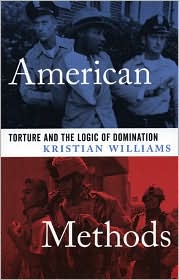
In American Methods author Kristian Williams argues that the U.S. Government has used torture as a method of social control and terror since the 1980s. Mr. Williams cites the 2004 Abu Ghraib prison incident, where American military personnel were investigated for the abuse of prisoners, as an example of traditional American torture. This event was hosted by Elliott Bay Book Company in Seattle, Washington.
Kristian Williams' writings have appeared in CounterPunch, Columbia Journalism Review, and We Are Everywhere: The Irresistible Rise of Global Anti-Capitalism. A member of Rose City Copwatch in Portland, Oregon, Williams also authored Our Enemies in Blue. There is no transcript for this program
To Watch the Episode
Kristian Williams: American Methods: Torture and the Logic of Domination
FORA TV (Originally broadcast on C-SPAN)
In American Methods author Kristian Williams argues that the U.S. Government has used torture as a method of social control and terror since the 1980s. Mr. Williams cites the 2004 Abu Ghraib prison incident, where American military personnel were investigated for the abuse of prisoners, as an example of traditional American torture. This event was hosted by Elliott Bay Book Company in Seattle, Washington.
Kristian Williams' writings have appeared in CounterPunch, Columbia Journalism Review, and We Are Everywhere: The Irresistible Rise of Global Anti-Capitalism. A member of Rose City Copwatch in Portland, Oregon, Williams also authored Our Enemies in Blue. There is no transcript for this program
To Watch the Episode
Tuesday, October 05, 2010
Glenn Greenwald: War on Terror Logic
(Extra credit opportunity for HUM 121 students--read entire essay, watch Rachel Maddow video, and write a response)
War on Terror logic
By Glenn Greenwald
Salon
The U.S. war in (against) Pakistan continues to escalate, as Pakistanis attacked NATO tankers carrying fuel through their country to soldiers in Afghanistan last night, killing three people, an attack that was in retaliation for vastly increased U.S. drone strikes in Pakistan this month, which were ordered in alleged response to reports of increased Terrorist threats aimed at Europe, which, in turn, were in retaliation for the escalating wars in Afghanistan and Pakistan (as evidenced by the large numbers of individuals of Afghan descent involved in these plots). Jim White -- in a post this morning entitled "Stuck in Feedback Loop: Drone Strikes Provoke Terrorists Who Provoke More Drone Strikes" -- documents exactly the process at play here:
What a surprise: bombing Muslims more and more causes more and more Muslims to want to bomb the countries responsible. That, of course, has long been the perverse "logic" driving the War on Terror. The very idea that we're going to reduce Terrorism by more intensively bombing more Muslim countries is one of the most patently absurd, self-contradicting premises that exists. It's exactly like announcing that the cure for lung cancer is to quadruple the number of cigarettes one smokes each day. But that's been the core premise (at least the stated one) of our foreign policy for the last decade: we're going to stop Terrorism by doing more and more of exactly the things that cause it (and see this very good Economist article on the ease with which drones allow a nation's leaders to pretend to its citizenry that they are not really at war -- as we're doing with Pakistan).
Speaking of counter-productive U.S. actions in Pakistan, this Washington Post article from Friday discusses the possibility that a coup could be engineered in that country to overthrow the current Government and replace it with one that is friendlier to U.S. interests:
The article does not say that the U.S. is actively involved in those efforts, but it's very difficult to imagine American military and intelligence officials simply sitting passively by as a coup is underway in a country (like Pakistan) where we are so invested, just keeping their fingers crossed that it results in a new government "better positioned to support U.S. policies." Whatever else is true, it's very easy to imagine how such a coup -- resulting in a more U.S.-friendly government -- will be perceived in that country and around the Muslim world. That perception is unlikely to help reduce the threat of Terrorism.
To Read the Rest of the Essay, Access More Resources, and Watch a Rachel Maddow Commentary
War on Terror logic
By Glenn Greenwald
Salon
The U.S. war in (against) Pakistan continues to escalate, as Pakistanis attacked NATO tankers carrying fuel through their country to soldiers in Afghanistan last night, killing three people, an attack that was in retaliation for vastly increased U.S. drone strikes in Pakistan this month, which were ordered in alleged response to reports of increased Terrorist threats aimed at Europe, which, in turn, were in retaliation for the escalating wars in Afghanistan and Pakistan (as evidenced by the large numbers of individuals of Afghan descent involved in these plots). Jim White -- in a post this morning entitled "Stuck in Feedback Loop: Drone Strikes Provoke Terrorists Who Provoke More Drone Strikes" -- documents exactly the process at play here:
The situation in Pakistan appears to have reached a point where a positive feedback loop prompts continued escalation on both sides. The US sees drone attacks as its primary weapon and has stepped up such attacks in the belief that they will create more security for military actions in Afghanistan and disrupt planning of terrorist attacks on the West. Instead, the attacks appear to enrage the surviving targets, recruit more to their ranks and lead to more attacks.
What a surprise: bombing Muslims more and more causes more and more Muslims to want to bomb the countries responsible. That, of course, has long been the perverse "logic" driving the War on Terror. The very idea that we're going to reduce Terrorism by more intensively bombing more Muslim countries is one of the most patently absurd, self-contradicting premises that exists. It's exactly like announcing that the cure for lung cancer is to quadruple the number of cigarettes one smokes each day. But that's been the core premise (at least the stated one) of our foreign policy for the last decade: we're going to stop Terrorism by doing more and more of exactly the things that cause it (and see this very good Economist article on the ease with which drones allow a nation's leaders to pretend to its citizenry that they are not really at war -- as we're doing with Pakistan).
Speaking of counter-productive U.S. actions in Pakistan, this Washington Post article from Friday discusses the possibility that a coup could be engineered in that country to overthrow the current Government and replace it with one that is friendlier to U.S. interests:
U.S. officials pointed to recent signs that Pakistan's powerful army and opposition parties are positioning themselves to install a new civilian government to replace President Asif Ali Zardari and his prime minister in the coming months. . . . U.S. officials indicated that the administration has begun to contemplate the effects of a change, engineered through Zardari's resignation as head of his political party, the dissolution of the current coalition government, or a call for new elections under the Pakistani constitution, rather than any overt action by the military. Some suggested that a new, constitutionally-approved government that was more competent and popular, and had strong military backing, might be better positioned to support U.S. policies.
The article does not say that the U.S. is actively involved in those efforts, but it's very difficult to imagine American military and intelligence officials simply sitting passively by as a coup is underway in a country (like Pakistan) where we are so invested, just keeping their fingers crossed that it results in a new government "better positioned to support U.S. policies." Whatever else is true, it's very easy to imagine how such a coup -- resulting in a more U.S.-friendly government -- will be perceived in that country and around the Muslim world. That perception is unlikely to help reduce the threat of Terrorism.
To Read the Rest of the Essay, Access More Resources, and Watch a Rachel Maddow Commentary
Saturday, September 04, 2010
Evangelos Tziallas: Torture porn and surveillance culture
Torture porn and surveillance culture
by Evangelos Tziallas
Jump Cut
Surveillance is everywhere, and its social ubiquity has led to it being a common element or mode of representation in contemporary moving image culture. As Thomas Levin has argued,
“By the 1990s…cinematic narration could be said, in many cases, to have effectively become synonymous with surveillant enunciation as such.”[1][open endnotes in new window]
Surveillance has become a mode of visual production, as in reality television shows like Big Brother (US, 2001) or films like Timecode (2000); it has become a narrative and thematic element, as in Caché (2005), Disturbia (2007) The Borne Ultimatum (2007); and sometime it serves as both a mode of production and narrative theme, as in The Conversation (1974), Sliver (1993), The Truman Show (1998), or the British sitcom Peep Show. When surveillance functions as both mode of production and major script element, as Levin puts it,
“It is this ambiguity—between surveillance as narrative subject, i.e. as thematic concern, and surveillance as the very condition or structure of narration itself—that will become increasingly characteristic of the cinema of the 1990s.”[2]
The prevalence of surveillance in contemporary media is now so vast that, for the purpose of this paper, I would like to focus on a small group of films that exemplify contemporary discourses on surveillance in a specific way. This group of films is collectively known as “torture porn.”
The label “torture porn” refers to a loose association of feature fiction films featuring scenes of extreme violence and torture. David Edelstein coined the phrase in his 2006 New York Magazine article as he quickly surveyed a common trend of violent representations in popular cinema. The catchy term became a trendy buzzword and now torture porn is considered a horror sub-genre in its own right.[3] Although I will in part investigate torture porn as a cinematic sub-genre, my goal is to demonstrate the centrality of surveillance in these films as shaping narrative elements, modes of presentation, and iconographic motifs in ways that convey deep anxieties about the alteration of “the gaze.”
Surveillance in torture porn allegorizes larger cultural and political trends in panoptic (the few watching the many) and synoptic (the many watching the few) subjectivities. Surveillance metonymically encompasses looking and the complex and ambivalent nature of looking and being looked at, and these elements of human social life are currently undergoing radical transformation due to technological advancements spurring on a “culture of surveillance,” or “surveillance culture.” As Nicholas Mirzoeff has noted,
“Surveillance” and the larger category, “image,” are merging together into surveillant images. If these two methods of representation have united, then this union requires us to investigate how the act of looking follows this social and technological change and what the ramifications of this merged, or altered, cultural gaze are. Looking is biological; gazing is cultural. As culture evolves, so too does the gaze.
To Read the Rest of the Essay
by Evangelos Tziallas
Jump Cut
Surveillance is everywhere, and its social ubiquity has led to it being a common element or mode of representation in contemporary moving image culture. As Thomas Levin has argued,
“By the 1990s…cinematic narration could be said, in many cases, to have effectively become synonymous with surveillant enunciation as such.”[1][open endnotes in new window]
Surveillance has become a mode of visual production, as in reality television shows like Big Brother (US, 2001) or films like Timecode (2000); it has become a narrative and thematic element, as in Caché (2005), Disturbia (2007) The Borne Ultimatum (2007); and sometime it serves as both a mode of production and narrative theme, as in The Conversation (1974), Sliver (1993), The Truman Show (1998), or the British sitcom Peep Show. When surveillance functions as both mode of production and major script element, as Levin puts it,
“It is this ambiguity—between surveillance as narrative subject, i.e. as thematic concern, and surveillance as the very condition or structure of narration itself—that will become increasingly characteristic of the cinema of the 1990s.”[2]
The prevalence of surveillance in contemporary media is now so vast that, for the purpose of this paper, I would like to focus on a small group of films that exemplify contemporary discourses on surveillance in a specific way. This group of films is collectively known as “torture porn.”
The label “torture porn” refers to a loose association of feature fiction films featuring scenes of extreme violence and torture. David Edelstein coined the phrase in his 2006 New York Magazine article as he quickly surveyed a common trend of violent representations in popular cinema. The catchy term became a trendy buzzword and now torture porn is considered a horror sub-genre in its own right.[3] Although I will in part investigate torture porn as a cinematic sub-genre, my goal is to demonstrate the centrality of surveillance in these films as shaping narrative elements, modes of presentation, and iconographic motifs in ways that convey deep anxieties about the alteration of “the gaze.”
Surveillance in torture porn allegorizes larger cultural and political trends in panoptic (the few watching the many) and synoptic (the many watching the few) subjectivities. Surveillance metonymically encompasses looking and the complex and ambivalent nature of looking and being looked at, and these elements of human social life are currently undergoing radical transformation due to technological advancements spurring on a “culture of surveillance,” or “surveillance culture.” As Nicholas Mirzoeff has noted,
“Since the 1970s, one of the striking phenomena that have come to make visual culture seem a vital topic has been the convergence of spectacle and surveillance.”[4]
“Surveillance” and the larger category, “image,” are merging together into surveillant images. If these two methods of representation have united, then this union requires us to investigate how the act of looking follows this social and technological change and what the ramifications of this merged, or altered, cultural gaze are. Looking is biological; gazing is cultural. As culture evolves, so too does the gaze.
To Read the Rest of the Essay
Sunday, August 22, 2010
Max Blumenthal: Days of Rage
Days of Rage -- The Noxious Transformation of the Conservative Movement into a Rabid Fringe
By Max Blumenthal
AlterNet
...
The experiments in "Terror Management Theory" of Sheldon Solomon, professor of psychology at Skidmore College, Jeff Greenberg, professor of psychologist at the Unviersity of Arizona, and Tom Pyszczynski, professor of psychology at the University of Colorado, have demonstrated the connection between fear of death and intensification of conservative attitudes. The findings help explain the effectiveness of the death panel rumor and insinuations by conservative figures that Obama was not truly American and somehow sympathetic to Islamic terrorists. Indeed, these seemingly irrational smears were guided by tactical reasoning, calculated to agitate voters with constant reminders of their own mortality. Whether or not Independents responded, the rhetoric of death kept the Tea Party crowd in a persistent state of panic and rage, ensuring a standing army ready to fan out to rallies and town halls at the first sign of liberal malfeasance.
Obama's first year in office was marked by more than raucous protests; there were several disturbing murders committed by far-right extremists. In April 2009, a 22-year-old neo-Nazi wannabe named Richard Poplawsi mowed down a SWAT team of Pittsburgh cops, killing three. Poplawski's best friend told reporters the young killer "grew angry recently over fears Obama would outlaw guns." Later it was discovered that Poplawski had posted a video clip to a neo-Nazi Web site portraying Fox's Glenn Beck contemplating the existence of concentration camps. (After a characteristically thorough investigation, Beck conceded they were not real.) On another occasion, the killer posted a video promoting Tea Party rallies. A month after the Pittsburgh bloodbath, Scott Roeder, a supporter of the militant anti-abortion group Operation Rescue, shot Dr. George Tiller to death while he prayed at his church in Wichita, Kansas. Tiller was declared fair game by the anti-abortion movement because of his role as Kansas's only late-term abortion provider. During at least 28 episodes of Bill O'Reilly's "O'Reilly Factor," O'Reilly had referred to Tiller as "Tiller the baby killer," a criminal guilty of "Nazi stuff." "I wouldn't want to be [Tiller] if there is a Judgment Day," O'Reilly proclaimed.
In August 2009, a middle-aged professional named George Sodini walked into a health club in suburban Pittsburgh and gunned down three women. The mainstream press explained Sodini's motives away by homing in on passages in his online diaries describing his loneliness, inability to convince women to have sex with him, and descent into chronic masturbation. Nearly every major media outlet omitted or ignored a long deranged entry in which Sodini projected his sexual frustration onto Obama, whom he seemed to view as a symbol of black male virility and predation.
The day after Obama's election victory, Sodini wrote: "Good luck to Obama! He will be successful. The liberal media LOVES him. Amerika has chosen The Black Man. Good! In light of this I got ideas outside of Obama's plans for the economy and such. Here it is: Every black man should get a young white girl … Kinda a reverse indentured servitude thing. Every daddy know when he sends his little girl to college, she be … real good. I saw it. 'Not my little girl', daddy says! (Yeah right!!) Black dudes have thier [sic] choice of best white?? [ellipses in original]."
In another posting to an anti-Clinton forum in 1994, during the height of the Republicans' Whitewater investigation, Sodini revealed that he had purchased a bumper sticker reading, "Stop Socialism, Impeach Clinton," from a National Review ad. A year later, Sodini ranted on an anti-government militia site, "I am convinced that more drastic action is required to bring the country back to the Constitutional order that it was 200 years ago. I don't think any group of political leaders will achieve this for us." Whether or not Sodini's murder spree was motivated by his political passions, he was pathologically death-driven and fixated on the phantasmagoria of right-wing imagery. In his final diary entry, Sodini proclaimed, "Death lives!"
More than any other media figure of the Obama era, Glenn Beck encouraged the campaign of racial demonization and conspiracy that consumed the Tea Party "Patriots." During a broadcast of "Fox and Friends," Beck opined that Obama "has exposed himself over and over and over again as a guy who has a deep-seated hatred for white people, or the white culture." As evidence, Beck pointed to White House green-jobs czar Van Jones, an African American former community organizer who was eventually forced to resign as a direct result of Beck's crusade. From there, Beck targeted another black Obama adviser, Valerie Jarrett, highlighting her ties to ACORN while upholding her and Jones as evidence of Obama's "socialist" agenda. In another broadcast, Beck played an audio clip of unidentified African Americans referring to "Obama money" as they collected welfare checks in Detroit. Then he showed footage of members of a Kansas City-based youth group practicing a step show, a traditional African-American group dance apparently unfamiliar enough to Beck and his transfixed audience that he felt at liberty to claim the footage as evidence that "Obama's SS" was being trained across inner-city America.
In September 2009, Beck relentlessly targeted ACORN, the Right's new favorite hobgoblin, admitting that he intended to use the poor people's advocacy group to distract his viewers from the health care debate. "Trust me," Beck said, "Everybody now says they're going to be talking about health care. I don't think so." (His statement was reminiscent of Rush Limbaugh's scandal-mongering remark during the early Clinton administration: "Whitewater is about health care.") Beck promptly cued up a series of hidden camera videos shot by conservative youth activists James O'Keefe and Hannah Giles inside ACORN field offices. In the videos, O'Keefe baited African-American staffers into making statements explaining that Giles, who claimed she was a prostitute, could obtain low-income housing. O'Keefe edited in images of himself clad in an outlandish pimp costume to create the impression that he was dressed that way during the meetings with ACORN; however, Giles later admitted her partner had lied about wearing his costume to further incriminate ACORN. In the end, ACORN was exonerated of all criminal wrongdoing while in a separate incident O'Keefe was arrested and charged with a federal crime after he and several conservative pals disguised themselves as telephone repairmen and attempted to wiretap phone lines in the office of Senator Mary Landrieu of Louisiana. Like Ryan Sorba, O'Keefe and his posse were movement cadres paid and directed by well-funded conservative outfits; O'Keefe had been trained by the Leadership Institute, the right-wing youth group that nurtured leading lights like Jack Abramoff, Karl Rove, Ralph Reed, and Jeff Gannon.
While O'Keefe and his buddies plea-bargained with prosecutors, Beck basked in his formula for success. His show earned the highest ratings at Fox News, topping network franchises like O'Reilly and Sean Hannity. In the process, Beck's opinions became firmly implanted in the nervous systems of Tea Party activists. "Glenn Beck has taught us everything we know," a demonstrator at the 9-12 rally told me. "He's opened our eyes to so much."
But unlike the right-wing radio warhorses who helped usher in Newt Gingrich's Republican counter-revolution of 1994, Beck was not an authentic product of the movement. When Rush Limbaugh first began dominating the AM airwaves, Beck was mired in the world of mid-level commercial radio, delivering corny yarns about lesbians and celebrity trash in hopes of becoming the next Howard Stern. By night, as he has tirelessly recounted, he medicated his anxiety with cocaine and alcohol, destroying his first marriage in the process. "We remember Glenn from the womanizing, the drinking, the drugs. Everybody who knew him at the time saw what a complete mess he was," a shock jock from Tampa, Florida, who called himself Bubba the Love Sponge remarked to me during a broadcast of his nationally syndicated show.
Like Dusty Rhodes, the pseudo-populist demagogue of Elia Kazan's 1957 film, A Face in the Crowd, Beck was a self-destructive drifter who might have been crumpled up with a bottle of Mad Dog 20/20 in an alleyway or been locked away in a prison cell had fame not found him first. Beck was only able to stabilize his life when he made his escape from freedom, marrying a conservative Mormon, converting to her religion, and transmuting his urge to abuse drugs into conservative radio diatribes. When Beck first broke into television on CNN's Headline News Channel, he struggled to articulate a coherent political worldview. If he distinguished himself from other big-time conservative hosts in any way, he did so through strained and often snide attempts at humor, remnants of his failed radio career. Nevertheless, with help from his liberal agent, Matthew Hiltzik, Beck snagged a primetime slot at Fox News in early 2009. Around this same time, Beck began promoting the work of an arcane Mormon conspiracy-peddler named W. Cleon Skousen, whom he described as his political lodestar. Suddenly, Beck had something more to offer than irritable mental gestures.
To Read the Rest of the Essay
By Max Blumenthal
AlterNet
...
The experiments in "Terror Management Theory" of Sheldon Solomon, professor of psychology at Skidmore College, Jeff Greenberg, professor of psychologist at the Unviersity of Arizona, and Tom Pyszczynski, professor of psychology at the University of Colorado, have demonstrated the connection between fear of death and intensification of conservative attitudes. The findings help explain the effectiveness of the death panel rumor and insinuations by conservative figures that Obama was not truly American and somehow sympathetic to Islamic terrorists. Indeed, these seemingly irrational smears were guided by tactical reasoning, calculated to agitate voters with constant reminders of their own mortality. Whether or not Independents responded, the rhetoric of death kept the Tea Party crowd in a persistent state of panic and rage, ensuring a standing army ready to fan out to rallies and town halls at the first sign of liberal malfeasance.
Obama's first year in office was marked by more than raucous protests; there were several disturbing murders committed by far-right extremists. In April 2009, a 22-year-old neo-Nazi wannabe named Richard Poplawsi mowed down a SWAT team of Pittsburgh cops, killing three. Poplawski's best friend told reporters the young killer "grew angry recently over fears Obama would outlaw guns." Later it was discovered that Poplawski had posted a video clip to a neo-Nazi Web site portraying Fox's Glenn Beck contemplating the existence of concentration camps. (After a characteristically thorough investigation, Beck conceded they were not real.) On another occasion, the killer posted a video promoting Tea Party rallies. A month after the Pittsburgh bloodbath, Scott Roeder, a supporter of the militant anti-abortion group Operation Rescue, shot Dr. George Tiller to death while he prayed at his church in Wichita, Kansas. Tiller was declared fair game by the anti-abortion movement because of his role as Kansas's only late-term abortion provider. During at least 28 episodes of Bill O'Reilly's "O'Reilly Factor," O'Reilly had referred to Tiller as "Tiller the baby killer," a criminal guilty of "Nazi stuff." "I wouldn't want to be [Tiller] if there is a Judgment Day," O'Reilly proclaimed.
In August 2009, a middle-aged professional named George Sodini walked into a health club in suburban Pittsburgh and gunned down three women. The mainstream press explained Sodini's motives away by homing in on passages in his online diaries describing his loneliness, inability to convince women to have sex with him, and descent into chronic masturbation. Nearly every major media outlet omitted or ignored a long deranged entry in which Sodini projected his sexual frustration onto Obama, whom he seemed to view as a symbol of black male virility and predation.
The day after Obama's election victory, Sodini wrote: "Good luck to Obama! He will be successful. The liberal media LOVES him. Amerika has chosen The Black Man. Good! In light of this I got ideas outside of Obama's plans for the economy and such. Here it is: Every black man should get a young white girl … Kinda a reverse indentured servitude thing. Every daddy know when he sends his little girl to college, she be … real good. I saw it. 'Not my little girl', daddy says! (Yeah right!!) Black dudes have thier [sic] choice of best white?? [ellipses in original]."
In another posting to an anti-Clinton forum in 1994, during the height of the Republicans' Whitewater investigation, Sodini revealed that he had purchased a bumper sticker reading, "Stop Socialism, Impeach Clinton," from a National Review ad. A year later, Sodini ranted on an anti-government militia site, "I am convinced that more drastic action is required to bring the country back to the Constitutional order that it was 200 years ago. I don't think any group of political leaders will achieve this for us." Whether or not Sodini's murder spree was motivated by his political passions, he was pathologically death-driven and fixated on the phantasmagoria of right-wing imagery. In his final diary entry, Sodini proclaimed, "Death lives!"
More than any other media figure of the Obama era, Glenn Beck encouraged the campaign of racial demonization and conspiracy that consumed the Tea Party "Patriots." During a broadcast of "Fox and Friends," Beck opined that Obama "has exposed himself over and over and over again as a guy who has a deep-seated hatred for white people, or the white culture." As evidence, Beck pointed to White House green-jobs czar Van Jones, an African American former community organizer who was eventually forced to resign as a direct result of Beck's crusade. From there, Beck targeted another black Obama adviser, Valerie Jarrett, highlighting her ties to ACORN while upholding her and Jones as evidence of Obama's "socialist" agenda. In another broadcast, Beck played an audio clip of unidentified African Americans referring to "Obama money" as they collected welfare checks in Detroit. Then he showed footage of members of a Kansas City-based youth group practicing a step show, a traditional African-American group dance apparently unfamiliar enough to Beck and his transfixed audience that he felt at liberty to claim the footage as evidence that "Obama's SS" was being trained across inner-city America.
In September 2009, Beck relentlessly targeted ACORN, the Right's new favorite hobgoblin, admitting that he intended to use the poor people's advocacy group to distract his viewers from the health care debate. "Trust me," Beck said, "Everybody now says they're going to be talking about health care. I don't think so." (His statement was reminiscent of Rush Limbaugh's scandal-mongering remark during the early Clinton administration: "Whitewater is about health care.") Beck promptly cued up a series of hidden camera videos shot by conservative youth activists James O'Keefe and Hannah Giles inside ACORN field offices. In the videos, O'Keefe baited African-American staffers into making statements explaining that Giles, who claimed she was a prostitute, could obtain low-income housing. O'Keefe edited in images of himself clad in an outlandish pimp costume to create the impression that he was dressed that way during the meetings with ACORN; however, Giles later admitted her partner had lied about wearing his costume to further incriminate ACORN. In the end, ACORN was exonerated of all criminal wrongdoing while in a separate incident O'Keefe was arrested and charged with a federal crime after he and several conservative pals disguised themselves as telephone repairmen and attempted to wiretap phone lines in the office of Senator Mary Landrieu of Louisiana. Like Ryan Sorba, O'Keefe and his posse were movement cadres paid and directed by well-funded conservative outfits; O'Keefe had been trained by the Leadership Institute, the right-wing youth group that nurtured leading lights like Jack Abramoff, Karl Rove, Ralph Reed, and Jeff Gannon.
While O'Keefe and his buddies plea-bargained with prosecutors, Beck basked in his formula for success. His show earned the highest ratings at Fox News, topping network franchises like O'Reilly and Sean Hannity. In the process, Beck's opinions became firmly implanted in the nervous systems of Tea Party activists. "Glenn Beck has taught us everything we know," a demonstrator at the 9-12 rally told me. "He's opened our eyes to so much."
But unlike the right-wing radio warhorses who helped usher in Newt Gingrich's Republican counter-revolution of 1994, Beck was not an authentic product of the movement. When Rush Limbaugh first began dominating the AM airwaves, Beck was mired in the world of mid-level commercial radio, delivering corny yarns about lesbians and celebrity trash in hopes of becoming the next Howard Stern. By night, as he has tirelessly recounted, he medicated his anxiety with cocaine and alcohol, destroying his first marriage in the process. "We remember Glenn from the womanizing, the drinking, the drugs. Everybody who knew him at the time saw what a complete mess he was," a shock jock from Tampa, Florida, who called himself Bubba the Love Sponge remarked to me during a broadcast of his nationally syndicated show.
Like Dusty Rhodes, the pseudo-populist demagogue of Elia Kazan's 1957 film, A Face in the Crowd, Beck was a self-destructive drifter who might have been crumpled up with a bottle of Mad Dog 20/20 in an alleyway or been locked away in a prison cell had fame not found him first. Beck was only able to stabilize his life when he made his escape from freedom, marrying a conservative Mormon, converting to her religion, and transmuting his urge to abuse drugs into conservative radio diatribes. When Beck first broke into television on CNN's Headline News Channel, he struggled to articulate a coherent political worldview. If he distinguished himself from other big-time conservative hosts in any way, he did so through strained and often snide attempts at humor, remnants of his failed radio career. Nevertheless, with help from his liberal agent, Matthew Hiltzik, Beck snagged a primetime slot at Fox News in early 2009. Around this same time, Beck began promoting the work of an arcane Mormon conspiracy-peddler named W. Cleon Skousen, whom he described as his political lodestar. Suddenly, Beck had something more to offer than irritable mental gestures.
To Read the Rest of the Essay
As GOP and Some Top Dems Unite in Opposing NY Islamic Community Center, a Roundtable Discussion with Mother of 9/11 Victim, Rabbi, Muslim Lawmaker ...
As GOP and Some Top Dems Unite in Opposing NY Islamic Community Center, a Roundtable Discussion with Mother of 9/11 Victim, Rabbi, Muslim Lawmaker and Islamic Scholar
Democracy Now
We spend the hour on the controversy around the proposed construction of an Islamic community center in Lower Manhattan, which has turned into a national issue. Opposition to the center first started among fringe, right-wing blogs but has swept into the mainstream, with some Democrats, including Senate Majority Leader Harry Reid, coming out against it. Republicans have vowed to make the controversy a campaign issue in the fall. We host a roundtable with four guests: Minnesota Representative Keith Ellison, the first Muslim elected to Congress; Rabbi Irwin Kula of the National Jewish Center for Learning and Leadership; Islamic scholar John Esposito of Georgetown University; and Talat Hamdani, whose son Salman died on 9/11 in the attacks on the World Trade Center.
To Watch/Listen/Read
Democracy Now
We spend the hour on the controversy around the proposed construction of an Islamic community center in Lower Manhattan, which has turned into a national issue. Opposition to the center first started among fringe, right-wing blogs but has swept into the mainstream, with some Democrats, including Senate Majority Leader Harry Reid, coming out against it. Republicans have vowed to make the controversy a campaign issue in the fall. We host a roundtable with four guests: Minnesota Representative Keith Ellison, the first Muslim elected to Congress; Rabbi Irwin Kula of the National Jewish Center for Learning and Leadership; Islamic scholar John Esposito of Georgetown University; and Talat Hamdani, whose son Salman died on 9/11 in the attacks on the World Trade Center.
To Watch/Listen/Read
Thursday, March 11, 2010
Mark Benjamin: Waterboarding for Dummies
Waterboarding for dummies: Internal CIA documents reveal a meticulous protocol that was far more brutal than Dick Cheney's "dunk in the water"
By Mark Benjamin
Salon
Self-proclaimed waterboarding fan Dick Cheney called it a no-brainer in a 2006 radio interview: Terror suspects should get a "a dunk in the water." But recently released internal documents reveal the controversial "enhanced interrogation" practice was far more brutal on detainees than Cheney's description sounds, and was administered with meticulous cruelty.
Interrogators pumped detainees full of so much water that the CIA turned to a special saline solution to minimize the risk of death, the documents show. The agency used a gurney "specially designed" to tilt backwards at a perfect angle to maximize the water entering the prisoner's nose and mouth, intensifying the sense of choking – and to be lifted upright quickly in the event that a prisoner stopped breathing.
The documents also lay out, in chilling detail, exactly what should occur in each two-hour waterboarding "session." Interrogators were instructed to start pouring water right after a detainee exhaled, to ensure he inhaled water, not air, in his next breath. They could use their hands to "dam the runoff" and prevent water from spilling out of a detainee's mouth. They were allowed six separate 40-second "applications" of liquid in each two-hour session – and could dump water over a detainee's nose and mouth for a total of 12 minutes a day. Finally, to keep detainees alive even if they inhaled their own vomit during a session – a not-uncommon side effect of waterboarding – the prisoners were kept on a liquid diet. The agency recommended Ensure Plus.
"This is revolting and it is deeply disturbing," said Dr. Scott Allen, co-director of the Center for Prisoner Health and Human Rights at Brown University who has reviewed all of the documents for Physicians for Human Rights. "The so-called science here is a total departure from any ethics or any legitimate purpose. They are saying, ‘This is how risky and harmful the procedure is, but we are still going to do it.' It just sounds like lunacy," he said. "This fine-tuning of torture is unethical, incompetent and a disgrace to medicine."
To Read the Rest of the Article
By Mark Benjamin
Salon
Self-proclaimed waterboarding fan Dick Cheney called it a no-brainer in a 2006 radio interview: Terror suspects should get a "a dunk in the water." But recently released internal documents reveal the controversial "enhanced interrogation" practice was far more brutal on detainees than Cheney's description sounds, and was administered with meticulous cruelty.
Interrogators pumped detainees full of so much water that the CIA turned to a special saline solution to minimize the risk of death, the documents show. The agency used a gurney "specially designed" to tilt backwards at a perfect angle to maximize the water entering the prisoner's nose and mouth, intensifying the sense of choking – and to be lifted upright quickly in the event that a prisoner stopped breathing.
The documents also lay out, in chilling detail, exactly what should occur in each two-hour waterboarding "session." Interrogators were instructed to start pouring water right after a detainee exhaled, to ensure he inhaled water, not air, in his next breath. They could use their hands to "dam the runoff" and prevent water from spilling out of a detainee's mouth. They were allowed six separate 40-second "applications" of liquid in each two-hour session – and could dump water over a detainee's nose and mouth for a total of 12 minutes a day. Finally, to keep detainees alive even if they inhaled their own vomit during a session – a not-uncommon side effect of waterboarding – the prisoners were kept on a liquid diet. The agency recommended Ensure Plus.
"This is revolting and it is deeply disturbing," said Dr. Scott Allen, co-director of the Center for Prisoner Health and Human Rights at Brown University who has reviewed all of the documents for Physicians for Human Rights. "The so-called science here is a total departure from any ethics or any legitimate purpose. They are saying, ‘This is how risky and harmful the procedure is, but we are still going to do it.' It just sounds like lunacy," he said. "This fine-tuning of torture is unethical, incompetent and a disgrace to medicine."
To Read the Rest of the Article
Saturday, February 27, 2010
Standard Operating Procedure (USA: Errol Morris, 2008)
(Extra-Credit opportunity for my students--watch and write a 600+ response)
Standard Operating Procedure: Synopsis
by Errol Morris
Is it possible for a photograph to change the world? Photographs taken by soldiers in Abu Ghraib prison changed the war in Iraq and changed America’s image of itself. Yet, a central mystery remains. Did the notorious Abu Ghraib photographs constitute evidence of systematic abuse by the American military, or were they documenting the aberrant behavior of a few “bad apples”?
We set out to examine the context of these photographs. Why were they taken? What was happening outside the frame? We talked directly to the soldiers who took the photographs and who were in the photographs. Who are these people? What were they thinking? Over two years of investigation, we amassed a million and a half words of interview transcript, thousands of pages of unredacted reports, and hundreds of photographs.
The story of Abu Ghraib is still shrouded in moral ambiguity, but it is clear what happened there. The Abu Ghraib photographs serve as both an expose and a coverup. An expose, because the photographs offer us a glimpse of the horror of Abu Ghraib; and a coverup because they convinced journalists and readers they had seen everything, that there was no need to look further. In recent news reports, we have learned about the destruction of the Abu Zubaydah interrogation tapes. A coverup. It has been front page news. But the coverup at Abu Ghraib involved thousands of prisoners and hundreds of soldiers. We are still learning about the extent of it. Many journalists have asked about “the smoking gun” of Abu Ghraib. It is the wrong question. As Philip Gourevitch has commented, Abu Ghraib is the smoking gun. The underlying question that we still have not resolved, four years after the scandal: how could American values become so compromised that Abu Ghraib—and the subsequent coverup—could happen?
Link to the Synopsis
To watch the entire documentary online:
Standard Operating Procedure: Synopsis
by Errol Morris
Is it possible for a photograph to change the world? Photographs taken by soldiers in Abu Ghraib prison changed the war in Iraq and changed America’s image of itself. Yet, a central mystery remains. Did the notorious Abu Ghraib photographs constitute evidence of systematic abuse by the American military, or were they documenting the aberrant behavior of a few “bad apples”?
We set out to examine the context of these photographs. Why were they taken? What was happening outside the frame? We talked directly to the soldiers who took the photographs and who were in the photographs. Who are these people? What were they thinking? Over two years of investigation, we amassed a million and a half words of interview transcript, thousands of pages of unredacted reports, and hundreds of photographs.
The story of Abu Ghraib is still shrouded in moral ambiguity, but it is clear what happened there. The Abu Ghraib photographs serve as both an expose and a coverup. An expose, because the photographs offer us a glimpse of the horror of Abu Ghraib; and a coverup because they convinced journalists and readers they had seen everything, that there was no need to look further. In recent news reports, we have learned about the destruction of the Abu Zubaydah interrogation tapes. A coverup. It has been front page news. But the coverup at Abu Ghraib involved thousands of prisoners and hundreds of soldiers. We are still learning about the extent of it. Many journalists have asked about “the smoking gun” of Abu Ghraib. It is the wrong question. As Philip Gourevitch has commented, Abu Ghraib is the smoking gun. The underlying question that we still have not resolved, four years after the scandal: how could American values become so compromised that Abu Ghraib—and the subsequent coverup—could happen?
Link to the Synopsis
To watch the entire documentary online:
Monday, February 22, 2010
CNN: McChrystal apologizes as airstrike kills dozens in Afghanistan
McChrystal apologizes as airstrike kills dozens in Afghanistan
CNN
The head of U.S. forces in Afghanistan, General Stanley McChrystal, expressed regret Monday after more than two dozen civilians were killed in a NATO airstrike.
Twenty-seven civilians died and 14 others were wounded in the incident Sunday in the central Daikondi province, according to the Afghan Interior Ministry.
Ground forces at the scene found women and children among the casualties, the Afghan government and NATO's International Security Assistance Force (ISAF) said in a joint statement.
The U.S military told CNN Pentagon Correspondent Barbara Starr they "accept" the Afghan government's death toll. ISAF said it had ordered an immediate investigation into the incident, while the Afghan cabinet called the attack "unjustifiable."
"We are extremely saddened by the tragic loss of innocent lives," said McChrystal, who spoke to President Hamid Karzai Sunday evening to express his sorrow and regret over the incident.
"I have made it clear to our forces that we are here to protect the Afghan people, and inadvertently killing or injuring civilians undermines their trust and confidence in our mission. We will re-double our efforts to regain that trust."
Commanders ordered the daylight NATO airstrike because they had specific intelligence that a group of Taliban in vehicles was heading towards coalition forces on the ground, according to a senior U.S. military official.
To Read the Rest of the Report
CNN
The head of U.S. forces in Afghanistan, General Stanley McChrystal, expressed regret Monday after more than two dozen civilians were killed in a NATO airstrike.
Twenty-seven civilians died and 14 others were wounded in the incident Sunday in the central Daikondi province, according to the Afghan Interior Ministry.
Ground forces at the scene found women and children among the casualties, the Afghan government and NATO's International Security Assistance Force (ISAF) said in a joint statement.
The U.S military told CNN Pentagon Correspondent Barbara Starr they "accept" the Afghan government's death toll. ISAF said it had ordered an immediate investigation into the incident, while the Afghan cabinet called the attack "unjustifiable."
"We are extremely saddened by the tragic loss of innocent lives," said McChrystal, who spoke to President Hamid Karzai Sunday evening to express his sorrow and regret over the incident.
"I have made it clear to our forces that we are here to protect the Afghan people, and inadvertently killing or injuring civilians undermines their trust and confidence in our mission. We will re-double our efforts to regain that trust."
Commanders ordered the daylight NATO airstrike because they had specific intelligence that a group of Taliban in vehicles was heading towards coalition forces on the ground, according to a senior U.S. military official.
To Read the Rest of the Report
Saturday, February 20, 2010
Glenn Greenwald: Terrorism -- The Most Meaningless and Manipulated Word
Terrorism: The Most Meaningless and Manipulated Word
by Glenn Greenwald
Common Dreams
Yesterday, Joseph Stack deliberately flew an airplane into a building housing IRS offices in Austin, Texas, in order to advance the political grievances he outlined in a perfectly cogent suicide-manifesto. Stack's worldview contained elements of the tea party's anti-government anger along with substantial populist complaints generally associated with "the Left" (rage over bailouts, the suffering of America's poor, and the pilfering of the middle class by a corrupt economic elite and their government-servants). All of that was accompanied by an argument as to why violence was justified (indeed necessary) to protest those injustices:
Despite all that, The New York Times' Brian Stelter documents the deep reluctance of cable news chatterers and government officials to label the incident an act of "terrorism," even though -- as Dave Neiwert ably documents -- it perfectly fits, indeed is a classic illustration of, every official definition of that term. The issue isn't whether Stack's grievances are real or his responses just; it is that the act unquestionably comports with the official definition. But as NBC's Pete Williams said of the official insistence that this was not an act of Terrorism: there are "a couple of reasons to say that . . . One is he's an American citizen." Fox News' Megan Kelley asked Catherine Herridge about these denials: "I take it that they mean terrorism in the larger sense that most of us are used to?," to which Herridge replied: "they mean terrorism in that capital T way."
All of this underscores, yet again, that Terrorism is simultaneously the single most meaningless and most manipulated word in the American political lexicon. The term now has virtually nothing to do with the act itself and everything to do with the identity of the actor, especially his or her religious identity. It has really come to mean: "a Muslim who fights against or even expresses hostility towards the United States, Israel and their allies." That's why all of this confusion and doubt arose yesterday over whether a person who perpetrated a classic act of Terrorism should, in fact, be called a Terrorist: he's not a Muslim and isn't acting on behalf of standard Muslim grievances against the U.S. or Israel, and thus does not fit the "definition." One might concede that perhaps there's some technical sense in which term might apply to Stack, but as Fox News emphasized: it's not "terrorism in the larger sense that most of us are used to . . . terrorism in that capital T way." We all know who commits terrorism in "that capital T way," and it's not people named Joseph Stack.
Contrast the collective hesitance to call Stack a Terrorist with the extremely dubious circumstances under which that term is reflexively applied to Muslims. If a Muslim attacks a military base preparing to deploy soldiers to a war zone, that person is a Terrorist. If an American Muslim argues that violence against the U.S. (particularly when aimed at military targets) is justified due to American violence aimed at the Muslim world, that person is a Terrorist who deserves assassination. And if the U.S. military invades a Muslim country, Muslims who live in the invaded and occupied country and who fight back against the invading American army -- by attacking nothing but military targets -- are also Terrorists. Indeed, large numbers of detainees at Guantanamo were accused of being Terrorists for nothing more than attacking members of an invading foreign army in their country, including 14-year-old Mohamed Jawad, who spent many years in Guantanamo, accused (almost certainly falsely) of throwing a grenade at two American troops in Afghanistan who were part of an invading force in that country. Obviously, plots targeting civilians for death -- the 9/11 attacks and attempts to blow up civilian aircraft -- are pure terrorism, but a huge portion of the acts committed by Muslims that receive that label are not.
To Read the Rest of the Essay
by Glenn Greenwald
Common Dreams
Yesterday, Joseph Stack deliberately flew an airplane into a building housing IRS offices in Austin, Texas, in order to advance the political grievances he outlined in a perfectly cogent suicide-manifesto. Stack's worldview contained elements of the tea party's anti-government anger along with substantial populist complaints generally associated with "the Left" (rage over bailouts, the suffering of America's poor, and the pilfering of the middle class by a corrupt economic elite and their government-servants). All of that was accompanied by an argument as to why violence was justified (indeed necessary) to protest those injustices:
I remember reading about the stock market crash before the "great" depression and how there were wealthy bankers and businessmen jumping out of windows when they realized they screwed up and lost everything. Isn't it ironic how far we've come in 60 years in this country that they now know how to fix that little economic problem; they just steal from the middle class (who doesn't have any say in it, elections are a joke) to cover their asses and it's "business-as-usual" . . . . Sadly, though I spent my entire life trying to believe it wasn't so, but violence not only is the answer, it is the only answer.
Despite all that, The New York Times' Brian Stelter documents the deep reluctance of cable news chatterers and government officials to label the incident an act of "terrorism," even though -- as Dave Neiwert ably documents -- it perfectly fits, indeed is a classic illustration of, every official definition of that term. The issue isn't whether Stack's grievances are real or his responses just; it is that the act unquestionably comports with the official definition. But as NBC's Pete Williams said of the official insistence that this was not an act of Terrorism: there are "a couple of reasons to say that . . . One is he's an American citizen." Fox News' Megan Kelley asked Catherine Herridge about these denials: "I take it that they mean terrorism in the larger sense that most of us are used to?," to which Herridge replied: "they mean terrorism in that capital T way."
All of this underscores, yet again, that Terrorism is simultaneously the single most meaningless and most manipulated word in the American political lexicon. The term now has virtually nothing to do with the act itself and everything to do with the identity of the actor, especially his or her religious identity. It has really come to mean: "a Muslim who fights against or even expresses hostility towards the United States, Israel and their allies." That's why all of this confusion and doubt arose yesterday over whether a person who perpetrated a classic act of Terrorism should, in fact, be called a Terrorist: he's not a Muslim and isn't acting on behalf of standard Muslim grievances against the U.S. or Israel, and thus does not fit the "definition." One might concede that perhaps there's some technical sense in which term might apply to Stack, but as Fox News emphasized: it's not "terrorism in the larger sense that most of us are used to . . . terrorism in that capital T way." We all know who commits terrorism in "that capital T way," and it's not people named Joseph Stack.
Contrast the collective hesitance to call Stack a Terrorist with the extremely dubious circumstances under which that term is reflexively applied to Muslims. If a Muslim attacks a military base preparing to deploy soldiers to a war zone, that person is a Terrorist. If an American Muslim argues that violence against the U.S. (particularly when aimed at military targets) is justified due to American violence aimed at the Muslim world, that person is a Terrorist who deserves assassination. And if the U.S. military invades a Muslim country, Muslims who live in the invaded and occupied country and who fight back against the invading American army -- by attacking nothing but military targets -- are also Terrorists. Indeed, large numbers of detainees at Guantanamo were accused of being Terrorists for nothing more than attacking members of an invading foreign army in their country, including 14-year-old Mohamed Jawad, who spent many years in Guantanamo, accused (almost certainly falsely) of throwing a grenade at two American troops in Afghanistan who were part of an invading force in that country. Obviously, plots targeting civilians for death -- the 9/11 attacks and attempts to blow up civilian aircraft -- are pure terrorism, but a huge portion of the acts committed by Muslims that receive that label are not.
To Read the Rest of the Essay
Saturday, February 13, 2010
Anand Gopal: Obama’s Secret Prisons: Night Raids, Hidden Detention Centers, the “Black Jail,” and the Dogs of War in Afghanistan
Obama’s Secret Prisons: Night Raids, Hidden Detention Centers, the “Black Jail,” and the Dogs of War in Afghanistan
By Anand Gopal
The American Empire Project
One quiet, wintry night last year in the eastern Afghan town of Khost, a young government employee named Ismatullah simply vanished. He had last been seen in the town’s bazaar with a group of friends. Family members scoured Khost’s dust-doused streets for days. Village elders contacted Taliban commanders in the area who were wont to kidnap government workers, but they had never heard of the young man. Even the governor got involved, ordering his police to round up nettlesome criminal gangs that sometimes preyed on young bazaar-goers for ransom.
But the hunt turned up nothing. Spring and summer came and went with no sign of Ismatullah. Then one day, long after the police and village elders had abandoned their search, a courier delivered a neat, handwritten note on Red Cross stationary to the family. In it, Ismatullah informed them that he was in Bagram, an American prison more than 200 miles away. U.S. forces had picked him up while he was on his way home from the bazaar, the terse letter stated, and he didn’t know when he would be freed.
Sometime in the last few years, Pashtun villagers in Afghanistan’s rugged heartland began to lose faith in the American project. Many of them can point to the precise moment of this transformation, and it usually took place in the dead of the night, when most of the country was fast asleep. In the secretive U.S. detentions process, suspects are usually nabbed in the darkness and then sent to one of a number of detention areas on military bases, often on the slightest suspicion and without the knowledge of their families.
This process has become even more feared and hated in Afghanistan than coalition airstrikes. The night raids and detentions, little known or understood outside of these Pashtun villages, are slowly turning Afghans against the very forces they greeted as liberators just a few years ago.
One Dark Night in November
It was the 19th of November 2009, at 3:15 am. A loud blast awoke the villagers of a leafy neighborhood outside Ghazni city, a town of ancient provenance in the country’s south. A team of U.S. soldiers burst through the front gate of the home of Majidullah Qarar, the spokesman for the Minister of Agriculture. Qarar was in Kabul at the time, but his relatives were home, four of whom were sleeping in the family’s one-room guesthouse. One of them, Hamidullah, who sold carrots at the local bazaar, ran towards the door of the guesthouse. He was immediately shot, but managed to crawl back inside, leaving a trail of blood behind him. Then Azim, a baker, darted towards his injured cousin. He, too, was shot and crumpled to the floor. The fallen men cried out to the two relatives remaining in the room, but they -- both children -- refused to move, glued to their beds in silent horror.
The foreign soldiers, most of them tattooed and bearded, then went on to the main compound. They threw clothes on the floor, smashed dinner plates, and forced open closets. Finally, they found the man they were looking for: Habib-ur-Rahman, a computer programmer and government employee. Rahman was responsible for converting Microsoft Windows from English to the local Pashto language so that government offices could use the software. He had spent time in Kuwait, and the Afghan translator accompanying the soldiers said they were acting on a tip that Rahman was a member of al-Qaeda.
They took the barefoot Rahman and a cousin of his to a helicopter some distance away and transported them to a small American base in a neighboring province for interrogation. After two days, U.S. forces released Rahman’s cousin. But Rahman has not been seen or heard from since.
“We’ve called his phone, but it doesn’t answer,” says his cousin Qarar, the spokesman for the agriculture minister. Using his powerful connections, Qarar enlisted local police, parliamentarians, the governor, and even the agriculture minister himself in the search for his cousin, but they turned up nothing. Government officials who independently investigated the scene in the aftermath of the raid and corroborated the claims of the family also pressed for an answer as to why two of Qarar’s family members were killed. American forces issued a statement saying that the dead were “enemy militants [that] demonstrated hostile intent.”
Weeks after the raid, the family remains bitter. “Everyone in the area knew we were a family that worked for the government,” Qarar says. “Rahman couldn’t even leave the city because if the Taliban caught him in the countryside they would have killed him.”
Beyond the question of Rahman’s guilt or innocence, however, it’s how he was taken that has left such a residue of hate and anger among his family. “Did they have to kill my cousins? Did they have to destroy our house?” Qarar asks. “They knew where Rahman worked. Couldn’t they have at least tried to come with a warrant in the daytime? We would have forced Rahman to comply.”
“I used to go on TV and argue that people should support this government and the foreigners,” he adds. “But I was wrong. Why should anyone do so? I don’t care if I get fired for saying it, but that’s the truth.”
The Dogs of War
Night raids are only the first step in the American detention process in Afghanistan. Suspects are usually sent to one among a series of prisons on U.S. military bases around the country. There are officially nine such jails, called Field Detention Sites in military parlance. They are small holding areas, often just a clutch of cells divided by plywood, and are mainly used for prisoner interrogation.
In the early years of the war, these were but way stations for those en route to Bagram prison, a facility with a notorious reputation for abusive behavior. As a spotlight of international attention fell on Bagram in recent years, wardens there cleaned up their act and the mistreatment of prisoners began to shift to the little-noticed Field Detention Sites.
Of the 24 former detainees interviewed for this story, 17 claim to have been abused at or en route to these sites. Doctors, government officials, and the Afghan Independent Human Rights Commission, a body tasked with investigating abuse claims, corroborate 12 of these claims.
To Read the Rest of the Article
By Anand Gopal
The American Empire Project
One quiet, wintry night last year in the eastern Afghan town of Khost, a young government employee named Ismatullah simply vanished. He had last been seen in the town’s bazaar with a group of friends. Family members scoured Khost’s dust-doused streets for days. Village elders contacted Taliban commanders in the area who were wont to kidnap government workers, but they had never heard of the young man. Even the governor got involved, ordering his police to round up nettlesome criminal gangs that sometimes preyed on young bazaar-goers for ransom.
But the hunt turned up nothing. Spring and summer came and went with no sign of Ismatullah. Then one day, long after the police and village elders had abandoned their search, a courier delivered a neat, handwritten note on Red Cross stationary to the family. In it, Ismatullah informed them that he was in Bagram, an American prison more than 200 miles away. U.S. forces had picked him up while he was on his way home from the bazaar, the terse letter stated, and he didn’t know when he would be freed.
Sometime in the last few years, Pashtun villagers in Afghanistan’s rugged heartland began to lose faith in the American project. Many of them can point to the precise moment of this transformation, and it usually took place in the dead of the night, when most of the country was fast asleep. In the secretive U.S. detentions process, suspects are usually nabbed in the darkness and then sent to one of a number of detention areas on military bases, often on the slightest suspicion and without the knowledge of their families.
This process has become even more feared and hated in Afghanistan than coalition airstrikes. The night raids and detentions, little known or understood outside of these Pashtun villages, are slowly turning Afghans against the very forces they greeted as liberators just a few years ago.
One Dark Night in November
It was the 19th of November 2009, at 3:15 am. A loud blast awoke the villagers of a leafy neighborhood outside Ghazni city, a town of ancient provenance in the country’s south. A team of U.S. soldiers burst through the front gate of the home of Majidullah Qarar, the spokesman for the Minister of Agriculture. Qarar was in Kabul at the time, but his relatives were home, four of whom were sleeping in the family’s one-room guesthouse. One of them, Hamidullah, who sold carrots at the local bazaar, ran towards the door of the guesthouse. He was immediately shot, but managed to crawl back inside, leaving a trail of blood behind him. Then Azim, a baker, darted towards his injured cousin. He, too, was shot and crumpled to the floor. The fallen men cried out to the two relatives remaining in the room, but they -- both children -- refused to move, glued to their beds in silent horror.
The foreign soldiers, most of them tattooed and bearded, then went on to the main compound. They threw clothes on the floor, smashed dinner plates, and forced open closets. Finally, they found the man they were looking for: Habib-ur-Rahman, a computer programmer and government employee. Rahman was responsible for converting Microsoft Windows from English to the local Pashto language so that government offices could use the software. He had spent time in Kuwait, and the Afghan translator accompanying the soldiers said they were acting on a tip that Rahman was a member of al-Qaeda.
They took the barefoot Rahman and a cousin of his to a helicopter some distance away and transported them to a small American base in a neighboring province for interrogation. After two days, U.S. forces released Rahman’s cousin. But Rahman has not been seen or heard from since.
“We’ve called his phone, but it doesn’t answer,” says his cousin Qarar, the spokesman for the agriculture minister. Using his powerful connections, Qarar enlisted local police, parliamentarians, the governor, and even the agriculture minister himself in the search for his cousin, but they turned up nothing. Government officials who independently investigated the scene in the aftermath of the raid and corroborated the claims of the family also pressed for an answer as to why two of Qarar’s family members were killed. American forces issued a statement saying that the dead were “enemy militants [that] demonstrated hostile intent.”
Weeks after the raid, the family remains bitter. “Everyone in the area knew we were a family that worked for the government,” Qarar says. “Rahman couldn’t even leave the city because if the Taliban caught him in the countryside they would have killed him.”
Beyond the question of Rahman’s guilt or innocence, however, it’s how he was taken that has left such a residue of hate and anger among his family. “Did they have to kill my cousins? Did they have to destroy our house?” Qarar asks. “They knew where Rahman worked. Couldn’t they have at least tried to come with a warrant in the daytime? We would have forced Rahman to comply.”
“I used to go on TV and argue that people should support this government and the foreigners,” he adds. “But I was wrong. Why should anyone do so? I don’t care if I get fired for saying it, but that’s the truth.”
The Dogs of War
Night raids are only the first step in the American detention process in Afghanistan. Suspects are usually sent to one among a series of prisons on U.S. military bases around the country. There are officially nine such jails, called Field Detention Sites in military parlance. They are small holding areas, often just a clutch of cells divided by plywood, and are mainly used for prisoner interrogation.
In the early years of the war, these were but way stations for those en route to Bagram prison, a facility with a notorious reputation for abusive behavior. As a spotlight of international attention fell on Bagram in recent years, wardens there cleaned up their act and the mistreatment of prisoners began to shift to the little-noticed Field Detention Sites.
Of the 24 former detainees interviewed for this story, 17 claim to have been abused at or en route to these sites. Doctors, government officials, and the Afghan Independent Human Rights Commission, a body tasked with investigating abuse claims, corroborate 12 of these claims.
To Read the Rest of the Article
Tuesday, February 09, 2010
Weekly Signals: Chris Hedges co-author of Collateral Damage: America's War Against Iraqi Civilians
An interview with Pulitzer Prize-winning journalist Chris Hedges co-author of Collateral Damage: America's War Against Iraqi Civilians.
Weekly Signals
Hedges and journalist Laila Al-Arian spent the past year interviewing over fifty veterans to expose the patterns of the occupation in Iraq. The testimonies of these soldiers—many of who remain deeply traumatized by their experiences—uncover how the very conduct of the war and occupation have turned the American forces into agents of terror for most Iraqis.
Collateral Damage is organized around key military operations — Convoys, Checkpoints, Detentions, Raids, Suppressive Fire, and “Hearts and Minds.” Military convoys traveling at tremendous speeds through towns have become trains of death. Civilians are routinely run over or shot to death. Soldiers fire upon Iraqi vehicles with impunity at checkpoints. Late-night detentions based on shoddy intelligence terrify women, traumatize children, and radicalize the young men caught in their dragnet.
These soldiers have found the moral courage to speak out about the true nature of a war that has become one long, unchecked atrocity, and has given rise to the instability, sectarian violence and chaos that we witness today in Iraq.
Hedges, currently a senior fellow at The Nation Institute and a Lecturer in the Council of the Humanities and the Anschutz Distinguished Fellow at Princeton University, spent nearly two decades as a foreign correspondent in Central America, the Middle East, Africa and the Balkans. He has reported from more than 50 countries, worked for The Christian Science Monitor, National Public Radio, The Dallas Morning News and The New York Times, where he spent fifteen years. Hedges is also the author of the best selling War Is a Force That Gives Us Meaning, which draws on his experiences in various conflicts to describe the patterns and behavior of nations and individuals in wartime.
To Listen to the Interview
Weekly Signals
Hedges and journalist Laila Al-Arian spent the past year interviewing over fifty veterans to expose the patterns of the occupation in Iraq. The testimonies of these soldiers—many of who remain deeply traumatized by their experiences—uncover how the very conduct of the war and occupation have turned the American forces into agents of terror for most Iraqis.
Collateral Damage is organized around key military operations — Convoys, Checkpoints, Detentions, Raids, Suppressive Fire, and “Hearts and Minds.” Military convoys traveling at tremendous speeds through towns have become trains of death. Civilians are routinely run over or shot to death. Soldiers fire upon Iraqi vehicles with impunity at checkpoints. Late-night detentions based on shoddy intelligence terrify women, traumatize children, and radicalize the young men caught in their dragnet.
These soldiers have found the moral courage to speak out about the true nature of a war that has become one long, unchecked atrocity, and has given rise to the instability, sectarian violence and chaos that we witness today in Iraq.
Hedges, currently a senior fellow at The Nation Institute and a Lecturer in the Council of the Humanities and the Anschutz Distinguished Fellow at Princeton University, spent nearly two decades as a foreign correspondent in Central America, the Middle East, Africa and the Balkans. He has reported from more than 50 countries, worked for The Christian Science Monitor, National Public Radio, The Dallas Morning News and The New York Times, where he spent fifteen years. Hedges is also the author of the best selling War Is a Force That Gives Us Meaning, which draws on his experiences in various conflicts to describe the patterns and behavior of nations and individuals in wartime.
To Listen to the Interview
Sunday, February 07, 2010
Randall Amster: Homeland Insecurity -- Why "No-Fly" Just Doesn't Fly
Homeland Insecurity: Why "No-Fly" Just Doesn't Fly
by Randall Amster
Truthout
Here's a quick quiz: What do Ted Kennedy, Cat Stevens and Nelson Mandela have in common? Okay, so that's an easy one for you folks with attention spans longer than it takes to type out a tweet. Indeed, all of these luminaries have appeared on the "No-Fly List," also known as the "Terrorist Watch List," which is used to prevent suspect persons from being able to fly on commercial aircraft in or out of the United States. The list was established after 9/11, and is estimated to contain perhaps half a million names, although its precise workings are shrouded by the vicissitudes of "national security."
Following the Christmas Day bombing attempt, it has been reported by CNN that "the US government has lowered the threshold for information deemed important enough to put suspicious individuals on a watch list or no-fly list, or have their visa revoked." Officials have stated that "the new standard is much lower than before December 25. For example, decisions could be taken to put someone on a no-fly list or a watch list based on one credible source, instead of the previous standard of using multiple sources." As Wired subsequently reported, not everyone on a "watch list" automatically winds up on the "no fly list," although the implications of being on any incarnation of these lists can include immediate arrest, the collection of biometric data, information being gathered about contacts, and notification of local "fusion centers" that bring together law enforcement agencies at all levels.
Potential abuses of such all-encompassing and secretive powers are obvious, ranging from relatively minor inconveniences such as travel delays to more serious breaches of basic constitutional rights; as the ACLU has observed, the No-Fly List "is so broad that it is certain to include many people who pose no danger and have done nothing illegal." At an even more basic level, practices and policies of this sort brush up against the spirit of the 1976 Church Committee Report on intelligence abuses in the US, which warned in unequivocal terms that "unless new and tighter controls are established by legislation, domestic intelligence activities threaten to undermine our democratic society and fundamentally alter its nature." If anything, the ensuing decades have brought about a move away from the report's recommendations, and in the process have taken us closer to the predicted demise of democracy.
Obviously, these are crucial concerns that deserve to be explored at length. And yet, despite their pragmatic repercussions, there is a sense in which these issues can become something of a theoretical abstraction deployed in the service of expounding upon the Orwellian nature of our emerging surveillance society. As tempting as this is, I have more mundane notions in mind here. These policies impact actual people, their friends and families, and their ability to travel unfettered. They keep the populace in a state of fear and anxiety, grant clandestine officials control over our lives, and justify deeper incursions into not only our civil liberties but our capacities to live freely as well. In short, such policies are dehumanizing, rendering us mere data points in a complex matrix that exists beyond our purview.
One of these dehumanized points of data, however, now has a name and a face. A longtime friend has recently been informed that he is persona non grata in the US, having found himself on the No-Fly List without explanation or meaningful opportunity for rebuttal. Because of this, he has had to cancel a speaking tour here, in which he was to visit universities and community centers around the country, discussing his three new books as well as topics including social movements and political theory. It means that he won't be able to visit with friends and colleagues or to forge new connections here around his life's work. It also places a potentially permanent constraint on his travel to the US, and an official taint on his character as well.
His name is Gabriel Kuhn. I won't detail his entire biography here (you can read more about him on Wikipedia and on his PM Press author's page), but the basic gist is that he's an award-winning author who holds a Ph.D. in Philosophy from the University of Innsbruck. Kuhn has been politically active in ways consonant with his scholarship, focusing in particular on post-structuralism, social movements and anarchism. He was also a semi-professional soccer player and has lived in and traveled through numerous locales around the world. He presently resides in Sweden, where he has lived since 2006.
Beyond the mere biographical data, Kuhn is one of the kindest and most decent people you could ever hope to meet. I've known him for fifteen years and am proud to count him as one of my closest friends and colleagues. His gentle nature and good humor are evident, and he's a particularly thoughtful person when it comes to things people often take for granted, such as staying in touch across the miles and years, asking about professional activities and family news, and sharing personal stories of his life and travels. Kuhn has never been charged with a crime or an immigration violation, and is a highly respected scholar in the fields of radical politics and anarchist praxis, among other spheres of inquiry.
Yes, Kuhn is an anarchist. But don't get too excited about that - like most, he's an anarchist who believes in community and solidarity, not violence. He has a sophisticated outlook on reconciling the longstanding individual/community tension that lies at the heart of most social and political theories, as indicated by his statement regarding a recent controversy over tactics for change: "Anarchy can only work if the notion of individual freedom is accompanied by the notion of individual responsibility. Where the latter is missing, 'individual freedom' only becomes a pretext for bourgeois egoism, capitalist greed or - as in this case - disrespectful and self-centered conduct...." In other words, he believes that freedom necessitates responsibility if it is to be anything more than an excuse for self-indulgence and disrespecting others.
To Read the Rest of the Essay
More resources:
Here is Gabriel Kuhn's blog at PM Press
by Randall Amster
Truthout
Here's a quick quiz: What do Ted Kennedy, Cat Stevens and Nelson Mandela have in common? Okay, so that's an easy one for you folks with attention spans longer than it takes to type out a tweet. Indeed, all of these luminaries have appeared on the "No-Fly List," also known as the "Terrorist Watch List," which is used to prevent suspect persons from being able to fly on commercial aircraft in or out of the United States. The list was established after 9/11, and is estimated to contain perhaps half a million names, although its precise workings are shrouded by the vicissitudes of "national security."
Following the Christmas Day bombing attempt, it has been reported by CNN that "the US government has lowered the threshold for information deemed important enough to put suspicious individuals on a watch list or no-fly list, or have their visa revoked." Officials have stated that "the new standard is much lower than before December 25. For example, decisions could be taken to put someone on a no-fly list or a watch list based on one credible source, instead of the previous standard of using multiple sources." As Wired subsequently reported, not everyone on a "watch list" automatically winds up on the "no fly list," although the implications of being on any incarnation of these lists can include immediate arrest, the collection of biometric data, information being gathered about contacts, and notification of local "fusion centers" that bring together law enforcement agencies at all levels.
Potential abuses of such all-encompassing and secretive powers are obvious, ranging from relatively minor inconveniences such as travel delays to more serious breaches of basic constitutional rights; as the ACLU has observed, the No-Fly List "is so broad that it is certain to include many people who pose no danger and have done nothing illegal." At an even more basic level, practices and policies of this sort brush up against the spirit of the 1976 Church Committee Report on intelligence abuses in the US, which warned in unequivocal terms that "unless new and tighter controls are established by legislation, domestic intelligence activities threaten to undermine our democratic society and fundamentally alter its nature." If anything, the ensuing decades have brought about a move away from the report's recommendations, and in the process have taken us closer to the predicted demise of democracy.
Obviously, these are crucial concerns that deserve to be explored at length. And yet, despite their pragmatic repercussions, there is a sense in which these issues can become something of a theoretical abstraction deployed in the service of expounding upon the Orwellian nature of our emerging surveillance society. As tempting as this is, I have more mundane notions in mind here. These policies impact actual people, their friends and families, and their ability to travel unfettered. They keep the populace in a state of fear and anxiety, grant clandestine officials control over our lives, and justify deeper incursions into not only our civil liberties but our capacities to live freely as well. In short, such policies are dehumanizing, rendering us mere data points in a complex matrix that exists beyond our purview.
One of these dehumanized points of data, however, now has a name and a face. A longtime friend has recently been informed that he is persona non grata in the US, having found himself on the No-Fly List without explanation or meaningful opportunity for rebuttal. Because of this, he has had to cancel a speaking tour here, in which he was to visit universities and community centers around the country, discussing his three new books as well as topics including social movements and political theory. It means that he won't be able to visit with friends and colleagues or to forge new connections here around his life's work. It also places a potentially permanent constraint on his travel to the US, and an official taint on his character as well.
His name is Gabriel Kuhn. I won't detail his entire biography here (you can read more about him on Wikipedia and on his PM Press author's page), but the basic gist is that he's an award-winning author who holds a Ph.D. in Philosophy from the University of Innsbruck. Kuhn has been politically active in ways consonant with his scholarship, focusing in particular on post-structuralism, social movements and anarchism. He was also a semi-professional soccer player and has lived in and traveled through numerous locales around the world. He presently resides in Sweden, where he has lived since 2006.
Beyond the mere biographical data, Kuhn is one of the kindest and most decent people you could ever hope to meet. I've known him for fifteen years and am proud to count him as one of my closest friends and colleagues. His gentle nature and good humor are evident, and he's a particularly thoughtful person when it comes to things people often take for granted, such as staying in touch across the miles and years, asking about professional activities and family news, and sharing personal stories of his life and travels. Kuhn has never been charged with a crime or an immigration violation, and is a highly respected scholar in the fields of radical politics and anarchist praxis, among other spheres of inquiry.
Yes, Kuhn is an anarchist. But don't get too excited about that - like most, he's an anarchist who believes in community and solidarity, not violence. He has a sophisticated outlook on reconciling the longstanding individual/community tension that lies at the heart of most social and political theories, as indicated by his statement regarding a recent controversy over tactics for change: "Anarchy can only work if the notion of individual freedom is accompanied by the notion of individual responsibility. Where the latter is missing, 'individual freedom' only becomes a pretext for bourgeois egoism, capitalist greed or - as in this case - disrespectful and self-centered conduct...." In other words, he believes that freedom necessitates responsibility if it is to be anything more than an excuse for self-indulgence and disrespecting others.
To Read the Rest of the Essay
More resources:
Here is Gabriel Kuhn's blog at PM Press
Subscribe to:
Posts (Atom)