Libya: UN security council backs no-fly zone and air strikesUN votes in favour of 'all necessary measures short of an occupation force' as Tripoli regime warns of counterattack
Guardian (United Kingdom)
British and French military aircraft are preparing to protect the Libyan rebel stronghold of Benghazi after the UN security council voted in favour of a no-fly zone and air strikes against Muammar Gaddafi's forces.
With Gaddafi's troops closing in on Benghazi, the French prime minister, François Fillon, said "time is of the essence" and that France would support military action within hours of the vote.
But a US official was more cautious, warning against expectations of imminent action. French planes will operate from bases on its Mediterranean coast. Several Arab countries have promised to join the operation. The US backed the resolution, a complete turnaround after weeks of resisting no-fly zone proposals, but has not yet said what role it would play in military action.
The 15-member security council voted in favour of a resolution authorising all necessary measures to protect civilians under threat of attack, in particular Benghazi. Ten members voted in favour, with five abstaining, including China, Russia and Germany. The resolution ruled out putting troops on the ground.
Rebels in Benghazi celebrated in the streets after the no-fly vote was announced. Gaddafi called the vote "flagrant colonisation" and warned of dire consequences. "This is craziness, madness, arrogance," he told the Portuguese TV channel. RTP. "If the world gets crazy with us, we will get crazy too. We will respond."
In a chilling message earlier, he also threatened that no mercy would be shown to residents of Benghazi who resisted him. Earlier, his regime issued a strong warning that it would target all maritime traffic in the Mediterranean if it is targeted by foreign forces. In a statement broadcast on Libyan television, the defence ministry said: "Any foreign military act against Libya will expose all air and maritime traffic in the Mediterranean Sea to danger and civilian and military [facilities] will become targets of Libya's counterattack."
To Read the Rest of the Article
Showing posts with label United Nations. Show all posts
Showing posts with label United Nations. Show all posts
Friday, March 18, 2011

Tuesday, March 01, 2011
The Guardian: Libya uprising - live updates• Libyan forces launch counter attacks against rebels
Libya uprising - live updates• Libyan forces launch counter attacks against rebels
The Guardian
• Prospect of military intervention by west moves closer
• Gaddafi labelled "delusional" by US ambassador to UN
• Libyan leader maintains "All my people love me"
To Access Reports and Live Updates
The Guardian
• Prospect of military intervention by west moves closer
• Gaddafi labelled "delusional" by US ambassador to UN
• Libyan leader maintains "All my people love me"
To Access Reports and Live Updates
Monday, February 28, 2011
Chris Hedges: No Other Way Out
No Other Way Out
by Chris Hedges
TruthDig
I have watched mothers and fathers keening in grief over the frail corpses of their children in hospitals in Gaza and rural villages in El Salvador, Bosnia and Kosovo. The faces of these dead children, their bodies ripped apart by iron fragments or bullets tumbling end over end through their small, delicate frames, appear to me almost daily like faint and sadly familiar ghosts. The frailty and innocence of my own children make these images difficult to bear.
A child a day dies in war-related violence in Afghanistan. Children die in roadside explosions. They die in airstrikes. They die after militants lure them to carry suicide bombs, usually without their knowledge. They die in firefights. They are executed by the Taliban after being accused, sometimes correctly, of spying for the Afghan National Army. They are tiny pawns in a futile and endless war. They are robbed of their childhood. They live in fear and surrounded by the terror of indiscriminate violence. The United Nations, whose most recent report on children in Afghanistan covered a two-year period from Sept. 1, 2008, to Aug. 30, 2010, estimates that in the first half of last year at least 176 children were killed and 389 more wounded. But the real number is probably much, much higher. There are big parts of the country where research can no longer be carried out.
We will not stop the war in Afghanistan and Iraq, we will not end this slaughter of innocents, unless we are willing to rise up as have state workers in Wisconsin and citizens on the streets of Arab capitals. Repeated and sustained acts of civil disobedience are the only weapons that remain to us. Our political system is as broken and dysfunctional as that once presided over in Egypt by Hosni Mubarak. We must be willing to accept personal discomfort, to put our bodies in the way of the machine, if we hope to expose the lies of war and blunt the abuse by corporate profiteers. To do nothing, to refuse to act, to be passive, is to be an agent of injustice and to be complicit in murder. The U.N. report estimates that during the two-year period it studied almost 1,800 children were killed or injured in conflict-related violence, but numbers can never transmit the reality of such suffering.
On March 19, the eighth anniversary of the invasion of Iraq, I will join a coalition of U.S. military veterans from Iraq Veterans Against the War, March Forward!, Vietnam Veterans Against the War and Veterans for Peace who will gather in Lafayette Park across from the White House. The veteran-led action will result in numerous arrests, as did a Dec. 16 protest organized by Veterans for Peace. It will seek, because it is all we have left, to use our bodies to challenge the crimes of the state.
It does not matter if this protest or any other does not work. It does not matter if we are 500, as we were in December, or 50. It does not matter if the event is covered in the press or ignored. It matters only that those of us who believe in the rule of law, who find the organized sadism of war and militarism repugnant and who seek to protect the sanctity of life rise up. If we do not defend these virtues they will be extinguished. No one in power will defend them for us. Protests are rending the fabric of the U.S.-backed dictatorships in Tunisia, Yemen, Jordan, Egypt and Libya. They are flickering to life in the U.S. in states like Wisconsin. And they are beginning to convulse Iraq. Iraqis, for whom eight years of war and occupation have brought nothing but misery and death, are surrounding government buildings to denounce their puppet government. They are rising up to demand jobs, basic services including electricity, a reining in of our mercenary killers, some of whom have been used to quell restless crowds, and a right to determine their own future. These protesters are our true allies, not the hired thugs we pay to repress them.
We are wasting $700 million a day to pay for the wars in Iraq and Afghanistan, while our teachers, firefighters and police lose their jobs, while we slash basic assistance programs for the poor, children and the elderly, while we turn our backs on the some 3 million people being pushed from their homes by foreclosures and bank repossessions and while we do nothing to help the one in six American workers who cannot find work. These wars have taken hundreds of thousands of lives. They have pushed millions into refugee or displacement camps. They have left young men and women severely crippled and maimed. They have turned our nation into an isolated pariah, fueling the very terrorism we seek to defeat. And they cannot be won. The sooner we leave Iraq and Afghanistan the sooner we will save others and finally save ourselves.
To Read the Rest of the Commentary
by Chris Hedges
TruthDig
I have watched mothers and fathers keening in grief over the frail corpses of their children in hospitals in Gaza and rural villages in El Salvador, Bosnia and Kosovo. The faces of these dead children, their bodies ripped apart by iron fragments or bullets tumbling end over end through their small, delicate frames, appear to me almost daily like faint and sadly familiar ghosts. The frailty and innocence of my own children make these images difficult to bear.
A child a day dies in war-related violence in Afghanistan. Children die in roadside explosions. They die in airstrikes. They die after militants lure them to carry suicide bombs, usually without their knowledge. They die in firefights. They are executed by the Taliban after being accused, sometimes correctly, of spying for the Afghan National Army. They are tiny pawns in a futile and endless war. They are robbed of their childhood. They live in fear and surrounded by the terror of indiscriminate violence. The United Nations, whose most recent report on children in Afghanistan covered a two-year period from Sept. 1, 2008, to Aug. 30, 2010, estimates that in the first half of last year at least 176 children were killed and 389 more wounded. But the real number is probably much, much higher. There are big parts of the country where research can no longer be carried out.
We will not stop the war in Afghanistan and Iraq, we will not end this slaughter of innocents, unless we are willing to rise up as have state workers in Wisconsin and citizens on the streets of Arab capitals. Repeated and sustained acts of civil disobedience are the only weapons that remain to us. Our political system is as broken and dysfunctional as that once presided over in Egypt by Hosni Mubarak. We must be willing to accept personal discomfort, to put our bodies in the way of the machine, if we hope to expose the lies of war and blunt the abuse by corporate profiteers. To do nothing, to refuse to act, to be passive, is to be an agent of injustice and to be complicit in murder. The U.N. report estimates that during the two-year period it studied almost 1,800 children were killed or injured in conflict-related violence, but numbers can never transmit the reality of such suffering.
On March 19, the eighth anniversary of the invasion of Iraq, I will join a coalition of U.S. military veterans from Iraq Veterans Against the War, March Forward!, Vietnam Veterans Against the War and Veterans for Peace who will gather in Lafayette Park across from the White House. The veteran-led action will result in numerous arrests, as did a Dec. 16 protest organized by Veterans for Peace. It will seek, because it is all we have left, to use our bodies to challenge the crimes of the state.
It does not matter if this protest or any other does not work. It does not matter if we are 500, as we were in December, or 50. It does not matter if the event is covered in the press or ignored. It matters only that those of us who believe in the rule of law, who find the organized sadism of war and militarism repugnant and who seek to protect the sanctity of life rise up. If we do not defend these virtues they will be extinguished. No one in power will defend them for us. Protests are rending the fabric of the U.S.-backed dictatorships in Tunisia, Yemen, Jordan, Egypt and Libya. They are flickering to life in the U.S. in states like Wisconsin. And they are beginning to convulse Iraq. Iraqis, for whom eight years of war and occupation have brought nothing but misery and death, are surrounding government buildings to denounce their puppet government. They are rising up to demand jobs, basic services including electricity, a reining in of our mercenary killers, some of whom have been used to quell restless crowds, and a right to determine their own future. These protesters are our true allies, not the hired thugs we pay to repress them.
We are wasting $700 million a day to pay for the wars in Iraq and Afghanistan, while our teachers, firefighters and police lose their jobs, while we slash basic assistance programs for the poor, children and the elderly, while we turn our backs on the some 3 million people being pushed from their homes by foreclosures and bank repossessions and while we do nothing to help the one in six American workers who cannot find work. These wars have taken hundreds of thousands of lives. They have pushed millions into refugee or displacement camps. They have left young men and women severely crippled and maimed. They have turned our nation into an isolated pariah, fueling the very terrorism we seek to defeat. And they cannot be won. The sooner we leave Iraq and Afghanistan the sooner we will save others and finally save ourselves.
To Read the Rest of the Commentary
Friday, February 25, 2011
Guardian Live Blog: Gaddafi defiant amid Libya turmoil – live
Gaddafi defiant amid Libya turmoil – live
Guardian
• Gaddafi speaks to supporters in Green Square
• More Libyan diplomats abandon regime
• Foreign Office denies paying bribes at Tripoli airport
• UN security council to meet to discuss action
To Read the Reports and Continuing Updates
Guardian
• Gaddafi speaks to supporters in Green Square
• More Libyan diplomats abandon regime
• Foreign Office denies paying bribes at Tripoli airport
• UN security council to meet to discuss action
To Read the Reports and Continuing Updates
Monday, February 21, 2011
Guardian: Libya in crisis - live updates
Libya in crisis - live updates
• Two Libyan fighter land in Malta seeking political asylum
• Libya denies reports Gaddafi is on way to Venezuela
• Ambassadors resign in China, India, Indonesia and Poland
• UN sec gen Ban Ki Moon says violence 'must stop immediately'
To Access the Guardian Live Reports Page
• Two Libyan fighter land in Malta seeking political asylum
• Libya denies reports Gaddafi is on way to Venezuela
• Ambassadors resign in China, India, Indonesia and Poland
• UN sec gen Ban Ki Moon says violence 'must stop immediately'
To Access the Guardian Live Reports Page
Naomi Klein: Goldstone's Legacy for Israel
Goldstone's Legacy for Israel
by Naomi Klein
The Nation
This essay is adapted from the introduction to The Goldstone Report: The Legacy of the Landmark Investigation of the Gaza Conflict (Nation Books).
A sprawling crime scene. That is what Gaza felt like when I visited in the summer of 2009, six months after the Israeli attack. Evidence of criminality was everywhere—the homes and schools that lay in rubble, the walls burned pitch black by white phosphorus, the children’s bodies still unhealed for lack of medical care. But where were the police? Who was documenting these crimes, interviewing the witnesses, protecting the evidence from tampering?
For months it seemed that there would be no investigation. Many Gazans I met on that trip appeared as traumatized by the absence of an international investigation as by the attacks. They explained that even in the darkest days of the Israeli onslaught, they had comforted themselves with the belief that, this time, Israel had gone too far. Mona al-Shawa, head of the Women’s Unit at the Palestinian Centre for Human Rights, told me that Gazans took great solace from news of pro-Palestinian protesters filling the streets of London and Toronto. “People called it war crimes,” she recalled. “We felt we were not alone in the world.” It seemed to follow from these expressions of outrage that there would be serious consequences for the attacks—criminal trials for the perpetrators, sentences. And under the glare of international investigation, Israel would surely have to lift the brutal embargo that had kept Gaza sealed off from the world since Hamas came to power. Those who really dared to dream convinced themselves that, out of the lawlessness and carnage, a just peace would emerge at last.
But six months later, an almost unbearable realization had set in: the cavalry wasn’t coming. Despite all the righteous indignation, Israel had not been forced to change its behavior in any way. Gaza’s borders were still sealed, only now the blockade was keeping out desperately needed rebuilding supplies in addition to many necessities of life. (It would take Israel’s lethal attack last year on a humanitarian aid flotilla for a debate about the siege to begin in earnest.) Even worse, the people I met were acutely aware that they could find themselves trapped under Israeli air bombardment again tomorrow, for any arbitrary excuse of Israel’s choosing. The message sent by the paralysis of the international legal system was terrifying: Israel enjoyed complete impunity. There was no recourse.
Then, out of nowhere, a representative of the law showed up. His name was Justice Richard Goldstone, and he was leading a fact-finding mission for the United Nations. His mandate was to assess whether war crimes had been committed in the context of the attack. I happened to be in Gaza City when Justice Goldstone was wrapping up his public hearings and met several people who had testified before him, as well as others who had opened their homes to the mission, showing the scars left by Israeli weapons and sharing photographs of family members killed in the attacks. Finally some light seemed to be shining on this rubble-choked strip of land. But it was faint, and many Gazans remained skeptical that justice would follow. If the attacks had failed to provoke action, they reasoned, what hope was there that words in a report would awaken the world? This caution, it turns out, was a wise form of self-preservation.
The attempts to block, then sabotage, then bury the Goldstone Report began before a single word had been written. The Israeli government rejected the original decision by the UN Human Rights Council to investigate allegations of war crimes during the Gaza attack. The council was hopelessly biased, Israel claimed, and the January 12, 2009, resolution creating the fact-finding mission was, according to Israel’s ministry of foreign affairs, “one-sided and irrelevant.” It is true that the original mandate of the mission called only for an investigation of violations committed “by the occupying Power, Israel, against the Palestinian people.” But when Justice Goldstone took the top job and announced that the mandate had been expanded to include possible crimes committed by Palestinians “whether before, during or after” the attacks, Israel flatly refused to acknowledge this new reality. “There is no formal expansion of the mandate,” foreign ministry spokesman Yossi Levy insisted, against abundant evidence to the contrary. He added, “We will not cooperate with the mission, because its duty is not to find the truth but to find semi-judicial ways to attack Israel.”
When it became clear that the mission would proceed despite this obstructionism, the Israeli government switched to a new strategy: doing almost everything in its considerable power to sabotage Goldstone’s work. To this end, the Israeli government refused to allow the UN team to travel inside Israel. That meant that to get into Gaza, members had to go through Egypt. It also meant that Goldstone’s investigators could not travel to Sderot and Ashkelon to hear from Israeli victims of Qassam rocket attacks—critical testimony if the mission was to fulfill its mandate to investigate crimes on all sides. Israel’s strategy was transparent enough: it would force Goldstone to produce a one-sided report, which it would then enthusiastically dismiss for being one-sided.
It didn’t work. To get around the government roadblocks, Goldstone flew Israelis to Geneva so he could hear their testimony in person. When the report came out, it reflected the scale of the crimes committed by each side, concentrating mostly on Israel’s actions, including attacks on houses, hospitals and mosques that together killed scores of people, as well as attacks on civilian infrastructure such as water installations, agricultural facilities and factories. But the report did not give Hamas a pass. Goldstone concluded that the launching of rockets and mortars into populated areas “where there is no intended military target”—a practice used by Hamas’s military wing as well as by other armed Palestinian groups—“indicates the commission of an indiscriminate attack on the civilian population of southern Israel, a war crime, and may amount to crimes against humanity.” He also accused Hamas of “extrajudicial executions” in the Gaza Strip and the Palestinian Authority of repression and possibly torture in the West Bank.
The Goldstone Report is a serious, fair-minded and extremely disturbing document—which is precisely why the Israeli strategy since its publication has been to talk about pretty much everything except the substance of the report. Distractions have ranged from further posturing about the UN’s bias, to smear campaigns about Justice Goldstone’s personal history, to claims that the report is an integral part of a grand conspiracy to deny Israel’s right to exist. Dore Gold, a former Israeli ambassador and top political adviser, said the report was “the most serious and vicious indictment of the State of Israel bearing the seal of the United Nations” since the UN equated Zionism with racism in 1975 and “an assault on Israeli society as a whole,” while Prime Minister Benjamin Netanyahu explained that “there are three primary threats facing us today: the nuclear threat, the missile threat and what I call the Goldstone threat.” The phrase “blood libel” was thrown around with great promiscuity, disgracefully equating the Goldstone Report with the anti-Semitic trials of the Middle Ages in which Jews were accused of drinking the blood of Christian children. (For some reason this seems to be a problem only when Sarah Palin abuses the term.)
Given this kind of incitement from the top, it’s little wonder that the 72-year-old judge was very nearly prevented from attending his grandson’s bar mitzvah in a Johannesburg suburb, with the synagogue worried about violence breaking out. “I could not believe that political anger against him—which people had every right to express—had evolved into an uncontrolled and unconscionable rage that sought to violate the spirit of one of the most sacred aspects of formal Jewish tradition,” observed noted South African judge Albie Sachs.
Israel has no shortage of critics, many of them Jewish. So what was it about Goldstone that ignited this conflagration? The likeliest answer lies in the particular rhetorical techniques Israel’s leaders reliably employ to defend their actions. For decades, Israeli officials have deflected any and all human rights criticisms by claiming that Israel was being unfairly “singled out” by those who claim to care about international law but who look the other way when equally serious crimes are committed by other states. The problem posed by Goldstone was that his record as a judge on the world stage made it impossible for Israel to make this claim with any credibility.
Goldstone began his judicial career as one of a handful of liberal judges serving on the South African bench during the apartheid era. Though required to enforce the country’s brutal discriminatory laws, these judges were also able to chip away at the system from within, helping to loosen the grip of apartheid in its final years. A 1982 ruling by Goldstone, for instance, blocked judges from evicting blacks and “coloreds” from their homes to make way for whites-only neighborhoods without considering whether suitable alternative accommodations could be found, a requirement that made it virtually impossible to enforce the much-hated Group Areas Act. As apartheid weakened, Goldstone began playing a more activist role, exposing a system of extrajudicial death squads within South Africa’s police and military—crimes that eventually came before the country’s Truth and Reconciliation Commission.
To Read the Rest of the Essay
by Naomi Klein
The Nation
This essay is adapted from the introduction to The Goldstone Report: The Legacy of the Landmark Investigation of the Gaza Conflict (Nation Books).
A sprawling crime scene. That is what Gaza felt like when I visited in the summer of 2009, six months after the Israeli attack. Evidence of criminality was everywhere—the homes and schools that lay in rubble, the walls burned pitch black by white phosphorus, the children’s bodies still unhealed for lack of medical care. But where were the police? Who was documenting these crimes, interviewing the witnesses, protecting the evidence from tampering?
For months it seemed that there would be no investigation. Many Gazans I met on that trip appeared as traumatized by the absence of an international investigation as by the attacks. They explained that even in the darkest days of the Israeli onslaught, they had comforted themselves with the belief that, this time, Israel had gone too far. Mona al-Shawa, head of the Women’s Unit at the Palestinian Centre for Human Rights, told me that Gazans took great solace from news of pro-Palestinian protesters filling the streets of London and Toronto. “People called it war crimes,” she recalled. “We felt we were not alone in the world.” It seemed to follow from these expressions of outrage that there would be serious consequences for the attacks—criminal trials for the perpetrators, sentences. And under the glare of international investigation, Israel would surely have to lift the brutal embargo that had kept Gaza sealed off from the world since Hamas came to power. Those who really dared to dream convinced themselves that, out of the lawlessness and carnage, a just peace would emerge at last.
But six months later, an almost unbearable realization had set in: the cavalry wasn’t coming. Despite all the righteous indignation, Israel had not been forced to change its behavior in any way. Gaza’s borders were still sealed, only now the blockade was keeping out desperately needed rebuilding supplies in addition to many necessities of life. (It would take Israel’s lethal attack last year on a humanitarian aid flotilla for a debate about the siege to begin in earnest.) Even worse, the people I met were acutely aware that they could find themselves trapped under Israeli air bombardment again tomorrow, for any arbitrary excuse of Israel’s choosing. The message sent by the paralysis of the international legal system was terrifying: Israel enjoyed complete impunity. There was no recourse.
Then, out of nowhere, a representative of the law showed up. His name was Justice Richard Goldstone, and he was leading a fact-finding mission for the United Nations. His mandate was to assess whether war crimes had been committed in the context of the attack. I happened to be in Gaza City when Justice Goldstone was wrapping up his public hearings and met several people who had testified before him, as well as others who had opened their homes to the mission, showing the scars left by Israeli weapons and sharing photographs of family members killed in the attacks. Finally some light seemed to be shining on this rubble-choked strip of land. But it was faint, and many Gazans remained skeptical that justice would follow. If the attacks had failed to provoke action, they reasoned, what hope was there that words in a report would awaken the world? This caution, it turns out, was a wise form of self-preservation.
The attempts to block, then sabotage, then bury the Goldstone Report began before a single word had been written. The Israeli government rejected the original decision by the UN Human Rights Council to investigate allegations of war crimes during the Gaza attack. The council was hopelessly biased, Israel claimed, and the January 12, 2009, resolution creating the fact-finding mission was, according to Israel’s ministry of foreign affairs, “one-sided and irrelevant.” It is true that the original mandate of the mission called only for an investigation of violations committed “by the occupying Power, Israel, against the Palestinian people.” But when Justice Goldstone took the top job and announced that the mandate had been expanded to include possible crimes committed by Palestinians “whether before, during or after” the attacks, Israel flatly refused to acknowledge this new reality. “There is no formal expansion of the mandate,” foreign ministry spokesman Yossi Levy insisted, against abundant evidence to the contrary. He added, “We will not cooperate with the mission, because its duty is not to find the truth but to find semi-judicial ways to attack Israel.”
When it became clear that the mission would proceed despite this obstructionism, the Israeli government switched to a new strategy: doing almost everything in its considerable power to sabotage Goldstone’s work. To this end, the Israeli government refused to allow the UN team to travel inside Israel. That meant that to get into Gaza, members had to go through Egypt. It also meant that Goldstone’s investigators could not travel to Sderot and Ashkelon to hear from Israeli victims of Qassam rocket attacks—critical testimony if the mission was to fulfill its mandate to investigate crimes on all sides. Israel’s strategy was transparent enough: it would force Goldstone to produce a one-sided report, which it would then enthusiastically dismiss for being one-sided.
It didn’t work. To get around the government roadblocks, Goldstone flew Israelis to Geneva so he could hear their testimony in person. When the report came out, it reflected the scale of the crimes committed by each side, concentrating mostly on Israel’s actions, including attacks on houses, hospitals and mosques that together killed scores of people, as well as attacks on civilian infrastructure such as water installations, agricultural facilities and factories. But the report did not give Hamas a pass. Goldstone concluded that the launching of rockets and mortars into populated areas “where there is no intended military target”—a practice used by Hamas’s military wing as well as by other armed Palestinian groups—“indicates the commission of an indiscriminate attack on the civilian population of southern Israel, a war crime, and may amount to crimes against humanity.” He also accused Hamas of “extrajudicial executions” in the Gaza Strip and the Palestinian Authority of repression and possibly torture in the West Bank.
The Goldstone Report is a serious, fair-minded and extremely disturbing document—which is precisely why the Israeli strategy since its publication has been to talk about pretty much everything except the substance of the report. Distractions have ranged from further posturing about the UN’s bias, to smear campaigns about Justice Goldstone’s personal history, to claims that the report is an integral part of a grand conspiracy to deny Israel’s right to exist. Dore Gold, a former Israeli ambassador and top political adviser, said the report was “the most serious and vicious indictment of the State of Israel bearing the seal of the United Nations” since the UN equated Zionism with racism in 1975 and “an assault on Israeli society as a whole,” while Prime Minister Benjamin Netanyahu explained that “there are three primary threats facing us today: the nuclear threat, the missile threat and what I call the Goldstone threat.” The phrase “blood libel” was thrown around with great promiscuity, disgracefully equating the Goldstone Report with the anti-Semitic trials of the Middle Ages in which Jews were accused of drinking the blood of Christian children. (For some reason this seems to be a problem only when Sarah Palin abuses the term.)
Given this kind of incitement from the top, it’s little wonder that the 72-year-old judge was very nearly prevented from attending his grandson’s bar mitzvah in a Johannesburg suburb, with the synagogue worried about violence breaking out. “I could not believe that political anger against him—which people had every right to express—had evolved into an uncontrolled and unconscionable rage that sought to violate the spirit of one of the most sacred aspects of formal Jewish tradition,” observed noted South African judge Albie Sachs.
Israel has no shortage of critics, many of them Jewish. So what was it about Goldstone that ignited this conflagration? The likeliest answer lies in the particular rhetorical techniques Israel’s leaders reliably employ to defend their actions. For decades, Israeli officials have deflected any and all human rights criticisms by claiming that Israel was being unfairly “singled out” by those who claim to care about international law but who look the other way when equally serious crimes are committed by other states. The problem posed by Goldstone was that his record as a judge on the world stage made it impossible for Israel to make this claim with any credibility.
Goldstone began his judicial career as one of a handful of liberal judges serving on the South African bench during the apartheid era. Though required to enforce the country’s brutal discriminatory laws, these judges were also able to chip away at the system from within, helping to loosen the grip of apartheid in its final years. A 1982 ruling by Goldstone, for instance, blocked judges from evicting blacks and “coloreds” from their homes to make way for whites-only neighborhoods without considering whether suitable alternative accommodations could be found, a requirement that made it virtually impossible to enforce the much-hated Group Areas Act. As apartheid weakened, Goldstone began playing a more activist role, exposing a system of extrajudicial death squads within South Africa’s police and military—crimes that eventually came before the country’s Truth and Reconciliation Commission.
To Read the Rest of the Essay
Wednesday, January 12, 2011
Tyson Slocum of Public Citizen on the state of energy and climate politics in DC; Lucia Green-Weiskel on Cancún and Chinese energy and climate politi
Behind the News with Doug Henwood (KPFA: Berkeley, CA)
Tyson Slocum of Public Citizen on the state of energy and climate politics in DC • Lucia Green-Weiskel, author of "Climate Clash in Cancun", on Cancún and Chinese energy and climate politics
To Listen to the Episode and Access More Resources
Tyson Slocum of Public Citizen on the state of energy and climate politics in DC • Lucia Green-Weiskel, author of "Climate Clash in Cancun", on Cancún and Chinese energy and climate politics
To Listen to the Episode and Access More Resources
Sunday, November 28, 2010
CommonDreams: US Cables Leak Sparks Global Diplomatic Crisis; UK Guardian: Interactive Searchable by Country Database
US Cables Leak Sparks Global Diplomatic Crisis: Classified embassy dispatches reveal Saudi king pressed US for military action on Iran and Washington used diplomats to spy on UN
by David Leigh
CommonDreams
The United States was catapulted into a worldwide diplomatic crisis today, with the leaking to the Guardian and other international media of more than 250,000 classified cables from its embassies, many sent as recently as February this year.
At the start of a series of daily extracts from the US embassy cables - many of which are designated "secret" – the Guardian can disclose that Arab leaders are privately urging an air strike on Iran and that US officials have been instructed to spy on the UN's leadership.
These two revelations alone would be likely to reverberate around the world. But the secret dispatches which were obtained by WikiLeaks, the whistlebowers' website, also reveal Washington's evaluation of many other highly sensitive international issues.
These include a major shift in relations between China and North Korea, Pakistan's growing instability and details of clandestine US efforts to combat al-Qaida in Yemen.
Among scores of other disclosures that are likely to cause uproar, the cables detail:
• Grave fears in Washington and London over the security of Pakistan's nuclear weapons programme
• Alleged links between the Russian government and organised crime.
• Devastating criticism of the UK's military operations in Afghanistan.
• Claims of inappropriate behaviour by a member of the British royal family.
To Read the Rest of the Article
More Resources:
UK Guardian: Use our interactive guide to discover what has been revealed in the leak of 250,000 US diplomatic cables. Mouse over the map below to find stories and original documents by country, subject or people
by David Leigh
CommonDreams
The United States was catapulted into a worldwide diplomatic crisis today, with the leaking to the Guardian and other international media of more than 250,000 classified cables from its embassies, many sent as recently as February this year.
At the start of a series of daily extracts from the US embassy cables - many of which are designated "secret" – the Guardian can disclose that Arab leaders are privately urging an air strike on Iran and that US officials have been instructed to spy on the UN's leadership.
These two revelations alone would be likely to reverberate around the world. But the secret dispatches which were obtained by WikiLeaks, the whistlebowers' website, also reveal Washington's evaluation of many other highly sensitive international issues.
These include a major shift in relations between China and North Korea, Pakistan's growing instability and details of clandestine US efforts to combat al-Qaida in Yemen.
Among scores of other disclosures that are likely to cause uproar, the cables detail:
• Grave fears in Washington and London over the security of Pakistan's nuclear weapons programme
• Alleged links between the Russian government and organised crime.
• Devastating criticism of the UK's military operations in Afghanistan.
• Claims of inappropriate behaviour by a member of the British royal family.
To Read the Rest of the Article
More Resources:
UK Guardian: Use our interactive guide to discover what has been revealed in the leak of 250,000 US diplomatic cables. Mouse over the map below to find stories and original documents by country, subject or people
Friday, September 10, 2010
Radio Open Source: Steve Kinzer’s ‘Reset’ Roles for Turkey and Iran
Steve Kinzer’s ‘Reset’ Roles for Turkey and Iran
Radio Open Source with Christopher Lydon (Watson Institute for International Studies)
Stephen Kinzer is a journalist of a certain cheeky fearlessnes and exquisite timing. In his new book he’s ahead of the game again.

The ink was barely dry on Kinzer’s Reset: Iran, Turkey, and America’s Future, when events conspired late in May to demonstrate his logic in action. It was the sort of crack in the hegemonic eggshell that had to show up sooner or later, when leaders of rising powers — from that restless tier of less-than-permanent members of the U.N. Security Council, or what Parag Khanna calls The Second World — would announce themselves on the main stage with an idea that Uncle Sam and NATO hadn’t thought of first. And suddenly, out of a hat, there they were together in Tehran: President Lula of Brazil and Prime Minister Erdogan of Turkey and President Ahmedinejad, their host, with an agreement to off-load Iranian uranium and avert a nuclear-proliferation crisis with Iran and a sanctions campaign at the United Nations. The seriousness of the diplomatic initiative seemed to be certified by Hillary Clinton’s hauteur in dismissing it — then further by Tom Friedman’s ugly trashing of it. But PM Erdogan held his ground: “This is the moment to discuss if we believe in the supremacy of law or in the law of the supremes and superiors,” he said. And the example stands. Mariano Aguirre writes on the indispensable openDemocracy site: “it is a watershed in the configuration of a new multipolar world.”
Steve Kinzer’s Reset is a bold exercise in reimagining the United States’ big links in the Middle East. His essential question is: what if Turkey and Iran, of all nations, are to be our critical partners in stabilizing the region — not Saudi Arabia and Israel? Not the least of my questions is: how dare an ex-New York Times reporter try to shape history, after writing so much of it? I asked him whether Washington’s objection to the Brazil-Turkey-Iran triangle was perhaps less to their nuclear-fuel deal than to their presumption in advancing it:
Steve Kinzer — once the Times’ man in Central America, then Berlin, Istanbul and Tehran — reminds you what a newspaperman’s virtues are good for, all the better when freed from his newspaper chains.
To Listen to the Conservation
Radio Open Source with Christopher Lydon (Watson Institute for International Studies)
Stephen Kinzer is a journalist of a certain cheeky fearlessnes and exquisite timing. In his new book he’s ahead of the game again.
The ink was barely dry on Kinzer’s Reset: Iran, Turkey, and America’s Future, when events conspired late in May to demonstrate his logic in action. It was the sort of crack in the hegemonic eggshell that had to show up sooner or later, when leaders of rising powers — from that restless tier of less-than-permanent members of the U.N. Security Council, or what Parag Khanna calls The Second World — would announce themselves on the main stage with an idea that Uncle Sam and NATO hadn’t thought of first. And suddenly, out of a hat, there they were together in Tehran: President Lula of Brazil and Prime Minister Erdogan of Turkey and President Ahmedinejad, their host, with an agreement to off-load Iranian uranium and avert a nuclear-proliferation crisis with Iran and a sanctions campaign at the United Nations. The seriousness of the diplomatic initiative seemed to be certified by Hillary Clinton’s hauteur in dismissing it — then further by Tom Friedman’s ugly trashing of it. But PM Erdogan held his ground: “This is the moment to discuss if we believe in the supremacy of law or in the law of the supremes and superiors,” he said. And the example stands. Mariano Aguirre writes on the indispensable openDemocracy site: “it is a watershed in the configuration of a new multipolar world.”
Steve Kinzer’s Reset is a bold exercise in reimagining the United States’ big links in the Middle East. His essential question is: what if Turkey and Iran, of all nations, are to be our critical partners in stabilizing the region — not Saudi Arabia and Israel? Not the least of my questions is: how dare an ex-New York Times reporter try to shape history, after writing so much of it? I asked him whether Washington’s objection to the Brazil-Turkey-Iran triangle was perhaps less to their nuclear-fuel deal than to their presumption in advancing it:
I think there’s still a residue of anger at Turkey for its refusal to let American troops through to invade Iraq in 2003. That might be the beginning of this whole process. There are still some people in Washington who are angry at Turkey for not doing that, and in fact at one point Turkey was even being blamed by senior Bush Administration officials for helping to cause the crisis in Iraq because they didn’t allow us to launch that kind of invasion.
I also think there’s a mindset that tells people in Washington: when we decide something, the NATO allies and everybody else that considers themselves our friends have to go along. The idea that another group of countries in the world is going to suggest, “We live here, we know this neighborhood, and we have a different idea,” is something the US is still very uncomfortable with. The mindset says we need to hold onto the kind of power that we’re used to having, and this to me is one of the biggest problems that my book and others are trying to address…
There is such an inertia in the foreign policy-making process that any original thinking is crushed immediately as the germ of some terrible plague… So although I like to think I’ve come up with an interesting approach to the Middle East… what I really would like to get across as a bigger message is: let’s think big. Let’s come up with some new ideas. The century changed. The Cold War is over. But our policies, particularly in the Middle East, have not changed… Keeping yourself stuck in the same rut is going to intensify these interlocking crises…
Stephen Kinzer in conversation with Chris Lydon in Boston, June 8, 2010.
Steve Kinzer — once the Times’ man in Central America, then Berlin, Istanbul and Tehran — reminds you what a newspaperman’s virtues are good for, all the better when freed from his newspaper chains.
To Listen to the Conservation
Tuesday, May 25, 2010
Scott Ritter -- Iraq Confidential : The Untold Story of the Intelligence Conspiracy to Undermine the UN and Overthrow Saddam Hussein
Scott Ritter
Weekly Signals
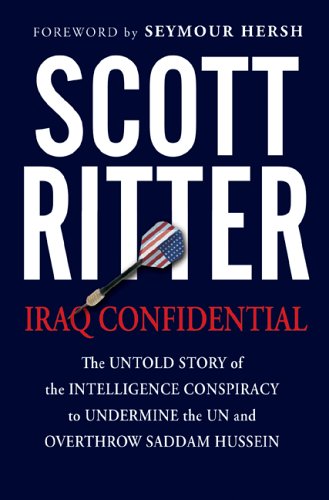
Scott Ritter, former chief UN weapons inspector in Iraq, discusses his new book Iraq Confidential : The Untold Story of the Intelligence Conspiracy to Undermine the UN and Overthrow Saddam Hussein.
To Listen to the Interview
Weekly Signals
Scott Ritter, former chief UN weapons inspector in Iraq, discusses his new book Iraq Confidential : The Untold Story of the Intelligence Conspiracy to Undermine the UN and Overthrow Saddam Hussein.
To Listen to the Interview
Monday, April 19, 2010
UCLA African Studies Center: Stephen Lewis -- Promises in AIDS Fight Not Met
Promises in AIDS Fight Not Met
African Studies Center (UCLA)
Focusing on Africa, former UN envoy Stephen Lewis expresses amazement at the passivity of the international community as the HIV/AIDS epidemic traumatizes women, creates orphans, and continues on its decades-long path of devastation.
To Listen to the Speech
African Studies Center (UCLA)
Focusing on Africa, former UN envoy Stephen Lewis expresses amazement at the passivity of the international community as the HIV/AIDS epidemic traumatizes women, creates orphans, and continues on its decades-long path of devastation.
To Listen to the Speech
Sunday, March 07, 2010
Democracy Now: Filmmaker Philippe Diaz on The End of Poverty?
Filmmaker Philippe Diaz on “The End of Poverty?"
Democracy Now

Earlier this year, the IMF and the World Bank warned that the financial crisis posed a serious challenge to reducing poverty. The World Bank predicted that the economic crisis could push another 53 million people in the global South into poverty. Well, according to the latest numbers from the United Nations, we’re now up to 2.7 billion people around the world who survive on less than two dollars a day, one billion of whom live on less than a dollar a day. Given the dire statistics and the widening gap between the rich and the poor, how can we see the eradication of poverty? That’s the central question of a new documentary called The End of Poverty?
To Read/Listen/Watch
Democracy Now
Earlier this year, the IMF and the World Bank warned that the financial crisis posed a serious challenge to reducing poverty. The World Bank predicted that the economic crisis could push another 53 million people in the global South into poverty. Well, according to the latest numbers from the United Nations, we’re now up to 2.7 billion people around the world who survive on less than two dollars a day, one billion of whom live on less than a dollar a day. Given the dire statistics and the widening gap between the rich and the poor, how can we see the eradication of poverty? That’s the central question of a new documentary called The End of Poverty?
To Read/Listen/Watch
Sunday, January 31, 2010
Sue Halpern: Breaking a Conspiracy of Silence
Breaking a Conspiracy of Silence
By Sue Halpern
The New York Review of Books

This past July, a little over a year after the United Nations Security Council finally declared rape a crime of war, the parents of Taraneh Mousavi, a twenty-eight-year-old beautician from Tehran, received a call from an anonymous stranger. The young woman had been missing for weeks, ever since she'd attended a post-election rally at the Ghoba mosque; it was rumored that she was being held by Basiji militiamen. The caller said that Mousavi had had "an accident," and was in the hospital with "tears in her womb and her anus." Mousavi's parents rushed to the place where she was supposed to be, but she wasn't there. They still have not found her—or her body.
UN Resolution 1820 expressly foresaw the situation that Taraneh Mousavi found herself in on June 19, one year to the day of its adoption. " Noting," it says,
...that women and girls are particularly targeted by the use of sexual violence, including as a tactic of war to humiliate, dominate, instill fear in, disperse and/or forcibly relocate civilian members of a community or ethnic group.
There are many ways to define war, just as there are many ways to violate a woman's body.
It would be naive to imagine that a string of tortuously constructed sentences issued by an organization whose own "peacekeepers" have been implicated in the rapes of girls and women in Sierra Leone, Congo, Ivory Coast, Haiti, Cambodia, and Bosnia, among other places, would reverse or forestall a practice that dates back to the Mongols, and likely before them. Indeed, as the playwright Eve Ensler wrote in The Washington Post the day that UN Secretary-General Ban Ki-Moon was supposed to issue a one-year assessment of the resolution, rape in the eastern Democratic Republic of Congo, where girls as young as three are systematically brutalized, has actually doubled and in some areas tripled in that time. As she pointed out, "The girl children born of rape are now being raped."
Ban's report, when it was finally released, was full of recommendations to gather
It urged
Still, as toothless as all this reads, UN Resolution 1820 was a small step toward ending what Jan Egeland, the former United Nations undersecretary-general for humanitarian affairs, called recently "one of the biggest conspiracies of silence in history."
One party to that conspiracy has been the mainstream media, which, as Nicholas Kristof and Sheryl WuDunn point out in their stellar new book, Half the Sky: Turning Oppression into Opportunity for Women Worldwide, is what happens when a phenomenon is extensive, entrenched, and so common as to be perpetually old news even while it's happening. The one consistent exception has been Kristof himself, in the column he's written for the Op-Ed page of The New York Times since 2001. On a page where others can be relied on to elevate the conventional wisdom, Kristof earnestly takes up the cause of the poor and oppressed of the world, most of them women, and of those who work on their behalf. For him, it seems, the traditional newsroom dynamic is reversed: the fact that another girl has been denied an education, or sold to a brothel at seven, or raped by the police to whom she was reporting that she had been raped, or left to die because of an obstetric fistula that has left her leaking urine and feces is worthy of comment because it has happened again, and will keep on happening until something—moral outrage, jurisprudence, grace—intervenes. In the meantime, and to press for change, Kristof invites us all to bear witness with him.
It wasn't always like this. As Kristof and WuDunn, who is both his writing partner and his wife, point out, when they were young reporters, newly married and newly posted to China for the Times,
Then Tiananmen Square happened, and the recondite was overtaken by the intractable but urgent issue of human rights. (The two reporters won a Pulitzer Prize for their coverage of China.) And then they stumbled upon another, less dramatic human rights story, the widespread practice by Chinese parents of withholding medical treatment for their baby girls, who were, therefore, dying in infancy in statistically anomalous numbers. "Those Chinese girls never received a column inch of news coverage," they write, "and we began to wonder if our journalistic priorities were skewed."
To Read the Rest of the Review

By Sue Halpern
The New York Review of Books
This past July, a little over a year after the United Nations Security Council finally declared rape a crime of war, the parents of Taraneh Mousavi, a twenty-eight-year-old beautician from Tehran, received a call from an anonymous stranger. The young woman had been missing for weeks, ever since she'd attended a post-election rally at the Ghoba mosque; it was rumored that she was being held by Basiji militiamen. The caller said that Mousavi had had "an accident," and was in the hospital with "tears in her womb and her anus." Mousavi's parents rushed to the place where she was supposed to be, but she wasn't there. They still have not found her—or her body.
UN Resolution 1820 expressly foresaw the situation that Taraneh Mousavi found herself in on June 19, one year to the day of its adoption. " Noting," it says,
...that women and girls are particularly targeted by the use of sexual violence, including as a tactic of war to humiliate, dominate, instill fear in, disperse and/or forcibly relocate civilian members of a community or ethnic group.
There are many ways to define war, just as there are many ways to violate a woman's body.
It would be naive to imagine that a string of tortuously constructed sentences issued by an organization whose own "peacekeepers" have been implicated in the rapes of girls and women in Sierra Leone, Congo, Ivory Coast, Haiti, Cambodia, and Bosnia, among other places, would reverse or forestall a practice that dates back to the Mongols, and likely before them. Indeed, as the playwright Eve Ensler wrote in The Washington Post the day that UN Secretary-General Ban Ki-Moon was supposed to issue a one-year assessment of the resolution, rape in the eastern Democratic Republic of Congo, where girls as young as three are systematically brutalized, has actually doubled and in some areas tripled in that time. As she pointed out, "The girl children born of rape are now being raped."
Ban's report, when it was finally released, was full of recommendations to gather
more and better data to enhance our understanding of the various forms of sexual violence in conflict and its aftermath, including its magnitude, nature and risk factors; the profile and the motivation of perpetrators; the consequences of this violence; and the effectiveness of programmes and prevention strategies.
It urged
State and non-State parties to armed conflicts to ensure that civilian superiors and military commanders use their authority and powers to prevent sexual violence and punish crimes committed by subordinates, failing which they themselves must be punished.
Still, as toothless as all this reads, UN Resolution 1820 was a small step toward ending what Jan Egeland, the former United Nations undersecretary-general for humanitarian affairs, called recently "one of the biggest conspiracies of silence in history."
One party to that conspiracy has been the mainstream media, which, as Nicholas Kristof and Sheryl WuDunn point out in their stellar new book, Half the Sky: Turning Oppression into Opportunity for Women Worldwide, is what happens when a phenomenon is extensive, entrenched, and so common as to be perpetually old news even while it's happening. The one consistent exception has been Kristof himself, in the column he's written for the Op-Ed page of The New York Times since 2001. On a page where others can be relied on to elevate the conventional wisdom, Kristof earnestly takes up the cause of the poor and oppressed of the world, most of them women, and of those who work on their behalf. For him, it seems, the traditional newsroom dynamic is reversed: the fact that another girl has been denied an education, or sold to a brothel at seven, or raped by the police to whom she was reporting that she had been raped, or left to die because of an obstetric fistula that has left her leaking urine and feces is worthy of comment because it has happened again, and will keep on happening until something—moral outrage, jurisprudence, grace—intervenes. In the meantime, and to press for change, Kristof invites us all to bear witness with him.
It wasn't always like this. As Kristof and WuDunn, who is both his writing partner and his wife, point out, when they were young reporters, newly married and newly posted to China for the Times,
We assumed that the foreign policy issues that properly furrowed the brow were lofty and complex, like nuclear proliferation. It was difficult back then to envision the Council on Foreign Relations fretting about maternal mortality or female genital mutilation. Back then, the oppression of women was a fringe issue, the kind of worthy cause the Girl Scouts might raise money for. We preferred to probe the recondite "serious issues."
Then Tiananmen Square happened, and the recondite was overtaken by the intractable but urgent issue of human rights. (The two reporters won a Pulitzer Prize for their coverage of China.) And then they stumbled upon another, less dramatic human rights story, the widespread practice by Chinese parents of withholding medical treatment for their baby girls, who were, therefore, dying in infancy in statistically anomalous numbers. "Those Chinese girls never received a column inch of news coverage," they write, "and we began to wonder if our journalistic priorities were skewed."
To Read the Rest of the Review
Subscribe to:
Posts (Atom)