Anti-terrorism and uprisings: North African leaders have worked with the West against Islamists and migrants - becoming more repressive as a result.
by Yasmine Ryan
Al Jazeera
The string of uprisings in North Africa have laid bare Western governments' relationships with regimes in the region, which pro-democracy activists argue have long been fixated on anti-terrorism, immigration and oil.
Muammar Gaddafi, the Libyan leader, appears to be on the brink of joining Tunisia's Zine El Abidine Ben Ali and Egypt's Hosni Mubarak - both ousted by their own people. In Algeria, meanwhile, Abdelaziz Bouteflika's government is holding firm, clamping down on protests and carrying out limited reforms in a bid to lull anti-regime rage.
The four men have co-operated to varying degrees with the West in the post 9/11 era, offering their services against the perceived twin menaces of political Islam and migration from the African continent to Europe.
Salima Ghezali, a well-known Algerian journalist and rights activist, says that politicians have used these supposed threats to justify state violence. Elites in the West, she argues, have attempted to distract voters by playing up threats to security, whilst sidestepping debate on their economies. Their counterparts in the developing world have used the same arguments to draw attention away from "institutional chaos".
"It is this chaos which is provoking and fuelling the anger of the people," she says.
By focusing on security, leaders have found a means to legitimise state violence, withhold rights and freedoms and neglect political and social management, Ghezali says. "Violence has even become a means of social and political advancement. Murderers have become heroes and hold power in public institutions."
Jeremy Keenan, a professorial research associate at the School of Oriental and African Studies in London, agrees that the uprisings are, in some way, related to the prevalence of anti-terrorist policy.
"I think that whole 'war on terror' syndrome has had a potentially significant role in what we're seeing today," Keenan says. "These states have become more repressive in the knowledge that they have the backing of the West."
Demographic disconnect
Many youthful protesters are no longer willing to swallow their leaders’ use of anti-colonialist ideology to justify their political power.
Far from fighting imperialism, these leaders, their opponents say, have been complicit with the West: Acting as its torturers, buying its arms and patrolling the Mediterranean Sea to stem the tides of young people desperate to flee their homelands. All were partners in the CIA's controversial 'extraordinary rendition programme' and Libya has been a pro-active partner in a secretive Rome-Tripoli deal, signed in 2009, to intercept boats carrying migrants. In return for the sea patrols, Italy pledged to pay Libya $7bn over 20 years.
"The young generation of Algerians, and the not-so-young, don’t have any illusions about the convictions of their leaders," Ghezali explains.
Despite being sceptical of their leaders' ideological leanings, Ghezali says the youth do still respect authentic symbols of the Algerian War of Independence. Anti-government protesters in Libya have taken to waving the pre-Gaddafi, post-independence flag - a reference to the country's struggle against colonial rule.
With the exception of Ben Ali, all of these leaders have been in government since before most of their people were born. Bouteflika, for example, first became a minister in 1962, yet rules over a country where the average age is 27, according to the CIA World Factbook. Gaddafi took power in 1969, while the average Libyan is just 24.
Playing the 'Islamist card'
The region's leaders have repeatedly tried to portray the current wave of uprisings as somehow terrorist-related.
In a recently released report, Martin Scheinin, the UN special rapporteur on the protection of human rights while countering terrorism, details how Tunisia's counterterrorism laws and policies played a central part in the former government's crushing of political opposition.
And, as Scheinin notes in an interview with Al Jazeera, this was the very language Ben Ali turned to when he responded to the Tunisian uprising.
"I think it is important that when the people started to revolt in Tunisia, the initial reaction by the president and by the government was to say this is terrorists," the UN Rapporteur says.
Ben Ali accused demonstrators in the centre of the country of "unpardonable terrorist acts" on January 10, two days after Tunisian security forces had begun deliberately killing protesters in the centre of the country. The Libyan leader's son, Saadi Gaddafi, told the Financial Times on Wednesday that bombing in the east of Libya was necessary because "thousands" of al-Qaeda fighters were taking control of the region. His father elaborated on these allegations in a speech on Thursday night, accusing Osama bin Laden of brainwashing, and even drugging, the country's youth.
Ghezali points to Gaddafi's most recent threats to end his co-operation on immigration, as well as his attempts to blame protests on al-Qaeda, as a particularly "ludicrous" example of what has become a standard form of blackmail.
Tunisian activists interviewed by Al Jazeera cited ending corruption and tyranny and the right to employment, democracy and freedom of expression as the motivations that drove their uprising, while Libyans likewise dismissed Gaddafi's assertion that Osama bin Laden was working to incite dissent against his rule.
Keenan says that the absence of Islamist ideology in the protest movements has underlined the extent to which the "Islamist card" has been overplayed by politicians and the media. "These revolts have nothing much to do with Islamism, they are to do with young people fighting for their rights.
"All of these countries, to varying degrees, have exaggerated the menace of terrorism," says the author of The Dark Sahara: America's War on Terror in Africa.
To Read the Rest of the Article
Showing posts with label Human Rights. Show all posts
Showing posts with label Human Rights. Show all posts
Friday, February 25, 2011

William John Cox: Political Upheaval and Women's Rights
Political Upheaval and Women's Rights
By William John Cox
Consortium
As the youth-led Freedom Movement of 2011 spreads rapidly across the Middle East, one can only wonder what would be happening in Iraq today if the U.S. had not invaded eight years ago.
Might Saddam Hussein have been driven from power by an internal popular uprising – as happened to Hosni Mubarak in Egypt and Zine El Abidine Ben Ali in Tunisia – without all the death and destruction wrought by George W. Bush’s invasion?
And, what does the overthrow of authoritarian governments – whether in Iraq from the U.S. invasion or in Tunisia from a popular uprising – portend for the rights of women? Will the changes unleash more Islamic fundamentalism and thus worsen the status of women in those countries?
Women’s rights continue to deteriorate in Iraq under the U.S.-installed Shiite government; their status is also threatened by Islamists in Tunisia, which – like Iraq – was long renowned as among the most secular of Arab nations.
It should be noted, too, that the personal liberties of women are under assault in the United States – by Christian fundamentalist politicians. The rise of fundamentalism, whether Islamic or Christian, almost always translates into fewer freedoms for women.
Iraq’s History
Under Iraq’s longtime Ba’athist government led by Saddam Hussein, Iraqi women enjoyed greater freedom than women in most other Arab nations and they played an active role in the political, economic and educational development of the nation.
The 1970 Constitution formally guaranteed equal rights to women and ensured their right to obtain an education, own property, vote and be elected to political offices. Iraq acceded to the United Nations Convention on the Elimination of All Forms of Discrimination Against Women in 1986.
However, at a cost of more than $1 trillion to the U.S. Treasury, President George W. Bush’s “Operation Iraqi Freedom” led to the slaughter of well over 100,000 Iraqis, including thousands of children, and the invasion resulted in women losing many of their previous rights.
After the ouster of Saddam Hussein, President Bush often bragged that now “Iraq is free of rape rooms;” however, his illegal invasion of Iraq not only exposed its women to rape by U.S. soldiers and mercenaries, but rape is increasingly used as a weapon by warring tribal factions, according to evidence gathered by women’s rights organizations.
“Rape is being used in the settling of scores in the sectarian war,” said Besmia Khatib of the Iraqi Women's Network.
While the new Iraqi constitution adopted after the invasion requires that women hold 25 percent of the seats in the parliament, it also provides that no law can contradict the “established rulings of Islam.”
Thus, the personal rights of women are subject to the interpretation of religious leaders, and those rights are being officially curtailed by the Shiite-controlled government.
Iraqi women must now submit to any male authority, including boys as young as 12-years-old, and they are being attacked and murdered for working, dressing "inappropriately" or attending university.
Because Iraq has more than three million widows – a result of Bush’s invasion and earlier wars under Saddam Hussein – sex trafficking has become widespread, as there is little or no opportunity for these women to find other employment.
Today, as the youth-driven Freedom Movement sweeps across the Middle East, it is touching Iraq, too, where freedom demonstrations have drawn thousands of protesters in the cities of Sulaimaniya, Falluja, Nassiriya Province, and Baghdad.
These demonstrations are being suppressed by the Iraqi security forces using U.S. supplied weapons and intimidation tactics, including raids on the office of the Iraqi organization that monitors press freedom.
The U.S. mainstream media and the Obama Administration have been largely silent about the Iraqi demonstrations; however, fair-minded Americans should conclude that, absent the invasion, the young people of Iraq would have been in the forefront of the Freedom Movement of 2011.
If history had taken that course, untold lives would have been spared and vast sums of money could have been spent improving the quality of life rather than destroying Iraqi standards of living. Plus, the United States would today enjoy greater respect from the world for promoting freedom and the rule of law, rather than violating those principles.
To Read the Rest of the Essay
By William John Cox
Consortium
As the youth-led Freedom Movement of 2011 spreads rapidly across the Middle East, one can only wonder what would be happening in Iraq today if the U.S. had not invaded eight years ago.
Might Saddam Hussein have been driven from power by an internal popular uprising – as happened to Hosni Mubarak in Egypt and Zine El Abidine Ben Ali in Tunisia – without all the death and destruction wrought by George W. Bush’s invasion?
And, what does the overthrow of authoritarian governments – whether in Iraq from the U.S. invasion or in Tunisia from a popular uprising – portend for the rights of women? Will the changes unleash more Islamic fundamentalism and thus worsen the status of women in those countries?
Women’s rights continue to deteriorate in Iraq under the U.S.-installed Shiite government; their status is also threatened by Islamists in Tunisia, which – like Iraq – was long renowned as among the most secular of Arab nations.
It should be noted, too, that the personal liberties of women are under assault in the United States – by Christian fundamentalist politicians. The rise of fundamentalism, whether Islamic or Christian, almost always translates into fewer freedoms for women.
Iraq’s History
Under Iraq’s longtime Ba’athist government led by Saddam Hussein, Iraqi women enjoyed greater freedom than women in most other Arab nations and they played an active role in the political, economic and educational development of the nation.
The 1970 Constitution formally guaranteed equal rights to women and ensured their right to obtain an education, own property, vote and be elected to political offices. Iraq acceded to the United Nations Convention on the Elimination of All Forms of Discrimination Against Women in 1986.
However, at a cost of more than $1 trillion to the U.S. Treasury, President George W. Bush’s “Operation Iraqi Freedom” led to the slaughter of well over 100,000 Iraqis, including thousands of children, and the invasion resulted in women losing many of their previous rights.
After the ouster of Saddam Hussein, President Bush often bragged that now “Iraq is free of rape rooms;” however, his illegal invasion of Iraq not only exposed its women to rape by U.S. soldiers and mercenaries, but rape is increasingly used as a weapon by warring tribal factions, according to evidence gathered by women’s rights organizations.
“Rape is being used in the settling of scores in the sectarian war,” said Besmia Khatib of the Iraqi Women's Network.
While the new Iraqi constitution adopted after the invasion requires that women hold 25 percent of the seats in the parliament, it also provides that no law can contradict the “established rulings of Islam.”
Thus, the personal rights of women are subject to the interpretation of religious leaders, and those rights are being officially curtailed by the Shiite-controlled government.
Iraqi women must now submit to any male authority, including boys as young as 12-years-old, and they are being attacked and murdered for working, dressing "inappropriately" or attending university.
Because Iraq has more than three million widows – a result of Bush’s invasion and earlier wars under Saddam Hussein – sex trafficking has become widespread, as there is little or no opportunity for these women to find other employment.
Today, as the youth-driven Freedom Movement sweeps across the Middle East, it is touching Iraq, too, where freedom demonstrations have drawn thousands of protesters in the cities of Sulaimaniya, Falluja, Nassiriya Province, and Baghdad.
These demonstrations are being suppressed by the Iraqi security forces using U.S. supplied weapons and intimidation tactics, including raids on the office of the Iraqi organization that monitors press freedom.
The U.S. mainstream media and the Obama Administration have been largely silent about the Iraqi demonstrations; however, fair-minded Americans should conclude that, absent the invasion, the young people of Iraq would have been in the forefront of the Freedom Movement of 2011.
If history had taken that course, untold lives would have been spared and vast sums of money could have been spent improving the quality of life rather than destroying Iraqi standards of living. Plus, the United States would today enjoy greater respect from the world for promoting freedom and the rule of law, rather than violating those principles.
To Read the Rest of the Essay
Monday, February 21, 2011
Naomi Klein: Goldstone's Legacy for Israel
Goldstone's Legacy for Israel
by Naomi Klein
The Nation
This essay is adapted from the introduction to The Goldstone Report: The Legacy of the Landmark Investigation of the Gaza Conflict (Nation Books).
A sprawling crime scene. That is what Gaza felt like when I visited in the summer of 2009, six months after the Israeli attack. Evidence of criminality was everywhere—the homes and schools that lay in rubble, the walls burned pitch black by white phosphorus, the children’s bodies still unhealed for lack of medical care. But where were the police? Who was documenting these crimes, interviewing the witnesses, protecting the evidence from tampering?
For months it seemed that there would be no investigation. Many Gazans I met on that trip appeared as traumatized by the absence of an international investigation as by the attacks. They explained that even in the darkest days of the Israeli onslaught, they had comforted themselves with the belief that, this time, Israel had gone too far. Mona al-Shawa, head of the Women’s Unit at the Palestinian Centre for Human Rights, told me that Gazans took great solace from news of pro-Palestinian protesters filling the streets of London and Toronto. “People called it war crimes,” she recalled. “We felt we were not alone in the world.” It seemed to follow from these expressions of outrage that there would be serious consequences for the attacks—criminal trials for the perpetrators, sentences. And under the glare of international investigation, Israel would surely have to lift the brutal embargo that had kept Gaza sealed off from the world since Hamas came to power. Those who really dared to dream convinced themselves that, out of the lawlessness and carnage, a just peace would emerge at last.
But six months later, an almost unbearable realization had set in: the cavalry wasn’t coming. Despite all the righteous indignation, Israel had not been forced to change its behavior in any way. Gaza’s borders were still sealed, only now the blockade was keeping out desperately needed rebuilding supplies in addition to many necessities of life. (It would take Israel’s lethal attack last year on a humanitarian aid flotilla for a debate about the siege to begin in earnest.) Even worse, the people I met were acutely aware that they could find themselves trapped under Israeli air bombardment again tomorrow, for any arbitrary excuse of Israel’s choosing. The message sent by the paralysis of the international legal system was terrifying: Israel enjoyed complete impunity. There was no recourse.
Then, out of nowhere, a representative of the law showed up. His name was Justice Richard Goldstone, and he was leading a fact-finding mission for the United Nations. His mandate was to assess whether war crimes had been committed in the context of the attack. I happened to be in Gaza City when Justice Goldstone was wrapping up his public hearings and met several people who had testified before him, as well as others who had opened their homes to the mission, showing the scars left by Israeli weapons and sharing photographs of family members killed in the attacks. Finally some light seemed to be shining on this rubble-choked strip of land. But it was faint, and many Gazans remained skeptical that justice would follow. If the attacks had failed to provoke action, they reasoned, what hope was there that words in a report would awaken the world? This caution, it turns out, was a wise form of self-preservation.
The attempts to block, then sabotage, then bury the Goldstone Report began before a single word had been written. The Israeli government rejected the original decision by the UN Human Rights Council to investigate allegations of war crimes during the Gaza attack. The council was hopelessly biased, Israel claimed, and the January 12, 2009, resolution creating the fact-finding mission was, according to Israel’s ministry of foreign affairs, “one-sided and irrelevant.” It is true that the original mandate of the mission called only for an investigation of violations committed “by the occupying Power, Israel, against the Palestinian people.” But when Justice Goldstone took the top job and announced that the mandate had been expanded to include possible crimes committed by Palestinians “whether before, during or after” the attacks, Israel flatly refused to acknowledge this new reality. “There is no formal expansion of the mandate,” foreign ministry spokesman Yossi Levy insisted, against abundant evidence to the contrary. He added, “We will not cooperate with the mission, because its duty is not to find the truth but to find semi-judicial ways to attack Israel.”
When it became clear that the mission would proceed despite this obstructionism, the Israeli government switched to a new strategy: doing almost everything in its considerable power to sabotage Goldstone’s work. To this end, the Israeli government refused to allow the UN team to travel inside Israel. That meant that to get into Gaza, members had to go through Egypt. It also meant that Goldstone’s investigators could not travel to Sderot and Ashkelon to hear from Israeli victims of Qassam rocket attacks—critical testimony if the mission was to fulfill its mandate to investigate crimes on all sides. Israel’s strategy was transparent enough: it would force Goldstone to produce a one-sided report, which it would then enthusiastically dismiss for being one-sided.
It didn’t work. To get around the government roadblocks, Goldstone flew Israelis to Geneva so he could hear their testimony in person. When the report came out, it reflected the scale of the crimes committed by each side, concentrating mostly on Israel’s actions, including attacks on houses, hospitals and mosques that together killed scores of people, as well as attacks on civilian infrastructure such as water installations, agricultural facilities and factories. But the report did not give Hamas a pass. Goldstone concluded that the launching of rockets and mortars into populated areas “where there is no intended military target”—a practice used by Hamas’s military wing as well as by other armed Palestinian groups—“indicates the commission of an indiscriminate attack on the civilian population of southern Israel, a war crime, and may amount to crimes against humanity.” He also accused Hamas of “extrajudicial executions” in the Gaza Strip and the Palestinian Authority of repression and possibly torture in the West Bank.
The Goldstone Report is a serious, fair-minded and extremely disturbing document—which is precisely why the Israeli strategy since its publication has been to talk about pretty much everything except the substance of the report. Distractions have ranged from further posturing about the UN’s bias, to smear campaigns about Justice Goldstone’s personal history, to claims that the report is an integral part of a grand conspiracy to deny Israel’s right to exist. Dore Gold, a former Israeli ambassador and top political adviser, said the report was “the most serious and vicious indictment of the State of Israel bearing the seal of the United Nations” since the UN equated Zionism with racism in 1975 and “an assault on Israeli society as a whole,” while Prime Minister Benjamin Netanyahu explained that “there are three primary threats facing us today: the nuclear threat, the missile threat and what I call the Goldstone threat.” The phrase “blood libel” was thrown around with great promiscuity, disgracefully equating the Goldstone Report with the anti-Semitic trials of the Middle Ages in which Jews were accused of drinking the blood of Christian children. (For some reason this seems to be a problem only when Sarah Palin abuses the term.)
Given this kind of incitement from the top, it’s little wonder that the 72-year-old judge was very nearly prevented from attending his grandson’s bar mitzvah in a Johannesburg suburb, with the synagogue worried about violence breaking out. “I could not believe that political anger against him—which people had every right to express—had evolved into an uncontrolled and unconscionable rage that sought to violate the spirit of one of the most sacred aspects of formal Jewish tradition,” observed noted South African judge Albie Sachs.
Israel has no shortage of critics, many of them Jewish. So what was it about Goldstone that ignited this conflagration? The likeliest answer lies in the particular rhetorical techniques Israel’s leaders reliably employ to defend their actions. For decades, Israeli officials have deflected any and all human rights criticisms by claiming that Israel was being unfairly “singled out” by those who claim to care about international law but who look the other way when equally serious crimes are committed by other states. The problem posed by Goldstone was that his record as a judge on the world stage made it impossible for Israel to make this claim with any credibility.
Goldstone began his judicial career as one of a handful of liberal judges serving on the South African bench during the apartheid era. Though required to enforce the country’s brutal discriminatory laws, these judges were also able to chip away at the system from within, helping to loosen the grip of apartheid in its final years. A 1982 ruling by Goldstone, for instance, blocked judges from evicting blacks and “coloreds” from their homes to make way for whites-only neighborhoods without considering whether suitable alternative accommodations could be found, a requirement that made it virtually impossible to enforce the much-hated Group Areas Act. As apartheid weakened, Goldstone began playing a more activist role, exposing a system of extrajudicial death squads within South Africa’s police and military—crimes that eventually came before the country’s Truth and Reconciliation Commission.
To Read the Rest of the Essay
by Naomi Klein
The Nation
This essay is adapted from the introduction to The Goldstone Report: The Legacy of the Landmark Investigation of the Gaza Conflict (Nation Books).
A sprawling crime scene. That is what Gaza felt like when I visited in the summer of 2009, six months after the Israeli attack. Evidence of criminality was everywhere—the homes and schools that lay in rubble, the walls burned pitch black by white phosphorus, the children’s bodies still unhealed for lack of medical care. But where were the police? Who was documenting these crimes, interviewing the witnesses, protecting the evidence from tampering?
For months it seemed that there would be no investigation. Many Gazans I met on that trip appeared as traumatized by the absence of an international investigation as by the attacks. They explained that even in the darkest days of the Israeli onslaught, they had comforted themselves with the belief that, this time, Israel had gone too far. Mona al-Shawa, head of the Women’s Unit at the Palestinian Centre for Human Rights, told me that Gazans took great solace from news of pro-Palestinian protesters filling the streets of London and Toronto. “People called it war crimes,” she recalled. “We felt we were not alone in the world.” It seemed to follow from these expressions of outrage that there would be serious consequences for the attacks—criminal trials for the perpetrators, sentences. And under the glare of international investigation, Israel would surely have to lift the brutal embargo that had kept Gaza sealed off from the world since Hamas came to power. Those who really dared to dream convinced themselves that, out of the lawlessness and carnage, a just peace would emerge at last.
But six months later, an almost unbearable realization had set in: the cavalry wasn’t coming. Despite all the righteous indignation, Israel had not been forced to change its behavior in any way. Gaza’s borders were still sealed, only now the blockade was keeping out desperately needed rebuilding supplies in addition to many necessities of life. (It would take Israel’s lethal attack last year on a humanitarian aid flotilla for a debate about the siege to begin in earnest.) Even worse, the people I met were acutely aware that they could find themselves trapped under Israeli air bombardment again tomorrow, for any arbitrary excuse of Israel’s choosing. The message sent by the paralysis of the international legal system was terrifying: Israel enjoyed complete impunity. There was no recourse.
Then, out of nowhere, a representative of the law showed up. His name was Justice Richard Goldstone, and he was leading a fact-finding mission for the United Nations. His mandate was to assess whether war crimes had been committed in the context of the attack. I happened to be in Gaza City when Justice Goldstone was wrapping up his public hearings and met several people who had testified before him, as well as others who had opened their homes to the mission, showing the scars left by Israeli weapons and sharing photographs of family members killed in the attacks. Finally some light seemed to be shining on this rubble-choked strip of land. But it was faint, and many Gazans remained skeptical that justice would follow. If the attacks had failed to provoke action, they reasoned, what hope was there that words in a report would awaken the world? This caution, it turns out, was a wise form of self-preservation.
The attempts to block, then sabotage, then bury the Goldstone Report began before a single word had been written. The Israeli government rejected the original decision by the UN Human Rights Council to investigate allegations of war crimes during the Gaza attack. The council was hopelessly biased, Israel claimed, and the January 12, 2009, resolution creating the fact-finding mission was, according to Israel’s ministry of foreign affairs, “one-sided and irrelevant.” It is true that the original mandate of the mission called only for an investigation of violations committed “by the occupying Power, Israel, against the Palestinian people.” But when Justice Goldstone took the top job and announced that the mandate had been expanded to include possible crimes committed by Palestinians “whether before, during or after” the attacks, Israel flatly refused to acknowledge this new reality. “There is no formal expansion of the mandate,” foreign ministry spokesman Yossi Levy insisted, against abundant evidence to the contrary. He added, “We will not cooperate with the mission, because its duty is not to find the truth but to find semi-judicial ways to attack Israel.”
When it became clear that the mission would proceed despite this obstructionism, the Israeli government switched to a new strategy: doing almost everything in its considerable power to sabotage Goldstone’s work. To this end, the Israeli government refused to allow the UN team to travel inside Israel. That meant that to get into Gaza, members had to go through Egypt. It also meant that Goldstone’s investigators could not travel to Sderot and Ashkelon to hear from Israeli victims of Qassam rocket attacks—critical testimony if the mission was to fulfill its mandate to investigate crimes on all sides. Israel’s strategy was transparent enough: it would force Goldstone to produce a one-sided report, which it would then enthusiastically dismiss for being one-sided.
It didn’t work. To get around the government roadblocks, Goldstone flew Israelis to Geneva so he could hear their testimony in person. When the report came out, it reflected the scale of the crimes committed by each side, concentrating mostly on Israel’s actions, including attacks on houses, hospitals and mosques that together killed scores of people, as well as attacks on civilian infrastructure such as water installations, agricultural facilities and factories. But the report did not give Hamas a pass. Goldstone concluded that the launching of rockets and mortars into populated areas “where there is no intended military target”—a practice used by Hamas’s military wing as well as by other armed Palestinian groups—“indicates the commission of an indiscriminate attack on the civilian population of southern Israel, a war crime, and may amount to crimes against humanity.” He also accused Hamas of “extrajudicial executions” in the Gaza Strip and the Palestinian Authority of repression and possibly torture in the West Bank.
The Goldstone Report is a serious, fair-minded and extremely disturbing document—which is precisely why the Israeli strategy since its publication has been to talk about pretty much everything except the substance of the report. Distractions have ranged from further posturing about the UN’s bias, to smear campaigns about Justice Goldstone’s personal history, to claims that the report is an integral part of a grand conspiracy to deny Israel’s right to exist. Dore Gold, a former Israeli ambassador and top political adviser, said the report was “the most serious and vicious indictment of the State of Israel bearing the seal of the United Nations” since the UN equated Zionism with racism in 1975 and “an assault on Israeli society as a whole,” while Prime Minister Benjamin Netanyahu explained that “there are three primary threats facing us today: the nuclear threat, the missile threat and what I call the Goldstone threat.” The phrase “blood libel” was thrown around with great promiscuity, disgracefully equating the Goldstone Report with the anti-Semitic trials of the Middle Ages in which Jews were accused of drinking the blood of Christian children. (For some reason this seems to be a problem only when Sarah Palin abuses the term.)
Given this kind of incitement from the top, it’s little wonder that the 72-year-old judge was very nearly prevented from attending his grandson’s bar mitzvah in a Johannesburg suburb, with the synagogue worried about violence breaking out. “I could not believe that political anger against him—which people had every right to express—had evolved into an uncontrolled and unconscionable rage that sought to violate the spirit of one of the most sacred aspects of formal Jewish tradition,” observed noted South African judge Albie Sachs.
Israel has no shortage of critics, many of them Jewish. So what was it about Goldstone that ignited this conflagration? The likeliest answer lies in the particular rhetorical techniques Israel’s leaders reliably employ to defend their actions. For decades, Israeli officials have deflected any and all human rights criticisms by claiming that Israel was being unfairly “singled out” by those who claim to care about international law but who look the other way when equally serious crimes are committed by other states. The problem posed by Goldstone was that his record as a judge on the world stage made it impossible for Israel to make this claim with any credibility.
Goldstone began his judicial career as one of a handful of liberal judges serving on the South African bench during the apartheid era. Though required to enforce the country’s brutal discriminatory laws, these judges were also able to chip away at the system from within, helping to loosen the grip of apartheid in its final years. A 1982 ruling by Goldstone, for instance, blocked judges from evicting blacks and “coloreds” from their homes to make way for whites-only neighborhoods without considering whether suitable alternative accommodations could be found, a requirement that made it virtually impossible to enforce the much-hated Group Areas Act. As apartheid weakened, Goldstone began playing a more activist role, exposing a system of extrajudicial death squads within South Africa’s police and military—crimes that eventually came before the country’s Truth and Reconciliation Commission.
To Read the Rest of the Essay
Thursday, February 10, 2011
Democracy Now Reports on the Egyptian Revolution: February 9th/10th
Democracy Now
February 10th
Striking Egyptian Workers Fuel the Uprising After 10 Years of Labor Organizing
Egypt’s pro-democracy uprising is surging after striking workers joined in the protests nationwide. Thousands of Egyptian workers walked off the job Wednesday demanding better wages and benefits. Strikes were reported in Cairo, Alexandria, Luxor and the Suez Canal. We speak to Stanford University Professor Joel Beinin, who, as the former director of Middle East Studies at the American University in Cairo, has closely studied the Egyptian labor movement for years. “This is huge, because there has been for the last 10 years an enormous wave of labor protests in Egypt,” Beinin says. “In the last few days what you’ve seen is tens of thousands of workers linking their economic demands to the political demand that the Mubarak regime step aside.”
Defying Regime Threats, Thousands of Workers Join Protesters in Tahrir Square
February 9th
After Record-Level Turnout in Tahrir, Egyptian Protests Spread to Parliament, Cabinet Buildings; Labor Unions Launch Strikes Nationwide
Egypt’s pro-democracy uprising is seizing new momentum one day after hundreds of thousands turned out for one of the largest protests in Cairo’s Tahrir Square to date. A gathering of protesters led to the evacuation of the Egyptian cabinet building today, and tent camps are also being set up outside the Egyptian parliament. Egypt’s labor movement has launched new strikes across the country, with an estimated 10,000 workers taking part. Democracy Now! senior producer Sharif Abdel Kouddous interviews a demonstrator outside the Egyptian parliament building.
“We Are Writing History by Our Blood”: Egyptian Physician on Why Protests Won’t End Until Mubarak Resigns
Democracy Now! senior producer Sharif Abdel Kouddous speaks to Egyptian physician Dr. Ali El Mashad in Cairo’s Tahrir Square over the weekend. Dr. Mashad describes being injured in the streets and bleeding from the head. “We are writing history by our blood,” he says. Mashad says he will not stop demonstrating until Mubarak leaves office.
Human Rights Watch: 300 Deaths, Massive Detentions and Abuse under Mubarak Regime Crackdown
Human Rights Watch is reporting that at least 302 people have died in Egypt since pro-Mubarak forces launched a violent response to the popular uprising last month. The group says at least 232 people have died in Cairo, 52 in Alexandria, and 18 in Suez, but warns the actual death toll could be far higher. We speak with Human Rights Watch researcher Heba Morayef, who has been monitoring the situation on the ground since the protests began.
“People Are Taking Care of Each Other”: Democracy Now!’s Anjali Kamat Camps with Protesters Overnight in Tahrir Square
Democracy Now! correspondent Anjali Kamat reports on the festive atmosphere in Tahrir Square last night following a record-level turnout of protesters: “People are really taking care of each other very well, giving each other food, water and blankets. It was a very moving experience,” Kamat says.
“The Great Tragedy is Obama Chose Not to Hold Out His Hand”: Robert Fisk on the Gap Between U.S. Rhetoric and Action in the Egyptian Uprising
The longtime Middle East correspondent of The Independent newspaper in London joins us from Cairo to talk about the popular uprising ongoing across Egypt, its regional implications, and how Obama should respond. “[The protesters] are asking for nothing less than Americans accept in their own lives,” Fisk says.
February 10th
Striking Egyptian Workers Fuel the Uprising After 10 Years of Labor Organizing
Egypt’s pro-democracy uprising is surging after striking workers joined in the protests nationwide. Thousands of Egyptian workers walked off the job Wednesday demanding better wages and benefits. Strikes were reported in Cairo, Alexandria, Luxor and the Suez Canal. We speak to Stanford University Professor Joel Beinin, who, as the former director of Middle East Studies at the American University in Cairo, has closely studied the Egyptian labor movement for years. “This is huge, because there has been for the last 10 years an enormous wave of labor protests in Egypt,” Beinin says. “In the last few days what you’ve seen is tens of thousands of workers linking their economic demands to the political demand that the Mubarak regime step aside.”
Defying Regime Threats, Thousands of Workers Join Protesters in Tahrir Square
February 9th
After Record-Level Turnout in Tahrir, Egyptian Protests Spread to Parliament, Cabinet Buildings; Labor Unions Launch Strikes Nationwide
Egypt’s pro-democracy uprising is seizing new momentum one day after hundreds of thousands turned out for one of the largest protests in Cairo’s Tahrir Square to date. A gathering of protesters led to the evacuation of the Egyptian cabinet building today, and tent camps are also being set up outside the Egyptian parliament. Egypt’s labor movement has launched new strikes across the country, with an estimated 10,000 workers taking part. Democracy Now! senior producer Sharif Abdel Kouddous interviews a demonstrator outside the Egyptian parliament building.
“We Are Writing History by Our Blood”: Egyptian Physician on Why Protests Won’t End Until Mubarak Resigns
Democracy Now! senior producer Sharif Abdel Kouddous speaks to Egyptian physician Dr. Ali El Mashad in Cairo’s Tahrir Square over the weekend. Dr. Mashad describes being injured in the streets and bleeding from the head. “We are writing history by our blood,” he says. Mashad says he will not stop demonstrating until Mubarak leaves office.
Human Rights Watch: 300 Deaths, Massive Detentions and Abuse under Mubarak Regime Crackdown
Human Rights Watch is reporting that at least 302 people have died in Egypt since pro-Mubarak forces launched a violent response to the popular uprising last month. The group says at least 232 people have died in Cairo, 52 in Alexandria, and 18 in Suez, but warns the actual death toll could be far higher. We speak with Human Rights Watch researcher Heba Morayef, who has been monitoring the situation on the ground since the protests began.
“People Are Taking Care of Each Other”: Democracy Now!’s Anjali Kamat Camps with Protesters Overnight in Tahrir Square
Democracy Now! correspondent Anjali Kamat reports on the festive atmosphere in Tahrir Square last night following a record-level turnout of protesters: “People are really taking care of each other very well, giving each other food, water and blankets. It was a very moving experience,” Kamat says.
“The Great Tragedy is Obama Chose Not to Hold Out His Hand”: Robert Fisk on the Gap Between U.S. Rhetoric and Action in the Egyptian Uprising
The longtime Middle East correspondent of The Independent newspaper in London joins us from Cairo to talk about the popular uprising ongoing across Egypt, its regional implications, and how Obama should respond. “[The protesters] are asking for nothing less than Americans accept in their own lives,” Fisk says.
Bush’s Shrinking World: George W. Bush Cancels Europe Trip as Human Rights Lawyers Threaten Legal Action over Torture
Bush’s Shrinking World: George W. Bush Cancels Europe Trip as Human Rights Lawyers Threaten Legal Action over Torture
Democracy Now
Former President George W. Bush has been forced to cancel a planned trip to Switzerland after human rights attorneys threatened to take legal action against him for sanctioning the use of torture. The Center for Constitutional Rights said they had planned to bring a complaint on behalf of two men who were tortured by U.S. interrogators and held at the military base at Guantánamo Bay, Cuba. "It was disappointing that we’re not able to actually prosecute him," says CCR legal director Bill Quigley. "But I think it has shown worldwide that even though he was the president of the United States, if you engage in torture... there are consequences."
To Watch/Listen/Read
Democracy Now
Former President George W. Bush has been forced to cancel a planned trip to Switzerland after human rights attorneys threatened to take legal action against him for sanctioning the use of torture. The Center for Constitutional Rights said they had planned to bring a complaint on behalf of two men who were tortured by U.S. interrogators and held at the military base at Guantánamo Bay, Cuba. "It was disappointing that we’re not able to actually prosecute him," says CCR legal director Bill Quigley. "But I think it has shown worldwide that even though he was the president of the United States, if you engage in torture... there are consequences."
To Watch/Listen/Read
Tuesday, January 25, 2011
Michael Ratner: Obama's National Security State
Obama’s national security state: Interview with Michael Ratner
by Anthony Arnove
International Socialist Review
Michael Ratner is president of the Center for Constitutional Rights (CCR) and is adjunct professor of law at Columbia University Law School. Ratner has also been a lecturer of international human rights litigation at the Yale Law School and the Columbia School of Law, president of the National Lawyers Guild, legal director of the Center for Constitutional Rights, and radio co-host for the civil rights show Law and Disorder. Ratner serves on the board of The Culture Project in New York City and is vice-president of the board of Voices of a People’s History of the United States. He spoke to Anthony Arnove, a member of the ISR editorial board and author of the book Iraq: The Logic of Withdrawal.
LET’S START with the Obama administration’s policies on habeas corpus and on torture. As a presidential candidate, Obama said he would close Guantánamo, said he believed in habeas corpus rights, and was critical of President Bush. What’s been his practice since he came to office?
MY OFFICE, CCR, is one of the legal groups that represents many of the Guantánamo detainees and brings these writs of habeas corpus. That is a fancy way of saying, “Let’s go to court, and see if there’s any evidence to hold the person.” The expectations of the team of lawyers representing the detainees was very high that Guantánamo would actually close, that Obama would do it. There were probably a little over 300 people in Guantánamo when he took office. It’s down to maybe 200-some now. But we expected better—and now it may go on for years. We really thought that Obama wouldn’t fight us in court on the rights of the detainees, that he would get the detainees either to another country or he would charge and try them. And of course, it hasn’t worked out that way at all, and it’s a deep disappointment. In fact a lot of the habeas lawyers signed a letter supporting Obama saying his election would actually be good for our clients. Obama’s effort to close it seemingly got off to a somewhat quick start. Obama, within two days of being in office, signed an executive order, which is essentially a presidential order, which said that Guantánamo would be closed in a year. Of course, as we speak now, it’s more than a year and a half after that order, and it is not near closed. Obama’s commitment has been abandoned. And he made a number of other promises that have not been met about secret detention sites, military commissions, and the like.
Obama has put new clothes on the Bush doctrine toward “enemy combatants,” but the underlying lawlessness of the doctrine is the same. In particular, imagine this: you go to court on behalf of someone in Guantánamo, and the judge has to decide whether there is sufficient evidence to hold him. What Bush said was they can be held as “enemy combatants,” and he gave the term a vague definition, such as that the person was hostile to the United States or picked up arms against the United States or belonged to a group that was hostile to the United States. If there was “evidence” those detainees could be held in prison indefinitely, essentially a form of preventive detention. We had hoped Obama would get rid of that entire preventive detention scheme. CCR’s view is there should not be a preventive detention scheme—it’s illegal and immoral. What you must do, and what is legally necessary, is to charge someone with a crime, and hold them only if they’re convicted. The rule is simple: charge and try people with crimes, or release them. There are not any other valid legal choices.
I considered this preventive detention scheme to be one of the worst hallmarks of the Bush administration. Sadly, this intolerable preventive detention scheme has continued, and you could say continued with a vengeance, under Obama. He has repeatedly stated that he is continuing the preventive detention scheme. He said that at his major speech on Guantánamo in May 2009. He has repeated it again and again. We expect at least fifty of the Guantánamo people to be held under a scheme in which they’re preventively detained, which is to say they are never charged with a crime. They’re held in a prison right now in Guantánamo, or perhaps could be taken somewhere else. Now the somewhere else could be this prison the U.S. government is trying to buy in Illinois. For now, Congress is stopping that, as Congress, including many Democrats, wants to keep Guantánamo opened. It passed legislation prohibiting the spending of any money to buy or refurbish a prison in the United States for this purpose. Our view is that moving Guantánamo from an offshore location to a U.S. continental location makes no difference to our clients. In fact, it could be worse if the process is exactly the same, if they’re still held in preventive detention and if the administration then considers the problem solved. The effort to repackage Guantánamo in Illinois is a transparent attempt to close Guantánamo while keeping it open in Illinois. So what’s the difference? They’re just moving the Bush scheme from an island to the continent.
So as to closing Guantánamo, and particularly on this issue of habeas corpus and preventive detention, Obama has been a disaster. And Obama has followed the Bush policy on its limitations as to the power of judges to release Guantánamo detainees. When you win a habeas corpus case in the court, the court says, “Well, even under the Obama definition,” which is roughly the same as a Bush definition of enemy combatant, “there’s no evidence that your client was hostile to the United States in the way in which the U.S. claims. The evidence is fallacious. It’s no good. And therefore, I order your client released.” The Bush administration took the position that, yes, the judge could find that a detainee shouldn’t be held, but the judge had no right to release him because that was a foreign policy matter up to the president. So you had a system of law that had no power. No matter what the court decided, the president could decide differently. You might ask, “What happened to checks and balances under our Constitution and what happened to the independence of the judiciary?” Well, the president made himself the boss.
We had hoped Obama would do better, but that’s not the case. We’ve won a number of habeas cases before federal judges in Washington, D.C. They’ve said, “As to your client, there’s no evidence to hold him.” The Uighurs, Muslims from Western China, are the classic example of that. They can’t be sent back to China because it is likely they will be tortured in China. Therefore, the judge says, “I’m going to release them.” Fine, they should be released to the United States. And of course, the Obama administration then asserts that a federal court has no right to release the detainees into the United States even if they are utterly innocent. So our clients, even though many of them have been found to not fit any definition of an enemy combatant are still sitting in Guantánamo.
So Obama is the same as Bush regarding the use of preventive detention. He’s the same regarding his refusal to accept that a federal judge has the authority to release a detainee who is innocent. Now think about that. If a federal judge doesn’t have the right to release someone from custody, what kind of a state are we talking about? Is that a democratic state with protections for the individual? Or is it essentially a police state where the executive overrides a court decision and says, “I’m going to keep you in prison?” So to say I’m disappointed, disappointed would not be the right word for me. I didn’t have high expectations. I never have for the executive. But after eight and a half years of litigation, win after win in the courts, and after Obama’s promises, his actions regarding Guantánamo are repugnant: repugnant for those wrongly tortured and jailed—and repugnant to fundamental precepts of liberty that have taken a thousand years to establish.
The fight continues. The lawyers, and sadly the clients, are deep in the trenches and no one seems to give a damn about it. In fact, you could almost say Obama is one thing, but of course the Congress is, I wouldn’t say another thing, but it is so right wing on these issues, so nasty and draconian, that the slightest effort to bring a Guantánamo detainee to the United States brings out the nativism and antediluvian Republicans and Democrats, which constitute a majority. The Democratic Congress actually passed a law saying no Guantánamo detainee could be brought to the United States, even if the detainee was jailed, much less released.
Some people say, well, “Obama is caught by the right-wingers in Congress. And what can you do about it?” But of course, many Democrats, obviously a majority of them, go along with these punitive policies. The Democrats apparently don’t want to appear weak on national security or perhaps they really believe in preventive detention or that a Uighur is a danger in America. They think if they appear weak on what they consider national security that somehow they’re going to lose the next election. And so they almost outdo the Republicans on these issues with Guantánamo and the like.
We now have the spectacle of a Democratic president selling out the Constitution and with it the lives of innocents at Guantánamo and the freedom of future generations as these special laws become the laws for all of us.
To Read the Rest of the Interview
by Anthony Arnove
International Socialist Review
Michael Ratner is president of the Center for Constitutional Rights (CCR) and is adjunct professor of law at Columbia University Law School. Ratner has also been a lecturer of international human rights litigation at the Yale Law School and the Columbia School of Law, president of the National Lawyers Guild, legal director of the Center for Constitutional Rights, and radio co-host for the civil rights show Law and Disorder. Ratner serves on the board of The Culture Project in New York City and is vice-president of the board of Voices of a People’s History of the United States. He spoke to Anthony Arnove, a member of the ISR editorial board and author of the book Iraq: The Logic of Withdrawal.
LET’S START with the Obama administration’s policies on habeas corpus and on torture. As a presidential candidate, Obama said he would close Guantánamo, said he believed in habeas corpus rights, and was critical of President Bush. What’s been his practice since he came to office?
MY OFFICE, CCR, is one of the legal groups that represents many of the Guantánamo detainees and brings these writs of habeas corpus. That is a fancy way of saying, “Let’s go to court, and see if there’s any evidence to hold the person.” The expectations of the team of lawyers representing the detainees was very high that Guantánamo would actually close, that Obama would do it. There were probably a little over 300 people in Guantánamo when he took office. It’s down to maybe 200-some now. But we expected better—and now it may go on for years. We really thought that Obama wouldn’t fight us in court on the rights of the detainees, that he would get the detainees either to another country or he would charge and try them. And of course, it hasn’t worked out that way at all, and it’s a deep disappointment. In fact a lot of the habeas lawyers signed a letter supporting Obama saying his election would actually be good for our clients. Obama’s effort to close it seemingly got off to a somewhat quick start. Obama, within two days of being in office, signed an executive order, which is essentially a presidential order, which said that Guantánamo would be closed in a year. Of course, as we speak now, it’s more than a year and a half after that order, and it is not near closed. Obama’s commitment has been abandoned. And he made a number of other promises that have not been met about secret detention sites, military commissions, and the like.
Obama has put new clothes on the Bush doctrine toward “enemy combatants,” but the underlying lawlessness of the doctrine is the same. In particular, imagine this: you go to court on behalf of someone in Guantánamo, and the judge has to decide whether there is sufficient evidence to hold him. What Bush said was they can be held as “enemy combatants,” and he gave the term a vague definition, such as that the person was hostile to the United States or picked up arms against the United States or belonged to a group that was hostile to the United States. If there was “evidence” those detainees could be held in prison indefinitely, essentially a form of preventive detention. We had hoped Obama would get rid of that entire preventive detention scheme. CCR’s view is there should not be a preventive detention scheme—it’s illegal and immoral. What you must do, and what is legally necessary, is to charge someone with a crime, and hold them only if they’re convicted. The rule is simple: charge and try people with crimes, or release them. There are not any other valid legal choices.
I considered this preventive detention scheme to be one of the worst hallmarks of the Bush administration. Sadly, this intolerable preventive detention scheme has continued, and you could say continued with a vengeance, under Obama. He has repeatedly stated that he is continuing the preventive detention scheme. He said that at his major speech on Guantánamo in May 2009. He has repeated it again and again. We expect at least fifty of the Guantánamo people to be held under a scheme in which they’re preventively detained, which is to say they are never charged with a crime. They’re held in a prison right now in Guantánamo, or perhaps could be taken somewhere else. Now the somewhere else could be this prison the U.S. government is trying to buy in Illinois. For now, Congress is stopping that, as Congress, including many Democrats, wants to keep Guantánamo opened. It passed legislation prohibiting the spending of any money to buy or refurbish a prison in the United States for this purpose. Our view is that moving Guantánamo from an offshore location to a U.S. continental location makes no difference to our clients. In fact, it could be worse if the process is exactly the same, if they’re still held in preventive detention and if the administration then considers the problem solved. The effort to repackage Guantánamo in Illinois is a transparent attempt to close Guantánamo while keeping it open in Illinois. So what’s the difference? They’re just moving the Bush scheme from an island to the continent.
So as to closing Guantánamo, and particularly on this issue of habeas corpus and preventive detention, Obama has been a disaster. And Obama has followed the Bush policy on its limitations as to the power of judges to release Guantánamo detainees. When you win a habeas corpus case in the court, the court says, “Well, even under the Obama definition,” which is roughly the same as a Bush definition of enemy combatant, “there’s no evidence that your client was hostile to the United States in the way in which the U.S. claims. The evidence is fallacious. It’s no good. And therefore, I order your client released.” The Bush administration took the position that, yes, the judge could find that a detainee shouldn’t be held, but the judge had no right to release him because that was a foreign policy matter up to the president. So you had a system of law that had no power. No matter what the court decided, the president could decide differently. You might ask, “What happened to checks and balances under our Constitution and what happened to the independence of the judiciary?” Well, the president made himself the boss.
We had hoped Obama would do better, but that’s not the case. We’ve won a number of habeas cases before federal judges in Washington, D.C. They’ve said, “As to your client, there’s no evidence to hold him.” The Uighurs, Muslims from Western China, are the classic example of that. They can’t be sent back to China because it is likely they will be tortured in China. Therefore, the judge says, “I’m going to release them.” Fine, they should be released to the United States. And of course, the Obama administration then asserts that a federal court has no right to release the detainees into the United States even if they are utterly innocent. So our clients, even though many of them have been found to not fit any definition of an enemy combatant are still sitting in Guantánamo.
So Obama is the same as Bush regarding the use of preventive detention. He’s the same regarding his refusal to accept that a federal judge has the authority to release a detainee who is innocent. Now think about that. If a federal judge doesn’t have the right to release someone from custody, what kind of a state are we talking about? Is that a democratic state with protections for the individual? Or is it essentially a police state where the executive overrides a court decision and says, “I’m going to keep you in prison?” So to say I’m disappointed, disappointed would not be the right word for me. I didn’t have high expectations. I never have for the executive. But after eight and a half years of litigation, win after win in the courts, and after Obama’s promises, his actions regarding Guantánamo are repugnant: repugnant for those wrongly tortured and jailed—and repugnant to fundamental precepts of liberty that have taken a thousand years to establish.
The fight continues. The lawyers, and sadly the clients, are deep in the trenches and no one seems to give a damn about it. In fact, you could almost say Obama is one thing, but of course the Congress is, I wouldn’t say another thing, but it is so right wing on these issues, so nasty and draconian, that the slightest effort to bring a Guantánamo detainee to the United States brings out the nativism and antediluvian Republicans and Democrats, which constitute a majority. The Democratic Congress actually passed a law saying no Guantánamo detainee could be brought to the United States, even if the detainee was jailed, much less released.
Some people say, well, “Obama is caught by the right-wingers in Congress. And what can you do about it?” But of course, many Democrats, obviously a majority of them, go along with these punitive policies. The Democrats apparently don’t want to appear weak on national security or perhaps they really believe in preventive detention or that a Uighur is a danger in America. They think if they appear weak on what they consider national security that somehow they’re going to lose the next election. And so they almost outdo the Republicans on these issues with Guantánamo and the like.
We now have the spectacle of a Democratic president selling out the Constitution and with it the lives of innocents at Guantánamo and the freedom of future generations as these special laws become the laws for all of us.
To Read the Rest of the Interview
Monday, January 17, 2011
Wendell Berry: The Idea of a Local Economy
The Idea of a Local Economy: 'The idea of a local economy rests upon only two principles: neighborhood and subsistence..."
by Wendell Berry
Orion
A TOTAL ECONOMY is one in which everything—“life forms,” for instance,—or the “right to pollute” is “private property” and has a price and is for sale. In a total economy significant and sometimes critical choices that once belonged to individuals or communities become the property of corporations. A total economy, operating internationally, necessarily shrinks the powers of state and national governments, not only because those governments have signed over significant powers to an international bureaucracy or because political leaders become the paid hacks of the corporations but also because political processes—and especially democratic processes—are too slow to react to unrestrained economic and technological development on a global scale. And when state and national governments begin to act in effect as agents of the global economy, selling their people for low wages and their people’s products for low prices, then the rights and liberties of citizenship must necessarily shrink. A total economy is an unrestrained taking of profits from the disintegration of nations: communities, households, landscapes, and ecosystems. It licenses symbolic or artificial wealth to “grow” by means of the destruction of the real wealth of all the world…
Aware of industrialism’s potential for destruction, as well as the considerable political danger of great concentrations of wealth and power in industrial corporations, American leaders developed, and for a while used, the means of limiting and restraining such concentrations, and of somewhat equitable distributing wealth and property. The means were: laws against trusts and monopolies, the principle of collective bargaining, the concept of one-hundred-percent parity between the land-using and the manufacturing economies, and the progressive income tax. And to protect domestic producers and production capacities it is possible for governments to impose tariffs on cheap imported goods. These means are justified by the government’s obligation to protect the lives, livelihoods, and freedoms of its citizens. There is, then, no necessity or inevitability requiring our government to sacrifice the livelihoods or our small farmers, small business people, and workers, along with our domestic economic independence to the global “free market.” But now all of these means are either weakened or in disuse. The global economy is intended as a means of subverting them.
In default of government protections against the total economy of the supranational corporations, people are where they have been many times before: in danger of losing their economic security and their freedom, both at once. But at the same time the means of defending themselves belongs to them in the form of a venerable principle: powers not exercised by government return to the people. If the government does not propose to protect the lives, livelihoods, and freedoms of its people, then the people must think about protecting themselves.
How are they to protect themselves? There seems, really, to be only one way, and that is to develop and put into practice the idea of a local economy—something that growing numbers of people are now doing. For several good reasons, they are beginning with the idea of a local food economy. People are trying to find ways to shorten the distance between producers and consumers, to make the connections between the two more direct, and to make this local economic activity a benefit to the local community. They are trying to learn to use the consumer economies of local towns and cities to preserve the livelihoods of local farm families and farm communities. They want to use the local economy to give consumers an influence over the kind and quality of their food, and to preserve land and enhance the local landscapes. They want to give everybody in the local community a direct, long-term interest in the prosperity, health, and beauty of their homeland. This is the only way presently available to make the total economy less total. It was once, I believe, the only way to make a national or a colonial economy less total. But now the necessity is greater.
To Read the Rest of the Essay
by Wendell Berry
Orion
A TOTAL ECONOMY is one in which everything—“life forms,” for instance,—or the “right to pollute” is “private property” and has a price and is for sale. In a total economy significant and sometimes critical choices that once belonged to individuals or communities become the property of corporations. A total economy, operating internationally, necessarily shrinks the powers of state and national governments, not only because those governments have signed over significant powers to an international bureaucracy or because political leaders become the paid hacks of the corporations but also because political processes—and especially democratic processes—are too slow to react to unrestrained economic and technological development on a global scale. And when state and national governments begin to act in effect as agents of the global economy, selling their people for low wages and their people’s products for low prices, then the rights and liberties of citizenship must necessarily shrink. A total economy is an unrestrained taking of profits from the disintegration of nations: communities, households, landscapes, and ecosystems. It licenses symbolic or artificial wealth to “grow” by means of the destruction of the real wealth of all the world…
Aware of industrialism’s potential for destruction, as well as the considerable political danger of great concentrations of wealth and power in industrial corporations, American leaders developed, and for a while used, the means of limiting and restraining such concentrations, and of somewhat equitable distributing wealth and property. The means were: laws against trusts and monopolies, the principle of collective bargaining, the concept of one-hundred-percent parity between the land-using and the manufacturing economies, and the progressive income tax. And to protect domestic producers and production capacities it is possible for governments to impose tariffs on cheap imported goods. These means are justified by the government’s obligation to protect the lives, livelihoods, and freedoms of its citizens. There is, then, no necessity or inevitability requiring our government to sacrifice the livelihoods or our small farmers, small business people, and workers, along with our domestic economic independence to the global “free market.” But now all of these means are either weakened or in disuse. The global economy is intended as a means of subverting them.
In default of government protections against the total economy of the supranational corporations, people are where they have been many times before: in danger of losing their economic security and their freedom, both at once. But at the same time the means of defending themselves belongs to them in the form of a venerable principle: powers not exercised by government return to the people. If the government does not propose to protect the lives, livelihoods, and freedoms of its people, then the people must think about protecting themselves.
How are they to protect themselves? There seems, really, to be only one way, and that is to develop and put into practice the idea of a local economy—something that growing numbers of people are now doing. For several good reasons, they are beginning with the idea of a local food economy. People are trying to find ways to shorten the distance between producers and consumers, to make the connections between the two more direct, and to make this local economic activity a benefit to the local community. They are trying to learn to use the consumer economies of local towns and cities to preserve the livelihoods of local farm families and farm communities. They want to use the local economy to give consumers an influence over the kind and quality of their food, and to preserve land and enhance the local landscapes. They want to give everybody in the local community a direct, long-term interest in the prosperity, health, and beauty of their homeland. This is the only way presently available to make the total economy less total. It was once, I believe, the only way to make a national or a colonial economy less total. But now the necessity is greater.
To Read the Rest of the Essay
Saturday, January 01, 2011
Midnight on the Mavi Marmara: The Attack on the Gaza Freedom Flotilla and How it Changed the Course of the Israel/Palestine Conflict
Midnight on the Mavi Marmara: The Attack on the Gaza Freedom Flotilla and How it Changed the Course of the Israel/Palestine Conflict
Panel discussion with Moustafa Bayoumi, Max Blumenthal, Rashid Khalidi, Alia Malek, Arun Gupta, Phil Weiss and Adam Horowitz
We Are Many

To Listen to the Podcast
Panel discussion with Moustafa Bayoumi, Max Blumenthal, Rashid Khalidi, Alia Malek, Arun Gupta, Phil Weiss and Adam Horowitz
We Are Many
To Listen to the Podcast
Saturday, December 04, 2010
Transformative Radio: Reproductive Freedom
Reproductive Freedom
Transformative Radio
In late February of 2010, various members of Queers without Borders and the Hartford local of the Workers Solidarity Alliance did a panel discussion on reproductive freedom. Among other things, they touch on the theory of intersectionality, the problem of “rights”, anarchism, and organizing in the trans community.
To Listen to the Panel Discussion
Transformative Radio
In late February of 2010, various members of Queers without Borders and the Hartford local of the Workers Solidarity Alliance did a panel discussion on reproductive freedom. Among other things, they touch on the theory of intersectionality, the problem of “rights”, anarchism, and organizing in the trans community.
To Listen to the Panel Discussion
Saturday, October 16, 2010
Kristian Williams: American Methods: Torture and the Logic of Domination
(Extra credit opportunity for HUM 121 students--watch the episode and write a response)
Kristian Williams: American Methods: Torture and the Logic of Domination
FORA TV (Originally broadcast on C-SPAN)
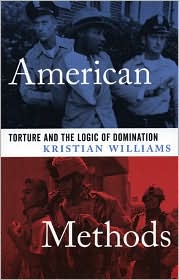
In American Methods author Kristian Williams argues that the U.S. Government has used torture as a method of social control and terror since the 1980s. Mr. Williams cites the 2004 Abu Ghraib prison incident, where American military personnel were investigated for the abuse of prisoners, as an example of traditional American torture. This event was hosted by Elliott Bay Book Company in Seattle, Washington.
Kristian Williams' writings have appeared in CounterPunch, Columbia Journalism Review, and We Are Everywhere: The Irresistible Rise of Global Anti-Capitalism. A member of Rose City Copwatch in Portland, Oregon, Williams also authored Our Enemies in Blue. There is no transcript for this program
To Watch the Episode
Kristian Williams: American Methods: Torture and the Logic of Domination
FORA TV (Originally broadcast on C-SPAN)
In American Methods author Kristian Williams argues that the U.S. Government has used torture as a method of social control and terror since the 1980s. Mr. Williams cites the 2004 Abu Ghraib prison incident, where American military personnel were investigated for the abuse of prisoners, as an example of traditional American torture. This event was hosted by Elliott Bay Book Company in Seattle, Washington.
Kristian Williams' writings have appeared in CounterPunch, Columbia Journalism Review, and We Are Everywhere: The Irresistible Rise of Global Anti-Capitalism. A member of Rose City Copwatch in Portland, Oregon, Williams also authored Our Enemies in Blue. There is no transcript for this program
To Watch the Episode
Sunday, May 30, 2010
Laurence W. Britt: 14 Characteristics of Fascism
(Images courtesy of a Sociological Tour Through Cyberspace)
"Fascism Anyone."
Laurence W. Britt
Free Inquiry 33.2 (Spring 2003)

For the purpose of this perspective, I will consider the following regimes: Nazi Germany, Fascist Italy, Franco’s Spain, Salazar’s Portugal, Papadopoulos’s Greece, Pinochet’s Chile, and Suharto’s Indonesia. To be sure, they constitute a mixed bag of national identities, cultures, developmental levels, and history. But they all followed the fascist or protofascist model in obtaining, expanding, and maintaining power. Further, all these regimes have been overthrown, so a more or less complete picture of their basic characteristics and abuses is possible.
Analysis of these seven regimes reveals fourteen common threads that link them in recognizable patterns of national behavior and abuse of power. These basic characteristics are more prevalent and intense in some regimes than in others, but they all share at least some level of similarity.
1. Powerful and continuing expressions of nationalism. From the prominent displays of flags and bunting to the ubiquitous lapel pins, the fervor to show patriotic nationalism, both on the part of the regime itself and of citizens caught up in its frenzy, was always obvious. Catchy slogans, pride in the military, and demands for unity were common themes in expressing this nationalism. It was usually coupled with a suspicion of things foreign that often bordered on xenophobia.
2. Disdain for the importance of human rights. The regimes themselves viewed human rights as of little value and a hindrance to realizing the objectives of the ruling elite. Through clever use of propaganda, the population was brought to accept these human rights abuses by marginalizing, even demonizing, those being targeted. When abuse was egregious, the tactic was to use secrecy, denial, and disinformation.
3. Identification of enemies/scapegoats as a unifying cause. The most significant common thread among these regimes was the use of scapegoating as a means to divert the people’s attention from other problems, to shift blame for failures, and to channel frustration in controlled directions. The methods of choice—relentless propaganda and disinformation—were usually effective. Often the regimes would incite “spontaneous” acts against the target scapegoats, usually communists, socialists, liberals, Jews, ethnic and racial minorities, traditional national enemies, members of other religions, secularists, homosexuals, and “terrorists.” Active opponents of these regimes were inevitably labeled as terrorists and dealt with accordingly.
4. The supremacy of the military/avid militarism. Ruling elites always identified closely with the military and the industrial infrastructure that supported it. A disproportionate share of national resources was allocated to the military, even when domestic needs were acute. The military was seen as an expression of nationalism, and was used whenever possible to assert national goals, intimidate other nations, and increase the power and prestige of the ruling elite.
5. Rampant sexism. Beyond the simple fact that the political elite and the national culture were male-dominated, these regimes inevitably viewed women as second-class citizens. They were adamantly anti-abortion and also homophobic. These attitudes were usually codified in Draconian laws that enjoyed strong support by the orthodox religion of the country, thus lending the regime cover for its abuses.
6. A controlled mass media. Under some of the regimes, the mass media were under strict direct control and could be relied upon never to stray from the party line. Other regimes exercised more subtle power to ensure media orthodoxy. Methods included the control of licensing and access to resources, economic pressure, appeals to patriotism, and implied threats. The leaders of the mass media were often politically compatible with the power elite. The result was usually success in keeping the general public unaware of the regimes’ excesses.
7. Obsession with national security. Inevitably, a national security apparatus was under direct control of the ruling elite. It was usually an instrument of oppression, operating in secret and beyond any constraints. Its actions were justified under the rubric of protecting “national security,” and questioning its activities was portrayed as unpatriotic or even treasonous.
8. Religion and ruling elite tied together. Unlike communist regimes, the fascist and protofascist regimes were never proclaimed as godless by their opponents. In fact, most of the regimes attached themselves to the predominant religion of the country and chose to portray themselves as militant defenders of that religion. The fact that the ruling elite’s behavior was incompatible with the precepts of the religion was generally swept under the rug. Propaganda kept up the illusion that the ruling elites were defenders of the faith and opponents of the “godless.” A perception was manufactured that opposing the power elite was tantamount to an attack on religion.
9. Power of corporations protected. Although the personal life of ordinary citizens was under strict control, the ability of large corporations to operate in relative freedom was not compromised. The ruling elite saw the corporate structure as a way to not only ensure military production (in developed states), but also as an additional means of social control. Members of the economic elite were often pampered by the political elite to ensure a continued mutuality of interests, especially in the repression of “have-not” citizens.
10. Power of labor suppressed or eliminated. Since organized labor was seen as the one power center that could challenge the political hegemony of the ruling elite and its corporate allies, it was inevitably crushed or made powerless. The poor formed an underclass, viewed with suspicion or outright contempt. Under some regimes, being poor was considered akin to a vice.
11. Disdain and suppression of intellectuals and the arts. Intellectuals and the inherent freedom of ideas and expression associated with them were anathema to these regimes. Intellectual and academic freedom were considered subversive to national security and the patriotic ideal. Universities were tightly controlled; politically unreliable faculty harassed or eliminated. Unorthodox ideas or expressions of dissent were strongly attacked, silenced, or crushed. To these regimes, art and literature should serve the national interest or they had no right to exist.
12. Obsession with crime and punishment. Most of these regimes maintained Draconian systems of criminal justice with huge prison populations. The police were often glorified and had almost unchecked power, leading to rampant abuse. “Normal” and political crime were often merged into trumped-up criminal charges and sometimes used against political opponents of the regime. Fear, and hatred, of criminals or “traitors” was often promoted among the population as an excuse for more police power.
13. Rampant cronyism and corruption. Those in business circles and close to the power elite often used their position to enrich themselves. This corruption worked both ways; the power elite would receive financial gifts and property from the economic elite, who in turn would gain the benefit of government favoritism. Members of the power elite were in a position to obtain vast wealth from other sources as well: for example, by stealing national resources. With the national security apparatus under control and the media muzzled, this corruption was largely unconstrained and not well understood by the general population.
14. Fraudulent elections. Elections in the form of plebiscites or public opinion polls were usually bogus. When actual elections with candidates were held, they would usually be perverted by the power elite to get the desired result. Common methods included maintaining control of the election machinery, intimidating and disenfranchising opposition voters, destroying or disallowing legal votes, and, as a last resort, turning to a judiciary beholden to the power elite.
Does any of this ring alarm bells? Of course not. After all, this is America, officially a democracy with the rule of law, a constitution, a free press, honest elections, and a well-informed public constantly being put on guard against evils. Historical comparisons like these are just exercises in verbal gymnastics. Maybe, maybe not.

Fascism Anyone

"Fascism Anyone."
Laurence W. Britt
Free Inquiry 33.2 (Spring 2003)
For the purpose of this perspective, I will consider the following regimes: Nazi Germany, Fascist Italy, Franco’s Spain, Salazar’s Portugal, Papadopoulos’s Greece, Pinochet’s Chile, and Suharto’s Indonesia. To be sure, they constitute a mixed bag of national identities, cultures, developmental levels, and history. But they all followed the fascist or protofascist model in obtaining, expanding, and maintaining power. Further, all these regimes have been overthrown, so a more or less complete picture of their basic characteristics and abuses is possible.
Analysis of these seven regimes reveals fourteen common threads that link them in recognizable patterns of national behavior and abuse of power. These basic characteristics are more prevalent and intense in some regimes than in others, but they all share at least some level of similarity.
1. Powerful and continuing expressions of nationalism. From the prominent displays of flags and bunting to the ubiquitous lapel pins, the fervor to show patriotic nationalism, both on the part of the regime itself and of citizens caught up in its frenzy, was always obvious. Catchy slogans, pride in the military, and demands for unity were common themes in expressing this nationalism. It was usually coupled with a suspicion of things foreign that often bordered on xenophobia.
2. Disdain for the importance of human rights. The regimes themselves viewed human rights as of little value and a hindrance to realizing the objectives of the ruling elite. Through clever use of propaganda, the population was brought to accept these human rights abuses by marginalizing, even demonizing, those being targeted. When abuse was egregious, the tactic was to use secrecy, denial, and disinformation.
3. Identification of enemies/scapegoats as a unifying cause. The most significant common thread among these regimes was the use of scapegoating as a means to divert the people’s attention from other problems, to shift blame for failures, and to channel frustration in controlled directions. The methods of choice—relentless propaganda and disinformation—were usually effective. Often the regimes would incite “spontaneous” acts against the target scapegoats, usually communists, socialists, liberals, Jews, ethnic and racial minorities, traditional national enemies, members of other religions, secularists, homosexuals, and “terrorists.” Active opponents of these regimes were inevitably labeled as terrorists and dealt with accordingly.
4. The supremacy of the military/avid militarism. Ruling elites always identified closely with the military and the industrial infrastructure that supported it. A disproportionate share of national resources was allocated to the military, even when domestic needs were acute. The military was seen as an expression of nationalism, and was used whenever possible to assert national goals, intimidate other nations, and increase the power and prestige of the ruling elite.
5. Rampant sexism. Beyond the simple fact that the political elite and the national culture were male-dominated, these regimes inevitably viewed women as second-class citizens. They were adamantly anti-abortion and also homophobic. These attitudes were usually codified in Draconian laws that enjoyed strong support by the orthodox religion of the country, thus lending the regime cover for its abuses.
6. A controlled mass media. Under some of the regimes, the mass media were under strict direct control and could be relied upon never to stray from the party line. Other regimes exercised more subtle power to ensure media orthodoxy. Methods included the control of licensing and access to resources, economic pressure, appeals to patriotism, and implied threats. The leaders of the mass media were often politically compatible with the power elite. The result was usually success in keeping the general public unaware of the regimes’ excesses.
7. Obsession with national security. Inevitably, a national security apparatus was under direct control of the ruling elite. It was usually an instrument of oppression, operating in secret and beyond any constraints. Its actions were justified under the rubric of protecting “national security,” and questioning its activities was portrayed as unpatriotic or even treasonous.
8. Religion and ruling elite tied together. Unlike communist regimes, the fascist and protofascist regimes were never proclaimed as godless by their opponents. In fact, most of the regimes attached themselves to the predominant religion of the country and chose to portray themselves as militant defenders of that religion. The fact that the ruling elite’s behavior was incompatible with the precepts of the religion was generally swept under the rug. Propaganda kept up the illusion that the ruling elites were defenders of the faith and opponents of the “godless.” A perception was manufactured that opposing the power elite was tantamount to an attack on religion.
9. Power of corporations protected. Although the personal life of ordinary citizens was under strict control, the ability of large corporations to operate in relative freedom was not compromised. The ruling elite saw the corporate structure as a way to not only ensure military production (in developed states), but also as an additional means of social control. Members of the economic elite were often pampered by the political elite to ensure a continued mutuality of interests, especially in the repression of “have-not” citizens.
10. Power of labor suppressed or eliminated. Since organized labor was seen as the one power center that could challenge the political hegemony of the ruling elite and its corporate allies, it was inevitably crushed or made powerless. The poor formed an underclass, viewed with suspicion or outright contempt. Under some regimes, being poor was considered akin to a vice.
11. Disdain and suppression of intellectuals and the arts. Intellectuals and the inherent freedom of ideas and expression associated with them were anathema to these regimes. Intellectual and academic freedom were considered subversive to national security and the patriotic ideal. Universities were tightly controlled; politically unreliable faculty harassed or eliminated. Unorthodox ideas or expressions of dissent were strongly attacked, silenced, or crushed. To these regimes, art and literature should serve the national interest or they had no right to exist.
12. Obsession with crime and punishment. Most of these regimes maintained Draconian systems of criminal justice with huge prison populations. The police were often glorified and had almost unchecked power, leading to rampant abuse. “Normal” and political crime were often merged into trumped-up criminal charges and sometimes used against political opponents of the regime. Fear, and hatred, of criminals or “traitors” was often promoted among the population as an excuse for more police power.
13. Rampant cronyism and corruption. Those in business circles and close to the power elite often used their position to enrich themselves. This corruption worked both ways; the power elite would receive financial gifts and property from the economic elite, who in turn would gain the benefit of government favoritism. Members of the power elite were in a position to obtain vast wealth from other sources as well: for example, by stealing national resources. With the national security apparatus under control and the media muzzled, this corruption was largely unconstrained and not well understood by the general population.
14. Fraudulent elections. Elections in the form of plebiscites or public opinion polls were usually bogus. When actual elections with candidates were held, they would usually be perverted by the power elite to get the desired result. Common methods included maintaining control of the election machinery, intimidating and disenfranchising opposition voters, destroying or disallowing legal votes, and, as a last resort, turning to a judiciary beholden to the power elite.
Does any of this ring alarm bells? Of course not. After all, this is America, officially a democracy with the rule of law, a constitution, a free press, honest elections, and a well-informed public constantly being put on guard against evils. Historical comparisons like these are just exercises in verbal gymnastics. Maybe, maybe not.
Fascism Anyone
Thursday, March 11, 2010
Mark Benjamin: Waterboarding for Dummies
Waterboarding for dummies: Internal CIA documents reveal a meticulous protocol that was far more brutal than Dick Cheney's "dunk in the water"
By Mark Benjamin
Salon
Self-proclaimed waterboarding fan Dick Cheney called it a no-brainer in a 2006 radio interview: Terror suspects should get a "a dunk in the water." But recently released internal documents reveal the controversial "enhanced interrogation" practice was far more brutal on detainees than Cheney's description sounds, and was administered with meticulous cruelty.
Interrogators pumped detainees full of so much water that the CIA turned to a special saline solution to minimize the risk of death, the documents show. The agency used a gurney "specially designed" to tilt backwards at a perfect angle to maximize the water entering the prisoner's nose and mouth, intensifying the sense of choking – and to be lifted upright quickly in the event that a prisoner stopped breathing.
The documents also lay out, in chilling detail, exactly what should occur in each two-hour waterboarding "session." Interrogators were instructed to start pouring water right after a detainee exhaled, to ensure he inhaled water, not air, in his next breath. They could use their hands to "dam the runoff" and prevent water from spilling out of a detainee's mouth. They were allowed six separate 40-second "applications" of liquid in each two-hour session – and could dump water over a detainee's nose and mouth for a total of 12 minutes a day. Finally, to keep detainees alive even if they inhaled their own vomit during a session – a not-uncommon side effect of waterboarding – the prisoners were kept on a liquid diet. The agency recommended Ensure Plus.
"This is revolting and it is deeply disturbing," said Dr. Scott Allen, co-director of the Center for Prisoner Health and Human Rights at Brown University who has reviewed all of the documents for Physicians for Human Rights. "The so-called science here is a total departure from any ethics or any legitimate purpose. They are saying, ‘This is how risky and harmful the procedure is, but we are still going to do it.' It just sounds like lunacy," he said. "This fine-tuning of torture is unethical, incompetent and a disgrace to medicine."
To Read the Rest of the Article
By Mark Benjamin
Salon
Self-proclaimed waterboarding fan Dick Cheney called it a no-brainer in a 2006 radio interview: Terror suspects should get a "a dunk in the water." But recently released internal documents reveal the controversial "enhanced interrogation" practice was far more brutal on detainees than Cheney's description sounds, and was administered with meticulous cruelty.
Interrogators pumped detainees full of so much water that the CIA turned to a special saline solution to minimize the risk of death, the documents show. The agency used a gurney "specially designed" to tilt backwards at a perfect angle to maximize the water entering the prisoner's nose and mouth, intensifying the sense of choking – and to be lifted upright quickly in the event that a prisoner stopped breathing.
The documents also lay out, in chilling detail, exactly what should occur in each two-hour waterboarding "session." Interrogators were instructed to start pouring water right after a detainee exhaled, to ensure he inhaled water, not air, in his next breath. They could use their hands to "dam the runoff" and prevent water from spilling out of a detainee's mouth. They were allowed six separate 40-second "applications" of liquid in each two-hour session – and could dump water over a detainee's nose and mouth for a total of 12 minutes a day. Finally, to keep detainees alive even if they inhaled their own vomit during a session – a not-uncommon side effect of waterboarding – the prisoners were kept on a liquid diet. The agency recommended Ensure Plus.
"This is revolting and it is deeply disturbing," said Dr. Scott Allen, co-director of the Center for Prisoner Health and Human Rights at Brown University who has reviewed all of the documents for Physicians for Human Rights. "The so-called science here is a total departure from any ethics or any legitimate purpose. They are saying, ‘This is how risky and harmful the procedure is, but we are still going to do it.' It just sounds like lunacy," he said. "This fine-tuning of torture is unethical, incompetent and a disgrace to medicine."
To Read the Rest of the Article
Wednesday, December 09, 2009
Lisa Sullivan: Elections in Honduras -- Whitewashing the Path to a Past of Horrors
Elections in Honduras: Whitewashing the Path to a Past of Horrors
by Lisa Sullivan
School of Americas Watch
I came to Honduras to participate as a human rights observer of the electoral climate in a delegation organized by the Quixote Center. Several delegations converged, connecting some 30 U.S. citizens with dozens more from Canada, Europe and Latin America. In the days prior to the elections we scattered to different cities, towns and villages, meeting with fishermen, farmers, maquila workers, labor leaders, teachers and lawyers, as well as those who were jailed for carrying spray paint, hospitalized for being shot in the head by the military, and detained for reporting on the repression. It was, most likely, a bit off the 5-star, air-conditioned path of most of the mainstream journalists who are filling your morning papers with the wonders of today´s elections.
But by the evening of the day of the elections, what we had witnessed in previous days pushed those of us from the U.S. directly to the doors of our embassy in Tegucigalpa. We realized that this place, not the polling stations, was where this horrific destiny of Honduras, and perhaps all of Latin America, was being determined. And so the U.S. citizens among us took our statements and signs and determination there.
We were, indeed, greeted by many: dozens of guards with cameras, some 30 journalists, Honduran police with guns and also cameras, as well as a low flying helicopter that at least made us feel important. While the journalists let us read our entire statement of why these elections should be not be recognized by our government because of the egregious repression, the embassy guards wouldn´t even let us leave our slip of paper. That, in spite of the fact that the embassy´s human rights officer, Nate Macklin, told our delegation leader to make sure to let him know if there were any human rights abuses.
Any? In each of the many corners of the country visited by the 70-plus international observers, we witnessed the fear, repression, intimidation, bribery and outright brutality of the government security forces (note: we were there to observe the electoral climate, not electoral observers, since we consider the elections to be illegal. Likewise, the UN, OAS, and Carter Center and other bedrock electoral groups boycotted "the event" as many Hondurans called the day.)
As elections were in full swing in the morning, our delegate and nurse practitioner, Silvia Metzler visited Angel Salgado and Maria Elena Hernandez who were languishing in the intensive care unit of the Hospital Escuela in Tegucigalpa . Both had been shot in the head at one of the many military checkpoints, no questions asked. Doctors give Angel a zero possibility of survival and he leaves behind a 6 year old son. Maria Elena has a better chance of recovery, but it will be a long road. She was selling snacks on the side of the road to support her teenage children when caught by military bullet.
Tom Loudon was on the streets of San Pedro Sula when police tanks and water trucks and tear gas canisters attacked a peaceful march of the resistance movement. It took him a long time to find other members of his delegation who had scattered in the frenzy, but they were luckier than two observers from the Latin America Council of Churches who were detained or a Reuters photographer who was injured in the massive display of repression. Dozens of cells phones captured the police beating anyone they could catch with their billy clubs.
The first person I thought of as I awoke on election day was Wlmer Rivero, a fisherman in a small town with the big name of Puerto Grande. I kept thinking of the fear in his eyes as he relayed how the police have been visiting his house and asking for him, ever since he trekked 6 days on foot to greet a returning President Zelaya. Each local mayor has been asked to put together a list of resistance leaders, and his name was one of 22 from his town. We suggested to Wilmer that he not sleep at home during the electoral days. He called the next day to thank us for our advise. The police had ransacked his home, and that of many of his neighbors, the night before elections, threatening his life. But, he wondered, what will he do now.
I also thought of Merly Eguigure who I had visited 2 days earlier in a cold and crumbling jail cell, reeking of human waste. She had been captured for having a can of spray paint in her car. Though she was released shortly before elections, she will face trial and probably prison for defacing government property. Merly claims that the spray paint was to be used in an activity to raise awareness of violence towards women. Perhaps authorities worried that the paint was destined to add a new message to the city walls. Every square inch of blank wall space in the city is covered with powerful graffiti against the coup. In spite of government to whitewash over it, the blank spaces are filled in again within hours.
To Read the Rest of the Report
by Lisa Sullivan
School of Americas Watch
I came to Honduras to participate as a human rights observer of the electoral climate in a delegation organized by the Quixote Center. Several delegations converged, connecting some 30 U.S. citizens with dozens more from Canada, Europe and Latin America. In the days prior to the elections we scattered to different cities, towns and villages, meeting with fishermen, farmers, maquila workers, labor leaders, teachers and lawyers, as well as those who were jailed for carrying spray paint, hospitalized for being shot in the head by the military, and detained for reporting on the repression. It was, most likely, a bit off the 5-star, air-conditioned path of most of the mainstream journalists who are filling your morning papers with the wonders of today´s elections.
But by the evening of the day of the elections, what we had witnessed in previous days pushed those of us from the U.S. directly to the doors of our embassy in Tegucigalpa. We realized that this place, not the polling stations, was where this horrific destiny of Honduras, and perhaps all of Latin America, was being determined. And so the U.S. citizens among us took our statements and signs and determination there.
We were, indeed, greeted by many: dozens of guards with cameras, some 30 journalists, Honduran police with guns and also cameras, as well as a low flying helicopter that at least made us feel important. While the journalists let us read our entire statement of why these elections should be not be recognized by our government because of the egregious repression, the embassy guards wouldn´t even let us leave our slip of paper. That, in spite of the fact that the embassy´s human rights officer, Nate Macklin, told our delegation leader to make sure to let him know if there were any human rights abuses.
Any? In each of the many corners of the country visited by the 70-plus international observers, we witnessed the fear, repression, intimidation, bribery and outright brutality of the government security forces (note: we were there to observe the electoral climate, not electoral observers, since we consider the elections to be illegal. Likewise, the UN, OAS, and Carter Center and other bedrock electoral groups boycotted "the event" as many Hondurans called the day.)
As elections were in full swing in the morning, our delegate and nurse practitioner, Silvia Metzler visited Angel Salgado and Maria Elena Hernandez who were languishing in the intensive care unit of the Hospital Escuela in Tegucigalpa . Both had been shot in the head at one of the many military checkpoints, no questions asked. Doctors give Angel a zero possibility of survival and he leaves behind a 6 year old son. Maria Elena has a better chance of recovery, but it will be a long road. She was selling snacks on the side of the road to support her teenage children when caught by military bullet.
Tom Loudon was on the streets of San Pedro Sula when police tanks and water trucks and tear gas canisters attacked a peaceful march of the resistance movement. It took him a long time to find other members of his delegation who had scattered in the frenzy, but they were luckier than two observers from the Latin America Council of Churches who were detained or a Reuters photographer who was injured in the massive display of repression. Dozens of cells phones captured the police beating anyone they could catch with their billy clubs.
The first person I thought of as I awoke on election day was Wlmer Rivero, a fisherman in a small town with the big name of Puerto Grande. I kept thinking of the fear in his eyes as he relayed how the police have been visiting his house and asking for him, ever since he trekked 6 days on foot to greet a returning President Zelaya. Each local mayor has been asked to put together a list of resistance leaders, and his name was one of 22 from his town. We suggested to Wilmer that he not sleep at home during the electoral days. He called the next day to thank us for our advise. The police had ransacked his home, and that of many of his neighbors, the night before elections, threatening his life. But, he wondered, what will he do now.
I also thought of Merly Eguigure who I had visited 2 days earlier in a cold and crumbling jail cell, reeking of human waste. She had been captured for having a can of spray paint in her car. Though she was released shortly before elections, she will face trial and probably prison for defacing government property. Merly claims that the spray paint was to be used in an activity to raise awareness of violence towards women. Perhaps authorities worried that the paint was destined to add a new message to the city walls. Every square inch of blank wall space in the city is covered with powerful graffiti against the coup. In spite of government to whitewash over it, the blank spaces are filled in again within hours.
To Read the Rest of the Report
Subscribe to:
Posts (Atom)