Al Jazeera
Showing posts with label Foreign Policy. Show all posts
Showing posts with label Foreign Policy. Show all posts
Saturday, January 08, 2011

Saturday, October 16, 2010
Kristian Williams: American Methods: Torture and the Logic of Domination
(Extra credit opportunity for HUM 121 students--watch the episode and write a response)
Kristian Williams: American Methods: Torture and the Logic of Domination
FORA TV (Originally broadcast on C-SPAN)
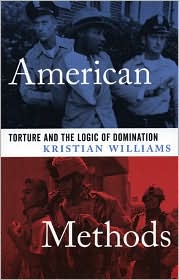
In American Methods author Kristian Williams argues that the U.S. Government has used torture as a method of social control and terror since the 1980s. Mr. Williams cites the 2004 Abu Ghraib prison incident, where American military personnel were investigated for the abuse of prisoners, as an example of traditional American torture. This event was hosted by Elliott Bay Book Company in Seattle, Washington.
Kristian Williams' writings have appeared in CounterPunch, Columbia Journalism Review, and We Are Everywhere: The Irresistible Rise of Global Anti-Capitalism. A member of Rose City Copwatch in Portland, Oregon, Williams also authored Our Enemies in Blue. There is no transcript for this program
To Watch the Episode
Kristian Williams: American Methods: Torture and the Logic of Domination
FORA TV (Originally broadcast on C-SPAN)
In American Methods author Kristian Williams argues that the U.S. Government has used torture as a method of social control and terror since the 1980s. Mr. Williams cites the 2004 Abu Ghraib prison incident, where American military personnel were investigated for the abuse of prisoners, as an example of traditional American torture. This event was hosted by Elliott Bay Book Company in Seattle, Washington.
Kristian Williams' writings have appeared in CounterPunch, Columbia Journalism Review, and We Are Everywhere: The Irresistible Rise of Global Anti-Capitalism. A member of Rose City Copwatch in Portland, Oregon, Williams also authored Our Enemies in Blue. There is no transcript for this program
To Watch the Episode
Tuesday, September 14, 2010
CEPR Co-Director Mark Weisbrot and Bob McChesney discuss "South of the Border"
CEPR Co-Director Mark Weisbrot and Bob discuss "South of the Border"
Media Matters with Bob McChesney (WILL: Illinois)

Mark Weisbrot is co-director of the Center for Economic and Policy Research, in Washington, D.C. He received his Ph.D. in economics from the University of Michigan. He has written numerous research papers on economic policy, especially on Latin America and international economic policy. He is also co-author, with Dean Baker, of Social Security: The Phony Crisis (University of Chicago Press, 2000).
He writes a weekly column for The Guardian Unlimited (U.K.), and a regular column on economic and policy issues that is distributed to over 550 newspapers by McClatchy-Tribune Information Services. He also writes a column for Brazil’s largest newspaper, Folha de Sao Paulo. His opinion pieces have appeared in the New York Times, Washington Post, the Los Angeles Times, and almost every major U.S. newspaper. He appears regularly on national and local television and radio programs. He is also president of Just Foreign Policy. Listen while he and Bob discuss Mark Weisbrot's collaboration with Oliver Stone on the film "South of the Border."
To Listen to the Conversation
Media Matters with Bob McChesney (WILL: Illinois)
Mark Weisbrot is co-director of the Center for Economic and Policy Research, in Washington, D.C. He received his Ph.D. in economics from the University of Michigan. He has written numerous research papers on economic policy, especially on Latin America and international economic policy. He is also co-author, with Dean Baker, of Social Security: The Phony Crisis (University of Chicago Press, 2000).
He writes a weekly column for The Guardian Unlimited (U.K.), and a regular column on economic and policy issues that is distributed to over 550 newspapers by McClatchy-Tribune Information Services. He also writes a column for Brazil’s largest newspaper, Folha de Sao Paulo. His opinion pieces have appeared in the New York Times, Washington Post, the Los Angeles Times, and almost every major U.S. newspaper. He appears regularly on national and local television and radio programs. He is also president of Just Foreign Policy. Listen while he and Bob discuss Mark Weisbrot's collaboration with Oliver Stone on the film "South of the Border."
To Listen to the Conversation
Friday, September 10, 2010
Radio Open Source: Steve Kinzer’s ‘Reset’ Roles for Turkey and Iran
Steve Kinzer’s ‘Reset’ Roles for Turkey and Iran
Radio Open Source with Christopher Lydon (Watson Institute for International Studies)
Stephen Kinzer is a journalist of a certain cheeky fearlessnes and exquisite timing. In his new book he’s ahead of the game again.

The ink was barely dry on Kinzer’s Reset: Iran, Turkey, and America’s Future, when events conspired late in May to demonstrate his logic in action. It was the sort of crack in the hegemonic eggshell that had to show up sooner or later, when leaders of rising powers — from that restless tier of less-than-permanent members of the U.N. Security Council, or what Parag Khanna calls The Second World — would announce themselves on the main stage with an idea that Uncle Sam and NATO hadn’t thought of first. And suddenly, out of a hat, there they were together in Tehran: President Lula of Brazil and Prime Minister Erdogan of Turkey and President Ahmedinejad, their host, with an agreement to off-load Iranian uranium and avert a nuclear-proliferation crisis with Iran and a sanctions campaign at the United Nations. The seriousness of the diplomatic initiative seemed to be certified by Hillary Clinton’s hauteur in dismissing it — then further by Tom Friedman’s ugly trashing of it. But PM Erdogan held his ground: “This is the moment to discuss if we believe in the supremacy of law or in the law of the supremes and superiors,” he said. And the example stands. Mariano Aguirre writes on the indispensable openDemocracy site: “it is a watershed in the configuration of a new multipolar world.”
Steve Kinzer’s Reset is a bold exercise in reimagining the United States’ big links in the Middle East. His essential question is: what if Turkey and Iran, of all nations, are to be our critical partners in stabilizing the region — not Saudi Arabia and Israel? Not the least of my questions is: how dare an ex-New York Times reporter try to shape history, after writing so much of it? I asked him whether Washington’s objection to the Brazil-Turkey-Iran triangle was perhaps less to their nuclear-fuel deal than to their presumption in advancing it:
Steve Kinzer — once the Times’ man in Central America, then Berlin, Istanbul and Tehran — reminds you what a newspaperman’s virtues are good for, all the better when freed from his newspaper chains.
To Listen to the Conservation
Radio Open Source with Christopher Lydon (Watson Institute for International Studies)
Stephen Kinzer is a journalist of a certain cheeky fearlessnes and exquisite timing. In his new book he’s ahead of the game again.
The ink was barely dry on Kinzer’s Reset: Iran, Turkey, and America’s Future, when events conspired late in May to demonstrate his logic in action. It was the sort of crack in the hegemonic eggshell that had to show up sooner or later, when leaders of rising powers — from that restless tier of less-than-permanent members of the U.N. Security Council, or what Parag Khanna calls The Second World — would announce themselves on the main stage with an idea that Uncle Sam and NATO hadn’t thought of first. And suddenly, out of a hat, there they were together in Tehran: President Lula of Brazil and Prime Minister Erdogan of Turkey and President Ahmedinejad, their host, with an agreement to off-load Iranian uranium and avert a nuclear-proliferation crisis with Iran and a sanctions campaign at the United Nations. The seriousness of the diplomatic initiative seemed to be certified by Hillary Clinton’s hauteur in dismissing it — then further by Tom Friedman’s ugly trashing of it. But PM Erdogan held his ground: “This is the moment to discuss if we believe in the supremacy of law or in the law of the supremes and superiors,” he said. And the example stands. Mariano Aguirre writes on the indispensable openDemocracy site: “it is a watershed in the configuration of a new multipolar world.”
Steve Kinzer’s Reset is a bold exercise in reimagining the United States’ big links in the Middle East. His essential question is: what if Turkey and Iran, of all nations, are to be our critical partners in stabilizing the region — not Saudi Arabia and Israel? Not the least of my questions is: how dare an ex-New York Times reporter try to shape history, after writing so much of it? I asked him whether Washington’s objection to the Brazil-Turkey-Iran triangle was perhaps less to their nuclear-fuel deal than to their presumption in advancing it:
I think there’s still a residue of anger at Turkey for its refusal to let American troops through to invade Iraq in 2003. That might be the beginning of this whole process. There are still some people in Washington who are angry at Turkey for not doing that, and in fact at one point Turkey was even being blamed by senior Bush Administration officials for helping to cause the crisis in Iraq because they didn’t allow us to launch that kind of invasion.
I also think there’s a mindset that tells people in Washington: when we decide something, the NATO allies and everybody else that considers themselves our friends have to go along. The idea that another group of countries in the world is going to suggest, “We live here, we know this neighborhood, and we have a different idea,” is something the US is still very uncomfortable with. The mindset says we need to hold onto the kind of power that we’re used to having, and this to me is one of the biggest problems that my book and others are trying to address…
There is such an inertia in the foreign policy-making process that any original thinking is crushed immediately as the germ of some terrible plague… So although I like to think I’ve come up with an interesting approach to the Middle East… what I really would like to get across as a bigger message is: let’s think big. Let’s come up with some new ideas. The century changed. The Cold War is over. But our policies, particularly in the Middle East, have not changed… Keeping yourself stuck in the same rut is going to intensify these interlocking crises…
Stephen Kinzer in conversation with Chris Lydon in Boston, June 8, 2010.
Steve Kinzer — once the Times’ man in Central America, then Berlin, Istanbul and Tehran — reminds you what a newspaperman’s virtues are good for, all the better when freed from his newspaper chains.
To Listen to the Conservation
Wednesday, July 28, 2010
Behind the News with Doug Henwood: Norman Finkelstein on Israel's Invasion of Gaza in 2009
Norman Finkelstein
Behind the News with Doug Henwood

Norman Finkelstein, author of This Time We Went Too Far, talks about Israel’s invasion of Gaza in late 2009, and about changing U.S. public opinion towards that country
To Listen to the Interview
Behind the News with Doug Henwood
Norman Finkelstein, author of This Time We Went Too Far, talks about Israel’s invasion of Gaza in late 2009, and about changing U.S. public opinion towards that country
To Listen to the Interview
Wednesday, March 31, 2010
Intelligence Squared U.S.: Should The U.S. Scale Back Relations With Israel?
Should The U.S. Scale Back Relations With Israel?
Intelligence Squared U.S. (NPR)
The special relationship between the United States and Israel is based on a history of shared intelligence, military cooperation and a reverence for the Holy Land held by many in the United States.
But does America's close relationship with Israel come at too high a cost in the Muslim world? Should the U.S. consider stepping back from that relationship?
...
The debate, held Feb. 9, was moderated by John Donvan, correspondent for ABC News' Nightline. Those debating were:
FOR THE MOTION
Roger Cohen joined The New York Times in 1990. He was a foreign correspondent for more than a decade before becoming acting foreign editor on Sept. 11, 2001, and foreign editor six months later. Since 2004 he has written a column for the Times-owned International Herald Tribune, first for the news pages and then, since 2007, for the op-ed page. In 2009, he was named a columnist of the Times.
Rashid Khalidi is the Edward Said professor of Arab studies at Columbia University. He was president of the Middle East Studies Association and was an adviser to the Palestinian delegation to the 1991-93 Arab-Israeli peace negotiations. Khalidi is the author of six books, including Sowing Crisis: The Cold War and American Dominance in the Middle East, The Iron Cage: The Story of the Palestinian Struggle for Statehood and Palestinian Identity: The Construction of Modern National Consciousness.
AGAINST THE MOTION
Stuart Eizenstat has held a number of key senior positions in three U.S. administrations, including chief White House domestic policy adviser to President Jimmy Carter (1977-81); U.S. ambassador to the European Union, undersecretary of commerce for international trade, undersecretary of state for economic, business and agricultural affairs and deputy secretary of the Treasury in the Clinton administration (1993-2001). Eizenstat is currently a partner at the law firm Covington & Burling LLP.
Itamar Rabinovich is Israel's former ambassador to the United States and was chief negotiator with Syria in the mid-1990s. He is the incumbent of the Ettinger Chair of Contemporary Middle Eastern History of Tel Aviv University and recently completed an eight-year term as the president of the university, where he has been a faculty member since 1971. He is currently a distinguished global professor at New York University and visiting professor at the Kennedy School of Government at Harvard University.
To Listen to the Debate
Intelligence Squared U.S. (NPR)
The special relationship between the United States and Israel is based on a history of shared intelligence, military cooperation and a reverence for the Holy Land held by many in the United States.
But does America's close relationship with Israel come at too high a cost in the Muslim world? Should the U.S. consider stepping back from that relationship?
...
The debate, held Feb. 9, was moderated by John Donvan, correspondent for ABC News' Nightline. Those debating were:
FOR THE MOTION
Roger Cohen joined The New York Times in 1990. He was a foreign correspondent for more than a decade before becoming acting foreign editor on Sept. 11, 2001, and foreign editor six months later. Since 2004 he has written a column for the Times-owned International Herald Tribune, first for the news pages and then, since 2007, for the op-ed page. In 2009, he was named a columnist of the Times.
Rashid Khalidi is the Edward Said professor of Arab studies at Columbia University. He was president of the Middle East Studies Association and was an adviser to the Palestinian delegation to the 1991-93 Arab-Israeli peace negotiations. Khalidi is the author of six books, including Sowing Crisis: The Cold War and American Dominance in the Middle East, The Iron Cage: The Story of the Palestinian Struggle for Statehood and Palestinian Identity: The Construction of Modern National Consciousness.
AGAINST THE MOTION
Stuart Eizenstat has held a number of key senior positions in three U.S. administrations, including chief White House domestic policy adviser to President Jimmy Carter (1977-81); U.S. ambassador to the European Union, undersecretary of commerce for international trade, undersecretary of state for economic, business and agricultural affairs and deputy secretary of the Treasury in the Clinton administration (1993-2001). Eizenstat is currently a partner at the law firm Covington & Burling LLP.
Itamar Rabinovich is Israel's former ambassador to the United States and was chief negotiator with Syria in the mid-1990s. He is the incumbent of the Ettinger Chair of Contemporary Middle Eastern History of Tel Aviv University and recently completed an eight-year term as the president of the university, where he has been a faculty member since 1971. He is currently a distinguished global professor at New York University and visiting professor at the Kennedy School of Government at Harvard University.
To Listen to the Debate
Subscribe to:
Posts (Atom)