US’ New “Abu Ghraib” in Afghanistan
by Julius Cavendish
Frontlines of Revolutionary Struggle
The US Army has been forced into an acutely embarrassing apology after photographs emerged of American soldiers posing with the corpses of Afghan civilians in scenes reminiscent of the Abu Ghraib prison scandal during the Iraq war. In one picture, a US soldier grins wolfishly for the camera while gripping a corpse’s hair, pulling back its head like a hunting trophy, in what could become an enduring image of how the West lost its way in Afghanistan. The picture, one of three published by the German news weekly Der Spiegel, has forced the US Army into a rare public apology and attempts to distance itself from a handful of rogue troops who are charged with killing Afghan civilians for fun. The photographs depict “actions repugnant to us as human beings and contrary to the standards and values of the United States Army”, it said in a statement yesterday. “We apologise for the distress these photos cause.” The US military had tried to suppress the photos, which are part of the evidence seized in a case against 12 US soldiers accused of crimes ranging from murder to hoarding body parts as trophies, and which it believes could incite riots and attacks on its personnel in Afghanistan.
But the magazine, which says it obtained access to about 4,000 pictures and videos pertaining to the case, argued that it was important to publish a “tiny” number of them in order to document a war in which all sides had “lost sight” of their original objectives. The case has drawn parallels with the Abu Ghraib scandal, in which US military police, CIA officers and private contractors abused, tortured and in one instance killed prisoners in their care. In both cases the perpetrators recorded their crimes on camera. The Abu Ghraib incident led to a furious public reaction in Iraq. In the Afghanistan case, that anger has yet to materialise.
To Read the Rest of the Report and to Access the Pictures
Showing posts with label Abu Ghraib. Show all posts
Showing posts with label Abu Ghraib. Show all posts
Wednesday, March 23, 2011

Monday, March 21, 2011
Jon Boone: US Army 'kill team' in Afghanistan posed for photos of murdered civilians
US Army 'kill team' in Afghanistan posed for photos of murdered civilians: Commanders brace for backlash of anti-US sentiment that could be more damaging than after the Abu Ghraib scandal
by Jon Boone
Guardian
Commanders in Afghanistan are bracing themselves for possible riots and public fury triggered by the publication of "trophy" photographs of US soldiers posing with the dead bodies of defenceless Afghan civilians they killed.
Senior officials at Nato's International Security Assistance Force in Kabul have compared the pictures published by the German news weekly Der Spiegel to the images of US soldiers abusing prisoners in Abu Ghraib in Iraq which sparked waves of anti-US protests around the world.
They fear that the pictures could be even more damaging as they show the aftermath of the deliberate murders of Afghan civilians by a rogue US Stryker tank unit that operated in the southern province of Kandahar last year.
Some of the activities of the self-styled "kill team" are already public, with 12 men currently on trial in Seattle for their role in the killing of three civilians.
Five of the soldiers are on trial for pre-meditated murder, after they staged killings to make it look like they were defending themselves from Taliban attacks.
Other charges include the mutilation of corpses, the possession of images of human casualties and drug abuse.
All of the soldiers have denied the charges. They face the death penalty or life in prison if convicted.
The case has already created shock around the world, particularly with the revelations that the men cut "trophies" from the bodies of the people they killed.
An investigation by Der Spiegel has unearthed approximately 4,000 photos and videos taken by the men.
The magazine, which is planning to publish only three images, said that in addition to the crimes the men were on trial for there are "also entire collections of pictures of other victims that some of the defendants were keeping".
The US military has strived to keep the pictures out of the public domain fearing it could inflame feelings at a time when anti-Americanism in Afghanistan is already running high.
To Read the Rest of the Article
More:
Frontlines of Revolutionary Struggle: US' New Abu Ghraib in Afghanistan
by Jon Boone
Guardian
Commanders in Afghanistan are bracing themselves for possible riots and public fury triggered by the publication of "trophy" photographs of US soldiers posing with the dead bodies of defenceless Afghan civilians they killed.
Senior officials at Nato's International Security Assistance Force in Kabul have compared the pictures published by the German news weekly Der Spiegel to the images of US soldiers abusing prisoners in Abu Ghraib in Iraq which sparked waves of anti-US protests around the world.
They fear that the pictures could be even more damaging as they show the aftermath of the deliberate murders of Afghan civilians by a rogue US Stryker tank unit that operated in the southern province of Kandahar last year.
Some of the activities of the self-styled "kill team" are already public, with 12 men currently on trial in Seattle for their role in the killing of three civilians.
Five of the soldiers are on trial for pre-meditated murder, after they staged killings to make it look like they were defending themselves from Taliban attacks.
Other charges include the mutilation of corpses, the possession of images of human casualties and drug abuse.
All of the soldiers have denied the charges. They face the death penalty or life in prison if convicted.
The case has already created shock around the world, particularly with the revelations that the men cut "trophies" from the bodies of the people they killed.
An investigation by Der Spiegel has unearthed approximately 4,000 photos and videos taken by the men.
The magazine, which is planning to publish only three images, said that in addition to the crimes the men were on trial for there are "also entire collections of pictures of other victims that some of the defendants were keeping".
The US military has strived to keep the pictures out of the public domain fearing it could inflame feelings at a time when anti-Americanism in Afghanistan is already running high.
To Read the Rest of the Article
More:
Frontlines of Revolutionary Struggle: US' New Abu Ghraib in Afghanistan
Saturday, October 16, 2010
Kristian Williams: American Methods: Torture and the Logic of Domination
(Extra credit opportunity for HUM 121 students--watch the episode and write a response)
Kristian Williams: American Methods: Torture and the Logic of Domination
FORA TV (Originally broadcast on C-SPAN)
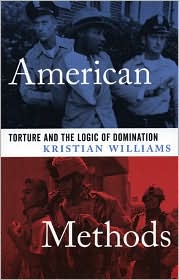
In American Methods author Kristian Williams argues that the U.S. Government has used torture as a method of social control and terror since the 1980s. Mr. Williams cites the 2004 Abu Ghraib prison incident, where American military personnel were investigated for the abuse of prisoners, as an example of traditional American torture. This event was hosted by Elliott Bay Book Company in Seattle, Washington.
Kristian Williams' writings have appeared in CounterPunch, Columbia Journalism Review, and We Are Everywhere: The Irresistible Rise of Global Anti-Capitalism. A member of Rose City Copwatch in Portland, Oregon, Williams also authored Our Enemies in Blue. There is no transcript for this program
To Watch the Episode
Kristian Williams: American Methods: Torture and the Logic of Domination
FORA TV (Originally broadcast on C-SPAN)
In American Methods author Kristian Williams argues that the U.S. Government has used torture as a method of social control and terror since the 1980s. Mr. Williams cites the 2004 Abu Ghraib prison incident, where American military personnel were investigated for the abuse of prisoners, as an example of traditional American torture. This event was hosted by Elliott Bay Book Company in Seattle, Washington.
Kristian Williams' writings have appeared in CounterPunch, Columbia Journalism Review, and We Are Everywhere: The Irresistible Rise of Global Anti-Capitalism. A member of Rose City Copwatch in Portland, Oregon, Williams also authored Our Enemies in Blue. There is no transcript for this program
To Watch the Episode
Monday, July 26, 2010
Linda Williams: “Cluster fuck” -- The forcible frame in Errol Morris’s Standard Operating Procedure
“Cluster fuck”: the forcible frame in Errol Morris’s Standard Operating Procedure
by Linda Williams
Jump Cut

Morris’s contextualization and constant reframing of the photos, qua photos, makes it possible for us to realize that the human pyramid and the simultaneously orchestrated masturbations were most likely not the worst or even the true crimes of the U.S. military and “other governmental agencies”—code for the CIA and other groups whose presence in the prison never formed part of the official record and who could thus apparently act with impunity—at Abu Ghraib.
When Susan Sontag wrote not long after their publication that these “photographs are us,”[19] she meant that we as a nation are responsible for what they show: the corruption, waste, and immorality of our occupation of Iraq (26).[20] But I suggest that they are also “us” because we recognize in them a familiar spirit of play, however perverted, that seeks distraction—even something called “fun”—in the very midst of horror. Kracauer writes of the mass ornament:
This disclosure “in distraction,” he adds, “is therefore of moral significance.”[21] What is “legitimate,” then, about the photos framed by this film is that with the aid of the Interrotron Morris makes us see how such photos could have made sense to these soldiers “on the ground” who craved a higher vantage point that would dissociate them from the prisoners with whom they lived. The photos were a legitimate expression of the frustration of their own impotency, their own inability to act successfully as soldiers, their pathetic imitation of “norms” that utterly failed to tell them their duty. Both the framed photos and Morris’s extravagant (re)enactments of what might have occurred are the ornamental cluster fucks of this misguided war
The most important ethical lesson of the film, however, may be to discourage us from judging Harman, England, or any of the cast of characters from any higher ground, as Pack would do and as the military tribunal did. The value of the film, rather, is to have shown us what it was like to be there on the ground aspiring to be somewhere else, somewhere higher.
In Regarding the Pain of Others, Sontag argues that pictures cannot provide their own interpretations; they need captions to provide context.[22] This may not be an accurate assessment of all photos, but it seems patently true of these almost too obviously self-incriminating ones of Abu Ghraib. On first seeing these pictures, few people thought they needed further explanations or a frame of reference. In Morris’s film it is the interviews and the imaginative enactments of possible acts that provide the rich captions to complicate each photo.
Judith Butler challenges Sontag, writing that we do not always need a caption to understand that a political background is formulated and renewed through the work of a frame:
This, I argue is what Morris’s film does. It asks us to interpret the interpretation, to witness the witnesses. But it does so not only by citing the photos that so “forcibly” framed these acts of inhumanity but also by reframing and contextualizing them, showing us how very delimited these frames were, how much of “the visual field,” as Butler puts it, is “ruled out” (952).
The photos of Abu Ghraib pointed to and were often themselves evidence of crimes. But they are not the smoking guns they seemed to be. They suggest that “straight photographs” must always be considered in light of what we know about the situation of their taking and that very often, as in the torture-death of al-Jamadi, the real incriminating photo does not exist. Had the military prosecution that focused so intensely only on the little guys pursued the larger “primary framework” that set the conditions for what we see in these pictures, rather than assume, as the Guantánamo alum Pack does, that nakedness and stress positions were to be expected, then we might have gotten to the bottom of the torture that took place under the direct auspices of the “other government agencies.” Such a trial might have discovered whose decision it was to keep prisoners naked and shackled, whose decision it was to hold prisoners indefinitely and drive them to despair. But that would have been another movie.
To Read the Entire Essay
by Linda Williams
Jump Cut
Morris’s contextualization and constant reframing of the photos, qua photos, makes it possible for us to realize that the human pyramid and the simultaneously orchestrated masturbations were most likely not the worst or even the true crimes of the U.S. military and “other governmental agencies”—code for the CIA and other groups whose presence in the prison never formed part of the official record and who could thus apparently act with impunity—at Abu Ghraib.
When Susan Sontag wrote not long after their publication that these “photographs are us,”[19] she meant that we as a nation are responsible for what they show: the corruption, waste, and immorality of our occupation of Iraq (26).[20] But I suggest that they are also “us” because we recognize in them a familiar spirit of play, however perverted, that seeks distraction—even something called “fun”—in the very midst of horror. Kracauer writes of the mass ornament:
“Here, in pure externality the audience encounters itself. Its own reality is revealed in the fragmented sequence of splendid sense impressions.”
This disclosure “in distraction,” he adds, “is therefore of moral significance.”[21] What is “legitimate,” then, about the photos framed by this film is that with the aid of the Interrotron Morris makes us see how such photos could have made sense to these soldiers “on the ground” who craved a higher vantage point that would dissociate them from the prisoners with whom they lived. The photos were a legitimate expression of the frustration of their own impotency, their own inability to act successfully as soldiers, their pathetic imitation of “norms” that utterly failed to tell them their duty. Both the framed photos and Morris’s extravagant (re)enactments of what might have occurred are the ornamental cluster fucks of this misguided war
The most important ethical lesson of the film, however, may be to discourage us from judging Harman, England, or any of the cast of characters from any higher ground, as Pack would do and as the military tribunal did. The value of the film, rather, is to have shown us what it was like to be there on the ground aspiring to be somewhere else, somewhere higher.
In Regarding the Pain of Others, Sontag argues that pictures cannot provide their own interpretations; they need captions to provide context.[22] This may not be an accurate assessment of all photos, but it seems patently true of these almost too obviously self-incriminating ones of Abu Ghraib. On first seeing these pictures, few people thought they needed further explanations or a frame of reference. In Morris’s film it is the interviews and the imaginative enactments of possible acts that provide the rich captions to complicate each photo.
Judith Butler challenges Sontag, writing that we do not always need a caption to understand that a political background is formulated and renewed through the work of a frame:
“Whenever and wherever the photograph yields up its own forcible frame to visual scrutiny and interpretation, it opens up the restrictions of interpreting reality to critical scrutiny . . . we come to interpret that interpretation that has been imposed upon us.”[23]
This, I argue is what Morris’s film does. It asks us to interpret the interpretation, to witness the witnesses. But it does so not only by citing the photos that so “forcibly” framed these acts of inhumanity but also by reframing and contextualizing them, showing us how very delimited these frames were, how much of “the visual field,” as Butler puts it, is “ruled out” (952).
The photos of Abu Ghraib pointed to and were often themselves evidence of crimes. But they are not the smoking guns they seemed to be. They suggest that “straight photographs” must always be considered in light of what we know about the situation of their taking and that very often, as in the torture-death of al-Jamadi, the real incriminating photo does not exist. Had the military prosecution that focused so intensely only on the little guys pursued the larger “primary framework” that set the conditions for what we see in these pictures, rather than assume, as the Guantánamo alum Pack does, that nakedness and stress positions were to be expected, then we might have gotten to the bottom of the torture that took place under the direct auspices of the “other government agencies.” Such a trial might have discovered whose decision it was to keep prisoners naked and shackled, whose decision it was to hold prisoners indefinitely and drive them to despair. But that would have been another movie.
To Read the Entire Essay
Friday, July 23, 2010
David Andrews: Reframing Standard Operating Procedure: Errol Morris and the creative treatment of Abu Ghraib
(What i appreciate about SOP is that it is problematizing our [perceived] direct truth correspondence with images [in particular photographs, videos and films] in an age when we should always be skeptical of that relationship... )
Reframing Standard Operating Procedure: Errol Morris and the creative treatment of Abu Ghraib
Jump Cut

...
Janet Walker, a trauma studies scholar, noted in counterpoint that the discussion might profit if we supplemented trauma studies’ primary focus on victim trauma with a similar focus on “perpetrator trauma”—an expansion that might be linked to the kind of spectator trauma that Nichols touches on in his own paper. Like Sobchack’s comment, Walker’s comment was mainly a response to Kahana’s paper, which posited a tradition of films in which real “soldiers give testimony about their . . . violent actions, carried out in the midst of war,” actions they can never forget. Standard Operating Procedure fits this category, Walker (still alluding to Kahana) noted, in its “presentation of psychologically charged veteran interviews as simultaneously confessional and exculpatory.”[30]
At this point, my own trauma has everything to do with personal experience, not documentary practice. I am a U.S. liberal who lived through the Bush-Cheney era. Like Morris, I feel a great deal of guilt over what happened in those years (and over what may still be happening now, for all we know). It is predictable, then, that after watching Standard Operating Procedure, my own moral center fixed on Morris’ haunting précis: the guards weren’t innocent, but they were scapegoats.[31] No matter how morally superior we feel, the guards had few choices within a machine whose policies standardized abuse and enforced obedience in its ranks. As Kleinhans notes, one “incontrovertibly true” fact of torture is that it is only
“the exceptional person who refuses to torture, especially under the conditions of military organization.”[32]
The guards may not have been exceptional people (do “the best and brightest” typically end up as enlistees in the U.S. military?) but they were people working in a situation not of their own making. They acted badly and were treated badly: they were perpetrators and victims. This means that the greatest responsibility lies with those who created the situation that ran away from the guards: the military higher-ups, the Bush administration, and the electorate.
And if we, as liberals, fall into the trap of not listening to the guards or to Morris, if we refuse to see the guards as people whose “free will” was constrained by the same machine that constrained us all, we may end up simply repeating the actions of the Bush administration, which protected itself by blaming the scandal on a few bad apples. After all, apart from the extravagant abuses—the human pyramid, the masturbating detainees—the actions of the guards were, practically speaking, unavoidable. If the guards hadn’t put the detainees in stress positions or otherwise “softened” them up, how would the guards have been treated? Would they have been demoted, discharged, court-martialed?
And what about us, the symbolic warriors who were paying for all this and increasingly knew what we were paying for as its elements were repeated at “black sites” or outsourced through rendition—what were our choices? We could have stopped paying our taxes and gone to jail or fled abroad. But how many of us could actually have done this? Haven’t we all had responsibilities that have held us in place as investors in the larger machine of the nation? (Henry David Thoreau, we should remember, was unattached, childless, and jobless when he refused to pay poll taxes so as to resist the expansionist Mexican War.) Many of us probably had the same grim, awful sense that I had during the 9/11 disaster: what was happening to us was just a particle of what the Bush administration would do in our name in retribution. And many of us probably wanted to resist this end. But we did not, mostly could not. This is not to exonerate us or the guards. It is to see ourselves in the guards, whose situation we helplessly helped create.
To Read the Entire Introduction and to Access the Other Essays
Reframing Standard Operating Procedure: Errol Morris and the creative treatment of Abu Ghraib
Jump Cut
...
Janet Walker, a trauma studies scholar, noted in counterpoint that the discussion might profit if we supplemented trauma studies’ primary focus on victim trauma with a similar focus on “perpetrator trauma”—an expansion that might be linked to the kind of spectator trauma that Nichols touches on in his own paper. Like Sobchack’s comment, Walker’s comment was mainly a response to Kahana’s paper, which posited a tradition of films in which real “soldiers give testimony about their . . . violent actions, carried out in the midst of war,” actions they can never forget. Standard Operating Procedure fits this category, Walker (still alluding to Kahana) noted, in its “presentation of psychologically charged veteran interviews as simultaneously confessional and exculpatory.”[30]
At this point, my own trauma has everything to do with personal experience, not documentary practice. I am a U.S. liberal who lived through the Bush-Cheney era. Like Morris, I feel a great deal of guilt over what happened in those years (and over what may still be happening now, for all we know). It is predictable, then, that after watching Standard Operating Procedure, my own moral center fixed on Morris’ haunting précis: the guards weren’t innocent, but they were scapegoats.[31] No matter how morally superior we feel, the guards had few choices within a machine whose policies standardized abuse and enforced obedience in its ranks. As Kleinhans notes, one “incontrovertibly true” fact of torture is that it is only
“the exceptional person who refuses to torture, especially under the conditions of military organization.”[32]
The guards may not have been exceptional people (do “the best and brightest” typically end up as enlistees in the U.S. military?) but they were people working in a situation not of their own making. They acted badly and were treated badly: they were perpetrators and victims. This means that the greatest responsibility lies with those who created the situation that ran away from the guards: the military higher-ups, the Bush administration, and the electorate.
And if we, as liberals, fall into the trap of not listening to the guards or to Morris, if we refuse to see the guards as people whose “free will” was constrained by the same machine that constrained us all, we may end up simply repeating the actions of the Bush administration, which protected itself by blaming the scandal on a few bad apples. After all, apart from the extravagant abuses—the human pyramid, the masturbating detainees—the actions of the guards were, practically speaking, unavoidable. If the guards hadn’t put the detainees in stress positions or otherwise “softened” them up, how would the guards have been treated? Would they have been demoted, discharged, court-martialed?
And what about us, the symbolic warriors who were paying for all this and increasingly knew what we were paying for as its elements were repeated at “black sites” or outsourced through rendition—what were our choices? We could have stopped paying our taxes and gone to jail or fled abroad. But how many of us could actually have done this? Haven’t we all had responsibilities that have held us in place as investors in the larger machine of the nation? (Henry David Thoreau, we should remember, was unattached, childless, and jobless when he refused to pay poll taxes so as to resist the expansionist Mexican War.) Many of us probably had the same grim, awful sense that I had during the 9/11 disaster: what was happening to us was just a particle of what the Bush administration would do in our name in retribution. And many of us probably wanted to resist this end. But we did not, mostly could not. This is not to exonerate us or the guards. It is to see ourselves in the guards, whose situation we helplessly helped create.
To Read the Entire Introduction and to Access the Other Essays
Saturday, February 27, 2010
Standard Operating Procedure (USA: Errol Morris, 2008)
(Extra-Credit opportunity for my students--watch and write a 600+ response)
Standard Operating Procedure: Synopsis
by Errol Morris
Is it possible for a photograph to change the world? Photographs taken by soldiers in Abu Ghraib prison changed the war in Iraq and changed America’s image of itself. Yet, a central mystery remains. Did the notorious Abu Ghraib photographs constitute evidence of systematic abuse by the American military, or were they documenting the aberrant behavior of a few “bad apples”?
We set out to examine the context of these photographs. Why were they taken? What was happening outside the frame? We talked directly to the soldiers who took the photographs and who were in the photographs. Who are these people? What were they thinking? Over two years of investigation, we amassed a million and a half words of interview transcript, thousands of pages of unredacted reports, and hundreds of photographs.
The story of Abu Ghraib is still shrouded in moral ambiguity, but it is clear what happened there. The Abu Ghraib photographs serve as both an expose and a coverup. An expose, because the photographs offer us a glimpse of the horror of Abu Ghraib; and a coverup because they convinced journalists and readers they had seen everything, that there was no need to look further. In recent news reports, we have learned about the destruction of the Abu Zubaydah interrogation tapes. A coverup. It has been front page news. But the coverup at Abu Ghraib involved thousands of prisoners and hundreds of soldiers. We are still learning about the extent of it. Many journalists have asked about “the smoking gun” of Abu Ghraib. It is the wrong question. As Philip Gourevitch has commented, Abu Ghraib is the smoking gun. The underlying question that we still have not resolved, four years after the scandal: how could American values become so compromised that Abu Ghraib—and the subsequent coverup—could happen?
Link to the Synopsis
To watch the entire documentary online:
Standard Operating Procedure: Synopsis
by Errol Morris
Is it possible for a photograph to change the world? Photographs taken by soldiers in Abu Ghraib prison changed the war in Iraq and changed America’s image of itself. Yet, a central mystery remains. Did the notorious Abu Ghraib photographs constitute evidence of systematic abuse by the American military, or were they documenting the aberrant behavior of a few “bad apples”?
We set out to examine the context of these photographs. Why were they taken? What was happening outside the frame? We talked directly to the soldiers who took the photographs and who were in the photographs. Who are these people? What were they thinking? Over two years of investigation, we amassed a million and a half words of interview transcript, thousands of pages of unredacted reports, and hundreds of photographs.
The story of Abu Ghraib is still shrouded in moral ambiguity, but it is clear what happened there. The Abu Ghraib photographs serve as both an expose and a coverup. An expose, because the photographs offer us a glimpse of the horror of Abu Ghraib; and a coverup because they convinced journalists and readers they had seen everything, that there was no need to look further. In recent news reports, we have learned about the destruction of the Abu Zubaydah interrogation tapes. A coverup. It has been front page news. But the coverup at Abu Ghraib involved thousands of prisoners and hundreds of soldiers. We are still learning about the extent of it. Many journalists have asked about “the smoking gun” of Abu Ghraib. It is the wrong question. As Philip Gourevitch has commented, Abu Ghraib is the smoking gun. The underlying question that we still have not resolved, four years after the scandal: how could American values become so compromised that Abu Ghraib—and the subsequent coverup—could happen?
Link to the Synopsis
To watch the entire documentary online:
Subscribe to:
Posts (Atom)