Showing posts with label Morality. Show all posts

Monday, November 22, 2010

Left Field Cinema: Horror Movies as Modern Day Morality Tales, Pts. 1-5

Analysis: Horror Movies as Modern Day Morality Tales – Introduction
by Mike Dawson
Left Field Cinema

Part one of a five part series asking whether horror movies are the modern day equivalent of the classical morality tales from the years before cinema.
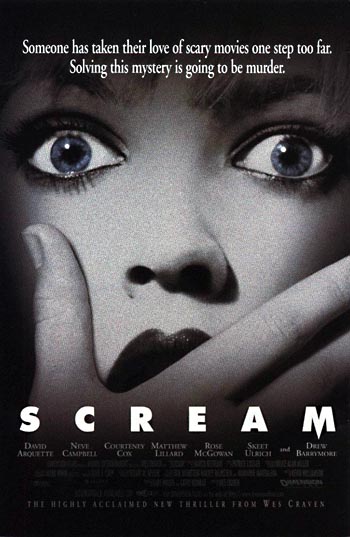


“There are certain rules that one must abide by in order to successfully survive a horror movie. Number one: You can never have sex… Sex equals death… Number two: You can never drink or do drugs. It’s the sin factor, it’s a sin, it’s an extension of number one. And number three, never, ever, under any circumstances say ‘I’ll be right back’, because you won’t be back.” (Craven, 1996)


This quote is taken from the Wes Craven film Scream (1996), a part parody, part pastiche, part postmodern thriller. It can easily be considered the most self-observant horror movie ever made. It examines its own genre clichés and traits with the keenest eye. The ‘sin factor’, which the character of Randy (played by Jamie Kennedy) refers to in Scream, is rightly stated to be the creative force behind these clichés and traits. The ’sin factor’ is central to the nature of horror films, and means that the issue of morality is innate within the genre. The horror film can be viewed as a modern day version of the classical morality tales which took the popular shape of nursery rhymes and fairy tales in the years before cinema was invented. Morality tales are narratives with a clear moral message that is reinforced as the plot unfolds; usually the message of the piece is a warning of some kind that is often set in a metaphorical scenario. The supernatural or hyper real settings and the simplistic plotlines of morality tales are often in place for two reasons. Firstly to simplify the message to a form which is not complicated by the intricacies and ambiguities of the modern world. Secondly to produce messages and warnings about sensitive or recent subjects without directly commenting on those subjects, therefore reducing the culpability for any offence taken by the readership or audience. This is a four part episode and a study of whether horror films can truly be viewed as morality tales, whether the various elements and narrative details of morality tales also apply to horror films.

Horror is arguably films most excessive, extroverted, and exploitative genre, (using in many cases, grim prosthetic effects, sudden bursts of sound or music, incredulous resurrections, and unnecessary scenes of nudity to surprise or titillate the audience) it also has a very conservative undertone intrinsic to most morality tales. This undertone contradicts the violent uncensored approach that most horror films adopt.


The ‘creature feature’ films of the 1950’s are interesting examples where radiation (usually) from A-bombs creates a giant insect or lizard of some kind. This was a thinly veiled metaphor for the then current communist fears, they could be simple everyday creatures like tiny insects, or a friendly next door neighbour, but then nuclear bombs are detonated and they transform into deadly monsters, just as the next door neighbour transforms into a soviet agent ready to invade the USA from within.

P. Wells makes the connection between national fears and the horror movie in the 2000 book The Horror Genre:

“The history of the horror film is essentially a history of anxiety in twentieth century. In the way that fairytales, folktales and gothic romances articulated the fears of the ‘old’ world characterised by a rationale of industrial, technological and economic determinism. Arguably, more than any other genre, it has interrogated the deep-seated effects of change…”


However it has interrogated these effects with a largely conservative bias, essentially fighting against change. This bias is not only in terms of international politics, or xenophobia, but also domestic conservatism.

To Read the Rest of the Introduction

To Listen to the Analysis


The rest of the series:


"Horror Movies as Modern Day Morality Tales – The Exorcist."


"Horror Movies as Modern Day Morality Tales – Friday the 13th and Halloween"


"Horror Movies as Modern Day Morality Tales – The Silence of the Lambs and Se7en."


"Horror Movies as Modern Day Morality Tales – Conclusions."

Friday, July 23, 2010

David Andrews: Reframing Standard Operating Procedure: Errol Morris and the creative treatment of Abu Ghraib

(What i appreciate about SOP is that it is problematizing our [perceived] direct truth correspondence with images [in particular photographs, videos and films] in an age when we should always be skeptical of that relationship... )


Reframing Standard Operating Procedure: Errol Morris and the creative treatment of Abu Ghraib
Jump Cut


...

Janet Walker, a trauma studies scholar, noted in counterpoint that the discussion might profit if we supplemented trauma studies’ primary focus on victim trauma with a similar focus on “perpetrator trauma”—an expansion that might be linked to the kind of spectator trauma that Nichols touches on in his own paper. Like Sobchack’s comment, Walker’s comment was mainly a response to Kahana’s paper, which posited a tradition of films in which real “soldiers give testimony about their . . . violent actions, carried out in the midst of war,” actions they can never forget. Standard Operating Procedure fits this category, Walker (still alluding to Kahana) noted, in its “presentation of psychologically charged veteran interviews as simultaneously confessional and exculpatory.”[30]

At this point, my own trauma has everything to do with personal experience, not documentary practice. I am a U.S. liberal who lived through the Bush-Cheney era. Like Morris, I feel a great deal of guilt over what happened in those years (and over what may still be happening now, for all we know). It is predictable, then, that after watching Standard Operating Procedure, my own moral center fixed on Morris’ haunting précis: the guards weren’t innocent, but they were scapegoats.[31] No matter how morally superior we feel, the guards had few choices within a machine whose policies standardized abuse and enforced obedience in its ranks. As Kleinhans notes, one “incontrovertibly true” fact of torture is that it is only

“the exceptional person who refuses to torture, especially under the conditions of military organization.”[32]

The guards may not have been exceptional people (do “the best and brightest” typically end up as enlistees in the U.S. military?) but they were people working in a situation not of their own making. They acted badly and were treated badly: they were perpetrators and victims. This means that the greatest responsibility lies with those who created the situation that ran away from the guards: the military higher-ups, the Bush administration, and the electorate.

And if we, as liberals, fall into the trap of not listening to the guards or to Morris, if we refuse to see the guards as people whose “free will” was constrained by the same machine that constrained us all, we may end up simply repeating the actions of the Bush administration, which protected itself by blaming the scandal on a few bad apples. After all, apart from the extravagant abuses—the human pyramid, the masturbating detainees—the actions of the guards were, practically speaking, unavoidable. If the guards hadn’t put the detainees in stress positions or otherwise “softened” them up, how would the guards have been treated? Would they have been demoted, discharged, court-martialed?

And what about us, the symbolic warriors who were paying for all this and increasingly knew what we were paying for as its elements were repeated at “black sites” or outsourced through rendition—what were our choices? We could have stopped paying our taxes and gone to jail or fled abroad. But how many of us could actually have done this? Haven’t we all had responsibilities that have held us in place as investors in the larger machine of the nation? (Henry David Thoreau, we should remember, was unattached, childless, and jobless when he refused to pay poll taxes so as to resist the expansionist Mexican War.) Many of us probably had the same grim, awful sense that I had during the 9/11 disaster: what was happening to us was just a particle of what the Bush administration would do in our name in retribution. And many of us probably wanted to resist this end. But we did not, mostly could not. This is not to exonerate us or the guards. It is to see ourselves in the guards, whose situation we helplessly helped create.

To Read the Entire Introduction and to Access the Other Essays

Wednesday, May 19, 2010

Left Field Cinema: Horror Movies as Modern Day Morality Tales

Analysis: Horror Movies as Modern Day Morality Tales – Introduction
by Mike Dawson
Left Field Cinema

Part one of a five part series asking whether horror movies are the modern day equivalent of the classical morality tales from the years before cinema.


“There are certain rules that one must abide by in order to successfully survive a horror movie. Number one: You can never have sex… Sex equals death… Number two: You can never drink or do drugs. It’s the sin factor, it’s a sin, it’s an extension of number one. And number three, never, ever, under any circumstances say ‘I’ll be right back’, because you won’t be back.” (Craven, 1996)


This quote is taken from the Wes Craven film Scream (1996), a part parody, part pastiche, part postmodern thriller. It can easily be considered the most self-observant horror movie ever made. It examines its own genre clichés and traits with the keenest eye. The ‘sin factor’, which the character of Randy (played by Jamie Kennedy) refers to in Scream, is rightly stated to be the creative force behind these clichés and traits. The ’sin factor’ is central to the nature of horror films, and means that the issue of morality is innate within the genre. The horror film can be viewed as a modern day version of the classical morality tales which took the popular shape of nursery rhymes and fairy tales in the years before cinema was invented. Morality tales are narratives with a clear moral message that is reinforced as the plot unfolds; usually the message of the piece is a warning of some kind that is often set in a metaphorical scenario. The supernatural or hyper real settings and the simplistic plotlines of morality tales are often in place for two reasons. Firstly to simplify the message to a form which is not complicated by the intricacies and ambiguities of the modern world. Secondly to produce messages and warnings about sensitive or recent subjects without directly commenting on those subjects, therefore reducing the culpability for any offence taken by the readership or audience. This is a four part episode and a study of whether horror films can truly be viewed as morality tales, whether the various elements and narrative details of morality tales also apply to horror films.

Horror is arguably films most excessive, extroverted, and exploitative genre, (using in many cases, grim prosthetic effects, sudden bursts of sound or music, incredulous resurrections, and unnecessary scenes of nudity to surprise or titillate the audience) it also has a very conservative undertone intrinsic to most morality tales. This undertone contradicts the violent uncensored approach that most horror films adopt.


The ‘creature feature’ films of the 1950’s are interesting examples where radiation (usually) from A-bombs creates a giant insect or lizard of some kind. This was a thinly veiled metaphor for the then current communist fears, they could be simple everyday creatures like tiny insects, or a friendly next door neighbour, but then nuclear bombs are detonated and they transform into deadly monsters, just as the next door neighbour transforms into a soviet agent ready to invade the USA from within.

P. Wells makes the connection between national fears and the horror movie in the 2000 book The Horror Genre:

“The history of the horror film is essentially a history of anxiety in twentieth century. In the way that fairytales, folktales and gothic romances articulated the fears of the ‘old’ world characterised by a rationale of industrial, technological and economic determinism. Arguably, more than any other genre, it has interrogated the deep-seated effects of change…”


However it has interrogated these effects with a largely conservative bias, essentially fighting against change. This bias is not only in terms of international politics, or xenophobia, but also domestic conservatism.

To Read the Rest of the Introduction

To Listen to the Analysis


The rest of the series:


"Horror Movies as Modern Day Morality Tales – The Exorcist."


"Horror Movies as Modern Day Morality Tales – Friday the 13th and Halloween"


"Horror Movies as Modern Day Morality Tales – The Silence of the Lambs and Se7en."


"Horror Movies as Modern Day Morality Tales – Conclusions."

Saturday, February 20, 2010

Speaking of Faith: Binyavanga Wainaina -- The Ethic's of Aid

The Ethic's of Aid: One Kenyan's Perspective
Speaking of Faith

We explore the complex ethics of global aid with a young writer from Kenya, Binyavanga Wainaina. He is among a rising generation of African voices who bring a cautionary perspective to the morality and efficacy behind many Western initiatives to abolish poverty and speed development in Africa.

To Listen to this episode and access more resources

Wednesday, February 10, 2010

Greta Christina: Atheism and Sexuality

(Courtesy of Laura W.)

Atheism and Sexuality
by Greta Christina
Vimeo

The sexual morality of traditional religion tends to be based, not on solid ethical principles, but on a set of taboos about what kinds of sex God does and doesn't want people to have. And while the sex-positive community offers a more thoughtful view of sexual morality, it still often frames sexuality as positive by seeing it as a spiritual experience. What are some atheist alternatives to these views? How can atheists view sexual ethics without a belief in God? And how can atheists view sexual transcendence without a belief in the supernatural?

To Watch the Lecture