Showing posts with label Thriller. Show all posts

Monday, November 22, 2010

Left Field Cinema: Horror Movies as Modern Day Morality Tales, Pts. 1-5

Analysis: Horror Movies as Modern Day Morality Tales – Introduction
by Mike Dawson
Left Field Cinema

Part one of a five part series asking whether horror movies are the modern day equivalent of the classical morality tales from the years before cinema.
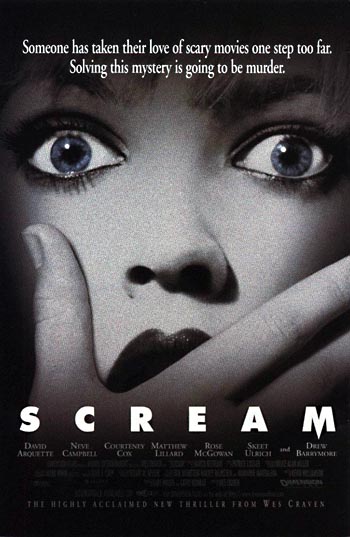


“There are certain rules that one must abide by in order to successfully survive a horror movie. Number one: You can never have sex… Sex equals death… Number two: You can never drink or do drugs. It’s the sin factor, it’s a sin, it’s an extension of number one. And number three, never, ever, under any circumstances say ‘I’ll be right back’, because you won’t be back.” (Craven, 1996)


This quote is taken from the Wes Craven film Scream (1996), a part parody, part pastiche, part postmodern thriller. It can easily be considered the most self-observant horror movie ever made. It examines its own genre clichés and traits with the keenest eye. The ‘sin factor’, which the character of Randy (played by Jamie Kennedy) refers to in Scream, is rightly stated to be the creative force behind these clichés and traits. The ’sin factor’ is central to the nature of horror films, and means that the issue of morality is innate within the genre. The horror film can be viewed as a modern day version of the classical morality tales which took the popular shape of nursery rhymes and fairy tales in the years before cinema was invented. Morality tales are narratives with a clear moral message that is reinforced as the plot unfolds; usually the message of the piece is a warning of some kind that is often set in a metaphorical scenario. The supernatural or hyper real settings and the simplistic plotlines of morality tales are often in place for two reasons. Firstly to simplify the message to a form which is not complicated by the intricacies and ambiguities of the modern world. Secondly to produce messages and warnings about sensitive or recent subjects without directly commenting on those subjects, therefore reducing the culpability for any offence taken by the readership or audience. This is a four part episode and a study of whether horror films can truly be viewed as morality tales, whether the various elements and narrative details of morality tales also apply to horror films.

Horror is arguably films most excessive, extroverted, and exploitative genre, (using in many cases, grim prosthetic effects, sudden bursts of sound or music, incredulous resurrections, and unnecessary scenes of nudity to surprise or titillate the audience) it also has a very conservative undertone intrinsic to most morality tales. This undertone contradicts the violent uncensored approach that most horror films adopt.


The ‘creature feature’ films of the 1950’s are interesting examples where radiation (usually) from A-bombs creates a giant insect or lizard of some kind. This was a thinly veiled metaphor for the then current communist fears, they could be simple everyday creatures like tiny insects, or a friendly next door neighbour, but then nuclear bombs are detonated and they transform into deadly monsters, just as the next door neighbour transforms into a soviet agent ready to invade the USA from within.

P. Wells makes the connection between national fears and the horror movie in the 2000 book The Horror Genre:

“The history of the horror film is essentially a history of anxiety in twentieth century. In the way that fairytales, folktales and gothic romances articulated the fears of the ‘old’ world characterised by a rationale of industrial, technological and economic determinism. Arguably, more than any other genre, it has interrogated the deep-seated effects of change…”


However it has interrogated these effects with a largely conservative bias, essentially fighting against change. This bias is not only in terms of international politics, or xenophobia, but also domestic conservatism.

To Read the Rest of the Introduction

To Listen to the Analysis


The rest of the series:
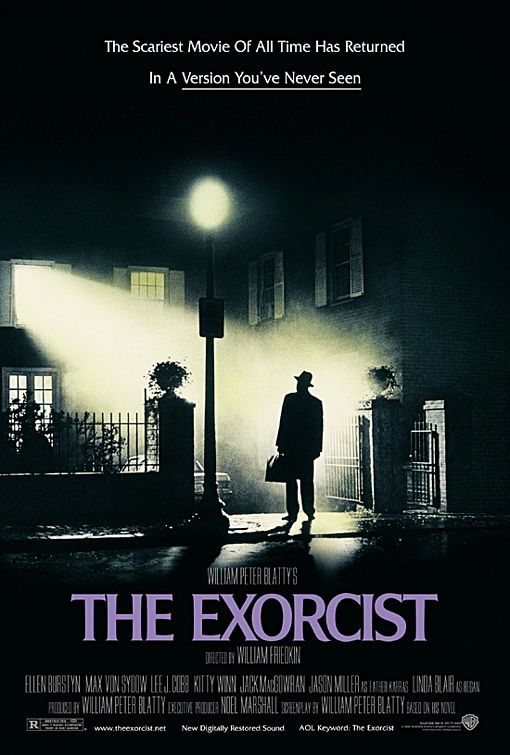


"Horror Movies as Modern Day Morality Tales – The Exorcist."


"Horror Movies as Modern Day Morality Tales – Friday the 13th and Halloween"
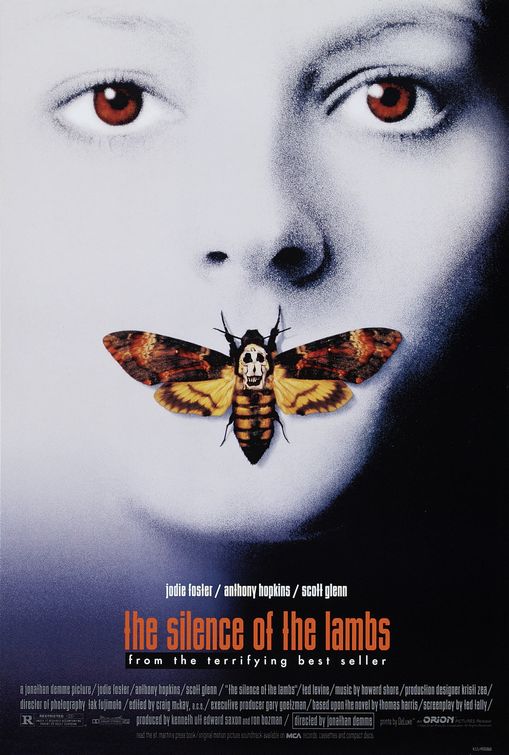


"Horror Movies as Modern Day Morality Tales – The Silence of the Lambs and Se7en."


"Horror Movies as Modern Day Morality Tales – Conclusions."

Monday, June 07, 2010

Scott Tobias: Gateway to Geekery -- Michael Haneke

Gateway to Geekery: Michael Haneke
by Scott Tobias
The A.V. Club


Geek obsession: The films of Austrian director Michael Haneke

Why it’s daunting: From the beginning, Haneke has been a polarizing figure on the international scene, a moralist whose cold appraisals of man’s basest instincts are a far cry from the gentle humanism that tends to win plaudits and awards. He isn’t given to cutting his dark visions with a sliver of hope, and the audience isn’t spared from his scolding—even at its most direct, in the case of 1997’s Funny Games and its 2007 English-language remake.

Possible gateway: Caché

Why: Even after 15 years of lobbing grenades on the festival circuit, where the battle lines between his supporters and detractors had been firmly drawn, Haneke didn’t achieve a real breakthrough success—commercially, and to some extent critically—until his 2005 thriller Caché. And there’s a reason for that: It’s the most accessible and conventionally satisfying film of his career, while also crisply synthesizing his long-running themes and proving again that no director alive can suck the air out of the room quite like Haneke. For Haneke neophytes, it’s both the perfect way to ease into his work—the word “ease” being extremely relative—and a solid primer on what to expect from him.

With echoes of the first two reels of David Lynch’s Lost Highway, the film begins with a Parisian couple (Daniel Auteuil and Juliette Binoche) receiving a videotape that’s nothing but a long static shot of the outside of their apartment. As new tapes arrive on the porch—some wrapped in disturbing, child-like drawings—the images start to open up into a voyeuristic narrative that stretches back into Auteuil’s past. From there, Haneke deepens a precisely calibrated thriller with a sharp critique of bourgeois arrogance and a politically charged allegory on French-Algerian relations.

Alive with the threat of home invasion, dark secrets, and a malevolent voyeur, Caché sustains an air of such unbearable tension that something as minor as a joke at a dinner party leads to the film’s second-biggest jolt. (The biggest will be obvious to anyone who’s seen it.) It also ends on an image of such ambiguity that fans have looked at it literally frame by frame to figure out exactly what happens. Like Haneke’s other work, it’s blunt and unsparing, but it leaves something for viewers to mull over.

To Read the Rest of the Profile

Monday, February 22, 2010

Kevin L. Ferguson: Yuppie devil -- Villainy in Kathryn Bigelow’s Blue Steel

Yuppie devil: villainy in Kathryn Bigelow’s Blue Steel
by Kevin L. Ferguson
Jump Cut

“When Mephistopheles shows up wearing a gold Rolex he’s truly a creature for our age.”
— Janet Maslin


Film critic Janet Maslin must call forth the devil himself to explain the curious appeal of the yuppie to late-80s filmgoers. The yuppie devil at the end of the 80s, though, is more a crafty Mephistopheles than a fearsome Lucifer. A sly character with a keen sense for bargain and an eye for economy, this devil wears his gold Rolex in fashionable display and makes his pacts in public. No more magical, smoke-filled entrances, the devil at the end of the 80s confidently takes his seat at the head of the yuppie bargaining table. The devil’s public appearance as a yuppie points up the heartless greed of that decade, and so Mephistopheles’ gold watch indicates not only his proper place at the yuppie’s table, but also the culpability of those seated across from him (with their own Rolexes, Mont Blanc pens, and Ferragamos). Maslin’s article focuses on two films, Internal Affairs (dir. Mike Figgis, U.S., 1990) and Bad Influence (dir. Curtis Hanson, U.S., 1990), to demonstrate this new trend in late-80s Hollywood cinema, where the formerly successful yuppie was conflated with the newly fashionable serial killer to create the hybrid character of the psychotic, villainous yuppie devil.

In this essay, I want to reexamine a third film that Maslin mentions briefly, Kathryn Bigelow’s Blue Steel (U.S., 1990). Bigelow’s film is unusual since it simultaneously sustains and critiques the new trope of the yuppie devil. Furthermore, the film generated puzzled responses that allow us to see the ambivalent attitudes late-80s spectators held towards this new kind of yuppie villain. For example, even Maslin, in pointing out how yuppie devil films reveal the dangerous effects of “a decade of relative conscience-free complacency,” nonetheless mirrors this complacency by implicitly accepting the merging of yuppie and psycho tropes:

“When [Blue Steel] assumes that [its villain] automatically has the makings of a psychotic killer, it doesn’t imagine itself to be making any kind of leap.”[2]

The self-evident “obviousness” of Blue Steel’s yuppie devil makes the film worth revisiting since its ideological obviousness hides more complex cultural negotiations in the 1980s between economic power and filmic evil. Finally, since Blue Steel features a female heroine who must face the male yuppie devil, the film further questions the obviousness of assumed gender roles in late-80s imaginings of yuppie lifestyles. I will start by offering a reading of Blue Steel which argues that its yuppie devil was hastily dismissed, but is constructed in a significant visual relationship with that film’s heroine. I will then discuss the rapid transformation between 1984-1989 in U.S. popular culture representations of the yuppie from a success story to a symbol of evil.

As Maslin suggested, yuppie devil films like Blue Steel rely on a shared understanding of what the yuppie would signify to a late-80s audience. In that decade, the yuppie was a new figure in the popular imagination who reiterated an U.S. myth of economic success. The term was coined in 1983 and first popularized in 1984, which publications like Newsweek labeled “The Year of the Yuppie.” The word “yuppie,” which comes from mixing the acronym for “young urban professional” with “hippie” or “preppy,”[3] was initially used as a demographic label to describe Baby Boomers

“aged 29 to 35 who live in metropolitan areas, work in professional or managerial occupations, and have an income of at least $30,000 if they live alone.”[4]

Soon, though, “yuppie” became a pejorative description of a lifestyle, and yuppies were identified with a culture of wealth, conspicuous consumption, and conservative politics. Driving a BMW, working on Wall Street, exercising constantly, living in an expensively renovated loft in a gentrified neighborhood, or purchasing imported tarragon vinaigrette from an upscale gourmet store made one a yuppie. A backlash against the expensive, self-absorbed frivolity of the yuppie’s designer lifestyle quickly set in. By the end of the 1980s, the valueless yuppie lifestyle was a ready signifier for the selfish evil born of capitalism, and villains in films like Blue Steel could rely on this signification to scare audiences.

To Read the Rest of the Essay

Green Cine Daily: DVD OF THE WEEK & PODCAST: Revanche (Gotz Spielmann)

DVD OF THE WEEK & PODCAST: Revanche (Gotz Spielmann)
Green Cine Daily


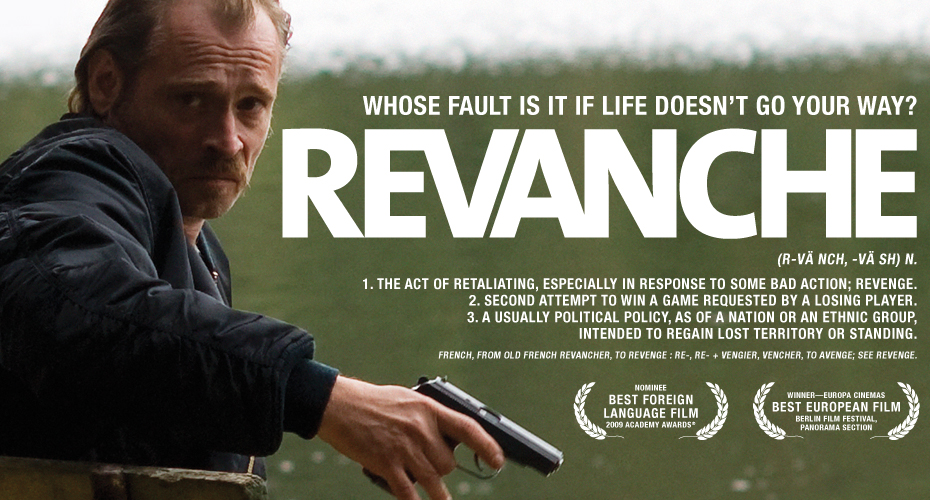
A gripping thriller and a tragic drama of nearly Greek proportions, Revanche is the stunning, Oscar-nominated international breakthrough of Austrian filmmaker Götz Spielmann. In a ragged section of Vienna, hardened ex-con Alex (the mesmerizing Johannes Krisch) works in a brothel, where he falls for Ukrainian hooker Tamara. Their desperate plans for escape unexpectedly intersect with the lives of a rural cop and his seemingly content wife. With meticulous, elegant direction, Spielmann creates a tense, existential, and surprising portrait of vengeance and redemption, and a journey into the darkest forest of human nature, in which violence and beauty exist side by side.

To Listen to the Podcast