Politics Seen to Limit E.P.A. as It Sets Rules for Natural Gas
By IAN URBINA
The New York Times
When Congress considered whether to regulate more closely the handling of wastes from oil and gas drilling in the 1980s, it turned to the Environmental Protection Agency to research the matter. E.P.A. researchers concluded that some of the drillers’ waste was hazardous and should be tightly controlled.
But that is not what Congress heard. Some of the recommendations concerning oil and gas waste were eliminated in the final report handed to lawmakers in 1987.
“It was like the science didn’t matter,” Carla Greathouse, the author of the study, said in a recent interview. “The industry was going to get what it wanted, and we were not supposed to stand in the way.”
E.P.A. officials told her, she said, that her findings were altered because of pressure from the Office of Legal Counsel of the White House under Ronald Reagan. A spokesman for the E.P.A. declined to comment.
Ms. Greathouse’s experience was not an isolated case. More than a quarter century of efforts by some lawmakers and regulators to force the federal government to police the industry better have been thwarted, as E.P.A. studies have been repeatedly narrowed in scope, and important findings have been removed.
For example, the agency had planned to call last year for a moratorium on the gas-drilling technique known as hydrofracking in the New York City watershed, according to internal documents, but the advice was removed from the publicly released letter sent to New York.
Now some scientists and lawyers at the E.P.A. are wondering whether history is about to repeat itself, as the agency undertakes a broad new study of natural gas drilling and its potential risks, with preliminary results scheduled to be delivered next year.
The documents show that the agency dropped some plans to model radioactivity in drilling wastewater being discharged by treatment plants into rivers upstream from drinking water intake plants. And in Congress, members from drilling states like Oklahoma have pressured the agency to keep the focus of the new study narrow.
They have been helped in their lobbying efforts by a compelling storyline: Cutting red tape helps these energy companies reduce the nation’s dependence on other countries for fuel. Natural gas is also a cleaner-burning alternative to coal and plentiful within United States borders, so it can create jobs.
But interviews with E.P.A. scientists, and confidential documents obtained by The New York Times, show long and deep divisions within the agency over whether and how to increase regulation of oil and gas drillers, and over the enforcement of existing laws that some agency officials say are clearly being violated.
Agency lawyers are in a heated debate over whether to intervene in Pennsylvania, where drilling for gas has increased sharply, to stop what some of those lawyers say is a clear violation of federal pollution laws: drilling waste discharged into rivers and streams with minimal treatment. The outcome of that dispute has the potential to halt the breakneck growth of drilling in Pennsylvania.
The E.P.A. has taken strong stands in some places, like Texas, where in December it overrode state regulators and intervened after a local driller was suspected of water contamination. Elsewhere, the agency has pulled its punches, as in New York.
Asked why the letter about hydrofracking in the New York City watershed had been revised, an agency scientist who was involved in writing it offered a one-word explanation: “politics.”
Natural gas drilling companies have major exemptions from parts of at least seven of the 15 sweeping federal environmental laws that regulate most other heavy industries and that were written to protect air and drinking water from radioactive and hazardous chemicals.
Coal mine operators that want to inject toxic wastewater into the ground must get permission from the federal authorities. But when natural gas companies want to inject chemical-laced water and sand into the ground during hydrofracking, they do not have to follow the same rules.
The air pollution from a sprawling steel plant with different buildings is added together when regulators decide whether certain strict rules will apply. At a natural gas site, the toxic fumes from various parts of it — a compressor station and a storage tank, for example — are counted separately rather than cumulatively, so many overall gas well operations are subject to looser caps on their emissions.
An Earlier Reversal
The E.P.A. also studied hydrofracking in 2004, when Congress considered whether the process should be fully regulated by the Safe Drinking Water Act.
An early draft of the study discussed potentially dangerous levels of contamination in hydrofracking fluids and mentioned “possible evidence” of contamination of an aquifer. The final version of the report excluded these points, concluding instead that hydrofracking “poses little or no threat to drinking water.”
Shortly after the study was released, an E.P.A. whistleblower said the agency had been strongly influenced by industry and political pressure. Agency leaders at the time stood by the study’s findings.
“It was shameful,” Weston Wilson, the E.P.A. whistleblower, said in a recent interview about the study. He explained that five of the seven members of that study’s peer review panel were current or former employees of the oil and gas industry.
“The study ended up being the basis for this industry getting yet another exemption from federal law when it should have resulted in greater regulation of this industry,” Mr. Wilson added.
Some E.P.A. scientists say this pattern may be playing out again in the national study of hydrofracking that Congress will consider as it decides whether drillers will have to operate under stricter rules.
Internal documents from early meetings, obtained through public-records requests filed by The Times and provided by E.P.A. officials who are frustrated with how research is being handled, show agency field scientists demanding that certain topics be included in the study. And earlier versions of the research plan indicate that many of those topics were to be included.
For example, the study was to consider the dangers of toxic fumes released during drilling, the impact of drilling waste on the food chain and the risks of this radioactive waste to workers.
But many of these concerns, cited by field scientists in earlier documents as high priorities, were cut from the current study plan, according to a version of it made public on Feb. 8.
Earlier planning documents also called for a study of the risks of contaminated runoff from landfills where drilling waste is disposed and included detailed plans to model whether rivers can sufficiently dilute hazardous gas-well wastewater discharged from treatment plants.
These topics were cut from the current study plan, even though E.P.A. officials have acknowledged that sewage treatment plants are not able to treat drilling waste fully before it is discharged into rivers, sometimes just miles upstream from drinking water intake plants. While the current study plan clearly indicates that the agency plans to research various types of radioactivity concerns related to natural gas drilling, this river modeling, which E.P.A. scientists say is important, has been removed.
In interviews, several agency scientists and consultants, who declined to be named for fear of reprisals, said the study was narrowed because of pressure from industry and its allies in Congress, as well as budget and time constraints.
Brendan Gilfillan, an agency spokesman, said that the plan remained broad and that the agency had taken additional steps to investigate the impacts of drilling, including recently issuing a subpoena against the energy services company Halliburton to force the company to provide fuller disclosure about its drilling operations.
To Read the Rest of the Article
Showing posts with label 1980s. Show all posts
Showing posts with label 1980s. Show all posts
Thursday, March 03, 2011

Wednesday, October 13, 2010
Left Field Cinema: The Political Position of Glengarry Glen Ross
The Political Position of Glengarry Glen Ross
by Mike Dawson
Left Field Cinema
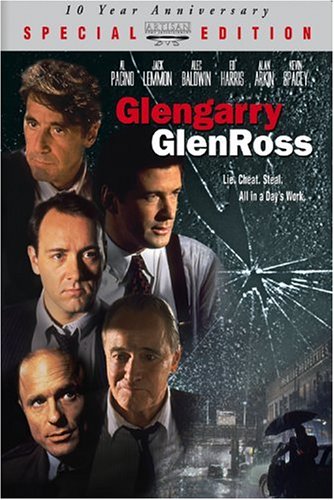
The early 1980’s. This is the era; the time when David Mamet wrote Glengarry Glen Ross. A play about the competitive and ruthless world of a real estate salesman. A play which is very reflective of its time. The early 1980’s in the United States of America is a time of consumerism; materialism; and of competition. Ronald Reagan was the president of the country for most of the decade; as a result the trend of the rich getting richer and the poor getting poorer was largely due to his administration and the creation of Reaganism. A set of economic policies very similar to Thatcherism; which was rising in Britain at the same time. Reaganism centred on the individual prospering.
Ronald Reagan was inaugurated President in 1980 and succeeded James Carter, the democrat. He would usher in a twelve-year era of Republican Party rule, which would change the shape of the USA in many ways. The US was a nation still dealing with the scars of the Watergate scandal and the Vietnam War, scars which hadn’t been healed completely by the Carter Administration. Both Carter and Reagan were elected largely because of public dissatisfaction with the current state of affairs in Washington. There was a lack of trust. They were both political outsiders; from other states and had little to do with central government until their elections to President.
“Both Carter and Reagan played successfully on business or public dissatisfaction with government to get elected… Once in office they became targets. They were outsiders who became insiders, anti-Washington candidates who became, with success, the very symbol of Washington.” (Fawcett and Thomas, 1983, 140)
Where Carter failed to heal the nation, Reagan partly succeeded. Instead of trying to be the ‘outsider’ after taking office. He worked on ways of making the people trust Washington again. Unlike Carter, he was an actor, and managed the public well for the most part.
“Carter a conservative Southern populist campaigned under Democratic colours, who promised lower defence spending and national health insurance, raised the first and never got around to the second.” (Fawcett and Thomas, 1983, 166)
Instead of continuing to heal the wounds of the Nixon era; Reagan decided to change the way people felt and what they were thinking by a series of new laws, which would radically alter the labour forces. “By partially ‘deregulating’ labour relations along with banking and transportation, Reagan has paved the way for more rapid capital flight, plant closure, deunionisation, and the proliferation of all manner of new sweated industries. In the process he has also eliminated, temporarily or permanently, the judicial supports upon which the practice of bureaucratic trade unionism has vitally depended for over a generation.” (Davis, 1986, 131)
The Reagan administration - similarly to the Thatcher government – had a goal of phasing out the work unions. This was done primarily to make new work related laws easier to enforce. The new laws created a situation where low level employees were paid less, and the higher level employees were paid more. Attorneys, stockbrokers, landowners, and many other professions in the private sector all earned more. Meanwhile government workers, and others suffered from pay cuts and redundancies. One of the laws which allowed this difference in wages to expand was the ‘two tier’ system. The system was created allowed the more recently commissioned employees to be started on a lower wage than their older counterparts for doing the same job. This encouraged many employers to simply make redundant older employees and bring a cheaper and younger work force whose pensions weren’t close at hand. Another law was introduced which allowed part time workers to be paid less than the full time workers. This encouraged full time workers to be replaced by part time workers.
To Read the Rest of the Analysis
To Listen to the Analysis
by Mike Dawson
Left Field Cinema
The early 1980’s. This is the era; the time when David Mamet wrote Glengarry Glen Ross. A play about the competitive and ruthless world of a real estate salesman. A play which is very reflective of its time. The early 1980’s in the United States of America is a time of consumerism; materialism; and of competition. Ronald Reagan was the president of the country for most of the decade; as a result the trend of the rich getting richer and the poor getting poorer was largely due to his administration and the creation of Reaganism. A set of economic policies very similar to Thatcherism; which was rising in Britain at the same time. Reaganism centred on the individual prospering.
Ronald Reagan was inaugurated President in 1980 and succeeded James Carter, the democrat. He would usher in a twelve-year era of Republican Party rule, which would change the shape of the USA in many ways. The US was a nation still dealing with the scars of the Watergate scandal and the Vietnam War, scars which hadn’t been healed completely by the Carter Administration. Both Carter and Reagan were elected largely because of public dissatisfaction with the current state of affairs in Washington. There was a lack of trust. They were both political outsiders; from other states and had little to do with central government until their elections to President.
“Both Carter and Reagan played successfully on business or public dissatisfaction with government to get elected… Once in office they became targets. They were outsiders who became insiders, anti-Washington candidates who became, with success, the very symbol of Washington.” (Fawcett and Thomas, 1983, 140)
Where Carter failed to heal the nation, Reagan partly succeeded. Instead of trying to be the ‘outsider’ after taking office. He worked on ways of making the people trust Washington again. Unlike Carter, he was an actor, and managed the public well for the most part.
“Carter a conservative Southern populist campaigned under Democratic colours, who promised lower defence spending and national health insurance, raised the first and never got around to the second.” (Fawcett and Thomas, 1983, 166)
Instead of continuing to heal the wounds of the Nixon era; Reagan decided to change the way people felt and what they were thinking by a series of new laws, which would radically alter the labour forces. “By partially ‘deregulating’ labour relations along with banking and transportation, Reagan has paved the way for more rapid capital flight, plant closure, deunionisation, and the proliferation of all manner of new sweated industries. In the process he has also eliminated, temporarily or permanently, the judicial supports upon which the practice of bureaucratic trade unionism has vitally depended for over a generation.” (Davis, 1986, 131)
The Reagan administration - similarly to the Thatcher government – had a goal of phasing out the work unions. This was done primarily to make new work related laws easier to enforce. The new laws created a situation where low level employees were paid less, and the higher level employees were paid more. Attorneys, stockbrokers, landowners, and many other professions in the private sector all earned more. Meanwhile government workers, and others suffered from pay cuts and redundancies. One of the laws which allowed this difference in wages to expand was the ‘two tier’ system. The system was created allowed the more recently commissioned employees to be started on a lower wage than their older counterparts for doing the same job. This encouraged many employers to simply make redundant older employees and bring a cheaper and younger work force whose pensions weren’t close at hand. Another law was introduced which allowed part time workers to be paid less than the full time workers. This encouraged full time workers to be replaced by part time workers.
To Read the Rest of the Analysis
To Listen to the Analysis
Monday, February 22, 2010
Kevin L. Ferguson: Yuppie devil -- Villainy in Kathryn Bigelow’s Blue Steel
Yuppie devil: villainy in Kathryn Bigelow’s Blue Steel
by Kevin L. Ferguson
Jump Cut
“When Mephistopheles shows up wearing a gold Rolex he’s truly a creature for our age.”
— Janet Maslin

Film critic Janet Maslin must call forth the devil himself to explain the curious appeal of the yuppie to late-80s filmgoers. The yuppie devil at the end of the 80s, though, is more a crafty Mephistopheles than a fearsome Lucifer. A sly character with a keen sense for bargain and an eye for economy, this devil wears his gold Rolex in fashionable display and makes his pacts in public. No more magical, smoke-filled entrances, the devil at the end of the 80s confidently takes his seat at the head of the yuppie bargaining table. The devil’s public appearance as a yuppie points up the heartless greed of that decade, and so Mephistopheles’ gold watch indicates not only his proper place at the yuppie’s table, but also the culpability of those seated across from him (with their own Rolexes, Mont Blanc pens, and Ferragamos). Maslin’s article focuses on two films, Internal Affairs (dir. Mike Figgis, U.S., 1990) and Bad Influence (dir. Curtis Hanson, U.S., 1990), to demonstrate this new trend in late-80s Hollywood cinema, where the formerly successful yuppie was conflated with the newly fashionable serial killer to create the hybrid character of the psychotic, villainous yuppie devil.
In this essay, I want to reexamine a third film that Maslin mentions briefly, Kathryn Bigelow’s Blue Steel (U.S., 1990). Bigelow’s film is unusual since it simultaneously sustains and critiques the new trope of the yuppie devil. Furthermore, the film generated puzzled responses that allow us to see the ambivalent attitudes late-80s spectators held towards this new kind of yuppie villain. For example, even Maslin, in pointing out how yuppie devil films reveal the dangerous effects of “a decade of relative conscience-free complacency,” nonetheless mirrors this complacency by implicitly accepting the merging of yuppie and psycho tropes:
“When [Blue Steel] assumes that [its villain] automatically has the makings of a psychotic killer, it doesn’t imagine itself to be making any kind of leap.”[2]
The self-evident “obviousness” of Blue Steel’s yuppie devil makes the film worth revisiting since its ideological obviousness hides more complex cultural negotiations in the 1980s between economic power and filmic evil. Finally, since Blue Steel features a female heroine who must face the male yuppie devil, the film further questions the obviousness of assumed gender roles in late-80s imaginings of yuppie lifestyles. I will start by offering a reading of Blue Steel which argues that its yuppie devil was hastily dismissed, but is constructed in a significant visual relationship with that film’s heroine. I will then discuss the rapid transformation between 1984-1989 in U.S. popular culture representations of the yuppie from a success story to a symbol of evil.
As Maslin suggested, yuppie devil films like Blue Steel rely on a shared understanding of what the yuppie would signify to a late-80s audience. In that decade, the yuppie was a new figure in the popular imagination who reiterated an U.S. myth of economic success. The term was coined in 1983 and first popularized in 1984, which publications like Newsweek labeled “The Year of the Yuppie.” The word “yuppie,” which comes from mixing the acronym for “young urban professional” with “hippie” or “preppy,”[3] was initially used as a demographic label to describe Baby Boomers
“aged 29 to 35 who live in metropolitan areas, work in professional or managerial occupations, and have an income of at least $30,000 if they live alone.”[4]
Soon, though, “yuppie” became a pejorative description of a lifestyle, and yuppies were identified with a culture of wealth, conspicuous consumption, and conservative politics. Driving a BMW, working on Wall Street, exercising constantly, living in an expensively renovated loft in a gentrified neighborhood, or purchasing imported tarragon vinaigrette from an upscale gourmet store made one a yuppie. A backlash against the expensive, self-absorbed frivolity of the yuppie’s designer lifestyle quickly set in. By the end of the 1980s, the valueless yuppie lifestyle was a ready signifier for the selfish evil born of capitalism, and villains in films like Blue Steel could rely on this signification to scare audiences.
To Read the Rest of the Essay
by Kevin L. Ferguson
Jump Cut
“When Mephistopheles shows up wearing a gold Rolex he’s truly a creature for our age.”
— Janet Maslin
Film critic Janet Maslin must call forth the devil himself to explain the curious appeal of the yuppie to late-80s filmgoers. The yuppie devil at the end of the 80s, though, is more a crafty Mephistopheles than a fearsome Lucifer. A sly character with a keen sense for bargain and an eye for economy, this devil wears his gold Rolex in fashionable display and makes his pacts in public. No more magical, smoke-filled entrances, the devil at the end of the 80s confidently takes his seat at the head of the yuppie bargaining table. The devil’s public appearance as a yuppie points up the heartless greed of that decade, and so Mephistopheles’ gold watch indicates not only his proper place at the yuppie’s table, but also the culpability of those seated across from him (with their own Rolexes, Mont Blanc pens, and Ferragamos). Maslin’s article focuses on two films, Internal Affairs (dir. Mike Figgis, U.S., 1990) and Bad Influence (dir. Curtis Hanson, U.S., 1990), to demonstrate this new trend in late-80s Hollywood cinema, where the formerly successful yuppie was conflated with the newly fashionable serial killer to create the hybrid character of the psychotic, villainous yuppie devil.
In this essay, I want to reexamine a third film that Maslin mentions briefly, Kathryn Bigelow’s Blue Steel (U.S., 1990). Bigelow’s film is unusual since it simultaneously sustains and critiques the new trope of the yuppie devil. Furthermore, the film generated puzzled responses that allow us to see the ambivalent attitudes late-80s spectators held towards this new kind of yuppie villain. For example, even Maslin, in pointing out how yuppie devil films reveal the dangerous effects of “a decade of relative conscience-free complacency,” nonetheless mirrors this complacency by implicitly accepting the merging of yuppie and psycho tropes:
“When [Blue Steel] assumes that [its villain] automatically has the makings of a psychotic killer, it doesn’t imagine itself to be making any kind of leap.”[2]
The self-evident “obviousness” of Blue Steel’s yuppie devil makes the film worth revisiting since its ideological obviousness hides more complex cultural negotiations in the 1980s between economic power and filmic evil. Finally, since Blue Steel features a female heroine who must face the male yuppie devil, the film further questions the obviousness of assumed gender roles in late-80s imaginings of yuppie lifestyles. I will start by offering a reading of Blue Steel which argues that its yuppie devil was hastily dismissed, but is constructed in a significant visual relationship with that film’s heroine. I will then discuss the rapid transformation between 1984-1989 in U.S. popular culture representations of the yuppie from a success story to a symbol of evil.
As Maslin suggested, yuppie devil films like Blue Steel rely on a shared understanding of what the yuppie would signify to a late-80s audience. In that decade, the yuppie was a new figure in the popular imagination who reiterated an U.S. myth of economic success. The term was coined in 1983 and first popularized in 1984, which publications like Newsweek labeled “The Year of the Yuppie.” The word “yuppie,” which comes from mixing the acronym for “young urban professional” with “hippie” or “preppy,”[3] was initially used as a demographic label to describe Baby Boomers
“aged 29 to 35 who live in metropolitan areas, work in professional or managerial occupations, and have an income of at least $30,000 if they live alone.”[4]
Soon, though, “yuppie” became a pejorative description of a lifestyle, and yuppies were identified with a culture of wealth, conspicuous consumption, and conservative politics. Driving a BMW, working on Wall Street, exercising constantly, living in an expensively renovated loft in a gentrified neighborhood, or purchasing imported tarragon vinaigrette from an upscale gourmet store made one a yuppie. A backlash against the expensive, self-absorbed frivolity of the yuppie’s designer lifestyle quickly set in. By the end of the 1980s, the valueless yuppie lifestyle was a ready signifier for the selfish evil born of capitalism, and villains in films like Blue Steel could rely on this signification to scare audiences.
To Read the Rest of the Essay
Subscribe to:
Posts (Atom)