Documentary Stream
Human Resources explores the rise of mechanistic philosophy and the exploitation of human beings under modern hierarchical systems. Topics covered include behaviorism, scientific management, work-place democracy, schooling, frustration-aggression hypothesis and human experimentation.
Sources:
Anarcho -- Anti-Capitalism or State Capitalism?
Beissinger, Mark R. -- Scientific Management, socialist discipline and Soviet power
Chang, Iris -- the Rape of Nanking
Cockburn, Alex and St. Claire, Jeffrey -- Whiteout: The CIA, drugs and the press
Gatto, John Taylor -- The Underground History of American Education; Dumbing Us Down
Goliszek, Andrew -- In the name of science
Klein, Naomi -- The Shock Doctrine
Kohn, Alfie -- What does it mean to be well-educated?; No contest: the case against competition
Lemov, Rebecca -- World as Laboratory: Experiments with mice, mazes and men
Noble, David -- Forces of Production: a social history of industrial automation
Ritzer, George -- The McDonaldization of Society
Shepherd, Harold & Herrick, Neil -- Where Have All the Robots Gone?
Smith, Sharon -- Subterranean Fire: A History of working class radicalism
Szulc, Tad -- The CIA's Electric Kool-Aid Acid Test
Showing posts with label Competition. Show all posts
Showing posts with label Competition. Show all posts
Wednesday, March 09, 2011

Wednesday, October 13, 2010
Left Field Cinema: The Political Position of Glengarry Glen Ross
The Political Position of Glengarry Glen Ross
by Mike Dawson
Left Field Cinema
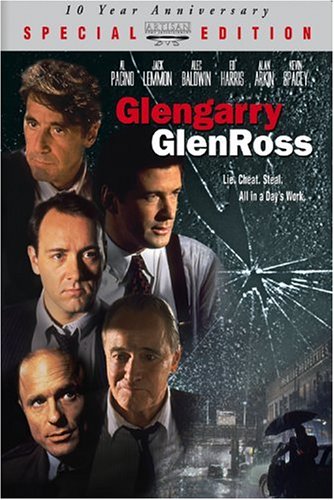
The early 1980’s. This is the era; the time when David Mamet wrote Glengarry Glen Ross. A play about the competitive and ruthless world of a real estate salesman. A play which is very reflective of its time. The early 1980’s in the United States of America is a time of consumerism; materialism; and of competition. Ronald Reagan was the president of the country for most of the decade; as a result the trend of the rich getting richer and the poor getting poorer was largely due to his administration and the creation of Reaganism. A set of economic policies very similar to Thatcherism; which was rising in Britain at the same time. Reaganism centred on the individual prospering.
Ronald Reagan was inaugurated President in 1980 and succeeded James Carter, the democrat. He would usher in a twelve-year era of Republican Party rule, which would change the shape of the USA in many ways. The US was a nation still dealing with the scars of the Watergate scandal and the Vietnam War, scars which hadn’t been healed completely by the Carter Administration. Both Carter and Reagan were elected largely because of public dissatisfaction with the current state of affairs in Washington. There was a lack of trust. They were both political outsiders; from other states and had little to do with central government until their elections to President.
“Both Carter and Reagan played successfully on business or public dissatisfaction with government to get elected… Once in office they became targets. They were outsiders who became insiders, anti-Washington candidates who became, with success, the very symbol of Washington.” (Fawcett and Thomas, 1983, 140)
Where Carter failed to heal the nation, Reagan partly succeeded. Instead of trying to be the ‘outsider’ after taking office. He worked on ways of making the people trust Washington again. Unlike Carter, he was an actor, and managed the public well for the most part.
“Carter a conservative Southern populist campaigned under Democratic colours, who promised lower defence spending and national health insurance, raised the first and never got around to the second.” (Fawcett and Thomas, 1983, 166)
Instead of continuing to heal the wounds of the Nixon era; Reagan decided to change the way people felt and what they were thinking by a series of new laws, which would radically alter the labour forces. “By partially ‘deregulating’ labour relations along with banking and transportation, Reagan has paved the way for more rapid capital flight, plant closure, deunionisation, and the proliferation of all manner of new sweated industries. In the process he has also eliminated, temporarily or permanently, the judicial supports upon which the practice of bureaucratic trade unionism has vitally depended for over a generation.” (Davis, 1986, 131)
The Reagan administration - similarly to the Thatcher government – had a goal of phasing out the work unions. This was done primarily to make new work related laws easier to enforce. The new laws created a situation where low level employees were paid less, and the higher level employees were paid more. Attorneys, stockbrokers, landowners, and many other professions in the private sector all earned more. Meanwhile government workers, and others suffered from pay cuts and redundancies. One of the laws which allowed this difference in wages to expand was the ‘two tier’ system. The system was created allowed the more recently commissioned employees to be started on a lower wage than their older counterparts for doing the same job. This encouraged many employers to simply make redundant older employees and bring a cheaper and younger work force whose pensions weren’t close at hand. Another law was introduced which allowed part time workers to be paid less than the full time workers. This encouraged full time workers to be replaced by part time workers.
To Read the Rest of the Analysis
To Listen to the Analysis
by Mike Dawson
Left Field Cinema
The early 1980’s. This is the era; the time when David Mamet wrote Glengarry Glen Ross. A play about the competitive and ruthless world of a real estate salesman. A play which is very reflective of its time. The early 1980’s in the United States of America is a time of consumerism; materialism; and of competition. Ronald Reagan was the president of the country for most of the decade; as a result the trend of the rich getting richer and the poor getting poorer was largely due to his administration and the creation of Reaganism. A set of economic policies very similar to Thatcherism; which was rising in Britain at the same time. Reaganism centred on the individual prospering.
Ronald Reagan was inaugurated President in 1980 and succeeded James Carter, the democrat. He would usher in a twelve-year era of Republican Party rule, which would change the shape of the USA in many ways. The US was a nation still dealing with the scars of the Watergate scandal and the Vietnam War, scars which hadn’t been healed completely by the Carter Administration. Both Carter and Reagan were elected largely because of public dissatisfaction with the current state of affairs in Washington. There was a lack of trust. They were both political outsiders; from other states and had little to do with central government until their elections to President.
“Both Carter and Reagan played successfully on business or public dissatisfaction with government to get elected… Once in office they became targets. They were outsiders who became insiders, anti-Washington candidates who became, with success, the very symbol of Washington.” (Fawcett and Thomas, 1983, 140)
Where Carter failed to heal the nation, Reagan partly succeeded. Instead of trying to be the ‘outsider’ after taking office. He worked on ways of making the people trust Washington again. Unlike Carter, he was an actor, and managed the public well for the most part.
“Carter a conservative Southern populist campaigned under Democratic colours, who promised lower defence spending and national health insurance, raised the first and never got around to the second.” (Fawcett and Thomas, 1983, 166)
Instead of continuing to heal the wounds of the Nixon era; Reagan decided to change the way people felt and what they were thinking by a series of new laws, which would radically alter the labour forces. “By partially ‘deregulating’ labour relations along with banking and transportation, Reagan has paved the way for more rapid capital flight, plant closure, deunionisation, and the proliferation of all manner of new sweated industries. In the process he has also eliminated, temporarily or permanently, the judicial supports upon which the practice of bureaucratic trade unionism has vitally depended for over a generation.” (Davis, 1986, 131)
The Reagan administration - similarly to the Thatcher government – had a goal of phasing out the work unions. This was done primarily to make new work related laws easier to enforce. The new laws created a situation where low level employees were paid less, and the higher level employees were paid more. Attorneys, stockbrokers, landowners, and many other professions in the private sector all earned more. Meanwhile government workers, and others suffered from pay cuts and redundancies. One of the laws which allowed this difference in wages to expand was the ‘two tier’ system. The system was created allowed the more recently commissioned employees to be started on a lower wage than their older counterparts for doing the same job. This encouraged many employers to simply make redundant older employees and bring a cheaper and younger work force whose pensions weren’t close at hand. Another law was introduced which allowed part time workers to be paid less than the full time workers. This encouraged full time workers to be replaced by part time workers.
To Read the Rest of the Analysis
To Listen to the Analysis
Subscribe to:
Posts (Atom)