Showing posts with label Austria. Show all posts

Saturday, October 16, 2010

Armond White: Revival of the Fittest

(ENG 282 students--this is a highly recommended film that is one of your options for outside viewing responses)

Revival of the Fittest
by Armond White
Criterion Collection


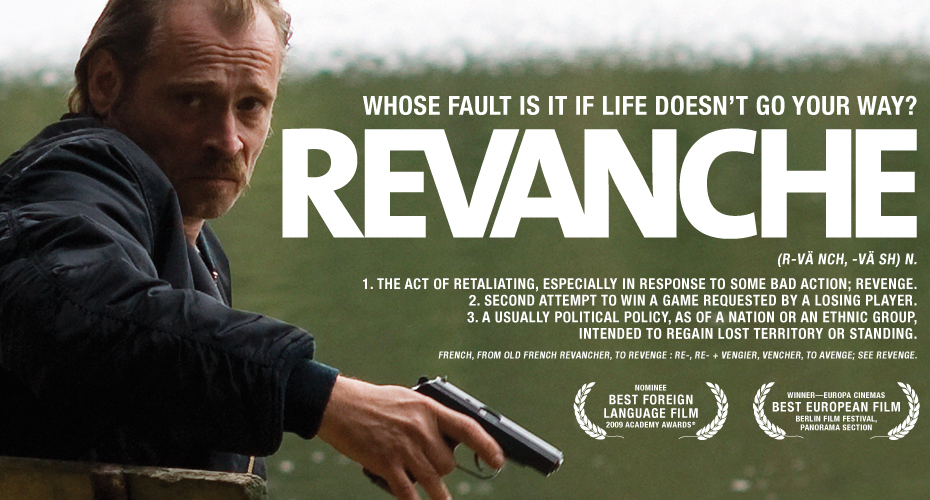
Revanche begins with a reflection of trees in a lake at twilight. They’re seen upside down—an image of nature reversed—yet the earth is eerily calm. This almost otherworldly illusion arouses a viewer’s awareness of perspective, which is then disturbed by the splash of an object tossed into the middle of the lake. Widening ripples shatter the impression of stillness, and a genuine sense of mystery sets in. Such an intimation of the supernatural typifies Austrian writer-director Götz Spielmann’s unique vision in this film.

Although Revanche is Spielmann’s first film to be released in the United States, it is actually his fifth overall, so his style and tone come to us fully developed. He began his career as a playwright, yet Revanche is thoroughly cinematic in story, look, and pace. Its chronicle of underworld desperation and domestic loyalties observes a plain, uncontrived natural universe whose immanence and splendor are depicted realistically, mysteriously, classically. This is the story of several seemingly unrelated characters whose interconnectedness evokes the quizzical, unknowable facts of existence and announces the potential of faith.

Spielmann’s arrival on the American film scene is exciting for the way Revanche opposes the contemporary trend toward dark pessimism with a vision that contemplates light and, conditionally, belief. At one point, a repentant character is asked, “What would your God say?” and she answers, “He’d understand.” Revanche’s plot resembles classic film noir yet ultimately renovates it: Alex (Johannes Krisch), a strapping ex-convict working as a bouncer at the Cinderella, a bar/brothel in Vienna, schemes to escape that mean world, along with Tamara (Irina Potapenko), a Ukrainian immigrant working there as a stripper and prostitute, by robbing a bank and investing the money in a friend’s bar. An unforeseen turn of events reconnects Alex to his estranged grandfather, Hausner (Hannes Thanheiser), an elderly farmer in a small village, and to the rural life Alex escaped. These events also irrevocably tie Alex’s and Tamara’s fates to those of a couple living near Hausner’s farm, policeman Robert (Andreas Lust) and housewife Susanne (Ursula Strauss). Moving from city to country allows Spielmann to poignantly contrast the experiences of the two couples.

But these characters’ relationships go deeper than dramatic coincidence. By giving both couples equal narrative weight, Spielmann shows striking commonalities among seemingly different people. When Robert complains of being cursed with bad luck, he echoes Alex’s earlier cry of desperation. Each of the four main characters becomes involved in a form of retaliation against life’s unfairness (Revanche is German for “revenge,” as well as “second chance,” as in a rematch). Spielmann’s classical unities and timeless storytelling verities avoid sentimentality and thus seem fresh.

Like that disturbing image of an upside-down lakefront, Spielmann’s charac­ters change our perspective on the world and life as movies conventionally present them. The spiritual conflicts of the dead-end urban underground, where gangsters and hookers deceive and exploit one another, extend to the peaceful-looking countryside, where people live in neat houses and work in respectable professions. Bringing together urban and rural struggle, Spielmann balances mankind’s philosophical quandaries and daily strife, searching for meaning in our shared fate.

To Read the Rest of the Essay

Sunday, July 04, 2010

Video Roundtable on Michael Haneke's Cache (2005)

Caché - Videoed roundtable discussion of Michael Haneke's film with Roy Grundman, Edward Nersessian, Brigitte Peucker, Brian Price, and Garrett Stewart (1hr25), Philoctetes Center

Link to view the discussion

Monday, June 07, 2010

Scott Tobias: Gateway to Geekery -- Michael Haneke

Gateway to Geekery: Michael Haneke
by Scott Tobias
The A.V. Club


Geek obsession: The films of Austrian director Michael Haneke

Why it’s daunting: From the beginning, Haneke has been a polarizing figure on the international scene, a moralist whose cold appraisals of man’s basest instincts are a far cry from the gentle humanism that tends to win plaudits and awards. He isn’t given to cutting his dark visions with a sliver of hope, and the audience isn’t spared from his scolding—even at its most direct, in the case of 1997’s Funny Games and its 2007 English-language remake.

Possible gateway: Caché

Why: Even after 15 years of lobbing grenades on the festival circuit, where the battle lines between his supporters and detractors had been firmly drawn, Haneke didn’t achieve a real breakthrough success—commercially, and to some extent critically—until his 2005 thriller Caché. And there’s a reason for that: It’s the most accessible and conventionally satisfying film of his career, while also crisply synthesizing his long-running themes and proving again that no director alive can suck the air out of the room quite like Haneke. For Haneke neophytes, it’s both the perfect way to ease into his work—the word “ease” being extremely relative—and a solid primer on what to expect from him.

With echoes of the first two reels of David Lynch’s Lost Highway, the film begins with a Parisian couple (Daniel Auteuil and Juliette Binoche) receiving a videotape that’s nothing but a long static shot of the outside of their apartment. As new tapes arrive on the porch—some wrapped in disturbing, child-like drawings—the images start to open up into a voyeuristic narrative that stretches back into Auteuil’s past. From there, Haneke deepens a precisely calibrated thriller with a sharp critique of bourgeois arrogance and a politically charged allegory on French-Algerian relations.

Alive with the threat of home invasion, dark secrets, and a malevolent voyeur, Caché sustains an air of such unbearable tension that something as minor as a joke at a dinner party leads to the film’s second-biggest jolt. (The biggest will be obvious to anyone who’s seen it.) It also ends on an image of such ambiguity that fans have looked at it literally frame by frame to figure out exactly what happens. Like Haneke’s other work, it’s blunt and unsparing, but it leaves something for viewers to mull over.

To Read the Rest of the Profile

Sunday, May 09, 2010

The Marketplace of Ideas: Peter Brunette on Austrian Filmmaker Michael Haneke

Peter Brunette on Austrian Director Michael Haneke
The Marketplace of Ideas (KCSB: Santa Monica)


Colin Marshall talks to Peter Brunette, Reynolds Professor of Film Studies and director of the Film Studies program at Wake Forest University. The author of books on such beloved filmmakers as Michelangelo Antonioni, Wong Kar-Wai and Roberto Rossellini, Brunette has now written a book on Austrian cinematic provocateur Michael Haneke. The latest published entry in the University of Illinois Press’ “Contemporary Film Directors” series, Michael Haneke examines in depth the art of and the ideas behind the auteur’s theatrical releases, from late-1980s and early-1990s works such as The Seventh Continent and Benny’s Video through his newest and best-known pictures Caché and The White Ribbon.

To Listen to the Episode (MP3)

Monday, February 22, 2010

Green Cine Daily: DVD OF THE WEEK & PODCAST: Revanche (Gotz Spielmann)

DVD OF THE WEEK & PODCAST: Revanche (Gotz Spielmann)
Green Cine Daily


A gripping thriller and a tragic drama of nearly Greek proportions, Revanche is the stunning, Oscar-nominated international breakthrough of Austrian filmmaker Götz Spielmann. In a ragged section of Vienna, hardened ex-con Alex (the mesmerizing Johannes Krisch) works in a brothel, where he falls for Ukrainian hooker Tamara. Their desperate plans for escape unexpectedly intersect with the lives of a rural cop and his seemingly content wife. With meticulous, elegant direction, Spielmann creates a tense, existential, and surprising portrait of vengeance and redemption, and a journey into the darkest forest of human nature, in which violence and beauty exist side by side.

To Listen to the Podcast

Friday, January 22, 2010

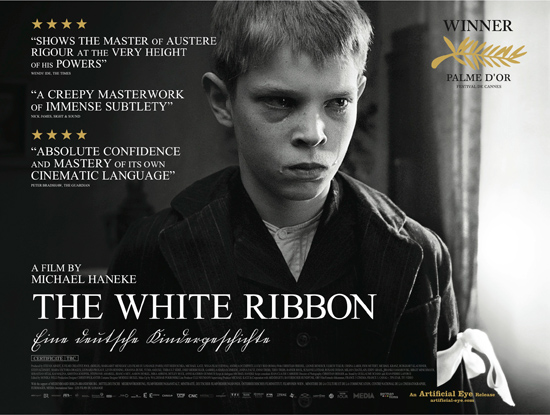
Alexander Horwath: Michael Haneke -- Talking shop, theory, and practice with the director of The White Ribbon

MICHAEL HANEKE UNCUT: Talking shop, theory, and practice with the director of The White Ribbon
by Alexander Horwath
Film Comment


ALEXANDER HORWATH: Is it a coincidence that you followed your American remake of Funny Games, a production that in some ways seems the most “foreign” in your career, with a work that moves deeper into your own culture and its history than any of your previous films?

MICHAEL HANEKE: It’s pure coincidence; nothing pre-planned about it. To be honest, it’s hard to talk about the “inner logic” of one’s own work. I rarely think about such things. It’s certainly easier to categorize after the fact. The so-called Austrian trilogy, for instance, was not planned as one. It was only after having made Benny’s Video that I thought there needed to be a third film. And later, too, it was more a question of what each production context allowed me to do, rather than any overall aesthetic notion of following this film with that film.

ALEXANDER HORWATH: So the new film isn’t a counter-reaction to your experience of working in the U.S.?

MICHAEL HANEKE: The only counter-reaction was that I was much more relaxed on the set of The White Ribbon! It’s a lot easier to control the situation if you work in your own language, and my English is not very good. As a control freak, I need to be fully aware of what goes on around me on the set. So, although The White Ribbon was by far the most complex, expensive, and time-consuming of my films, the work was also very easy and natural from my point of view.

ALEXANDER HORWATH: The film is set in 1913-14, in a small town in northern Germany. As a moment in history, this date carries great importance. On the other hand, the locale is extremely remote from the historical centers and important events. How did you arrive at this conjunction of time and place?

MICHAEL HANEKE: I think it’s always in the “small” places that larger events or developments are being rehearsed, in terms of the spiritual and moral climate. My basic idea was to tell the story of a group of kids who make an absolute of the ideals that are hammered into them by their parents and educators. They turn inhuman by appointing themselves as judges of those who do not live by what they preach. If the drill to which you’re exposed is really rigorous, it becomes a perfect breeding ground for all kinds of terrorism. You turn an ideal into an ideology, and all those who oppose it or are neutral toward it can be constructed as the enemy.

The choice to tell this story in a small town in Protestant Germany on the eve of World War I has a bit of a personal background, but the main reason was that it allowed the film to implicitly refer to things that went on later in the 20th century, or even today. The personal aspect is that I was the rare case of a Protestant child in Catholic Austria. And the rigor that I encountered in Protestantism as a boy was quite fascinating. It’s much more elitist and arrogant, if you like, than Catholicism, where you have a go-between between yourself and God. The Catholic priest can absolve you and take away your guilt, whereas in Protestantism you are directly accountable to God.

ALEXANDER HORWATH: And historically speaking, the generation of children that you show and the kind of “training” they were subjected to makes us think of their future roles as adults, or even of their own future offspring. I assume that’s why the voice of the narrator is that of a very old man. The distance between his voice and the appearance of his character in the film, a young teacher, opens up a wide range of historical experiences that lie between.

MICHAEL HANEKE: 1914 was the real cultural break. In Germany and Austria, the unity of God, Emperor, and Fatherland broke down with World War I, and in many ways World War II and postwar developments can be related to this. At the height of National Socialism, the 8- to 15-year-olds in The White Ribbon would have reached an age where one takes responsibility. But I was also thinking of the history of leftist terrorism, the Red Army Faction. Gudrun Ensslin was the fourth of seven daughters of an evangelical pastor, and Ulrike Meinhof also came from a very religious background. They both had this moral rigor that I found very interesting. I knew Meinhof a bit in the late-Sixties, when she prepared her teleplay Bambule for German Südwestfunk where I was a young broadcast editor. She didn’t appear to be a fanatic, actually. She was charming, highly educated, and pretty funny. Once, her children were late for school, and she told them that if it happened again they should justify it by saying “It’s the fault of capitalism.”

A different context, again with different roots but with a similar moral structure, is that of Islamic fundamentalists and terrorists. What all these groups and individuals share is that ideals are being turned into ideologies to a degree which is life-threatening—not only for other people but also for themselves, because they are willing to die for their convictions.

ALEXANDER HORWATH: Except for a brief and vague remark at the beginning, the narrator does not reflect on anything beyond this one story and these local characters. And his last words are: “I never saw any of them ever again.” The paradoxical effect, of course, is that we immediately start to think of where and when we might have encountered them in other shapes—throughout history or in our own lives. This is a good example of your double strategy to leave some things open but also leave enough traces for substantial interpretation.

MICHAEL HANEKE: I always look for the places in a story where leaving things open can become really productive for the viewer. I often compare filmmaking with building a ski jump; the actual jumping should be done by the audience. For the filmmaker, this is pretty hard—it’s much easier to do the jump yourself, to do it for the viewer. Because there’s always the fear of frustrating them. What do I have to indicate? What do I leave out? How much can I not spell out when constructing a film and still not frustrate the audience? Such strategies have become widely accepted in modern literature, but much less so in cinema. That’s a bit sad.

To Read the Entire Interview