Showing posts with label Torture. Show all posts

Friday, February 25, 2011

Emptywheel: Spain Will Investigate Gitmo Torture

Spain Will Investigate Gitmo Torture
Emptywheel

The High Court in Spain has decided that it can proceed with its investigation of the torture that Lahcen Ikassrien alleges he suffered at Gitmo.

A Spanish court Friday agreed to investigate a complaint by a Moroccan who said he was tortured while in the US detention camp in Guantanamo Bay, Cuba, judicial sources said.

The National Court said it was competent to take the case as the complainant, Lahcen Ikassrien, has been living in Spain for 13 years.

[snip]

The judges Friday rejected an appeal by prosecutors who sought to have the case thrown out on the grounds that Ikassrien did not have sufficient links with Spain.


Here’s what the Center for Constitutional Rights has to say about the news:

This is a monumental decision that will enable a Spanish judge to continue a case on the “authorized and systematic plan of torture and ill treatment” by U.S. officials at Guantanamo. Geoffrey Miller, the former commanding officer at Guantánamo, has already been implicated, and the case will surely move up the chain of command. Since the U.S. government has not only failed to investigate the illegal actions of its own officials and, according to diplomatic cables released by WikiLeaks, also sought to interfere in the Spanish judicial process and stop the case from proceeding, this will be the first real investigation of the U.S. torture program. This is a victory for accountability and a blow against impunity. The Center for Constitutional Rights applauds the Spanish courts for not bowing to political pressure and for undertaking what may be the most important investigation in decades.


As always, it pays to be skeptical that the US won’t still find a way to quash this investigation. But given the exposure WikiLeaks gave DOJ’s prior interventions with Spanish officials, they may have overplayed their hand.Also note, this is not the case that implicates the 6 lawyers who approved torture. I suspect that the pending suits against John Yoo and others might give the DOJ the ability to claim that crime is still being investigated here in the states.

Link to the Report and To Access More Resources

Sunday, February 20, 2011

Glenn Greenwald: U.S. Justice v. The World

U.S. Justice v. the world
by Glenn Greenwald
Salon

In March, 2002, American citizen Jose Padilla was arrested in Chicago and publicly accused by then-Attorney-General John Ashcroft of being "The Dirty Bomber." Shortly thereafter, he was transferred to a military brig in South Carolina, where he was held for almost two years completely incommunicado (charged with no crime and denied all access to the outside world, including even a lawyer) and was brutally tortured, both physically and psychologically. All of this -- including the torture -- was carried out pursuant to orders from President Bush, Secretary Rumsfeld and other high-ranking officials. Just as the Supreme Court was about to hear Padilla's plea to be charged or released -- and thus finally decide if the President has the power to imprison American citizens on U.S. soil with no charges of any kind -- the Government indicted him in a federal court on charges far less serious than Ashcroft had touted years earlier, causing the Supreme Court to dismiss Padilla's arguments as "moot"; Padilla was then convicted and sentenced to 17 years in prison.

Padilla -- like so many other War on Terror detainees -- has spent years in American courts trying unsuccessfully to hold accountable the high-level government officials responsible for his abuse and lawless imprisonment (which occurred for years prior to his indictment). Not only has Padilla (and all other detainees) failed to obtain redress for what was done to them, but worse, they have been entirely denied even the right to have their cases heard in court. That's because the U.S. Government has invented -- and federal courts have dutifully accepted -- a whole slew of legal doctrines which have only one purpose: to insulate the country's most powerful political officials from legal accountability even when they commit the most egregious crimes, such as imprisoning incommunicado and torturing an American citizen arrested and detained on U.S. soil.

Yesterday, in South Carolina, an Obama-appointed federal judge dismissed a lawsuit brought by Padilla against former Bush officials Donald Rumsfeld, John Ashcroft, Paul Wolfowitz and others. That suit alleges that those officials knowingly violated Padilla's Constitutional rights by ordering his due-process-free detention and torture. In dismissing Padilla's lawsuit, the court's opinion relied on the same now-depressingly-familiar weapons routinely used by our political class to immunize itself from judicial scrutiny: national security would be undermined by allowing Padilla to sue; "government officials could be distracted from their vital duties to attend depositions or respond to other discovery requests"; "a trial on the merits would be an international spectacle with Padilla, a convicted terrorist, summoning America's present and former leaders to a federal courthouse to answer his charges"; the litigation would risk disclosure of vital state secrets; and "discovery procedures could be used by our enemies to obtain valuable intelligence."

In other words, our political officials are Too Important, and engaged in far Too Weighty Matters in Keeping Us Safe, to subject them to the annoyance of the rule of law. It's much more important to allow them to Fight The Terrorists without restraints than to bother them with claims that they broke the law and violated the rights guaranteed by the U.S. Constitution. That's the mentality that has resulted in full-scale immunity for both political and now private-sector elites in a whole slew of lawbreaking scandals -- from Obama's refusal to investigate Bush-era crimes or high-level Wall Street criminality to retroactive immunity for lawbreaking telecoms and legal protection for defrauding mortgage banks. With very few exceptions -- yesterday's ruling, for instance, brushed aside a contrary decision from a Bush-43-appointed federal judge in California last year that refused to dismiss Padilla's lawsuit against John Yoo for having authorized his torture (that decision is on appeal) -- Executive Branch officials and the federal judiciary have conspired to ensure that the former are shielded from judicial scrutiny even for the most blatant and horrifying crimes.

To Read the Rest of the Report

Friday, February 11, 2011

Lisa Hajjar: “Omar Suleiman, the CIA’s Man in Cairo and Egypt’s Torturer-in-Chief”

[Herb Reid related to me: "I've been watching Al Jazeera on the revolution in Egypt. As one demonstrator said awhile ago, now that Mubarak is gone it is time to get rid of the Mubarak dictatorship."]

“Omar Suleiman, the CIA’s Man in Cairo and Egypt’s Torturer-in-Chief”
Democracy Now

During his televised speech on February 10, Egyptian President Hosni Mubarak delegated some of his presidential authority to handpicked Vice-President Omar Suleiman. Professor Lisa Hajjar of the University of California, Santa Barbara chronicles Suleiman’s record, including his role in the U.S. extraordinary rendition program, his close ties to Israel and his personal involvement in the torture of prisoners.

To Watch/Listen/Read

Thursday, February 10, 2011

Bush’s Shrinking World: George W. Bush Cancels Europe Trip as Human Rights Lawyers Threaten Legal Action over Torture

Bush’s Shrinking World: George W. Bush Cancels Europe Trip as Human Rights Lawyers Threaten Legal Action over Torture
Democracy Now

Former President George W. Bush has been forced to cancel a planned trip to Switzerland after human rights attorneys threatened to take legal action against him for sanctioning the use of torture. The Center for Constitutional Rights said they had planned to bring a complaint on behalf of two men who were tortured by U.S. interrogators and held at the military base at Guantánamo Bay, Cuba. "It was disappointing that we’re not able to actually prosecute him," says CCR legal director Bill Quigley. "But I think it has shown worldwide that even though he was the president of the United States, if you engage in torture... there are consequences."

To Watch/Listen/Read

Tuesday, February 08, 2011

Robert Parry: Ronald Reagan, Enabler of Atrocities

Ronald Reagan, Enabler of Atrocities
By Robert Parry
Consortium News

When you’re listening to the many tributes to President Ronald Reagan, often for his talent making Americans feel better about themselves, you might want to spend a minute thinking about the many atrocities in Latin America and elsewhere that Reagan aided, covered up or shrugged off in his inimitable "aw shucks" manner.

After all, the true measure of a president shouldn’t be his style or how he made us feel but rather what he did with his extraordinary power, what were the consequences for real people, either for good or ill.

Yet, even as the United States celebrates Reagan’s centennial birthday and lavishes praise on his supposed accomplishments, very little time has been spent reflecting on the unnecessary bloodbaths that Reagan enabled in many parts of the world.

Those grisly deaths and ugly tortures get whisked away as if they were just small necessities in Reagan’s larger success “winning the Cold War” – even though the competition between the United States and the Soviet Union was already winding down before Reagan arrived on the national scene. [See Consortiumnews.com’s “Reagan’s ‘Tear Down This Wall’ Myth.”]

Yet, Reagan’s Cold War obsessions helped unleash right-wing “death squads” and murderous militaries on the common people in many parts of the Third World, but nowhere worse than in Latin America.

In the 1970s and 1980s, as Latin American security forces were sharpening themselves into finely honed killing machines, Reagan was there as an ardent defender, making excuses for the atrocities, and sending money and equipment to make the forces even more lethal.

To Read the Rest of the Essay

Tuesday, January 25, 2011

Michael Ratner: Obama's National Security State

Obama’s national security state: Interview with Michael Ratner
by Anthony Arnove
International Socialist Review

Michael Ratner is president of the Center for Constitutional Rights (CCR) and is adjunct professor of law at Columbia University Law School. Ratner has also been a lecturer of international human rights litigation at the Yale Law School and the Columbia School of Law, president of the National Lawyers Guild, legal director of the Center for Constitutional Rights, and radio co-host for the civil rights show Law and Disorder. Ratner serves on the board of The Culture Project in New York City and is vice-president of the board of Voices of a People’s History of the United States. He spoke to Anthony Arnove, a member of the ISR editorial board and author of the book Iraq: The Logic of Withdrawal.

LET’S START with the Obama administration’s policies on habeas corpus and on torture. As a presidential candidate, Obama said he would close Guantánamo, said he believed in habeas corpus rights, and was critical of President Bush. What’s been his practice since he came to office?

MY OFFICE, CCR, is one of the legal groups that represents many of the Guantánamo detainees and brings these writs of habeas corpus. That is a fancy way of saying, “Let’s go to court, and see if there’s any evidence to hold the person.” The expectations of the team of lawyers representing the detainees was very high that Guantánamo would actually close, that Obama would do it. There were probably a little over 300 people in Guantánamo when he took office. It’s down to maybe 200-some now. But we expected better—and now it may go on for years. We really thought that Obama wouldn’t fight us in court on the rights of the detainees, that he would get the detainees either to another country or he would charge and try them. And of course, it hasn’t worked out that way at all, and it’s a deep disappointment. In fact a lot of the habeas lawyers signed a letter supporting Obama saying his election would actually be good for our clients. Obama’s effort to close it seemingly got off to a somewhat quick start. Obama, within two days of being in office, signed an executive order, which is essentially a presidential order, which said that Guantánamo would be closed in a year. Of course, as we speak now, it’s more than a year and a half after that order, and it is not near closed. Obama’s commitment has been abandoned. And he made a number of other promises that have not been met about secret detention sites, military commissions, and the like.

Obama has put new clothes on the Bush doctrine toward “enemy combatants,” but the underlying lawlessness of the doctrine is the same. In particular, imagine this: you go to court on behalf of someone in Guantánamo, and the judge has to decide whether there is sufficient evidence to hold him. What Bush said was they can be held as “enemy combatants,” and he gave the term a vague definition, such as that the person was hostile to the United States or picked up arms against the United States or belonged to a group that was hostile to the United States. If there was “evidence” those detainees could be held in prison indefinitely, essentially a form of preventive detention. We had hoped Obama would get rid of that entire preventive detention scheme. CCR’s view is there should not be a preventive detention scheme—it’s illegal and immoral. What you must do, and what is legally necessary, is to charge someone with a crime, and hold them only if they’re convicted. The rule is simple: charge and try people with crimes, or release them. There are not any other valid legal choices.

I considered this preventive detention scheme to be one of the worst hallmarks of the Bush administration. Sadly, this intolerable preventive detention scheme has continued, and you could say continued with a vengeance, under Obama. He has repeatedly stated that he is continuing the preventive detention scheme. He said that at his major speech on Guantánamo in May 2009. He has repeated it again and again. We expect at least fifty of the Guantánamo people to be held under a scheme in which they’re preventively detained, which is to say they are never charged with a crime. They’re held in a prison right now in Guantánamo, or perhaps could be taken somewhere else. Now the somewhere else could be this prison the U.S. government is trying to buy in Illinois. For now, Congress is stopping that, as Congress, including many Democrats, wants to keep Guantánamo opened. It passed legislation prohibiting the spending of any money to buy or refurbish a prison in the United States for this purpose. Our view is that moving Guantánamo from an offshore location to a U.S. continental location makes no difference to our clients. In fact, it could be worse if the process is exactly the same, if they’re still held in preventive detention and if the administration then considers the problem solved. The effort to repackage Guantánamo in Illinois is a transparent attempt to close Guantánamo while keeping it open in Illinois. So what’s the difference? They’re just moving the Bush scheme from an island to the continent.

So as to closing Guantánamo, and particularly on this issue of habeas corpus and preventive detention, Obama has been a disaster. And Obama has followed the Bush policy on its limitations as to the power of judges to release Guantánamo detainees. When you win a habeas corpus case in the court, the court says, “Well, even under the Obama definition,” which is roughly the same as a Bush definition of enemy combatant, “there’s no evidence that your client was hostile to the United States in the way in which the U.S. claims. The evidence is fallacious. It’s no good. And therefore, I order your client released.” The Bush administration took the position that, yes, the judge could find that a detainee shouldn’t be held, but the judge had no right to release him because that was a foreign policy matter up to the president. So you had a system of law that had no power. No matter what the court decided, the president could decide differently. You might ask, “What happened to checks and balances under our Constitution and what happened to the independence of the judiciary?” Well, the president made himself the boss.

We had hoped Obama would do better, but that’s not the case. We’ve won a number of habeas cases before federal judges in Washington, D.C. They’ve said, “As to your client, there’s no evidence to hold him.” The Uighurs, Muslims from Western China, are the classic example of that. They can’t be sent back to China because it is likely they will be tortured in China. Therefore, the judge says, “I’m going to release them.” Fine, they should be released to the United States. And of course, the Obama administration then asserts that a federal court has no right to release the detainees into the United States even if they are utterly innocent. So our clients, even though many of them have been found to not fit any definition of an enemy combatant are still sitting in Guantánamo.

So Obama is the same as Bush regarding the use of preventive detention. He’s the same regarding his refusal to accept that a federal judge has the authority to release a detainee who is innocent. Now think about that. If a federal judge doesn’t have the right to release someone from custody, what kind of a state are we talking about? Is that a democratic state with protections for the individual? Or is it essentially a police state where the executive overrides a court decision and says, “I’m going to keep you in prison?” So to say I’m disappointed, disappointed would not be the right word for me. I didn’t have high expectations. I never have for the executive. But after eight and a half years of litigation, win after win in the courts, and after Obama’s promises, his actions regarding Guantánamo are repugnant: repugnant for those wrongly tortured and jailed—and repugnant to fundamental precepts of liberty that have taken a thousand years to establish.

The fight continues. The lawyers, and sadly the clients, are deep in the trenches and no one seems to give a damn about it. In fact, you could almost say Obama is one thing, but of course the Congress is, I wouldn’t say another thing, but it is so right wing on these issues, so nasty and draconian, that the slightest effort to bring a Guantánamo detainee to the United States brings out the nativism and antediluvian Republicans and Democrats, which constitute a majority. The Democratic Congress actually passed a law saying no Guantánamo detainee could be brought to the United States, even if the detainee was jailed, much less released.

Some people say, well, “Obama is caught by the right-wingers in Congress. And what can you do about it?” But of course, many Democrats, obviously a majority of them, go along with these punitive policies. The Democrats apparently don’t want to appear weak on national security or perhaps they really believe in preventive detention or that a Uighur is a danger in America. They think if they appear weak on what they consider national security that somehow they’re going to lose the next election. And so they almost outdo the Republicans on these issues with Guantánamo and the like.

We now have the spectacle of a Democratic president selling out the Constitution and with it the lives of innocents at Guantánamo and the freedom of future generations as these special laws become the laws for all of us.

To Read the Rest of the Interview

Wednesday, December 01, 2010

Gabrielle Murray: Images of Torture, Images of Terror: Post 9/11 and the Escalation of Screen Violence

Images of Torture, Images of Terror: Post 9/11 and the Escalation of Screen Violence
by Gabrielle Murray (La Trobe)
Monash University Film & Television Studies


David Edelstein, the New York Magazine film critic, commenting on the surge in extreme, prolonged graphic torture, abduction, rape and dismemberment in films such as The Devil’s Rejects, Saw, Wolf Creek and Hostel, dubbed the phenomenon “torture porn” (2006). The current box-office success of films like the Saw and Hostel series stunned many critics; most seemed bewildered by young audiences’ thirst for such graphic fare. Edelstein’s uneasy review suggests that the media release of documentary images of US and UK military personal torturing prisoners at Abu Ghraib helped feed the escalation of uninhibited images of torture, degradation and mutilation in fiction film. This claim is echoed in most reviews and commentaries on the phenomenon (Barber 2007; Douthat 2006; Rimanelli and Liden 2006; Newman 2006). Furthermore, the critical literature argues increasingly graphic scenes are appearing in a broader range of mainstream and art-house releases.

However, while much of the critical literature agrees that public attitudes toward violent imagery are generally historically determined, most discussion of the nature of the linkages between social and cinematic violence remain circumstantial and speculative (Slocum 2004). This paper poses questions regarding the public and critical perception post 9/11 that there is a direct link between increased visual knowledge of violence and torture in the “real” world acquired from images on television and the internet, with an escalation of representations of explicit violence in the commercial and cultural medium of popular western cinema.


To Listen to the Lecture

Saturday, November 27, 2010

Torturing Democracy

Torturing Democracy

Documentary showing how at the request of the Bush administration, the legal staff pushed the envelope and redefined torture in an attempt to stay out of trouble. No war crimes for this administration and so far with help from their friends, they have gotten away with it.


Maximilian Forte's study guides and archive of resources for the documentary.

Tuesday, November 23, 2010

John Conroy: A Torture Story Without End; Waterboarding and Torture; Neal Desai: Newspapers and "Waterboarding"

On the Media (NPR)

For Reporter John Conroy, A Torture Story Without End

[In July], former police commander Jon Burge was convicted after 30 years of accusations that he’d tortured dozens of suspects on Chicago’s South Side. It should have been the satisfying culmination of decades of single-minded investigative reporting on the story by longtime Chicago reporter John Conroy. But as Conroy explains, not all is as it appears to be.

To Listen/Read the Episode

Waterboarding and Torture

On the Media has discussed the semantic, political and ethical debate over torture and waterboarding since 9/11/2001. Brooke returns to some of the voices we've heard from on the subject and appraises where we stand in 2010.

To Listen/Read the Episode

Newspapers and "Waterboarding"

When details emerged during the Bush Administration about so-called "harsh interrogation techniques," news organizations debated whether they should classify waterboarding as torture. A recent study from the Shorenstein Center at Harvard took a look back at the coverage and found that four of the largest newspapers did not classify it as torture after 2004, even though for the previous century they had. Neal Desai, the main author of the paper, explains how they found this dramatic shift.

To Listen/Read the Episode

Thursday, November 04, 2010

Martin Robbins: Does torture work?

Does torture work?: Debates about the ethics of torture are all very well, but does it even work in the first place?
by Martin Robbins
U.K. Guardian

I'm a pragmatic humanist , and so I don't really believe in absolutes when it comes to morals. Could I support the use of torture in some contrived situation? Yes, definitely, and it would be irrational to say otherwise. If mutilating John Doe's balls is going to stop a nuclear bomb going off in my favourite London pub then hand me the curling tongs.

But what if it doesn't work? Much of the discussion about torture concentrates on the moral and ethical dilemmas involved, but in fact these arguments and make-believe situations are irrelevant if torture doesn't work in the first place. If those who advocate it can't prove that it works, then they have already lost the debate.

The strongest argument in favour of torture is the so called 'ticking bomb' scenario, re-imagined with the help of John Doe's toasty testicles above. Alan Dershowitz gave a good summary of it in the San Francisco Chronicle back in 2001:

Everybody says they're opposed to torture. But everyone would do it personally if they knew it could save the life of a kidnapped child who had only two hours of oxygen left before death. And it would be the right thing to do.

It's a compelling argument, until you start to look at the assumptions that you have to make to accept it. This argument assumes that you have the right person in custody, it assumes that this person actually has the information you need, it assumes that there isn't a better way of getting hold of the evidence, and above all it assumes that torture is an effective way of getting that information.

One of the interesting features of the torture debate is that many in the military and intelligence communities seem decidedly unconviced about the effectiveness of torture. Ali Soufan, a former FBI special agent with considerable experience interrogating al-Qaeda operatives, pointed out in Time that:

When they are in pain, people will say anything to get the pain to stop. Most of the time, they will lie, make up anything to make you stop hurting them. That means the information you're getting is useless.

He isn't alone in this assessment – a number of former intelligence people have expressed similar views, and his words are echoed by the US Army Training Manual's section on interrogation, which suggests that:

…the use of force is a poor technique, as it yields unreliable results, may damage subsequent collection efforts, and can induce the source to say whatever he thinks the interrogator wants to hear.

The situation is further clouded by the fact that members of the George W. Bush administration made claims for the effectiveness of torture that have later been proven to be untrue. One such claim was that the water-boarding (simulated drowning) of Khalid Shaikh Mohammed produced vital information that allowed them to break up a plot to attack the Liberty Tower in Los Angeles in 2002. Slight problem - in 2002 Shaikh Mohammed was busy evading capture in Pakistan.

But enough anecdotes, let's look at the science. Why wouldn't torture be effective? Actually there are many reasons. Let's assume that we have the right guy, and that he does in fact know the information that we need. All we need to do is beat it out of him, right?

Well, no. Suppose I start beating you around the head, demanding that you tell me that Justin Bieber is in fact a supremely talented artist. Eventually, although it may take several days of torture to get there, you'll tell me what I want to hear, but that doesn't make it true.

The second major problem is that human memory just isn't reliable. Take a bunch of witnesses from any major news event: a bombing, 9/11, a car crash, wherever. The more people you interview, the more different stories you'll get, because our recall of past events isn't always very accurate. On top of that, there is a vast body of scientific literature telling us that one way to make a person's memory even less reliable is to deprive them of sleep, or put them under great stress, or otherwise confuse them. You know, like you do with torture.

To Read the Rest of the Essay

Saturday, October 16, 2010

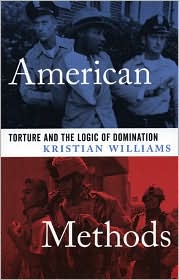
Kristian Williams: American Methods: Torture and the Logic of Domination

(Extra credit opportunity for HUM 121 students--watch the episode and write a response)

Kristian Williams: American Methods: Torture and the Logic of Domination
FORA TV (Originally broadcast on C-SPAN)


In American Methods author Kristian Williams argues that the U.S. Government has used torture as a method of social control and terror since the 1980s. Mr. Williams cites the 2004 Abu Ghraib prison incident, where American military personnel were investigated for the abuse of prisoners, as an example of traditional American torture. This event was hosted by Elliott Bay Book Company in Seattle, Washington.

Kristian Williams' writings have appeared in CounterPunch, Columbia Journalism Review, and We Are Everywhere: The Irresistible Rise of Global Anti-Capitalism. A member of Rose City Copwatch in Portland, Oregon, Williams also authored Our Enemies in Blue. There is no transcript for this program

To Watch the Episode

Saturday, September 04, 2010

Evangelos Tziallas: Torture porn and surveillance culture

Torture porn and surveillance culture
by Evangelos Tziallas
Jump Cut

Surveillance is everywhere, and its social ubiquity has led to it being a common element or mode of representation in contemporary moving image culture. As Thomas Levin has argued,

“By the 1990s…cinematic narration could be said, in many cases, to have effectively become synonymous with surveillant enunciation as such.”[1][open endnotes in new window]

Surveillance has become a mode of visual production, as in reality television shows like Big Brother (US, 2001) or films like Timecode (2000); it has become a narrative and thematic element, as in Caché (2005), Disturbia (2007) The Borne Ultimatum (2007); and sometime it serves as both a mode of production and narrative theme, as in The Conversation (1974), Sliver (1993), The Truman Show (1998), or the British sitcom Peep Show. When surveillance functions as both mode of production and major script element, as Levin puts it,

“It is this ambiguity—between surveillance as narrative subject, i.e. as thematic concern, and surveillance as the very condition or structure of narration itself—that will become increasingly characteristic of the cinema of the 1990s.”[2]

The prevalence of surveillance in contemporary media is now so vast that, for the purpose of this paper, I would like to focus on a small group of films that exemplify contemporary discourses on surveillance in a specific way. This group of films is collectively known as “torture porn.”

The label “torture porn” refers to a loose association of feature fiction films featuring scenes of extreme violence and torture. David Edelstein coined the phrase in his 2006 New York Magazine article as he quickly surveyed a common trend of violent representations in popular cinema. The catchy term became a trendy buzzword and now torture porn is considered a horror sub-genre in its own right.[3] Although I will in part investigate torture porn as a cinematic sub-genre, my goal is to demonstrate the centrality of surveillance in these films as shaping narrative elements, modes of presentation, and iconographic motifs in ways that convey deep anxieties about the alteration of “the gaze.”

Surveillance in torture porn allegorizes larger cultural and political trends in panoptic (the few watching the many) and synoptic (the many watching the few) subjectivities. Surveillance metonymically encompasses looking and the complex and ambivalent nature of looking and being looked at, and these elements of human social life are currently undergoing radical transformation due to technological advancements spurring on a “culture of surveillance,” or “surveillance culture.” As Nicholas Mirzoeff has noted,

“Since the 1970s, one of the striking phenomena that have come to make visual culture seem a vital topic has been the convergence of spectacle and surveillance.”[4]


“Surveillance” and the larger category, “image,” are merging together into surveillant images. If these two methods of representation have united, then this union requires us to investigate how the act of looking follows this social and technological change and what the ramifications of this merged, or altered, cultural gaze are. Looking is biological; gazing is cultural. As culture evolves, so too does the gaze.

To Read the Rest of the Essay

Friday, August 13, 2010

As White House Press Secretary Gibbs Attacks Progressive Critics, ACLU Says Obama White House Enshrining Bush-Era Policies

As Gibbs Attacks Progressive Critics, ACLU Says Obama White House Enshrining Bush-Era Policies
Democracy Now

As White House Press Secretary Robert Gibbs attacks progressives for comparing President Obama’s polices to George W. Bush’s, we look at a new ACLU report on how the Obama administration is permanently enshrining into law many of President Bush’s most controversial policies. The report, "Establishing a New Normal," warns: "There is a very real danger that the Obama administration will enshrine permanently within the law policies and practices that were widely considered extreme and unlawful during the Bush administration."

To Watch/Listen/Read

Tuesday, July 27, 2010

Democracy Now: Jury Convicts Chicago Police Commander Jon Burge of Lying About Torture

Jury Convicts Chicago Police Commander Jon Burge of Lying About Torture
Democracy Now

Decades after torture allegations were first leveled against former Chicago police commander Jon Burge, a federal jury has found him guilty of lying about torturing prisoners into making confessions. Burge has long been accused of overseeing the systematic torture of more than 100 African American men. Two years ago federal prosecutors finally brought charges against Burge—not for torture, but for lying about it. On Monday afternoon, after a five-week trial, Jon Burge was found guilty on all counts of perjury and obstruction of justice for lying about the abuse. He could face up to forty-five years in prison.

To Watch/Listen/Read

Monday, July 26, 2010

Linda Williams: “Cluster fuck” -- The forcible frame in Errol Morris’s Standard Operating Procedure

“Cluster fuck”: the forcible frame in Errol Morris’s Standard Operating Procedure
by Linda Williams
Jump Cut


Morris’s contextualization and constant reframing of the photos, qua photos, makes it possible for us to realize that the human pyramid and the simultaneously orchestrated masturbations were most likely not the worst or even the true crimes of the U.S. military and “other governmental agencies”—code for the CIA and other groups whose presence in the prison never formed part of the official record and who could thus apparently act with impunity—at Abu Ghraib.

When Susan Sontag wrote not long after their publication that these “photographs are us,”[19] she meant that we as a nation are responsible for what they show: the corruption, waste, and immorality of our occupation of Iraq (26).[20] But I suggest that they are also “us” because we recognize in them a familiar spirit of play, however perverted, that seeks distraction—even something called “fun”—in the very midst of horror. Kracauer writes of the mass ornament:

“Here, in pure externality the audience encounters itself. Its own reality is revealed in the fragmented sequence of splendid sense impressions.”


This disclosure “in distraction,” he adds, “is therefore of moral significance.”[21] What is “legitimate,” then, about the photos framed by this film is that with the aid of the Interrotron Morris makes us see how such photos could have made sense to these soldiers “on the ground” who craved a higher vantage point that would dissociate them from the prisoners with whom they lived. The photos were a legitimate expression of the frustration of their own impotency, their own inability to act successfully as soldiers, their pathetic imitation of “norms” that utterly failed to tell them their duty. Both the framed photos and Morris’s extravagant (re)enactments of what might have occurred are the ornamental cluster fucks of this misguided war

The most important ethical lesson of the film, however, may be to discourage us from judging Harman, England, or any of the cast of characters from any higher ground, as Pack would do and as the military tribunal did. The value of the film, rather, is to have shown us what it was like to be there on the ground aspiring to be somewhere else, somewhere higher.

In Regarding the Pain of Others, Sontag argues that pictures cannot provide their own interpretations; they need captions to provide context.[22] This may not be an accurate assessment of all photos, but it seems patently true of these almost too obviously self-incriminating ones of Abu Ghraib. On first seeing these pictures, few people thought they needed further explanations or a frame of reference. In Morris’s film it is the interviews and the imaginative enactments of possible acts that provide the rich captions to complicate each photo.

Judith Butler challenges Sontag, writing that we do not always need a caption to understand that a political background is formulated and renewed through the work of a frame:

“Whenever and wherever the photograph yields up its own forcible frame to visual scrutiny and interpretation, it opens up the restrictions of interpreting reality to critical scrutiny . . . we come to interpret that interpretation that has been imposed upon us.”[23]


This, I argue is what Morris’s film does. It asks us to interpret the interpretation, to witness the witnesses. But it does so not only by citing the photos that so “forcibly” framed these acts of inhumanity but also by reframing and contextualizing them, showing us how very delimited these frames were, how much of “the visual field,” as Butler puts it, is “ruled out” (952).

The photos of Abu Ghraib pointed to and were often themselves evidence of crimes. But they are not the smoking guns they seemed to be. They suggest that “straight photographs” must always be considered in light of what we know about the situation of their taking and that very often, as in the torture-death of al-Jamadi, the real incriminating photo does not exist. Had the military prosecution that focused so intensely only on the little guys pursued the larger “primary framework” that set the conditions for what we see in these pictures, rather than assume, as the Guantánamo alum Pack does, that nakedness and stress positions were to be expected, then we might have gotten to the bottom of the torture that took place under the direct auspices of the “other government agencies.” Such a trial might have discovered whose decision it was to keep prisoners naked and shackled, whose decision it was to hold prisoners indefinitely and drive them to despair. But that would have been another movie.

To Read the Entire Essay

Friday, July 23, 2010

David Andrews: Reframing Standard Operating Procedure: Errol Morris and the creative treatment of Abu Ghraib

(What i appreciate about SOP is that it is problematizing our [perceived] direct truth correspondence with images [in particular photographs, videos and films] in an age when we should always be skeptical of that relationship... )


Reframing Standard Operating Procedure: Errol Morris and the creative treatment of Abu Ghraib
Jump Cut


...

Janet Walker, a trauma studies scholar, noted in counterpoint that the discussion might profit if we supplemented trauma studies’ primary focus on victim trauma with a similar focus on “perpetrator trauma”—an expansion that might be linked to the kind of spectator trauma that Nichols touches on in his own paper. Like Sobchack’s comment, Walker’s comment was mainly a response to Kahana’s paper, which posited a tradition of films in which real “soldiers give testimony about their . . . violent actions, carried out in the midst of war,” actions they can never forget. Standard Operating Procedure fits this category, Walker (still alluding to Kahana) noted, in its “presentation of psychologically charged veteran interviews as simultaneously confessional and exculpatory.”[30]

At this point, my own trauma has everything to do with personal experience, not documentary practice. I am a U.S. liberal who lived through the Bush-Cheney era. Like Morris, I feel a great deal of guilt over what happened in those years (and over what may still be happening now, for all we know). It is predictable, then, that after watching Standard Operating Procedure, my own moral center fixed on Morris’ haunting précis: the guards weren’t innocent, but they were scapegoats.[31] No matter how morally superior we feel, the guards had few choices within a machine whose policies standardized abuse and enforced obedience in its ranks. As Kleinhans notes, one “incontrovertibly true” fact of torture is that it is only

“the exceptional person who refuses to torture, especially under the conditions of military organization.”[32]

The guards may not have been exceptional people (do “the best and brightest” typically end up as enlistees in the U.S. military?) but they were people working in a situation not of their own making. They acted badly and were treated badly: they were perpetrators and victims. This means that the greatest responsibility lies with those who created the situation that ran away from the guards: the military higher-ups, the Bush administration, and the electorate.

And if we, as liberals, fall into the trap of not listening to the guards or to Morris, if we refuse to see the guards as people whose “free will” was constrained by the same machine that constrained us all, we may end up simply repeating the actions of the Bush administration, which protected itself by blaming the scandal on a few bad apples. After all, apart from the extravagant abuses—the human pyramid, the masturbating detainees—the actions of the guards were, practically speaking, unavoidable. If the guards hadn’t put the detainees in stress positions or otherwise “softened” them up, how would the guards have been treated? Would they have been demoted, discharged, court-martialed?

And what about us, the symbolic warriors who were paying for all this and increasingly knew what we were paying for as its elements were repeated at “black sites” or outsourced through rendition—what were our choices? We could have stopped paying our taxes and gone to jail or fled abroad. But how many of us could actually have done this? Haven’t we all had responsibilities that have held us in place as investors in the larger machine of the nation? (Henry David Thoreau, we should remember, was unattached, childless, and jobless when he refused to pay poll taxes so as to resist the expansionist Mexican War.) Many of us probably had the same grim, awful sense that I had during the 9/11 disaster: what was happening to us was just a particle of what the Bush administration would do in our name in retribution. And many of us probably wanted to resist this end. But we did not, mostly could not. This is not to exonerate us or the guards. It is to see ourselves in the guards, whose situation we helplessly helped create.

To Read the Entire Introduction and to Access the Other Essays

Wednesday, June 09, 2010

Democracy Now: Trial Begins for Ex-Chicago Police Lt. Accused of Torturing More than 100 African American Men

Trial Begins for Ex-Chicago Police Lt. Accused of Torturing More than 100 African American Men
Democracy Now

A former police commander accused of overseeing the torture of more than 100 African American men goes on trial today in Chicago. Former Lieutenant Jon Burge is accused of lying when he denied in a civil lawsuit that he and other detectives had tortured anyone. He faces a maximum of forty-five years in prison if convicted of all charges. The accusations of torture date back forty years, but Burge has avoided prosecution until now. For nearly two decades, beginning in 1971, Burge was at the epicenter of what has been described as the systematic torture of dozens of black men to coerce confessions. In total, more than 100 people in Chicago say they were subjected to abuse, including having guns forced into their mouths, suffocation with bags placed over their heads, and electric shocks inflicted to their genitals. We speak to attorney Flint Taylor and torture victim Darrell Cannon.

Guests:

Flint Taylor, attorney with the People’s Law Office in Chicago. He has represented many of the torture victims and was directly involved in spearheading the special prosecutor’s investigation.

Darrell Cannon, one of dozens of men to come forward with allegations of abuse at the hands of the Chicago police. Darrell says police tortured him in 1983 and forced him to confess to a murder he didn’t commit. He spent more than twenty years in prison, but after a hearing on his tortured confession, prosecutors dismissed his case in 2004. He was released three years later.

To Read/Listen/Watch

Monday, June 07, 2010

Amy Goodman: Alleged Chicago Police Torturer’s Overdue Day in Court

Alleged Chicago Torturer’s Overdue Day in Court
by Amy Goodman
Democracy Now

Burge rose in the ranks to become a commander in Chicago’s South Side, called Area 2. Electric shocks to the genitals, mock executions, suffocation with bags over the head, beatings and painful stress positions are among the torture techniques that Burge and police officers under his command are accused of using to extract confessions in Chicago, mostly from African-American men.

To Listen to the Report

Saturday, March 13, 2010

Democracy Now: Ignoring Torture Claims and Questionable Evidence, New York Jury Convicts Pakistani Scientist Aafia Siddiqui

Ignoring Torture Claims and Questionable Evidence, New York Jury Convicts Pakistani Scientist Aafia Siddiqui
Democracy Now

A New York jury has convicted the US-educated Pakistani neuroscientist Aafia Siddiqui of attempted murder for shooting at US forces while jailed in Afghanistan in 2008. None of the Americans were injured, but Siddiqui was shot and wounded while in US custody. Human rights groups have long alleged that Siddiqui was forcibly disappeared by Pakistani authorities in 2003 and interrogated and tortured at the behest of the United States. In her testimony, Siddiqui claimed to have been held in a US secret prison. We speak to Siddiqui family spokesperson Tina Foster of the International Justice Network and Petra Bartosiewicz, an independent journalist who has been closely following Siddiqui’s case.

Guests:

Tina Foster, Executive Director of the International Justice Network and the spokesperson for Aafia Siddiqui’s family.

Petra Bartosiewicz, independent journalist who wrote about Aafia Siddiqui in the November 2009 edition of Harper’s Magazine and covered the trial with daily dispatches for the website Cage Prisoners. She is also working on a book titled The Best Terrorists We Could Find, an investigation of terrorism trials in the US since 9/11.

To Read/Listen/Watch