#22) 1.2 Billion People in India to be Given Biometric ID Cards
Project Censored
Student Researcher: Danielle Caruso (Sonoma State University)
Faculty Evaluator: Rashmi Singh (Sonoma State University)
India’s 1.2 billion citizens are to be issued biometric identification cards. The cards will hold the person’s name, age, and birth date, as well as fingerprints or iris scans, though no caste or religious identification. Within the next five years a giant computer will hold the personal details of at least 600 million citizens, making this new information technology system the largest in the world. The project will cost an estimated $3.5 billion. The 600 million Indians will receive a sixteen-digit identity number by 2014 in the first phase of the project.
India’s red tape is legendary: citizens have dozens of types of identity verification, ranging from electoral rolls to ration cards, yet almost none can be used universally. The new system will be a national proof of identity, effective for everything, from welfare benefits to updating land records. Forty-two percent of India’s population is below the poverty line and citizens frequently move in search of jobs. The government believes the ID system will help citizens because they will no longer have a problem identifying themselves. The biometric identity number will be entered every time someone accesses services from government departments, driver’s license offices, and hospitals, as well as insurance, credit card, telecom, and banking companies. By bringing more people into the banking system, Indian officials also hope to raise the number of people paying income taxes; currently, less than 5 percent of the population pays income taxes.
The head of Oxfam India, Nisha Agarwal, says a lack of identity verification is a major problem, especially for urban migrants. As a result, they are excluded from dozens of government programs, which offer cheaper food, jobs, and other benefits for poor people. “They remain treated as temporary migrants and, without that piece of paper, some form of identification, they are not able to access many of these government schemes that exist now, that have large funds behind them and could actually make a huge difference in poor people’s lives.”
The scheme is the brainchild of Nandan Nilekani, one of India’s best-known software tycoons and now head of the government’s Unique Identification Authority. “We are going to have to build something on the scale of Google, but it will change the country . . . every person for first time [will] be able to prove who he or she is. . . . We are not profiling a billion people. This will provide an ID database which government can access online. There will be checks and balances to protect identities,” said Nilekani, who has also been in talks to create a personalized carbon account so that all Indians might buy “green technologies” using a government subsidy.
The government also plans to use the database to monitor bank transactions, cell phone purchases, and the movements of individuals and groups suspected of fomenting terrorism. In January 2010, the Ministry of Home Affairs began collecting biometric details of people in coastal villages to boost security; the gunmen in the 2008 Mumbai attacks, which killed 165 people, sneaked into the country from the sea.
Critics say the project will turn India into an Orwellian police state that will spy on citizens’ private lives. “We do not want an intrusive, surveillance state in India,” said Usha Ramanathan, a lawyer who has written and lobbied against the project. “Information about people will be shared with intelligence agencies, banks and companies, and we will have no idea how our information is interpreted and used.” Civil liberty campaigners fear the ID card will become a tool of repression. Nandita Haskar, a human rights lawyer, said, “There is already no accountability in regards to violations of human and civil rights. In this atmosphere, what are the oversight mechanisms for this kind of surveillance?”
India’s plunge into biometric identification comes as countries around the globe are making similar moves. In 2006, Britain approved a mandatory national ID system with fingerprints for its citizens before public opposition prompted the government to scale back plans for a voluntary pilot program beginning in Manchester. United States senators have proposed requiring all citizens and immigrants who want to work in the country to carry a new high-tech social security card linked to fingerprints as part of an immigration overhaul.
Sources:
Randeep Ramesh, “1.2 Billion People in India to be Given Biometric ID Cards.” Guardian (September 16, 2009)
Anjana Pasricha, “India Begins Project to Issue Biometric Identity Cards to All Citizens” Voice of America News (September 24, 2009)
Corporate Media Source:
Rama Lakshmi, “Biometric Identity Project in India Aims to Provide for Poor, End Corruption,” Washington Post, March 28, 2010, A8.
Source Link and to Access the Rest of the List and More Resources
Showing posts with label Surveillance. Show all posts
Showing posts with label Surveillance. Show all posts
Wednesday, March 23, 2011

Friday, January 28, 2011
Timothy Karr: One U.S. Corporation's Role in Egypt's Brutal Crackdown
(via Literaghost)
One U.S. Corporation's Role in Egypt's Brutal Crackdown
by Timothy Karr
Huffington Post
The open Internet's role in popular uprising is now undisputed. Look no further than Egypt, where the Mubarak regime today reportedly shut down Internet and cell phone communications -- a troubling predictor of the fierce crackdown that has followed.
What's even more troubling is news that one American company is aiding Egypt's harsh response through sales of technology that makes this repression possible.
The Internet's favorite offspring -- Twitter, Facebook and YouTube -- are now heralded on CNN, BBC and Fox News as flag-bearers for a new era of citizen journalism and activism. (More and more these same news organizations have abandoned their own, more traditional means of newsgathering to troll social media for breaking information.)
But the open Internet's power cuts both ways: The tools that connect, organize and empower protesters can also be used to hunt them down.
Telecom Egypt, the nation's dominant phone and Internet service provider, is a state-run enterprise, which made it easy on Friday morning for authorities to pull the plug and plunge much of the nation into digital darkness.
Moreover, Egypt also has the ability to spy on Internet and cell phone users, by opening their communication packets and reading their contents. Iran used similar methods during the 2009 unrest to track, imprison and in some cases, "disappear" truckloads of cyber-dissidents.
The companies that profit from sales of this technology need to be held to a higher standard. One in particular is an American firm, Narus of Sunnyvale, Calif., which has sold Telecom Egypt "real-time traffic intelligence" equipment.
Narus, now owned by Boeing, was founded in 1997 by Israeli security experts to create and sell mass surveillance systems for governments and large corporate clients.
To Read the Rest of the Article
One U.S. Corporation's Role in Egypt's Brutal Crackdown
by Timothy Karr
Huffington Post
The open Internet's role in popular uprising is now undisputed. Look no further than Egypt, where the Mubarak regime today reportedly shut down Internet and cell phone communications -- a troubling predictor of the fierce crackdown that has followed.
What's even more troubling is news that one American company is aiding Egypt's harsh response through sales of technology that makes this repression possible.
The Internet's favorite offspring -- Twitter, Facebook and YouTube -- are now heralded on CNN, BBC and Fox News as flag-bearers for a new era of citizen journalism and activism. (More and more these same news organizations have abandoned their own, more traditional means of newsgathering to troll social media for breaking information.)
But the open Internet's power cuts both ways: The tools that connect, organize and empower protesters can also be used to hunt them down.
Telecom Egypt, the nation's dominant phone and Internet service provider, is a state-run enterprise, which made it easy on Friday morning for authorities to pull the plug and plunge much of the nation into digital darkness.
Moreover, Egypt also has the ability to spy on Internet and cell phone users, by opening their communication packets and reading their contents. Iran used similar methods during the 2009 unrest to track, imprison and in some cases, "disappear" truckloads of cyber-dissidents.
The companies that profit from sales of this technology need to be held to a higher standard. One in particular is an American firm, Narus of Sunnyvale, Calif., which has sold Telecom Egypt "real-time traffic intelligence" equipment.
Narus, now owned by Boeing, was founded in 1997 by Israeli security experts to create and sell mass surveillance systems for governments and large corporate clients.
To Read the Rest of the Article
Saturday, January 22, 2011
Seung-hoon Jeong: Gaze, Suture, Interface: The Suicide Scene in Michael Haneke’s Caché
(If you have not seen this excellent film, wait to read this until after watching it because it will ruin the film for you. ENG 282 students, we will be watching this in class.)
Gaze, Suture, Interface: The Suicide Scene in Michael Haneke’s Caché
Seung-hoon Jeong
Cinephile (The University of British Columbia)
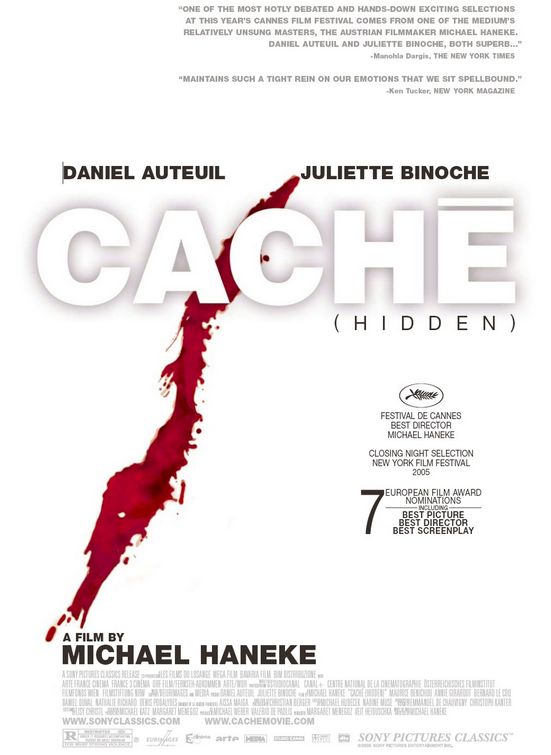
Georges (Daniel Auteuil), a host of a high-brow talk show, receives suspicious videotapes that display the peaceful façade of his upper middle class house. Nothing is clear in this CCTV footage in which there is ostensibly ‘nothing happening’: who has been watching his family, and why? Subsequent clips lead him to his childhood home and to an unknown apartment, which turns out to be the dingy place of his adopted, then abandoned, Algerian brother Majid (Maurice Bénichou). This forgotten ‘other’ confronts Georges with an uncomfortable truth from the past: young Georges’s jealousy forced Majid to be sent off to an orphanage, whereafter Majid had to survive without the educational and social benefits given to Georges. The nature of the video thus changes from provocation to evocation, from surveillance to reminiscence. Michael Haneke’s Caché [Hidden] (2005) uncannily uncovers this hidden trauma that resurfaces in the present. But my primary question is simple: why video?
Let me call this video an ‘interface’. Technically meaning the contact surface between image and spectator, the notion can be applied to the camera, the filmstrip, and the screen. That such a cinematic interface appears onscreen might not merit discussion in many cases, but it can play a central role in the narrative, whose unity is often thwarted and destabilized by the interface image. The subjectivity of characters or spectators can also be shaped or shaken through their encounters with the interface-within-the-film. A diegetic interface may then affect the ‘perception’ and ‘memory’ chain along which ‘image’ and ‘subjectivity’ are interconnected. Caché seems ideal for a case study in this regard, not only because of its video insertions, but because of the consequent revelation of perceptual and mnemonic mechanisms. What follows begins with a close analysis of a scene that exposes these mechanisms and thereby inspires us to explore, even expand the theoretical implications of the interface.
Among many significant scenes, I take Georges’s second visit to Majid’s flat as a kernel of the film’s structure. Its impressiveness, of course, bursts out of Majid’s sudden suicide; Majid lets Georges in, talks for a second, takes out a knife as Georges slightly falters, and slits his own throat, leaving no room for anticipation. The abruptness of this action marks the abruption of Majid’s emotion: a remarkable calmness and gentleness, not usually found in revenge suspects. It is rather Georges, the white Parisian intellectual, who has always lost his temper in front of his lower class, dark-skinned brother (and later, in front of Majid’s son, too); this Algerian outcast has reversed the standard image of the brutal invader of the bourgeois family like the De Niro figure in Cape Fear (Martin Scorsese, 1991). By killing himself, Majid releases something repressed beneath his tranquil face and fractures the peace of both his banlieue home and Georges’s bourgeois life. The flash of his blood sprayed onto the wall visualizes this fracture like an unstitched slash; the blood slowly exuding from his head onto the floor insinuates that this trauma will only grow like a nightmare in Georges’s memory.
In view of other scenes, Majid’s bloodstain on the wall triggers a déjà-vu that allows us to retroactively recognize the drawings sent to Georges (of a child vomiting blood) as forewarnings of this suicide. And through the same logic of ‘deferred action’ (Freudian Nachträglichkeit), this bloody event serves to repeat the film’s first instant flashback, prompted by a reverse-action tape, of young Majid coughing tubercular blood by a window, and the childhood trauma staged in Georges’s nightmare: Majid kills a cockerel, which also leaves a sharp blood mark, and he approaches Georges with the bloody hatchet. This killing was in fact orchestrated by Georges, but he told his parents that Majid had wanted to scare him, a joking lie that, along with Majid’s tuberculosis, ultimately resulted in Majid’s expulsion. However, only through recurrent visual traces after the fact does that original scene manifest its latent meaning as Georges’s original sin. The question would be how guilty and responsible the child and/or adult Georges is for that tiny ‘twisted joke’ that had lifelong repercussions/consequences for Majid. One may conclude: “Georges’s refusal as an adult to acknowledge the effects of his earlier actions suggests a parallel with the postcolonial metropolitan who is neither wholly responsible for, nor wholly untainted by, past events from which he or she has benefited” (Ezra and Sillars 219).1 Or, Majid’s suicide might bring a deep, if guilty, pleasure to a deeply ‘twisted’ xenophobe European: “the comforting idea that the colonial native can be made to disappear in an instant through the auto-combustive agency of their own violence” (Gilroy 234).
To See the Video of the Scene and Read the Rest of the Analysis
Gaze, Suture, Interface: The Suicide Scene in Michael Haneke’s Caché
Seung-hoon Jeong
Cinephile (The University of British Columbia)
Georges (Daniel Auteuil), a host of a high-brow talk show, receives suspicious videotapes that display the peaceful façade of his upper middle class house. Nothing is clear in this CCTV footage in which there is ostensibly ‘nothing happening’: who has been watching his family, and why? Subsequent clips lead him to his childhood home and to an unknown apartment, which turns out to be the dingy place of his adopted, then abandoned, Algerian brother Majid (Maurice Bénichou). This forgotten ‘other’ confronts Georges with an uncomfortable truth from the past: young Georges’s jealousy forced Majid to be sent off to an orphanage, whereafter Majid had to survive without the educational and social benefits given to Georges. The nature of the video thus changes from provocation to evocation, from surveillance to reminiscence. Michael Haneke’s Caché [Hidden] (2005) uncannily uncovers this hidden trauma that resurfaces in the present. But my primary question is simple: why video?
Let me call this video an ‘interface’. Technically meaning the contact surface between image and spectator, the notion can be applied to the camera, the filmstrip, and the screen. That such a cinematic interface appears onscreen might not merit discussion in many cases, but it can play a central role in the narrative, whose unity is often thwarted and destabilized by the interface image. The subjectivity of characters or spectators can also be shaped or shaken through their encounters with the interface-within-the-film. A diegetic interface may then affect the ‘perception’ and ‘memory’ chain along which ‘image’ and ‘subjectivity’ are interconnected. Caché seems ideal for a case study in this regard, not only because of its video insertions, but because of the consequent revelation of perceptual and mnemonic mechanisms. What follows begins with a close analysis of a scene that exposes these mechanisms and thereby inspires us to explore, even expand the theoretical implications of the interface.
Among many significant scenes, I take Georges’s second visit to Majid’s flat as a kernel of the film’s structure. Its impressiveness, of course, bursts out of Majid’s sudden suicide; Majid lets Georges in, talks for a second, takes out a knife as Georges slightly falters, and slits his own throat, leaving no room for anticipation. The abruptness of this action marks the abruption of Majid’s emotion: a remarkable calmness and gentleness, not usually found in revenge suspects. It is rather Georges, the white Parisian intellectual, who has always lost his temper in front of his lower class, dark-skinned brother (and later, in front of Majid’s son, too); this Algerian outcast has reversed the standard image of the brutal invader of the bourgeois family like the De Niro figure in Cape Fear (Martin Scorsese, 1991). By killing himself, Majid releases something repressed beneath his tranquil face and fractures the peace of both his banlieue home and Georges’s bourgeois life. The flash of his blood sprayed onto the wall visualizes this fracture like an unstitched slash; the blood slowly exuding from his head onto the floor insinuates that this trauma will only grow like a nightmare in Georges’s memory.
In view of other scenes, Majid’s bloodstain on the wall triggers a déjà-vu that allows us to retroactively recognize the drawings sent to Georges (of a child vomiting blood) as forewarnings of this suicide. And through the same logic of ‘deferred action’ (Freudian Nachträglichkeit), this bloody event serves to repeat the film’s first instant flashback, prompted by a reverse-action tape, of young Majid coughing tubercular blood by a window, and the childhood trauma staged in Georges’s nightmare: Majid kills a cockerel, which also leaves a sharp blood mark, and he approaches Georges with the bloody hatchet. This killing was in fact orchestrated by Georges, but he told his parents that Majid had wanted to scare him, a joking lie that, along with Majid’s tuberculosis, ultimately resulted in Majid’s expulsion. However, only through recurrent visual traces after the fact does that original scene manifest its latent meaning as Georges’s original sin. The question would be how guilty and responsible the child and/or adult Georges is for that tiny ‘twisted joke’ that had lifelong repercussions/consequences for Majid. One may conclude: “Georges’s refusal as an adult to acknowledge the effects of his earlier actions suggests a parallel with the postcolonial metropolitan who is neither wholly responsible for, nor wholly untainted by, past events from which he or she has benefited” (Ezra and Sillars 219).1 Or, Majid’s suicide might bring a deep, if guilty, pleasure to a deeply ‘twisted’ xenophobe European: “the comforting idea that the colonial native can be made to disappear in an instant through the auto-combustive agency of their own violence” (Gilroy 234).
To See the Video of the Scene and Read the Rest of the Analysis
Saturday, September 04, 2010
Evangelos Tziallas: Torture porn and surveillance culture
Torture porn and surveillance culture
by Evangelos Tziallas
Jump Cut
Surveillance is everywhere, and its social ubiquity has led to it being a common element or mode of representation in contemporary moving image culture. As Thomas Levin has argued,
“By the 1990s…cinematic narration could be said, in many cases, to have effectively become synonymous with surveillant enunciation as such.”[1][open endnotes in new window]
Surveillance has become a mode of visual production, as in reality television shows like Big Brother (US, 2001) or films like Timecode (2000); it has become a narrative and thematic element, as in Caché (2005), Disturbia (2007) The Borne Ultimatum (2007); and sometime it serves as both a mode of production and narrative theme, as in The Conversation (1974), Sliver (1993), The Truman Show (1998), or the British sitcom Peep Show. When surveillance functions as both mode of production and major script element, as Levin puts it,
“It is this ambiguity—between surveillance as narrative subject, i.e. as thematic concern, and surveillance as the very condition or structure of narration itself—that will become increasingly characteristic of the cinema of the 1990s.”[2]
The prevalence of surveillance in contemporary media is now so vast that, for the purpose of this paper, I would like to focus on a small group of films that exemplify contemporary discourses on surveillance in a specific way. This group of films is collectively known as “torture porn.”
The label “torture porn” refers to a loose association of feature fiction films featuring scenes of extreme violence and torture. David Edelstein coined the phrase in his 2006 New York Magazine article as he quickly surveyed a common trend of violent representations in popular cinema. The catchy term became a trendy buzzword and now torture porn is considered a horror sub-genre in its own right.[3] Although I will in part investigate torture porn as a cinematic sub-genre, my goal is to demonstrate the centrality of surveillance in these films as shaping narrative elements, modes of presentation, and iconographic motifs in ways that convey deep anxieties about the alteration of “the gaze.”
Surveillance in torture porn allegorizes larger cultural and political trends in panoptic (the few watching the many) and synoptic (the many watching the few) subjectivities. Surveillance metonymically encompasses looking and the complex and ambivalent nature of looking and being looked at, and these elements of human social life are currently undergoing radical transformation due to technological advancements spurring on a “culture of surveillance,” or “surveillance culture.” As Nicholas Mirzoeff has noted,
“Surveillance” and the larger category, “image,” are merging together into surveillant images. If these two methods of representation have united, then this union requires us to investigate how the act of looking follows this social and technological change and what the ramifications of this merged, or altered, cultural gaze are. Looking is biological; gazing is cultural. As culture evolves, so too does the gaze.
To Read the Rest of the Essay
by Evangelos Tziallas
Jump Cut
Surveillance is everywhere, and its social ubiquity has led to it being a common element or mode of representation in contemporary moving image culture. As Thomas Levin has argued,
“By the 1990s…cinematic narration could be said, in many cases, to have effectively become synonymous with surveillant enunciation as such.”[1][open endnotes in new window]
Surveillance has become a mode of visual production, as in reality television shows like Big Brother (US, 2001) or films like Timecode (2000); it has become a narrative and thematic element, as in Caché (2005), Disturbia (2007) The Borne Ultimatum (2007); and sometime it serves as both a mode of production and narrative theme, as in The Conversation (1974), Sliver (1993), The Truman Show (1998), or the British sitcom Peep Show. When surveillance functions as both mode of production and major script element, as Levin puts it,
“It is this ambiguity—between surveillance as narrative subject, i.e. as thematic concern, and surveillance as the very condition or structure of narration itself—that will become increasingly characteristic of the cinema of the 1990s.”[2]
The prevalence of surveillance in contemporary media is now so vast that, for the purpose of this paper, I would like to focus on a small group of films that exemplify contemporary discourses on surveillance in a specific way. This group of films is collectively known as “torture porn.”
The label “torture porn” refers to a loose association of feature fiction films featuring scenes of extreme violence and torture. David Edelstein coined the phrase in his 2006 New York Magazine article as he quickly surveyed a common trend of violent representations in popular cinema. The catchy term became a trendy buzzword and now torture porn is considered a horror sub-genre in its own right.[3] Although I will in part investigate torture porn as a cinematic sub-genre, my goal is to demonstrate the centrality of surveillance in these films as shaping narrative elements, modes of presentation, and iconographic motifs in ways that convey deep anxieties about the alteration of “the gaze.”
Surveillance in torture porn allegorizes larger cultural and political trends in panoptic (the few watching the many) and synoptic (the many watching the few) subjectivities. Surveillance metonymically encompasses looking and the complex and ambivalent nature of looking and being looked at, and these elements of human social life are currently undergoing radical transformation due to technological advancements spurring on a “culture of surveillance,” or “surveillance culture.” As Nicholas Mirzoeff has noted,
“Since the 1970s, one of the striking phenomena that have come to make visual culture seem a vital topic has been the convergence of spectacle and surveillance.”[4]
“Surveillance” and the larger category, “image,” are merging together into surveillant images. If these two methods of representation have united, then this union requires us to investigate how the act of looking follows this social and technological change and what the ramifications of this merged, or altered, cultural gaze are. Looking is biological; gazing is cultural. As culture evolves, so too does the gaze.
To Read the Rest of the Essay
Tuesday, August 24, 2010
POLICING FREE SPEECH: Police Surveillance and Obstruction of First Amendment‐Protected Activity
POLICING FREE SPEECH: Police Surveillance and Obstruction of First Amendment‐Protected Activity
An ACLU Survey of Reported Incidents
June 29, 2010
United States law enforcement agencies, from the FBI to local police, have a long history of spying on American citizens and infiltrating or otherwise obstructing political activist groups. Political spying was rampant during the Cold War under the FBI’s COINTELPRO, the CIA’s Operation Chaos, and other program.
Unfortunately, it appears that these old tendencies have once again come to the fore. Law enforcement agencies across America continue to monitor and harass groups and individuals for doing little more than peacefully exercising their First Amendment rights.
A thorough search and review of news accounts by the ACLU reveals that these law enforcement behaviors have taken place in at least 33 states plus the District of Columbia in recent years. Americans have been put under surveillance or harassed by the police just for deciding to organize, march, protest, espouse unusual viewpoints, and engage in normal, innocuous behaviors such as writing notes or taking
photographs in public.
For example, in the past year, at least four troubling Fusion Center reports have come to light:
‐ The Virginia Fusion Center’s Homegrown Terrorism Document
‐ The Texas Fusion Center’s Prevention Awareness Bulletin
‐ The Missouri Fusion Center’s Document on the Modern Militia Movement
‐ The Massachusetts Fusion Center’s “Commonwealth Fusion Center’s Standard Operating
Procedures” (not available online)
The following is a state‐by‐state compilation of examples of these behaviors in recent years.
To Read the State by State Reports
An ACLU Survey of Reported Incidents
June 29, 2010
United States law enforcement agencies, from the FBI to local police, have a long history of spying on American citizens and infiltrating or otherwise obstructing political activist groups. Political spying was rampant during the Cold War under the FBI’s COINTELPRO, the CIA’s Operation Chaos, and other program.
Unfortunately, it appears that these old tendencies have once again come to the fore. Law enforcement agencies across America continue to monitor and harass groups and individuals for doing little more than peacefully exercising their First Amendment rights.
A thorough search and review of news accounts by the ACLU reveals that these law enforcement behaviors have taken place in at least 33 states plus the District of Columbia in recent years. Americans have been put under surveillance or harassed by the police just for deciding to organize, march, protest, espouse unusual viewpoints, and engage in normal, innocuous behaviors such as writing notes or taking
photographs in public.
For example, in the past year, at least four troubling Fusion Center reports have come to light:
‐ The Virginia Fusion Center’s Homegrown Terrorism Document
‐ The Texas Fusion Center’s Prevention Awareness Bulletin
‐ The Missouri Fusion Center’s Document on the Modern Militia Movement
‐ The Massachusetts Fusion Center’s “Commonwealth Fusion Center’s Standard Operating
Procedures” (not available online)
The following is a state‐by‐state compilation of examples of these behaviors in recent years.
To Read the State by State Reports
Monday, June 07, 2010
On the Media: I'll Be Watching You
I'll Be Watching You
On the Media (NPR)
Written in 1986, the Stored Communications Act allows the government to obtain emails hosted on the internet more easily than they would those stored on your computer. Ryan Singel, blogger for wired.com, talks about how this law came to exist, and why it has advocacy groups and mail hosts like Google and Yahoo up-in-arms.
To Listen to the Episode
On the Media (NPR)
Written in 1986, the Stored Communications Act allows the government to obtain emails hosted on the internet more easily than they would those stored on your computer. Ryan Singel, blogger for wired.com, talks about how this law came to exist, and why it has advocacy groups and mail hosts like Google and Yahoo up-in-arms.
To Listen to the Episode
Wednesday, April 21, 2010
Monday, April 19, 2010
Dave Lindorff: I’m Not Shedding Any Tears for Daryl Gates
RedI’m Not Shedding Any Tears for Daryl Gates
by Dave Lindorff
Common Dreams
The former Los Angeles police chief, Daryl Gates, who died last Friday of cancer at his home in California, is being widely credited in mostly laudatory newspaper obituaries as the man who developed the idea of Special Weapons And Tactics (SWAT)units--those paramilitary police teams so loved by Hollywood filmmakers--who bring the art and weaponry of modern warfare into communities, breaking into houses with faces covered in ski masks, and carrying assault weapons in order to make arrests for often minor offenses, or blowing away people--often innocent people--in what the modern military calls "force escalation incidents."
But Gates was more than just the Sultan of SWAT.
He was also a proponent of the police-state tactic of massive surveillance and spying. Not that he invented it. As a deputy chief under Chief Ed Davis, and later as chief of police, Gates inherited the LAPD's notorious "Red Squad," known as the Public Disorder Intelligence Division (PDID), which had a sordid history going back into the 1920s, but he certainly expanded it dramatically.
I had my own experience with the PDID when I was an editor of the little alternative news weekly, the Los Angeles Vanguard, founded by myself and several other Los Angeles journalists in 1976, after the demise of the venerable Los Angeles Free Press. Our publication, which took on the issue of police brutality and especially the all-to-frequent shooting of unarmed citizens, very quickly became a special focus of the PDID. We learned, years after our publication had folded, that our volunteer staff had been infiltrated by a young PDID officer named Connie Milazzo, a woman just out of the Police Academy, who came to us posing as a journalist wannabe.
In a depositions taken by attorneys with the Southern California American Civil LIberties Union as part of a class action suit against the LAPD and the City of Los Angeles in the early 1980s, after Milazzo and other equally young Red Squad spies had been discovered infiltrating over 200 peaceful organizations in Los Angeles ranging from our newspaper to the local chapters of NOW, the Peace & Freedom Party, and even the office of City Councillor Zev Yaroslavsky, we learned that the PDID was gathering dossiers on literally thousands of local political activists, infiltrating and spying on protected political activities like peace demonstrations, anti-nuclear demonstrations and even political campaigns, and also engaging in provocateur activities, trying to encourage peaceful groups to cross the line into criminal actions.
To Read the Rest of the Remembrance
by Dave Lindorff
Common Dreams
The former Los Angeles police chief, Daryl Gates, who died last Friday of cancer at his home in California, is being widely credited in mostly laudatory newspaper obituaries as the man who developed the idea of Special Weapons And Tactics (SWAT)units--those paramilitary police teams so loved by Hollywood filmmakers--who bring the art and weaponry of modern warfare into communities, breaking into houses with faces covered in ski masks, and carrying assault weapons in order to make arrests for often minor offenses, or blowing away people--often innocent people--in what the modern military calls "force escalation incidents."
But Gates was more than just the Sultan of SWAT.
He was also a proponent of the police-state tactic of massive surveillance and spying. Not that he invented it. As a deputy chief under Chief Ed Davis, and later as chief of police, Gates inherited the LAPD's notorious "Red Squad," known as the Public Disorder Intelligence Division (PDID), which had a sordid history going back into the 1920s, but he certainly expanded it dramatically.
I had my own experience with the PDID when I was an editor of the little alternative news weekly, the Los Angeles Vanguard, founded by myself and several other Los Angeles journalists in 1976, after the demise of the venerable Los Angeles Free Press. Our publication, which took on the issue of police brutality and especially the all-to-frequent shooting of unarmed citizens, very quickly became a special focus of the PDID. We learned, years after our publication had folded, that our volunteer staff had been infiltrated by a young PDID officer named Connie Milazzo, a woman just out of the Police Academy, who came to us posing as a journalist wannabe.
In a depositions taken by attorneys with the Southern California American Civil LIberties Union as part of a class action suit against the LAPD and the City of Los Angeles in the early 1980s, after Milazzo and other equally young Red Squad spies had been discovered infiltrating over 200 peaceful organizations in Los Angeles ranging from our newspaper to the local chapters of NOW, the Peace & Freedom Party, and even the office of City Councillor Zev Yaroslavsky, we learned that the PDID was gathering dossiers on literally thousands of local political activists, infiltrating and spying on protected political activities like peace demonstrations, anti-nuclear demonstrations and even political campaigns, and also engaging in provocateur activities, trying to encourage peaceful groups to cross the line into criminal actions.
To Read the Rest of the Remembrance
Thursday, February 25, 2010
Glenn Greenwald: Excessive bipartisanship and other matters
Excessive bipartisanship and other matters
By Glenn Greenwald
Salon
One of the strangest prongs of conventional Beltway wisdom is the lament that there is not enough bipartisanship. The opposite is true: many of the most damaging acts inflicted on the country by Washington are enacted on a fully bipartisan basis -- the most destructive political act of this generation, the invasion of Iraq, was fully bipartisan, as were most of the post-9/11 civil liberties abuses and other Bush-era initiatives-- and, at least in certain areas, the harmonious joining together of Republicans and Democrats continues unabated:
A mountain of evidence has emerged over the last several years documenting pervasive, systematic abuse of the Patriot Act powers. The proposed safeguards were extremely modest and would have provided minimal oversight on how those powers were exercised. Leading Democrats such as Dianne Feinstein spent all years ensuring that the proposed reforms were weakened to the point of virtual meaningless. But as weakened as they were, "some Republican senators objected" and might have called Democrats "soft on terror," so that was the end of that. The domestic surveillance law that Democrats spent years assailing as dangerously overbroad when out of power is renewed in full now that they are in power. That's the Beauty of Bipartisanship, and the last thing we need is more of it.
To read the rest of the post and to access hyperlinked resources
By Glenn Greenwald
Salon
One of the strangest prongs of conventional Beltway wisdom is the lament that there is not enough bipartisanship. The opposite is true: many of the most damaging acts inflicted on the country by Washington are enacted on a fully bipartisan basis -- the most destructive political act of this generation, the invasion of Iraq, was fully bipartisan, as were most of the post-9/11 civil liberties abuses and other Bush-era initiatives-- and, at least in certain areas, the harmonious joining together of Republicans and Democrats continues unabated:
Senate votes to extend Patriot Act
Democrats retreat from adding new privacy protections to the law
The Senate voted Wednesday to extend for a year key provisions of the nation's counterterrorism surveillance law that are scheduled to expire at the end of the month.
In agreeing to pass the bill, Senate Democrats retreated from adding new privacy protections to the USA Patriot Act.
The Senate approved the bill on a voice vote with no debate. It now goes to the House. . . .
Supporters say extending the law enables authorities to keep important tools in the fight against terrorism. It would also give Democrats some cover from Republican criticism that the Obama administration is soft on terrorism. . . . Some Democrats, however, had to forfeit new privacy protections they had sought for the law. . . .
"I would have preferred to add oversight and judicial review improvements to any extension of expiring provisions in the USA Patriot Act," said Sen. Patrick Leahy, D-Vt., chairman of the Senate Judiciary Committee. "But I understand some Republican senators objected."
A mountain of evidence has emerged over the last several years documenting pervasive, systematic abuse of the Patriot Act powers. The proposed safeguards were extremely modest and would have provided minimal oversight on how those powers were exercised. Leading Democrats such as Dianne Feinstein spent all years ensuring that the proposed reforms were weakened to the point of virtual meaningless. But as weakened as they were, "some Republican senators objected" and might have called Democrats "soft on terror," so that was the end of that. The domestic surveillance law that Democrats spent years assailing as dangerously overbroad when out of power is renewed in full now that they are in power. That's the Beauty of Bipartisanship, and the last thing we need is more of it.
To read the rest of the post and to access hyperlinked resources
Wednesday, February 24, 2010
William Fisher: US Government Sued Over Cell Phone Tracking
Gov't Sued Over Cell Phone Tracking
by William Fisher
Common Dreams
If you are a U.S. resident who owns a cell phone, you should care about the outcome of a court case that "could well decide whether the government can use your cell phone to track you - even if it hasn't shown probable cause to believe it will turn up evidence of a crime."
That was the warning issued to the public by several major civil liberties organizations as they appeared in federal court in Philadelphia to argue for more privacy protections in the use of cell phones as tracking devices by law enforcement agents.
The case is at the heart of the constitutional crisis now being played out in the U.S. federal court. Civil liberties groups are asking the court to require that the government show probable cause before it can track your whereabouts.
The groups are the Electronic Frontier Foundation (EFF), the American Civil Liberties Union (ACLU), the ACLU of Pennsylvania, and the Center for Democracy and Technology (CDT).
Back in 2007, the U.S. government applied for court permission to obtain information about the location of an individual's cell phone, without showing probable cause that tracking the individual would turn up evidence of a crime.
A magistrate judge denied the government's request and a district court upheld that decision in September 2008. The government is appealing the ruling in the U.S. Court of Appeals.
A number of civil liberties groups, on behalf of plaintiffs in the case, filed a friend-of-the-court brief in support of the district court decision, arguing that district courts must require the government to show probable cause before permitting the government to obtain information about the location of a cell phone.
To Read the Rest of the Report
by William Fisher
Common Dreams
If you are a U.S. resident who owns a cell phone, you should care about the outcome of a court case that "could well decide whether the government can use your cell phone to track you - even if it hasn't shown probable cause to believe it will turn up evidence of a crime."
That was the warning issued to the public by several major civil liberties organizations as they appeared in federal court in Philadelphia to argue for more privacy protections in the use of cell phones as tracking devices by law enforcement agents.
The case is at the heart of the constitutional crisis now being played out in the U.S. federal court. Civil liberties groups are asking the court to require that the government show probable cause before it can track your whereabouts.
The groups are the Electronic Frontier Foundation (EFF), the American Civil Liberties Union (ACLU), the ACLU of Pennsylvania, and the Center for Democracy and Technology (CDT).
Back in 2007, the U.S. government applied for court permission to obtain information about the location of an individual's cell phone, without showing probable cause that tracking the individual would turn up evidence of a crime.
A magistrate judge denied the government's request and a district court upheld that decision in September 2008. The government is appealing the ruling in the U.S. Court of Appeals.
A number of civil liberties groups, on behalf of plaintiffs in the case, filed a friend-of-the-court brief in support of the district court decision, arguing that district courts must require the government to show probable cause before permitting the government to obtain information about the location of a cell phone.
To Read the Rest of the Report
Subscribe to:
Posts (Atom)