China: Shaking the World.
BBC World Service Documentaries
"China," Napoleon is believed to have once said, "is a sleeping giant. When she awakes, she will shake the world."
China endured decades of occupation, division and international isolation since that 19th century warning. When it finally opened to the rest of the world, foreign money and expertise flooded in.
Now - little more than a generation later - China is poised to overtake Japan to become the world's second largest economy. Its unprecedented growth in exports has left it holding more foreign currency than any other nation - financial power which China is beginning to use to challenge the US dollar's long-standing dominance as the medium of international trade.
This documentary series examines the political, economic and cultural mechanisms of China's growing global influence. Michael Robinson, who documented China's awakening for the BBC almost 20 years ago, returns to assess the prospects and problems of the unrelenting shift of power from West to East.
Part One explores China's massive internal infrastructure transformation.
Part Two looks at the potentially world-shaking clash of cultures between non-democratic, state-planned China and the American-centred world of democracy and free market ideology.
Part Three looks at the social tensions within China that threaten the growth upon which much of the rest of the world now relies.
Part Four asks whether the political model which has delivered China's fantastic economic growth over the last 30 years is the same model that will deliver growth over the next 30 years.
To Listen to the Documentaries
Showing posts with label China. Show all posts
Showing posts with label China. Show all posts
Thursday, February 03, 2011

Wednesday, January 12, 2011
Tyson Slocum of Public Citizen on the state of energy and climate politics in DC; Lucia Green-Weiskel on Cancún and Chinese energy and climate politi
Behind the News with Doug Henwood (KPFA: Berkeley, CA)
Tyson Slocum of Public Citizen on the state of energy and climate politics in DC • Lucia Green-Weiskel, author of "Climate Clash in Cancun", on Cancún and Chinese energy and climate politics
To Listen to the Episode and Access More Resources
Tyson Slocum of Public Citizen on the state of energy and climate politics in DC • Lucia Green-Weiskel, author of "Climate Clash in Cancun", on Cancún and Chinese energy and climate politics
To Listen to the Episode and Access More Resources
Monday, January 03, 2011
Worldview: Megacities Must Not Lose Their Humanizing Qualities
Megacities Must Not Lose Their HumanizingQualities
Worldview (WBEZ: Chicago Public Media)
Shanghai's population is approaching 20 million and as it, and other mega cities expand, Barry hopes that our global obsession with development doesn't come at a great cost…
Traveling through the world's megacities has resembled the journey described in Invisible Cities by Italo Calvino. In this fictional masterpiece Marco Polo describes to Kubla Khan what he saw on his journey. After four decades of visits to megacities, it is also difficult to describe, let alone understand, the modern megacity, world city or global city. What they have in common are qualities of size, scale, shape and speed that are new in human development and unique in the history of globalization. For example, size proportionately affects both the physical and mental health of people and geometrically increases the global footprint of a city. We make cities, but they remake us.
The megacity, determined by a population of ten million or more, or the global city, determined by capital concentration, signals a new partition of the world. This spatial partition is represented within the city by formal vs. non-formal settlements or vertical vs. horizontal growth.
These new (in)human settlements are full with both promise and peril, beauty and barbarism. More important than the fact that half the world's population is living in cities is the emergence of the very large city. It is in the megacities that the fate of global and planetary development rests. In such cities there is a dance between promise and peril, each partner uncertain of who is leading.
The promise of the megacity can be the diversity of experience, people and cultures; economies of scale; human capital; or the concentration of science-technology-innovation. The peril of the megacity includes both planetary and global threats, such as inequality, pollution, violence or earthquakes. Martin Oppenheimer, father of the atomic bomb, recognized that “Today's city is the most vulnerable social structure ever conceived by man.”
The bewildering methods of defining and measuring urban population suggest that even our conception of the city is indefinite. The megacity has been the subject of numerous horrific fictional accounts. But no one has managed to depict a city of twenty, thirty or forty million people as equitable and ecological. Such an idea cannot be sustained in the imagination.
Cities are problems in “organized complexity,” stated Jane Jacobs in 1961. The most difficult challenge facing megacites is to discover the challenge of this “organized complexity”. It is the interaction between the hard and soft infrastructure that sustains the urban area, including the full array of global and planetary systems that engage or are engaged by cities. One obvious example is the Icelandic Volcano. A planetary event dramatically impacted the global system of air traffic, and related activities.
Looking at the movement in and out of people, freight, power, ideas, services, waste in cities, it is obvious that Tokyo, New York, Shanghai, Mumbai, Sao Paulo or Lagos represent distinct examples of “organized complexity.” They are driven by factors that are poorly understood in isolation, let alone in their interaction.
To Listen to the Episode
Worldview (WBEZ: Chicago Public Media)
Shanghai's population is approaching 20 million and as it, and other mega cities expand, Barry hopes that our global obsession with development doesn't come at a great cost…
Traveling through the world's megacities has resembled the journey described in Invisible Cities by Italo Calvino. In this fictional masterpiece Marco Polo describes to Kubla Khan what he saw on his journey. After four decades of visits to megacities, it is also difficult to describe, let alone understand, the modern megacity, world city or global city. What they have in common are qualities of size, scale, shape and speed that are new in human development and unique in the history of globalization. For example, size proportionately affects both the physical and mental health of people and geometrically increases the global footprint of a city. We make cities, but they remake us.
The megacity, determined by a population of ten million or more, or the global city, determined by capital concentration, signals a new partition of the world. This spatial partition is represented within the city by formal vs. non-formal settlements or vertical vs. horizontal growth.
These new (in)human settlements are full with both promise and peril, beauty and barbarism. More important than the fact that half the world's population is living in cities is the emergence of the very large city. It is in the megacities that the fate of global and planetary development rests. In such cities there is a dance between promise and peril, each partner uncertain of who is leading.
The promise of the megacity can be the diversity of experience, people and cultures; economies of scale; human capital; or the concentration of science-technology-innovation. The peril of the megacity includes both planetary and global threats, such as inequality, pollution, violence or earthquakes. Martin Oppenheimer, father of the atomic bomb, recognized that “Today's city is the most vulnerable social structure ever conceived by man.”
The bewildering methods of defining and measuring urban population suggest that even our conception of the city is indefinite. The megacity has been the subject of numerous horrific fictional accounts. But no one has managed to depict a city of twenty, thirty or forty million people as equitable and ecological. Such an idea cannot be sustained in the imagination.
Cities are problems in “organized complexity,” stated Jane Jacobs in 1961. The most difficult challenge facing megacites is to discover the challenge of this “organized complexity”. It is the interaction between the hard and soft infrastructure that sustains the urban area, including the full array of global and planetary systems that engage or are engaged by cities. One obvious example is the Icelandic Volcano. A planetary event dramatically impacted the global system of air traffic, and related activities.
Looking at the movement in and out of people, freight, power, ideas, services, waste in cities, it is obvious that Tokyo, New York, Shanghai, Mumbai, Sao Paulo or Lagos represent distinct examples of “organized complexity.” They are driven by factors that are poorly understood in isolation, let alone in their interaction.
To Listen to the Episode
Sunday, December 26, 2010
Joan Hechinger: U.S. Teens Lag as China Soars on International Test
"U.S. Teens Lag as China Soars on International Test"
by John Hechinger
Bloomberg
China’s success in Shanghai results from the government’s abandonment of a system of “key schools” for elites and the institution of “a more inclusive system in which all students are expected to perform at high levels,” the OECD said in the report. China also raised teacher pay and standards and reduced rote learning, while giving... students and local authorities more choice in curriculum.
To Read the Article
by John Hechinger
Bloomberg
China’s success in Shanghai results from the government’s abandonment of a system of “key schools” for elites and the institution of “a more inclusive system in which all students are expected to perform at high levels,” the OECD said in the report. China also raised teacher pay and standards and reduced rote learning, while giving... students and local authorities more choice in curriculum.
To Read the Article
Tuesday, August 10, 2010
Meterologist Jeff Masters on Extreme Weather Trends Across the Globe
Meterologist: Record Heat Wave in Russia Could Kill Tens of Thousands
Democracy Now
Wildfires across Russia. Devastating floods in Pakistan. Deadly landslides and flash floods in India and China. Heat wave across the United States. Severe drought in Niger. Taken together, scientists warn the events match predictions for extreme climate events caused by global warming. This year is on track to be the warmest since reliable temperature records began over a century ago, mainly due to a buildup of greenhouse gases from fossil fuels. We speak to Jeff Masters, co-founder and director of meteorology for Weather Underground, a weather information website.
To Watch/Listen/Read
Democracy Now
Wildfires across Russia. Devastating floods in Pakistan. Deadly landslides and flash floods in India and China. Heat wave across the United States. Severe drought in Niger. Taken together, scientists warn the events match predictions for extreme climate events caused by global warming. This year is on track to be the warmest since reliable temperature records began over a century ago, mainly due to a buildup of greenhouse gases from fossil fuels. We speak to Jeff Masters, co-founder and director of meteorology for Weather Underground, a weather information website.
To Watch/Listen/Read
Saturday, January 16, 2010
Esther M.K. Cheung: Dialogues with Critics on Chinese Independent Cinemas
Dialogues with Critics on Chinese independent cinemas
by Esther M.K. Cheung
Jump Cut
The following dialogues with film critics in the PRC and Macau were conducted over a period of one month in 2004. [1] While there are some changes in the independent film scenes in the PRC and Hong Kong ever since these interviews were done, their views and observations offer us useful understanding of Chinese independent cinemas in a global context. Some of these recent changes will be updated at the end of this essay. These critics generally share strong convictions in upholding the oppositional nature and critical role of independent cinema. Many of these concerns are central to the traditional debates of auteurism. Their views on the notion of authenticity, personal vision, independent spirit and adherence to realism demonstrate a crucial strand of cultural and aesthetic value which still persists in a postmodernist world where the erasure of high-low culture seems to have weakened such a conviction. Some of them have also commented on the different patterns of independent filmmaking in Hong Kong and the PRC. These cross-cultural comparisons have helped us to see the relationship between cinema as art and cinema as industry in different regions. Very interestingly one critic has illuminated the connection between cinema and its publics, urging for wider circulation and reception of independent films. Their opinion has led us to consider once again how independent cinema can function as a form of public criticism in a rapidly globalized world.
Interviewees
* Ou Ning, founder of the film appreciation organization U-theque in Guangzhou and Shenzhen
* Wang Bang, Guangzhou film critic and essayist
* Hu Yuan, co-editor of the film magazine called DVD Guide and coordinator of the film group named Shanghai 101
* Yang Lu, co-editor of DVD Guide and coordinator of Shanghai 101
* Ping Hui, co-editor of DVD Guide and coordinator of Shanghai 101
* Johnny Wong Chi Weng, film critic and part-time lecturer at the University of Macau, person-in-charge of the visual art organization Espaco Video
* Frankie Lau, film critic and historian, coordinator of Espaco Video [2]
Definitions of independent cinema
How do you define independent cinema?
Ou: To define filmmakers as independent, we would normally consider their finances first, i.e. from where the directors get their funding. Then we have to see if they hold on to their free and independent thinking in the production process. The latter is crucial in defining an independent filmmaker, because it’s hard simply to look at the budget and production cost of a film and decide if this film is an independent film or not. Budget and production cost can be misleading. For example, the production cost of Made in Hong Kong (Fruit Chan, 1997), HK$500,000 (US$64,000), is considered inexpensive in Hong Kong, but it is a lot of money in the PRC, and can come along with a lot of professional and technical support. Simply looking at the production cost and ignoring the context in which the film is made doesn’t really help us define independent cinema.
We could define whether a film is independent from different aspects such as visual style, subject matter, funding institutes, etc. But it’s better to define independent cinema in terms of critical thought and independent spirit expressed in a work. Independent cinema should always be personal. In filmmaking, whenever it comes to final editing and how the film should look like, the producer and the production company have a very strong say in the decision-making process. We should investigate if the director and his production crews have been interfered with by their financing agencies and market considerations. Besides, sometimes the government intervenes, too.
Yang: First, independent cinema is produced on a low budget. Second, it is not funded by a major film studio. Third, the rationale behind film production is that there is something personal that needs to be articulated. Fourth, it doesn’t intend to pander to mass taste. Fifth, it is not designed for mass distribution.
Ping: First, independent film production is not backed up by a big film studio. Second, directors have to be responsible for the whole production process and the thought expressed in the film. The concept of independent cinema is always related to a low budget, limited resources, and little technical support. It should be something authentic. The director should not represent any film studio or government. Since film production is different from novel writing, it has to involve a lot of people. But a truly independent production is not a mass-produced commodity—it is something personal, like a form of novel writing.
Hu: Independent cinema is not and should not be an industrial product. Therefore, it is not something produced efficiently with a high degree of division of labor, and more importantly, it should not be subjected to market forces. For example, Shanghai Panic (Andrew Cheng, 2001) and Welcome to Destination Shanghai (Andrew Cheng, 2003) are typical examples of independent cinema. The director was simultaneously the scriptwriter, the cinematographer, the editor, and the actor because of limited resources and limited technical support. The director is responsible for the whole production process and the film is shot in a very short time with a realistic documentary style. He was also responsible for all the distribution work and festival competitions.
Wong: In fact, these days, people prefer to use the term “do-it-yourself (DIY) video,” instead of the term “independent cinema.” But if you need a definition of independent cinema, I would say independent cinema means, first, independent critically, and second, independent financially. Financial independence is a bit tricky, because film financing is seldom independent at all. But in independent film production, even if you are financed by some outside parties, they shouldn’t interfere with your production and impose their thoughts or rules on your works. Although many films are funded by institutions in the industry, to be qualified as independent films they shouldn’t be governed by the rules of commercial markets. Critical independence means that the creator articulates some original and authentic thoughts in their production, because filmic creations so far have been allied with commercial productions which are subjected mainly to market forces. After all, it’s about a filmmaker’s independence. It’s difficult to create films without any commercial linkages, though.
Can films really be independent? I am highly skeptical of the idea of independence, especially in the area of cinema. In fact, the definition and meaning of independent cinema cannot be delineated properly. That’s why I prefer the term “DIY video,” because at least the intention and the production process are authentic, as implied by the word DIY. What I stress is the level of independence a filmmaker achieves in making their own work. Nothing can really be truly independent. But the spirit of DIY is that you are creating something yourself and you are responsible for that work. DIY video is the kind of film practice I enjoy the most, because it is more personal, I mean, in the production process and in the thoughts expressed.
Lau: My definition of independent cinema is that first, the thematic concerns should be different from genre films. Second, they should be funded by studio-size production house. Third, there is no star-driven system as independent films should use non-professional actors, or at least less famous people or people from other fields like modeling or drama.
To Read the Rest of the Essay
by Esther M.K. Cheung
Jump Cut
The following dialogues with film critics in the PRC and Macau were conducted over a period of one month in 2004. [1] While there are some changes in the independent film scenes in the PRC and Hong Kong ever since these interviews were done, their views and observations offer us useful understanding of Chinese independent cinemas in a global context. Some of these recent changes will be updated at the end of this essay. These critics generally share strong convictions in upholding the oppositional nature and critical role of independent cinema. Many of these concerns are central to the traditional debates of auteurism. Their views on the notion of authenticity, personal vision, independent spirit and adherence to realism demonstrate a crucial strand of cultural and aesthetic value which still persists in a postmodernist world where the erasure of high-low culture seems to have weakened such a conviction. Some of them have also commented on the different patterns of independent filmmaking in Hong Kong and the PRC. These cross-cultural comparisons have helped us to see the relationship between cinema as art and cinema as industry in different regions. Very interestingly one critic has illuminated the connection between cinema and its publics, urging for wider circulation and reception of independent films. Their opinion has led us to consider once again how independent cinema can function as a form of public criticism in a rapidly globalized world.
Interviewees
* Ou Ning, founder of the film appreciation organization U-theque in Guangzhou and Shenzhen
* Wang Bang, Guangzhou film critic and essayist
* Hu Yuan, co-editor of the film magazine called DVD Guide and coordinator of the film group named Shanghai 101
* Yang Lu, co-editor of DVD Guide and coordinator of Shanghai 101
* Ping Hui, co-editor of DVD Guide and coordinator of Shanghai 101
* Johnny Wong Chi Weng, film critic and part-time lecturer at the University of Macau, person-in-charge of the visual art organization Espaco Video
* Frankie Lau, film critic and historian, coordinator of Espaco Video [2]
Definitions of independent cinema
How do you define independent cinema?
Ou: To define filmmakers as independent, we would normally consider their finances first, i.e. from where the directors get their funding. Then we have to see if they hold on to their free and independent thinking in the production process. The latter is crucial in defining an independent filmmaker, because it’s hard simply to look at the budget and production cost of a film and decide if this film is an independent film or not. Budget and production cost can be misleading. For example, the production cost of Made in Hong Kong (Fruit Chan, 1997), HK$500,000 (US$64,000), is considered inexpensive in Hong Kong, but it is a lot of money in the PRC, and can come along with a lot of professional and technical support. Simply looking at the production cost and ignoring the context in which the film is made doesn’t really help us define independent cinema.
We could define whether a film is independent from different aspects such as visual style, subject matter, funding institutes, etc. But it’s better to define independent cinema in terms of critical thought and independent spirit expressed in a work. Independent cinema should always be personal. In filmmaking, whenever it comes to final editing and how the film should look like, the producer and the production company have a very strong say in the decision-making process. We should investigate if the director and his production crews have been interfered with by their financing agencies and market considerations. Besides, sometimes the government intervenes, too.
Yang: First, independent cinema is produced on a low budget. Second, it is not funded by a major film studio. Third, the rationale behind film production is that there is something personal that needs to be articulated. Fourth, it doesn’t intend to pander to mass taste. Fifth, it is not designed for mass distribution.
Ping: First, independent film production is not backed up by a big film studio. Second, directors have to be responsible for the whole production process and the thought expressed in the film. The concept of independent cinema is always related to a low budget, limited resources, and little technical support. It should be something authentic. The director should not represent any film studio or government. Since film production is different from novel writing, it has to involve a lot of people. But a truly independent production is not a mass-produced commodity—it is something personal, like a form of novel writing.
Hu: Independent cinema is not and should not be an industrial product. Therefore, it is not something produced efficiently with a high degree of division of labor, and more importantly, it should not be subjected to market forces. For example, Shanghai Panic (Andrew Cheng, 2001) and Welcome to Destination Shanghai (Andrew Cheng, 2003) are typical examples of independent cinema. The director was simultaneously the scriptwriter, the cinematographer, the editor, and the actor because of limited resources and limited technical support. The director is responsible for the whole production process and the film is shot in a very short time with a realistic documentary style. He was also responsible for all the distribution work and festival competitions.
Wong: In fact, these days, people prefer to use the term “do-it-yourself (DIY) video,” instead of the term “independent cinema.” But if you need a definition of independent cinema, I would say independent cinema means, first, independent critically, and second, independent financially. Financial independence is a bit tricky, because film financing is seldom independent at all. But in independent film production, even if you are financed by some outside parties, they shouldn’t interfere with your production and impose their thoughts or rules on your works. Although many films are funded by institutions in the industry, to be qualified as independent films they shouldn’t be governed by the rules of commercial markets. Critical independence means that the creator articulates some original and authentic thoughts in their production, because filmic creations so far have been allied with commercial productions which are subjected mainly to market forces. After all, it’s about a filmmaker’s independence. It’s difficult to create films without any commercial linkages, though.
Can films really be independent? I am highly skeptical of the idea of independence, especially in the area of cinema. In fact, the definition and meaning of independent cinema cannot be delineated properly. That’s why I prefer the term “DIY video,” because at least the intention and the production process are authentic, as implied by the word DIY. What I stress is the level of independence a filmmaker achieves in making their own work. Nothing can really be truly independent. But the spirit of DIY is that you are creating something yourself and you are responsible for that work. DIY video is the kind of film practice I enjoy the most, because it is more personal, I mean, in the production process and in the thoughts expressed.
Lau: My definition of independent cinema is that first, the thematic concerns should be different from genre films. Second, they should be funded by studio-size production house. Third, there is no star-driven system as independent films should use non-professional actors, or at least less famous people or people from other fields like modeling or drama.
To Read the Rest of the Essay
Thursday, January 14, 2010
Sheldon Lu: Dialect and modernity in 21st century Sinophone cinema
Dialect and modernity in 21st century Sinophone cinema
by Sheldon Lu
Jump Cut
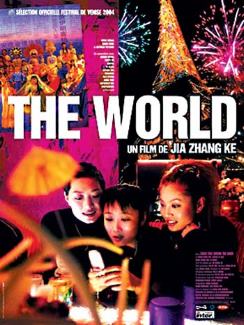
Just as China has the largest population in the world, its citizens speak a bewildering array of dialects (fangyan) and languages (yuyan). In modern times, new communication technologies such as radio and film potentially promise to speak to the ears of all citizens in the nation-state. But what language should be used as the standard for all citizens? As a modern and modernizing media, cinema could mold and unify the language of the nation. In this regard, unsurprisingly, language and dialect have been a particularly important issue in Chinese cinema from early twentieth century to the present time. Indeed, the use of a specific dialect in a film pertains to nothing less than the symbolic construction of the modern Chinese nation-state. As Chinese film historians well know, the Nationalist Party (Kuomintang, or Guomindang) in Nanjing established a film censorship board soon after its unification of China in 1927. The Republic of China stipulated that Mandarin be the lingua franca of Chinese cinema and banned the use of local dialects such as Cantonese. A unified China must have a unified Chinese language. As a result, Cantonese-language cinema could only be made outside the sovereignty of the Chinese nation, the island of Hong Kong.
When the Republic of China relocated itself to Taiwan after the end of Japanese colonial rule, the Mainlanders who wielded power in Taiwan established Mandarin as the island's official dialect. Two parallel cinemas existed in Taiwan: Taiwanese (Hokkienese)-language cinema and Mandarin cinema. After the Nationalist Party's decline in power, and with the rise of pro-independence, separatist sentiments in Taiwan since the late 20th century, the Taiwanese dialect has gained importance in all walks of life, even in Presidential politics. Utilizing a variety of languages and dialects, Taiwanese New-Wave filmmakers such as Hou Hsiao-hsien have also consciously explored the intricacies of Chinese/ Taiwanese politics and history by featuring a variety of dialects in some of their films, most notably in City of Sadness (Beiqing chengshi), where a profusion of dialects and languages: Mandarin, Hokkienese, Hakka, Shanghainese, and Japanese, are all heard. Moreover, the film's protagonist is a deaf-mute photographer who is incapable of speaking any of the Chinese/Taiwanese dialects. This situation thus further questions what ought to be the common mother tongue of Taiwan.
In the case of Hong Kong after 1949, we may also speak of two parallel cinemas: Cantonese-language cinema and Mandarin cinema. Although the dominant cinema in early days, Mandarin cinema gradually lost to the ascendancy of Cantonese-language cinema as a result of broad social and demographic changes, namely indigenization movements, or “Hong Kongization” from the 1970s onward.
In the People’s Republic of China, official film policy has dictated that Mandarin be the standard language of film despite the great variety of existing Chinese dialects within the nation. The overwhelming majority of films made in China have used Mandarin indeed. However, starting in the post-Mao era of “Reforms and Openness,” a variety of film production practices have emerged, and language politics has become more diversified. The usual stipulation solely to use Mandarin is now and then ignored. Even official mainstream (zhu xuan lü) films depicting the lives of the country’s former leaders often use the local dialects of the particular characters. For instance, the actor for Mao Zedong speaks a Hunan dialect in the way Mao himself spoke during his life. By doing this, the actor Gu Yue established himself as a famous household name because his film character looked like Mao and spoke like Mao. In such cases, the use of local (“unfamiliar,” “quaint”) dialects creates an atmosphere of realism, or in the case of comedy, elicits audience laughter. Meantime, self-conscious arthouse filmmakers also employ local dialects to achieve specific aesthetic effects.
Outside the Chinese sovereign state (Republic of China or People’s Republic of China), the question of Chinese dialect is still a thorny issue. China cum nationhood may be no longer relevant, but questions of ethnicity, Chineseness, and multiculturalism loom large. For example, Singapore, an independent non-Chinese country run by an ethnic Chinese elite, its language policy, and its cinema bring up a new set of issues in the study of Chinese-language cinema.[1] [open endnotes in new window] Furthermore, at the turn of the twenty-first century the widespread production and circulation of Chinese-language films outside the Chinese nation-state in the diaspora and the world further complicate language politics in cinematic discourse.
This essay aims to explore the use of dialects in varieties of Chinese-language films in the early twenty-first century. I briefly examine such diverse films as
* Viva Tonal: The Dance Age (Taiwanese documentary 2003), which hinges on a notion of local modernity based on the Fukienese/Taiwanese dialect in early 20th-century Taiwanese popular songs;
* a mainland Chinese arthouse film The World (2004) by Jia Zhangke, whose works have developed a dialectal film aesthetics based on the Shanxi dialects of Fenyang and Datong;
* Feng Xiaogang’s new-year films Cell Phone (2003) and A World without Thieves (2004) where some key characters speak provincial dialects; and
* Zhang Yimou’s pan-Chinese films Hero (2002) and House of Flying Daggers (2004), which employ a cast of stars from Greater China who all speak Mandarin.
I analyze how such films articulate distinct visions of China as nation-state or Chineseness as ethnicity. The films address different audiences and embody various conceptions of China. How a film employs specific local and provincial dialects, or does not, is an important marker of a film's cultural imaginary, be it about local Taiwanese identity, the moral economy of the mainland Chinese nation, or historico-cultural China. Overall, I lay out a spreadsheet of the typography of different dialectal strands in contemporary Chinese-language film production. These relate to identity-formation at various levels: local, national, subnational, supranational, and global.
To Read the Rest of the Essay

by Sheldon Lu
Jump Cut
Just as China has the largest population in the world, its citizens speak a bewildering array of dialects (fangyan) and languages (yuyan). In modern times, new communication technologies such as radio and film potentially promise to speak to the ears of all citizens in the nation-state. But what language should be used as the standard for all citizens? As a modern and modernizing media, cinema could mold and unify the language of the nation. In this regard, unsurprisingly, language and dialect have been a particularly important issue in Chinese cinema from early twentieth century to the present time. Indeed, the use of a specific dialect in a film pertains to nothing less than the symbolic construction of the modern Chinese nation-state. As Chinese film historians well know, the Nationalist Party (Kuomintang, or Guomindang) in Nanjing established a film censorship board soon after its unification of China in 1927. The Republic of China stipulated that Mandarin be the lingua franca of Chinese cinema and banned the use of local dialects such as Cantonese. A unified China must have a unified Chinese language. As a result, Cantonese-language cinema could only be made outside the sovereignty of the Chinese nation, the island of Hong Kong.
When the Republic of China relocated itself to Taiwan after the end of Japanese colonial rule, the Mainlanders who wielded power in Taiwan established Mandarin as the island's official dialect. Two parallel cinemas existed in Taiwan: Taiwanese (Hokkienese)-language cinema and Mandarin cinema. After the Nationalist Party's decline in power, and with the rise of pro-independence, separatist sentiments in Taiwan since the late 20th century, the Taiwanese dialect has gained importance in all walks of life, even in Presidential politics. Utilizing a variety of languages and dialects, Taiwanese New-Wave filmmakers such as Hou Hsiao-hsien have also consciously explored the intricacies of Chinese/ Taiwanese politics and history by featuring a variety of dialects in some of their films, most notably in City of Sadness (Beiqing chengshi), where a profusion of dialects and languages: Mandarin, Hokkienese, Hakka, Shanghainese, and Japanese, are all heard. Moreover, the film's protagonist is a deaf-mute photographer who is incapable of speaking any of the Chinese/Taiwanese dialects. This situation thus further questions what ought to be the common mother tongue of Taiwan.
In the case of Hong Kong after 1949, we may also speak of two parallel cinemas: Cantonese-language cinema and Mandarin cinema. Although the dominant cinema in early days, Mandarin cinema gradually lost to the ascendancy of Cantonese-language cinema as a result of broad social and demographic changes, namely indigenization movements, or “Hong Kongization” from the 1970s onward.
In the People’s Republic of China, official film policy has dictated that Mandarin be the standard language of film despite the great variety of existing Chinese dialects within the nation. The overwhelming majority of films made in China have used Mandarin indeed. However, starting in the post-Mao era of “Reforms and Openness,” a variety of film production practices have emerged, and language politics has become more diversified. The usual stipulation solely to use Mandarin is now and then ignored. Even official mainstream (zhu xuan lü) films depicting the lives of the country’s former leaders often use the local dialects of the particular characters. For instance, the actor for Mao Zedong speaks a Hunan dialect in the way Mao himself spoke during his life. By doing this, the actor Gu Yue established himself as a famous household name because his film character looked like Mao and spoke like Mao. In such cases, the use of local (“unfamiliar,” “quaint”) dialects creates an atmosphere of realism, or in the case of comedy, elicits audience laughter. Meantime, self-conscious arthouse filmmakers also employ local dialects to achieve specific aesthetic effects.
Outside the Chinese sovereign state (Republic of China or People’s Republic of China), the question of Chinese dialect is still a thorny issue. China cum nationhood may be no longer relevant, but questions of ethnicity, Chineseness, and multiculturalism loom large. For example, Singapore, an independent non-Chinese country run by an ethnic Chinese elite, its language policy, and its cinema bring up a new set of issues in the study of Chinese-language cinema.[1] [open endnotes in new window] Furthermore, at the turn of the twenty-first century the widespread production and circulation of Chinese-language films outside the Chinese nation-state in the diaspora and the world further complicate language politics in cinematic discourse.
This essay aims to explore the use of dialects in varieties of Chinese-language films in the early twenty-first century. I briefly examine such diverse films as
* Viva Tonal: The Dance Age (Taiwanese documentary 2003), which hinges on a notion of local modernity based on the Fukienese/Taiwanese dialect in early 20th-century Taiwanese popular songs;
* a mainland Chinese arthouse film The World (2004) by Jia Zhangke, whose works have developed a dialectal film aesthetics based on the Shanxi dialects of Fenyang and Datong;
* Feng Xiaogang’s new-year films Cell Phone (2003) and A World without Thieves (2004) where some key characters speak provincial dialects; and
* Zhang Yimou’s pan-Chinese films Hero (2002) and House of Flying Daggers (2004), which employ a cast of stars from Greater China who all speak Mandarin.
I analyze how such films articulate distinct visions of China as nation-state or Chineseness as ethnicity. The films address different audiences and embody various conceptions of China. How a film employs specific local and provincial dialects, or does not, is an important marker of a film's cultural imaginary, be it about local Taiwanese identity, the moral economy of the mainland Chinese nation, or historico-cultural China. Overall, I lay out a spreadsheet of the typography of different dialectal strands in contemporary Chinese-language film production. These relate to identity-formation at various levels: local, national, subnational, supranational, and global.
To Read the Rest of the Essay
Saturday, January 09, 2010
Jenny Kwok Wah Lau: Zhang Yimou's Hero -- China’s response to Hollywood globalization
Hero: China’s response to Hollywood globalization
by Jenny Kwok Wah Lau
Jump Cut

The 2002 film Hero, directed by the internationally renowned director Zhang Yimou, stormed through China with massive media coverage, vehement critical debates and audience response — both in print media and Internet. In the end, its box office receipts of 2.5 billion yuan out of 9 billion total revenue for all films in that year made it the top grossing film in the entire history of Chinese cinema up to that point. The coming of Hero signified the final institutionalization of a new era in Chinese filmmaking, one that single-mindedly pushes for market success. Thus, we need to ask what conditions in Chinese cinema affected the emergence of films such as Hero and what does that film's success mean for Chinese films' future?
To answer these questions we must begin from when the changes first started. Since the 1980s China has actively re-organized its film industry from a socialist to a semi-capitalist market system. 1982 marked the beginning of “outside” investment in film production. This so-called “outside” refers to sources extraneous to the China Film Bureau, such as private entities from China, Hong Kong, Taiwan, and some Western companies, which were allowed to participate in this once completely-enclosed filmmaking circle. In 1989 China abandoned the Film Bureau's monopoly of film distribution and allowed the establishment of private distribution companies.
The next ten years were a period of consolidation. By the end of the 90s all three phases of filmmaking — production, distribution, and exhibition — had very much opened to private investment. This process also partly prefigured China’s entry into the World Trade Organization (WTO), which was considered vital for China’s participation in world capitalism. After years of fierce negotiation, especially with the United States, whose approval or veto was decisive in the whole process, in December, 2001 China entered the WTO. China’s strong desire to get into the WTO was not unaccompanied by skeptics within China itself, including from the film community, which was facing economic hard times.
In fact, while the 90s saw the consolidation of a capitalist filmmaking system, they also saw a massive and debilitating slide in the size of the movie-going audience. Box office receipts declined from 1991's 23.6 billion yuan (1 U$ appr. = 7.8 yuan) to 2001's 8.4 billion yuan, a more than threefold drop in ten years. Furthermore, only 35% of the revenue during that time came from China-made films, the remaining 65% derived from Hollywood or other imported films. Meanwhile, film production also dropped throughout the 90s, from 167 films in 1992 to 80 films in 2001.[1]
Some film scholars in China blamed the drop in numbers on the shift to a capitalist system, and they doubted whether China could adapt to the pressure of the open market.[2] No doubt, system change did affect film production. For example, the more open system brought in popular films from other cinemas, such as from Hong Kong and Hollywood, which proved highly competitive in the local market. It also generated a large DVD market, part of which relied on piracy practices that seriously hurt the film industry. Nevertheless, it can also be argued that some of the pain that the Chinese film industry suffered during those years was partly self-inflicted by internal censorship.
Many of the best “artisan/cultural” films made during that period — such as, Judou (1990, Zhang Yimou), Farewell My Concubine (1993, Chan Kaige), Blue Kite (1994, Tian Zhanzhan), and To Live (1994, Zhang, Yimou) — were initially banned in China. Similarly, many of the 6th generation new wave films — such as Beijing Bastards (1994, Zhang Yuan), Postman (Ho Jianjun, 1995), Pickpocket (or Xiao Wu by Jia Zhangke, 1997, director of The World, 2004), and East Palace, West Palace (Zhang Yuan, 1997) — were potentially attractive to the new urban masses but not screened. Most of these directors suffered interference from the government and some were even banned from making films for a period of time.[3]
Instead of supporting these films, made in the tradition of artisan filmmaking, the government encouraged a new type of film called the “new mainstream,” through expeditious granting of shooting and screening permits. These films were mostly Hollywood imitations financed by private investments. By the late nineties, 70% of China’s production consisted of “new mainstream” films — such as Part A, Part B (Jiafang Yifang), Be There or Be Square (Bujian Busan) , and Shower (Xi Zao). These films were called the new mainstream as opposed to the “old mainstream” because the latter were “mainstream” by government design, intended as “educational” or “culturally or politically uplifting.” As the government strongly supported them, the films were guaranteed wide distribution. However, even though screened throughout China, the films had a disproportionately small viewership, mostly due to their traditional form and didactic content.[4] Examples include Jiao Yulu (Our Party’s Good Cadre, 1990, dir. Wang Jixin) and The Opium War (1997, dir. Xie Jin). In contrast, the “new mainstream” became the “real mainstream” in terms of popularity.
Thus, from the early 90s one can identify three major types of cinema in China: the artisan/cultural films, usually banned; the state-sponsored films (old mainstream), usually not popular; and the new mainstream entertainment, commercial and stylistically imitating Hollywood.
To Read the Rest of the Essay
by Jenny Kwok Wah Lau
Jump Cut
The 2002 film Hero, directed by the internationally renowned director Zhang Yimou, stormed through China with massive media coverage, vehement critical debates and audience response — both in print media and Internet. In the end, its box office receipts of 2.5 billion yuan out of 9 billion total revenue for all films in that year made it the top grossing film in the entire history of Chinese cinema up to that point. The coming of Hero signified the final institutionalization of a new era in Chinese filmmaking, one that single-mindedly pushes for market success. Thus, we need to ask what conditions in Chinese cinema affected the emergence of films such as Hero and what does that film's success mean for Chinese films' future?
To answer these questions we must begin from when the changes first started. Since the 1980s China has actively re-organized its film industry from a socialist to a semi-capitalist market system. 1982 marked the beginning of “outside” investment in film production. This so-called “outside” refers to sources extraneous to the China Film Bureau, such as private entities from China, Hong Kong, Taiwan, and some Western companies, which were allowed to participate in this once completely-enclosed filmmaking circle. In 1989 China abandoned the Film Bureau's monopoly of film distribution and allowed the establishment of private distribution companies.
The next ten years were a period of consolidation. By the end of the 90s all three phases of filmmaking — production, distribution, and exhibition — had very much opened to private investment. This process also partly prefigured China’s entry into the World Trade Organization (WTO), which was considered vital for China’s participation in world capitalism. After years of fierce negotiation, especially with the United States, whose approval or veto was decisive in the whole process, in December, 2001 China entered the WTO. China’s strong desire to get into the WTO was not unaccompanied by skeptics within China itself, including from the film community, which was facing economic hard times.
In fact, while the 90s saw the consolidation of a capitalist filmmaking system, they also saw a massive and debilitating slide in the size of the movie-going audience. Box office receipts declined from 1991's 23.6 billion yuan (1 U$ appr. = 7.8 yuan) to 2001's 8.4 billion yuan, a more than threefold drop in ten years. Furthermore, only 35% of the revenue during that time came from China-made films, the remaining 65% derived from Hollywood or other imported films. Meanwhile, film production also dropped throughout the 90s, from 167 films in 1992 to 80 films in 2001.[1]
Some film scholars in China blamed the drop in numbers on the shift to a capitalist system, and they doubted whether China could adapt to the pressure of the open market.[2] No doubt, system change did affect film production. For example, the more open system brought in popular films from other cinemas, such as from Hong Kong and Hollywood, which proved highly competitive in the local market. It also generated a large DVD market, part of which relied on piracy practices that seriously hurt the film industry. Nevertheless, it can also be argued that some of the pain that the Chinese film industry suffered during those years was partly self-inflicted by internal censorship.
Many of the best “artisan/cultural” films made during that period — such as, Judou (1990, Zhang Yimou), Farewell My Concubine (1993, Chan Kaige), Blue Kite (1994, Tian Zhanzhan), and To Live (1994, Zhang, Yimou) — were initially banned in China. Similarly, many of the 6th generation new wave films — such as Beijing Bastards (1994, Zhang Yuan), Postman (Ho Jianjun, 1995), Pickpocket (or Xiao Wu by Jia Zhangke, 1997, director of The World, 2004), and East Palace, West Palace (Zhang Yuan, 1997) — were potentially attractive to the new urban masses but not screened. Most of these directors suffered interference from the government and some were even banned from making films for a period of time.[3]
Instead of supporting these films, made in the tradition of artisan filmmaking, the government encouraged a new type of film called the “new mainstream,” through expeditious granting of shooting and screening permits. These films were mostly Hollywood imitations financed by private investments. By the late nineties, 70% of China’s production consisted of “new mainstream” films — such as Part A, Part B (Jiafang Yifang), Be There or Be Square (Bujian Busan) , and Shower (Xi Zao). These films were called the new mainstream as opposed to the “old mainstream” because the latter were “mainstream” by government design, intended as “educational” or “culturally or politically uplifting.” As the government strongly supported them, the films were guaranteed wide distribution. However, even though screened throughout China, the films had a disproportionately small viewership, mostly due to their traditional form and didactic content.[4] Examples include Jiao Yulu (Our Party’s Good Cadre, 1990, dir. Wang Jixin) and The Opium War (1997, dir. Xie Jin). In contrast, the “new mainstream” became the “real mainstream” in terms of popularity.
Thus, from the early 90s one can identify three major types of cinema in China: the artisan/cultural films, usually banned; the state-sponsored films (old mainstream), usually not popular; and the new mainstream entertainment, commercial and stylistically imitating Hollywood.
To Read the Rest of the Essay
Kin-Yan Szeto: The politics of historiography in Stephen Chow’s Kung Fu Hustle
The politics of historiography in Stephen Chow’s Kung Fu Hustle
by Kin-Yan Szeto
Jump Cut
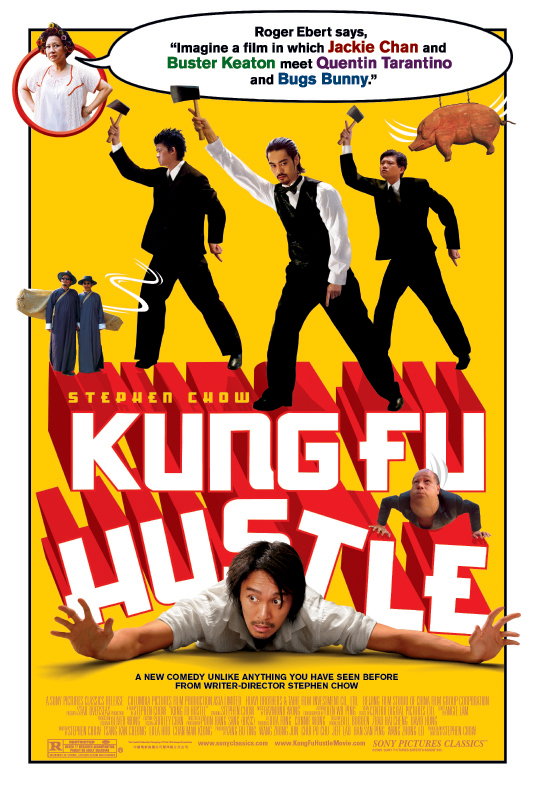
This essay examines how the Hong Kong director Stephen Chow’s recent action comedy Kung Fu Hustle depicts an imaginary China in ways that commingle various historical and political meanings. The film thereby encourages viewers to reflect upon the past and present conditions of the Chinese nation-state and its people and culture, as well as on cinema’s own complex relations with history.[1][open notes in new window] I argue that the film deliberately evokes a 1940s Shanghai to play off its drama against the backdrop of Hollywood’s globalization and Hong Kong's political transformation from a former British colony to a Special Administrative Region of the People’s Republic of China in 1997. Kung Fu Hustle embraces the history of martial arts films and other popular genres to evoke an earlier period of Shanghai that is permeated with multiple temporal, spatial, political, and cultural contexts that shape and comment upon each other.
This analysis offers a contribution to historiography, or at least that of film, by following Michel de Certeau’s conception of historiography as a complex set of theories and methods for researching and presenting a history that always is contingent upon relations between knowledge and power as well as past and present. As de Certeau observed, history often assumes or depicts a simple “clean break between the past and the present,” but actually is shaped by more complex
The past always influences the present, and vice versa, while ideologies and politics mediate both. History is shaped by conscious and unconscious judgments about what constitutes legitimate or authentic sources, issues, and modes of presentation. More specific to film, this article also follows Robert Rosenstone’s observation that cinema tends to create a complex representation of history that blends fact and fiction
Seeing should not simply be believing, as all images are mediated before, during, and after they are created. Following and expanding upon these notions, this essay examines the politics that govern Kung Fu Hustle’s assumptions and agendas in structuring relations between the present and the past. I critically explore the socio-political, economic and cultural discourses determining the historiography of an imaginary 1940s China as presented in this film. And I also note how the film contemplates, if less overtly, the new configuration of the Chinese nation-state after the Hong Kong handover. As part of its complex blending of historical contexts and political concerns, Kung Fu Hustle combines conventions of the Hong Kong martial arts film with other genres or modes of filmmaking including science fiction, gangster, western, slapstick and animation. These genre conventions together lead us to reflect on filmic interactions and translations between different geo-political spaces — Hong Kong, the Mainland and Hollywood. By analyzing Kung Fu Hustle from a transnational perspective, this article examines how the film interconnects and is shaped by the past and the present, the near and the distant, and fact and fiction as well as the political connotations involved in the writing of history. It proposes a new understanding of the politics of historiography in post-1997 Hong Kong, with broader implications for film and for history more generally.
To Read the Rest of the Essay
by Kin-Yan Szeto
Jump Cut
This essay examines how the Hong Kong director Stephen Chow’s recent action comedy Kung Fu Hustle depicts an imaginary China in ways that commingle various historical and political meanings. The film thereby encourages viewers to reflect upon the past and present conditions of the Chinese nation-state and its people and culture, as well as on cinema’s own complex relations with history.[1][open notes in new window] I argue that the film deliberately evokes a 1940s Shanghai to play off its drama against the backdrop of Hollywood’s globalization and Hong Kong's political transformation from a former British colony to a Special Administrative Region of the People’s Republic of China in 1997. Kung Fu Hustle embraces the history of martial arts films and other popular genres to evoke an earlier period of Shanghai that is permeated with multiple temporal, spatial, political, and cultural contexts that shape and comment upon each other.
This analysis offers a contribution to historiography, or at least that of film, by following Michel de Certeau’s conception of historiography as a complex set of theories and methods for researching and presenting a history that always is contingent upon relations between knowledge and power as well as past and present. As de Certeau observed, history often assumes or depicts a simple “clean break between the past and the present,” but actually is shaped by more complex
“relations of knowledge and power linking [these] two supposedly distinct domains” (Heterologies 4).
The past always influences the present, and vice versa, while ideologies and politics mediate both. History is shaped by conscious and unconscious judgments about what constitutes legitimate or authentic sources, issues, and modes of presentation. More specific to film, this article also follows Robert Rosenstone’s observation that cinema tends to create a complex representation of history that blends fact and fiction
“through poetic overlays of sounds, images, words and ideas” (213).
Seeing should not simply be believing, as all images are mediated before, during, and after they are created. Following and expanding upon these notions, this essay examines the politics that govern Kung Fu Hustle’s assumptions and agendas in structuring relations between the present and the past. I critically explore the socio-political, economic and cultural discourses determining the historiography of an imaginary 1940s China as presented in this film. And I also note how the film contemplates, if less overtly, the new configuration of the Chinese nation-state after the Hong Kong handover. As part of its complex blending of historical contexts and political concerns, Kung Fu Hustle combines conventions of the Hong Kong martial arts film with other genres or modes of filmmaking including science fiction, gangster, western, slapstick and animation. These genre conventions together lead us to reflect on filmic interactions and translations between different geo-political spaces — Hong Kong, the Mainland and Hollywood. By analyzing Kung Fu Hustle from a transnational perspective, this article examines how the film interconnects and is shaped by the past and the present, the near and the distant, and fact and fiction as well as the political connotations involved in the writing of history. It proposes a new understanding of the politics of historiography in post-1997 Hong Kong, with broader implications for film and for history more generally.
To Read the Rest of the Essay
Subscribe to:
Posts (Atom)