THE SHORTWAVE REPORT
The Shortwave Report Is a 30 minute review of news stories recorded from a shortwave radio. Times and frequencies for English-language programs are included to encourage you to listen on your own. It's easy. There is a new show posted every Friday morning, record it in mono!
FREE TO REBROADCAST! Please notify.
Latest show:
PROGRAM NOTES 03/18/11- This weeks show features stories from NHK Japan, Radio Deutsche-Welle, Radio Havana Cuba, and The Voice of Russia.
From JAPAN- First a review of Wednesday's news on the nuclear disaster. Then a Japanese nuclear expert speaks about the fire at the nuclear reactor and how it could affect the nuclear fuel rods stored there. The Japanese Emperor delivered a video message to the people, a rare event.
From GERMANY- The nuclear disaster in Japan has caused a turnaround in German plans to extend the lives of its power plants. The events in Japan may end the recent romance governments have had with nuclear power developers. Anti-Gaddafi rebels in Libya seemed to be failing as proposals to impose a no-fly zone in the country failed to get support.
From CUBA- This weekend saw mass anti-nuclear protests across Europe. Tens of thousands of young Palestinians demonstrated on Tuesday for reconciliation between all Palestinians. In Bahrain, state forces are using deadly force in attacking protestors. Hillary Clinton is visiting Egypt where she has been snubbed by the youth groups that spearheaded the anti-Mubarak protests. Two more children have been killed by US troops in Afghanistan while General Petraeus said that US troops may stay beyond the latest withdrawal date of 2014.
From RUSSIA- On Saturday at a memorial for 74 civilians victims, Afghan President Karzai urged US led military forces to leave Afghanistan.
--"One must always maintain one's connection to the past and yet ceaselessly pull away from it."
--Gaston Bachelard
Showing posts with label Russia. Show all posts
Showing posts with label Russia. Show all posts
Wednesday, March 23, 2011

Thursday, January 06, 2011
Adi Kuntsman: Online Memories, Digital Conflicts and the Cybertouch of War
Online Memories, Digital Conflicts and the Cybertouch of War
by Adi Kuntsman
Digital Icons
Wars, conflicts and commemoration occupy the minds of today’s users of new media across the globe; and those in Russia, Eurasia and Central Europe are no exception. Digital reporting of military actions and virtual museums of past wars and genocides; hacker attacks against websites and databases and computer war games; online antiwar organising and digital performances of postwar trauma; flashmobs of political protest or racist incitement and digitalised personal memories and family histories – these are only some of the examples of the ways in which war, conflict and commemoration are narrated, experienced and performed in contemporary digital media. Thus, the aim of the special issue entitled ’War, Conflict and Commemoration in the Age of Digital Reproduction’ is to explore these and other phenomena, by looking at various forms and segments of digital media: Internet sites, blogs and forums, online news and discussions, social networks, commemoration sites and virtual museums, digital games, video performance and computer crimes.
The issue brings together ten authors, working in a variety of formats – articles, essays, reports, ethnographic film and digital performance – and reflecting on the following questions:
What is the role of new media in understanding, representing, negotiating and remembering (or forgetting) war and genocide?
What is the status of testimony, evidence and reportage in the age of digital reproduction?
What practices of memory do new information and communication technologies entail?
What structures of feeling operate in online reports and debates around military operations and human suffering?
How can digital mediations of conflict bring people and communities together, while tearing others apart?
And lastly, how can the embodied, physical violence intensify in digital interactions, and how can it be diffused, resisted and remembered?
This special issue was born out of a sense of political and intellectual necessity, posed by recent developments in digital media and its use. Digital media is fundamentally changing the terrain of politics, due to its reach and speed, and its function in the lives of civilian populations and states alike. For example, together with ‘citizen journalism’, enabled by blogs, the Internet has given a platform to political extremism, racism and neo-Nazism. (While Web 2.0 technologies allow non-hierarchical participation,
they also, at times, turn the Internet into a digital war zone (Karatzogianni 2006, 2009).
In today’s ‘global matrix of war’ (Kaplan 2009), digital technologies are used by both state and non-state actors, often blurring the line between military and entertainment and between control and resistance. Attacks on the ground and in the air now go hand in hand with information warfare, propaganda and racist attacks in blogs and YouTube vlogs; conflicts between states or stateless groups reverberate in cyberattacks by hackers from each side; and testimonies of atrocities are captured on mobile phones and circulated on Facebook, irrevocably changing our modes of witnessing, feeling and remembering violent and traumatic events (Ibrahim 2009; Kaplan 2009; Reading 2009).
Politically, then, the topic of war and conflict and of their relations with digital media is clearly an urgent one. In that respect, Central and Eastern Europe is not unique. The region, however, has its own, very particular, record of past wars and conflicts that scar social and mnemonic fabrics of today’s life: World War II, German occupation and the Holocaust, decades under communism, twenty years of post-communist transformation, and waves of conflicts and bloodshed they brought.
More recently, the region has witnessed a rise in the right wing nationalism and extremist racism, struggles for sovereignty and independence, ‘wars on terror’ and localised armed conflicts. Addressing all these together, through the lens of shared political conditions, while remaining attentive to each country’s unique culture and
circumstances, is what encouraged me to assemble this collection.
The special issue is also motivated by an intellectual need to shed light on the role of digital media in these processes across the region. With the growing integration of digital media into most aspects of our lives, we witness an explosion of scholarly interest in the subject, cutting across many disciplines. Similarly, the topic of war, conflict and memory is widely explored. The two, however, only recently began to intersect, for example in the special issue of Journal of Computer Mediated Communication (2006), ‘War Coverage in Cyberspace’ (2006) or in edited collections such as Digital War Reporting (Matheson and Stuart 2009) or Save As… Digital Memories (Garde-Hansen et.al. 2009).1 But even when the two fields are explored in conjunction, they mostly concentrate on one narrow aspect – such as war coverage and reportage, or memories – rather than a complex examination of how digital media and computer technologies affect the warfare itself, its social perception and the ways of remembrance and commemoration. Such complex approach is precisely what unites the papers in this special issue, when they examine how war and conflicts of past and present are negotiated, performed and remembered on the Internet and in other digital media tools.
To Read the Rest of the Introduction to the Special Issue and to Access the Issue's Essays
by Adi Kuntsman
Digital Icons
Wars, conflicts and commemoration occupy the minds of today’s users of new media across the globe; and those in Russia, Eurasia and Central Europe are no exception. Digital reporting of military actions and virtual museums of past wars and genocides; hacker attacks against websites and databases and computer war games; online antiwar organising and digital performances of postwar trauma; flashmobs of political protest or racist incitement and digitalised personal memories and family histories – these are only some of the examples of the ways in which war, conflict and commemoration are narrated, experienced and performed in contemporary digital media. Thus, the aim of the special issue entitled ’War, Conflict and Commemoration in the Age of Digital Reproduction’ is to explore these and other phenomena, by looking at various forms and segments of digital media: Internet sites, blogs and forums, online news and discussions, social networks, commemoration sites and virtual museums, digital games, video performance and computer crimes.
The issue brings together ten authors, working in a variety of formats – articles, essays, reports, ethnographic film and digital performance – and reflecting on the following questions:
What is the role of new media in understanding, representing, negotiating and remembering (or forgetting) war and genocide?
What is the status of testimony, evidence and reportage in the age of digital reproduction?
What practices of memory do new information and communication technologies entail?
What structures of feeling operate in online reports and debates around military operations and human suffering?
How can digital mediations of conflict bring people and communities together, while tearing others apart?
And lastly, how can the embodied, physical violence intensify in digital interactions, and how can it be diffused, resisted and remembered?
This special issue was born out of a sense of political and intellectual necessity, posed by recent developments in digital media and its use. Digital media is fundamentally changing the terrain of politics, due to its reach and speed, and its function in the lives of civilian populations and states alike. For example, together with ‘citizen journalism’, enabled by blogs, the Internet has given a platform to political extremism, racism and neo-Nazism. (While Web 2.0 technologies allow non-hierarchical participation,
they also, at times, turn the Internet into a digital war zone (Karatzogianni 2006, 2009).
In today’s ‘global matrix of war’ (Kaplan 2009), digital technologies are used by both state and non-state actors, often blurring the line between military and entertainment and between control and resistance. Attacks on the ground and in the air now go hand in hand with information warfare, propaganda and racist attacks in blogs and YouTube vlogs; conflicts between states or stateless groups reverberate in cyberattacks by hackers from each side; and testimonies of atrocities are captured on mobile phones and circulated on Facebook, irrevocably changing our modes of witnessing, feeling and remembering violent and traumatic events (Ibrahim 2009; Kaplan 2009; Reading 2009).
Politically, then, the topic of war and conflict and of their relations with digital media is clearly an urgent one. In that respect, Central and Eastern Europe is not unique. The region, however, has its own, very particular, record of past wars and conflicts that scar social and mnemonic fabrics of today’s life: World War II, German occupation and the Holocaust, decades under communism, twenty years of post-communist transformation, and waves of conflicts and bloodshed they brought.
More recently, the region has witnessed a rise in the right wing nationalism and extremist racism, struggles for sovereignty and independence, ‘wars on terror’ and localised armed conflicts. Addressing all these together, through the lens of shared political conditions, while remaining attentive to each country’s unique culture and
circumstances, is what encouraged me to assemble this collection.
The special issue is also motivated by an intellectual need to shed light on the role of digital media in these processes across the region. With the growing integration of digital media into most aspects of our lives, we witness an explosion of scholarly interest in the subject, cutting across many disciplines. Similarly, the topic of war, conflict and memory is widely explored. The two, however, only recently began to intersect, for example in the special issue of Journal of Computer Mediated Communication (2006), ‘War Coverage in Cyberspace’ (2006) or in edited collections such as Digital War Reporting (Matheson and Stuart 2009) or Save As… Digital Memories (Garde-Hansen et.al. 2009).1 But even when the two fields are explored in conjunction, they mostly concentrate on one narrow aspect – such as war coverage and reportage, or memories – rather than a complex examination of how digital media and computer technologies affect the warfare itself, its social perception and the ways of remembrance and commemoration. Such complex approach is precisely what unites the papers in this special issue, when they examine how war and conflicts of past and present are negotiated, performed and remembered on the Internet and in other digital media tools.
To Read the Rest of the Introduction to the Special Issue and to Access the Issue's Essays
Tuesday, November 23, 2010
Kristina Radford: The Return
Response to The Return
by Kristina Radford
ENG 282

This movie struck me as a dark tale of miscommunication and misunderstanding between parent and child. The father in this film reappears after twelve years of absence with no explanation of his adventures away from home. The youngest son Ivan is distraught over the father’s reappearance and seeks answers to what took his father away from their family for so long. Without an explanation Ivan finds it difficult to honor his father's commands and shows blatant disrespect for the man he was told to abide by. The older brother, Andre on the other hand is delighted to have his father back and wants to please the man by following his every order. Without proper explanation of his wants and actions the father has isolated Ivan and alienated him from wanting to be a good son. Ivan feels as if his father is a dangerous mystery man and uses caution when dealing with his antics. The father shows a need to be supportive of his children and you get the idea he wants to teach them everything he knows about being a man. However he has little patience or compassion for either of the boys and I feel his expectations for their behaviors were much too high. I feel a strong relation to Ivan’s actions toward his father. If placed in the same situation I would not want to be managed by this man I did not know anything about a man who I felt had abandoned me my entire life and could not feel the importance and necessity of an honest explanation of what he had been doing.
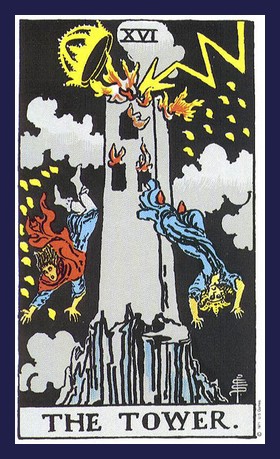
I felt a lot of symbolism being used in this movie especially in the use of the tower in the beginning and the end. It reminds me The Tower card used in a tarot deck. The Tower card depicts a large tower that has suddenly been struck by a powerful bolt of lightening. The lightening strike is so powerful it has knocked the towers two occupants out of its open windows and they are forever suspended in the air seemingly falling toward dangerous and deadly sharp rocks. When examining The Tower card one can only assume impending misfortune for the two people falling. If they reach the jagged rocks below their bodies will surely break from the brute force. This concept of The Tower tarot card mirrors the story of Ivan and Andre with the return of their father. Out of the blue their father strikes back into their lives with no warning and given no ideas as to why they are sent on a thrilling and dangerous voyage partly filled with excitement and dread. The boys are given little time to think about what this sudden change means for their lives before they are isolated with this unknown patriarchal force. The boys are uncertain of what their fishing trip with their father will hold much like the people falling from the tower are unable to know weather their fall will be the end of their lives or a crippling start to a new life. The tower seems to imply destruction and uncertainty as does the fathers attitude toward his children.
Perhaps his long absence from home has hardened the father's heart or maybe there is a cultural gap I do not understand about the way Russian people deal with their children. I do feel that much of the complications in this movie could have been avoided if the father could have shown a little bit of compassion. His lack of empathy facilitated his demise as he fell from the tower and the two boys are left with further ambivalent feelings toward the man they were expected to respect and adore with no solid explanation to his actions.
by Kristina Radford
ENG 282
This movie struck me as a dark tale of miscommunication and misunderstanding between parent and child. The father in this film reappears after twelve years of absence with no explanation of his adventures away from home. The youngest son Ivan is distraught over the father’s reappearance and seeks answers to what took his father away from their family for so long. Without an explanation Ivan finds it difficult to honor his father's commands and shows blatant disrespect for the man he was told to abide by. The older brother, Andre on the other hand is delighted to have his father back and wants to please the man by following his every order. Without proper explanation of his wants and actions the father has isolated Ivan and alienated him from wanting to be a good son. Ivan feels as if his father is a dangerous mystery man and uses caution when dealing with his antics. The father shows a need to be supportive of his children and you get the idea he wants to teach them everything he knows about being a man. However he has little patience or compassion for either of the boys and I feel his expectations for their behaviors were much too high. I feel a strong relation to Ivan’s actions toward his father. If placed in the same situation I would not want to be managed by this man I did not know anything about a man who I felt had abandoned me my entire life and could not feel the importance and necessity of an honest explanation of what he had been doing.
I felt a lot of symbolism being used in this movie especially in the use of the tower in the beginning and the end. It reminds me The Tower card used in a tarot deck. The Tower card depicts a large tower that has suddenly been struck by a powerful bolt of lightening. The lightening strike is so powerful it has knocked the towers two occupants out of its open windows and they are forever suspended in the air seemingly falling toward dangerous and deadly sharp rocks. When examining The Tower card one can only assume impending misfortune for the two people falling. If they reach the jagged rocks below their bodies will surely break from the brute force. This concept of The Tower tarot card mirrors the story of Ivan and Andre with the return of their father. Out of the blue their father strikes back into their lives with no warning and given no ideas as to why they are sent on a thrilling and dangerous voyage partly filled with excitement and dread. The boys are given little time to think about what this sudden change means for their lives before they are isolated with this unknown patriarchal force. The boys are uncertain of what their fishing trip with their father will hold much like the people falling from the tower are unable to know weather their fall will be the end of their lives or a crippling start to a new life. The tower seems to imply destruction and uncertainty as does the fathers attitude toward his children.
Perhaps his long absence from home has hardened the father's heart or maybe there is a cultural gap I do not understand about the way Russian people deal with their children. I do feel that much of the complications in this movie could have been avoided if the father could have shown a little bit of compassion. His lack of empathy facilitated his demise as he fell from the tower and the two boys are left with further ambivalent feelings toward the man they were expected to respect and adore with no solid explanation to his actions.
Thursday, November 04, 2010
Alex Sanders: Response to the The Return
'THE RETURN'
ENG 282 Response

Okay, this is honestly one of the best movies I've ever seen!
I'm not going to review the film from a filmmaker's point of view because I didn't watch it from a filmmaker's point of view and I ALWAYS, ALWAYS watch movies through a filmmaker's eyes!
The way the film looked was sort of low-budget but that didn't take anything away from the story nor the film itself! It just made it seem more impressive because it lookeded like a film that my friends and me could've made. Omigod - I haven't stopped thinking about it since I saw it. The ending of the film hurt to watch because I think I know what was in the box. I grew up never knowing my mother so the relationship between him and Ivan was sort of like mine and my father. The soundtrack of the film, which I think was only several instrumentals is absolutely captivating and at the end of the film, the music helped make the ending as superb as it was! It was odd that that THE FATHER never really showed love but some fathers are like that - they love their children but have a hard time showing it. Especially fathers to sons. But I could see the love in the father's eyes sometimes - like for instance, when IVAN told him he was nothing and he said you're wrong, son (I THINK WHATEVER WAS IN THE BOX had something to do with the father replying to this like he did).
I think also what was in the box was something that he wanted to SHARE with his sons - something that described me or was something that maybe his father gave him. Something that would help his sons figure him out since they didn't know him.
But all in all, man, such a great film, it made me want to BE a father for some reason and have sons and just
love them. I will buy this movie and watch it probably watch a month - it's like The Shawshank Redemption - a movie that I will watch over and over and share with others!
The theme of the film to me has to do with the universal tales of fathers and sons, meaning a lot of times in life with everyone, there is this sort of rebellion we have against our fathers. Either we don't want to be like them or we feel compelled to BECOME SOMETHING because they put high expectations on it. But with this one, I think it has to do with never getting a chance to say what you want to someone you love or need to say. But it's strange because some people believe that there never was a father so if that's the case, the theme of the movie is letting go of their father and moving on. If that's the case, it has to do with them going on this trip to become men and grow up and leave behind the need of a father.
ENG 282 Response
Okay, this is honestly one of the best movies I've ever seen!
I'm not going to review the film from a filmmaker's point of view because I didn't watch it from a filmmaker's point of view and I ALWAYS, ALWAYS watch movies through a filmmaker's eyes!
The way the film looked was sort of low-budget but that didn't take anything away from the story nor the film itself! It just made it seem more impressive because it lookeded like a film that my friends and me could've made. Omigod - I haven't stopped thinking about it since I saw it. The ending of the film hurt to watch because I think I know what was in the box. I grew up never knowing my mother so the relationship between him and Ivan was sort of like mine and my father. The soundtrack of the film, which I think was only several instrumentals is absolutely captivating and at the end of the film, the music helped make the ending as superb as it was! It was odd that that THE FATHER never really showed love but some fathers are like that - they love their children but have a hard time showing it. Especially fathers to sons. But I could see the love in the father's eyes sometimes - like for instance, when IVAN told him he was nothing and he said you're wrong, son (I THINK WHATEVER WAS IN THE BOX had something to do with the father replying to this like he did).
I think also what was in the box was something that he wanted to SHARE with his sons - something that described me or was something that maybe his father gave him. Something that would help his sons figure him out since they didn't know him.
But all in all, man, such a great film, it made me want to BE a father for some reason and have sons and just
love them. I will buy this movie and watch it probably watch a month - it's like The Shawshank Redemption - a movie that I will watch over and over and share with others!
The theme of the film to me has to do with the universal tales of fathers and sons, meaning a lot of times in life with everyone, there is this sort of rebellion we have against our fathers. Either we don't want to be like them or we feel compelled to BECOME SOMETHING because they put high expectations on it. But with this one, I think it has to do with never getting a chance to say what you want to someone you love or need to say. But it's strange because some people believe that there never was a father so if that's the case, the theme of the movie is letting go of their father and moving on. If that's the case, it has to do with them going on this trip to become men and grow up and leave behind the need of a father.
Tuesday, August 10, 2010
Meterologist Jeff Masters on Extreme Weather Trends Across the Globe
Meterologist: Record Heat Wave in Russia Could Kill Tens of Thousands
Democracy Now
Wildfires across Russia. Devastating floods in Pakistan. Deadly landslides and flash floods in India and China. Heat wave across the United States. Severe drought in Niger. Taken together, scientists warn the events match predictions for extreme climate events caused by global warming. This year is on track to be the warmest since reliable temperature records began over a century ago, mainly due to a buildup of greenhouse gases from fossil fuels. We speak to Jeff Masters, co-founder and director of meteorology for Weather Underground, a weather information website.
To Watch/Listen/Read
Democracy Now
Wildfires across Russia. Devastating floods in Pakistan. Deadly landslides and flash floods in India and China. Heat wave across the United States. Severe drought in Niger. Taken together, scientists warn the events match predictions for extreme climate events caused by global warming. This year is on track to be the warmest since reliable temperature records began over a century ago, mainly due to a buildup of greenhouse gases from fossil fuels. We speak to Jeff Masters, co-founder and director of meteorology for Weather Underground, a weather information website.
To Watch/Listen/Read
Thursday, February 25, 2010
The Auteurs: True/False Film Festival Celebration
In honor of this year's True/False Film Festival The Auteurs are hosting an online a retrospective selection of documentaries from past festivals (all free).
The Auteurs
True/False Film Festival
To Watch the Documentaries Online
Sons of a Gun (USA: Rivkah Beth Medow and Greg O'Toole, 2008: 70 mins)
A freshly minted classic, Sons of a Gun is a portrait of a new archetypal American family—Larry, a laissez-faire LAPD hostage negotiator, and the three mentally ill adults under his care in a Bay Area motel room. Inside this claustrophobic fish bowl, we come to see lovability and comic timing along with the tics and the outbursts. Delightful and disturbing, the film crackles like a dark sitcom by way of R. Crumb and the Beale sisters. With expressive camerawork and brisk editing, Medow and O’Toole have created indelible characters and a narrative that fulfills a social mission much more effectively than a prescriptive piece on behalf of the mentally ill. It’s a jaw-dropping ride that confounds our expectations at every turn — including a second-act twist that shatters any notion their lives were going to be romanticized.
Someday My Prince Will Come Someday My Prince Will Come (UK: Marc Isaacs, 2005: 48 mins)
Heartrending and hilarious in ways that only the love life of an 11-year-old can be, this British doc is certain to provoke lots of discussion and perhaps some controversy. Rare in its willingness to accept kids on their own terms, Someday My Prince Will Come is narrated in rhyming voice-over by its subject, Laura-Anne, as she brings us along on her quest to find a “prince.” Along the way, we’re reminded of the tumultuous nature of young love and offered an unvarnished look at the social life of a small British coastal village.
The Mother (Russia/France/Switzerland: Antoine Cattin and Pavel Kostomarov, 2007: 80 mins)
Though its focus remains tight on its main subject — a Russian single mother of nine — Antoine Cattin and Pavel Kostomarov’s award-winning film has the scope, precision and resonance of a literary masterpiece. The cinematography is startling, with bleached colors that reflect the washed-out dreams of its subjects. Though shot largely with handheld cameras, its compositions would do Cartier-Bresson proud. The film’s blend of long takes and jump cuts give it the feel of an epic. And the characters and their stories are richer than fiction, as they celebrate, fight, grieve and survive. But The Mother is more than the sum of these magnificent parts, thanks to the richness and complexity of the themes it explores: the daily violence absorbed by women and children, the impossible traps of modern masculinity, the generations-long impact of addiction, the innocence of first love. Taking the long-form documentary to new heights, Cattin and Kostomarov have crafted an urgent classic of 21st-century cinema.
The Order of Myths (USA: Margaret Brown, 2008: 97 mins)
The first Mardi Gras in America was celebrated in Mobile, Alabama in 1703. In 2007, it is still racially segregated. Filmmaker Margaret Brown (Be Here to Love Me: A Film about Townes Van Zandt), herself a daughter of Mobile, escorts us into the parallel hearts of the city s two carnivals. With unprecedented access, she traces the exotic world of secret mystic societies and centuries-old traditions and pageantry; diamond-encrusted crowns, voluminous, hand-sewn gowns, surreal masks and enormous paper mache floats. Against this opulent backdrop, she uncovers a tangled web of historical violence and power dynamics, elusive forces that keep this hallowed tradition organized along enduring color lines.
Running Stumbled (USA: John Maringouin, 2006: 85 mins)
Louisiana-born filmmaker John Maringouin arrives at the front door of his father Johnny Roe’s New Orleans home unannounced to offer an apocalyptic portrait of his dysfunctional family in this unflinching, multi-sensory documentary that utilizes digital and auditory manipulation to take the viewer deeper into the psyche of a disturbed artist than they may care to travel. When Maringouin was just a child, his drug-addicted father once threatened to kill his family. These days, artist Johnny lives in drug-addicted squalor with his common-law wife Virgie. Now, as arguments erupt and threats are made, the pieces of the puzzle that Maringouin has worked for years to assemble finally begin to fall into place. —allmovie guide
The Mosquito Problem and Other Stories (Bulgaria: Andrey Paounov, 2007: 100 mins)
A small town and its hopeful citizens are about to embark on a bright new journey. Massive rusty cranes, foreign investors, and the joyful chants of cheerleaders carry the dream of a great nuclear future. Disturbed only by gigantic stinging mosquitoes, the townsfolk celebrate the atomic hurray by engraving the nuclear power plant logo on buildings and soup bowls. Amidst the apparent atomic prosperity, lies a past that no one wants to remember. An island holding terrifying secrets. Stories of shocking and horrible crimes loom on the city just like the dark clouds of mosquitoes descending on its citizens. A world instantly transformed by ideologies, regimes and dreams of economic prosperity. The tales of characters whose lives intersect in a sinister past, nuclear future and the stinging mosquitoes flying through time, sealing their fate together.
The Auteurs
True/False Film Festival
To Watch the Documentaries Online
Sons of a Gun (USA: Rivkah Beth Medow and Greg O'Toole, 2008: 70 mins)
A freshly minted classic, Sons of a Gun is a portrait of a new archetypal American family—Larry, a laissez-faire LAPD hostage negotiator, and the three mentally ill adults under his care in a Bay Area motel room. Inside this claustrophobic fish bowl, we come to see lovability and comic timing along with the tics and the outbursts. Delightful and disturbing, the film crackles like a dark sitcom by way of R. Crumb and the Beale sisters. With expressive camerawork and brisk editing, Medow and O’Toole have created indelible characters and a narrative that fulfills a social mission much more effectively than a prescriptive piece on behalf of the mentally ill. It’s a jaw-dropping ride that confounds our expectations at every turn — including a second-act twist that shatters any notion their lives were going to be romanticized.
Someday My Prince Will Come Someday My Prince Will Come (UK: Marc Isaacs, 2005: 48 mins)
Heartrending and hilarious in ways that only the love life of an 11-year-old can be, this British doc is certain to provoke lots of discussion and perhaps some controversy. Rare in its willingness to accept kids on their own terms, Someday My Prince Will Come is narrated in rhyming voice-over by its subject, Laura-Anne, as she brings us along on her quest to find a “prince.” Along the way, we’re reminded of the tumultuous nature of young love and offered an unvarnished look at the social life of a small British coastal village.
The Mother (Russia/France/Switzerland: Antoine Cattin and Pavel Kostomarov, 2007: 80 mins)
Though its focus remains tight on its main subject — a Russian single mother of nine — Antoine Cattin and Pavel Kostomarov’s award-winning film has the scope, precision and resonance of a literary masterpiece. The cinematography is startling, with bleached colors that reflect the washed-out dreams of its subjects. Though shot largely with handheld cameras, its compositions would do Cartier-Bresson proud. The film’s blend of long takes and jump cuts give it the feel of an epic. And the characters and their stories are richer than fiction, as they celebrate, fight, grieve and survive. But The Mother is more than the sum of these magnificent parts, thanks to the richness and complexity of the themes it explores: the daily violence absorbed by women and children, the impossible traps of modern masculinity, the generations-long impact of addiction, the innocence of first love. Taking the long-form documentary to new heights, Cattin and Kostomarov have crafted an urgent classic of 21st-century cinema.
The Order of Myths (USA: Margaret Brown, 2008: 97 mins)
The first Mardi Gras in America was celebrated in Mobile, Alabama in 1703. In 2007, it is still racially segregated. Filmmaker Margaret Brown (Be Here to Love Me: A Film about Townes Van Zandt), herself a daughter of Mobile, escorts us into the parallel hearts of the city s two carnivals. With unprecedented access, she traces the exotic world of secret mystic societies and centuries-old traditions and pageantry; diamond-encrusted crowns, voluminous, hand-sewn gowns, surreal masks and enormous paper mache floats. Against this opulent backdrop, she uncovers a tangled web of historical violence and power dynamics, elusive forces that keep this hallowed tradition organized along enduring color lines.
Running Stumbled (USA: John Maringouin, 2006: 85 mins)
Louisiana-born filmmaker John Maringouin arrives at the front door of his father Johnny Roe’s New Orleans home unannounced to offer an apocalyptic portrait of his dysfunctional family in this unflinching, multi-sensory documentary that utilizes digital and auditory manipulation to take the viewer deeper into the psyche of a disturbed artist than they may care to travel. When Maringouin was just a child, his drug-addicted father once threatened to kill his family. These days, artist Johnny lives in drug-addicted squalor with his common-law wife Virgie. Now, as arguments erupt and threats are made, the pieces of the puzzle that Maringouin has worked for years to assemble finally begin to fall into place. —allmovie guide
The Mosquito Problem and Other Stories (Bulgaria: Andrey Paounov, 2007: 100 mins)
A small town and its hopeful citizens are about to embark on a bright new journey. Massive rusty cranes, foreign investors, and the joyful chants of cheerleaders carry the dream of a great nuclear future. Disturbed only by gigantic stinging mosquitoes, the townsfolk celebrate the atomic hurray by engraving the nuclear power plant logo on buildings and soup bowls. Amidst the apparent atomic prosperity, lies a past that no one wants to remember. An island holding terrifying secrets. Stories of shocking and horrible crimes loom on the city just like the dark clouds of mosquitoes descending on its citizens. A world instantly transformed by ideologies, regimes and dreams of economic prosperity. The tales of characters whose lives intersect in a sinister past, nuclear future and the stinging mosquitoes flying through time, sealing their fate together.
Saturday, January 16, 2010
All Songs Considered: GlobalFEST 2010 -- A World Music Showcase
GlobalFEST 2010: A World Music Showcase
All Songs Considered (NPR)
Alif Naaba

All Songs Considered host Bob Boilen talks with Banning Eyre (Afropop) and Rob Weisberg (WFMU's Trans Pacific Sound Paradise) about some of the standout artists at this year's GlobalFEST. The annual world-music and cultural festival, held each winter in New York City, is a brief but intense one-day event featuring more than a dozen international bands and artists. This year's showcase included club music from Argentina, Colombian roots music, traditional songs from Ireland, Romanian hybrid blues and much more. Hear concert highlights on this edition of All Songs Considered.
Caravan Palace

To Listen to the Episode
Nguyên Lê

All Songs Considered (NPR)
Alif Naaba
All Songs Considered host Bob Boilen talks with Banning Eyre (Afropop) and Rob Weisberg (WFMU's Trans Pacific Sound Paradise) about some of the standout artists at this year's GlobalFEST. The annual world-music and cultural festival, held each winter in New York City, is a brief but intense one-day event featuring more than a dozen international bands and artists. This year's showcase included club music from Argentina, Colombian roots music, traditional songs from Ireland, Romanian hybrid blues and much more. Hear concert highlights on this edition of All Songs Considered.
Caravan Palace
To Listen to the Episode
Nguyên Lê
Sunday, November 15, 2009
Maryna Reshetnyak: Drop-in Center -- Ukrainian Experience in Harm Reduction
(Great program! Too bad we insist on stigmatizing, persecuting and locking them up here in the good ol' democratic US of A.)
Drop-in Center: Major Russian Paper Wrote about Ukrainian Experience in Harm Reduction
by Maryna Reshetnyak
Rising Voices
...
10 AM. There is a short line next to entrance of the pharmacology clinic called “Sociotherapy”. I see a poster on the wall in Ukrainian: “Not all people are alcoholics or drug addicts, but all alcoholics and drug addicts are people”. This is “the site” – a place where patients of substitution therapy receive pills of Methadone and Buprenorphine.
There are no very young people in line. Most of them are in their 30's, but there are a few of 40's and older. Each person has a story. There is a person with crutch, a mother holding a small child …
I am entering the site together with Pavel Kutsev. He is a journalist. He is 48 and he is an opiate addict. He and his wife Yanina, the editor-in chief for a newsletter for drug addicts “Motylek” has been in the program for a year and a half.
“Sometimes I hear that substitution therapy is a legalization of drugs” says Pavel. “No, it is the legalization of drug addicts. Addiction is a snowball of problems. Starting substitution therapy you start dealing with them. Later on you can start thinking about givin drugs up completely.”
“What are the most common associations that people have about drugs?” asked Pavel “Everybody would say: death, crime, children without parents, infections, asocial lifestyle. Now let's take a person taking substitute medications. He will not die because of drug overdose. He does not participate in criminal activity. He re-establishes relations with the family. He is able to treat HIV, TB and hepatitis. Moreover, he stops taking drugs intravenously, thus reduces risks of spreading infection. Substitution therapy reduces the most dangerous consequence of the drug addiction.”
A nurse is greeting us. She has to assess the health of the patient, provide the medication, and make sure the patient has taken it (sometimes she crushes the pill with a glass) and make proper records. The nurse is taking three pills from a bottle and, with a piece of folded paper, put them directly to Pavel’s mouth. He is swallowing them up with a bit of water and showing his tongue to the nurse. There is nothing in the mouth. The nurse is nodding and the next person enters the site.
To Read the Rest of the Report
Drop-in Center: Major Russian Paper Wrote about Ukrainian Experience in Harm Reduction
by Maryna Reshetnyak
Rising Voices
...
10 AM. There is a short line next to entrance of the pharmacology clinic called “Sociotherapy”. I see a poster on the wall in Ukrainian: “Not all people are alcoholics or drug addicts, but all alcoholics and drug addicts are people”. This is “the site” – a place where patients of substitution therapy receive pills of Methadone and Buprenorphine.
There are no very young people in line. Most of them are in their 30's, but there are a few of 40's and older. Each person has a story. There is a person with crutch, a mother holding a small child …
I am entering the site together with Pavel Kutsev. He is a journalist. He is 48 and he is an opiate addict. He and his wife Yanina, the editor-in chief for a newsletter for drug addicts “Motylek” has been in the program for a year and a half.
“Sometimes I hear that substitution therapy is a legalization of drugs” says Pavel. “No, it is the legalization of drug addicts. Addiction is a snowball of problems. Starting substitution therapy you start dealing with them. Later on you can start thinking about givin drugs up completely.”
“What are the most common associations that people have about drugs?” asked Pavel “Everybody would say: death, crime, children without parents, infections, asocial lifestyle. Now let's take a person taking substitute medications. He will not die because of drug overdose. He does not participate in criminal activity. He re-establishes relations with the family. He is able to treat HIV, TB and hepatitis. Moreover, he stops taking drugs intravenously, thus reduces risks of spreading infection. Substitution therapy reduces the most dangerous consequence of the drug addiction.”
A nurse is greeting us. She has to assess the health of the patient, provide the medication, and make sure the patient has taken it (sometimes she crushes the pill with a glass) and make proper records. The nurse is taking three pills from a bottle and, with a piece of folded paper, put them directly to Pavel’s mouth. He is swallowing them up with a bit of water and showing his tongue to the nurse. There is nothing in the mouth. The nurse is nodding and the next person enters the site.
To Read the Rest of the Report
Subscribe to:
Posts (Atom)