Showing posts with label Digital Media. Show all posts
Showing posts with label Digital Media. Show all posts
Saturday, February 26, 2011

Thursday, January 06, 2011
Adi Kuntsman: Online Memories, Digital Conflicts and the Cybertouch of War
Online Memories, Digital Conflicts and the Cybertouch of War
by Adi Kuntsman
Digital Icons
Wars, conflicts and commemoration occupy the minds of today’s users of new media across the globe; and those in Russia, Eurasia and Central Europe are no exception. Digital reporting of military actions and virtual museums of past wars and genocides; hacker attacks against websites and databases and computer war games; online antiwar organising and digital performances of postwar trauma; flashmobs of political protest or racist incitement and digitalised personal memories and family histories – these are only some of the examples of the ways in which war, conflict and commemoration are narrated, experienced and performed in contemporary digital media. Thus, the aim of the special issue entitled ’War, Conflict and Commemoration in the Age of Digital Reproduction’ is to explore these and other phenomena, by looking at various forms and segments of digital media: Internet sites, blogs and forums, online news and discussions, social networks, commemoration sites and virtual museums, digital games, video performance and computer crimes.
The issue brings together ten authors, working in a variety of formats – articles, essays, reports, ethnographic film and digital performance – and reflecting on the following questions:
What is the role of new media in understanding, representing, negotiating and remembering (or forgetting) war and genocide?
What is the status of testimony, evidence and reportage in the age of digital reproduction?
What practices of memory do new information and communication technologies entail?
What structures of feeling operate in online reports and debates around military operations and human suffering?
How can digital mediations of conflict bring people and communities together, while tearing others apart?
And lastly, how can the embodied, physical violence intensify in digital interactions, and how can it be diffused, resisted and remembered?
This special issue was born out of a sense of political and intellectual necessity, posed by recent developments in digital media and its use. Digital media is fundamentally changing the terrain of politics, due to its reach and speed, and its function in the lives of civilian populations and states alike. For example, together with ‘citizen journalism’, enabled by blogs, the Internet has given a platform to political extremism, racism and neo-Nazism. (While Web 2.0 technologies allow non-hierarchical participation,
they also, at times, turn the Internet into a digital war zone (Karatzogianni 2006, 2009).
In today’s ‘global matrix of war’ (Kaplan 2009), digital technologies are used by both state and non-state actors, often blurring the line between military and entertainment and between control and resistance. Attacks on the ground and in the air now go hand in hand with information warfare, propaganda and racist attacks in blogs and YouTube vlogs; conflicts between states or stateless groups reverberate in cyberattacks by hackers from each side; and testimonies of atrocities are captured on mobile phones and circulated on Facebook, irrevocably changing our modes of witnessing, feeling and remembering violent and traumatic events (Ibrahim 2009; Kaplan 2009; Reading 2009).
Politically, then, the topic of war and conflict and of their relations with digital media is clearly an urgent one. In that respect, Central and Eastern Europe is not unique. The region, however, has its own, very particular, record of past wars and conflicts that scar social and mnemonic fabrics of today’s life: World War II, German occupation and the Holocaust, decades under communism, twenty years of post-communist transformation, and waves of conflicts and bloodshed they brought.
More recently, the region has witnessed a rise in the right wing nationalism and extremist racism, struggles for sovereignty and independence, ‘wars on terror’ and localised armed conflicts. Addressing all these together, through the lens of shared political conditions, while remaining attentive to each country’s unique culture and
circumstances, is what encouraged me to assemble this collection.
The special issue is also motivated by an intellectual need to shed light on the role of digital media in these processes across the region. With the growing integration of digital media into most aspects of our lives, we witness an explosion of scholarly interest in the subject, cutting across many disciplines. Similarly, the topic of war, conflict and memory is widely explored. The two, however, only recently began to intersect, for example in the special issue of Journal of Computer Mediated Communication (2006), ‘War Coverage in Cyberspace’ (2006) or in edited collections such as Digital War Reporting (Matheson and Stuart 2009) or Save As… Digital Memories (Garde-Hansen et.al. 2009).1 But even when the two fields are explored in conjunction, they mostly concentrate on one narrow aspect – such as war coverage and reportage, or memories – rather than a complex examination of how digital media and computer technologies affect the warfare itself, its social perception and the ways of remembrance and commemoration. Such complex approach is precisely what unites the papers in this special issue, when they examine how war and conflicts of past and present are negotiated, performed and remembered on the Internet and in other digital media tools.
To Read the Rest of the Introduction to the Special Issue and to Access the Issue's Essays
by Adi Kuntsman
Digital Icons
Wars, conflicts and commemoration occupy the minds of today’s users of new media across the globe; and those in Russia, Eurasia and Central Europe are no exception. Digital reporting of military actions and virtual museums of past wars and genocides; hacker attacks against websites and databases and computer war games; online antiwar organising and digital performances of postwar trauma; flashmobs of political protest or racist incitement and digitalised personal memories and family histories – these are only some of the examples of the ways in which war, conflict and commemoration are narrated, experienced and performed in contemporary digital media. Thus, the aim of the special issue entitled ’War, Conflict and Commemoration in the Age of Digital Reproduction’ is to explore these and other phenomena, by looking at various forms and segments of digital media: Internet sites, blogs and forums, online news and discussions, social networks, commemoration sites and virtual museums, digital games, video performance and computer crimes.
The issue brings together ten authors, working in a variety of formats – articles, essays, reports, ethnographic film and digital performance – and reflecting on the following questions:
What is the role of new media in understanding, representing, negotiating and remembering (or forgetting) war and genocide?
What is the status of testimony, evidence and reportage in the age of digital reproduction?
What practices of memory do new information and communication technologies entail?
What structures of feeling operate in online reports and debates around military operations and human suffering?
How can digital mediations of conflict bring people and communities together, while tearing others apart?
And lastly, how can the embodied, physical violence intensify in digital interactions, and how can it be diffused, resisted and remembered?
This special issue was born out of a sense of political and intellectual necessity, posed by recent developments in digital media and its use. Digital media is fundamentally changing the terrain of politics, due to its reach and speed, and its function in the lives of civilian populations and states alike. For example, together with ‘citizen journalism’, enabled by blogs, the Internet has given a platform to political extremism, racism and neo-Nazism. (While Web 2.0 technologies allow non-hierarchical participation,
they also, at times, turn the Internet into a digital war zone (Karatzogianni 2006, 2009).
In today’s ‘global matrix of war’ (Kaplan 2009), digital technologies are used by both state and non-state actors, often blurring the line between military and entertainment and between control and resistance. Attacks on the ground and in the air now go hand in hand with information warfare, propaganda and racist attacks in blogs and YouTube vlogs; conflicts between states or stateless groups reverberate in cyberattacks by hackers from each side; and testimonies of atrocities are captured on mobile phones and circulated on Facebook, irrevocably changing our modes of witnessing, feeling and remembering violent and traumatic events (Ibrahim 2009; Kaplan 2009; Reading 2009).
Politically, then, the topic of war and conflict and of their relations with digital media is clearly an urgent one. In that respect, Central and Eastern Europe is not unique. The region, however, has its own, very particular, record of past wars and conflicts that scar social and mnemonic fabrics of today’s life: World War II, German occupation and the Holocaust, decades under communism, twenty years of post-communist transformation, and waves of conflicts and bloodshed they brought.
More recently, the region has witnessed a rise in the right wing nationalism and extremist racism, struggles for sovereignty and independence, ‘wars on terror’ and localised armed conflicts. Addressing all these together, through the lens of shared political conditions, while remaining attentive to each country’s unique culture and
circumstances, is what encouraged me to assemble this collection.
The special issue is also motivated by an intellectual need to shed light on the role of digital media in these processes across the region. With the growing integration of digital media into most aspects of our lives, we witness an explosion of scholarly interest in the subject, cutting across many disciplines. Similarly, the topic of war, conflict and memory is widely explored. The two, however, only recently began to intersect, for example in the special issue of Journal of Computer Mediated Communication (2006), ‘War Coverage in Cyberspace’ (2006) or in edited collections such as Digital War Reporting (Matheson and Stuart 2009) or Save As… Digital Memories (Garde-Hansen et.al. 2009).1 But even when the two fields are explored in conjunction, they mostly concentrate on one narrow aspect – such as war coverage and reportage, or memories – rather than a complex examination of how digital media and computer technologies affect the warfare itself, its social perception and the ways of remembrance and commemoration. Such complex approach is precisely what unites the papers in this special issue, when they examine how war and conflicts of past and present are negotiated, performed and remembered on the Internet and in other digital media tools.
To Read the Rest of the Introduction to the Special Issue and to Access the Issue's Essays
Wednesday, March 31, 2010
Konrad Ng: “You Offend Me You Offend My Family” -- Justin Lin and Asian American Cinema and Social Media in the Digital Age
“You Offend Me You Offend My Family”: Justin Lin and Asian American Cinema and Social Media in the Digital Age
by Konrad Ng
Flow TV
In “Talking About a Revolution (for a Digital Age),” New York Times film critic Manohla Dargis reflects on the evolution of American independent cinema in the wake of its “Hollywood hangover.” She contends that starting in 1993, the emergence of a “studio-indie infrastructure” transformed American independent cinema into a micro Hollywood industry that allowed some filmmakers to go “from Sundance to Scorsese.” However, she contends, this studio-indie film system has been “rocked by seismic changes – including downsized companies and emerging technologies” and giving way to a leaner, non-studio version of independent cinema. Dargis states that American independent cinema is being shaped by the rise of an interactive, digitally assisted “Do-it-yourself” (D.Y.I.) film culture. She points to how digital media forms of self-distribution and promotion have enhanced independent cinema’s important connection with audiences to create “a more complex, interactive and personalized relationship.” She states that the vitality of American independent cinema also depends on “the cultivation of younger patrons who are used to receiving much if not all of their entertainment at home and on hand-held devices” and making them into “active participants in the movie and its meaning.” For Dargis, the ebb of Hollywood’s role in independent cinema means that youthfulness and digital D.Y.I. interactivity are forming the conditions for American independent cinema’s next generation of iconic films and filmmakers.
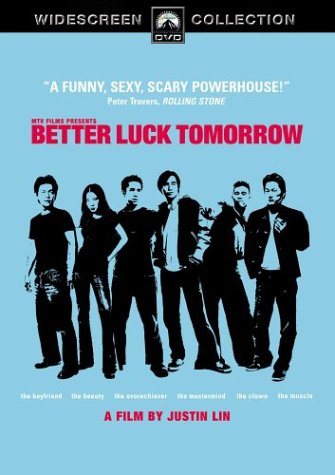
Manohla Dargis’s article prompts me to think about filmmaker Justin Lin. Lin’s young film career is characteristic of the studio-indie age before its current malaise. Lin went to great lengths, personal sacrifice and debt to make his solo debut feature film, Better Luck Tomorrow, a film that premiered at the 2003 Sundance Film Festival to critical acclaim, a distribution deal with MTV Films and eventually, work as a director for studios such as Universal Pictures and Touchstone Pictures. My interest in Lin lies not in discussing his merits as a filmmaker. Rather, I am interested in how Lin’s trajectory embodies a set of digital age D.Y.I. generational tactics and strategies that emerged in a tradition of American cinema that has rarely found studio traction during independent cinema’s Hollywood bubble: Asian American cinema. After Lin made his Hollywood films, Annapolis (2006) and The Fast and the Furious: Tokyo Drift (2006), he returned to the world of the independent cinema to make the film, Finishing the Game (2007). The promotional campaigns for Better Luck Tomorrow and Finishing the Game embody the practices of digital age independent cinema culture discussed by Dargis, but Lin’s strategy is both unique and instructive, I suggest, for its form of Asian American political and cultural engagement. The strategies behind Lin’s films reveal aims that went beyond simply “breaking out” as most independent films aspire to do. Instead, Lin’s films became platforms for community organizing and engagement that sought to impact the meaning of Asian America in American film history and popular culture.
To be sure, both films are notable for how they critically explore race and representation and both took refuge in the lean, but creatively free world of independent cinema. Better Luck Tomorrow tells the story of a group of high school students who use their status as academic overachievers to mask and enable their illicit activities. Finishing the Game is a mockumentary about the search for an actor to replace Bruce Lee after his unexpected death during the filming of Game of Death (1978). When considered through the lens of Asian American representation, each film becomes a provocative commentary on stereotypes, genre and cinema. As non-studio productions, Lin maintained a creative commitment to an Asian American agenda that included, among other objectives, introducing a range of multi-dimensional Asian American characters and showing how Asian America is a commercially viable audience and source of cinema. This creative independence and ethical imperative became inter-articulated with the political and cultural tactics behind the digital D.Y.I. promotional campaigns for the films. I want to save a fuller discussion of Justin Lin for another time and focus on just some of the practices that emerged from Lin’s films. My tack in exploring this topic is to study selected new media activities as part of a larger example of Asian American community organizing and political engagement in the digital age. In this regard, Lin is a pioneering figure.
To Read the Rest of the Essay

by Konrad Ng
Flow TV
In “Talking About a Revolution (for a Digital Age),” New York Times film critic Manohla Dargis reflects on the evolution of American independent cinema in the wake of its “Hollywood hangover.” She contends that starting in 1993, the emergence of a “studio-indie infrastructure” transformed American independent cinema into a micro Hollywood industry that allowed some filmmakers to go “from Sundance to Scorsese.” However, she contends, this studio-indie film system has been “rocked by seismic changes – including downsized companies and emerging technologies” and giving way to a leaner, non-studio version of independent cinema. Dargis states that American independent cinema is being shaped by the rise of an interactive, digitally assisted “Do-it-yourself” (D.Y.I.) film culture. She points to how digital media forms of self-distribution and promotion have enhanced independent cinema’s important connection with audiences to create “a more complex, interactive and personalized relationship.” She states that the vitality of American independent cinema also depends on “the cultivation of younger patrons who are used to receiving much if not all of their entertainment at home and on hand-held devices” and making them into “active participants in the movie and its meaning.” For Dargis, the ebb of Hollywood’s role in independent cinema means that youthfulness and digital D.Y.I. interactivity are forming the conditions for American independent cinema’s next generation of iconic films and filmmakers.
Manohla Dargis’s article prompts me to think about filmmaker Justin Lin. Lin’s young film career is characteristic of the studio-indie age before its current malaise. Lin went to great lengths, personal sacrifice and debt to make his solo debut feature film, Better Luck Tomorrow, a film that premiered at the 2003 Sundance Film Festival to critical acclaim, a distribution deal with MTV Films and eventually, work as a director for studios such as Universal Pictures and Touchstone Pictures. My interest in Lin lies not in discussing his merits as a filmmaker. Rather, I am interested in how Lin’s trajectory embodies a set of digital age D.Y.I. generational tactics and strategies that emerged in a tradition of American cinema that has rarely found studio traction during independent cinema’s Hollywood bubble: Asian American cinema. After Lin made his Hollywood films, Annapolis (2006) and The Fast and the Furious: Tokyo Drift (2006), he returned to the world of the independent cinema to make the film, Finishing the Game (2007). The promotional campaigns for Better Luck Tomorrow and Finishing the Game embody the practices of digital age independent cinema culture discussed by Dargis, but Lin’s strategy is both unique and instructive, I suggest, for its form of Asian American political and cultural engagement. The strategies behind Lin’s films reveal aims that went beyond simply “breaking out” as most independent films aspire to do. Instead, Lin’s films became platforms for community organizing and engagement that sought to impact the meaning of Asian America in American film history and popular culture.
To be sure, both films are notable for how they critically explore race and representation and both took refuge in the lean, but creatively free world of independent cinema. Better Luck Tomorrow tells the story of a group of high school students who use their status as academic overachievers to mask and enable their illicit activities. Finishing the Game is a mockumentary about the search for an actor to replace Bruce Lee after his unexpected death during the filming of Game of Death (1978). When considered through the lens of Asian American representation, each film becomes a provocative commentary on stereotypes, genre and cinema. As non-studio productions, Lin maintained a creative commitment to an Asian American agenda that included, among other objectives, introducing a range of multi-dimensional Asian American characters and showing how Asian America is a commercially viable audience and source of cinema. This creative independence and ethical imperative became inter-articulated with the political and cultural tactics behind the digital D.Y.I. promotional campaigns for the films. I want to save a fuller discussion of Justin Lin for another time and focus on just some of the practices that emerged from Lin’s films. My tack in exploring this topic is to study selected new media activities as part of a larger example of Asian American community organizing and political engagement in the digital age. In this regard, Lin is a pioneering figure.
To Read the Rest of the Essay
Subscribe to:
Posts (Atom)