Showing posts with label Western. Show all posts

Thursday, January 27, 2011

Tuesday, July 20, 2010

Barbara Koziak: Shepherding Romance -- Reviving the Politics of Romantic Love in Brokeback Mountain

Shepherding Romance: Reviving the Politics of Romantic Love in Brokeback Mountain
By BARBARA KOZIAK
Genders


[1] The recent film, Brokeback Mountain, directed by Ang Lee and based on Annie Proulx’s short story, received an overwhelmingly admiring response from newspaper and magazine film critics, won a series of prominent film awards, and roused a large, fervent fan base. Several large on-line discussion forums created in the months following the film’s release analyze every scene, symbol, and character, and remain to this day communities with interests that have expanded beyond the film. Coinciding with the emergence of You Tube and a new amateur video culture, fan enthusiasm created both lyrical tributes and hilarious parodies on video websites. A mini-Brokeback tourist industry emerged, with one website devoting itself to mapping and photographing every shooting location for every scene. These web-based responses culminated in net-generated cultural activism and even the popular naming of a new syndrome, “Brokeback Mountain Fever.”

[2] Such exuberant responses to the film appeared in the midst of a politically treacherous period for sexuality in public life. In the years before the film’s appearance, the U.S. Supreme Court ruled state anti-sodomy laws unconstitutional in their 2003 decision Lawrence v. Texas, five U.S. states enacted civil union or domestic partnership legislation while a handful of others recognized some spousal rights, and Massachusetts legalized gay marriage. On the other hand, during the 2004 election season, eleven states passed amendments or laws effectively barring same-sex marriage, and the red and blue state divide has largely formed around such prominent issues of sexuality and marriage. Political events after the appearance of the film were similarly ambivalent: Connecticut legalized same-sex marriage in 2008, four other states enacted some form of civil union or domestic partnership laws, and New York now recognizes all marriages contracted in other states. Pulling in the opposite direction, the rush to exclude gays and lesbians from marrying continued with eight more states in 2006 and three in 2008. The last group included the stunning reversal through popular ballot of the California Supreme Court’s approval of gay marriage. Remarkably, although politics have been dominated by a sharp backlash against the early victories for gay rights, over the same period, popular support nationwide for gay marriage has been slowly increasing (Campo-Flores 38). Just this year, in the space of a week, legislators in Vermont and the courts in Iowa legalized same-sex marriage.

[3] To explain this growing support, cultural studies scholar David Shumway has argued that we should understand the changing social and narrative context for heterosexual relationships. In particular, Shumway claims that a new class of intimacy narratives in literature and film, in which people expect multiple relationships requiring intensive communicative work, has prepared the straight world to accept gay unions. However, unlike the intimacy narratives Shumway discusses, no single narrative work in the late twentieth century has so broadly appealed to both gays and straights. Although the approval has hardly been universal, popular gay websites and magazines were enthusiastic. For example, AfterElton.com’s list of 50 greatest gay movies begins with Brokeback as number one, and The Advocate featured several Brokeback themed covers. In addition, the film won numerous awards, including MTV’s Best Kiss award and the Academy Award for Best Director (if not for Best Picture), and it continues to appear in popular newspaper and magazine lists of the most romantic movies. The studio, Focus Features, understood these possibilities and worked to broaden the film’s appeal beyond GLBT and art house audiences principally by marketing the film to women, and particularly by branding it as romance (Lippman). This wide embrace is significant since Brokeback Mountain encompasses a classical romantic love narrative, not an intimacy narrative.

[4] In fact, the film arrived at a particularly strange, uncertain moment in the cultural course of love. Some have argued that romantic love emerged in the West in the milieu surrounding the production of French troubadour poetry of the twelfth century, gained widespread popularization in the nineteenth and twentieth century, but lately has been successfully challenged by new modes of heterosexual relations (Shumway, Modern Love; Bloch). In response to this historical thesis, a new debate has emerged on the cultural universality of such a love (Cheung; Janowiak; Gottschall and Nordlund). Others argue that romantic love as currently practiced has undergone a dangerous intensification (Beck and Beck-Gernsheim), while others examine how it has been infiltrated by consumerist desires (Illouz). More recently, some sociologists and historians have reemphasized the historical and psychic disjunction of love and marriage (Coontz), how marriage was traditionally not based on love, and how the effort to link the two has destabilized marriage. Feminist conversations, which in the second wave often critiqued both marriage and love (Beauvoir; Firestone), more recently turned to examining sexual desire and marriage in the midst of the politics surrounding gay and lesbian unions. This new conversation in feminist theory has been relatively silent on romantic love (Card; Josephson; Ferguson; Shanley). Those early second generation feminists had often seen romantic love as a velvet trap for women, but their analysis was rightly devoted to this trap, and they often ended on a utopian hope for a transformed love. It is time to reconsider the socio-political effect of romantic love narratives, particularly because Brokeback and the emergence of online communities enable us to reexamine both a new iteration of this orthodox tale and its contemporary reception.

To Read the Rest of the Essay

Thursday, June 03, 2010

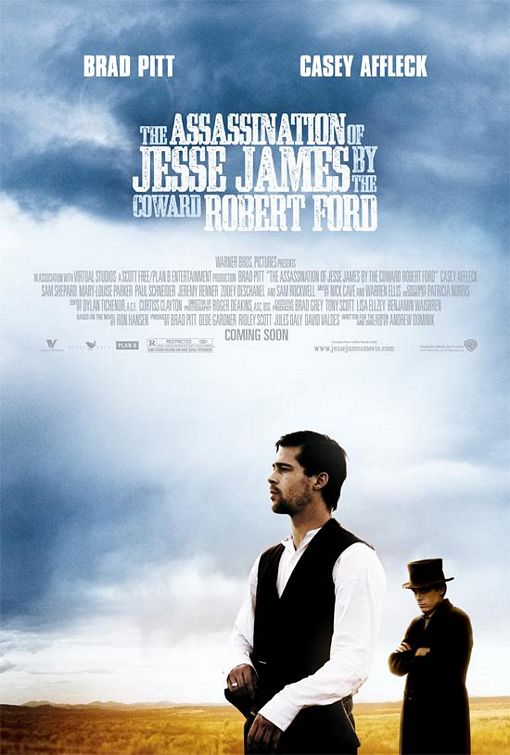
Left Field Cinema: American Masterpiece -- The Assassination of Jesse James by the Coward Robert Ford

American Masterpiece: The Assassination of Jesse James by the Coward Robert Ford
by Mike Dawson
Left Field Cinema


Perhaps it is a little unfair that Andrew Dominik’s sophomore cinematic offering has been frequently compared to the work of Terrance Malick. For such grand comparisons often result in disappointment for the viewer with the revelation that although they are not ill founded they are not entirely accurate either. Along with statements that the makers of The Blair Witch Project suffered upon release like “the greatest horror movie ever made” they raise the bar to such a significant height that even the most accomplished director would feel the weight of expectation crippling them where they stand. Malick is considered by many to be a lyrical genius, a modern American auteur and the greatest director working in the United States today; he is a colossus in the world of film with unquestionable artistic integrity. Dominik by comparison is a relative unknown New Zealander with 2000’s Chopper as his only previous film; in this sense he is in many ways like Malick, taking an extended seven-year absence before releasing this follow-up. Chopper was met with general critical acclaim, and yet he is still considered an unusual choice to direct a film about such a significant American legend. In actuality Dominik is perfect for the challenge, as with previous films dealing with either significant events in American history or commenting on the psyche of the nation – an outsider does it best. United 93, American Beauty and the like work better because of there is a more objective foreigner at the helm who can look at the events from the outside.

The story of the film follows the last days of the life of notorious gunslinger and outlaw Jesse James, multiple murderer, criminal, and fugitive. He and his brother worked with a small gang and successfully robbed banks and trains for many years, only the brothers remain alive from the original gang, and the elder brother Frank James has had enough of his younger siblings peculiar attitude and decides to leave this world behind. Sam Shepard is coldly menacing in the few scenes he is present, but without words or extended screen time manages to conjure a sense of dread, that the dark days are coming. What follows is the drifting of Jesse, constantly paranoid about who will try to capture or kill him, and aware that his greatest enemies are very probably the ones closest to him. The films second act is very passive, setting the criminal minds in play and switching perspective between our two titular characters, and other subordinates. Jesse then begins to kill the remaining members of his gang one by one as and when he deems them disloyal, whilst his gang attempt to decipher his next move, and are constantly aware that with Jesse often comes death. In the gang is the other titular character, nineteen year old Robert Ford, another younger brother, and a borderline fantasist. He has been obsessed with Jesse James from a young age and is determined to get as close to his hero as he can. As his canonised image of Jesse begins to be unraveled he is left crushed with the knowledge that his life has been wasted idolising a bully, a sociopath, and a madman. As the truth comes to light, so to do Robert’s murderous impulses, leading to climax which is reached as much through fate as it is though callous manipulation with an almost suicidal streak in Jesse’s choices.

To Read the Rest of the Essay

To Listen to It

Thursday, February 04, 2010

Discovering America -- Reflections on Brokeback Mountain

Discovering America: Reflections on Brokeback Mountain
by Justin Vicari
Jump Cut


...

As I watched Brokeback Mountain, I wondered if its total despair would sit well with gay activists, who have striven to promote uplifting images of gays in the media. Moreover, contemporary homosexuals seem to pride themselves on having conquered at least the kind of self-inflicted quagmires that Jack and Ennis find themselves consumed in. But ultimately I don’t think this film was made for the gay community. As a primer on the devastating effects of external and internalized homophobia, Brokeback Mountain is probably more revelatory and sobering for the straight audience, who are, at this point, more familiar with gay fashion-sense than with all-out gay despair. (It goes without saying: this is as far removed from the cuddly camp of Queer Eye for the Straight Guy as it is humanly possible to get.) And director Ang Lee, perhaps reasoning that to fully “convert” the mainstream a certain vulgar overstatement must be risked, has pulled no punches in bringing this despair to life. [1]

Such deep fatalism is largely alien to Hollywood cinema — the existential seriousness which Lee brings to Brokeback Mountain has more in common with “art-filmmakers” like Wong Kar-Wai, Malick, Bresson, Tarkovsky, Herzog or Fassbinder. [2] In the work of those great directors, one finds similar characters groping inarticulately through a life that is more like living hell or living death, characters whose complete suppression of emotion is the unmistakable sign of being imprisoned in hostile, even fascistic environments. Indeed, Brokeback Mountain deconstructs the very fabric of the social environment as a series of ugly, uncomprehending face-offs of fear and intolerance, a relentless grid-work of people squaring off over various kinds of turf. Many scenes of the film play like a bad acid trip, thick with malevolence and paranoia. Jack’s co-workers insult him behind his back. Husbands and wives bicker in ways that suggest years of pent-up frustration and murderous rage. Children shy away from adults as if from incomprehensible monsters. Straight men in cowboy bars turn pale at the presumed sexual advance of another male. When people come on to each other (both heterosexually and homosexually) the moment is always claustrophobic, tense, even life-threatening. All human intercourse is viewed through the eyes of two men who are living with a vast secret, divided against themselves, and, as it were, spies or interlopers in this world of marriage and family, ever in fear of being caught out and excommunicated or worse. Through the cold shadows and gray twilights of Brokeback Mountain, there is a constant feel of lurking terror and dread.

This “immense on-sliding American dread,” as Norman Mailer has written (“sad as the ghost of tenderness itself”), is palpable even in those epic scenes that take place in enormous outdoor vistas, on sun-swept plains. Spectacularly filmed by cinematographer Rodrigo Prieto, Brokeback Mountain is loaded with breathtaking panoramic shots of “Big Sky” country: azure and white cumulus, Bighorn ranges, sylvan forests. (In spite of its philosophical affinity to the work of certain European filmmakers, this is visually a very North American film — one of the most American of recent films.) This landscape is freedom and openness itself, unbounded, majestic, pure; as such, it only serves as an ironic teasing counterpoint to the conflicted relationship of the protagonists. They want to be as vast and free as this landscape, but are often dwarfed against it. Already in My Own Private Idaho (1991), Gus Van Sant made similar use of sprawling horizons to accentuate the loneliness of the futureless young hustler (River Phoenix) who could find no rooted identity or belonging. [3] Here, the U.S. that’s held up to Jack and Ennis inspires them, seemingly, to try to rise to its challenge, to claim some piece of it for themselves — and in raw unspoiled nature, away from other people, they can almost achieve this. The scenes on the mountain have a primeval quality that suggests the first stirrings of life on some dormant planet. Though taking place in the mid twentieth century, these scenes have a primitiveness that harkens back to at least the nineteenth, when the men scrub their clothes on a rock by a streambed, or hunt the elk that they will eat for dinner. (Other shots in the film convey a gloomy tumbledown beauty reminiscent of the dustbowl photographs of Walker Evans and Dorothea Lange.)

A certain “backwardness” is central to Brokeback Mountain’s vision of the United States. The U.S. West may or may not like the way it’s presented here: as a slough of pathic defensiveness and murderous intolerance, similar to the Badlands of Boys Don’t Cry (1999) but, if anything, more pervasive. Unlike Boys Don’t Cry, Brokeback Mountain is not limited to the exceptional brutality of ex-cons and trailer parks (a brutality which might be expected, after all), but roams its eye over the hidden brutality of “respectable” mainstream society. It takes on the “sacred” U.S.A. of God-and-family. Brokeback Mountain is a goading reminder that whatever public liberation of gays has taken place over the past thirty-five years has been almost exclusively confined to a few urban centers, where economic demands have forced a greater reliance on others and created more universal openness to the pursuit of happiness. But what of the lonesome West, rugged and insular, knitted by tradition and stubbornly resistant to change? The self-reliant mentality (we might deploy the folkloric wisdom, “Good fence-posts make good neighbors,” as an anti-motto here) and the hyper-religiosity of the God-fearing are hardly conducive to a climate of openness or acceptance for anyone. Of course, if homosexuality is a phenomenon that can naturally occur anywhere, then gays must already exist even in those places where few provisions are made for them. Sometimes, we know they are unable to exist there for long: in one of Brokeback Mountain’s most unsettling scenes, we feel like we are watching a nightmarish reenactment of the murder of Matthew Shepard in Laramie.

This last point could give an ultimate clue to the reason why Brokeback Mountain got overlooked for Best Picture by the Academy: not because it’s “about gays,” but because it seems to have so little to do with the reality of life in urban L.A. (unlike Crash, the film that got the 2005 nod). One can imagine many cosmopolitan Angelenos throwing up their hands: “Well, of course, that’s just the way it is outside of California! Why didn’t Jack and Ennis move here?” It’s all well and good to accuse Jack and Ennis of being “flat-earthers,” clinging to an impossible way of life in which they can’t be free when they could just as easily have moved away. But could it be that easy? Leaving their homeland would be akin to breaking out of their heavily guarded character armor. “You know me,” Ennis grumbles to Jack. “About all the travelin’ I ever done is around a coffeepot, lookin’ for the handle.” At their boldest, they discuss opening a small ranch together in the same western states where they already live in fear of persecution. These men are as psychologically tied to the land they come from as they are to each other. It’s clear that the film does not want to force them into making such a hard, final choice between the men they were raised to be, and the men they actually are.

For they are both those things, and remain so to the end. If the deep dichotomy in Ennis and Jack is disturbing even to the occasional point of seeming schizophrenic, the film is rooting for their freedom to have it all. One could argue that the film allows them almost too much freedom. Is it credible that two men so inherently homophobic keep returning to each other throughout the years, or are able to wholeheartedly enjoy and invest emotionally in the furtive sex they have together? I don’t know the answer to that; one of Brokeback Mountain’s virtues is that it doesn’t present either character as a readymade composite of gay-identity or lack-thereof. Like the short story (by Annie Proulx) from which it derives, the film simply, and convincingly, suggests that this is how these two men handle their struggle for identity, a struggle that takes a lifetime and consumes nearly all their reserves of emotional and psychological energy.

To Read the Entire Essay

Sunday, January 10, 2010

Left Field Cinema: Michael Cimino's Heaven's Gate (1978)

Misunderstood Modern Cinema: Heaven's Gate
by Mike Dawson
Left Field Cinema


Heaven’s Gate is a western, however it is unlike any other western you’re ever likely to see. Based on historical events from 1890 Wyoming, a powerful group of land owners known as the association are in the midst of conflict with European immigrants who are trying to forge a life on the American frontier. The judicial system favours the immigrants, and the land owners decide that they must bypass the law in order to rid themselves of these interlopers. Their extreme solution is to create a death list with one-hundred and twenty-five names on it, and then hire a small army of bounty hunters and mercenaries to hunt down every man and woman on the list and kill them. Sheriff James Averill played by Kris Kristofferson comes to town and finds violence on the streets and murder brewing amongst civil unrest, he visits with his prostitute girlfriend Ella Watson played by a very young Isabelle Huppert; his former university friend from Harvard - Billy played by the incredible John Hurt; and a bar owner and prospector John played by Jeff Bridges. Slowly Averill gets a picture of the violently volatile situation and wants to convince Ella to leave before the situation explodes, but Ella is content with her life, she runs a successful brothel, and has everything she could want where she is. Averill isn’t the only one who wants Ella to leave, hired gun Nathan played by Christopher Walken wants to marry Ella and start a life together away from her prostitute occupation. A love triangle is formed with both men wanting the same thing, but neither of them may achieve their goal in the end as it comes to light that Ella’s name is also on the death list and the illegal army begin their march towards the town to kill the majority of the inhabitants.

To Read the Rest of the Analysis

To Listen to the Analysis as a Podcast