Showing posts with label Critics. Show all posts

Wednesday, March 23, 2011

To the Best of Our Knowledge: Arts Education

Arts Education
To the Best of Our Knowledge (Wisconsin Public Radio)

SEGMENT 1:


Eric Booth is one of America's leading teaching artists and trainer of teaching artists. He's also the author of "The Music Teaching Artist's Bible: Becoming a Virtuoso Educator." He talks to Steve Paulson about the current state of arts education in American schools and shares his thoughts on how to engage children through arts education.

SEGMENT 2:


Michael Doucet is the founder of the pioneering, Grammy Award-winning Cajun band, BeauSoleil. The band recently released its 29th album, "Alligator Purse." Doucet also has an extensive background in arts education. He talks to Steve Paulson about educating people about Cajun culture through Cajun music. We also hear some music from BeauSoleil's "Alligator Purse" album.

Katie Salen is a game designer, interactive designer, animator and design educator. She's also the editor of "The Ecology of Games: Connecting Youth, Games, and Learning." Salen talks to Anne Strainchamps about what children can learn from designing and playing games.

SEGMENT 3:


David Gilmour is a Canadian film critic and novelist. He's also the author of a memoir called "The Film Club." In the book, Gilmour writes about his decision to let his son, Jesse, drop out of school, provided that he agrees to watch three movies a week with his father. Gilmour talks to Jim Fleming about the experience. We also hear clips from a few of the films that Gilmour watched with his son

To Listen to the Episode

Thursday, July 15, 2010

Pinocchio Theory: Slow Cinema vs Fast Films

(Important statement on the problematic critical celebration of contemplative cinema as the pinnacle of filmmaking--if this piece interests you, definitely check out the comments ...)

Slow Cinema Vs Fast Films
by Steven Shaviro
Pinocchio Theory

...

Anyway. Like Nick James, I am not insensitive to the greatness and power of many of these recent “slow” or “contemplative” films. Tsai Ming-Liang is a great director by any accounting; Tarr, Kore-eda, and Sokurov have in my opinion made some important and powerful films (though in both cases, I find their work uneven). And friends of mine, whose aesthetic sensibilities I respect, have had sublime experiences with films by Reygadas, Weerasethakul, and Alonso — and I can see what it is in the films by these directors that appeal to them, even though I do not quite share their admiration.

And yet, and yet… There seems to be something lacking to me in nearly all the recent exercises in contemplative (or slow) cinema, when you compare them with such older “contemplative” works as Antonioni’s films of the 1960s, Chantal Akerman’s early films from the 1970s, Miklos Jancsó’s films of the 1960s and early 1970s, and Tarkovsky’s films before he left Russia. There was something daring and provocative about Antonioni’s portrayals of fatigue and ennui, and his precise contemplations of the positive emptiness of both natural and human-made landscapes; about Akerman’s digging into the horrors of women’s everydayness; of Jancsó’s icy priouettes around the clashes of armies on vast plains; about Tarkovsky’s patience and sense of duration. All these directors were extremists in their own singular ways: by which I mean they were pushing cinema to its extreme limits, as well as exploring the extreme aspects of human possibility and impossibility (and not just human ones — some of these directors may well be credited with pioneering a potential posthuman and object-oriented cinema).

In today’s contemplative cinema, in contrast, the daringness and provocation are missing. I never get the sense that Dumont, or Reygadas, for instance, are ever taking risks or pushing boundaries. There’s an oppressive sense in which the long-take, long-shot, slow-camera-movement, sparse-dialogue style has become entirely routinized; it’s become a sort of default international style that signifies “serious art cinema” without having to display any sort of originality or insight. “Contemplative cinema” has become a cliche; it has outlived the time in which it was refreshing or inventive.

I’d even say that the most inspired works of “difficult” international cinema are characterized by the ways that they depart from slow-cinema norms. Claire Denis’ 35 Shots of Rum, for instance, cannot be classified as slow or contemplative cinema: its narrative is oblique, as is its presentation of that narrative, but it is too intimate, or too interested in the feelings and everyday shifts of attention and mood of its protagonists, to fit the “slow” paradigm. The late (and still woefully underappreciated) Edward Yang abandoned the Antonioniesque stylings and slownesses of his earlier films for something more like a Renoiresque social realism with ensemble casts (I still think that Confucian Confusion and Mahjong are two of the greatest films of the 1990s, together constituting the postmodern equivalent of Rules of the Game). Hirokazu Kore-eda’s After Life is utterly inspired, with its peculiar, more-than-Gondryesque take on mortality and memory, while Still Walking seems to me to be just standard-issue CCC, with a deep-emotions-displayed-through-restraint portrayal that is strictly by the numbers, more “moving” than actually moving. Similarly, the handheld-camera rawness of Jia Zhang-ke’s earlier films (like the intensely disillusioning Xiao Wu) seem to me to be far superior to his “slower” recent works. The crazy excesses of the best Korean directors (Bong Joon-ho, park Chan-wook, and Kim Ki-Duk) all evidence, in their utterly different ways, a hunger for all the dimensions of life (from corporeal to spiritual to social) that contemplative cinema systematically omits. In his best films, Takeshi Kitano pushes slow cinema to the point of buffoonery and absurdity. And Takashi Miike has shown more formal invention, and rethinking of what cinema is, what it can be, and what it means, in each year of his career than all the CCC directors combined have shown over their entire careers. (And I could go on; Wong Kar-Wai, David Lynch, Guy Maddin, and Mladen Djordjevic are all important contemporary directors who have nothing whatsoever to do with Contemplative Cinema).

To Read the Entire Essay

Thursday, June 17, 2010

To the Best of Our Knowledge: Dancing About Architecture -- Arts Criticism

Dancing About Architecture: Arts Criticism
To the Best of Our Knowledge (PRI)

SEGMENT 1:

Manohla Dargis is co-chief film critic for the New York Times. She talks with Steve Paulson about the role of film criticism in contemporary society.

SEGMENT 2:

Robert Palmer was a music critic and musician. Yoko Ono said she, Palmer and John Lennon "touched each other's spirit." Palmer's fellow critic, Anthony DeCurtis, has edited a new book called "Blues and Chaos: The Music Writing of Robert Palmer." Palmer's daughter, Augusta Palmer, recently made a documentary about her father called "The Hand of Fatima." In a rare joint interview, DeCurtis and Palmer talk with Steve Paulson about Robert Palmer and his work. (also check out the complete and unedited web extra version below) Also, Geeta Dayal is the author of "Another Green World." It's a short book about Brian Eno's 1975 album of the same name. Eno used a deck of "Oblique Strategies" cards to create the album. He created these cards with his friend, the late artist Peter Schmidt. The cards contain phrases like "Honor thy error as a hidden intention." Dayal also used them to help write her book and talks about it with Jim Fleming.

SEGMENT 3:

In the early 1970s, John Mendelsohn wrote for "Rolling Stone" and the LA Times and recorded for Warner Brothers Records as a member of the band Christopher Milk. Now he has a new CD called "Sorry We're Open." Mendelsohn talks with Anne Strainchamps and we hear what he's up to now musically.

To Listen to the Episodes

Thursday, June 10, 2010

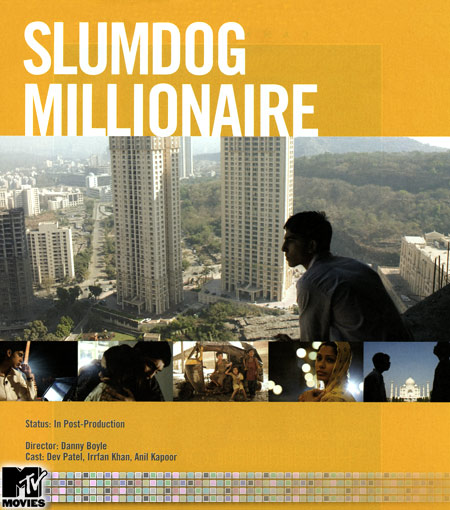
Sakuntala Banaji: Seduced ‘Outsiders’ versus Sceptical ‘Insiders’? -- Slumdog Millionaire through its Re/Viewers

Seduced ‘Outsiders’ versus Sceptical ‘Insiders’?: Slumdog Millionaire through its Re/Viewers
by Shakuntala Banaji,
Centre for the Study of Children, Youth & Media, UK
Participations


Slumdog Millionaire (Dir. Danny Boyle, 2008) is now best known for winning numerous Awards at the Baftas, Golden Globes and the Oscars. After being publicly championed by an unprecedented number of film critics, it caused something of a media sensation when celebrities in Bollywood and some (but not all) viewers in India publicly labeled it exploitative and unfair to India and Indians. Told in flashback from the point of view of a young man, the film narrates the story of two brothers from a shantytown in Bombay, who choose different pathways in life. In the opening sequence of the film, one of the brothers has reached the final of the much-vaunted TV quiz show, the Indian version of ‘Who wants to be a Millionaire’. Arrested, apparently for cheating, Jamal Malik ‘explains’ to his police interrogators how it is possible for someone like him, a slum child with little formal education, to know the answers to the most seemingly esoteric questions: he has learned the answers through bitter experience. And in the process of recounting these, he opens for the audience (what is displayed unashamedly by the film as) a window on the world of two Muslim children born in a Bombay shantytown in the 1980s. Via fast-paced sequences full of jump cuts – depicting communal riots, professional begging and child molesting gangsters – the boys and the camera travel across India and back again. They return in search of an old girlfriend as Bombay’s/Mumbai’s economy goes neo-liberal and gated communities spring up, isolating the rich from the poor. In tandem, the younger brother, Jamal, stays honest, innocent, hard-working and loyal – a tea-boy in a call centre; the older brother becomes a gangster’s lackey, corrupt and aggressive, taking the quickest possible route to what seems like financial success.

A viewing of the film during a year of media hype, followed by a series of random but heated discussions about it, crystallised into an urge to discover whether and how different kinds of knowledge and experience – about cinema, about Hindi cinema, about India, about Bombay, about urban poverty (Indian style) – played into critical responses to the film, by viewers or by established film critics. Saying that the same film and the same set of circumstances can call up wildly different even contradictory viewpoints from people, or from the same person at different times should no longer be much of a surprise. Meaning does not reside solely in media texts; this has been established over the decades via painstaking theoretical critique and empirical scholarship (see, among others, Austin 2002, Buckingham 1993, Barker and Brooks 1998, Mankekar 1999 and Staiger 1999). Although there are still those new to the subject who might write as though texts are all-powerful and hold ultimate sway, enough has been done to challenge a text-centric understanding of meaning and effects to obviate the necessity for another paper on this topic. What is interesting about people’s reactions to this particular film is not, in fact, the divergence of opinion per se. What is intriguing however is, first, the vehemence and types of the feelings called forth by what might seem a fairly prosaic rags to riches story, albeit set in a (to most Western audiences) exotic setting: delight and jubilation, inspiration, tears, disgust, anger and humiliation are only some of the emotions expressed by those who watched it. Second, and more confusingly, perhaps, it was read as an educational – almost an ethnographic – tale by some re/viewers, a contrast to Bollywood glitz and to the mawkish sentimentality of documentaries about India. Additionally, and more problematically, perhaps, opinions expressed about the film contained tropes of quasi-orientalist (Said 1978) or re-orientalist (Lau 2007) cultural and political discourse. Indeed, the quaint assumption of an ethnographic subject when a film or book happens to feature non-white and non-western protagonists is a classic feature of such discourse in relation to fiction genres. In a fascinating paper delivered on this subject, Ellen Dengel-Janic argues that ‘[w]hat the film negates and helps to mask in a pleasurable visual manner is a translocated fear of poverty and the abject…. the film’s appeal reflects not only the West’s exoticism of India, but also its repressed fear and paranoia of becoming abject and poor’ (2009: NP). But given the wide range of viewers who ultimately encountered the film, can such a critical reading be sustained? Understanding the combinations of circumstance and experience, contextual and technical knowledge and generic expectation that led to particular discourses or technical sequences in films being picked up and enjoyed or selectively critiqued has been the aim of much of my work on Hindi cinema to date (see Banaji 2006 and 2008) and remains at the core of this paper. However, even these combinations do not capture fully the investments people have in their judgments about films or indeed the complexity of the emotional and cultural histories that inflect these judgments.

To Read the Rest of the Essay