Showing posts with label Characters. Show all posts

Tuesday, November 02, 2010

Ramona Waldman: Response to Code Unknown

Code Unknown
by Ramona Waldman
ENG 282 Response


Haneke’s fragmented masterpiece calls attention to the notion of communication, or, more precisely, the lack of it. Each scene seems to be a story in itself, apparently unrelated to the rest of the film. The movie begins with deaf-mute kids, playing charades. Soon enough the whole film becomes a game of charade where Haneke chops and switches between the different lives of his characters, joining each scene after it’s started and cutting away before it’s finished.

Things take place in real time, like the long opening scene along the boulevard that draws together all the characters in “one big picture”. Anne Laurent (Juliette Binoche) is an actress working in Paris, and she walks briefly with her boyfriend's younger brother Jean. After they separate, Jean tosses waste paper into the lap of Maria, a homeless-beggar woman sitting on the side of the road (whom we later learn is a Romanian illegal immigrant). We also meet Amadou, from an African immigrant family, who witnesses this and ends up as “a victim” after confronting Jean and asking him to apologize to the woman beggar. The two fight, Anne intervenes to stop the fight, and eventually Amadou and Maria are both taken to a police station for questioning. Amadou is released presumably shortly after, though we later find out that he was held, beaten and shamed. As if to balance this scene (blacks are victims and white people are victimizers), by the end of the movie we see an adolescent arab, without any reason, taunting Anne about her race, class and gender in an extremely powerful and nerve-wracking scene.

Maria is deported to her native Romania where she “reconnects” with her family there. After a while she returns to Paris.

The film’s technique is sometimes deceptive, as the spectator watches “a real scene” is only to discover it’s a film within this film. Code Unknown manages to put the audience out of their comfort zone, forcing viewers to work at filling in missing links. Haneke highlights the amalgamation of multiple cultures and miscommunication. The film is also a morality play, which investigates if justice is still honorable and relevant in today's world. One point of the film seems to be that modern society is heartless, that it is infected with preconceived ideas and intolerance which threaten to destroy us unless addressed on individual and political levels.

After watching this movie I felt like we’re all trapped behind ethnicity, class, wealth/poverty, bigotry, and position, we are searching out some common thread of courtesy, thinking hard before we speak, sometimes becoming paralyzed by fear, loneliness and isolation.

It is definitely worth decoding this film!

Friday, June 11, 2010

Brannon M. Hannock: A Community of Characters – the Narrative Self in the Films of Wes Anderson

A Community of Characters – the Narrative Self in the Films of Wes Anderson
By Brannon M. Hancock
Journal of Religion and Film


In his 1999 article "If I Can Dream: The Everlasting Boyhoods of Wes Anderson,” Mark Olsen dubbed the young filmmaker the beginning of a movement he called "the New Sincerity.” Olsen hints at the possible criteria for the New Sincerity when he notes that:

Unlike many writer-directors of his generation, Wes Anderson does not view his characters from some distant Olympus of irony. He stands beside them – or rather, just behind them – cheering them on as they chase their miniaturist renditions of the American Dream. The characters who inhabit Anderson's cinematic universe, a Middle West of the Imagination, embody both sides of William Carlos Williams' famous edict that the pure products of America go crazy, being, for the most part, both purely American and slightly crazy. Though some might label his people losers, or even invoke that generational curse, slackers, they are in fact ambitious.2

The New Sincerity is an apt phrase, and while it never caught on as a new movement in film, other recent titles come to mind: P. T. Anderson's (no known relation to Wes, by the way) Punch-Drunk Love, Todd Luiso's Love Liza, Sofia Coppola's Lost in Translation, Michel Gondry's Eternal Sunshine of the Spotless Mind (by screenwriter Charlie Kaufman), Zach Braff's stunning debut Garden State, and Jared Hess' Napoleon Dynamite – quirky films that have reminded audiences of their own humanity, of the love and pain and confusion and ecstasy that one feels in the most outlandish and the most commonplace of circumstances. No matter how ridiculous their actions, characters in these films are treated not with pity or irony but with respect and admiration. As Olsen points out, Wes Anderson "is immune to the urge to be down,”3 and the same could be said for the others mentioned above, who eschew the kind of dark, Tarantino-derived edge that seems to proliferate amongst many young filmmakers.

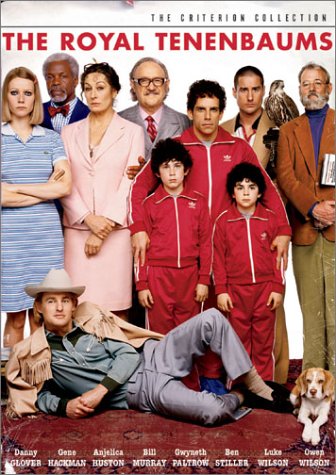
I would like to explore the value of Wes Anderson's films for theological reflection by focusing on the characters that populate his mythopoetic worlds in Bottle Rocket, Rushmore and The Royal Tenenbaums. I will attend to two qualities common to the central characters across Anderson's first three films.4 The first of these qualities I call the abilitytoimaginatively construct, or reconstruct, their own reality. The second might be described as the characters' recognition thatauthentic being or personhood is found only in communion, which is to say in radical inter-relationship with others through participation in a particular community of character(s). Once we have examined these characteristics of Anderson's films, I will conclude by suggesting why Anderson's unique vision, as embodied by his uncanny characters, might teach us something important about what it means, in the first instance, to be, and what it means to be in communion.

Collaboration – Wes and Owen (or, where two or more are gathered...)

I feel as though I should begin by correcting myself, for it is slightly misleading to describe these three films as " Anderson's.” More accurately, they are collaborations between writer-director Anderson and writer-actor Owen Wilson, who has since become widely known for his roles in films such as Zoolander and Armageddon. Anderson and Wilson became acquainted in 1989, where the two then-college-sophomores were enrolled in a lack-lustre playwriting course at the University of Texas at Austin5 (where Anderson went on to earn a degree in Philosophy.6) Both were compulsive cinephiles and storytellers, and soon a creative partnership formed which led to the screenplay for Bottle Rocket. Bottle Rocket and its follow-up Rushmore were both filmed in their native Texas, and both projects involved many friends and relatives from "back home” as cast and crew, including Owen Wilson's two brothers, Luke and Andrew. In a sense, the community of characters within the films mirrors the external community collaborating to produce the films. In this way Anderson and Wilson have much in common with their characters, finding within this creative community the fulfillment and identification that their characters seek within their own fictional communities.

In his foreword to the screenplay for Rushmore, producer James L. Brooks notes that "Wes and Owen are Texans and so their endless fascination with the ol' game of life...is very often concealed behind tight-lipped rhetoric with a distinct sense of the absurd, the joke of it all, which they exhibit whenever there is danger in the air.”7 The danger is the cutthroat man's-world of Hollywood, and Anderson and Wilson are boys brimming with enthusiasm running headlong into it. They are boys with stories to tell, and the stories are their own. They might be dreamers, like their slightly-off-kilter but always empathetic protagonists, but as Bottle Rocket's Mr. Henry reminds us, "The world needs dreamers.”

To Read the Rest of the Essay