(via Literaghost)
Why a Wisconsin Sheriff Refuses to Serve as Governor Walker's 'Palace Guard'
by John Nichols
The Nation
No one has worked harder—and smarter—to keep the peace in Madison during the dispute over Governor Scott Walker’s attempt to crush public employee unions than Dane County Sheriff Dave Mahoney.
A veteran lawman who came up through the ranks of the sheriff’s department in the state’s second- largest county before being elected sheriff in 2006, he’s hugely popular in the capital county—winning re-election in 2010 with 71 percent of the vote. He’s also hugely respected, as a key contributor to the work of the Governor’s Council on Domestic Violence, the Governor’s Council on Wisconsin Homeland Security, the Wisconsin Supreme Court Task Force on Mental Health and Criminal Justice System, Wisconsin law-enforcement groups and the National Sheriff’s Association.
That respect has served Sheriff Mahoney as he has worked long hours to help coordinate the response of various law-enforcement agencies to demonstrations that have attracted over 100,000 people, round-the-clock sleep-ins and sit-ins at the state Capitol and even clashing rallies between a small Tea Party contingent and a very large union crowd.
There has been no serious violence, no serious destruction and no serious arrests.
So you would think that Governor Walker and his aides—as well as their media echo chamber—would be hailing Sheriff Mahoney.
Of course, you would think wrong.
Sheriff Mahoney’s determination to preserve the peace, protect demonstrators and officials and respect basic liberties has earned him the scorn of those who are calling for an aggressive crackdown on dissent.
As the governor and his aides have attempted to limit access to the state Capitol—which the Wisconsin constitution says must remain open to all citizens—Sheriff Mahoney has steadily argued that he and his deputies are present both to maintain public safety and to defend the right of citizens to assemble and petition for the redress of grievances.
As Walker’s lawless approach has gone to extremes, culminating in a failure by the governor’s Department of Administration to obey an order from a Dane County Judge that the Capitol be opened, Sheriff Mahoney has become more explicit in his objections.
The sheriff objected when Dane County deputies, who have been frontline officers from the start of the recent protests, were the doors of the Capitol were not opened. Finally, he pulled his officers from the scene.
“When asked to stand guard at the doors that duty was turned over to the Wisconsin State Patrol because our deputies would not stand and be palace guards,” said Sheriff Mahoney. “I refused to put deputy sheriffs in a position to be palace guards.”
The sheriff and I have walked through the Capitol several times in recent days and he has reflected again and again on the importance of respecting the Constitution and maintaining a free and open space for honest debate and dissent.
“I smile everyday at what I am seeing take place in this building,” the lawman told me as we walked amid throngs of protesters on Sunday, before Walker’s administration ordered an aggressive crackdown on dissent.
The crowds have been noisy and passionate, he said, as might be expected when issues of such consequence are at stake. But they have also been responsible and respectful.”They’ve helped law-enforcement agencies to keep the peace, and we have helped to assure that they can exercise their First Amendment rights,” the sheriff explains.
To Read the Rest of the Article
Showing posts with label John Nichols. Show all posts
Showing posts with label John Nichols. Show all posts
Wednesday, March 02, 2011

Saturday, October 16, 2010
Tell Somebody: Robert McChesney On Saving Journalism
Prof. Robert McChesney On Saving Journalism
Tell Somebody
Recently, Robert McChesney put out an email that said,in part, "The Nation just published an article I wrote on the crisis on journalism with my friend John Nichols. It is titled " The Death and Life of Great American Newspapers," though it concerns the entirety of journalism. If this is an issue that you care about, I think you might find the piece of more than passing interest. We make an argument to address the problem going far beyond most of what has been proposed to date."
To Listen to the Interview
Tell Somebody
Recently, Robert McChesney put out an email that said,in part, "The Nation just published an article I wrote on the crisis on journalism with my friend John Nichols. It is titled " The Death and Life of Great American Newspapers," though it concerns the entirety of journalism. If this is an issue that you care about, I think you might find the piece of more than passing interest. We make an argument to address the problem going far beyond most of what has been proposed to date."
To Listen to the Interview
Sunday, May 23, 2010
Bill Moyers Journal: John Nichols & Terry O'Neill on Health Care Reform
John Nichols & Terry O'Neill on Health Care Reform
Bill Moyers Journal
The Patient Protection and Affordable Care Act is now law — but the battle over health care reform is far from over. Already at least 14 state attorneys general have filed lawsuits in state courts charging that the mandate for individuals to buy health insurance is unconstitutional. The Republican Party has vowed to make health care reform the central issue in their bid to gain Democratic seats in the mid-term elections. Stalwart advocates of a single-payer system are also unhappy with the outcome — calling the bill "a false promise of reform" and "wimpy."
John Nichols of THE NATION and Terry O'Neill of the National Organization of Women (NOW), have looked over the final legislation and made their assessments. Nichols suggests that while the act is deeply flawed, it has moved the national conversation to a new, more positive, place. No longer is there a question about whether to reform health care, but how to reform it — and it is very difficult, notes Nichols, to move backward along that path:
Terry O'Neill is not as sanguine: "My organization looked at the entire bill at the end of the day when it was passed. And we concluded that on balance, despite the good things that are in the bill, the bill actually is bad for women." As part of a deal to win pro-life Democratic votes, President Obama signed an Executive Order which "requires adequate enforcement mechanism to ensure that Federal funds are not used for abortion services." According to O'Neill and other pro-choice groups, it is, in fact, an extension of the Hyde Amendment (which originally only applied to Medicaid funds) and "A Tragic Setback for Women's Rights."
But the blanket restriction on use the federal funds for abortion services is not the only problem O'Neill sees with the bill. She notes that it also does not ameliorate gender and age bias in insurance coverage and delivers 32 million new customers to the insurance industry.
John Nichols
John Nichols, author and political journalist has been writing the "Online Beat" for THE NATION magazine since 1999. Nichols also serves as Washington correspondent for THE NATION, as well as the associate editor of the CAPITAL TIMES, the daily newspaper in Madison, Wisconsin and a contributing writer for THE PROGRESSIVE and IN THESE TIMES.
Along with fellow author Robert McChesney, Nichols co-founded the media-reform group Free Press. Nichols has also authored several books, including JEWS FOR BUCHANAN, which analyzed the recount vote of 2000, and DICK: THE MAN WHO IS PRESIDENT, his best-selling biography of Vice President Dick Cheney. Nichols most recent book, THE GENIUS OF IMPEACHMENT, argues that impeachment is an essential instrument of America's democratic system.
Terry O'Neill
Terry O'Neill, a feminist attorney, professor and activist for social justice, was elected president of NOW in June 2009. She is also president of the NOW Foundation and chair of the NOW Political Action Committees, and serves as the principal spokesperson for all three entities.
A former law professor, O'Neill taught at Tulane in New Orleans and at the University of California at Davis, where her courses included feminist legal theory and international women's rights law, in addition to corporate law and legal ethics. She has testified before committees in the Maryland House of Delegates and has written federal amicus briefs on abortion rights for Louisiana NOW, Planned Parenthood and the American Civil Liberties Union.
O'Neill worked on such historic campaigns as Hillary Clinton's campaign for the Democratic presidential nomination, Barack Obama's presidential campaign, and the campaign leading to the election of Louisiana's first woman U.S. senator, Mary Landrieu.
To Listen/Watch the Episode and to Access More Resources
Bill Moyers Journal
The Patient Protection and Affordable Care Act is now law — but the battle over health care reform is far from over. Already at least 14 state attorneys general have filed lawsuits in state courts charging that the mandate for individuals to buy health insurance is unconstitutional. The Republican Party has vowed to make health care reform the central issue in their bid to gain Democratic seats in the mid-term elections. Stalwart advocates of a single-payer system are also unhappy with the outcome — calling the bill "a false promise of reform" and "wimpy."
John Nichols of THE NATION and Terry O'Neill of the National Organization of Women (NOW), have looked over the final legislation and made their assessments. Nichols suggests that while the act is deeply flawed, it has moved the national conversation to a new, more positive, place. No longer is there a question about whether to reform health care, but how to reform it — and it is very difficult, notes Nichols, to move backward along that path:
For 100 years...we tried to take this vacant site and dig a hole, put a foundation, and start some construction. That's what's happened. The fact of the matter is it's best to understand the health care legislation that was passed on Sunday as the beginning of a construction project. And that's why some people fought so hard against it, because they understood. Once you begin that project, it is very unlikely that we're going to fill the hole in, tear down all the construction.
Terry O'Neill is not as sanguine: "My organization looked at the entire bill at the end of the day when it was passed. And we concluded that on balance, despite the good things that are in the bill, the bill actually is bad for women." As part of a deal to win pro-life Democratic votes, President Obama signed an Executive Order which "requires adequate enforcement mechanism to ensure that Federal funds are not used for abortion services." According to O'Neill and other pro-choice groups, it is, in fact, an extension of the Hyde Amendment (which originally only applied to Medicaid funds) and "A Tragic Setback for Women's Rights."
But the blanket restriction on use the federal funds for abortion services is not the only problem O'Neill sees with the bill. She notes that it also does not ameliorate gender and age bias in insurance coverage and delivers 32 million new customers to the insurance industry.
John Nichols
John Nichols, author and political journalist has been writing the "Online Beat" for THE NATION magazine since 1999. Nichols also serves as Washington correspondent for THE NATION, as well as the associate editor of the CAPITAL TIMES, the daily newspaper in Madison, Wisconsin and a contributing writer for THE PROGRESSIVE and IN THESE TIMES.
Along with fellow author Robert McChesney, Nichols co-founded the media-reform group Free Press. Nichols has also authored several books, including JEWS FOR BUCHANAN, which analyzed the recount vote of 2000, and DICK: THE MAN WHO IS PRESIDENT, his best-selling biography of Vice President Dick Cheney. Nichols most recent book, THE GENIUS OF IMPEACHMENT, argues that impeachment is an essential instrument of America's democratic system.
Terry O'Neill
Terry O'Neill, a feminist attorney, professor and activist for social justice, was elected president of NOW in June 2009. She is also president of the NOW Foundation and chair of the NOW Political Action Committees, and serves as the principal spokesperson for all three entities.
A former law professor, O'Neill taught at Tulane in New Orleans and at the University of California at Davis, where her courses included feminist legal theory and international women's rights law, in addition to corporate law and legal ethics. She has testified before committees in the Maryland House of Delegates and has written federal amicus briefs on abortion rights for Louisiana NOW, Planned Parenthood and the American Civil Liberties Union.
O'Neill worked on such historic campaigns as Hillary Clinton's campaign for the Democratic presidential nomination, Barack Obama's presidential campaign, and the campaign leading to the election of Louisiana's first woman U.S. senator, Mary Landrieu.
To Listen/Watch the Episode and to Access More Resources
Saturday, March 27, 2010
John Nichols: Banking for the People
Banking for the People
By John Nichols
The Nation
That's a question that a growing number of candidates and legislators across the country are answering with proposals to create state-owned banks. Though these initiatives borrow from an old model--North Dakota has run a successful state bank since 1919--they are a response to a new reality: the hundreds of billions of public dollars plowed into big banks by the federal bailout have done little to free credit for job creation or economic development in recession-ravaged communities. So, taking a cue from Nobel Prize-winning economist Joseph Stiglitz and other critics of private-bank bailouts, latter-day populists are proposing to put public money to work for the public good.
Oregon Democratic gubernatorial candidate Bill Bradbury is calling for the creation of a Bank of Oregon, which would keep money in the state and invest in sustainable development. "It is time to declare economic sovereignty from the multinational banks that are responsible for much of our current economic crisis," says the former State Senate president and secretary of state. "Every year we ship over a billion dollars in Oregon taxpayer dollars to out-of-state and multinational banks in the form of deposits, only to see that money invested elsewhere. It's time to put our money to work for Oregonians."
Michigan's Virg Bernero, a leading candidate for the Democratic nomination for governor in that hard-hit state, is another public-banking proponent. "We can break the credit crunch and beat Wall Street at their own game by keeping our money right here in Michigan and investing it to retool our economy and create jobs," says the populist mayor of Lansing. In Illinois, Green Party gubernatorial nominee Rich Whitney, who won 10 percent of the statewide vote in 2006, proposes depositing all state tax revenues and pension contributions in a state bank. "Instead of using state funds as a means to further enrich private banks, a state-owned bank could earn additional revenue for the state while at the same time help spur economic development in Illinois," he argues.
It is not just candidates who are talking up bold remedies to the challenges created and perpetuated by "too big to fail" banks. Legislators from Vermont to Virginia, from Michigan to Washington State, are proposing to start state banks. They take inspiration from the Bank of North Dakota, created ninety-one years ago by radical Non-Partisan Leaguers to serve as the depository for all state tax collections and fees. The nation's only state-owned bank avoided subprime lending and the derivatives markets during the recent real estate bubble and now has $4 billion under management. It maintains the faith of its founders and, in the words of bank president Eric Hardmeyer, continues to "plow those deposits back into the state of North Dakota in the form of loans. We invest back into the state in economic development type of activities." What that means, according to Ellen Brown, author of the book Web of Debt, is that North Dakota has avoided the credit freeze "by creating its own credit [and] leading the nation in establishing state economic sovereignty."
That sounds good to Massachusetts Senate president Therese Murray, who wants her state to look into creating its own bank. Washington House finance committee vice chair Bob Hasegawa, a Seattle Democrat, has formally proposed a State Bank of Washington. "Imagine financing student aid, infrastructure, industry and community development. Imagine providing access to capital for small businesses, or otherwise leveraging our resources instead of having to do it with tax incentives," he says. "Imagine keeping our resources local instead of exporting them as profits, never to be seen again--that's what this bank could do."
To Read the Rest
By John Nichols
The Nation
That's a question that a growing number of candidates and legislators across the country are answering with proposals to create state-owned banks. Though these initiatives borrow from an old model--North Dakota has run a successful state bank since 1919--they are a response to a new reality: the hundreds of billions of public dollars plowed into big banks by the federal bailout have done little to free credit for job creation or economic development in recession-ravaged communities. So, taking a cue from Nobel Prize-winning economist Joseph Stiglitz and other critics of private-bank bailouts, latter-day populists are proposing to put public money to work for the public good.
Oregon Democratic gubernatorial candidate Bill Bradbury is calling for the creation of a Bank of Oregon, which would keep money in the state and invest in sustainable development. "It is time to declare economic sovereignty from the multinational banks that are responsible for much of our current economic crisis," says the former State Senate president and secretary of state. "Every year we ship over a billion dollars in Oregon taxpayer dollars to out-of-state and multinational banks in the form of deposits, only to see that money invested elsewhere. It's time to put our money to work for Oregonians."
Michigan's Virg Bernero, a leading candidate for the Democratic nomination for governor in that hard-hit state, is another public-banking proponent. "We can break the credit crunch and beat Wall Street at their own game by keeping our money right here in Michigan and investing it to retool our economy and create jobs," says the populist mayor of Lansing. In Illinois, Green Party gubernatorial nominee Rich Whitney, who won 10 percent of the statewide vote in 2006, proposes depositing all state tax revenues and pension contributions in a state bank. "Instead of using state funds as a means to further enrich private banks, a state-owned bank could earn additional revenue for the state while at the same time help spur economic development in Illinois," he argues.
It is not just candidates who are talking up bold remedies to the challenges created and perpetuated by "too big to fail" banks. Legislators from Vermont to Virginia, from Michigan to Washington State, are proposing to start state banks. They take inspiration from the Bank of North Dakota, created ninety-one years ago by radical Non-Partisan Leaguers to serve as the depository for all state tax collections and fees. The nation's only state-owned bank avoided subprime lending and the derivatives markets during the recent real estate bubble and now has $4 billion under management. It maintains the faith of its founders and, in the words of bank president Eric Hardmeyer, continues to "plow those deposits back into the state of North Dakota in the form of loans. We invest back into the state in economic development type of activities." What that means, according to Ellen Brown, author of the book Web of Debt, is that North Dakota has avoided the credit freeze "by creating its own credit [and] leading the nation in establishing state economic sovereignty."
That sounds good to Massachusetts Senate president Therese Murray, who wants her state to look into creating its own bank. Washington House finance committee vice chair Bob Hasegawa, a Seattle Democrat, has formally proposed a State Bank of Washington. "Imagine financing student aid, infrastructure, industry and community development. Imagine providing access to capital for small businesses, or otherwise leveraging our resources instead of having to do it with tax incentives," he says. "Imagine keeping our resources local instead of exporting them as profits, never to be seen again--that's what this bank could do."
To Read the Rest
Wednesday, March 17, 2010
John Nichols: Iceland Busts the Banksters -- In a symbolic decision, democracy trumps capital as Icelanders say "no" to big bank bailouts
Iceland Busts the Banksters: In a symbolic decision, democracy trumps capital as Icelanders say "no" to big bank bailouts.
by John Nichols
Yes! Magazine
What if Americans had been asked whether they wanted to bail out big bankers and Wall Street speculators?
How many would have voted "no"?
A measure of patriotism feeds the hope that they would have made their opposition known as resoundingly as have the voters of Iceland, who on Saturday rejected demands by the United Kingdom and the Netherlands—working hand-in-hand with the rapacious International Monetary Fund—that the people of the tiny island nation cover losses triggered by the failure of a private bank.
A "yes" vote on Saturday's referendum would have saddled each citizen of Iceland with $16,400 of debt, with the money to be paid to compensate the British and Dutch governments for expenditures to cover depositor losses stemming from the failure of the Icelandic bank Icesave.
The overall debt of $5.3 billion, or 45 percent of Iceland's economic output for last year, would have impoverished the country.
As Icelandic President Olafur R. Grimsson explained this week: "Ordinary people, farmers and fishermen, taxpayers, doctors, nurses, teachers, (were) being asked to shoulder through their taxes a burden that was created by irresponsible greedy bankers."
Fortunately, Iceland is a democracy. So those farmers and fishermen, taxpayers, doctors, nurses, teachers got to decide whether they were inclined to pay for a bank bailout.
They shouted "no" as loudly as that word could be uttered.
An early analysis suggests that roughly 98 percent of the Icelanders who cast valid ballots rejected the "deal."
To Read the Rest of the Article
by John Nichols
Yes! Magazine
What if Americans had been asked whether they wanted to bail out big bankers and Wall Street speculators?
How many would have voted "no"?
A measure of patriotism feeds the hope that they would have made their opposition known as resoundingly as have the voters of Iceland, who on Saturday rejected demands by the United Kingdom and the Netherlands—working hand-in-hand with the rapacious International Monetary Fund—that the people of the tiny island nation cover losses triggered by the failure of a private bank.
A "yes" vote on Saturday's referendum would have saddled each citizen of Iceland with $16,400 of debt, with the money to be paid to compensate the British and Dutch governments for expenditures to cover depositor losses stemming from the failure of the Icelandic bank Icesave.
The overall debt of $5.3 billion, or 45 percent of Iceland's economic output for last year, would have impoverished the country.
As Icelandic President Olafur R. Grimsson explained this week: "Ordinary people, farmers and fishermen, taxpayers, doctors, nurses, teachers, (were) being asked to shoulder through their taxes a burden that was created by irresponsible greedy bankers."
Fortunately, Iceland is a democracy. So those farmers and fishermen, taxpayers, doctors, nurses, teachers got to decide whether they were inclined to pay for a bank bailout.
They shouted "no" as loudly as that word could be uttered.
An early analysis suggests that roughly 98 percent of the Icelanders who cast valid ballots rejected the "deal."
To Read the Rest of the Article
Saturday, March 13, 2010
Democracy Now: Robert McChesney and John Nichols on “The Death and Life of American Journalism: The Media Revolution that Will Begin the World Again”
Robert McChesney and John Nichols on “The Death and Life of American Journalism: The Media Revolution that Will Begin the World Again”
Democracy Now
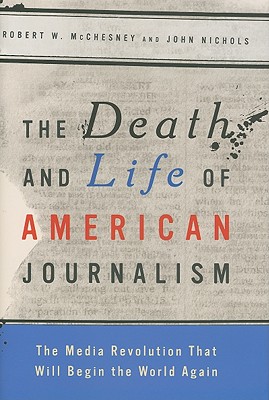
University of Illinois Professor Robert McChesney and The Nation correspondent John Nichols, two leading advocates of the media reform movement, join us to talk about their new book, The Death and Life of American Journalism: The Media Revolution that Will Begin the World Again. McChesney and Nichols argue that journalism should be seen as a public good and that the government should help save American journalism by granting more subsidies to newspapers and media outlets.
Guests:
Robert McChesney and John Nichols, McChesney is a professor at the University of Illinois, while Nichols is the Washington correspondent for The Nation magazine. Together they helped found the media reform organization Free Press. Their new book is titled The Death and Life of American Journalism: The Media Revolution that Will Begin the World Again.
To Watch/Listen/Read
Democracy Now
University of Illinois Professor Robert McChesney and The Nation correspondent John Nichols, two leading advocates of the media reform movement, join us to talk about their new book, The Death and Life of American Journalism: The Media Revolution that Will Begin the World Again. McChesney and Nichols argue that journalism should be seen as a public good and that the government should help save American journalism by granting more subsidies to newspapers and media outlets.
Guests:
Robert McChesney and John Nichols, McChesney is a professor at the University of Illinois, while Nichols is the Washington correspondent for The Nation magazine. Together they helped found the media reform organization Free Press. Their new book is titled The Death and Life of American Journalism: The Media Revolution that Will Begin the World Again.
To Watch/Listen/Read
Wednesday, March 03, 2010
CounterSpin: Robert McChesney and John Nichols on The Death and Life of American Journalism
Robert McChesney and John Nichols on The Death and Life of American Journalism
CounterSpin
A special look at the state of the media in America. Every week on CounterSpin we talk mostly about what the media are getting wrong. But the big story inside the news industry is the collapse of the business itself. What are the implications for citizens? What can we do about it? And how concerned should we be about the failures of corporate owners that have done so little to promote good journalism in the first place? We'll talk about all that and more with our guests Robert McChesney and John Nichols, co-authors of the new book The Death and Life of American Journalism: the Media Revolution That Will Begin the World Again.
To Listen to the Conversation
CounterSpin
A special look at the state of the media in America. Every week on CounterSpin we talk mostly about what the media are getting wrong. But the big story inside the news industry is the collapse of the business itself. What are the implications for citizens? What can we do about it? And how concerned should we be about the failures of corporate owners that have done so little to promote good journalism in the first place? We'll talk about all that and more with our guests Robert McChesney and John Nichols, co-authors of the new book The Death and Life of American Journalism: the Media Revolution That Will Begin the World Again.
To Listen to the Conversation
Subscribe to:
Posts (Atom)