Martin Luther King, Jr. is a radical hero that should be remembered for his ethical challenge to the American government/people:
In this excerpt from Shambhala magazine Charles Johnson reveals The King We Need.
Earl Ofari Hutchison at AlterNet examines how many local government agenices still ignore this national Holiday for a Hero.
Martin Luther King was a pacifist in that he preached change through non-violent protest, but he was not "passive" when confronted with the need to address injustice and oppression. His words were an active rallying cry for a re-vision of the United States of America... now that he has a holiday, streets, and schools named for him it is easy to forget how he, and other strong souls, fearlessly spoke truth to power:
Film: Honor the Legacy
One of the better articles attempting to realize Martin Luther King's "truth force":
Dr. King: The Remix
And from Cornel West (thanks to Ray Garraud for pointing this essay out):
Prisoners of Hope
Showing posts with label Nonviolence. Show all posts
Showing posts with label Nonviolence. Show all posts
Monday, September 20, 2010

Friday, September 10, 2010
Rajni Bakshi: A Choice of 9/11s
A choice of 9/11s
by Rajni Bakshi
Open Democracy
Whatever else may be beyond our control, we are all free to choose which 9/11 moves us most deeply.
It may well be the oddest date in history.
However much they dominate our present, the human missiles of 2001 don’t have a unique claim on 9/11.
It was on September 11, 1906, that Mohandas Karamchand Gandhi first articulated the concept of ‘satyagraha’, non-violent resistance, at a public meeting in South Africa. His rigorous application of this philosophy over the next 40 years earned Gandhi the title of Mahatma – great soul. It also gave the modern world a powerful new political tool for dealing with conflict and hurt.
It was on September 11, 1893 that an Indian monk, Swami Vivekananda, was overwhelmed by a three minute standing ovation at the World Parliament of Religions in Chicago. Reverberations of his appeal for universal brotherhood persist today beside the buzz of protest and counter-protest over Park51.
It was on September 11, 1609 that Henry Hudson became the first European to set foot on an island which natives called ‘Menatay’ – our present day Manhattan. Hudson’s landing, somewhere in the vicinity of today’s Ground Zero, was a precursor to European settlements and mass death of native populations.
A collage of all four 9/11s can potentially serve as a map quest – showing us different pathways to resolving the tussle between co-existence and conflict, faith and reason.
Reflecting on this combination of stories is one possible way of picking our way through the tangled web of complications triggered by the plans for a mosque at 51 Park Place in Lower Manhattan.
To Read the Rest of the Essays
by Rajni Bakshi
Open Democracy
Whatever else may be beyond our control, we are all free to choose which 9/11 moves us most deeply.
It may well be the oddest date in history.
However much they dominate our present, the human missiles of 2001 don’t have a unique claim on 9/11.
It was on September 11, 1906, that Mohandas Karamchand Gandhi first articulated the concept of ‘satyagraha’, non-violent resistance, at a public meeting in South Africa. His rigorous application of this philosophy over the next 40 years earned Gandhi the title of Mahatma – great soul. It also gave the modern world a powerful new political tool for dealing with conflict and hurt.
It was on September 11, 1893 that an Indian monk, Swami Vivekananda, was overwhelmed by a three minute standing ovation at the World Parliament of Religions in Chicago. Reverberations of his appeal for universal brotherhood persist today beside the buzz of protest and counter-protest over Park51.
It was on September 11, 1609 that Henry Hudson became the first European to set foot on an island which natives called ‘Menatay’ – our present day Manhattan. Hudson’s landing, somewhere in the vicinity of today’s Ground Zero, was a precursor to European settlements and mass death of native populations.
A collage of all four 9/11s can potentially serve as a map quest – showing us different pathways to resolving the tussle between co-existence and conflict, faith and reason.
Reflecting on this combination of stories is one possible way of picking our way through the tangled web of complications triggered by the plans for a mosque at 51 Park Place in Lower Manhattan.
To Read the Rest of the Essays
Sunday, March 14, 2010
To the Best of Our Knowledge: Give Peace a Chance
Give Peace a Chance
To the Best of Our Knowledge (Wisconsin Public Radio)
Host: Steve Paulson
When asked what he thought about Western civilization, Gandhi once famously said: I think it's a good idea. Gandhi's form of extreme nonviolence led to the civilized retreat of the British from the Indian sub-continent. But does non-violence still have the right stuff to effect social change in today's world? In this hour of To the Best of Our Knowledge, some new ideas about a very old subject - non-violence. And, could nonviolence have prevented World War II?
SEGMENT 1:

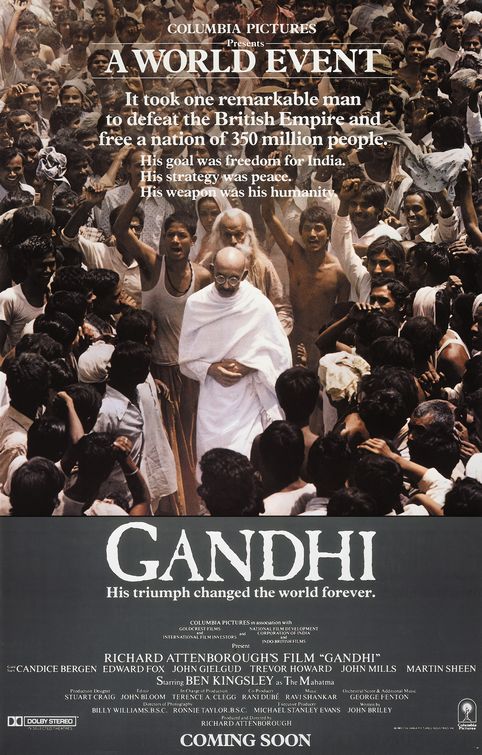
Satish Kumar is a peace activist who lives in Devon, England, and he's the author of "The Buddha and the Terrorist." A former Jain monk, he still follows Gandhi's principles of non-violence. Kumar tells Jim Fleming about some of the people he met on his 8,000 mile walk for peace, and why he thinks violence is an obsolete weapon. Also, Reihan Salam critiqued the movie "Gandhi" for Slate Magazine in an article called "Meet the Hindustani Malcolm X." Salam tells Steve Paulson that David Attenborough's bio-pic may have been about an Indian man, but it was a thoroughly Western movie.
 >
>
SEGMENT 2:

Mark Kurlansky is the author of "Nonviolence: Twenty-Five Lessons in the History of a Dangerous Idea." In constructing his history of non-violence, Kurlansky looks at history with a revisionist's eye and tells Steve Paulson that WWII might not have been necessary ...
SEGMENT 3:
Andrew Carroll is the Founder of the Legacy Project whose latest book is "Grace under Fire: Letters of Faith in Times of War." The Legacy Project collects and publishes letters from combatants and their families and friends, and others who have been touched by the experience of war.
To Listen to the Episode
To the Best of Our Knowledge (Wisconsin Public Radio)
Host: Steve Paulson
When asked what he thought about Western civilization, Gandhi once famously said: I think it's a good idea. Gandhi's form of extreme nonviolence led to the civilized retreat of the British from the Indian sub-continent. But does non-violence still have the right stuff to effect social change in today's world? In this hour of To the Best of Our Knowledge, some new ideas about a very old subject - non-violence. And, could nonviolence have prevented World War II?
SEGMENT 1:
Satish Kumar is a peace activist who lives in Devon, England, and he's the author of "The Buddha and the Terrorist." A former Jain monk, he still follows Gandhi's principles of non-violence. Kumar tells Jim Fleming about some of the people he met on his 8,000 mile walk for peace, and why he thinks violence is an obsolete weapon. Also, Reihan Salam critiqued the movie "Gandhi" for Slate Magazine in an article called "Meet the Hindustani Malcolm X." Salam tells Steve Paulson that David Attenborough's bio-pic may have been about an Indian man, but it was a thoroughly Western movie.
>SEGMENT 2:
Mark Kurlansky is the author of "Nonviolence: Twenty-Five Lessons in the History of a Dangerous Idea." In constructing his history of non-violence, Kurlansky looks at history with a revisionist's eye and tells Steve Paulson that WWII might not have been necessary ...
SEGMENT 3:
Andrew Carroll is the Founder of the Legacy Project whose latest book is "Grace under Fire: Letters of Faith in Times of War." The Legacy Project collects and publishes letters from combatants and their families and friends, and others who have been touched by the experience of war.
To Listen to the Episode
Subscribe to:
Posts (Atom)