5 Ways You Can Fight Citizens United: The Story of Citizens United v FEC - How we the people can reclaim our democracy.
by Annie Leonard and Allison Cook
Yes!
We never expected to be writing an article with this title. Aren’t united citizens a good thing? Civil Rights movement? Egypt? Madison?
Yes, but that’s not the kind of people power we’re talking about here. What we want to fight is the disastrous 2010 Supreme Court Citizens United v Federal Election Commission (FEC) decision. Ironically, “Citizens United” is the name of a conservative advocacy group which receives corporate funding and works to promote increased rights for corporations. The Citizens United v. FEC case originally dealt with the question of whether or not airing Citizens United’s documentary about Hillary Clinton was an advocacy ad, and therefore subject to existing restrictions on election ads under the McCain-Feingold law.
Whether your passion is protecting the environment or creating green jobs or improving public education—or really any other issue on which corporate interests are blocking real solutions—this is your campaign too.But in a brazen act of judicial activism, the court decided to consider the much broader issue of corporate spending to influence elections, which wasn’t even presented in the original case. In a decision that stunned democracy advocates and trampled a number of campaign finance laws, a slim five-Justice majority ruled that corporations—including for-profit corporations—do indeed have a right to spend as much money as they want to elect or defeat candidates in our elections.
This decision effectively grants corporations the same First Amendment Free Speech protections granted to real live people.
The catch is that corporations obviously are not people. Someone get the Supreme Court a biology textbook! There are some really big, and really significant, differences. For starters, people are part of the biological system; we need clear air and water, a healthy environment, a stable climate to thrive. Corporations are legal entities, created by people, and have no such biological needs and thus no inherent reason to safeguard the environment.
People make decisions based on a constant balancing of many interests, including love for our families and communities, compassion, kindness, desire for a better world, as well as economic and material interests. Corporations don’t have families and communities, nor hearts with which to love them. As Justice Stevens said in his dissenting opinion, “corporations have no consciences, no beliefs, no feelings, no thoughts and no desires.” Instead, corporations—by both law and the demands of the market—are under enormous pressure to focus on one thing: maximizing profit.
To Read the Rest of the Essay
Showing posts with label Citizens United. Show all posts
Showing posts with label Citizens United. Show all posts
Monday, February 21, 2011

Tuesday, February 15, 2011
A Reply to a Mass Email That All We Need to Do Is Remove the Current Elected Officials and Our Political System Will Be Fixed
[My response to a mass email sent by a relative trying to convince people that what need to do is to get rid of the current elected representatives and that will solve our current social/economic problems]
I would like to encourage you all to reconsider what the problem is here. You can do whatever you want to your elected officials, but they are not really the true problem. I would encourage you to look into the recent Supreme Court decision on "Citizen United vs the US" and consider the implications of unregulated corporate cash influx into our so-called democratic elections. The problem is the unchecked flow of corporate money in our democracy and the dependence of our elected officials on that money to get elected (and re-elected). Get rid of many as you want, the new ones will still be dependent on the same masters.....
Take, for instance, the Tea Party, which is corporate funded and is not about dismantling the current system. What they are about is deregulating the social system in order to continue to benefit our country's elites (this is not to discount the legitimate worries of the Tea Party masses, this is to say they are being misled by their corporate funded leadership). The first thing newly elected Tea Party Senator Rand Paul did here in KY was to seek to continue the tax cuts Bush had temporarily instituted for those that make over 250,000 dollars.
A current report from Democracy Now lets us know how bad it is for working people who have lost their jobs and/or have seen their wages frozen/cut these past few years:
... and then this report comes out in the NY Times about all-time record corporate profits last quarter:
Corporate Profits Were the Highest on Record Last Quarter
Record "profits" for the few through the exploitation of workers. Record "growth" for corporations through systemic economic disparity and extreme poverty for the majority of workers. Currently 1 in 7 families in America are at or below the poverty line ($22,000 for a family of four), in KY it is 1 in 4. This is disturbing to me.
Michael
I would like to encourage you all to reconsider what the problem is here. You can do whatever you want to your elected officials, but they are not really the true problem. I would encourage you to look into the recent Supreme Court decision on "Citizen United vs the US" and consider the implications of unregulated corporate cash influx into our so-called democratic elections. The problem is the unchecked flow of corporate money in our democracy and the dependence of our elected officials on that money to get elected (and re-elected). Get rid of many as you want, the new ones will still be dependent on the same masters.....
Take, for instance, the Tea Party, which is corporate funded and is not about dismantling the current system. What they are about is deregulating the social system in order to continue to benefit our country's elites (this is not to discount the legitimate worries of the Tea Party masses, this is to say they are being misled by their corporate funded leadership). The first thing newly elected Tea Party Senator Rand Paul did here in KY was to seek to continue the tax cuts Bush had temporarily instituted for those that make over 250,000 dollars.
A current report from Democracy Now lets us know how bad it is for working people who have lost their jobs and/or have seen their wages frozen/cut these past few years:
Food banks across the country are serving a record number of people and many agencies are struggling to meet the demand ahead of Thanksgiving. In Texas, the Montgomery County Food Bank served a record 31,000 people last month. The Washington Post reports the demand for meals at the Arlington Food Assistance Center in Virginia
has jumped 50 percent in the past two years. In the Washington DC area, the Capital Area Food Bank is on pace to distribute a record 30 million pounds of food this year, an increase of more than 10 percent since 2009. According to the U.S. Department of Agriculture, the number of families seeking assistance from food pantries jumped from 3.9 million in 2007 to 5.6 million last year. The number of U.S.
households deemed "food insecure" also exceeded 50 million last year, amounting to a record 14.7 percent.
... and then this report comes out in the NY Times about all-time record corporate profits last quarter:
Corporate Profits Were the Highest on Record Last Quarter
Record "profits" for the few through the exploitation of workers. Record "growth" for corporations through systemic economic disparity and extreme poverty for the majority of workers. Currently 1 in 7 families in America are at or below the poverty line ($22,000 for a family of four), in KY it is 1 in 4. This is disturbing to me.
Michael
Friday, December 03, 2010
Andy Kroll: The New American Oligarchy
The New American Oligarchy: Creating a Country of the Rich, by the Rich, and for the Rich
By Andy Kroll
TomDisaptch
There is a war underway. I'm not talking about Washington’s bloody misadventures in Afghanistan and Iraq, but a war within our own borders. It’s a war fought on the airwaves, on television and radio and over the Internet, a war of words and images, of half-truth, innuendo, and raging lies. I'm talking about a political war, pitting liberals against conservatives, Democrats against Republicans. I'm talking about a spending war, fueled by stealthy front groups and deep-pocketed anonymous donors. It’s a war that's poised to topple what's left of American democracy.
The right wing won the opening battle. In the 2010 midterm elections, shadowy outside organizations (who didn’t have to disclose their donors until well after Election Day, if at all) backing Republican candidates doled out $190 million, outspending their adversaries by a more than two-to-one margin, according to the Center for Responsive Politics. American Action Network, operated by Republican consultant Fred Malek and former Republican Senator Norm Coleman, spent $26 million; the U.S. Chamber of Commerce plunked down $33 million; and Karl Rove's American Crossroads and Crossroads GPS shelled out a combined $38.6 million. Their investments in conservative candidates across the country paid off: the 62 House seats and six Senate seats claimed by Republicans were the most in the postwar era -- literally, a historic victory.
Knocked out of their complacency, no longer basking in the glow of Barack Obama's 2008 victory, wealthy Democrats are now plotting their response. Left-wing media mogul David Brock plans to create an outside group dubbed American Bridge in response to Rove's Crossroads outfits that will fight in the trenches of 2012 campaign spending. Many more outfits like Brock's will surely follow, as liberal and centrist Democrats brace for a promised $500 million onslaught by the Chamber of Commerce and others of its ilk.
Even the Obama administration, which shunned outside groups in 2008, has opened the door to a covert spending war. The Democrats will now fight fire with fire. "Is small money better? You bet. But we're in a fucking fight," Democratic strategist and fundraiser Harold Ickes told me recently. "And if you're in a fistfight, then you're in a fistfight, and you use all legal means available."
The endgame here, of course, is non-stop war. No longer will outside groups come and go every two years. Now, such groups will be running attack ads, sending out mailers, and deploying robo-calls year-round in what is going to become a perpetual campaign to sway voters and elect friendly lawmakers. "We're definitely building a foundation," was how American Crossroads president Steven Law put it.
This is what nowadays passes for the heart and soul of American democracy. It used to be that citizens in large numbers, mobilized by labor unions or political parties or a single uniting cause, determined the course of American politics. After World War II, a swelling middle class was the most powerful voting bloc, while, in those same decades, the working and middle classes enjoyed comparatively greater economic prosperity than their wealthy counterparts. Kiss all that goodbye. We're now a country run by rich people.
Not surprisingly, political power has a way of following wealth. What that means is: you can't understand how the rich seized control of American politics, and arguably American society, without understanding how a small group of Americans got so much money in the first place.
That story begins in the late 1970s and continues through the Obama years, a period in which American policy has been so skewed toward the rich that we're now living through the worst period of income inequality in modern history. Consider the statistics: 50 years ago, the wealthiest 1% of Americans accounted for one of every 10 dollars of the nation's income; today, it's nearly one in every four. Between 1979 and 2006, the average post-tax household income (including benefits) of the wealthiest 1% increased by 256%; the poorest households saw an increase of 11%; middle class homes, 21%, much of which was due to the arrival of two-job families.
Tax guru David Cay Johnston recently crunched new Social Security Administration data and discovered an even starker divide. On the one hand, the number of Americans earning a steady income declined by 4.5 million between 2008 and 2009, and the average wage in the U.S. dipped by 1.2%, to $39,055. On the other hand, the average wage among Americans earning more than $50 million per year was $91 million in 2008 and $84 million in 2009.
Harvard University economist Lawrence Katz put the situation Americans now find themselves in this way:
"Think of the American economy as a large apartment block. A century ago -- even 30 years ago -- it was the object of envy. But in the last generation its character has changed. The penthouses at the top keep getting larger and larger. The apartments in the middle are feeling more and more squeezed and the basement has flooded. To round it off, the elevator is no longer working. That broken elevator is what gets people down the most."
Let's call those select few in the penthouse the New Oligarchy, an awesomely rich sliver of Americans raking in an outsized share of the nation's wealth. They're oil magnates and media tycoons, corporate executives and hedge-fund traders, philanthropists and entertainers. Depending on where you want to draw the line, they're the top 1%, or the top 0.1%, or even the top 0.01% of the population. And when the Supreme Court handed down its controversial Citizens United decision in January, it broke the floodgates so that a torrent of anonymous donations from this oligarchic class could flood back down from the heights and inundate the political lands below.
To Read the Rest of the Essay and Access Hyerplinked Resources
By Andy Kroll
TomDisaptch
There is a war underway. I'm not talking about Washington’s bloody misadventures in Afghanistan and Iraq, but a war within our own borders. It’s a war fought on the airwaves, on television and radio and over the Internet, a war of words and images, of half-truth, innuendo, and raging lies. I'm talking about a political war, pitting liberals against conservatives, Democrats against Republicans. I'm talking about a spending war, fueled by stealthy front groups and deep-pocketed anonymous donors. It’s a war that's poised to topple what's left of American democracy.
The right wing won the opening battle. In the 2010 midterm elections, shadowy outside organizations (who didn’t have to disclose their donors until well after Election Day, if at all) backing Republican candidates doled out $190 million, outspending their adversaries by a more than two-to-one margin, according to the Center for Responsive Politics. American Action Network, operated by Republican consultant Fred Malek and former Republican Senator Norm Coleman, spent $26 million; the U.S. Chamber of Commerce plunked down $33 million; and Karl Rove's American Crossroads and Crossroads GPS shelled out a combined $38.6 million. Their investments in conservative candidates across the country paid off: the 62 House seats and six Senate seats claimed by Republicans were the most in the postwar era -- literally, a historic victory.
Knocked out of their complacency, no longer basking in the glow of Barack Obama's 2008 victory, wealthy Democrats are now plotting their response. Left-wing media mogul David Brock plans to create an outside group dubbed American Bridge in response to Rove's Crossroads outfits that will fight in the trenches of 2012 campaign spending. Many more outfits like Brock's will surely follow, as liberal and centrist Democrats brace for a promised $500 million onslaught by the Chamber of Commerce and others of its ilk.
Even the Obama administration, which shunned outside groups in 2008, has opened the door to a covert spending war. The Democrats will now fight fire with fire. "Is small money better? You bet. But we're in a fucking fight," Democratic strategist and fundraiser Harold Ickes told me recently. "And if you're in a fistfight, then you're in a fistfight, and you use all legal means available."
The endgame here, of course, is non-stop war. No longer will outside groups come and go every two years. Now, such groups will be running attack ads, sending out mailers, and deploying robo-calls year-round in what is going to become a perpetual campaign to sway voters and elect friendly lawmakers. "We're definitely building a foundation," was how American Crossroads president Steven Law put it.
This is what nowadays passes for the heart and soul of American democracy. It used to be that citizens in large numbers, mobilized by labor unions or political parties or a single uniting cause, determined the course of American politics. After World War II, a swelling middle class was the most powerful voting bloc, while, in those same decades, the working and middle classes enjoyed comparatively greater economic prosperity than their wealthy counterparts. Kiss all that goodbye. We're now a country run by rich people.
Not surprisingly, political power has a way of following wealth. What that means is: you can't understand how the rich seized control of American politics, and arguably American society, without understanding how a small group of Americans got so much money in the first place.
That story begins in the late 1970s and continues through the Obama years, a period in which American policy has been so skewed toward the rich that we're now living through the worst period of income inequality in modern history. Consider the statistics: 50 years ago, the wealthiest 1% of Americans accounted for one of every 10 dollars of the nation's income; today, it's nearly one in every four. Between 1979 and 2006, the average post-tax household income (including benefits) of the wealthiest 1% increased by 256%; the poorest households saw an increase of 11%; middle class homes, 21%, much of which was due to the arrival of two-job families.
Tax guru David Cay Johnston recently crunched new Social Security Administration data and discovered an even starker divide. On the one hand, the number of Americans earning a steady income declined by 4.5 million between 2008 and 2009, and the average wage in the U.S. dipped by 1.2%, to $39,055. On the other hand, the average wage among Americans earning more than $50 million per year was $91 million in 2008 and $84 million in 2009.
Harvard University economist Lawrence Katz put the situation Americans now find themselves in this way:
"Think of the American economy as a large apartment block. A century ago -- even 30 years ago -- it was the object of envy. But in the last generation its character has changed. The penthouses at the top keep getting larger and larger. The apartments in the middle are feeling more and more squeezed and the basement has flooded. To round it off, the elevator is no longer working. That broken elevator is what gets people down the most."
Let's call those select few in the penthouse the New Oligarchy, an awesomely rich sliver of Americans raking in an outsized share of the nation's wealth. They're oil magnates and media tycoons, corporate executives and hedge-fund traders, philanthropists and entertainers. Depending on where you want to draw the line, they're the top 1%, or the top 0.1%, or even the top 0.01% of the population. And when the Supreme Court handed down its controversial Citizens United decision in January, it broke the floodgates so that a torrent of anonymous donations from this oligarchic class could flood back down from the heights and inundate the political lands below.
To Read the Rest of the Essay and Access Hyerplinked Resources
Tuesday, November 23, 2010
A Reply to a Mass Email That All We Need to Do Is Remove the Current Elected Officials and Our Political System Will Be Fixed
[My response to a mass email sent by a relative trying to convince people that what need to do is to get rid of the current elected representatives and that will solve our current social/economic problems]
I would like to encourage you all to reconsider what the problem is here. You can do whatever you want to your elected officials, but they are not really the true problem. I would encourage you to look into the recent Supreme Court decision on "Citizen United vs the US" and consider the implications of unregulated corporate cash influx into our so-called democratic elections. The problem is the unchecked flow of corporate money in our democracy and the dependence of our elected officials on that money to get elected (and re-elected). Get rid of many as you want, the new ones will still be dependent on the same masters.....
Take, for instance, the Tea Party, which is corporate funded and is not about dismantling the current system. What they are about is deregulating the social system in order to continue to benefit our country's elites (this is not to discount the legitimate worries of the Tea Party masses, this is to say they are being misled by their corporate funded leadership). The first thing newly elected Tea Party Senator Rand Paul did here in KY was to seek to continue the tax cuts Bush had temporarily instituted for those that make over 250,000 dollars.
A current report from Democracy Now lets us know how bad it is for working people who have lost their jobs and/or have seen their wages frozen/cut these past few years:
... and then this report comes out today in the NY Times about all-time record corporate profits last quarter:
Corporate Profits Were the Highest on Record Last Quarter
Record "profits" for the few through the exploitation of workers. Record "growth" for corporations through systemic economic disparity and extreme poverty for the majority of workers. Currently 1 in 7 families in America are at or below the poverty line ($22,000 for a family of four), in KY it is 1 in 4. This is disturbing to me.
Michael
PS: On my flight to California this Christmas should I go for the full body X-Ray
contamination or a full body grope by TSA airport security ;)
I would like to encourage you all to reconsider what the problem is here. You can do whatever you want to your elected officials, but they are not really the true problem. I would encourage you to look into the recent Supreme Court decision on "Citizen United vs the US" and consider the implications of unregulated corporate cash influx into our so-called democratic elections. The problem is the unchecked flow of corporate money in our democracy and the dependence of our elected officials on that money to get elected (and re-elected). Get rid of many as you want, the new ones will still be dependent on the same masters.....
Take, for instance, the Tea Party, which is corporate funded and is not about dismantling the current system. What they are about is deregulating the social system in order to continue to benefit our country's elites (this is not to discount the legitimate worries of the Tea Party masses, this is to say they are being misled by their corporate funded leadership). The first thing newly elected Tea Party Senator Rand Paul did here in KY was to seek to continue the tax cuts Bush had temporarily instituted for those that make over 250,000 dollars.
A current report from Democracy Now lets us know how bad it is for working people who have lost their jobs and/or have seen their wages frozen/cut these past few years:
Food banks across the country are serving a record number of people and many agencies are struggling to meet the demand ahead of Thanksgiving. In Texas, the Montgomery County Food Bank served a record 31,000 people last month. The Washington Post reports the demand for meals at the Arlington Food Assistance Center in Virginia
has jumped 50 percent in the past two years. In the Washington DC area, the Capital Area Food Bank is on pace to distribute a record 30 million pounds of food this year, an increase of more than 10 percent since 2009. According to the U.S. Department of Agriculture, the number of families seeking assistance from food pantries jumped from 3.9 million in 2007 to 5.6 million last year. The number of U.S.
households deemed "food insecure" also exceeded 50 million last year, amounting to a record 14.7 percent.
... and then this report comes out today in the NY Times about all-time record corporate profits last quarter:
Corporate Profits Were the Highest on Record Last Quarter
Record "profits" for the few through the exploitation of workers. Record "growth" for corporations through systemic economic disparity and extreme poverty for the majority of workers. Currently 1 in 7 families in America are at or below the poverty line ($22,000 for a family of four), in KY it is 1 in 4. This is disturbing to me.
Michael
PS: On my flight to California this Christmas should I go for the full body X-Ray
contamination or a full body grope by TSA airport security ;)
Friday, July 02, 2010
Tell Somebody: Free Press' Tim Karr - FCC's Ominous Intentions?; Mary Lindsay -- history leading up to the right wing activist Supreme Court's recent
Free Press' Tim Karr - FCC's Ominous Intentions?
Tell Somebody (KKFI: Kansas City)
Tim Karr, Campaign Director for Free Press and SaveTheInternet.com responds to the Kansas City Star's editorial on Net Neutrality headlined as FCC"s ominous intimidation imperils free growth of the Internet.
Also, Kansas City Activist Mary Lindsay gives some of the history leading up to the right wing activist Supreme Court's recent Citizens United v FEC decision.
To Listen to the Episode
Tell Somebody (KKFI: Kansas City)
Tim Karr, Campaign Director for Free Press and SaveTheInternet.com responds to the Kansas City Star's editorial on Net Neutrality headlined as FCC"s ominous intimidation imperils free growth of the Internet.
Also, Kansas City Activist Mary Lindsay gives some of the history leading up to the right wing activist Supreme Court's recent Citizens United v FEC decision.
To Listen to the Episode
Saturday, May 01, 2010
Bill Moyers Journal: Justice for Sale; Jeffrey Toobin; Buying the Bench
Bill Moyers Journal (PBS)
Justice for Sale
How would you feel if you were in court and knew that the opposing lawyer had contributed money to the judge's campaign fund? This is not an improbable hypothetical question, but could be a commonplace occurrence in the 21 states where judges must raise money to campaign for their seats — often from people with business before the court.
Though many states have elected judges since their founding, in the past 30 years, judicial elections have morphed from low-key affairs to big money campaigns. From 1999-2008, judicial candidates raised $200.4 million, more than double the $85.4 million raised in the previous decade (1989-1998).
Because of the costs of running such a campaign, critics contend that judges have had to become politicians and fundraisers rather than jurists. In a poll by Justice at Stake, 97% of elected state Supreme Court justices said they were under pressure to raise money during their election years.
According to retired Supreme Court Justice Sandra Day O'Connor, of all the fallout from the Citizens United decision, the most dangerous may be in judicial elections. These often low-profile affairs have become extraordinarily expensive in recent years, as interest groups have sought to shape the court in their favor by electing judges who share their views. With 87% of state judges facing election, the Citizens United case could have profound effects on the nation's court system. In remarks to Georgetown University law students, O'Connor said, "This rise in judicial campaigning makes last week's opinion in Citizens United a problem for an independent judiciary. No state can possibly benefit from having that much money injected into a political campaign."
This week the JOURNAL revisits "Justice for Sale," a 1999 documentary about the impact of money on judicial elections in three states — Pennsylvania, Texas and Louisiana. To create the documentary — produced by Steve Talbot and Sheila Kaplan — Bill Moyers collaborated with public television's acclaimed documentary series FRONTLINE and the Center for Investigative Reporting.
To Listen to the Episode and Access More Resources
Jeffrey Toobin
A late February 2010 ABC NEWS/WASHINGTON POST poll found that 80 percent of Americans on both sides of the aisle oppose the Supreme Court's ruling on campaign finance in Citizens United v. FEC. Sixty-five percent of those asked "strongly" oppose it. Legal analyst Jeffrey Toobin contends that, indeed, the ruling's potential to harm democracy runs very deep:
Biography
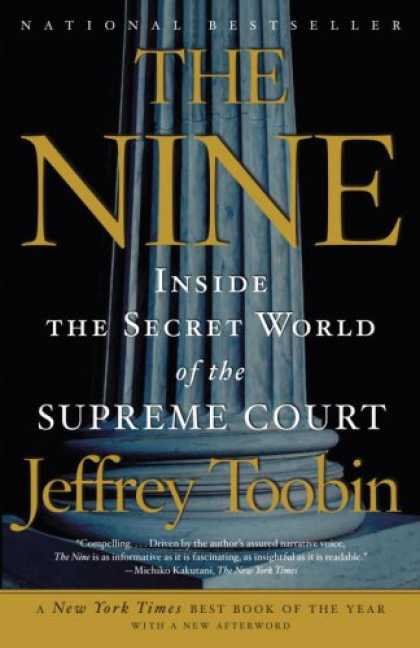
Jeffrey Toobin is a staff writer at THE NEW YORKER and a senior analyst for CNN. He is a well-known legal journalist and has written profiles of Supreme Court Justices Stephen Breyer, Anthony Kennedy, and Clarence Thomas for THE NEW YORKER. His most recent book, THE NINE: INSIDE THE SECRET WORLD OF THE SUPREME COURT, spent more than four months on THE NEW YORK TIMES best-seller list and was named one of the ten best books of the year by THE NEW YORK TIMES BOOK REVIEW, TIME, NEWSWEEK, FORTUNE, ENTERTAINMENT WEEKLY, and the ECONOMIST. His other books include TOO CLOSE TO CALL: THE 36-DAY BATTLE TO DECIDE THE 2000 ELECTION and A VAST CONSPIRACY: THE REAL STORY OF THE SEX SCANDAL THAT NEARLY BROUGHT DOWN A PRESIDENT, and THE RUN OF HIS LIFE: THE PEOPLE v. O.J. SIMPSON.
Before joining THE NEW YORKER in 1993, Toobin served as an Assistant United States Attorney in Brooklyn, New York. He also served as an associate counsel in the Office of Independent Counsel Lawrence E. Walsh, an experience that provided the basis for his first book, OPENING ARGUMENTS: A YOUNG LAWYER'S FIRST CASE — UNITED STATES V. OLIVER NORTH.
To Listen to the Episode and Access More Resources
More resources:
Bill Moyers: Buying the Bench
Justice for Sale
How would you feel if you were in court and knew that the opposing lawyer had contributed money to the judge's campaign fund? This is not an improbable hypothetical question, but could be a commonplace occurrence in the 21 states where judges must raise money to campaign for their seats — often from people with business before the court.
Though many states have elected judges since their founding, in the past 30 years, judicial elections have morphed from low-key affairs to big money campaigns. From 1999-2008, judicial candidates raised $200.4 million, more than double the $85.4 million raised in the previous decade (1989-1998).
Because of the costs of running such a campaign, critics contend that judges have had to become politicians and fundraisers rather than jurists. In a poll by Justice at Stake, 97% of elected state Supreme Court justices said they were under pressure to raise money during their election years.
According to retired Supreme Court Justice Sandra Day O'Connor, of all the fallout from the Citizens United decision, the most dangerous may be in judicial elections. These often low-profile affairs have become extraordinarily expensive in recent years, as interest groups have sought to shape the court in their favor by electing judges who share their views. With 87% of state judges facing election, the Citizens United case could have profound effects on the nation's court system. In remarks to Georgetown University law students, O'Connor said, "This rise in judicial campaigning makes last week's opinion in Citizens United a problem for an independent judiciary. No state can possibly benefit from having that much money injected into a political campaign."
This week the JOURNAL revisits "Justice for Sale," a 1999 documentary about the impact of money on judicial elections in three states — Pennsylvania, Texas and Louisiana. To create the documentary — produced by Steve Talbot and Sheila Kaplan — Bill Moyers collaborated with public television's acclaimed documentary series FRONTLINE and the Center for Investigative Reporting.
To Listen to the Episode and Access More Resources
Jeffrey Toobin
A late February 2010 ABC NEWS/WASHINGTON POST poll found that 80 percent of Americans on both sides of the aisle oppose the Supreme Court's ruling on campaign finance in Citizens United v. FEC. Sixty-five percent of those asked "strongly" oppose it. Legal analyst Jeffrey Toobin contends that, indeed, the ruling's potential to harm democracy runs very deep:
I think judicial elections are really the untold story of Citizens United, the untold implication. Because when the decision happened, a lot of people said, 'Okay. This means that Exxon will spend millions of dollars to defeat Barack Obama when he runs for re-election.' I don't think there's any chance of that at all. That's too high profile. There's too much money available from other sources in a presidential race. But judicial elections are really a national scandal that few people really know about. Because corporations in particular, and labor unions to a lesser extent, have such tremendous interest in who's on state supreme courts and even lower state courts that that's where they're going to put their money and their energy because they'll get better bang for their buck there.
Biography
Jeffrey Toobin is a staff writer at THE NEW YORKER and a senior analyst for CNN. He is a well-known legal journalist and has written profiles of Supreme Court Justices Stephen Breyer, Anthony Kennedy, and Clarence Thomas for THE NEW YORKER. His most recent book, THE NINE: INSIDE THE SECRET WORLD OF THE SUPREME COURT, spent more than four months on THE NEW YORK TIMES best-seller list and was named one of the ten best books of the year by THE NEW YORK TIMES BOOK REVIEW, TIME, NEWSWEEK, FORTUNE, ENTERTAINMENT WEEKLY, and the ECONOMIST. His other books include TOO CLOSE TO CALL: THE 36-DAY BATTLE TO DECIDE THE 2000 ELECTION and A VAST CONSPIRACY: THE REAL STORY OF THE SEX SCANDAL THAT NEARLY BROUGHT DOWN A PRESIDENT, and THE RUN OF HIS LIFE: THE PEOPLE v. O.J. SIMPSON.
Before joining THE NEW YORKER in 1993, Toobin served as an Assistant United States Attorney in Brooklyn, New York. He also served as an associate counsel in the Office of Independent Counsel Lawrence E. Walsh, an experience that provided the basis for his first book, OPENING ARGUMENTS: A YOUNG LAWYER'S FIRST CASE — UNITED STATES V. OLIVER NORTH.
To Listen to the Episode and Access More Resources
More resources:
Bill Moyers: Buying the Bench
Subscribe to:
Posts (Atom)