Christian-Muslim Dialogue
10:00 AM Saturday, February 27
Hunter Presbyterian Church
109 Rosemont Garden
Speaker: Dr. Ronald Formisano
UK Professor of American History
Professor Formisano's recent book (2008) is entititled "For the People: American Populist Movements from the Revolution to the 1850's". A recent article he published was entitled "Populist currents in the 2008 Presidential campaign" He frequently writes articles for the Lexington Herald Leader.
Following his talk of 30 minutes, there will be ample time for discussion on how the decision might affect us morally and ethically - as individuals and as a nation.
Please join this lively and growing group on Saturday, February 27, 10 AM as we explore this important issue. A potluck, as always, will cap and complete our time together. All are invited. Bring a friend.
With Kind Personal Regards,
Dr. John Parks
Co-ordinator: Christian-Muslim Dialogue
Monday, February 22, 2010

CNN: McChrystal apologizes as airstrike kills dozens in Afghanistan
McChrystal apologizes as airstrike kills dozens in Afghanistan
CNN
The head of U.S. forces in Afghanistan, General Stanley McChrystal, expressed regret Monday after more than two dozen civilians were killed in a NATO airstrike.
Twenty-seven civilians died and 14 others were wounded in the incident Sunday in the central Daikondi province, according to the Afghan Interior Ministry.
Ground forces at the scene found women and children among the casualties, the Afghan government and NATO's International Security Assistance Force (ISAF) said in a joint statement.
The U.S military told CNN Pentagon Correspondent Barbara Starr they "accept" the Afghan government's death toll. ISAF said it had ordered an immediate investigation into the incident, while the Afghan cabinet called the attack "unjustifiable."
"We are extremely saddened by the tragic loss of innocent lives," said McChrystal, who spoke to President Hamid Karzai Sunday evening to express his sorrow and regret over the incident.
"I have made it clear to our forces that we are here to protect the Afghan people, and inadvertently killing or injuring civilians undermines their trust and confidence in our mission. We will re-double our efforts to regain that trust."
Commanders ordered the daylight NATO airstrike because they had specific intelligence that a group of Taliban in vehicles was heading towards coalition forces on the ground, according to a senior U.S. military official.
To Read the Rest of the Report
CNN
The head of U.S. forces in Afghanistan, General Stanley McChrystal, expressed regret Monday after more than two dozen civilians were killed in a NATO airstrike.
Twenty-seven civilians died and 14 others were wounded in the incident Sunday in the central Daikondi province, according to the Afghan Interior Ministry.
Ground forces at the scene found women and children among the casualties, the Afghan government and NATO's International Security Assistance Force (ISAF) said in a joint statement.
The U.S military told CNN Pentagon Correspondent Barbara Starr they "accept" the Afghan government's death toll. ISAF said it had ordered an immediate investigation into the incident, while the Afghan cabinet called the attack "unjustifiable."
"We are extremely saddened by the tragic loss of innocent lives," said McChrystal, who spoke to President Hamid Karzai Sunday evening to express his sorrow and regret over the incident.
"I have made it clear to our forces that we are here to protect the Afghan people, and inadvertently killing or injuring civilians undermines their trust and confidence in our mission. We will re-double our efforts to regain that trust."
Commanders ordered the daylight NATO airstrike because they had specific intelligence that a group of Taliban in vehicles was heading towards coalition forces on the ground, according to a senior U.S. military official.
To Read the Rest of the Report

Green Cine Daily: DVD OF THE WEEK & PODCAST: Revanche (Gotz Spielmann)
DVD OF THE WEEK & PODCAST: Revanche (Gotz Spielmann)
Green Cine Daily
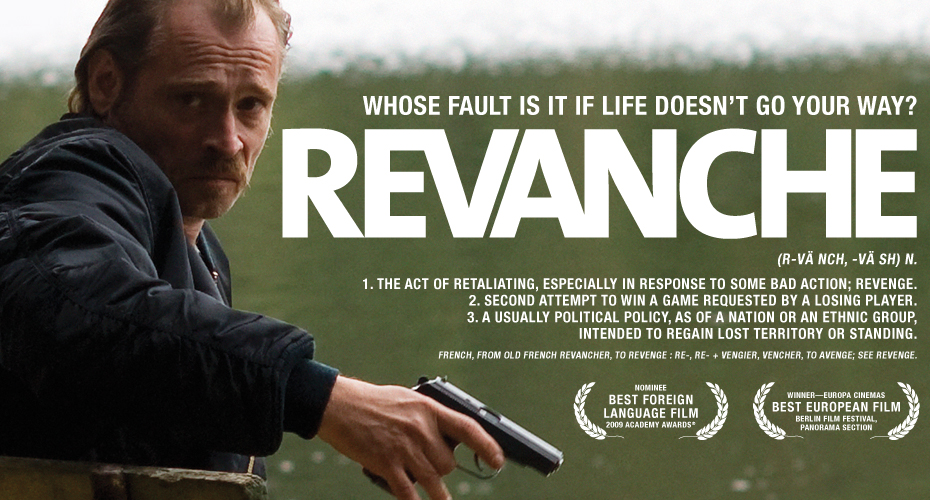
A gripping thriller and a tragic drama of nearly Greek proportions, Revanche is the stunning, Oscar-nominated international breakthrough of Austrian filmmaker Götz Spielmann. In a ragged section of Vienna, hardened ex-con Alex (the mesmerizing Johannes Krisch) works in a brothel, where he falls for Ukrainian hooker Tamara. Their desperate plans for escape unexpectedly intersect with the lives of a rural cop and his seemingly content wife. With meticulous, elegant direction, Spielmann creates a tense, existential, and surprising portrait of vengeance and redemption, and a journey into the darkest forest of human nature, in which violence and beauty exist side by side.
To Listen to the Podcast
Green Cine Daily
A gripping thriller and a tragic drama of nearly Greek proportions, Revanche is the stunning, Oscar-nominated international breakthrough of Austrian filmmaker Götz Spielmann. In a ragged section of Vienna, hardened ex-con Alex (the mesmerizing Johannes Krisch) works in a brothel, where he falls for Ukrainian hooker Tamara. Their desperate plans for escape unexpectedly intersect with the lives of a rural cop and his seemingly content wife. With meticulous, elegant direction, Spielmann creates a tense, existential, and surprising portrait of vengeance and redemption, and a journey into the darkest forest of human nature, in which violence and beauty exist side by side.
To Listen to the Podcast
Sunday, February 21, 2010
Revolution By the Book: Redefining Our Relationships -- An Interview with Wendy-O Matik
Redefining Our Relationships: An Interview with Wendy-O Matik
Revolution By the Book

...
I attended a workshop of yours back in ‘08 at the Longhaul and recall you speaking of open love not only positively transforming the ways we live our individual lives but also having an impact on the larger injustices of capitalism and the patriarchal pyramid of oppression and exploitation. Tell us a little about how you see one having an affect on the other.
Radical love has the potential to shift the dominant paradigm, to embrace institutional change and to dismantle systems of oppression, such as capitalism, greed, and patriarchy, but only if we’re interested in smashing the system and rebuilding it with a more holistic paradigm to replace it. As a feminist and anarchist in spirit, open relationships go to the very core of patriarchy and threaten to disrupt men’s historical control over how we love, who we love, how many we love, and so on.
The societal and cultural reality is that we are a far cry from sexual equality in this day and age. Men, straight or gay, have benefited from the luxury of sexual liberation without so much as their moral values being scrutinized by society. Women, whether straight or queer, have no such freedom. Labels such as “slut” or “nympho” continue to plague women who seek sexual autonomy. These stereotypes and misconceptions are perpetuated in the media, government, educational system, religious institutions, and even within the women’s movement. We still have a long way to go before we can dismantle these derogatory perceptions and liberate ourselves from the social constraints that have been imposed upon us since birth. The first place to start is with one’s self, confronting your own self-imposed guilt and your fears of stepping outside the standards of societal norms. It starts with freeing your mind, body, and heart to love openly despite judgment.
Who are some of the most influential authors in your approach to relationships & love?
To name just a few:
1. The Ethical Slut: A Guide to Infinite Sexual Possibilities by Dossie Easton & Catherine A. Liszt
2. Gaia and the New Politics of Love: Notes for a Poly Planet by Serena Anderlini-D’Onofrio
3. Living My Life: An Autobiography by Emma Goldman
4. Opening Up: A Guide to Creating and Sustaining Open Relationships by Tristan Taormino
5. Polyamory: The New Love without Limits by Dr. Deborah M. Anapol
To Read the Entire Interview
Revolution By the Book
...
I attended a workshop of yours back in ‘08 at the Longhaul and recall you speaking of open love not only positively transforming the ways we live our individual lives but also having an impact on the larger injustices of capitalism and the patriarchal pyramid of oppression and exploitation. Tell us a little about how you see one having an affect on the other.
Radical love has the potential to shift the dominant paradigm, to embrace institutional change and to dismantle systems of oppression, such as capitalism, greed, and patriarchy, but only if we’re interested in smashing the system and rebuilding it with a more holistic paradigm to replace it. As a feminist and anarchist in spirit, open relationships go to the very core of patriarchy and threaten to disrupt men’s historical control over how we love, who we love, how many we love, and so on.
The societal and cultural reality is that we are a far cry from sexual equality in this day and age. Men, straight or gay, have benefited from the luxury of sexual liberation without so much as their moral values being scrutinized by society. Women, whether straight or queer, have no such freedom. Labels such as “slut” or “nympho” continue to plague women who seek sexual autonomy. These stereotypes and misconceptions are perpetuated in the media, government, educational system, religious institutions, and even within the women’s movement. We still have a long way to go before we can dismantle these derogatory perceptions and liberate ourselves from the social constraints that have been imposed upon us since birth. The first place to start is with one’s self, confronting your own self-imposed guilt and your fears of stepping outside the standards of societal norms. It starts with freeing your mind, body, and heart to love openly despite judgment.
Who are some of the most influential authors in your approach to relationships & love?
To name just a few:
1. The Ethical Slut: A Guide to Infinite Sexual Possibilities by Dossie Easton & Catherine A. Liszt
2. Gaia and the New Politics of Love: Notes for a Poly Planet by Serena Anderlini-D’Onofrio
3. Living My Life: An Autobiography by Emma Goldman
4. Opening Up: A Guide to Creating and Sustaining Open Relationships by Tristan Taormino
5. Polyamory: The New Love without Limits by Dr. Deborah M. Anapol
To Read the Entire Interview
Revolution By the Book: Academic Repression -- Reflections from the Academic Industrial Complex
Academic Repression: Reflections from the Academic Industrial Complex
Peter McLaren (Editor), Steven Best (Editor), and Anthony J. Nocella, II (Editors)
Revolution By the Book

...
Neoliberalism and Academia
It was not paranoia that led John Dewey in the 1940s to warn that a corporatization process had begun whereby universities learned to shape and pattern themselves on a business model driven by the need to compete and turn education into a profit-making enterprise. Nor was it delusional when, in 1961, President Eisenhower warned that the “military industrial complex” posed a threat to the balance of powers and to civil liberties. The fusion of warfare, capitalism, science, and technology cannot take place without knowledge, advanced technologies, and a low-cost labor base, such as one finds ready-made in universities and their graduate student labor pools. Where science, engineering, and technology are crucial to capitalist militarism and militarist capitalism, universities form the third leg in a triadic system of postmodern power. It is a telling fact that the US spends more in the military sector than the rest of the world combined.
Consequently, deconstructing fictitious humanist ideals, describing the real goals and imperatives of “higher learning,” and delegitimizing the power systems that actually run universities, many theorists during the last two decades understood that the boundary lines between universities, corporations, and military/warfare/social policing systems were dissolving. They no longer saw three separate, unrelated entities, but rather one gigantic industrial complex. The term “academic-military-industrial complex” is shorthand for the intersection, overlapping, and implosion of universities, the corporate private sector, the Department of Defense and various armed forces services, and the security and regulatory apparatuses of the State—all knotted together in a vast, predatory bureaucratic system developed for social and geopolitical domination.1/2 By the 1990s, certainly, the questioning of scientific epistemology took on a far broader and more consequential term with critical scrutiny of the university institution itself, by charting the transformations of the mission and function of universities in the post-war era. Building on attacks on the politics of knowledge driving university research, a number of radical theorists, such as Stanley Aronowitz, Henry Giroux, Peter McLaren, Sandra Harding, and numerous contributors to this book analyzed how the nobler purposes and missions of universities and institutions of “higher learning” became corrupted and degraded. Hence, a spate of important new critical works emerged deconstructing the mythology of higher education and the academy as an institution.
As capitalism changes, so must education, and the rise of science and technology to dominant “productive forces” in the postindustrial phase of capital transforms education increasingly from a focus on humanities to narrow functional knowledge. The noble functions of higher education such as inculcating critical thinking skills, identities as citizens and members of interdependent communities, and the ability to meaningfully participate in and shape a democratic form of government gave way to reconfiguring the university as a corporation, ideological state apparatus, and technical school for training laborers.
Universities had become part of the “one dimensional society” (Marcuse), they had the potential to devastatingly criticize and overturn in favor of richly educated, highly cultured, autonomous citizens. Increasingly, the humanities and liberal arts were eclipsed by science, chemistry, mathematics, agriculture, geology, engineering, marketing, business, accounting, advertising, and other fields including sports. The economic rationale to increase university profits and functional purpose of producing individuals trained for science, technology, and business had the ideological bonus of homogenizing thought and stifling critical thinking. And under conditions of economic recession such as began to devastate global markets in 2008, universities have to tighten budgets and reduce or eliminate “superfluous” knowledges. Simultaneously, students increasingly turn toward practical realities of careers and economic survival and forego the “luxury” of studying literature, philosophy, or art, fields that regardless are grossly underfunded as they occupy the bottom rung of budgetary priorities. As the 2008–2009 crisis worsened, plunging much of the globe into recession and depression, worried students fall in line with corporate academic policies that reduce or eliminate “superfluous” humanities requirements in order to peddle degrees in marketable careers.
Partly due to economic constraints and partly because of the growing hegemony of technoscience, it is hard to miss the implosion between universities and vocational schools that eliminate liberal arts requirements and do little more than job training and indoctrinating students with capitalist values of competition, individualism, materialism, greed, and so on. Vocational schools such as Phoenix University are themselves corporate behemoths with branches spread throughout the US like fast-food chains. Indeed, on the neoliberal-consumerist model of education, knowledge is nothing but information to be consumed as quickly as possible, a sugary pabulum as injurious to the health of the mind as Whoppers and Big Macs are to the life of the body. In a society organized around work, productivity, and maximal exploitation of labor, no one has time for a satisfying meal let alone a genuine education, and the “slow food” movement ought to be linked to a drive toward a “slow education” that allows students the time and leisure to think and mature as human beings in pursuit of autonomy rather than in the service of capital.
As corporations, universities were interested in buying materials, investing in research and projects, inventing and patenting new technologies or advances in science and medicine, and competing on the marketplace. In fact, by the 1980s and 1990s, universities and society as a whole were becoming increasingly corporatized, marketized, and globalized. Acting like capitalists committed to the tyranny of the bottom line, universities began the cut-and-slash tactics that Reagan took to social programs in the 1980s, for a profitable enterprise cannot have excess costs, and labor expenses must be minimized. The dynamic that led to the restructuring of universities along corporate lines stemmed from aggressive neoliberal policies. The laissez-faire spirit of early capitalism was revived as neoliberalism, in order to dismantle welfare states, trade barriers, environmental regulations, and anything that stood in the way of trade. Universities moved in consort with the social, political, economic, and military systems that were changing the nature of the world through an aggressive neo-imperialism policy that was part and parcel of neoliberal attempts to subjugate the entire world to corporate power and market logic, while hopefully reviving a moribund American Empire.
Following the dominant corporate model, universities initiated a “de-skilling” of labor, and replaced the skilled labor of faculty with technology.3 Compliant with the needs of businesses and an overworked labor force, and updating higher learning for the age of the Internet, universities began to offer “long-distance learning” such that students could earn a degree at home through correspondence, with “teachers” reduced to functionaries who grade quantitative exams, raising the specter of a future university system that dispenses with teachers altogether in favor of computerized grading machines.4 “Increasingly,” Ollman writes, “university life has been organized on the basis of a complex system of tests, grades, and degrees, so that people know exactly where they fit, what they deserve, what has to be done to rise another notch on the scale, and so on. Discounting—as most educators do—their negative effects on scholarship, critical thinking, and collegiality, these practices have succeeded in instilling a new discipline and respect for hierarchy.”5
To Read the Rest of Excerpts
Peter McLaren (Editor), Steven Best (Editor), and Anthony J. Nocella, II (Editors)
Revolution By the Book
...
Neoliberalism and Academia
It was not paranoia that led John Dewey in the 1940s to warn that a corporatization process had begun whereby universities learned to shape and pattern themselves on a business model driven by the need to compete and turn education into a profit-making enterprise. Nor was it delusional when, in 1961, President Eisenhower warned that the “military industrial complex” posed a threat to the balance of powers and to civil liberties. The fusion of warfare, capitalism, science, and technology cannot take place without knowledge, advanced technologies, and a low-cost labor base, such as one finds ready-made in universities and their graduate student labor pools. Where science, engineering, and technology are crucial to capitalist militarism and militarist capitalism, universities form the third leg in a triadic system of postmodern power. It is a telling fact that the US spends more in the military sector than the rest of the world combined.
Consequently, deconstructing fictitious humanist ideals, describing the real goals and imperatives of “higher learning,” and delegitimizing the power systems that actually run universities, many theorists during the last two decades understood that the boundary lines between universities, corporations, and military/warfare/social policing systems were dissolving. They no longer saw three separate, unrelated entities, but rather one gigantic industrial complex. The term “academic-military-industrial complex” is shorthand for the intersection, overlapping, and implosion of universities, the corporate private sector, the Department of Defense and various armed forces services, and the security and regulatory apparatuses of the State—all knotted together in a vast, predatory bureaucratic system developed for social and geopolitical domination.1/2 By the 1990s, certainly, the questioning of scientific epistemology took on a far broader and more consequential term with critical scrutiny of the university institution itself, by charting the transformations of the mission and function of universities in the post-war era. Building on attacks on the politics of knowledge driving university research, a number of radical theorists, such as Stanley Aronowitz, Henry Giroux, Peter McLaren, Sandra Harding, and numerous contributors to this book analyzed how the nobler purposes and missions of universities and institutions of “higher learning” became corrupted and degraded. Hence, a spate of important new critical works emerged deconstructing the mythology of higher education and the academy as an institution.
As capitalism changes, so must education, and the rise of science and technology to dominant “productive forces” in the postindustrial phase of capital transforms education increasingly from a focus on humanities to narrow functional knowledge. The noble functions of higher education such as inculcating critical thinking skills, identities as citizens and members of interdependent communities, and the ability to meaningfully participate in and shape a democratic form of government gave way to reconfiguring the university as a corporation, ideological state apparatus, and technical school for training laborers.
Universities had become part of the “one dimensional society” (Marcuse), they had the potential to devastatingly criticize and overturn in favor of richly educated, highly cultured, autonomous citizens. Increasingly, the humanities and liberal arts were eclipsed by science, chemistry, mathematics, agriculture, geology, engineering, marketing, business, accounting, advertising, and other fields including sports. The economic rationale to increase university profits and functional purpose of producing individuals trained for science, technology, and business had the ideological bonus of homogenizing thought and stifling critical thinking. And under conditions of economic recession such as began to devastate global markets in 2008, universities have to tighten budgets and reduce or eliminate “superfluous” knowledges. Simultaneously, students increasingly turn toward practical realities of careers and economic survival and forego the “luxury” of studying literature, philosophy, or art, fields that regardless are grossly underfunded as they occupy the bottom rung of budgetary priorities. As the 2008–2009 crisis worsened, plunging much of the globe into recession and depression, worried students fall in line with corporate academic policies that reduce or eliminate “superfluous” humanities requirements in order to peddle degrees in marketable careers.
Partly due to economic constraints and partly because of the growing hegemony of technoscience, it is hard to miss the implosion between universities and vocational schools that eliminate liberal arts requirements and do little more than job training and indoctrinating students with capitalist values of competition, individualism, materialism, greed, and so on. Vocational schools such as Phoenix University are themselves corporate behemoths with branches spread throughout the US like fast-food chains. Indeed, on the neoliberal-consumerist model of education, knowledge is nothing but information to be consumed as quickly as possible, a sugary pabulum as injurious to the health of the mind as Whoppers and Big Macs are to the life of the body. In a society organized around work, productivity, and maximal exploitation of labor, no one has time for a satisfying meal let alone a genuine education, and the “slow food” movement ought to be linked to a drive toward a “slow education” that allows students the time and leisure to think and mature as human beings in pursuit of autonomy rather than in the service of capital.
As corporations, universities were interested in buying materials, investing in research and projects, inventing and patenting new technologies or advances in science and medicine, and competing on the marketplace. In fact, by the 1980s and 1990s, universities and society as a whole were becoming increasingly corporatized, marketized, and globalized. Acting like capitalists committed to the tyranny of the bottom line, universities began the cut-and-slash tactics that Reagan took to social programs in the 1980s, for a profitable enterprise cannot have excess costs, and labor expenses must be minimized. The dynamic that led to the restructuring of universities along corporate lines stemmed from aggressive neoliberal policies. The laissez-faire spirit of early capitalism was revived as neoliberalism, in order to dismantle welfare states, trade barriers, environmental regulations, and anything that stood in the way of trade. Universities moved in consort with the social, political, economic, and military systems that were changing the nature of the world through an aggressive neo-imperialism policy that was part and parcel of neoliberal attempts to subjugate the entire world to corporate power and market logic, while hopefully reviving a moribund American Empire.
Following the dominant corporate model, universities initiated a “de-skilling” of labor, and replaced the skilled labor of faculty with technology.3 Compliant with the needs of businesses and an overworked labor force, and updating higher learning for the age of the Internet, universities began to offer “long-distance learning” such that students could earn a degree at home through correspondence, with “teachers” reduced to functionaries who grade quantitative exams, raising the specter of a future university system that dispenses with teachers altogether in favor of computerized grading machines.4 “Increasingly,” Ollman writes, “university life has been organized on the basis of a complex system of tests, grades, and degrees, so that people know exactly where they fit, what they deserve, what has to be done to rise another notch on the scale, and so on. Discounting—as most educators do—their negative effects on scholarship, critical thinking, and collegiality, these practices have succeeded in instilling a new discipline and respect for hierarchy.”5
To Read the Rest of Excerpts

Kate Sandilands: Radical Democracy -- A Contested/ing Terrain
Radical Democracy: A Contested/ing Terrain
by Kate Sandilands, York University, Toronto
Synthesis/Regeneration
Not that long ago, during a discussion of university teaching, a friend of mine posed an interesting question: "who," he asked, "is your ideal student?" After some thought, I replied something like this: one who has understood the course materials in relation to her own experiences of the world; one who has considered the validity of these course materials, challenged them, and found them to be inadequate on their own; one who has formulated her own, independent analysis of the world and her own position within it, and has found that these, also, are not complete.
Upon further reflection, I found that this "ideal student" closely resembles my vision of an "ideal citizen" in a radical democracy. Substitute "common good" for "course materials" in the above description, and see what happens. To me, this similarity underscores the relationship between education and democracy. Not only should education (formal and informal) foster the types of awareness, empowerment, and participation that are crucial to active, democratic citizenship, but the processes of democracy themselves should be educative, dynamic, and ongoing. In this context, universities need to be both sites of education for democracy and sites, themselves, of democracy.
Clearly, this is no small task. The distance between what universities are now, and what they might be, is as great as the distance between what Bush and Mulroney (and, almost certainly, Clinton) claim as "democracy" and what we might envision. But "vision" (not necessarily "utopia") is a crucial part of our transformative project; without it, we are left with a series of practices devoid of the dynamism of a future orientation. Crucial though they may be, "techniques" for democratization, or floor plans for the forum, do not a radical democracy make.
It is my contention that this "visionary" moment is central to the project of radical democracy and radical citizenship, as it appears in formal education and elsewhere. So my contribution begins with this question: what is the radical democracy, and the radical citizenship, we are trying to foster? Beyond specific practices, beyond "techniques" to bridge the gap between present and future, what is the shape of our project?
The OED defines democracy as "government by the people," and radical as, among other things, "affecting the foundation, going to the root." We could thus argue that our vision of radical democracy begins in a space that combines these concepts: government going to the root. This definition may seem vague, but I would argue that it captures something quite complex, something that often gets "lost" in many discussions of democracy, namely, the "double-movement" that sets radical democracy apart from other versions.
First, radical democracy is, clearly and crucially, government by the root, by "the people." Although there are a number of different ways of thinking about "the people," I would argue that radical democracy understands "the people" to be constituted through diverse experiences, needs, and desires as both individuals and members of communities. Thus, radical democracy is a form of politics that recognizes diversity, and invites participation from a variety of social spaces. But radical democracy does not simply "represent" this plurality, as if "diversity" were a static enumeration of "who" people are; rather, it fosters the continual proliferation of new voices, new communities, and new identities, as part of an ongoing process of democratization. What this means is the recognition that many struggles are "democratic."
At the same time as radical democracy recognizes and fosters plurality, however, it also acts to define some common terrain in which this diversity can converse, and from which this diversity can be fostered. Thus, radical democracy is also government of the root, affecting "the people," constituting them as citizens. It is a form of politics that constructs a "we": at the very least a common language of discussion, but importantly, an articulation of something common. Thus, radical democracy is not simply a matter of fostering participation from more and more different communities; it also constitutes these people as citizens, as members of a democracy in addition to being members of specific groups. What this means is the recognition that "many" struggles are democratic.
The delightful paradox is that what counts as the "we," what counts as "citizenship," is always already subject to change through the very process of democratization, the continual inclusion of new voices to challenge the adequacy of any existing enumeration. In other words, "democracy" is never captured (Slavoj Zizek might call it a "sublime object": something desired but never attainable). There is, instead, a continual motion between proliferating democratic struggles and their constitution as struggles of citizenship.
This dual agenda with its inherent dynamism is, I think, the core of any radically democratic project. What we have, in essence, is a recognition of the contingency of diversity and commonality. In a radical democracy, it is precisely the double-movement between proliferation of specificities and constitution of a "we" that defines its difference from other versions of democracy: neither the universal nor the particular is sacred.
To Read the Entire Essay
by Kate Sandilands, York University, Toronto
Synthesis/Regeneration
Not that long ago, during a discussion of university teaching, a friend of mine posed an interesting question: "who," he asked, "is your ideal student?" After some thought, I replied something like this: one who has understood the course materials in relation to her own experiences of the world; one who has considered the validity of these course materials, challenged them, and found them to be inadequate on their own; one who has formulated her own, independent analysis of the world and her own position within it, and has found that these, also, are not complete.
Upon further reflection, I found that this "ideal student" closely resembles my vision of an "ideal citizen" in a radical democracy. Substitute "common good" for "course materials" in the above description, and see what happens. To me, this similarity underscores the relationship between education and democracy. Not only should education (formal and informal) foster the types of awareness, empowerment, and participation that are crucial to active, democratic citizenship, but the processes of democracy themselves should be educative, dynamic, and ongoing. In this context, universities need to be both sites of education for democracy and sites, themselves, of democracy.
Clearly, this is no small task. The distance between what universities are now, and what they might be, is as great as the distance between what Bush and Mulroney (and, almost certainly, Clinton) claim as "democracy" and what we might envision. But "vision" (not necessarily "utopia") is a crucial part of our transformative project; without it, we are left with a series of practices devoid of the dynamism of a future orientation. Crucial though they may be, "techniques" for democratization, or floor plans for the forum, do not a radical democracy make.
...what counts as the we, what counts as citizenship, is always already subject to change through the very process of democratization....
It is my contention that this "visionary" moment is central to the project of radical democracy and radical citizenship, as it appears in formal education and elsewhere. So my contribution begins with this question: what is the radical democracy, and the radical citizenship, we are trying to foster? Beyond specific practices, beyond "techniques" to bridge the gap between present and future, what is the shape of our project?
The OED defines democracy as "government by the people," and radical as, among other things, "affecting the foundation, going to the root." We could thus argue that our vision of radical democracy begins in a space that combines these concepts: government going to the root. This definition may seem vague, but I would argue that it captures something quite complex, something that often gets "lost" in many discussions of democracy, namely, the "double-movement" that sets radical democracy apart from other versions.
First, radical democracy is, clearly and crucially, government by the root, by "the people." Although there are a number of different ways of thinking about "the people," I would argue that radical democracy understands "the people" to be constituted through diverse experiences, needs, and desires as both individuals and members of communities. Thus, radical democracy is a form of politics that recognizes diversity, and invites participation from a variety of social spaces. But radical democracy does not simply "represent" this plurality, as if "diversity" were a static enumeration of "who" people are; rather, it fosters the continual proliferation of new voices, new communities, and new identities, as part of an ongoing process of democratization. What this means is the recognition that many struggles are "democratic."
At the same time as radical democracy recognizes and fosters plurality, however, it also acts to define some common terrain in which this diversity can converse, and from which this diversity can be fostered. Thus, radical democracy is also government of the root, affecting "the people," constituting them as citizens. It is a form of politics that constructs a "we": at the very least a common language of discussion, but importantly, an articulation of something common. Thus, radical democracy is not simply a matter of fostering participation from more and more different communities; it also constitutes these people as citizens, as members of a democracy in addition to being members of specific groups. What this means is the recognition that "many" struggles are democratic.
The delightful paradox is that what counts as the "we," what counts as "citizenship," is always already subject to change through the very process of democratization, the continual inclusion of new voices to challenge the adequacy of any existing enumeration. In other words, "democracy" is never captured (Slavoj Zizek might call it a "sublime object": something desired but never attainable). There is, instead, a continual motion between proliferating democratic struggles and their constitution as struggles of citizenship.
This dual agenda with its inherent dynamism is, I think, the core of any radically democratic project. What we have, in essence, is a recognition of the contingency of diversity and commonality. In a radical democracy, it is precisely the double-movement between proliferation of specificities and constitution of a "we" that defines its difference from other versions of democracy: neither the universal nor the particular is sacred.
To Read the Entire Essay
Kamran Afary and Kevin Anderson: Behind the 2009 Upheaval in Iran
Behind the 2009 Upheaval in Iran
By: Kamran Afary and Kevin Anderson
Logos
I. Not a Mere Election Protest
The Friday, June 12 election was widely expected to be a somnolent affair in which
Ahmadinejad coasted to a second term over some lackluster opponents. Instead, the Moussavi campaign quickly heated up, jarring not only the conservative establishment but also sparking a new and supposedly apathetic generation of youth into action. At a rally at the University of Tabriz, Moussavi appealed to youth alienated by the morality police. Students complained of political and gender repression, including cameras in classrooms to prevent conversation among students of the opposite sex.
The Zahra Rahnavard factor also took on great importance, reported Robert Dreyfuss: "Moussavi had another not-so-secret weapon: his wife, Zahra Rahnavard. A noted intellectual and sculptor, Rahnavard campaigned alongside her husband, sometimes holding his hand. Clearly a liberated woman, she called for an end to the much-despised harassment of women by the cultural police and backed equal rights for women. At a vast rally in downtown Tehran, I watched her mesmerize the crowd. 'We are going to make a revolution in the revolution!' she cried. Women in pink lipstick and with blond highlights in partly uncovered hair shouted beside women in black chadors" ("Iran's Green Wave," The Nation, 7/20/09 < http://www.thenation.com/doc/20090720/dreyfuss>)
Rahnavard has been part of the Islamist establishment, but has evolved in a feminist direction in recent years. Independent women's organizations also sprung up during the campaign: "Thirty-four Islamist and secular feminist groups coalesced to form the Women's Movement Convergence, for instance, with nearly 700 activists gathering to hammer out a common platform. A week before the election, the Convergence held a debate with the representatives of the reformist candidates in the Office of the Islamic Revolution's Women to assess which candidate would be most consistently committed to women's rights" (Kaveh Ehsani, Arang Keshavarzian and Norma Claire Moruzzi, "Tehran, June 2009," Middle East Report Online, 6/28/09)
Nothing helped to discredit Ahmadinejad more than the two weeks of television debates among the presidential contenders, which interrupted regime conservatives' monopoly over the broadcast media. The mass debates on the streets during the late evenings following the debates were crucial in convincing a large majority of the population to participate and to vote against Ahmadinejad.
During the TV debates, Moussavi attacked Ahmadinejad's practice of massive Stasi-like surveillance. He repeatedly denounced Ahmadinejad's bullying of activist students, and pledged to rein in the so called "morality police" who harass young people, especially women. For his part, Karroubi questioned Ahmadinejad about his statements (which he latter had denied) that he was protected by a "halo" from the 12th Shia Imam (the Madhi or Messiah) during his 2005 UN speech. Karroubi, a cleric who holds the rank of ayatollah, termed this the most crass charlatanism. In the June 6 debate, he also quoted a former head of Mossad, who had exulted on Israeli Arabic TV that Ahmadinejad's provocative language actually helped Israel: "If Mossad were to spend hundreds of billions of dollars on someone who would ensure Israeli interests -- no one could do this better than Ahmadinejad." Karroubi added, "Every sentence that Ahmadinejad says against Israel makes things easier for Israel in the world."
After each debate, young and old, men and women, gathered in the streets of Tehran and the provinces to show support for their candidates and argue for or against their policies. The debates emboldened people to openly characterize Ahmadinejad as a compulsive liar. One could argue that a new form of Iranian rap/hip hop was born on the streets during these days. Comic chants and call and responses attest to this. Here is one example: One group would chant: "Should I say it" (mocking Ahmadinejad's ham-handed question to Moussavi during the debate before holding up a copy of Rahnavard's doctoral diploma to question her qualifications). The other group, posing as Moussavi, would say: "Go ahead, say it." Then they all would chant "2X2=7, 2X2=10. 2X2 equals whatever I want it to be." For the first time since the 1979 revolution, the streets of Tehran and other cities were filled with people debating policy with gales of laughter as a form of comic relief.
Four days before the election, on June 8, Ahmadinejad held a boisterous rally of tens of thousands in central Tehran, many of them members of the Basiji militia and their families instructed to attend. But that evening, Moussavi supporters created an even larger outpouring, a human chain that stretched for twelve miles along Tehran's major north-south axis, Vali Asr Street. The fact that they were able to mount this event in more working class South Tehran as well as more affluent North Tehran showed the breadth of their support.
The vast crowds and intense anger stirred up by the brief two weeks of open election campaigning undoubtedly shocked and frightened regime conservatives, who a month earlier had been expecting voter apathy and another low-turnout Ahmadinejad victory, as in 2005. Although the office of the president has limited real power, Moussavi's campaign tactics seemed to suggest that he and Rahnavard would, were he elected, continue to use popular mobilizations to press for change. Moreover, with the opposition crowds growing by the day, there was probably worry as to what would happen had the election gone into a second round, which would have meant yet another week of boisterous reformist rallies. Thus, it is likely that this led regime conservatives to pull the plug at the end of the first round of the campaign, giving Ahmadinejad his stolen "landslide" in an improvised fashion.
There was a brief lull and widespread disbelief immediately after Ahmadinejad was declared the winner on Saturday, June 13. But within hours millions began asking, "Where is my vote?"
As vast numbers of people from all social classes took to the streets to protest the stolen election and its endorsement by Supreme Religious Leader Ali Khamenei, the world media seemed surprised at the movement's scope and persistence, even in the face of severe repression by the Basiji militia. During the week of June 15, demonstrations in Tehran were drawing over a million people, something not seen since the days of the 1978-79 Islamic Revolution. The street protests subsided somewhat by late June in the face of beatings, gunfire, and mass arrests of organizers. By late June, many experts and pundits were predicting that the movement on the streets would collapse or that people like Moussavi or Rafsanjani would compromise with Ahmadinejad and Khamenei. Instead, massive crowds of protestors have continued to appear when circumstances have allowed, as seen in the hundreds of thousands who took to the streets on July 17 as Rafsanjani denounced the repression of protestors in a major public sermon during a Friday prayer service broadcast nationwide over the radio. Moreover, after repression did not stop mass participation in the protests, even the regime conservatives began to argue publicly among themselves.
To Read the Rest of the Essay
By: Kamran Afary and Kevin Anderson
Logos
I. Not a Mere Election Protest
The Friday, June 12 election was widely expected to be a somnolent affair in which
Ahmadinejad coasted to a second term over some lackluster opponents. Instead, the Moussavi campaign quickly heated up, jarring not only the conservative establishment but also sparking a new and supposedly apathetic generation of youth into action. At a rally at the University of Tabriz, Moussavi appealed to youth alienated by the morality police. Students complained of political and gender repression, including cameras in classrooms to prevent conversation among students of the opposite sex.
The Zahra Rahnavard factor also took on great importance, reported Robert Dreyfuss: "Moussavi had another not-so-secret weapon: his wife, Zahra Rahnavard. A noted intellectual and sculptor, Rahnavard campaigned alongside her husband, sometimes holding his hand. Clearly a liberated woman, she called for an end to the much-despised harassment of women by the cultural police and backed equal rights for women. At a vast rally in downtown Tehran, I watched her mesmerize the crowd. 'We are going to make a revolution in the revolution!' she cried. Women in pink lipstick and with blond highlights in partly uncovered hair shouted beside women in black chadors" ("Iran's Green Wave," The Nation, 7/20/09 < http://www.thenation.com/doc/20090720/dreyfuss>)
Rahnavard has been part of the Islamist establishment, but has evolved in a feminist direction in recent years. Independent women's organizations also sprung up during the campaign: "Thirty-four Islamist and secular feminist groups coalesced to form the Women's Movement Convergence, for instance, with nearly 700 activists gathering to hammer out a common platform. A week before the election, the Convergence held a debate with the representatives of the reformist candidates in the Office of the Islamic Revolution's Women to assess which candidate would be most consistently committed to women's rights" (Kaveh Ehsani, Arang Keshavarzian and Norma Claire Moruzzi, "Tehran, June 2009," Middle East Report Online, 6/28/09
Nothing helped to discredit Ahmadinejad more than the two weeks of television debates among the presidential contenders, which interrupted regime conservatives' monopoly over the broadcast media. The mass debates on the streets during the late evenings following the debates were crucial in convincing a large majority of the population to participate and to vote against Ahmadinejad.
During the TV debates, Moussavi attacked Ahmadinejad's practice of massive Stasi-like surveillance. He repeatedly denounced Ahmadinejad's bullying of activist students, and pledged to rein in the so called "morality police" who harass young people, especially women. For his part, Karroubi questioned Ahmadinejad about his statements (which he latter had denied) that he was protected by a "halo" from the 12th Shia Imam (the Madhi or Messiah) during his 2005 UN speech. Karroubi, a cleric who holds the rank of ayatollah, termed this the most crass charlatanism. In the June 6 debate, he also quoted a former head of Mossad, who had exulted on Israeli Arabic TV that Ahmadinejad's provocative language actually helped Israel: "If Mossad were to spend hundreds of billions of dollars on someone who would ensure Israeli interests -- no one could do this better than Ahmadinejad." Karroubi added, "Every sentence that Ahmadinejad says against Israel makes things easier for Israel in the world."
After each debate, young and old, men and women, gathered in the streets of Tehran and the provinces to show support for their candidates and argue for or against their policies. The debates emboldened people to openly characterize Ahmadinejad as a compulsive liar. One could argue that a new form of Iranian rap/hip hop was born on the streets during these days. Comic chants and call and responses attest to this. Here is one example: One group would chant: "Should I say it" (mocking Ahmadinejad's ham-handed question to Moussavi during the debate before holding up a copy of Rahnavard's doctoral diploma to question her qualifications). The other group, posing as Moussavi, would say: "Go ahead, say it." Then they all would chant "2X2=7, 2X2=10. 2X2 equals whatever I want it to be." For the first time since the 1979 revolution, the streets of Tehran and other cities were filled with people debating policy with gales of laughter as a form of comic relief.
Four days before the election, on June 8, Ahmadinejad held a boisterous rally of tens of thousands in central Tehran, many of them members of the Basiji militia and their families instructed to attend. But that evening, Moussavi supporters created an even larger outpouring, a human chain that stretched for twelve miles along Tehran's major north-south axis, Vali Asr Street. The fact that they were able to mount this event in more working class South Tehran as well as more affluent North Tehran showed the breadth of their support.
The vast crowds and intense anger stirred up by the brief two weeks of open election campaigning undoubtedly shocked and frightened regime conservatives, who a month earlier had been expecting voter apathy and another low-turnout Ahmadinejad victory, as in 2005. Although the office of the president has limited real power, Moussavi's campaign tactics seemed to suggest that he and Rahnavard would, were he elected, continue to use popular mobilizations to press for change. Moreover, with the opposition crowds growing by the day, there was probably worry as to what would happen had the election gone into a second round, which would have meant yet another week of boisterous reformist rallies. Thus, it is likely that this led regime conservatives to pull the plug at the end of the first round of the campaign, giving Ahmadinejad his stolen "landslide" in an improvised fashion.
There was a brief lull and widespread disbelief immediately after Ahmadinejad was declared the winner on Saturday, June 13. But within hours millions began asking, "Where is my vote?"
As vast numbers of people from all social classes took to the streets to protest the stolen election and its endorsement by Supreme Religious Leader Ali Khamenei, the world media seemed surprised at the movement's scope and persistence, even in the face of severe repression by the Basiji militia. During the week of June 15, demonstrations in Tehran were drawing over a million people, something not seen since the days of the 1978-79 Islamic Revolution. The street protests subsided somewhat by late June in the face of beatings, gunfire, and mass arrests of organizers. By late June, many experts and pundits were predicting that the movement on the streets would collapse or that people like Moussavi or Rafsanjani would compromise with Ahmadinejad and Khamenei. Instead, massive crowds of protestors have continued to appear when circumstances have allowed, as seen in the hundreds of thousands who took to the streets on July 17 as Rafsanjani denounced the repression of protestors in a major public sermon during a Friday prayer service broadcast nationwide over the radio. Moreover, after repression did not stop mass participation in the protests, even the regime conservatives began to argue publicly among themselves.
To Read the Rest of the Essay
Saturday, February 20, 2010
Bill Moyers Journal: Glenn Greenwald on Afghanistan, Government Secrecy,and the Economy
Glenn Greenwald
Bill Moyers Journal
Bill Moyers conducts a Web exclusive interview with Glenn Greenwald, about Afghanistan, government secrecy, the economy and his challenge to the editorial staff of THE WASHINGTON POST to justify their argument that the U.S. should borrow money for war but not for health care.
Glenn Greenwald is a former constitutional lawyer and currently a contributing writer at Salon.com, where he maintains the highly popular political and legal blog Unclaimed Territory. He is also the author of three books: the NEW YORK TIMES-bestsellers HOW WOULD A PATRIOT ACT? (2006) and TRAGIC LEGACY (2007), and his 2008 release, GREAT AMERICAN HYPOCRITES.
Greenwald began his blog in October 2005. With a daily readership in excess of 100,000, and ranked in Technorati's Top 50 most-cited blogs, Greenwald has become one of the Web's most influential political writers, with one of the Internet's largest and most loyal readerships. In September 2008, NEW YORK MAGAZINE named him one of America's 40 most popular and widely-cited political pundits.
His work has been cited by numerous members of Congress and in Congressional reports; his journalism has been quoted by THE NEW YORK TIMES, THE WASHINGTON POST, THE LOS ANGELES TIMES and multiple other publications; and he has regularly appeared on THE RACHEL MADDOW SHOW, DEMOCRACY NOW with Amy Goodman, various NPR and C-SPAN shows, and numerous other shows.
To Listen to the Conversation and access more resources
Bill Moyers Journal
Bill Moyers conducts a Web exclusive interview with Glenn Greenwald, about Afghanistan, government secrecy, the economy and his challenge to the editorial staff of THE WASHINGTON POST to justify their argument that the U.S. should borrow money for war but not for health care.
Glenn Greenwald is a former constitutional lawyer and currently a contributing writer at Salon.com, where he maintains the highly popular political and legal blog Unclaimed Territory. He is also the author of three books: the NEW YORK TIMES-bestsellers HOW WOULD A PATRIOT ACT? (2006) and TRAGIC LEGACY (2007), and his 2008 release, GREAT AMERICAN HYPOCRITES.
Greenwald began his blog in October 2005. With a daily readership in excess of 100,000, and ranked in Technorati's Top 50 most-cited blogs, Greenwald has become one of the Web's most influential political writers, with one of the Internet's largest and most loyal readerships. In September 2008, NEW YORK MAGAZINE named him one of America's 40 most popular and widely-cited political pundits.
His work has been cited by numerous members of Congress and in Congressional reports; his journalism has been quoted by THE NEW YORK TIMES, THE WASHINGTON POST, THE LOS ANGELES TIMES and multiple other publications; and he has regularly appeared on THE RACHEL MADDOW SHOW, DEMOCRACY NOW with Amy Goodman, various NPR and C-SPAN shows, and numerous other shows.
To Listen to the Conversation and access more resources
Bill Moyers Journal: James K. Galbraith -- Economic Recovery in Review
James K. Galbraith
Bil Moyers Journal (PBS)

The headlines are trumpeting recovery — some are even proclaiming an end to the recession in the United States (unofficially, that is). The US economy grew in the third quarter for the first time in a year. But there are some caveats — although jobless claims dipped slightly, many analysts still warn of a "jobless recovery." for a number of years to come.
And then there's the small print — will this recovery be permanent or is it a function of the stimulus masking bigger problems? THE WALL STREET JOURNAL warned: "The recovery thus far has been heavily supported by federal money, casting a question mark over the economy's underlying strength as government support dwindles." That unease is echoed by JOURNAL guest James K. Galbraith:
Another Crash, Another Galbraith
The announcement of the possible end to recession came on the anniversary of "Black Tuesday," of the great Wall Street crash of 1929 which ushered in The Great Depression. James K. Galbraith's famous economist father, John Kenneth Galbraith, wrote his classic study THE GREAT CRASH in 1955. The senior Galbraith noted that both the willingness of the American people to get caught up in speculative bubbles and the close ties between big business and politics led to the crash — and might well do so again.
More than 50 years later the younger Galbraith reiterated his father's warning. "That's the point about the crisis, is that it could have been prevented. The people in authority two, three, five years ago, knew how to prevent it. They chose not to act, because they were getting a political and an economic benefit out of the speculative explosion that was occurring."
Additionally, Galbraith voiced similar worries about what might happen in Wall Street and Washington go back to business as usual:
To Listen to the Conversation and Access More Resources

Bil Moyers Journal (PBS)
The headlines are trumpeting recovery — some are even proclaiming an end to the recession in the United States (unofficially, that is). The US economy grew in the third quarter for the first time in a year. But there are some caveats — although jobless claims dipped slightly, many analysts still warn of a "jobless recovery." for a number of years to come.
And then there's the small print — will this recovery be permanent or is it a function of the stimulus masking bigger problems? THE WALL STREET JOURNAL warned: "The recovery thus far has been heavily supported by federal money, casting a question mark over the economy's underlying strength as government support dwindles." That unease is echoed by JOURNAL guest James K. Galbraith:
The fact is, the economy — production is going to turn around, has started to recover. But it will be six months in before a strong growth of production leads to new employment. And the question is, will that growth of production continue, after six months? The problem here is that we have a stimulus package, which is helping now, but it will be over with at the end of next year. Will there be a basis for another strong, privately financed expansion at that point? I don't see the evidence for that now. And that seems to me to be something we should be worrying about.
Another Crash, Another Galbraith
The announcement of the possible end to recession came on the anniversary of "Black Tuesday," of the great Wall Street crash of 1929 which ushered in The Great Depression. James K. Galbraith's famous economist father, John Kenneth Galbraith, wrote his classic study THE GREAT CRASH in 1955. The senior Galbraith noted that both the willingness of the American people to get caught up in speculative bubbles and the close ties between big business and politics led to the crash — and might well do so again.
Even in such a time of madness as the late '20s, a great many men in Wall Street remained quite sane. But they also remained very quiet. The sense of responsibility in the financial community for the community as a whole is not small. It is nearly nil. Perhaps this is inherent. In a community where the primary concern is making money, one of the necessary rules is to live and let live. To speak out against madness may be to ruin those who have succumbed to it. So the wise in Wall Street are nearly always silent. The foolish thus have the field to themselves. None rebukes them.
-John Kenneth Galbraith, THE GREAT CRASH: 1929, 1955.
More than 50 years later the younger Galbraith reiterated his father's warning. "That's the point about the crisis, is that it could have been prevented. The people in authority two, three, five years ago, knew how to prevent it. They chose not to act, because they were getting a political and an economic benefit out of the speculative explosion that was occurring."
Additionally, Galbraith voiced similar worries about what might happen in Wall Street and Washington go back to business as usual:
The overwhelming emphasis, in the administration's program, I think, has been to return things to a condition of normalcy, to use a 1920s word, that prevailed five and ten years ago. That is to say, we're back to a world in which Wall Street and the major banks are leading and setting the path... Do you want to have a financial sector dominated by a small number of very large institutions, very difficult to manage, practically impossible to regulate and ruled by, essentially, the same people and the same culture that caused the crisis in the first place.
To Listen to the Conversation and Access More Resources
Speaking of Faith: Binyavanga Wainaina -- The Ethic's of Aid
The Ethic's of Aid: One Kenyan's Perspective
Speaking of Faith
We explore the complex ethics of global aid with a young writer from Kenya, Binyavanga Wainaina. He is among a rising generation of African voices who bring a cautionary perspective to the morality and efficacy behind many Western initiatives to abolish poverty and speed development in Africa.
To Listen to this episode and access more resources
Speaking of Faith
We explore the complex ethics of global aid with a young writer from Kenya, Binyavanga Wainaina. He is among a rising generation of African voices who bring a cautionary perspective to the morality and efficacy behind many Western initiatives to abolish poverty and speed development in Africa.
To Listen to this episode and access more resources
Glenn Greenwald: Terrorism -- The Most Meaningless and Manipulated Word
Terrorism: The Most Meaningless and Manipulated Word
by Glenn Greenwald
Common Dreams
Yesterday, Joseph Stack deliberately flew an airplane into a building housing IRS offices in Austin, Texas, in order to advance the political grievances he outlined in a perfectly cogent suicide-manifesto. Stack's worldview contained elements of the tea party's anti-government anger along with substantial populist complaints generally associated with "the Left" (rage over bailouts, the suffering of America's poor, and the pilfering of the middle class by a corrupt economic elite and their government-servants). All of that was accompanied by an argument as to why violence was justified (indeed necessary) to protest those injustices:
Despite all that, The New York Times' Brian Stelter documents the deep reluctance of cable news chatterers and government officials to label the incident an act of "terrorism," even though -- as Dave Neiwert ably documents -- it perfectly fits, indeed is a classic illustration of, every official definition of that term. The issue isn't whether Stack's grievances are real or his responses just; it is that the act unquestionably comports with the official definition. But as NBC's Pete Williams said of the official insistence that this was not an act of Terrorism: there are "a couple of reasons to say that . . . One is he's an American citizen." Fox News' Megan Kelley asked Catherine Herridge about these denials: "I take it that they mean terrorism in the larger sense that most of us are used to?," to which Herridge replied: "they mean terrorism in that capital T way."
All of this underscores, yet again, that Terrorism is simultaneously the single most meaningless and most manipulated word in the American political lexicon. The term now has virtually nothing to do with the act itself and everything to do with the identity of the actor, especially his or her religious identity. It has really come to mean: "a Muslim who fights against or even expresses hostility towards the United States, Israel and their allies." That's why all of this confusion and doubt arose yesterday over whether a person who perpetrated a classic act of Terrorism should, in fact, be called a Terrorist: he's not a Muslim and isn't acting on behalf of standard Muslim grievances against the U.S. or Israel, and thus does not fit the "definition." One might concede that perhaps there's some technical sense in which term might apply to Stack, but as Fox News emphasized: it's not "terrorism in the larger sense that most of us are used to . . . terrorism in that capital T way." We all know who commits terrorism in "that capital T way," and it's not people named Joseph Stack.
Contrast the collective hesitance to call Stack a Terrorist with the extremely dubious circumstances under which that term is reflexively applied to Muslims. If a Muslim attacks a military base preparing to deploy soldiers to a war zone, that person is a Terrorist. If an American Muslim argues that violence against the U.S. (particularly when aimed at military targets) is justified due to American violence aimed at the Muslim world, that person is a Terrorist who deserves assassination. And if the U.S. military invades a Muslim country, Muslims who live in the invaded and occupied country and who fight back against the invading American army -- by attacking nothing but military targets -- are also Terrorists. Indeed, large numbers of detainees at Guantanamo were accused of being Terrorists for nothing more than attacking members of an invading foreign army in their country, including 14-year-old Mohamed Jawad, who spent many years in Guantanamo, accused (almost certainly falsely) of throwing a grenade at two American troops in Afghanistan who were part of an invading force in that country. Obviously, plots targeting civilians for death -- the 9/11 attacks and attempts to blow up civilian aircraft -- are pure terrorism, but a huge portion of the acts committed by Muslims that receive that label are not.
To Read the Rest of the Essay
by Glenn Greenwald
Common Dreams
Yesterday, Joseph Stack deliberately flew an airplane into a building housing IRS offices in Austin, Texas, in order to advance the political grievances he outlined in a perfectly cogent suicide-manifesto. Stack's worldview contained elements of the tea party's anti-government anger along with substantial populist complaints generally associated with "the Left" (rage over bailouts, the suffering of America's poor, and the pilfering of the middle class by a corrupt economic elite and their government-servants). All of that was accompanied by an argument as to why violence was justified (indeed necessary) to protest those injustices:
I remember reading about the stock market crash before the "great" depression and how there were wealthy bankers and businessmen jumping out of windows when they realized they screwed up and lost everything. Isn't it ironic how far we've come in 60 years in this country that they now know how to fix that little economic problem; they just steal from the middle class (who doesn't have any say in it, elections are a joke) to cover their asses and it's "business-as-usual" . . . . Sadly, though I spent my entire life trying to believe it wasn't so, but violence not only is the answer, it is the only answer.
Despite all that, The New York Times' Brian Stelter documents the deep reluctance of cable news chatterers and government officials to label the incident an act of "terrorism," even though -- as Dave Neiwert ably documents -- it perfectly fits, indeed is a classic illustration of, every official definition of that term. The issue isn't whether Stack's grievances are real or his responses just; it is that the act unquestionably comports with the official definition. But as NBC's Pete Williams said of the official insistence that this was not an act of Terrorism: there are "a couple of reasons to say that . . . One is he's an American citizen." Fox News' Megan Kelley asked Catherine Herridge about these denials: "I take it that they mean terrorism in the larger sense that most of us are used to?," to which Herridge replied: "they mean terrorism in that capital T way."
All of this underscores, yet again, that Terrorism is simultaneously the single most meaningless and most manipulated word in the American political lexicon. The term now has virtually nothing to do with the act itself and everything to do with the identity of the actor, especially his or her religious identity. It has really come to mean: "a Muslim who fights against or even expresses hostility towards the United States, Israel and their allies." That's why all of this confusion and doubt arose yesterday over whether a person who perpetrated a classic act of Terrorism should, in fact, be called a Terrorist: he's not a Muslim and isn't acting on behalf of standard Muslim grievances against the U.S. or Israel, and thus does not fit the "definition." One might concede that perhaps there's some technical sense in which term might apply to Stack, but as Fox News emphasized: it's not "terrorism in the larger sense that most of us are used to . . . terrorism in that capital T way." We all know who commits terrorism in "that capital T way," and it's not people named Joseph Stack.
Contrast the collective hesitance to call Stack a Terrorist with the extremely dubious circumstances under which that term is reflexively applied to Muslims. If a Muslim attacks a military base preparing to deploy soldiers to a war zone, that person is a Terrorist. If an American Muslim argues that violence against the U.S. (particularly when aimed at military targets) is justified due to American violence aimed at the Muslim world, that person is a Terrorist who deserves assassination. And if the U.S. military invades a Muslim country, Muslims who live in the invaded and occupied country and who fight back against the invading American army -- by attacking nothing but military targets -- are also Terrorists. Indeed, large numbers of detainees at Guantanamo were accused of being Terrorists for nothing more than attacking members of an invading foreign army in their country, including 14-year-old Mohamed Jawad, who spent many years in Guantanamo, accused (almost certainly falsely) of throwing a grenade at two American troops in Afghanistan who were part of an invading force in that country. Obviously, plots targeting civilians for death -- the 9/11 attacks and attempts to blow up civilian aircraft -- are pure terrorism, but a huge portion of the acts committed by Muslims that receive that label are not.
To Read the Rest of the Essay
Friday, February 19, 2010
Lawrence Lessig: For the Love of Culture
(Courtesy of Open Culture)
For the Love of Culture
Lawrence Lessig
The New Republic
In early 2002, the filmmaker Grace Guggenheim--the daughter of the late Charles Guggenheim, one of America’s greatest documentarians, and the sister of the filmmaker Davis Guggenheim, who made An Inconvenient Truth-decided to do something that might strike most of us as common sense. Her father had directed or produced more than a hundred documentaries. Some of these were quite famous (Nine from Little Rock). Some were well-known even if not known to be by him (Monument to a Dream, the film that plays at the St. Louis arch). Some were forgotten but incredibly important for understanding American history in the twentieth century (A Time for Justice). And some were just remarkably beautiful (D-Day Remembered). So, as curator of his work, Grace Guggenheim decided to remaster the collection and make it all available on DVD, which was then the emerging platform for film.
Her project faced two challenges, one obvious, one not. The obvious challenge was technical: gathering fifty years of film and restoring it digitally. The non-obvious challenge was legal: clearing the rights to move this creative work onto this new platform for distribution. Most people might be puzzled about just why there would be any legal issue with a child restoring her father’s life’s work. After all, when we decide to repaint our grandfather’s old desk, or sell it to a neighbor, or use it as a workbench or a kitchen table, no one thinks to call a lawyer first. But the property that Grace Guggenheim curates is of a special kind. It is protected by copyright law.
Documentaries in particular are property of a special kind. The copyright and contract claims that burden these compilations of creativity are impossibly complex. The reason is not hard to see. A part of it is the ordinary complexity of copyright in any film. A film is made up of many different creative elements--music, plot, characters, images, and so on. Once the film is made, any effort at remaking it--moving it to DVD, for example--could require clearing permissions for each of these original elements. But documentaries add another layer of complexity to this already healthy thicket, as they typically also include quotations, in the sense of film clips. So just as a book about Franklin Delano Roosevelt by Jonathan Alter might have quotes from famous people talking about its subject, a film about civil rights produced in the 1960s would include quotations--clips from news stations--from famous people of the time talking about the issue of the day. Unlike a book, however, these quotations are in film--typically, news footage from CBS or NBC.
Whenever a documentarian wanted to include these clips in his film, he would ask CBS or NBC for permission. Most of the time, at least for a healthy fee, CBS and NBC and everyone else was happy to give permission so as to be included. Sometimes they wanted to see first just how the clip would be used. Sometimes they would veto a particular use in a particular context. But in the main there was a healthy market for securing permission to quote. The lawyers flocked to this market for permission. (That’s their nature.) They drafted agreements to define the rights that the quoter would get.
I suspect that most filmmakers never thought for a second about how odd this “permission to quote” was. After all, does an author need to get permission from The New York Times when she quotes an article in a book about the Depression? Indeed, does anyone need permission from anyone when quoting public statements, at least in a work talking about those statements? Ordinarily, one would think that this sort of “use” is “fair,” under the rules of copyright at least. But most documentarians--indeed, most filmmakers--did not care to work through the complexity and the uncertainty of a doctrine such as “fair use.” Instead they agreed to licenses that govern--exclusively, as they typically asserted--the rights to use the quotes that were in the film. So, for example, the license would insist that the only right to use the film came from the license itself (not fair use). And it would then specify the scope and term of the right--five years, North American distribution, for educational use.
What that agreement means is that if the filmmaker wanted to continue to distribute the film after five years, he would have to go back to the original rights holder and ask for permission again. That task may not sound so difficult if you think about one clip in one documentary. But what about twenty, thirty, or more? And even assuming that you can find the original holders of the rights, they now have you over a barrel--as the owners of the famous series Eyes on the Prize discovered. Jon Else, the producer and cinematographer for the series, described the problem in 2004 (extraordinary efforts have now resolved it):
[The series] is no longer available for purchase. It is virtually the only audiovisual purveyor of the history of the civil rights movement in America. What happened was the series was done cheaply and had a terrible fundraising problem. There was barely enough to purchase a minimum five-year rights on the archive-heavy footage. Each episode in the series is fifty percent archival. And most of the archive shots are derived from commercial sources. The five-year licenses expired and the company that made the film also expired. And now we have a situation where we have this series for which there are no rights licenses. Eyes on the Prize cannot be broadcast on any TV venue anywhere, nor can it be sold. Whatever threadbare copies are available in universities around the country are the only ones that will ever exist. It will cost five hundred thousand dollars to re-up all the rights for this film.
As American University’s Center for Social Media concluded, “rights clearance costs are high, and have escalated dramatically in the last two decades,” and “limit the public’s access” to documentary film. The consequence of this ecology of creativity is that the vast majority of documentaries from the twentieth century cannot legally be restored or redistributed. They sit on film library shelves, many of them dissolving, since they were produced on nitrate-based film, and most of them forgotten, since no content company or anyone else can do anything with them. In this sense, most of these works have been made orphans by a set of agreements concluded at their birth, which--like lead in gasoline--were introduced without any public recognition of their inevitable toxicity.
Except of course for those with a devoted heir, such as Grace Guggenheim. She was not willing to accept defeat. Instead she set herself the extraordinary task of clearing all of the rights necessary to permit her father’s films to be shown. Eight years later, she is largely done. About ten major works remain. Just last year, her father’s most famous documentary--Robert Kennedy Remembered, made in 1968 in the two months between Kennedy’s assassination and the Democratic National Convention, and broadcast only once--was cleared for DVD release through the Robert F. Kennedy Memorial Center.
I entered the rare book room at the Harvard law library for the first time last fall. At the end of the main reading room, the Elihu Root Room, there are bookcases filled with old books, some of them older even than the Republic. I had come to see just what it would take to have a look at the oldest published works that were available at this, one of America’s premier libraries. Not much, it turned out. The librarians directed me to a table. I was free to page through the ancient text, carefully.
Books--physical books, and the copyrighted work that gets carried in them--are an extraordinarily robust cultural artifact. We have access to practically every book ever published anywhere. You do not need to be a Harvard professor to enter the rare book room at the law library. You do not need to touch rare books to read the work those books hold. Older works--before 1923, in the United States--are in the public domain, which means that anyone, including any publisher, can copy and reprint that work without any permission from anyone else. There is no Shakespeare estate that reviews requests for new editions of Hamlet. The same is true for every nineteenth-century author in America. These works are freely and widely available, because no law restricts access to these works.
And just about the same is effectively true for any book still under copyright. No doubt, publishers are not free to take the latest Grisham novel and print a knockoff. But through the extraordinary efforts of libraries (and they are Herculean, no doubt) and used bookstores, you can get access to basically anything, and for practically nothing. Your library can get it, and share it with you almost for free. Your used bookstore can find it and sell it to you for less than the cost of a night at the movies.
So notice, then, how different our access to books is from our access to documentary films. After a limited time, almost all published books (but not all: put aside picture books, poetry, and, for reasons that will become obvious, an increasing range of relatively modern work) can be republished and redistributed. No heir of a long-dead author will stop us from accessing her published work (or at least the heart of it--some would say that the cover, the foreword, the index might all have to go). But the vast majority of documentary films from the twentieth century will be forever buried in a lawyer’s thicket, inaccessible (legally) because of a set of permissions built into these films at their creation.
To Read the Rest of the Essay
For the Love of Culture
Lawrence Lessig
The New Republic
In early 2002, the filmmaker Grace Guggenheim--the daughter of the late Charles Guggenheim, one of America’s greatest documentarians, and the sister of the filmmaker Davis Guggenheim, who made An Inconvenient Truth-decided to do something that might strike most of us as common sense. Her father had directed or produced more than a hundred documentaries. Some of these were quite famous (Nine from Little Rock). Some were well-known even if not known to be by him (Monument to a Dream, the film that plays at the St. Louis arch). Some were forgotten but incredibly important for understanding American history in the twentieth century (A Time for Justice). And some were just remarkably beautiful (D-Day Remembered). So, as curator of his work, Grace Guggenheim decided to remaster the collection and make it all available on DVD, which was then the emerging platform for film.
Her project faced two challenges, one obvious, one not. The obvious challenge was technical: gathering fifty years of film and restoring it digitally. The non-obvious challenge was legal: clearing the rights to move this creative work onto this new platform for distribution. Most people might be puzzled about just why there would be any legal issue with a child restoring her father’s life’s work. After all, when we decide to repaint our grandfather’s old desk, or sell it to a neighbor, or use it as a workbench or a kitchen table, no one thinks to call a lawyer first. But the property that Grace Guggenheim curates is of a special kind. It is protected by copyright law.
Documentaries in particular are property of a special kind. The copyright and contract claims that burden these compilations of creativity are impossibly complex. The reason is not hard to see. A part of it is the ordinary complexity of copyright in any film. A film is made up of many different creative elements--music, plot, characters, images, and so on. Once the film is made, any effort at remaking it--moving it to DVD, for example--could require clearing permissions for each of these original elements. But documentaries add another layer of complexity to this already healthy thicket, as they typically also include quotations, in the sense of film clips. So just as a book about Franklin Delano Roosevelt by Jonathan Alter might have quotes from famous people talking about its subject, a film about civil rights produced in the 1960s would include quotations--clips from news stations--from famous people of the time talking about the issue of the day. Unlike a book, however, these quotations are in film--typically, news footage from CBS or NBC.
Whenever a documentarian wanted to include these clips in his film, he would ask CBS or NBC for permission. Most of the time, at least for a healthy fee, CBS and NBC and everyone else was happy to give permission so as to be included. Sometimes they wanted to see first just how the clip would be used. Sometimes they would veto a particular use in a particular context. But in the main there was a healthy market for securing permission to quote. The lawyers flocked to this market for permission. (That’s their nature.) They drafted agreements to define the rights that the quoter would get.
I suspect that most filmmakers never thought for a second about how odd this “permission to quote” was. After all, does an author need to get permission from The New York Times when she quotes an article in a book about the Depression? Indeed, does anyone need permission from anyone when quoting public statements, at least in a work talking about those statements? Ordinarily, one would think that this sort of “use” is “fair,” under the rules of copyright at least. But most documentarians--indeed, most filmmakers--did not care to work through the complexity and the uncertainty of a doctrine such as “fair use.” Instead they agreed to licenses that govern--exclusively, as they typically asserted--the rights to use the quotes that were in the film. So, for example, the license would insist that the only right to use the film came from the license itself (not fair use). And it would then specify the scope and term of the right--five years, North American distribution, for educational use.
What that agreement means is that if the filmmaker wanted to continue to distribute the film after five years, he would have to go back to the original rights holder and ask for permission again. That task may not sound so difficult if you think about one clip in one documentary. But what about twenty, thirty, or more? And even assuming that you can find the original holders of the rights, they now have you over a barrel--as the owners of the famous series Eyes on the Prize discovered. Jon Else, the producer and cinematographer for the series, described the problem in 2004 (extraordinary efforts have now resolved it):
[The series] is no longer available for purchase. It is virtually the only audiovisual purveyor of the history of the civil rights movement in America. What happened was the series was done cheaply and had a terrible fundraising problem. There was barely enough to purchase a minimum five-year rights on the archive-heavy footage. Each episode in the series is fifty percent archival. And most of the archive shots are derived from commercial sources. The five-year licenses expired and the company that made the film also expired. And now we have a situation where we have this series for which there are no rights licenses. Eyes on the Prize cannot be broadcast on any TV venue anywhere, nor can it be sold. Whatever threadbare copies are available in universities around the country are the only ones that will ever exist. It will cost five hundred thousand dollars to re-up all the rights for this film.
As American University’s Center for Social Media concluded, “rights clearance costs are high, and have escalated dramatically in the last two decades,” and “limit the public’s access” to documentary film. The consequence of this ecology of creativity is that the vast majority of documentaries from the twentieth century cannot legally be restored or redistributed. They sit on film library shelves, many of them dissolving, since they were produced on nitrate-based film, and most of them forgotten, since no content company or anyone else can do anything with them. In this sense, most of these works have been made orphans by a set of agreements concluded at their birth, which--like lead in gasoline--were introduced without any public recognition of their inevitable toxicity.
Except of course for those with a devoted heir, such as Grace Guggenheim. She was not willing to accept defeat. Instead she set herself the extraordinary task of clearing all of the rights necessary to permit her father’s films to be shown. Eight years later, she is largely done. About ten major works remain. Just last year, her father’s most famous documentary--Robert Kennedy Remembered, made in 1968 in the two months between Kennedy’s assassination and the Democratic National Convention, and broadcast only once--was cleared for DVD release through the Robert F. Kennedy Memorial Center.
I entered the rare book room at the Harvard law library for the first time last fall. At the end of the main reading room, the Elihu Root Room, there are bookcases filled with old books, some of them older even than the Republic. I had come to see just what it would take to have a look at the oldest published works that were available at this, one of America’s premier libraries. Not much, it turned out. The librarians directed me to a table. I was free to page through the ancient text, carefully.
Books--physical books, and the copyrighted work that gets carried in them--are an extraordinarily robust cultural artifact. We have access to practically every book ever published anywhere. You do not need to be a Harvard professor to enter the rare book room at the law library. You do not need to touch rare books to read the work those books hold. Older works--before 1923, in the United States--are in the public domain, which means that anyone, including any publisher, can copy and reprint that work without any permission from anyone else. There is no Shakespeare estate that reviews requests for new editions of Hamlet. The same is true for every nineteenth-century author in America. These works are freely and widely available, because no law restricts access to these works.
And just about the same is effectively true for any book still under copyright. No doubt, publishers are not free to take the latest Grisham novel and print a knockoff. But through the extraordinary efforts of libraries (and they are Herculean, no doubt) and used bookstores, you can get access to basically anything, and for practically nothing. Your library can get it, and share it with you almost for free. Your used bookstore can find it and sell it to you for less than the cost of a night at the movies.
So notice, then, how different our access to books is from our access to documentary films. After a limited time, almost all published books (but not all: put aside picture books, poetry, and, for reasons that will become obvious, an increasing range of relatively modern work) can be republished and redistributed. No heir of a long-dead author will stop us from accessing her published work (or at least the heart of it--some would say that the cover, the foreword, the index might all have to go). But the vast majority of documentary films from the twentieth century will be forever buried in a lawyer’s thicket, inaccessible (legally) because of a set of permissions built into these films at their creation.
To Read the Rest of the Essay
Democracy Now: In the Loop -- Oscar-Nominated Comedy Satirizes Lead-Up to US-UK Invasion of Iraq
“In the Loop”: Oscar-Nominated Comedy Satirizes Lead-Up to US-UK Invasion of Iraq
Democracy Now

In the Loop takes the view that the US-UK effort to attack Iraq was so absurd that it’s perfect fodder for a comedy. The Oscar-nominated film is a satire of the Anglo-American diplomatic wrangling in the lead-up to the war. We speak to In the Loop director and co-writer Armando Iannucci.
To Read/Listen/Watch
Democracy Now
In the Loop takes the view that the US-UK effort to attack Iraq was so absurd that it’s perfect fodder for a comedy. The Oscar-nominated film is a satire of the Anglo-American diplomatic wrangling in the lead-up to the war. We speak to In the Loop director and co-writer Armando Iannucci.
To Read/Listen/Watch
Democracy Now: A Paradise Built in Hell -- Rebecca Solnit on “The Extraordinary Communities that Arise in Disaster”
A Paradise Built in Hell: Rebecca Solnit on “The Extraordinary Communities that Arise in Disaster”
Democracy Now

We speak with author, historian and activist Rebecca Solnit about her latest book that examines Hurricane Katrina and other disasters. A Paradise Built in Hell: The Extraordinary Communities that Arise in Disaster chronicles both the crimes of the vigilantes and the powerful during Katrina, as well as the numerous instances of altruism, generosity and courage displayed by the vast majority of people who lived through this catastrophe.
To Read/Listen/Watch
More on this book:
Brooklyn Rail: Community Centering
Democracy Now
We speak with author, historian and activist Rebecca Solnit about her latest book that examines Hurricane Katrina and other disasters. A Paradise Built in Hell: The Extraordinary Communities that Arise in Disaster chronicles both the crimes of the vigilantes and the powerful during Katrina, as well as the numerous instances of altruism, generosity and courage displayed by the vast majority of people who lived through this catastrophe.
To Read/Listen/Watch
Brooklyn Rail: Community Centering
C. Richard King: The Rise of the Ghetto-Fabulous Party
(Thanks to Ryan Goodrich for sending me this after I posted a news story UCSD penalizes fraternity for black history party)
The Rise of the Ghetto-Fabulous Party
By C. Richard. King
Color Lines
In January, students at Clemson University in South Carolina and a number of other institutions of higher learning opted to mark Martin Luther King Jr. Day with what were called “ghetto-fabulous” parties at which white students dressed in blackface, drank 40s, wore fake teeth grills, flashed gang signs and, in some cases, padded their posteriors to conform to their stereotypes of the Black female body. A month later, white students at Santa Clara University in California threw a “Latino-themed” party, where young women feigned pregnancy, the young men played at being cholo and everyone reveled in the symbols and spectacle they associate with Mexican Americans.
Although not a new phenomenon, it seems that over the last year “ghetto,” “gangsta,” “south of the border” and “taco and tequila” parties have become college chic and cool. Parties at more than a dozen colleges and universities received national coverage in the past year, with countless others going unnoticed save for the pictures posted to sundry websites. It is tempting to interpret such events as clichéd racist expressions. They are, after all, contemporary minstrel theaters that allow middle- and upper-class white Americans to cross moral and social boundaries by racial crossdressing. But such easy explanations keep us from fully appreciating the circumstances on today’s college campus that make minstrel parties pleasing and powerful for so many.
In many respects, ghetto-fabulous parties are the culmination of conservative politics on college campuses. They reflect the ongoing insecurities of whiteness in the wake of the civil rights movement and the supposed prominence of multiculturalism and political correctness. Indeed, ghetto-fab parties are part of a broader reactionary movement that believes whiteness and the ivory tower are being imperiled by political correctness, radical professors and “minority rights.” Pushing against these perceived evils, conservative students have organized political theatrics on campuses, holding “affirmative action” bake sales and “white-only” scholarships. They have in essence created a culture today in which those with power think of themselves as victims and those without become targets for violence.
As key battlegrounds in the culture wars, colleges and universities have long been under fire for their purported liberal bias. However, with the corporate take-over of America’s colleges and universities, and since 9/11, academics and public intellectuals have become increasingly suspect. They have become visible targets for neoconservative racial projects.
“Over the past few years, we have seen a rise in ghetto parties on college campuses around the country. While these postmodern minstrel shows are not themselves new–fraternities, sororities and other social groups have conducted such parties for more than a century—the performance of these racist rituals in full public view indexes a sharp ideological shift on many of America’s campuses,” notes Marc Lamont Hill, an assistant professor of Urban Education at Temple University. “As universities become increasingly corporatized and militarized spaces, attacks on tenure, free speech, ethnic studies and student and faculty diversity are increasingly common features of the higher educational landscape. It is within this post-culture war context that ghetto parties and other spectacles—such as ‘whites-only bake sales’ and anti-affirmative action rallies—can be positioned within the public sphere with no substantive retribution.”
The corporatization of America’s universities is not simply resulting in corporate takeovers of book stores and food services, or even the corporate marking of buildings, departments and programs across the country; it isn’t just about the emphasis on business plans and profits, or corporate partnerships, but about changing the overall mindset of today’s university. In 1998, the Massachusetts Board of Higher Education called for the establishment of “a program productivity review” that required campuses to cut academic programs that did not produce the requisite number of graduates. While also calling for a reduction in “public service projects,” the decision made clear that the logic of markets and profitability rather than educational value govern today’s university. At the University of Akron in Ohio, its president invited faculty members to a lecture by a representative of the Disney Institute entitled “Delivering the Customer (Student) Experience: Keeping the Promise.”
To Read the Rest of the Essay
More reports:
RaceWire: College “Ghetto-Themed” Parties: The Awful, Racist Idea That Just Won’t Die
The Rise of the Ghetto-Fabulous Party
By C. Richard. King
Color Lines
In January, students at Clemson University in South Carolina and a number of other institutions of higher learning opted to mark Martin Luther King Jr. Day with what were called “ghetto-fabulous” parties at which white students dressed in blackface, drank 40s, wore fake teeth grills, flashed gang signs and, in some cases, padded their posteriors to conform to their stereotypes of the Black female body. A month later, white students at Santa Clara University in California threw a “Latino-themed” party, where young women feigned pregnancy, the young men played at being cholo and everyone reveled in the symbols and spectacle they associate with Mexican Americans.
Although not a new phenomenon, it seems that over the last year “ghetto,” “gangsta,” “south of the border” and “taco and tequila” parties have become college chic and cool. Parties at more than a dozen colleges and universities received national coverage in the past year, with countless others going unnoticed save for the pictures posted to sundry websites. It is tempting to interpret such events as clichéd racist expressions. They are, after all, contemporary minstrel theaters that allow middle- and upper-class white Americans to cross moral and social boundaries by racial crossdressing. But such easy explanations keep us from fully appreciating the circumstances on today’s college campus that make minstrel parties pleasing and powerful for so many.
In many respects, ghetto-fabulous parties are the culmination of conservative politics on college campuses. They reflect the ongoing insecurities of whiteness in the wake of the civil rights movement and the supposed prominence of multiculturalism and political correctness. Indeed, ghetto-fab parties are part of a broader reactionary movement that believes whiteness and the ivory tower are being imperiled by political correctness, radical professors and “minority rights.” Pushing against these perceived evils, conservative students have organized political theatrics on campuses, holding “affirmative action” bake sales and “white-only” scholarships. They have in essence created a culture today in which those with power think of themselves as victims and those without become targets for violence.
As key battlegrounds in the culture wars, colleges and universities have long been under fire for their purported liberal bias. However, with the corporate take-over of America’s colleges and universities, and since 9/11, academics and public intellectuals have become increasingly suspect. They have become visible targets for neoconservative racial projects.
“Over the past few years, we have seen a rise in ghetto parties on college campuses around the country. While these postmodern minstrel shows are not themselves new–fraternities, sororities and other social groups have conducted such parties for more than a century—the performance of these racist rituals in full public view indexes a sharp ideological shift on many of America’s campuses,” notes Marc Lamont Hill, an assistant professor of Urban Education at Temple University. “As universities become increasingly corporatized and militarized spaces, attacks on tenure, free speech, ethnic studies and student and faculty diversity are increasingly common features of the higher educational landscape. It is within this post-culture war context that ghetto parties and other spectacles—such as ‘whites-only bake sales’ and anti-affirmative action rallies—can be positioned within the public sphere with no substantive retribution.”
The corporatization of America’s universities is not simply resulting in corporate takeovers of book stores and food services, or even the corporate marking of buildings, departments and programs across the country; it isn’t just about the emphasis on business plans and profits, or corporate partnerships, but about changing the overall mindset of today’s university. In 1998, the Massachusetts Board of Higher Education called for the establishment of “a program productivity review” that required campuses to cut academic programs that did not produce the requisite number of graduates. While also calling for a reduction in “public service projects,” the decision made clear that the logic of markets and profitability rather than educational value govern today’s university. At the University of Akron in Ohio, its president invited faculty members to a lecture by a representative of the Disney Institute entitled “Delivering the Customer (Student) Experience: Keeping the Promise.”
To Read the Rest of the Essay
More reports:
RaceWire: College “Ghetto-Themed” Parties: The Awful, Racist Idea That Just Won’t Die
Speaking of Faith: Curiosity Over Assumptions -- Interreligiosity Meets a New Generation
Curiosity Over Assumptions: Interreligiosity Meets a New Generation
Speaking of Faith with Krista Tippett
We shine a light on two young leaders of a new generation of grassroots Muslim-Jewish encounter in Los Angeles. They're innovating templates of practical relationship that work with reality, acknowledge questions and conflict, yet resolve not to be enemies — whatever the political future of the Middle East may hold.
To Listen to the Episode and Access More Resources
Speaking of Faith with Krista Tippett
We shine a light on two young leaders of a new generation of grassroots Muslim-Jewish encounter in Los Angeles. They're innovating templates of practical relationship that work with reality, acknowledge questions and conflict, yet resolve not to be enemies — whatever the political future of the Middle East may hold.
To Listen to the Episode and Access More Resources
Subscribe to:
Posts (Atom)