National Public Radio
Both in name and in sound, Dead Confederate aims to further the cause of Southern rock. The Georgia band does indeed mix its Neil Young with its Lynyrd Skynyrd, but underneath all those heavy chords is a group of guys raised on Nirvana, Sonic Youth, and other titans of early-'90s alt-rock.
To Listen to the Concert
Tuesday, June 24, 2008

“One of the Greatest Intrusions, Potentially, on the Rights of Americans Protected Under the 4th Amendment”–Sen. Feingold Blasts Telecom Spy Bill
“One of the Greatest Intrusions, Potentially, on the Rights of Americans Protected Under the 4th Amendment”–Sen. Feingold Blasts Telecom Spy Bill
Host: Amy Goodman
Democracy Now
It’s being described as the most significant revision of the nation’s surveillance law in three decades. The Senate is preparing to vote on rewriting the nation’s Foreign Intelligence Surveillance Act and giving immunity to phone companies involved in President Bush’s secret domestic spy program. We speak with Senator Russ Feingold (D–WI), who has been the leading congressional voice against the Bush administration’s warrantless spy program since it was exposed nearly three years ago.
To Listen to the Interview
Host: Amy Goodman
Democracy Now
It’s being described as the most significant revision of the nation’s surveillance law in three decades. The Senate is preparing to vote on rewriting the nation’s Foreign Intelligence Surveillance Act and giving immunity to phone companies involved in President Bush’s secret domestic spy program. We speak with Senator Russ Feingold (D–WI), who has been the leading congressional voice against the Bush administration’s warrantless spy program since it was exposed nearly three years ago.
To Listen to the Interview
Remembering George Carlin (May 12, 1937 - June 22, 2008)

Democracy Now: Legendary Comedian Challenged Status Quo Throughout 50 Year Career
The Nation: American Radical
New York Times: A Master of Words, Including Some You Can’t Use
Psychology Today: George Carlin's Last Interview
George Carlin HBO Special "It's Bad For Ya" (2008)
Inside the Actor's Studio: George Carlin (2004)

Friday, June 20, 2008
Dana Stevens: A Movie Only a Spartan Could Love
(From when it was originally released. Courtesy of Stephen Groening.)
A Movie Only a Spartan Could Love: The battle epic 300.
by Dana Stevens
Slate

If 300, the new battle epic based on the graphic novel by Frank Miller and Lynn Varley, had been made in Germany in the mid-1930s, it would be studied today alongside The Eternal Jew as a textbook example of how race-baiting fantasy and nationalist myth can serve as an incitement to total war. Since it's a product of the post-ideological, post-Xbox 21st century, 300 will instead be talked about as a technical achievement, the next blip on the increasingly blurry line between movies and video games.
To Read the Rest of the Review
A Movie Only a Spartan Could Love: The battle epic 300.
by Dana Stevens
Slate
If 300, the new battle epic based on the graphic novel by Frank Miller and Lynn Varley, had been made in Germany in the mid-1930s, it would be studied today alongside The Eternal Jew as a textbook example of how race-baiting fantasy and nationalist myth can serve as an incitement to total war. Since it's a product of the post-ideological, post-Xbox 21st century, 300 will instead be talked about as a technical achievement, the next blip on the increasingly blurry line between movies and video games.
To Read the Rest of the Review
Merlene Davis: Lee Todd, Sacrifice Should be Spread Around
Sacrifice Should be Spread Around
Writer: Merlene Davis (Blog)
Lexington Herald-Leader
There is absolutely nothing legally wrong with University of Kentucky President Lee Todd taking $95,000 of the $145,000 bonus he earned through a good work evaluation recently. The bonus was in his contract and everything was approved by the UK Board of Trustees.
The other $50,000 will be donated to special programs at the university that he and his wife designate. That's very nice.
But when the university has had to take a cut in requested funding from the state legislature, when tuition has been raised for students, when 15 employees had to be fired and 173 positions eliminated, and when faculty and staff have had their pay frozen, there is something morally wrong with his accepting that money for work well done.
I don't understand that, probably because I've never been in a position to earn $304,010 annually with a potential for a $145,000 bonus. But I can't see lying down to sleep at night with my bag of bonus money while ignoring those 15 people who are now without a steady paycheck, shrugging my shoulders at the staff and faculty who have to work harder with 173 new people not being hired and discounting students who are going further into debt to pay for their chance at better career opportunities.
And Todd is not alone. This "I earned it" attitude is pervasive. The same attitude exists in management at McClatchy, the corporation that owns this newspaper and pays my salary.
McClatchy CEO Gary Pruitt didn't return his $800,000 bonus despite the company laying off 1,400 people. That money was in addition to his $1.1 million base pay last year and about $2 million in stocks, options and other compensation.
Todd said his bonus was "fair compensation." In good times, I would agree. But these times are nowhere near good.
In his presentation of the budget to the trustees, Todd noted that not many faculty had complained about the salary freeze, preferring that to raising tuition costs even more. "A faculty member told me it was the right decision to freeze pay so we could keep a tuition increase as low as possible," he said. "I don't think I've had an e-mail yet -- maybe one or two -- about not giving a raise."
Did he take a moment to reflect on that sacrifice? Did he, in turn, tell the trustees to put his bonus to better use?
No. Instead he praised faculty and staff for their willingness to work harder with less and for less to keep the university's standards high.
His words wouldn't sound like empty rhetoric if his wallet were a lot slimmer.
Writer: Merlene Davis (Blog)
Lexington Herald-Leader
There is absolutely nothing legally wrong with University of Kentucky President Lee Todd taking $95,000 of the $145,000 bonus he earned through a good work evaluation recently. The bonus was in his contract and everything was approved by the UK Board of Trustees.
The other $50,000 will be donated to special programs at the university that he and his wife designate. That's very nice.
But when the university has had to take a cut in requested funding from the state legislature, when tuition has been raised for students, when 15 employees had to be fired and 173 positions eliminated, and when faculty and staff have had their pay frozen, there is something morally wrong with his accepting that money for work well done.
I don't understand that, probably because I've never been in a position to earn $304,010 annually with a potential for a $145,000 bonus. But I can't see lying down to sleep at night with my bag of bonus money while ignoring those 15 people who are now without a steady paycheck, shrugging my shoulders at the staff and faculty who have to work harder with 173 new people not being hired and discounting students who are going further into debt to pay for their chance at better career opportunities.
And Todd is not alone. This "I earned it" attitude is pervasive. The same attitude exists in management at McClatchy, the corporation that owns this newspaper and pays my salary.
McClatchy CEO Gary Pruitt didn't return his $800,000 bonus despite the company laying off 1,400 people. That money was in addition to his $1.1 million base pay last year and about $2 million in stocks, options and other compensation.
Todd said his bonus was "fair compensation." In good times, I would agree. But these times are nowhere near good.
In his presentation of the budget to the trustees, Todd noted that not many faculty had complained about the salary freeze, preferring that to raising tuition costs even more. "A faculty member told me it was the right decision to freeze pay so we could keep a tuition increase as low as possible," he said. "I don't think I've had an e-mail yet -- maybe one or two -- about not giving a raise."
Did he take a moment to reflect on that sacrifice? Did he, in turn, tell the trustees to put his bonus to better use?
No. Instead he praised faculty and staff for their willingness to work harder with less and for less to keep the university's standards high.
His words wouldn't sound like empty rhetoric if his wallet were a lot slimmer.
Pamela Hess: House easily passes compromise surveillance law
House easily passes compromise surveillance law
By PAMELA HESS,
Associated Press Writer
The House Friday easily approved a compromise bill setting new electronic surveillance rules that effectively shield telecommunications companies from lawsuits arising from the government's terrorism-era warrantless eavesdropping on phone and computer lines in this country.
The bill, which was passed on a 293-129 vote, does more than just protect the telecoms. The update to the 30-year-old Foreign Intelligence Surveillance Act is an attempt to balance privacy rights with the government's responsibility to protect the country against attack, taking into account changes in telecommunications technologies.
"This bill, though imperfect, protects both," said Rep. Jane Harman, D-Calif., and a former member of the intelligence committee.
President Bush praised the bill Friday. "It will help our intelligence professionals learn enemies' plans for new attacks," he said in a statement before television cameras a few hours before the vote.
The House's passage of the FISA Amendment bill marks the beginning of the end to a monthslong standoff between Democrats and Republicans about the rules for government wiretapping inside the United States. The Senate was expected to pass the bill with a large margin, perhaps as soon as next week, before Congress takes a break during the week of the Fourth of July.
The government eavesdropped on American phone and computer lines for almost six years after the Sept. 11 attacks without permission from the Foreign Intelligence Surveillance Court, the special panel established for that purpose under the 1978 law. Some 40 lawsuits have been filed against the telecommunications companies by groups and individuals who think the Bush administration illegally monitored their phone calls or e-mails.
The White House had threatened to veto any surveillance bill that did not also shield the companies.
The compromise bill directs a federal district court to review certifications from the attorney general saying the telecommunications companies received presidential orders telling them wiretaps were needed to detect or prevent a terrorist attack. If the paperwork were deemed in order, the judge would dismiss the lawsuit.
It would also require the inspectors general of the Justice Department, Pentagon and intelligence agencies to investigate the wiretapping program, with a report due in a year.
Critics of the bill say dismissal is a foregone conclusion.
"These provisions turn the judiciary into the administration's rubber stamp," said Rep. Zoe Lofgren, D-Calif. She opposes the bill.
Opponents of immunity believe civil lawsuits are the only way the full extent of the wiretapping program will ever be revealed.
Key senators voiced strong opposition to the compromise, although they're unlikely to have the votes to either defeat or filibuster the bill. Sen. Arlen Specter of Pennsylvania, the top Republican on the Senate Judiciary Committee, condemned the immunity deal. He said that nothing in the new bill would prevent the government from once again wiretapping domestic phone and computer lines without court permission.
Specter said the problem is constitutional: The White House may still assert that the president's Article II powers as commander in chief supersede statutes that would limit him actions.
"Only the courts can decide that issue and this proposal dodges it," Specter said.
Speaker of the House Nancy Pelosi of California disputed that, saying FISA would from now on be the authority for the government to conduct electronic surveillance.
"There is no inherent authority of the president to do whatever he wants. This is a democracy, not a monarchy," she said.
Some civil liberties and privacy groups are also opposing the bill. They object not only to the immunity provision but to what they consider the weakening of the FISA court's oversight of government eavesdropping. For example, the government can initiate a wiretap without court permission if "important intelligence" would otherwise be lost. It has a week to file the request for approval with the court, and the court has 30 days to act on it. But if the court objects to how the government is carrying out the wiretap, it could be weeks before those methods are changed or stopped.
"What we have here is the opportunity for the government to commit mass untargeted surveillance," said Texas Democratic Rep. Sheila Jackson Lee.
Opponents also contend the privacy of Americans who communicate with people overseas is not adequately protected. The bill would allow the government to tap the foreigner's calls without court approval, and critics contend that innocent American conversations can be swept up in that.
The Foreign Intelligence Surveillance Act Amendment bill also would:
_Require FISA court permission to wiretap Americans who are overseas.
_Prohibit targeting a foreigner to secretly eavesdrop, without court approval, on an American's calls or e-mails.
_Require the government to protect American information or conversations that are collected when in communications with targeted foreigners.
_Allow the FISA court 30 days to review existing but expiring surveillance orders before renewing them.
_Allow eavesdropping in emergencies without court approval, provided the government files required papers within a week.
_Prohibits the president from superseding surveillance rules in the future.
Link to the Report
By PAMELA HESS,
Associated Press Writer
The House Friday easily approved a compromise bill setting new electronic surveillance rules that effectively shield telecommunications companies from lawsuits arising from the government's terrorism-era warrantless eavesdropping on phone and computer lines in this country.
The bill, which was passed on a 293-129 vote, does more than just protect the telecoms. The update to the 30-year-old Foreign Intelligence Surveillance Act is an attempt to balance privacy rights with the government's responsibility to protect the country against attack, taking into account changes in telecommunications technologies.
"This bill, though imperfect, protects both," said Rep. Jane Harman, D-Calif., and a former member of the intelligence committee.
President Bush praised the bill Friday. "It will help our intelligence professionals learn enemies' plans for new attacks," he said in a statement before television cameras a few hours before the vote.
The House's passage of the FISA Amendment bill marks the beginning of the end to a monthslong standoff between Democrats and Republicans about the rules for government wiretapping inside the United States. The Senate was expected to pass the bill with a large margin, perhaps as soon as next week, before Congress takes a break during the week of the Fourth of July.
The government eavesdropped on American phone and computer lines for almost six years after the Sept. 11 attacks without permission from the Foreign Intelligence Surveillance Court, the special panel established for that purpose under the 1978 law. Some 40 lawsuits have been filed against the telecommunications companies by groups and individuals who think the Bush administration illegally monitored their phone calls or e-mails.
The White House had threatened to veto any surveillance bill that did not also shield the companies.
The compromise bill directs a federal district court to review certifications from the attorney general saying the telecommunications companies received presidential orders telling them wiretaps were needed to detect or prevent a terrorist attack. If the paperwork were deemed in order, the judge would dismiss the lawsuit.
It would also require the inspectors general of the Justice Department, Pentagon and intelligence agencies to investigate the wiretapping program, with a report due in a year.
Critics of the bill say dismissal is a foregone conclusion.
"These provisions turn the judiciary into the administration's rubber stamp," said Rep. Zoe Lofgren, D-Calif. She opposes the bill.
Opponents of immunity believe civil lawsuits are the only way the full extent of the wiretapping program will ever be revealed.
Key senators voiced strong opposition to the compromise, although they're unlikely to have the votes to either defeat or filibuster the bill. Sen. Arlen Specter of Pennsylvania, the top Republican on the Senate Judiciary Committee, condemned the immunity deal. He said that nothing in the new bill would prevent the government from once again wiretapping domestic phone and computer lines without court permission.
Specter said the problem is constitutional: The White House may still assert that the president's Article II powers as commander in chief supersede statutes that would limit him actions.
"Only the courts can decide that issue and this proposal dodges it," Specter said.
Speaker of the House Nancy Pelosi of California disputed that, saying FISA would from now on be the authority for the government to conduct electronic surveillance.
"There is no inherent authority of the president to do whatever he wants. This is a democracy, not a monarchy," she said.
Some civil liberties and privacy groups are also opposing the bill. They object not only to the immunity provision but to what they consider the weakening of the FISA court's oversight of government eavesdropping. For example, the government can initiate a wiretap without court permission if "important intelligence" would otherwise be lost. It has a week to file the request for approval with the court, and the court has 30 days to act on it. But if the court objects to how the government is carrying out the wiretap, it could be weeks before those methods are changed or stopped.
"What we have here is the opportunity for the government to commit mass untargeted surveillance," said Texas Democratic Rep. Sheila Jackson Lee.
Opponents also contend the privacy of Americans who communicate with people overseas is not adequately protected. The bill would allow the government to tap the foreigner's calls without court approval, and critics contend that innocent American conversations can be swept up in that.
The Foreign Intelligence Surveillance Act Amendment bill also would:
_Require FISA court permission to wiretap Americans who are overseas.
_Prohibit targeting a foreigner to secretly eavesdrop, without court approval, on an American's calls or e-mails.
_Require the government to protect American information or conversations that are collected when in communications with targeted foreigners.
_Allow the FISA court 30 days to review existing but expiring surveillance orders before renewing them.
_Allow eavesdropping in emergencies without court approval, provided the government files required papers within a week.
_Prohibits the president from superseding surveillance rules in the future.
Link to the Report
Wednesday, June 18, 2008
Importance of Knowing Your Audience
The following ad in The Atlanta Journal is reported to have received numerous calls:
SINGLE BLACK FEMALE seeks male companionship, ethnicity unimportant. I'm a very good looking girl who LOVES to play. I love long walks in the woods, riding in your pickup truck, hunting, camping and fishing trips, cozy winter nights lying by the fire. Candlelight dinners will have me eating out of your hand. Rub me the right way and watch me respond. I'll be at the front door when you get home from work, wearing only what nature gave me. Kiss me and I'm yours.
Call (xxx) xxx-6420 and ask for Daisy.
Over 15,000 men found themselves talking to the Atlanta Humane Society about an 8-week old black Labrador retriever.
SINGLE BLACK FEMALE seeks male companionship, ethnicity unimportant. I'm a very good looking girl who LOVES to play. I love long walks in the woods, riding in your pickup truck, hunting, camping and fishing trips, cozy winter nights lying by the fire. Candlelight dinners will have me eating out of your hand. Rub me the right way and watch me respond. I'll be at the front door when you get home from work, wearing only what nature gave me. Kiss me and I'm yours.
Call (xxx) xxx-6420 and ask for Daisy.
Over 15,000 men found themselves talking to the Atlanta Humane Society about an 8-week old black Labrador retriever.
How I Learned About Marketing
People often ask for an explanation of "Marketing." Well, here it is:
You're a man and you see a beautiful woman at a party. You go up to her and say, "Im fantastic in bed." Thats Direct Marketing.
You're at a party with a bunch of friends and see a beautiful woman. One of your friends goes up to her and, pointing at you, says, "He's fantastic in bed" That is Advertising.
You see a beautiful woman at a party. You go up to her and get her telephone number. The next day you call and say, "Hi, I'm fantastic in bed," That's Telemarketing.
You see a woman at a party. You walk up to her and say, "May I," and reach up to pour her a drink, brushing your bicep lightly against her, and then say, "By the way, I'm fantastic in bed." Thats Public Relations.
You're at a party and see a beautiful woman. She walks up to you and says, I hear you're fantastic in bed," Thats Brand Recognition.
You're at a party and see a beautiful woman. She fancies you, but you talk her into going home with your friend. Thats a Sales Rep.
Your friend can't satisfy her so he calls you. That's Tech Support.
You're on your way to a party when you realize that there could be beautiful women in all these houses you're passing. So you climb onto the roof of one situated toward the center of the neighborhood and shout at the top of your lungs, "Im fantastic in bed!" Thats Junk Mail.
You're a man and you see a beautiful woman at a party. You go up to her and say, "Im fantastic in bed." Thats Direct Marketing.
You're at a party with a bunch of friends and see a beautiful woman. One of your friends goes up to her and, pointing at you, says, "He's fantastic in bed" That is Advertising.
You see a beautiful woman at a party. You go up to her and get her telephone number. The next day you call and say, "Hi, I'm fantastic in bed," That's Telemarketing.
You see a woman at a party. You walk up to her and say, "May I," and reach up to pour her a drink, brushing your bicep lightly against her, and then say, "By the way, I'm fantastic in bed." Thats Public Relations.
You're at a party and see a beautiful woman. She walks up to you and says, I hear you're fantastic in bed," Thats Brand Recognition.
You're at a party and see a beautiful woman. She fancies you, but you talk her into going home with your friend. Thats a Sales Rep.
Your friend can't satisfy her so he calls you. That's Tech Support.
You're on your way to a party when you realize that there could be beautiful women in all these houses you're passing. So you climb onto the roof of one situated toward the center of the neighborhood and shout at the top of your lungs, "Im fantastic in bed!" Thats Junk Mail.
Some Questions on Opening Up Minds
-What prevents us from changing our opinions?
-Does debate truly encourage people to change their minds, or does it actually prevent the formation of new opinions?
-Can one look at the opinions of others accurately without looking closely at their own assumptions?
-What is the role of mainstream media in the formation of public opinion?
-Does it allow for people to change opinions or work against it?
-How important is the public/independent/alternative media for people to seek new ways of knowing the world?
-Is action necessary to prove an opinion has truly changed; is saying one has changed enough?
-Is violence an option in changing dangerous opinions?
-What effect does an absence of imagination have on the possibilities for agency?
-Does academia serve to foster or prevent the changing of minds?
-Does experience override education (or vice versa) in the formation of beliefs, values, and opinions? Or, is it a blending along the lines of nature/nuture? Is experience education and vice versa?
-Does debate truly encourage people to change their minds, or does it actually prevent the formation of new opinions?
-Can one look at the opinions of others accurately without looking closely at their own assumptions?
-What is the role of mainstream media in the formation of public opinion?
-Does it allow for people to change opinions or work against it?
-How important is the public/independent/alternative media for people to seek new ways of knowing the world?
-Is action necessary to prove an opinion has truly changed; is saying one has changed enough?
-Is violence an option in changing dangerous opinions?
-What effect does an absence of imagination have on the possibilities for agency?
-Does academia serve to foster or prevent the changing of minds?
-Does experience override education (or vice versa) in the formation of beliefs, values, and opinions? Or, is it a blending along the lines of nature/nuture? Is experience education and vice versa?
Place/Environment/Geography (archive)
Ongoing:
AlterNet: Environment
AlterNet: Water
American Constitution Society for Law and Policy: Economic, Workplace and Environment
Apartment Therapy: Saving the World One Room at a Time
The Bluegrass and Beyond
Eat Well Guide: Local/Sustainable/Organic
Fora TV: Environment
Fora TV: Green
Institute for Policy Studies: Ideas Into Action for Peace, Justice, and the Envirnment
John Bowermaster
Kitchen Gardeners International
Living on Earth: Sound Journalism for the Whole Planet
Media Ecology: Composting the Western Mind
No Impact Man
Orion Magazine: Nature/Culture/Place
Preserve Lexington
Savoring Kentucky (Rona Roberts)
Science Friday (NPR)
UChannel: Environment
UK Guardian: Environment
US Seed Exchange (Blossom Swap)
Voice of San Diego
2008:
Counterspin: Kali Akuno, Andy Worthington and Francesca Grifo on the Bush legacy
Speaking of Faith: Architecture of Decency (Auburn Rural Studio)
Science Talk: Kayaking Antarctica with Jon Bowermaster
Margaret Trost - On That Day Everybody Ate: One Woman’s Story of Hope and Possibility in Haiti
Synthesis/Regeneration: A Magazine of Green Social Thought
Mona Domosh: On Nationalism
Jonathan Raban: Cut, Kill, Dig, Drill
Joan Hamilton: The Electronic Activist
What is the Green Scare?
BCTC Peace Art Garden
Guerrilla Gardening in Cincinatti, Pt. 1
Guerrilla Gardening in Cincinatti, Pt. 2
Kitchen Gardeners International
Becky McCane: Berea Sustainability and Rain Gardens
Non-Gardeners Guide
Non-Gardeners Guide, Pt.2
Maya Khankhoje: Review Guerrilla Gardening Manifesto
Moss Graffiti
Guerrilla Gardening
The Farm Bill: Understanding the Political, Agricultural, and Nutritional Impact
Fora TV: Bill Clinton in conversation with moderator James Fallows at the Aspen Institute's 2006 Aspen Ideas Festival
Film School: Irene Salina on FLOW: FOR LOVE OF WATER
Weekly Signals: An interview with Karl E. Meyer the author of Kingmakers: The Invention of the Modern Middle East
To the Best of Our Knowledge: Going Green
Tom Burgis: Addicted--William Burroughs and a world in heat
Richard Preston: Panic in Level 4
BBC News: Sign of the Times (Crimea)
Brian Holmes: Imaginary Maps, Global Solidarities
Thinking Allowed: Imagination and Suburbia
Living On Earth: Ah, Wilderness; Endangered Again; Invasion of the Invasives; Wireless Science; Amazing Rare Things; Spider Conversations
America Abroad Media: The Global Politics of Climate Change
Bees: Every Third Bite
Annenberg Media: Environmental Science
Sandra Steingraber: Environmental Amnesia
Aditya Chakrabortty: Internal World Bank study delivers blow to plant energy drive
Mike Davis: Evil Paradise--An Artist's Vision of Dubai in the Future
Democracy Now: Groundbreaking Lawsuit Accuses Big Oil of Conspiracy to Deceive Public About Climate Change; "Global Disruption" More Accurately Describes Climate Change, Not "Global Warming" - Leading Scientist John Holdren
Earth Revealed: Geology
The Habitable Planet: A Systems Approach to Environmental Science
A Toolbox for Sustainable City Living
Mike Davis: Living on the Ice Shelf--Humanity's Meltdown
NPR: 'Doomsday' Seed Vault Opens in the Arctic
Democracy Now: Supreme Court Slashes Exxon Valdez Oil Spill Fine to One-Tenth of Original $5 Billion Ruling
Rebecca Solnit: The Siege of the Sierra Club
NY Times: Sowing Art on the Kansas Prairie; Local Boy Returns to Add Color and Commerce to a Fading Town
Mark Townsend and Paul Bush: Now the Pentagon tells Bush "climate change will destroy us"
AlterNet: Exxon Valdez Disaster 101
Michael Benton: Teaching/Hiking at Natural Bridge, KY
Michael Benton: Writing About the Representation of Place in Film
Kari Lyderson: Bottled Water Blues
Nicole Brown and Dana Natale: New Jersey’s Campaign Against Lead
Janet Kauffman: The Fantasy of the Clip Art Farm
AlterNet: Environment
AlterNet: Water
American Constitution Society for Law and Policy: Economic, Workplace and Environment
Apartment Therapy: Saving the World One Room at a Time
The Bluegrass and Beyond
Eat Well Guide: Local/Sustainable/Organic
Fora TV: Environment
Fora TV: Green
Institute for Policy Studies: Ideas Into Action for Peace, Justice, and the Envirnment
John Bowermaster
Kitchen Gardeners International
Living on Earth: Sound Journalism for the Whole Planet
Media Ecology: Composting the Western Mind
No Impact Man
Orion Magazine: Nature/Culture/Place
Preserve Lexington
Savoring Kentucky (Rona Roberts)
Science Friday (NPR)
UChannel: Environment
UK Guardian: Environment
US Seed Exchange (Blossom Swap)
Voice of San Diego
2008:
Counterspin: Kali Akuno, Andy Worthington and Francesca Grifo on the Bush legacy
Speaking of Faith: Architecture of Decency (Auburn Rural Studio)
Science Talk: Kayaking Antarctica with Jon Bowermaster
Margaret Trost - On That Day Everybody Ate: One Woman’s Story of Hope and Possibility in Haiti
Synthesis/Regeneration: A Magazine of Green Social Thought
Mona Domosh: On Nationalism
Jonathan Raban: Cut, Kill, Dig, Drill
Joan Hamilton: The Electronic Activist
What is the Green Scare?
BCTC Peace Art Garden
Guerrilla Gardening in Cincinatti, Pt. 1
Guerrilla Gardening in Cincinatti, Pt. 2
Kitchen Gardeners International
Becky McCane: Berea Sustainability and Rain Gardens
Non-Gardeners Guide
Non-Gardeners Guide, Pt.2
Maya Khankhoje: Review Guerrilla Gardening Manifesto
Moss Graffiti
Guerrilla Gardening
The Farm Bill: Understanding the Political, Agricultural, and Nutritional Impact
Fora TV: Bill Clinton in conversation with moderator James Fallows at the Aspen Institute's 2006 Aspen Ideas Festival
Film School: Irene Salina on FLOW: FOR LOVE OF WATER
Weekly Signals: An interview with Karl E. Meyer the author of Kingmakers: The Invention of the Modern Middle East
To the Best of Our Knowledge: Going Green
Tom Burgis: Addicted--William Burroughs and a world in heat
Richard Preston: Panic in Level 4
BBC News: Sign of the Times (Crimea)
Brian Holmes: Imaginary Maps, Global Solidarities
Thinking Allowed: Imagination and Suburbia
Living On Earth: Ah, Wilderness; Endangered Again; Invasion of the Invasives; Wireless Science; Amazing Rare Things; Spider Conversations
America Abroad Media: The Global Politics of Climate Change
Bees: Every Third Bite
Annenberg Media: Environmental Science
Sandra Steingraber: Environmental Amnesia
Aditya Chakrabortty: Internal World Bank study delivers blow to plant energy drive
Mike Davis: Evil Paradise--An Artist's Vision of Dubai in the Future
Democracy Now: Groundbreaking Lawsuit Accuses Big Oil of Conspiracy to Deceive Public About Climate Change; "Global Disruption" More Accurately Describes Climate Change, Not "Global Warming" - Leading Scientist John Holdren
Earth Revealed: Geology
The Habitable Planet: A Systems Approach to Environmental Science
A Toolbox for Sustainable City Living
Mike Davis: Living on the Ice Shelf--Humanity's Meltdown
NPR: 'Doomsday' Seed Vault Opens in the Arctic
Democracy Now: Supreme Court Slashes Exxon Valdez Oil Spill Fine to One-Tenth of Original $5 Billion Ruling
Rebecca Solnit: The Siege of the Sierra Club
NY Times: Sowing Art on the Kansas Prairie; Local Boy Returns to Add Color and Commerce to a Fading Town
Mark Townsend and Paul Bush: Now the Pentagon tells Bush "climate change will destroy us"
AlterNet: Exxon Valdez Disaster 101
Michael Benton: Teaching/Hiking at Natural Bridge, KY
Michael Benton: Writing About the Representation of Place in Film
Kari Lyderson: Bottled Water Blues
Nicole Brown and Dana Natale: New Jersey’s Campaign Against Lead
Janet Kauffman: The Fantasy of the Clip Art Farm
Education (archive)
Ongoing:
American Library Association
Annenberg Media
Chronicle of Higher Education
Education Sector
European Graduate School
Facing History and Ourselves: Helping Communities and Classrooms Worldwide Link the Past to Moral Choices Today
Fora TV: Education
Harvard Magazine
History is a Weapon
H-NET: Humanities and Social Sciences Online
Inside Higher Ed
John Taylor Gatto: Challenging the Myths of Modern Schooling
Libr.org: Supporting Progressive Librarians Since 1998
New Teacher Project
Reading Critically (Natalie Gummer)
Teach for America
UChannel: Education
Yes! Magazine: Supporting You in Creating a More Just and Sustainable World
2008:
Counterspin: Michael Ratner on the Detainee Abuse Report, Alfie Kohn on Obama's Education Nominee
Speaking of Faith: Architecture of Decency (Auburn Rural Studio)
On the Media: The Paper Market (Online Essays for Sale)
David Moltz: Tenure on the Chopping Block in the Kentucky Community and Technical College System
Henry Giroux and Kerry T. Burch: Corporate Transformation of School Knowledge and the Mass Production of Idiocy
Michael Wesch: A Portal to Media Literacy
Slavoj Žižek: "The Spectre of Ideology"
Martin Heidegger: On Teaching to "Let" Learn
Kate Sandilands: Radical Democracy
Yes! Magazine: Speak Up! Against Everyday Bigotry
Michel Foucault: "So is it Important to Think?"
Science Talk: Saddle Up That Stegosaurus--A Visit to the Creation Museum
Rob Pope: Texts and Contexts
H.L. Goodall: Writing the New Ethnography; Allan Irving/Ken Moffatt: The Professor as Poet; Gary Snyder: The Etiquette of Freedom
The Impotence of Proof Reading
American Library Association: Banned Books Week 2008
Eddy Ramírez: Blogging from the Classroom, Teachers Seek Influence, Risk Trouble
University of Illinois: THE AAUP REAFFIRMS GRAD EMPLOYEE AND STAFF RIGHTS
We the People Stories: Cornel West -- Democracy Matters
Benjamin Barber: Global Citizen or Global Consumer?
The Story: Connie Heerman--At Risk Teacher
Speaking of Faith: Seane Corn on Yoga--Meditation in Action
Radio West: The Film Club
Philosophy Bites: Mary M. McCabe on Socratic Method
On the Media: Film School
On the Media: Text Me
St. Francis Xavier University: Student Engagement for Success
J.K. Rowling: The Fringe Benefits of Failure, and the Importance of Imagination
Tampa Tribune: Fewer Students Read Between Lines
Michael Benton: The Teachers Who Matter to Me
First Acts of Kentucky's New Republican Governor: Compassionate Conservatism?
Michael Benton: Disciplinary Letter Writing
Robert Tanner: Education Secretary Rod Paige Calls Teachers Union Terrorists!
Jerry Farber: The Student as Nigger
American Library Association
Annenberg Media
Chronicle of Higher Education
Education Sector
European Graduate School
Facing History and Ourselves: Helping Communities and Classrooms Worldwide Link the Past to Moral Choices Today
Fora TV: Education
Harvard Magazine
History is a Weapon
H-NET: Humanities and Social Sciences Online
Inside Higher Ed
John Taylor Gatto: Challenging the Myths of Modern Schooling
Libr.org: Supporting Progressive Librarians Since 1998
New Teacher Project
Reading Critically (Natalie Gummer)
Teach for America
UChannel: Education
Yes! Magazine: Supporting You in Creating a More Just and Sustainable World
2008:
Counterspin: Michael Ratner on the Detainee Abuse Report, Alfie Kohn on Obama's Education Nominee
Speaking of Faith: Architecture of Decency (Auburn Rural Studio)
On the Media: The Paper Market (Online Essays for Sale)
David Moltz: Tenure on the Chopping Block in the Kentucky Community and Technical College System
Henry Giroux and Kerry T. Burch: Corporate Transformation of School Knowledge and the Mass Production of Idiocy
Michael Wesch: A Portal to Media Literacy
Slavoj Žižek: "The Spectre of Ideology"
Martin Heidegger: On Teaching to "Let" Learn
Kate Sandilands: Radical Democracy
Yes! Magazine: Speak Up! Against Everyday Bigotry
Michel Foucault: "So is it Important to Think?"
Science Talk: Saddle Up That Stegosaurus--A Visit to the Creation Museum
Rob Pope: Texts and Contexts
H.L. Goodall: Writing the New Ethnography; Allan Irving/Ken Moffatt: The Professor as Poet; Gary Snyder: The Etiquette of Freedom
The Impotence of Proof Reading
American Library Association: Banned Books Week 2008
Eddy Ramírez: Blogging from the Classroom, Teachers Seek Influence, Risk Trouble
University of Illinois: THE AAUP REAFFIRMS GRAD EMPLOYEE AND STAFF RIGHTS
We the People Stories: Cornel West -- Democracy Matters
Benjamin Barber: Global Citizen or Global Consumer?
The Story: Connie Heerman--At Risk Teacher
Speaking of Faith: Seane Corn on Yoga--Meditation in Action
Radio West: The Film Club
Philosophy Bites: Mary M. McCabe on Socratic Method
On the Media: Film School
On the Media: Text Me
St. Francis Xavier University: Student Engagement for Success
J.K. Rowling: The Fringe Benefits of Failure, and the Importance of Imagination
Tampa Tribune: Fewer Students Read Between Lines
Michael Benton: The Teachers Who Matter to Me
First Acts of Kentucky's New Republican Governor: Compassionate Conservatism?
Michael Benton: Disciplinary Letter Writing
Robert Tanner: Education Secretary Rod Paige Calls Teachers Union Terrorists!
Jerry Farber: The Student as Nigger
Parker Palmer: How to Build a Democracy
How to Build a Democracy
by Parker Palmer
Word for Word (American Public Media)
According to author and educator Parker Palmer, democracy is not easy. In fact, Palmer says a truly functioning democracy must contain elements of tension and conflict in order to thrive. Parker Palmer, founder and senior partner of the Center for Courage and Renewal, described the building blocks of the American democratic experiment in a February 19 speech at the Commonwealth Club of California.
To Listen to the Episode
by Parker Palmer
Word for Word (American Public Media)
According to author and educator Parker Palmer, democracy is not easy. In fact, Palmer says a truly functioning democracy must contain elements of tension and conflict in order to thrive. Parker Palmer, founder and senior partner of the Center for Courage and Renewal, described the building blocks of the American democratic experiment in a February 19 speech at the Commonwealth Club of California.
To Listen to the Episode
In Our Time: Ada Lovelace
Ada Lovelace
Host: Melvyn Bragg
In Our Time

Deep in the heart of the Pentagon is a network of computers. They control the US military, the most powerful army on the planet, and are in turn controlled by a programming language called Ada.
It’s named after Ada Lovelace, the allegedly hard drinking 19th century mathematician and daughter of Lord Byron. In her work with Charles Babbage on a steam driven calculating machine, Ada understood, perhaps before anyone else, what a computer might truly be.
Ada Lovelace has been called many things - the first computer programmer and a prophet of the computer age – but most poetically perhaps by Babbage himself as an ‘enchantress of numbers’.
Contributors
Patricia Fara, Senior Tutor at Clare College, Cambridge
Doron Swade, Visiting Professor in the History of Computing at Portsmouth University
John Fuegi, Visiting Professor in Biography at Kingston University
To Listen to the Episode
Host: Melvyn Bragg
In Our Time
Deep in the heart of the Pentagon is a network of computers. They control the US military, the most powerful army on the planet, and are in turn controlled by a programming language called Ada.
It’s named after Ada Lovelace, the allegedly hard drinking 19th century mathematician and daughter of Lord Byron. In her work with Charles Babbage on a steam driven calculating machine, Ada understood, perhaps before anyone else, what a computer might truly be.
Ada Lovelace has been called many things - the first computer programmer and a prophet of the computer age – but most poetically perhaps by Babbage himself as an ‘enchantress of numbers’.
Contributors
Patricia Fara, Senior Tutor at Clare College, Cambridge
Doron Swade, Visiting Professor in the History of Computing at Portsmouth University
John Fuegi, Visiting Professor in Biography at Kingston University
To Listen to the Episode
Gregory Sholette: Disciplining The Avant-Garde, The United States versus The Critical Art Ensemble
Disciplining The Avant-Garde, The United States versus The Critical Art Ensemble
by Gregory Sholette
NeMe
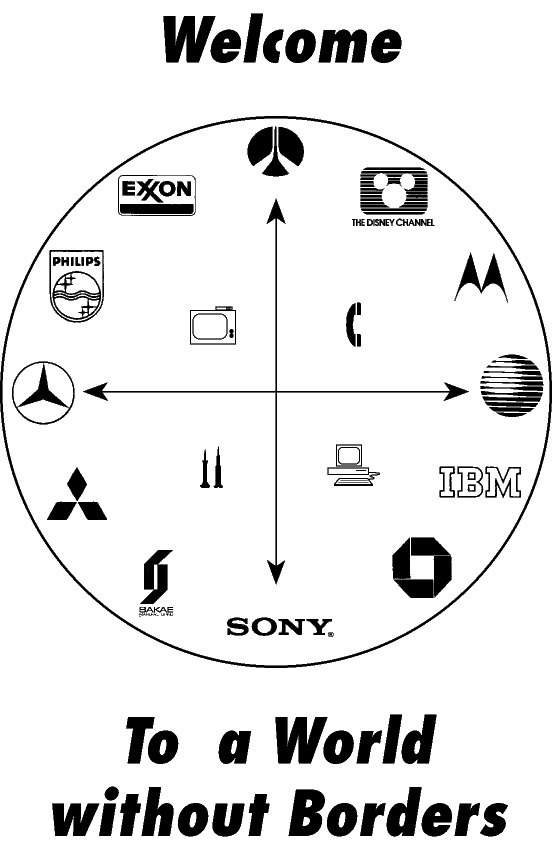
It has been three and one half years since President George W. Bush proclaimed, “you’re either with us or against us.” Since that time the neo-liberal ‘revolution’ has undergone a re-Balkanization in the United States. Gone is the ideology of fluidity and openness that presided over the post-Cold War years and in its place comes a new nationalist spirit complete with rising trade tariffs and a variety of seemingly expedient security measures that have evolved into a new way of life. From no-fly lists to ubiquitous public surveillance, from severe visa and immigration restrictions to the fingerprinting of tourists, ‘bunker America’ is replacing the fantasy of globalization. Even unilateral military action is justified as a preemptive defense of the homeland. Meanwhile, the rest of the world is offered Pax Americana, a sanctimonious sop revealing perhaps what was at stake all along, nothing less than global supremacy. Less well known at home, however, thanks to guilt-free ‘happy’ news and embedded reporting, is the targeted suspension of habeas corpus and mass cataloging of thousands of Islamic, Middle Eastern, or North African people inside the country. Thousands of individuals have been detained without trial, others deported, and some have been sent abroad into ‘extra-juridical’ zones within Pakistan and Syria where human rights do not stand in the way of extreme interrogation methods.
It comes as no surprise therefore that those who publicly question aspects of the new, homeland-security state apparatus also find themselves victims of government investigation and intimidation. While certainly not on par with disappearances and torture, scores of artists, journalists and academics, including several high school students, have been questioned recently about alleged anti-American activities by a variety of Federal and local law-enforcement officials. In at least one case, the one that concerns this essay, the U.S. government is aggressively seeking to portray a group of contemporary artists known for their politically provocative, yet legal and Constitutionally protected art, as a full-blown terrorist threat to the national security.
Since 11 September 2001, the FBI and the Secret Service have interrogated gallery curators in Chicago and Dallas for displaying images they deemed suspicious; accused a Nevada man of “borderline terrorism” because he had a bumper sticker that read “KING GEORGE – Off With His Head”; detained and questioned a Colorado highschool principle for permitting students to sing the Bob Dylan tune Masters of war during a public performance; and the culture-jamming group AdBusters were questioned by government agents over a flag-like billboard they installed in Times Square. Secret Service agents even prevented two teachers from attending a Bush rally because they wore t-shirts printed with the words “Protect our civil liberties.” The atmosphere of enhanced public security has apparently also emboldened some local law enforcement to disregard this very advice. Police in Albany arrested a man for wearing a peace sign on his T-Shirt; a young man was arrested outside an Armed Forces Career Center in Boston for dressing up as a U.S. torture victim in Iraq; six men were arrested in Pennsylvania for creating an Abu Ghraib-style human pyramid as the President’s motorcade drove past; and in August 2004 during the Republican National Convention the New York Police Department went so far as to take thousands of people into custody, holding them long past the legal twenty-four-hour limit in appalling conditions at a concrete and steel pier on the Hudson River.
Probing callsfrom Federal agents to university administrators have added to a chilling climate of suspicion within academia already apprehensive over Congressional debates about alleged anti-American curricula and over student groups like the ultra-conservative Campus Watch, who openly stake out ‘liberal’ instructors in order to document their so-called Left bias. Professors at universities in New Mexico, Houston, Urbana-Champaign, South Florida, Upstate New York and even Columbia University in New York City have discovered that raising questions about U.S. policy, about Israel, about 911 and homeland security inside the classroom can bring on disciplinary action and even dismissal. Regrettably, several university museum directors at Arizona State University, the City Museum of Washington, and Ohio University have gone so far as to actively self-censor their own exhibitions by removing socially critical work or by adding art that reflects a ‘conservative ‘ point of view. Meanwhile, the firing of several prize-winning journalists effectively demonstrates that challenging Bush administration policy even from within mainstream media can have considerable consequences.
Incomplete Installation by Critical Art Ensemble in The Interventionists exhibition at MASS MoCA, June 2004: note that most of the work was already in the custody of the FBI.The most alarming of these cases so far is certainly the U.S. Attorney General William Hochel’s unrelenting investigation of artist Steven Kurtz and his former colleague, Professor Robert Ferrell. Kurtz is a professor of art at the University of Buffalo in New York. He is also a co-founder of the Critical Art Ensemble (CAE), an artists’ collective that dates from 1986 which has become known for its multi-media projects splicing Brechtian pedagogy onto the comedic diligence of a Mr. Wizard. Donning white lab coats and assuming the personae of amateur scientists, they arm themselves with highschool lab equipment as well as common household supplies and groceries in order to demystify, or more to the point, democratize the increasingly privatized worlds of science, technology and information networks. These often-playful routines contrast with the serious intent and analytical approach of the group’s numerous books and manifestos. In Electronic Civil Disturbance, CAE celebrates anti-corporate, ‘slacker’ Ludditism and in Digital Resistance they provide plans for making graffiti-writing robots and reprogramming Nintendo games so that children will gain “the means to bring about a situation in which a process of broad spectrum invention, discovery, and criticality can occur” (page 139). Whether in a museum, an international conference, on the street or in print, the CAE’s work unvaryingly aims to inform, entertain and demonstrate the value of public knowledge.
For the past several years the group has focused attention on what they see as the misuse of biotechnology by private corporations operating outside the realm of democratic, public debate. CAE’s tactical response is what they term, ‘Fuzzy Biological Sabotage’ or FBS, a type of sophisticated, prank that uses harmless biological agents including plants, insects, reptiles and even microorganisms to operate in the gray, in-between spaces as yet unregulated by institutional regimes. In 2002 the group demonstrated one form of FBS in the project Contestational Biology, which was developed in conjunction with artists Beatriz de Costa and Claire Pentecost and installed at the Corcoran Art Gallery in Washington DC. Contestational Biology consisted of an ‘amateur’ scientific experiment that ‘reverse engineered’ samples of the Monsanto Corporation’s Round-Up Ready corn, canola and soy products, three of the many genetically modified organisms rapidly being integrated into modern agriculture industry. The ultimate goal of the installation, however, was to raise public awareness about the sweeping privatization of the human food supply by directly contesting Monsanto’s right to create and patent customized life forms for corporate profit.
To Read the Rest of the Essay

by Gregory Sholette
NeMe
It has been three and one half years since President George W. Bush proclaimed, “you’re either with us or against us.” Since that time the neo-liberal ‘revolution’ has undergone a re-Balkanization in the United States. Gone is the ideology of fluidity and openness that presided over the post-Cold War years and in its place comes a new nationalist spirit complete with rising trade tariffs and a variety of seemingly expedient security measures that have evolved into a new way of life. From no-fly lists to ubiquitous public surveillance, from severe visa and immigration restrictions to the fingerprinting of tourists, ‘bunker America’ is replacing the fantasy of globalization. Even unilateral military action is justified as a preemptive defense of the homeland. Meanwhile, the rest of the world is offered Pax Americana, a sanctimonious sop revealing perhaps what was at stake all along, nothing less than global supremacy. Less well known at home, however, thanks to guilt-free ‘happy’ news and embedded reporting, is the targeted suspension of habeas corpus and mass cataloging of thousands of Islamic, Middle Eastern, or North African people inside the country. Thousands of individuals have been detained without trial, others deported, and some have been sent abroad into ‘extra-juridical’ zones within Pakistan and Syria where human rights do not stand in the way of extreme interrogation methods.
It comes as no surprise therefore that those who publicly question aspects of the new, homeland-security state apparatus also find themselves victims of government investigation and intimidation. While certainly not on par with disappearances and torture, scores of artists, journalists and academics, including several high school students, have been questioned recently about alleged anti-American activities by a variety of Federal and local law-enforcement officials. In at least one case, the one that concerns this essay, the U.S. government is aggressively seeking to portray a group of contemporary artists known for their politically provocative, yet legal and Constitutionally protected art, as a full-blown terrorist threat to the national security.
Since 11 September 2001, the FBI and the Secret Service have interrogated gallery curators in Chicago and Dallas for displaying images they deemed suspicious; accused a Nevada man of “borderline terrorism” because he had a bumper sticker that read “KING GEORGE – Off With His Head”; detained and questioned a Colorado highschool principle for permitting students to sing the Bob Dylan tune Masters of war during a public performance; and the culture-jamming group AdBusters were questioned by government agents over a flag-like billboard they installed in Times Square. Secret Service agents even prevented two teachers from attending a Bush rally because they wore t-shirts printed with the words “Protect our civil liberties.” The atmosphere of enhanced public security has apparently also emboldened some local law enforcement to disregard this very advice. Police in Albany arrested a man for wearing a peace sign on his T-Shirt; a young man was arrested outside an Armed Forces Career Center in Boston for dressing up as a U.S. torture victim in Iraq; six men were arrested in Pennsylvania for creating an Abu Ghraib-style human pyramid as the President’s motorcade drove past; and in August 2004 during the Republican National Convention the New York Police Department went so far as to take thousands of people into custody, holding them long past the legal twenty-four-hour limit in appalling conditions at a concrete and steel pier on the Hudson River.
Probing callsfrom Federal agents to university administrators have added to a chilling climate of suspicion within academia already apprehensive over Congressional debates about alleged anti-American curricula and over student groups like the ultra-conservative Campus Watch, who openly stake out ‘liberal’ instructors in order to document their so-called Left bias. Professors at universities in New Mexico, Houston, Urbana-Champaign, South Florida, Upstate New York and even Columbia University in New York City have discovered that raising questions about U.S. policy, about Israel, about 911 and homeland security inside the classroom can bring on disciplinary action and even dismissal. Regrettably, several university museum directors at Arizona State University, the City Museum of Washington, and Ohio University have gone so far as to actively self-censor their own exhibitions by removing socially critical work or by adding art that reflects a ‘conservative ‘ point of view. Meanwhile, the firing of several prize-winning journalists effectively demonstrates that challenging Bush administration policy even from within mainstream media can have considerable consequences.
Incomplete Installation by Critical Art Ensemble in The Interventionists exhibition at MASS MoCA, June 2004: note that most of the work was already in the custody of the FBI.The most alarming of these cases so far is certainly the U.S. Attorney General William Hochel’s unrelenting investigation of artist Steven Kurtz and his former colleague, Professor Robert Ferrell. Kurtz is a professor of art at the University of Buffalo in New York. He is also a co-founder of the Critical Art Ensemble (CAE), an artists’ collective that dates from 1986 which has become known for its multi-media projects splicing Brechtian pedagogy onto the comedic diligence of a Mr. Wizard. Donning white lab coats and assuming the personae of amateur scientists, they arm themselves with highschool lab equipment as well as common household supplies and groceries in order to demystify, or more to the point, democratize the increasingly privatized worlds of science, technology and information networks. These often-playful routines contrast with the serious intent and analytical approach of the group’s numerous books and manifestos. In Electronic Civil Disturbance, CAE celebrates anti-corporate, ‘slacker’ Ludditism and in Digital Resistance they provide plans for making graffiti-writing robots and reprogramming Nintendo games so that children will gain “the means to bring about a situation in which a process of broad spectrum invention, discovery, and criticality can occur” (page 139). Whether in a museum, an international conference, on the street or in print, the CAE’s work unvaryingly aims to inform, entertain and demonstrate the value of public knowledge.
For the past several years the group has focused attention on what they see as the misuse of biotechnology by private corporations operating outside the realm of democratic, public debate. CAE’s tactical response is what they term, ‘Fuzzy Biological Sabotage’ or FBS, a type of sophisticated, prank that uses harmless biological agents including plants, insects, reptiles and even microorganisms to operate in the gray, in-between spaces as yet unregulated by institutional regimes. In 2002 the group demonstrated one form of FBS in the project Contestational Biology, which was developed in conjunction with artists Beatriz de Costa and Claire Pentecost and installed at the Corcoran Art Gallery in Washington DC. Contestational Biology consisted of an ‘amateur’ scientific experiment that ‘reverse engineered’ samples of the Monsanto Corporation’s Round-Up Ready corn, canola and soy products, three of the many genetically modified organisms rapidly being integrated into modern agriculture industry. The ultimate goal of the installation, however, was to raise public awareness about the sweeping privatization of the human food supply by directly contesting Monsanto’s right to create and patent customized life forms for corporate profit.
To Read the Rest of the Essay
In Our Time: The Multiverse
The Multiverse
Host: Melvyn Bragg
In Our Time (BBC Radio)

If you look up the word ‘universe’ in the Oxford English Dictionary you will find the following definition:
“The whole of created or existing things regarded collectively; all things (including the earth, the heavens, and all the phenomena of space) considered as constituting a systematic whole.”
That sounds fairly comprehensive as a description of everything, but for an increasing number of physicists and cosmologists the universe is not enough. They talk of a multiverse – literally many universes – to explain aspects of their theory, the character of the universe and the riddle of our existence within it. Indeed, compared to the scope and complexity of the multiverse, the whole of our known reality may be as a speck of sand upon a beach.
But what might a multiverse be like, why are physicists and cosmologists increasingly interested in it and is it really scientific to discuss the existence of universes we may never know anything about?
Contributors
Martin Rees, President of the Royal Society and Professor of Cosmology and Astrophysics at the University of Cambridge
Fay Dowker, Reader in Theoretical Physics at Imperial College
Bernard Carr, Professor of Mathematics and Astronomy at Queen Mary, University of London
To Listen to the Episode
Host: Melvyn Bragg
In Our Time (BBC Radio)
If you look up the word ‘universe’ in the Oxford English Dictionary you will find the following definition:
“The whole of created or existing things regarded collectively; all things (including the earth, the heavens, and all the phenomena of space) considered as constituting a systematic whole.”
That sounds fairly comprehensive as a description of everything, but for an increasing number of physicists and cosmologists the universe is not enough. They talk of a multiverse – literally many universes – to explain aspects of their theory, the character of the universe and the riddle of our existence within it. Indeed, compared to the scope and complexity of the multiverse, the whole of our known reality may be as a speck of sand upon a beach.
But what might a multiverse be like, why are physicists and cosmologists increasingly interested in it and is it really scientific to discuss the existence of universes we may never know anything about?
Contributors
Martin Rees, President of the Royal Society and Professor of Cosmology and Astrophysics at the University of Cambridge
Fay Dowker, Reader in Theoretical Physics at Imperial College
Bernard Carr, Professor of Mathematics and Astronomy at Queen Mary, University of London
To Listen to the Episode
Tuesday, June 17, 2008
Mikhail M. Bakhtin: The Dialogic Nature of Consciousness
Monologism at its extreme denies the existence outside itself of another consciousness with equal rights and equal responsibilities, another I with equal rights (thou). With a monologic approach…another person remains wholly and merely an object of consciousness, and not another consciousness. No response is expected from it that could change everything in the world of my consciousness. Monologue is finalized and deaf to the other's response, does not expect it and does not acknowledge in it any decisive force. Monologue manages without the other, and therefore to some degree materializes all reality. Monologue pretends to be the ultimate word. It closes down the represented world and represented persons. (Bakhtin: 292-93)
The dialogic nature of consciousness. The dialogic nature of human life itself. The single adequate form for verbally expressing authentic human life is the open- ended dialogue. Life by its very nature is dialogic. To live means to participate in dialogue: to ask questions, to heed, to respond, to agree, and so forth. In this dialogue a person participates wholly and throughout his whole life: with his eyes, lips, hands, soul, spirit, with his whole body and deeds. He invests his entire self in discourse, and this discourse enters into the dialogic fabric of human life, into the world symposium. (Bakhtin: 293)
Bakhtin, Mikhail M. Problems of Dostoyesky’s Poetics. ed. and trans. Caryl Emerson. Minneapolis: University of Minnesota P, 1984.
The dialogic nature of consciousness. The dialogic nature of human life itself. The single adequate form for verbally expressing authentic human life is the open- ended dialogue. Life by its very nature is dialogic. To live means to participate in dialogue: to ask questions, to heed, to respond, to agree, and so forth. In this dialogue a person participates wholly and throughout his whole life: with his eyes, lips, hands, soul, spirit, with his whole body and deeds. He invests his entire self in discourse, and this discourse enters into the dialogic fabric of human life, into the world symposium. (Bakhtin: 293)
Bakhtin, Mikhail M. Problems of Dostoyesky’s Poetics. ed. and trans. Caryl Emerson. Minneapolis: University of Minnesota P, 1984.
Cultural Analysis (Archive)
Ongoing:
16 Beaver Group
About SF
Adbusters: Journal of the Mental Environment
Art and popular Culture Wiki
Audio Anarchy
The Bat Segundo Show
Behind the Black Mask: Mystery Writers Revealed
Bill Moyers Journal (PBS)
Boing Boing
Book Ballon
Book TV on CSPAN: Top Nonfiction Authors
Borderlands: New Spaces in the Humanities
Bureau of Public Secrets
The Business (Film)
The Carnival of Feminists
Craphound (Cory Doctorow)
Creative Commons
Creative Screenwriting Magazine
Crimethinc.: Ex-Workers Collective
Critical Art Ensemble
Criticine (Southeast Asian Cinema)
Columbia University Press
Cyberpunk Radio: Politics, Indy-Music, Satire and SF
David Bordwell's Website on Cinema
Draconis Sanguis
Electronic Frontier Foundation: Defending Freedom in a Digital World
European Graduate School
Exiled: Banned in Russia
Facing History and Ourselves: Helping Communities and Classrooms Worldwide Link the Past to Moral Choices Today
Film Couch/Spout Blog
Film Noir Foundation
FilmSchool (KUCI: Irvine, CA)
Fora TV: Books and Authors
Fora TV: Culture
Fora TV: Giving
Fora TV: History
Fora TV: Law
Fora TV: Music
Fora TV: Religion
Fora TV: Sports
Fora TV: Visual Arts & Film
Generation Online
Golden Handcuffs Review
Green Cine Daily
Green Cine Primers: Your Guide to Film Movements and Careers
History is a Weapon
Hollywood Bitchslap
I Cite (Jodi Dean)
Independent Crime
IndieWire (Film)
I Sleep Naked: Musings of a Twentysomething Nomad
Jahsonic: A Vocabulary of Culture
Jesus General
Jonathan Rosenbaum
Journal of Religion and Film
Jump Cut: A Review of Contemporary Media
Just Seeds: Visual Resistance, Artists' Collective
Kristin Thompson/David Bordwell: Observations on film art and Film Art
Larval Subjects
London Review of Books
Media Ecology: Composting the Western Mind
New York Times Magazine
Observations on Film Art (David Bordwell/Kristin Thompson)
On the Media (NPR)
Open Source (Watson Institute for International Studies)
Orion Magazine: Nature/Culture/Place
Out of the Past: Investigating Film Noir
Paste Magazine
Political Affairs: Culture and Values
Popular Culture and Philosophy
Radio West (Public Radio International/KUER: University of Utah)
Reading Critically (Natalie Gummer)
Reconstruction: Studies in Contemporary Culture
re.press: Independent and Open Publishing
Robert Goldman: REINVENTING AMERICA III--The Contradictions of American Individualism from Liberal Society to the Consumer Society
Revolution by the Book (AK Press)
Rolling Stone
Saul Williams
Senses of Cinema: an online journal devoted to the serious and eclectic discussion of cinema
Situationist International Online
Snag Films (Free Documentaries Online)
Soil and Health Library
Stranger Than Fiction (Thom Powers on Documentaries)
Studio 360: Get Inside the Creative Mind (WNYC)
Supervalent Thought (Lauren Berlant)
To the Best of Our Knowledge (Wisconsin Public Radio)
The Treatment (KCRW: Santa Monica)
UChannel: Culture
Watching Journal: A Place for Talking About Movies and What They Mean
Xu Xanov (Farsi)
The Yes Men
Z-Net: The Spirit of Resistance Lives
Zone Zero:Exposiciones
2008:
Nathan Cunningham: Sex, Drugs, and Identity Crisis: a response to Performance
Jeremy LeGrand: Lines of Knowledge - A Response to A Bittersweet Life/Dalkomhan insaeng (South Korea: Ji-woon Kim, 2005)
Lance Hood: The Reign of the Chihuahua--A Response to Performance (1970)
Aeon Skoble: Rear Window - Looking at Things Ethically
Point of Inquiry: Jennifer Michael Hecht - Doubt
Out of the Past--Investigating Film Noir: Asphalt Jungle
On the Media: God No! (The New Atheists)
On the Media: Snap Judgments
Excerpt from the 5th supplement for HUM 220: Peace/Conflict Studies (Historical Perspectives) course
Manuel De Landa: On Gilles Deleuze's Philosophy
Michael Palmer: On the Sustaining of Culture in Dark Times
John H. Richardson: My History of Violence
Film School: Director Phillip Noyce on Catch a Fire
Film School: ABIGAIL DISNEY the producer of PRAY THE DEVIL BACK TO HELL
Cecilia Boateng: Response to Battle of Algiers
Film School: KURT KUENNE the director of DEAR ZACHARY: A LETTER TO A SON ABOUT HIS FATHER
Creative Screenwriting: Co-Writer Timothy J. Sexton on Children of Men
Creative Screenwriting: Thomas McCarthy Director of The Visitor
Henry Giroux and Kerry T. Burch: Corporate Transformation of School Knowledge and the Mass Production of Idiocy
Jared Rapfogel: Mister Freedom--An Interview with William Klein
Thom Powers: Wanted--Documentary Critics
Michael Wesch: A Portal to Media Literacy
A.O. Scott: The Way We Live Now--The Screening of America
This Pariah-to-Messiah Moment: Anthropologist John Comaroff on the Obama Moment
Open Source: Nicholson Baker - Human Smoke
Open Source: Chris Adrian - A Better Angel
Sylvère Lotringer on Paulo Virno's A Grammar of the Multitude
Chi-Yun Shin: Art of branding--Tartan "Asia Extreme" films
Slavoj Žižek: "The Spectre of Ideology"
Bill Moyers Journal: Historian Eric Foner and Legal Scholar Patricia J. Williams on the Significance of the 2008 Presidential Election
Watching Theology: Forbidden Planet (1956)
Film Couch #93: Kiss of the Spider Woman, The End of America, Synecdoche New York
Film Couch #95: The Wisdom of Crowds, the Horror of Mobs; Fury; The Ox Bow Incident; 12 Angry Men; To Kill a Mockingbird
To the Best of Our Knowledge: Nelson Algren; Tristram Shandy: A Cock and Bull Story; James M. Cain; Karin Fossum; Chris Ware; Charles Bukowski
Radio West: The Cultural History of Frankenstein
Naomi Wolf in the Documentary "The End of America" Directed by Rick Stern and Annie Sundberg
Radio West: Daniel Levitin - The World in Six Songs
Open Court Books: Regina Arnold - "Podcrastination"
Film School: Director Amy Berg on DELIVER US FROM EVIL
Film School: PETER GALISON and ROBB MOSS co-directors of SECRECY
Sean Wilentz: The Worst President in History
Film School: Tomas Alfredson on LET THE RIGHT ONE IN
Melissa Anne-Marie Curley: Dead Men Don't Lie--Sacred Texts in Jim Jarmusch’s Dead Man and Ghost Dog: Way of the Samurai
Democracy Now: Academy Award-Winning Filmmaker Michael Moore on the Election, the Bailout, Healthcare, and 10 Proposed Decrees for the New President’s
Hollywood Bitchslap: Stefan Forbes on Boogie Man: The Lee Atwater Story
Eugene Jarecki: The Straight Talk Train Wreck
David Bordwell: It Was a Dark and Stormy Campaign (on Narrative)
Milk (Gus Van Sant)
Charlie Kaufman on Filmmaking; Release of Synechdoche, New York
Hakim Bey: Poetic Terrorism
Mona Domosh: On Nationalism
Cecilia Boateng: Response to Ramin Bahrani's Chop Shop
Alma Guillermoprieto: How To Be a Mexican
Michel Foucault: "So is it Important to Think?"
GUERRILLA FILMMAKING ON A EPIC SCALE: Che comandante Steven Soderbergh talks strategy and tactics with Amy Taubin
Science Talk: Saddle Up That Stegosaurus--A Visit to the Creation Museum
Sam Green, Co-Director of THE WEATHER UNDERGROUND, on the New Notoriety of William Ayers
Gregory Colbert: Ashes and Snow; Susanna Helm: The Creation of Myth
Stephen Prothero on Religious Literacy; Lupe Fiasco Food and Liquor; Elaine Pagels on Reading Judas
Errol Morris: "The Photographs Actually Hide Things From Us"
Out of the Past--Investigating Film Noir: Ridley Scott's Bladerunner
Out of the Past--Investigating Film Noir: Rian Johnson's Brick
Virtual JFK: Vietnam (and us) if Kennedy had lived
Laura Poitras' My Country, My Country (Iraq)
Rob Pope: Texts and Contexts
Michael Benton: Violence in Films
Jonathan Rosenbaum: Bushwhacked Cinema
Creative Screenwriting: Clark Gregg, Gillian Jacobs and Sam Rockwell on Choke
The 20th Century on Trial: Norman Mailer
Days of War, Nights of Love: Crimethink for Beginners
The Bat Segundo Show #205: Errol Morris
Adventures in Sci Fi: Cory Doctorow on Little Brother
We the People Stories: Cornel West -- Democracy Matters
Film Couch #68: Paranoia
Mark Achbar's The Corporation Available for Free Online
FIPRESCI (The International Federation of Film Critics) 2008 Grand Prix Award: There Will Be Blood
To the Best of Our Knowledge: Making Movies
To the Best of Our Knowledge: Sherman Alexie; Alice Walker; V.S. Naipaul; Orhan Pamuk; Amy Tan; Toni Morrison
Quellcrist Falconer: Is it a Wolf I Hear..."
Studio 360: Errol Morris' Standard Operating Procedure; Depicting Abu Ghraib
Shannon Clute and Richard Edwards: John Huston's Maltese Falcon (1941)
Shannon Clute and Richard Edwards: Robert Polonsky's Force of Evil (1948)
Michael Benton: Ladies and Gentleman, The Fabulous Stains (1982)
Alex Gibney: Gonzo
Adam Fields -- Getting Rid of the (Production) Shingles
Al Ruddy: Shrugging Off Atlas Shrugged
Out of the Past--Investigating Film Noir: Chinatown
Jonathan Lethem: The Art of Darkness (The Dark Knight)
Film School: Makoto Sasa on FIRE UNDER THE SNOW
Film School: Irene Salina on FLOW: FOR LOVE OF WATER
Film School: Sean Baker and Shih-Ching Tsou on TAKE OUT
Andre Malraux/Human Nature/Dance, Monkey, Dance
M. Buck: Searching For A Primate Quintessence
Creative Screenwriting: Alan Ball on Towelhead
Michael Benton: Why I Listen to "Common Sense with Dan Carlin"
Watching Theology: Lars and the Real Girl
Film Couch #28: Rolf de Heer on Ten Canoes
America Abroad Media: Power, Politics, and the Olympics
Warlord (Written and Directed by David Garrett): Short Film
On the Media: Obama Nation Abomination
On the Media: No There There
Michael Benton: City of God, Schindler's List and Contextual Viewings
On the Media: Film School
On the Media: One for the Books
James Der Derian: Virtuous War
Kristin Thompson/David Bordwell: Is There a Blog in This Class? 2008
Richard K. Morgan: "The Human Eye is a Wonderful Device...."
Classic Video: Stephen Colbert's Speech at the 2006 White House Correspondents' Dinner
BBC News: Peru's first 'visionary' editor Doris Gibson
FilmSchool: Ramin Bahrani on MAN PUSH CART
FilmSchool: Patricia Foulkrod on THE GROUND TRUTH
Kirby Dick on This Film Is Not Yet Rated
Michael Benton: Response to I Am a Sexual Addict
Roy Wagner: The Invention of Culture
Online Storytelling & Cause Marketing: An Interview with Jonah Sachs of Free Range Studios
David Church: Alejandro Jodorowsky
Bat Segundo Show: Paul Auster
Watching Theology: Star Trek--The Motion Picture (1979)
Francine Prose: The Politics of Literary Scapegoating
Sci Fi Dimensions: Ken MacLeod
Caroline Ruddle: What Lies Beneath? Distinguishing Humans from Skinjobs
Gregory Esteven: Art in an "Ultra-Materialist Society"
Neil Young: Let's Impeach the President
Studio 360: Kimberly Pierce on her New Film Stop-Loss
SciFiDimensions: Cory Doctorow on Little Brother
Mike Davis: Evil Paradise--An Artist's Vision of Dubai in the Future
Jeff Vandermeer Interview of Paul Barnett aka John Grant: Science Has Been Corrupted
David Brin: "Star Wars" despots vs. "Star Trek" populists
This Brave Nation: Tom Hayden and Naomi Klein
This Brave Nation: Pete Seeger and Majora Carter
This Brave Nation: Anthony Romero and Ava Lowery
This Brave Nation: Bonnie Raitt and Dolores Huerta
This Brave Nation: Carl Pope and Van Jones
To the Best of Our Knwoledge: Apocalyptic Fiction
From Political Prisoner to Cabinet Minister: Legendary Brazilian Musician Gilberto Gil on His Life, His Music and the Digital Divide
Remembering Utah Phillips (May 15, 1935 - May 23, 2008)
NOW on PBS: Torture Tactics--Interview with Alex Gibney
Remebering George Carlin 1937 - 2008
Francois Cusset: THE STATE OF LITERARY THEORY
Gregory Sholette: Disciplining The Avant-Garde, The United States versus The Critical Art Ensemble
"The White House Has Disinvited the Poets" by Julia Alvarez
John Fea: Celebrating the Seussentennial
Tony Kushner: Radical Pragmatist
Edward Said: A Window on the World
Todd Gitlin: Eight Strategies We Use to Navigate the Ceaseless Flood of Media
David Lodge: Consciousness and Literature
Matthew Manus: ANNOUNCING THE GEOSIFT GENERAL THEORY OF DYNAMIC LIFE
Raymond Federman: The Real Begins Where the Spectacle Ends
Hakim Bey: Poetic Terrorism
Mikhail M. Bakhtin: Monologism and Dialogism
Jerry Farber: The Student as Nigger
Jean Renoir: I Know Where I am Going
16 Beaver Group
About SF
Adbusters: Journal of the Mental Environment
Art and popular Culture Wiki
Audio Anarchy
The Bat Segundo Show
Behind the Black Mask: Mystery Writers Revealed
Bill Moyers Journal (PBS)
Boing Boing
Book Ballon
Book TV on CSPAN: Top Nonfiction Authors
Borderlands: New Spaces in the Humanities
Bureau of Public Secrets
The Business (Film)
The Carnival of Feminists
Craphound (Cory Doctorow)
Creative Commons
Creative Screenwriting Magazine
Crimethinc.: Ex-Workers Collective
Critical Art Ensemble
Criticine (Southeast Asian Cinema)
Columbia University Press
Cyberpunk Radio: Politics, Indy-Music, Satire and SF
David Bordwell's Website on Cinema
Draconis Sanguis
Electronic Frontier Foundation: Defending Freedom in a Digital World
European Graduate School
Exiled: Banned in Russia
Facing History and Ourselves: Helping Communities and Classrooms Worldwide Link the Past to Moral Choices Today
Film Couch/Spout Blog
Film Noir Foundation
FilmSchool (KUCI: Irvine, CA)
Fora TV: Books and Authors
Fora TV: Culture
Fora TV: Giving
Fora TV: History
Fora TV: Law
Fora TV: Music
Fora TV: Religion
Fora TV: Sports
Fora TV: Visual Arts & Film
Generation Online
Golden Handcuffs Review
Green Cine Daily
Green Cine Primers: Your Guide to Film Movements and Careers
History is a Weapon
Hollywood Bitchslap
I Cite (Jodi Dean)
Independent Crime
IndieWire (Film)
I Sleep Naked: Musings of a Twentysomething Nomad
Jahsonic: A Vocabulary of Culture
Jesus General
Jonathan Rosenbaum
Journal of Religion and Film
Jump Cut: A Review of Contemporary Media
Just Seeds: Visual Resistance, Artists' Collective
Kristin Thompson/David Bordwell: Observations on film art and Film Art
Larval Subjects
London Review of Books
Media Ecology: Composting the Western Mind
New York Times Magazine
Observations on Film Art (David Bordwell/Kristin Thompson)
On the Media (NPR)
Open Source (Watson Institute for International Studies)
Orion Magazine: Nature/Culture/Place
Out of the Past: Investigating Film Noir
Paste Magazine
Political Affairs: Culture and Values
Popular Culture and Philosophy
Radio West (Public Radio International/KUER: University of Utah)
Reading Critically (Natalie Gummer)
Reconstruction: Studies in Contemporary Culture
re.press: Independent and Open Publishing
Robert Goldman: REINVENTING AMERICA III--The Contradictions of American Individualism from Liberal Society to the Consumer Society
Revolution by the Book (AK Press)
Rolling Stone
Saul Williams
Senses of Cinema: an online journal devoted to the serious and eclectic discussion of cinema
Situationist International Online
Snag Films (Free Documentaries Online)
Soil and Health Library
Stranger Than Fiction (Thom Powers on Documentaries)
Studio 360: Get Inside the Creative Mind (WNYC)
Supervalent Thought (Lauren Berlant)
To the Best of Our Knowledge (Wisconsin Public Radio)
The Treatment (KCRW: Santa Monica)
UChannel: Culture
Watching Journal: A Place for Talking About Movies and What They Mean
Xu Xanov (Farsi)
The Yes Men
Z-Net: The Spirit of Resistance Lives
Zone Zero:Exposiciones
2008:
Nathan Cunningham: Sex, Drugs, and Identity Crisis: a response to Performance
Jeremy LeGrand: Lines of Knowledge - A Response to A Bittersweet Life/Dalkomhan insaeng (South Korea: Ji-woon Kim, 2005)
Lance Hood: The Reign of the Chihuahua--A Response to Performance (1970)
Aeon Skoble: Rear Window - Looking at Things Ethically
Point of Inquiry: Jennifer Michael Hecht - Doubt
Out of the Past--Investigating Film Noir: Asphalt Jungle
On the Media: God No! (The New Atheists)
On the Media: Snap Judgments
Excerpt from the 5th supplement for HUM 220: Peace/Conflict Studies (Historical Perspectives) course
Manuel De Landa: On Gilles Deleuze's Philosophy
Michael Palmer: On the Sustaining of Culture in Dark Times
John H. Richardson: My History of Violence
Film School: Director Phillip Noyce on Catch a Fire
Film School: ABIGAIL DISNEY the producer of PRAY THE DEVIL BACK TO HELL
Cecilia Boateng: Response to Battle of Algiers
Film School: KURT KUENNE the director of DEAR ZACHARY: A LETTER TO A SON ABOUT HIS FATHER
Creative Screenwriting: Co-Writer Timothy J. Sexton on Children of Men
Creative Screenwriting: Thomas McCarthy Director of The Visitor
Henry Giroux and Kerry T. Burch: Corporate Transformation of School Knowledge and the Mass Production of Idiocy
Jared Rapfogel: Mister Freedom--An Interview with William Klein
Thom Powers: Wanted--Documentary Critics
Michael Wesch: A Portal to Media Literacy
A.O. Scott: The Way We Live Now--The Screening of America
This Pariah-to-Messiah Moment: Anthropologist John Comaroff on the Obama Moment
Open Source: Nicholson Baker - Human Smoke
Open Source: Chris Adrian - A Better Angel
Sylvère Lotringer on Paulo Virno's A Grammar of the Multitude
Chi-Yun Shin: Art of branding--Tartan "Asia Extreme" films
Slavoj Žižek: "The Spectre of Ideology"
Bill Moyers Journal: Historian Eric Foner and Legal Scholar Patricia J. Williams on the Significance of the 2008 Presidential Election
Watching Theology: Forbidden Planet (1956)
Film Couch #93: Kiss of the Spider Woman, The End of America, Synecdoche New York
Film Couch #95: The Wisdom of Crowds, the Horror of Mobs; Fury; The Ox Bow Incident; 12 Angry Men; To Kill a Mockingbird
To the Best of Our Knowledge: Nelson Algren; Tristram Shandy: A Cock and Bull Story; James M. Cain; Karin Fossum; Chris Ware; Charles Bukowski
Radio West: The Cultural History of Frankenstein
Naomi Wolf in the Documentary "The End of America" Directed by Rick Stern and Annie Sundberg
Radio West: Daniel Levitin - The World in Six Songs
Open Court Books: Regina Arnold - "Podcrastination"
Film School: Director Amy Berg on DELIVER US FROM EVIL
Film School: PETER GALISON and ROBB MOSS co-directors of SECRECY
Sean Wilentz: The Worst President in History
Film School: Tomas Alfredson on LET THE RIGHT ONE IN
Melissa Anne-Marie Curley: Dead Men Don't Lie--Sacred Texts in Jim Jarmusch’s Dead Man and Ghost Dog: Way of the Samurai
Democracy Now: Academy Award-Winning Filmmaker Michael Moore on the Election, the Bailout, Healthcare, and 10 Proposed Decrees for the New President’s
Hollywood Bitchslap: Stefan Forbes on Boogie Man: The Lee Atwater Story
Eugene Jarecki: The Straight Talk Train Wreck
David Bordwell: It Was a Dark and Stormy Campaign (on Narrative)
Milk (Gus Van Sant)
Charlie Kaufman on Filmmaking; Release of Synechdoche, New York
Hakim Bey: Poetic Terrorism
Mona Domosh: On Nationalism
Cecilia Boateng: Response to Ramin Bahrani's Chop Shop
Alma Guillermoprieto: How To Be a Mexican
Michel Foucault: "So is it Important to Think?"
GUERRILLA FILMMAKING ON A EPIC SCALE: Che comandante Steven Soderbergh talks strategy and tactics with Amy Taubin
Science Talk: Saddle Up That Stegosaurus--A Visit to the Creation Museum
Sam Green, Co-Director of THE WEATHER UNDERGROUND, on the New Notoriety of William Ayers
Gregory Colbert: Ashes and Snow; Susanna Helm: The Creation of Myth
Stephen Prothero on Religious Literacy; Lupe Fiasco Food and Liquor; Elaine Pagels on Reading Judas
Errol Morris: "The Photographs Actually Hide Things From Us"
Out of the Past--Investigating Film Noir: Ridley Scott's Bladerunner
Out of the Past--Investigating Film Noir: Rian Johnson's Brick
Virtual JFK: Vietnam (and us) if Kennedy had lived
Laura Poitras' My Country, My Country (Iraq)
Rob Pope: Texts and Contexts
Michael Benton: Violence in Films
Jonathan Rosenbaum: Bushwhacked Cinema
Creative Screenwriting: Clark Gregg, Gillian Jacobs and Sam Rockwell on Choke
The 20th Century on Trial: Norman Mailer
Days of War, Nights of Love: Crimethink for Beginners
The Bat Segundo Show #205: Errol Morris
Adventures in Sci Fi: Cory Doctorow on Little Brother
We the People Stories: Cornel West -- Democracy Matters
Film Couch #68: Paranoia
Mark Achbar's The Corporation Available for Free Online
FIPRESCI (The International Federation of Film Critics) 2008 Grand Prix Award: There Will Be Blood
To the Best of Our Knowledge: Making Movies
To the Best of Our Knowledge: Sherman Alexie; Alice Walker; V.S. Naipaul; Orhan Pamuk; Amy Tan; Toni Morrison
Quellcrist Falconer: Is it a Wolf I Hear..."
Studio 360: Errol Morris' Standard Operating Procedure; Depicting Abu Ghraib
Shannon Clute and Richard Edwards: John Huston's Maltese Falcon (1941)
Shannon Clute and Richard Edwards: Robert Polonsky's Force of Evil (1948)
Michael Benton: Ladies and Gentleman, The Fabulous Stains (1982)
Alex Gibney: Gonzo
Adam Fields -- Getting Rid of the (Production) Shingles
Al Ruddy: Shrugging Off Atlas Shrugged
Out of the Past--Investigating Film Noir: Chinatown
Jonathan Lethem: The Art of Darkness (The Dark Knight)
Film School: Makoto Sasa on FIRE UNDER THE SNOW
Film School: Irene Salina on FLOW: FOR LOVE OF WATER
Film School: Sean Baker and Shih-Ching Tsou on TAKE OUT
Andre Malraux/Human Nature/Dance, Monkey, Dance
M. Buck: Searching For A Primate Quintessence
Creative Screenwriting: Alan Ball on Towelhead
Michael Benton: Why I Listen to "Common Sense with Dan Carlin"
Watching Theology: Lars and the Real Girl

Film Couch #28: Rolf de Heer on Ten Canoes
America Abroad Media: Power, Politics, and the Olympics
Warlord (Written and Directed by David Garrett): Short Film
On the Media: Obama Nation Abomination
On the Media: No There There
Michael Benton: City of God, Schindler's List and Contextual Viewings
On the Media: Film School
On the Media: One for the Books
James Der Derian: Virtuous War
Kristin Thompson/David Bordwell: Is There a Blog in This Class? 2008
Richard K. Morgan: "The Human Eye is a Wonderful Device...."
Classic Video: Stephen Colbert's Speech at the 2006 White House Correspondents' Dinner
BBC News: Peru's first 'visionary' editor Doris Gibson
FilmSchool: Ramin Bahrani on MAN PUSH CART
FilmSchool: Patricia Foulkrod on THE GROUND TRUTH
Kirby Dick on This Film Is Not Yet Rated
Michael Benton: Response to I Am a Sexual Addict
Roy Wagner: The Invention of Culture
Online Storytelling & Cause Marketing: An Interview with Jonah Sachs of Free Range Studios
David Church: Alejandro Jodorowsky
Bat Segundo Show: Paul Auster
Watching Theology: Star Trek--The Motion Picture (1979)
Francine Prose: The Politics of Literary Scapegoating
Sci Fi Dimensions: Ken MacLeod
Caroline Ruddle: What Lies Beneath? Distinguishing Humans from Skinjobs
Gregory Esteven: Art in an "Ultra-Materialist Society"
Neil Young: Let's Impeach the President
Studio 360: Kimberly Pierce on her New Film Stop-Loss
SciFiDimensions: Cory Doctorow on Little Brother
Mike Davis: Evil Paradise--An Artist's Vision of Dubai in the Future
Jeff Vandermeer Interview of Paul Barnett aka John Grant: Science Has Been Corrupted
David Brin: "Star Wars" despots vs. "Star Trek" populists
This Brave Nation: Tom Hayden and Naomi Klein
This Brave Nation: Pete Seeger and Majora Carter
This Brave Nation: Anthony Romero and Ava Lowery
This Brave Nation: Bonnie Raitt and Dolores Huerta
This Brave Nation: Carl Pope and Van Jones
To the Best of Our Knwoledge: Apocalyptic Fiction
From Political Prisoner to Cabinet Minister: Legendary Brazilian Musician Gilberto Gil on His Life, His Music and the Digital Divide
Remembering Utah Phillips (May 15, 1935 - May 23, 2008)
NOW on PBS: Torture Tactics--Interview with Alex Gibney
Remebering George Carlin 1937 - 2008
Francois Cusset: THE STATE OF LITERARY THEORY
Gregory Sholette: Disciplining The Avant-Garde, The United States versus The Critical Art Ensemble
"The White House Has Disinvited the Poets" by Julia Alvarez
John Fea: Celebrating the Seussentennial
Tony Kushner: Radical Pragmatist
Edward Said: A Window on the World
Todd Gitlin: Eight Strategies We Use to Navigate the Ceaseless Flood of Media
David Lodge: Consciousness and Literature
Matthew Manus: ANNOUNCING THE GEOSIFT GENERAL THEORY OF DYNAMIC LIFE
Raymond Federman: The Real Begins Where the Spectacle Ends
Hakim Bey: Poetic Terrorism
Mikhail M. Bakhtin: Monologism and Dialogism
Jerry Farber: The Student as Nigger
Jean Renoir: I Know Where I am Going
Subscribe to:
Posts (Atom)